




Abstract
Mindfulness-based interventions are effective at improving sexual dysfunctions in women, yet the mechanisms of action are less clear. Our objective was to investigate the impact of three mindfulness exercises on women’s sexual response. Forty-nine women participated in a laboratory session involving a series of 5-min exercises and erotic films. They completed three mindfulness-based exercises and a mental-imagery task. Genital and subjective arousal were measured continuously during erotic films, and genital arousal was measured during the exercises. A focus on the genitals led to greater genital arousal during the exercise. A focus on sensations in the body and on the genitals was associated with greater subjective sexual arousal during erotic films. Effects were small in size. Taken together, the focus of attention during a mindfulness practice may differentially affect genital and subjective sexual arousal and has implications for women experiencing difficulties in different aspects of sexual response.
Keywords
Experimental studies manipulating attention in a laboratory setting suggest that women’s sexual-arousal response is affected by focus of attention (Both, Everaerd, & Laan, 2011). Directing one’s attention to the imagined bodily sensations (i.e., including changes in the genitals or faster heartbeat) of a female actor in an erotic film was associated with greater subjective arousal but not genital arousal. Both and colleagues (2011) concluded that it may be helpful for women to deliberately focus on their own bodily sensations to bring sensory information into awareness during sexual activity. Other studies that investigated the impact of different cognitive strategies on sexual arousal found that fantasizing and positive thoughts can be used to increase arousal, whereas concentrating on nonsexual and negative thoughts (e.g., including distraction, thinking about nonsexual situations, or taking a perspective as an observer) might be used to suppress genital and psychological sexual responding in men and women (Anderson & Hamilton, 2015; Laan, Everaerd, Van Aanhold, & Rebel, 1993).
Furthermore, nonsexual and distracting thoughts significantly interfere with attention to erotic stimuli and have been associated with low levels of sexual functioning in women (Nobre & Pinto-Gouveia, 2008). If a woman is receiving sensual touch, two scenarios (at least) are possible: A woman may find herself able to attend to sensations in the here and now and, most likely, her body and mind will respond accordingly. She might feel sexually excited, turned on, or “horny,” and her body may show signs of physiological sexual arousal, for example, in the form of increased blood flow to her genitals or lubrication (Laan & Everaerd, 1995, 1998). Another woman, however, may be distracted by nonsexual thoughts or worries about her sexual response or performance. This woman might neither have a personal feeling of sexual arousal nor experience a physiological arousal response.
Over the past decade, researchers have become increasingly interested in explaining these interpersonal differences in attention to erotic stimulation and have turned toward the concept of mindfulness (Chivers & Brotto, 2017), an ancient Eastern practice with roots in Buddhist meditation, defined as present-moment, nonjudgmental awareness (Hanh, 1976). Researchers have now focused on investigating how a mindful state, or a person’s ability to reach such a state, relates to healthy sexual functioning (Arora & Brotto, 2017; Brotto & Smith, 2014) and how a lack of mindfulness may threaten a person’s ability to respond sexually and to experience sexual pleasure (American Psychiatric Association, 2013).
Findings from a recent study suggest that mindfulness practice might improve sexual functioning by directly increasing women’s subjective feelings of sexual arousal (Velten, Margraf, Chivers, & Brotto, 2018). It remains unclear, however, whether the wide range of mindfulness-based exercises that are used in mindfulness interventions for women’s sexual problems, such as low desire and arousal, problems reaching orgasm, or genito-pelvic pain (McCabe et al., 2016), affect their subjective feelings of arousal or the physical (i.e., genital) sexual-arousal response (Arora & Brotto, 2017). Among the exercises that are frequently used in mindfulness-based treatments for sexual concerns are those that explicitly encourage a focus on sexual-arousal sensations and those that emphasize an equanimous orientation toward all physical sensations. Whether specific foci of attention are more or less effective in improving women’s sexual functioning has not been investigated. Therefore, in this study we aimed to close this gap in the literature by evaluating the impact of three different mindfulness exercises on women’s sexual response using a laboratory-based paradigm.
Relevance of Mindfulness for Sexual Response and Sexual Functioning
As stated, women who encounter a relevant sexual stimulus (e.g., watch an erotic video) regularly respond with some degree of subjective and genital sexual arousal (B. Singer & Toates, 1987; Toates, 2009). However, a sexual response will be triggered only when women pay attention to an erotic stimulus and are not distracted by, for example, nonsexual thoughts or other diversions. The Diagnostic and Statistical Manual of Mental Disorders, in its current fifth edition, lists a lack of sexual excitement or pleasure and an absent or reduced genital-arousal response during sex as criteria for female sexual interest/arousal disorder (American Psychiatric Association, 2013). Thus, it is clear that having both a subjective and genital response to adequate erotic stimulation is key in women’s sexual functioning. Among many women, however, subjective and genital sexual arousal are not or are only minimally associated (Chivers et al., 2010).
In other words, some women might feel sexually aroused on a subjective, emotional level without the corresponding genital-arousal response and vice versa. Although the question of whether this lack of agreement between subjective and genital sexual arousal is relevant when considering women’s sexual functioning elicited much debate in the field (Chivers & Brotto, 2017), it is undisputed that, for many women, the subjective- and genital-arousal responses themselves are highly relevant to how pleasurable and satisfying they perceive sexual encounters to be (Brotto, Bitzer, Laan, Leiblum, & Luria, 2010). Supporting the notion that it is important for women to be able to focus on present-moment sensations during sex, psychosocial interventions aiming to improve women’s sexual functioning by teaching them mindfulness have been found effective for the treatment of sexual difficulties, including sexual arousal disorder (Brotto et al., 2012; Brotto, Seal, & Rellini, 2012) and low sexual desire (Brotto & Basson, 2014; Paterson, Handy, & Brotto, 2016).
Attention Manipulation and Women’s Sexual Response in the Laboratory
Among some of the studies that have examined the influence of mindfulness-based interventions on both aspects of women’s sexual response measured in a laboratory setting (Brotto, Chivers, Millman, & Albert, 2016; Brotto et al., 2012), one study showed that a group mindfulness treatment for women with sexual distress and a history of sexual abuse led to a significant increase in subjective feelings of sexual arousal from pre- to posttreatment but no changes in genital sexual arousal (Brotto et al., 2012). Whereas concordance between genital and subjective arousal increased with mindfulness training, it was not affected by cognitive behavioral therapy. In another study, group mindfulness for women seeking treatment for lack of sexual desire did not lead to increased subjective or genital sexual arousal but to higher sexual-arousal concordance (i.e., the agreement between genital and subjective sexual arousal, or SSA; Brotto et al., 2016). In these studies, mindfulness interventions were delivered over several group sessions and included a combination of psychoeducational aspects (e.g., information about sexual response, prevalence rates of sexual dysfunction) and a variety of different mindfulness exercises of various lengths with foci ranging from breath to body to sounds to thoughts. Thus, it is unclear what treatment components had a substantial impact on women’s sexual response and whether these changes in women’s sexual response were responsible for their improvements in sexual functioning.
So far, one study has directly examined the impact of a mindfulness-based, attention-manipulation exercise on women’s sexual response in a laboratory setting (Velten, Margraf, et al., 2018). Forty-one women were invited twice into a lab to have their sexual-arousal response measured while they watched a series of neutral and erotic film clips. Before the erotic films were presented, the women were invited to listen to 6-min audio recordings of either a mindfulness-based exercise that directed their attention to sensations in their genitals or a mental-imagery task that invited them to imagine a walk through a lush forest. In this study, the mindfulness task led to greater subjective arousal and lower genital arousal during the erotic films following the exercises. Sexual-arousal concordance was greater in the mindfulness condition. Data were interpreted as mindfulness possibly having a positive impact on sexual functioning by leading to greater feelings of arousal during sex (Velten, Margraf, et al., 2018). The authors discussed two potential explanations for the surprising finding of lowered genital arousal after the mindfulness task by positing that the task that encouraged women to focus on genital sensations might have lowered their genital-arousal response by increasing self-consciousness (Meston, 2006) or that the control exercise might have led to increased levels of relaxation that might have contributed to increased blood flow to the genitals (Stanton & Meston, 2016).
However, they acknowledged some methodological shortcomings that might reduce generalizability of their findings. The study included two lab sessions to measure women’s responses to the two experimental conditions. Studies have shown, however, that genital sexual arousal shows large variation between testing sessions and lacks high test–retest reliability (Velten, Chivers, & Brotto, 2018). In addition, the mindfulness exercise used in the study included a very specific narrative, which invited women to focus on sensations in their genitals. In contrast, more broadly used mindfulness exercises use breath, the stream of thoughts, or other nonsexual bodily sensations as the point of focus (Segal, Teasdale, & Williams, 2004). Finally, genital arousal was assessed after but not during the actual attention manipulation, preventing an analysis of the time course of genital arousal, which might have shed light on the differential effects of the different tasks.
Current Study
The goal of this study was to replicate and expand on previous findings and to examine the effects of three mindfulness-based exercises on women’s genital sexual arousal, SSA, and sexual-arousal concordance. Toward this goal, all women who were participating in an in-laboratory assessment including sexual-arousal measurement listened to a series of audio recordings that encouraged them to focus on sensations in their genitals, sensations in their body as a whole, their stream of thoughts, or to imagine a walk through a lush forest (the control condition). Whereas the first three exercises were designed to foster a mindful focus of attention, the fourth task was added as a control exercise to encourage mental imagery rather than mindfulness. Whereas the mental-imagery task was included to control for a general state of relaxation (Trakhtenberg, 2008) and to prevent participants from ruminating about the research setting or the adequacy of their responses, the stream-of-thoughts exercise was included to control for being nonjudgmentally in the present moment and aware of thoughts as mental events—acknowledging them as if from a distance without getting caught up in their content. The task was about letting thoughts be (not challenging, ignoring, or eliminating them); rather than being about emptying the mind, it was about observing and acknowledging all that was there, including thoughts, whether they were neutral, positive, or negative.
Hypothesis 1 was that women’s genital sexual arousal would be higher during a mindfulness exercise (compared with the control exercise) that encouraged them to focus on the sensations in their genitals but not in the exercises with a focus on the body as a whole or their stream of thoughts. In addition, the level of genital sexual arousal during the erotic films following the exercises was explored. Because previous evidence is lacking, specific predictions about how the exercises would affect women’s levels of genital arousal during the erotic films were not made. Hypotheses 2 and 3 explored the impact of the four exercises on women’s subjective arousal during erotic films that were presented immediately after the exercises. Specifically, we expected that, compared with the control exercise, mindfulness-based exercises that encouraged women to focus on bodily sensations (i.e., either the genitals or their whole body) would lead to greater SSA (Hypothesis 2) and greater sexual-arousal concordance (Hypothesis 3). In addition, we examined how participants perceived and evaluated the different in-lab exercises and whether the exercises led to changes in state mindfulness.
Method
Participants
Premenopausal women 18 years or older who were fluent in German, who were not pregnant or breastfeeding, and who were not taking any medication that might interfere with sexual response (e.g., hormonal contraception, antidepressants) were eligible for this study. Participants were recruited via flyers at the university campus and via social media (i.e., Facebook, online discussion boards). Of the 144 women who completed an online screening questionnaire, 80.6% (n = 116) indicated an interest in the study and left either their email address or telephone number. Of these women, 14 did not meet the inclusion criteria and 45 did not respond to emails or decided not to participate after receiving detailed information about the study. In total, 50 women provided written consent and completed both the questionnaires and the in-laboratory assessment. Data from one woman were excluded after she acknowledged having started taking hormonal contraception between the online screening and the lab appointment. Because of technical problems, SSA was not measured in 1 participant and genital arousal was not measured in 3 participants. Data from 49 women were included in this study.
Nineteen women (38.8%) scored within the clinical ranges on the Female Sexual Distress Scale-Revised (DeRogatis, Clayton, Lewis-D’Agostino, Wunderlich, & Fu, 2008), which indicates that they felt significant distress because of a sexual difficulty. Among the 46 women who indicated any kind of sexual activity over the past month, 20 (43.5%) scored in the clinical range of the Female Sexual Function Index (Rosen et al., 2000), which indicates low sexual functioning. Fourteen women (28.6%) indicated clinically low levels of sexual desire (Gerstenberger et al., 2010). Among the 38 women who indicated having had intercourse over the preceding 4 weeks, 5 women (10.2%) reported discomfort or pain during or after vaginal penetration. This finding is in line with results from other studies (Velten, Margraf, et al., 2018; Velten, Scholten, Graham, Adolph, & Margraf, 2016), suggesting that a substantial number of women participating in lab-based studies investigating sexual response experience some sexual difficulties and/or sexuality-related personal distress. It also speaks to the representativeness of the study sample, in that sexual difficulties are also prevalent in the general population (Mitchell et al., 2013). Table 1 provides an overview of the demographic characteristics and sexual-function levels of the sample.
Sample Characteristics (N = 49)

Note: Values are ns with percentages in parentheses unless otherwise noted. Values vary because of missing data.
Instruments and measures
SSA
SSA was measured continuously during presentation of neutral and erotic videos. The device, called arousometer, consisted of a computer mouse, and women were instructed to move the mouse up and down whenever they noticed a change in SSA during stimulus presentation. Visual feedback about their current level of arousal was presented on the computer screen with a bar graph indicating levels of SSA ranging from 0 (lowest level of arousal) to 100 (highest level of arousal). Similar devices have been used to assess SSA in previous laboratory studies (Clifton, Seehuus, & Rellini, 2015; Velten, Margraf, et al., 2018).
Genital sexual arousal
Vaginal pulse amplitude (VPA) was used as a measure of genital sexual response, using a vaginal photoplethysmograph equipped with an orange-red spectrum light source (Technische Handelsonderneming, Coos, The Netherlands) during the complete experi-mental procedure. The signal was sampled at 200 Hz, band-pass filtered (0.5–30 Hz), and recorded continuously during the exercises and stimulus presentation. Data were acquired and processed using a data-acquisition unit (Model MP100) and AcqKnowledge (Version 3.9; BIOPAC Systems, Inc., Santa Barbara, CA).
State questionnaires
To assess how the four in-lab exercises were evaluated by participants, we asked them to rate, on a Likert-type scale, how difficult (i.e., 1 = extremely difficult; 9 = not at all difficult), relaxing (i.e., 1 = not at all relaxing; 9 = extremely relaxing), and pleasant (i.e., 1 = extremely unpleasant; 9 = extremely pleasant) they found the exercises. In addition, participants rated the extent to which they thought the exercises had influenced their response to the erotic film directly following the respective task. Questions included perception of sexual arousal, perception of other physical sensations, negative or distracting thoughts, and erotic thoughts. The 13-item Toronto Mindfulness Scale (Lau et al., 2006) was administered repeatedly during the lab session to assess whether the different exercises led to changes in state mindfulness. This scale consists of two factors: curiosity, which reflects awareness of present-moment experience with a quality of curiosity, and decentering, which reflects the ability to observe thoughts and feelings as only mental events rather than as reality or truths about oneself (Lau et al., 2006). In contrast to other self-report measures, this scale measures mindfulness as a state, not as a trait, and is therefore sensitive to changes in mindfulness over the course of a session (Sauer et al., 2013).
Procedure
After completion of a short Web-based screening questionnaire, eligible participants were contacted to schedule an appointment for the in-laboratory assessment. The assessments were scheduled so that women’s menses did not interfere with the genital-arousal measurement. Participants also received a link to an online questionnaire that included sociodemographic variables and measures of sexual functioning to be answered before the lab appointment. Informed consent was obtained twice; first, as part of the online questionnaire, and second, after receiving extensive information about the in-laboratory testing procedure right before the assessment.
The sexual-arousal assessments took place in a sexual psychophysiology laboratory located at the Department of Clinical Psychology and Psychotherapy at Ruhr University Bochum in Germany. Following informed consent, participants were tested by a female researcher. First, participants were shown the vaginal photoplethysmograph and were encouraged to ask any questions they had about how to insert it. Participants were also reminded to use the arousometer to capture their SSA throughout the neutral and erotic film presentations by monitoring their “subjective feelings of sexual arousal.” The researcher also explained that “subjective feelings of sexual arousal” means how mentally sexually aroused the participant felt while watching the films. During the first 10 s of every film presentation, a reminder to use the arousometer was presented on screen. The female researcher left the room while participants inserted the probe and informed the researcher via intercom of their readiness.
The researcher then initiated the video sequence. Women completed the state questionnaire, watched a 5-min nature documentary, a 5-min erotic film, and answered the same state questionnaire again. This first section, without attention manipulation, was followed by a series of four 20-min segments (consisting of a nature documentary, an attention manipulation, an erotic film, and a state questionnaire, each lasting 5 min). Each erotic film clip consisted of two 150-s scenes showing different couples engaging in penile–vaginal intercourse. Similar films were used in a previous study and were rated as pleasant and sexually arousing by women (Velten, Margraf, et al., 2018). The erotic films and exercises were presented in random order. The selection criteria for the neutral stimuli (i.e., the nature documentary) were pleasantness of the pictures and no display of aggression. During the attention manipulation, women listened to four different 5-min audio recordings, including three mindfulness-based exercises and one mental-imagery task, delivered via headphones. All exercises were presented to participants as exercises designed to focus their attention, and they were encouraged to just sit back, relax, and listen to the recordings. The women were also invited to close their eyes during the exercises if that felt comfortable for them. After the session, women were asked to remove the vaginal probe, place it in a plastic bag, and meet the researcher in a separate room. After a debriefing period, participants received either a small reimbursement (€20) or course credit for their efforts. All procedures were approved by the Clinical Research Ethics Board at the Faculty of Psychology of the Ruhr University Bochum. All procedures were carried out in accordance with the provisions of the World Medical Association’s Declaration of Helsinki (2013).
Attention manipulation
To assess the impact of mindfulness exercises on sexual response in women, we presented each participant with four different audio recordings. Three recordings consisted of exercises reflecting different aspects of mindfulness; the remaining exercise served as a control condition and included a mental-imagery task. The first mindfulness exercise, called sexual sensations, was adapted from a treatment manual for women with low sexual desire (Brotto, Paterson, Basson, Driscoll, & Grabovac, 2015) and translated into German. In this exercise, women were invited to deliberately focus their attention on feelings in their genitals as a whole and on sensations in specific areas of their genitals. The second mindfulness exercise, called body scan, was a task commonly used in mindfulness-based treatments and that encouraged women to scan through their body from head to toe. In this exercise, genital or sexual sensations were not mentioned. The third mindfulness exercise, entitled leaves on a stream, invited women to observe their stream of thoughts. The narrator guided the women to gently “put every thought on a leaf” and observe how the leaves disappeared with the flow of the river. This task did not include any focus on bodily sensations, and there was no imagery included in the instructions. Principles of mindfulness were woven throughout all three exercises, and women were guided to continually redirect their focus to the genitals, their body as a whole, or their thoughts when they became distracted, and to do so nonjudgmentally and compassionately. All three tasks encouraged women to guide their attention to experiences in the “here and now.” The last exercise, called forest visualization, was included as a control exercise. Women were invited to visualize a walk through a lush forest and were encouraged to imagine perceptions (e.g., smells, sounds) related to this setting. In this task, there was no mention of focusing on any present-moment sensations or thoughts. The audio recordings were of equal length (5 min) and were narrated by the same female speaker. English versions of the sexual-sensations and forest-visualization exercises have been used in a previous study (Velten, Margraf, et al., 2018).
Data reduction and analysis
In agreement with standardized procedures, photoplethysmography data were cleaned, and movement artifacts, defined as sudden and dramatic changes in pulse amplitude, were identified and deleted by being marked as missing for data analysis (Prause & Janssen, 2006). Data inspection and manual artifact rejection were performed using ANSLAB (Version 6.0; Wilhelm & Peyk, 2005). Data from the arousometer and the vaginal photoplethysmograph during the erotic-film presentation were averaged across 10-s intervals. A series of hierarchical linear models (HLM) was calculated using IBM SPSS (Version 24). For this study, the major advantage of HLM was that it conducted a within-subject analysis of the relationship between VPA and continuously measured SSA and used the coefficients that describe this relationship (i.e., slope and intercept) as outcome variables to test differences between participants (Page-Gould, 2016).
To investigate the impact of the mindfulness exercises on women’s genital sexual arousal (Hypothesis 1) and to explore potential effects of the exercises on genital arousal during the erotic films following the exercises, we analyzed data acquired during the four exercises and during the following erotic film clips. One HLM was calculated to test the impact of the three mindfulness exercises, compared with the control exercise (i.e., forest visualization), on VPA. To assess whether the impact of the exercises differed between the actual presentation of the audio recording and the following erotic stimulus, we created a dichotomous “section” variable (0 = exercise, 1 = erotic film). The model calculated to predict VPA used the following formula:
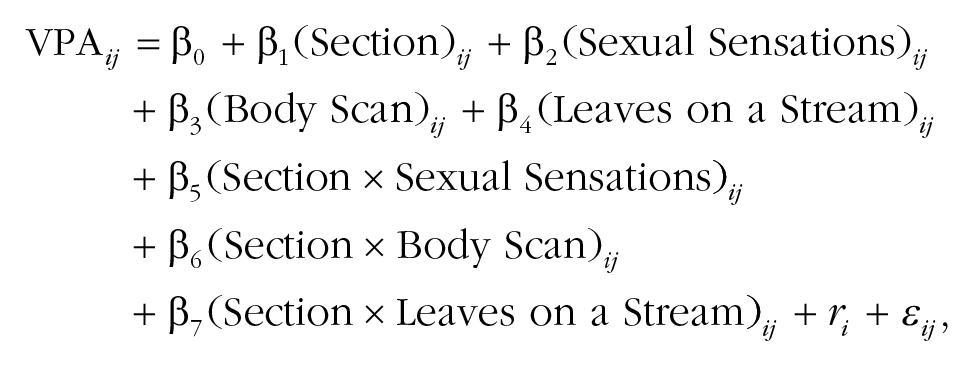
where VPA ij is the ith individual’s VPA at the jth time point, r i describes the random intercept, and ε ij indicates the residuals. The intercepts were allowed to vary across participants in order to account for differences in the baseline levels of the continuously measured VPA.
To address Hypotheses 2 and 3, we calculated a second HLM. SSA was not measured during any of the four attention-manipulation exercises because participants were invited to relax and listen to the audio recording. Thus, this model included only data that were measured during the erotic-film presentations. To include the complete range of sexual-arousal responses, we added the last 10-s bin of the neutral film as a first data point in our multilevel analysis before the respective attentional manipulation was added. The model calculated to address Hypotheses 2 and 3 used the following formula:

where SSAij is the ith individual’s SSA at the jth time point.
The perception and evaluation of the different in-lab exercises, as well as their impact on state mindfulness, were also explored with a series of HLM including only the different exercises as fixed factors and random intercepts.
All predictors were group-mean centered before data analysis. Data were estimated using maximum-likelihood estimation. We specified the covariance matrices of all tested models as unstructured (for an overview, see J. D. Singer & Willett, 2003). We also computed semipartial R2 (R2) effect sizes, representing the variance in the dependent variable (SSA or VPA) that is uniquely explained by the model parameter of each fixed effect (Page-Gould, 2016). The magnitude of R2 may be classified as small (.02– < .13), medium (.13– < .26), or large (≥ .26; Cohen, 1988; Page-Gould, 2016).
Results
Descriptive analysis
Table 2 shows the descriptive values of VPA and SSA averaged across the different phases of the in-laboratory assessment (i.e., during neutral films, exercises, and erotic films). Using 10-s bins, Figure 1 shows the time course of VPA during the last 30 s of neutral film clips, during the 300-s exercises, and the following 300-s erotic film clips for each of the four exercises.
Descriptive Values of Sexual-Arousal Measurements During Return to Baseline, In-Lab Exercises, and Erotic Film Clips

Note: VPA = vaginal pulse amplitude.
Not measured.

Time course of genital sexual arousal (as measured by vaginal pulse amplitude or VPA) across all participants during the last 30 s of neutral films, during the attention manipulation, and during the erotic film clips for each of the four exercises across 10-s bins.
In addition, Figure S1 in the Supplemental Material available online shows the time course of the continuously assessed SSA during the last 30 s of neutral films and during the erotic film clips. During the four in-lab exercises, SSA was not assessed because individuals were invited to close their eyes while they were focusing their attention on the exercises.
State questionnaires
A summary of participants’ responses to the state questionnaires is presented in Table 3. Effects of the three mindfulness exercises were estimated in comparison with the control exercise. Concerning the difficulty of following the instructions, only the body-scan exercise differed from the control exercise in that women perceived the body-scan exercise to be significantly more difficult, b = 0.92, t(135.58) = 2.32, p = .022, R2 = .038. No differences emerged concerning the perceived pleasantness of the different exercises (all ps > .137). The body-scan exercise was the only exercise that was perceived as more relaxing than the control exercise, b = 0.87, t(137.09) = 2.33, p = .021, R2 = .038. Women reported a greater perception of signs of sexual arousal after the sexual-sensations exercise, b = 1.08, t(136.74) = 4.50, p < .001, R2 = .129. Reported perception of other (i.e., nonsexual) physical sensations was greatest after the body-scan exercise, b = 0.74, t(138.30) = 2.84, p = .005, R2 = .055. Participants indicated no difference in the occurrence of distracting or negative thoughts compared with the control exercise (all ps > .600). The sexual-sensations exercise was perceived as leading to more erotic thoughts during the subsequent erotic film clip, b = 0.65, t(136.69) = 2.22, p = .027, R2 = .035.
Descriptive Values of State Questionnaires After the Four Attention-Manipulation Exercises
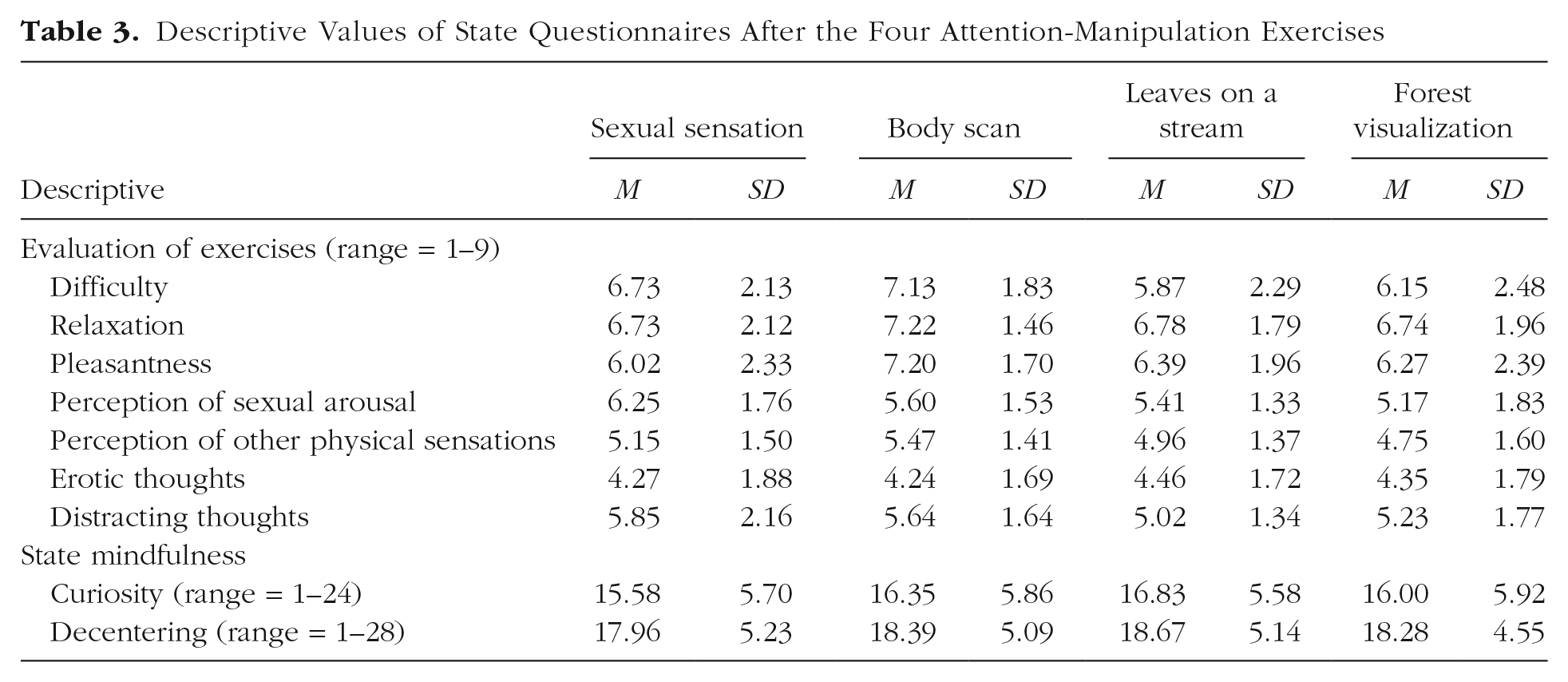
Concerning state mindfulness, differences in decentering in none of the mindfulness exercises significantly differed from the control exercise (all ps > .490). The same was true for the curiosity facet of state mindfulness (all ps > .076), with the exception of the leaves-on-a-stream exercise, which showed a trend toward significance, b = 0.88, t(137.43) = 1.79, p = .076, R2 = .023. To explore whether specific aspects of state mindfulness might still be affected by the exercises under investigation, we examined each item separately. Item 3 (“I was curious about what I might learn about myself by taking notice of how I react to certain thoughts, feelings, or sensations”), b = 0.38, t(132.00) = 2.89, p = .004, R2 = .060, and Item 5 (“I was curious to see what my mind was up to from moment to moment”), b = 0.36, t(132.00) = 2.51, p = .013, R2 = .045, were significantly more endorsed after the leaves-on-a-stream exercise. The sexual-sensations exercise led to significantly lower endorsement of Item 6 (“I was curious about each of the thoughts and feelings I was having”), b = ‒0.27, t(132.00) = ‒2.00, p = .047, R2 = .029, and Item 10 (“I remained curious about the nature of each experience as it arose”), b = ‒0.29, t(132.00) = ‒2.31, p = .023, R2 = .039, and higher endorsement of Item 13 (“I was curious about what I might learn about myself by just taking notice of what my attention gets drawn to”), b = 0.49, t(132.00) = 2.80, p = .006, R2 = .056. To sum up, although state mindfulness did not differ systematically between the mindfulness-based exercises and the control exercise, there appeared to be specific aspects of general mindfulness that seemed to have been affected by the attention manipulation.
Impact of mindfulness exercises on genital sexual arousal
A first HLM was calculated to investigate whether mindfulness-based exercises, compared with a control exercise (i.e., forest visualization), led to greater VPA during the exercises and/or during the erotic film clips. Across all exercises, VPA was significantly greater during the erotic films than during the exercises, b = 0.0020, SE = 0.0001, t(10943.00) = 35.30, p < .001, R2 = .102. This was expected, because three of four exercises did not include either a reference to sexual arousal or any other sexual content. The sexual-sensations exercise was the only mindfulness-based exercise that was associated with greater VPA, b = 0.00048, SE = 0.00006, t(10943.00) = 8.50, p < .001, R2 = .007, compared with the control exercise (all other ps > .239). This effect, however, was moderated by section, b = ‒0.000368, SE = 0.00008, t(10943.00) = ‒4.48, p < .001, R2 = .002. In other words, the sexual-sensations exercise led to greater VPA only during the actual exercise, not afterward, when an erotic video was presented (see also Fig. 1 and Fig. S2 in the Supplemental Material).
While the body-scan exercise did not generally increase VPA (p = .919), a significant interaction term with the dichotomous section variable (i.e., exercise vs. erotic video) indicated that this task was associated with a greater increase in VPA from the exercise to the erotic video, b = 0.00020, SE = 0.00008, t(10943.00) = ‒2.52, p = .012, R2 = .001. A post hoc analysis comparing the body-scan and sexual-sensations exercises with the leaves-on-a-stream exercise (i.e., a mindfulness exercise without reference to body sensations) yielded similar results, in that the sexual-sensations exercise was the only one to be associated with greater VPA, b = 0.00042, SE = 0.00006, t(8188.01) = 7.61, p < .001, an effect that was moderated by section, b = ‒0.00047, SE = 0.00008, t(8188.00) = ‒6.04, p < .001. Compared with the leaves-on-a-stream exercise, the body-scan exercise was not associated with increased VPA during the exercise or the erotic film (ps > .226). To sum up, during the actual exercise, VPA was increased when women were invited to focus on their genital sensations. In addition, VPA was increased during the erotic video when women had just focused on their body as a whole, immediately before the erotic-film presentation. Figure S2 in the Supplemental Material shows the level of VPA during both sections under investigation.
Impact of mindfulness exercises on SSA and sexual-arousal concordance
Another HLM was calculated to investigate whether mindfulness-based exercises, compared with a control exercise (i.e., forest visualization), led to greater SSA and/or greater sexual-arousal concordance (i.e., the agreement between genital and SSA). Compared with the control exercise, both the body-scan exercise, b = 2.18, SE = 0.60, t(3834.80) = 3.66, p < .001, R2 = .003, and the sexual-sensations exercise, b = 3.37, SE = 0.66, t(4748.46) = 5.11, p < .001, R2 = .005, led to greater SSA during the erotic film clip. The leaves-on-a-stream exercise, however, did lead to similar levels of SSA compared with the control exercise, b = 0.37, SE = 0.60, t(3844.76) = .612, p = .540, R2 = .000. Post hoc analyses including only the three mindfulness exercises showed that the body-scan exercise, b = 1.78, SE = 0.58, t(2501.04) = 3.23, p = .001, and the sexual-sensations exercise, b = 3.06, SE = 0.58, t(2500.62) = 5.28, p < .001, led to greater SSA during the erotic film clip than the leaves-on-a-stream exercise.
Sexual-arousal concordance was indicated by the significant prediction of SSA by VPA, b = 3,825.96, SE = 166.77, t(5079.93) = 22.94, p < .001, R2 = .094. The impact of the mindfulness exercises on sexual-arousal concordance was indicated by significant interaction terms between the respective exercise and VPA. Compared with the control exercise, the leaves-on-a-stream exercise, b = 1,319.47, SE = 447.73, t(4906.20) = 2.95, p = .003, R2 = .002, and the body-scan exercise, b = 2,131.15, SE = 447.48, t(4460.72) = 4.76, p < .001, R2 = .005, were associated with greater sexual-arousal concordance. The sexual-sensations exercise, however, was associated with similar levels of sexual concordance compared with the control exercise, b = ‒75.00, SE = 446.51, t(4898.63) = ‒0.17, p = .867, R2 < .001.
Discussion
The main goal of this study was to investigate how different kinds of mindfulness-based exercises affected women’s sexual arousal. Toward this goal, four different exercises followed by erotic film clips were presented to women while their subjective sexual-arousal and genital sexual-arousal responses were measured continuously. Our results provide evidence that a single exposure to a mindfulness exercise in a laboratory setting can influence women’s sexual response both during the task and during an erotic film that follows. The findings concerning our hypotheses are discussed first, followed by a discussion of the different state questionnaires that were used to further our understanding of how women themselves perceived the different exercises. Finally, we outline implications for future research and describe how our findings relate to the clinical application of mindfulness-based interventions for women’s sexual difficulties.
Mindfulness exercises and genital sexual arousal
In line with Hypothesis 1, VPA was highest during the sexual-sensations exercise. This finding suggests that encouraging women to focus their attention on sensations in their genitals does lead to immediate increases in blood flow to the genitals, as measured with vaginal photoplethysmography. This finding corresponds to an earlier study in which a focus on sensations of sexual arousal led to an increased sexual-arousal response during a mental-imagery condition but not during the presentation of erotic stimuli (Dekker & Everaerd, 1998). Attention allocation toward the genitals seems to be an effective means to directly increase vaginal blood flow and might therefore be useful for women who experience a lack of genital-arousal response (i.e., lack of lubrication) during sexual activity (Brotto et al., 2010). This effect, however, did not translate into stronger increases in VPA during the subsequent presentation of erotic film clips. Although the start of the erotic films was associated with significant increases in VPA across exercises, those increases were highest in the body-scan condition. Only in this condition did women show increased VPA levels during the erotic film compared with a control condition. As VPA tends to respond very quickly to sexual stimulation and reaches a maximum after 21 s, this likely left little room for increases in VPA during the subsequent erotic films (Huberman, Dawson, & Chivers, 2017).
Mindfulness exercises and SSA and sexual concordance
Hypothesis 2 was supported in that SSA, continuously measured during the erotic film clips following the sexual-sensations and body-scan exercises, was significantly higher than in the forest-visualization condition. This finding is in line with our proposition that a focus on bodily sensations can enhance women’s feelings of sexual arousal in subsequent erotic-film presentations. As expected, mindfully attending to their stream of thoughts was not an effective means to boost women’s SSA. These findings suggest that tuning into the body specifically, but not one’s thoughts, is effective at eliciting SSA, and is in line with an increasing body of literature showing the positive effects of comprehensive mindfulness programs on self-reported aspects of sexual functioning (e.g., Paterson et al., 2016).
Hypothesis 3 was only partially supported. Sexual-arousal concordance was increased after the body-scan and leaves-on-a-stream exercises but not after the sexual-sensations exercise. Thus, our findings do not support the notion that focusing on sensations specifically in the genitals might lead to women being more “in tune” with their physical-arousal response (Brotto et al., 2016). This finding contradicts a previous study that indicated increased levels of sexual-arousal concordance after the sexual-sensations exercise (Velten, Margraf, et al., 2018). It is also only partly in line with an early study on the effect of attention on sexual-arousal concordance (Korff & Geer, 1983). In this study, the agreement between subjective and genital arousal was enhanced when women were focusing on general body sensations as well as genital sensations while looking at erotic pictures. The differences in stimuli (i.e., pictures or videos) and the data-analysis techniques used, however, limit the comparability of the studies.
A possible explanation for the lower concordance that was found in this study relates to the fact that the sexual-sensations exercise was associated with higher VPA during the actual exercise, which might leave little room for further increases (Huberman et al., 2017). Therefore, VPA levels showed a smaller increase at the beginning of the erotic film, which might have contributed to this finding.
State questionnaires
In addition, we explored how participants perceived and evaluated the different in-lab exercises and whether the exercises led to changes in state mindfulness. Among the different mindfulness exercises, women rated the body-scan exercise as the most difficult but also the most relaxing and the best elicitor of (nonsexual) physical sensations. All were rated equally in terms of pleasantness. Moreover, the four conditions did not differ in state feelings of decentering or curiosity, suggesting that both mindfulness and imagery exercises (at least those administered in our lab) elicited state mindfulness. This study was not powered to detect smaller changes in state mindfulness, and no specific hypotheses about the differential impact of the exercises were made. The measure of mindfulness used in this study aimed to assess a general state of mindfulness, not sexual mindfulness, a facet of mindfulness that refers to nonjudgmental awareness of sexual thoughts and feelings during sexual activity more specifically (Adam, Heeren, Day, & de Sutter, 2015). Thus, specific aspects of mindfulness that should be highly relevant for sexual functioning (e.g., not judging one’s sexual responses negatively) may not have been captured adequately.
A detailed item-by-item analysis—conducted to guide future studies and to examine whether specific aspects of mindfulness might still be affected by the tasks—revealed some interesting patterns. Mindful observation of the stream of thoughts might be associated with a sense of curiosity toward the mind, indicated by a trend toward significance for the curiosity scale of the Toronto Mindfulness Scale as well as increased levels of two items reflecting this facet of mindfulness. The opposite was found for the sexual-sensations exercise, which led to lower endorsement of two curiosity items that described an equivocal perception of each experience, feeling, or thought. This finding may suggest that focusing on sensations in the genitals might induce a more localized focus of attention and might lead women to be less open to notice other physical sensations or thoughts. Future studies should aim to assess whether sexual mindfulness (Adam et al., 2015) or other potential mediators—such as interoceptive awareness (Velten & Brotto, 2017), negative expectancies, or rumination—might mediate the relationship between specific mindfulness exercises and sexual functioning in women (Stephenson, 2017).
Limitations and future research
Most effects reported in this study were small in size, which may be interpreted in line with recent criticisms challenging the clinical relevance of laboratory-based arousal measurements to further our understanding of women’s sexual dysfunctions (Meston & Stanton, 2018). In addition, one might argue that the impact of a single mindfulness-based exercise on sexual response in the laboratory might not correspond with effects of a longer mindfulness-based treatment program for concerns about sexual functioning and sexual activity in day-to-day life. The following steps are suggested to address this issue and to increase applicability and generalizability of the findings. As a next step, researchers may invite women to regularly practice mindful attention (i.e., toward general bodily sensations, the breath, or sensations in the genitals) over the course of several days or weeks. This would allow them to disentangle state effects caused by a specific focus of attention from longer-term effects of a mindfulness practice on sexual response (Brotto et al., 2016). To provide further data on the effects of mindfulness on sexual functioning, participants may also keep a diary of their mindfulness practice, as well as their sexual activities and responses with their partner.
Visual erotic stimuli (i.e., videos) are an effective and convenient means to elicit sexual arousal in the lab. As women were required to perceive the erotic stimulus, however, they were not explicitly encouraged to practice mindfulness during the actual stimulation. Replicating these findings with other, nonvisual erotic stimuli (e.g., sensual self-touch or a vibrator) may allow researchers to determine whether a state of mindfulness during sexual activity can also boost feelings of arousal.
Recruiting women with subclinical sexual problems or even sexual dysfunctions might be necessary to establish whether the effect that mindfulness has on women who are sexually healthy translates to clinical populations. As studies have already shown that long-term meditators report better sexual function (Dascalu & Brotto, 2018), qualitative studies using experienced meditators, participants in mindfulness programs, and nonpractitioners might help to shed light on the perceived effects of mindfulness on women’s sexuality.
Psychophysiological studies on sexual response often include a relatively small number of participants. To prevent potential order effects, future studies might consider using counterbalancing of attention-manipulation exercises and erotic stimuli instead of randomization as a means of making sure that each film is paired with each instruction for approximately equal amounts of time.
Clinical implications
Mindfulness-based interventions are effective treatments for low sexual desire, arousal concerns, and genito-pelvic pain (as summarized in Brotto & Goldmeier, 2015). Those interventions aim to give women an understanding of the concept of mindfulness and include a variety of formal (e.g., breathing meditation) and informal (e.g., mindful eating) mindfulness exercises. Whereas some of these exercises are explicitly sexual, such as being mindful and present during sensual touch, others are comparable with exercises that are used in the treatment of other mental-health issues (e.g., stress, depression; Kabat-Zinn & Hanh, 2009). Data presented in this article suggest that using mindfulness exercises that include an explicit focus on bodily sensations might be helpful for enhancing women’s feelings of arousal. When deciding whether it is necessary to specifically target genital sensations, different aspects should be considered. First, both kinds of exercise (i.e., sexual-sensations and body-scan exercises) can increase feelings of sexual arousal during sexual stimulation following the exercise. An explicit focus on genital sensations before sexual stimulation can, however, give women a “head start” and increase genital blood flow and potentially lubrication before sex. In retrospect, women report more erotic thoughts and a greater perception of signs of sexual arousal when they are encouraged to focus on sexual sensations. Although it is unclear whether this finding is influenced by demand effects and the face validity of the sexual-sensations exercise, women’s perceptions of how aroused they were matter.
One clinical implication of this finding is that women might benefit from engaging in a solo mindfulness exercise of noticing their genital sexual sensations before planned sexual activity as a means of boosting their subsequent sexual feelings. This strategy might be especially effective for women who are already incorporating a sense of their own sexual responding into the general evaluation of their sexual life (i.e., their sexual satisfaction). Our findings also lend support to the usefulness of a single session of mindfulness exercises on affecting sexual response. Above and beyond the treatment of sexual concerns, our findings imply that mindfulness-based exercises that encourage a focus on bodily sensations and/or the stream of thoughts are associated with different physiological responses. Mindfulness-based exercises (i.e., sitting or breathing meditation) are commonly used in treatments for other mental-health issues, such as chronic stress, pain, or anxiety; investigating how these exercises can affect physical arousal and/or relaxation may be important to further improve the effectiveness of these interventions.
Supplemental Material
Velten_Supplemental_Material – Supplemental material for The Power of the Present: Effects of Three Mindfulness Tasks on Women’s Sexual Response
Supplemental material, Velten_Supplemental_Material for The Power of the Present: Effects of Three Mindfulness Tasks on Women’s Sexual Response by Julia Velten, Lori A. Brotto, Meredith L. Chivers, Gerrit Hirschfeld and Jürgen Margraf in Clinical Psychological Science
Footnotes
Acknowledgements

Action Editor
Stefan G. Hofmann served as action editor for this article.
Author Contributions
J. Velten was the lead author and undertook the statistical analysis, with support from G. Hirschfeld. L. A. Brotto, M. L. Chivers, and J. Margraf supervised and gave advice on manuscript structure. J. Velten conducted the study. L. A. Brotto, M. L. Chivers, G. Hirschfeld, and J. Margraf advised on the research approach and statistical analysis. All the authors made substantial contributions to the interpretation of data. All the authors reviewed the draft manuscript, provided critical comments, and suggested additional analyses. J. Velten finalized the manuscript, and all of the authors approved the final version for submission. All the authors agreed to be accountable for all aspects of the work.
Declaration of Conflicting Interests
The author(s) declared that there were no conflicts of interest with respect to the authorship or the publication of this article.
References
Supplementary Material
Please find the following supplemental material available below.
For Open Access articles published under a Creative Commons License, all supplemental material carries the same license as the article it is associated with.
For non-Open Access articles published, all supplemental material carries a non-exclusive license, and permission requests for re-use of supplemental material or any part of supplemental material shall be sent directly to the copyright owner as specified in the copyright notice associated with the article.
