



Abstract
Individuals with social anxiety disorder (SAD) have substantial difficulties in romantic relationships. The aim of the present study was to examine initial, opposite-sex interactions of individuals with SAD and their interaction partners. Specifically, we investigated gender and social context (small talk vs. closeness-generating conversations) and their effects on momentary social anxiety during the interaction, as well as on participants’ desire for future interaction. Participants in this study (N = 160) formed 42 experimental dyads, each comprising one individual with SAD and another non–socially anxious (NSA) individual, and 38 control dyads of two NSA individuals. We found that men with SAD benefitted significantly from closeness-generating interactions such that levels of momentary social anxiety were greatly reduced and both members of the dyad reported increased desire for future interaction. This effect was not found in small-talk conversations and not found for women with SAD. Implications for psychopathology and treatment are discussed.
Keywords
Social anxiety disorder (SAD) is a common and debilitating psychiatric disorder that is associated with impairment in many facets of daily life, including work, studies, and relationships (Aderka et al., 2012; Alden & Taylor, 2004). Specifically, individuals with SAD have been shown to have substantial difficulties in close relationships, including romantic relationships and friendships, and in both forming and maintaining such relationships (Rodebaugh, 2009; see Alden & Taylor, 2004, 2010 for reviews). For instance, individuals with SAD are less likely to be married compared with individuals with other anxiety disorders (Fehm, Pelissolo, Furmark, & Wittchen, 2005; Lecrubier et al., 2000). Moreover, research has shown that even when individuals with SAD develop romantic relationships, they report more impaired relationship quality, less emotional expression, less self-disclosure, and less intimacy (e.g., Davila & Beck, 2002; Porter & Chambless, 2014; Sparrevohn & Rapee, 2009). Individuals with SAD also report lower global quality of friendships above and beyond the presence of additional diagnoses (Rodebaugh, 2009; Rodebaugh, Fernandez, & Levinson, 2012) and so do their friends (Rodebaugh et al., 2014).
Initial Interactions
Initial interactions are an important first step in developing longer-term relationships (Berscheid & Regan, 2016). Thus, understanding the processes occurring during such interactions may shed light on interpersonal impairment in SAD. Two studies have examined “getting-acquainted” interactions of individuals with SAD in a lab setting. In the first study, single women with and without SAD participated in a video conversation with an attractive male confederate (Vriends, Meral, Bargas-Avila, Stadler, & Bögels, 2017). Findings indicated that compared with women without SAD, women with SAD demonstrated increased self-focused attention and increased anxiety ratings during the conversation. In the second study, individuals with SAD interacted with study confederates trained to behave according to an interaction protocol (Vöncken, Alden, Bögels, & Roelofs, 2008). In that study, individuals with SAD were found to elicit a range of negative emotions in their interaction partners and were often rejected. Thus, previous studies have found that during initial interactions, individuals with SAD experience more anxiety and their partners report lower desire for future interaction.
The Effect of Social Context
Social context can significantly influence the experience and expression of social anxiety. For instance, the fifth edition of the Diagnostic and Statistical Manual of Mental Disorders (DSM–5; American Psychiatric Association, 2013), as well as the commonly used Liebowitz Social Anxiety Scale (LSAS; Liebowitz, 1987), both differentiate between social anxiety arising in different social contexts (e.g., performance situations vs. social interactions). In addition, it has been suggested that the expression of SAD may differ in important ways in different cultures (for a review, see Hofmann, Asnaani, & Hinton, 2011).
Two recent studies examined the effects of social context on social anxiety and relationship outcomes. Kashdan et al. (2014) examined opposite-sex dyads of undergraduate students who participated in a lab-based interaction. The social context of the interaction was manipulated such that each dyad was randomly assigned to a closeness-generating condition requiring self-disclosure or a small-talk condition. Pathological processes (e.g., experiential avoidance leading to increased anxiety) were observed only in the closeness-generating condition, as it may have been perceived as more threatening (Kashdan et al., 2014). Plasencia, Taylor, and Alden (2016) examined the effects of reducing self-concealment. In their study, individuals with SAD were randomized to either an exposure interaction or an interaction in which safety behaviors meant to conceal the self from others were reduced. They found that reducing self-concealment (i.e., enhancing self-disclosure) resulted in more positive relationship outcomes. When taken together, results from these studies suggest that enhancing self-disclosure may result in both increased anxiety and more positive relationship outcomes (e.g., greater desire for future interaction). Although these outcomes may at first appear to be contradictory, both can be expected as part of successful exposures in SAD (Hope, Heimberg, & Turk, 2006).
The Effect of Gender
Gender plays an important role in SAD. A recent review of the literature found significant gender differences in almost every aspect of the disorder, including romantic relations (Asher, Asnaani, & Aderka, 2017). For instance, social anxiety was associated with being less satisfied in romantic relationships and self-disclosing less to romantic partners, but only for women (Cuming & Rapee, 2010; Porter & Chambless, 2014). However, somewhat conflicting results were found in a study of couples, in which men’s (but not women’s) social anxiety ratings predicted higher rates of breakup 1 year later (Porter & Chambless, 2017).
It is important to note that these studies (Cuming & Rapee, 2010; Porter & Chambless, 2014, 2017) included nonclinical samples, and it remains unclear whether their findings extend to individuals with SAD. In addition, these studies did not examine initial interactions, and their findings are mixed.
Gaps and the Present Study
A number of gaps exist in this literature. First, most previous studies that examined the association between social anxiety and romantic relationships focused on nonclinical samples (e.g., Cuming & Rapee, 2010; Porter & Chambless, 2014). Second, many previous experimental studies (e.g., Plasencia et al., 2016; Vöncken & Dijk, 2013) have focused on interactions between individuals with SAD and study confederates (as opposed to interactions between 2 participants). Whereas use of confederates can increase internal validity, it may reduce external validity (i.e., may not adequately represent “real-world” interactions). Third, previous studies have not examined partners’ reports (although, see Porter & Chambless, 2017, for an exception). Thus, there is a paucity of information on partners’ reactions and experiences when interacting with individuals with SAD. Fourth, most previous studies did not examine potential moderators of interactions, such as gender and context. For instance, some previous studies have examined only female participants with SAD (Vöncken & Dijk, 2013; Vriends et al., 2017). A final gap in the literature is that most previous studies have presented data from a single measurement, or aggregated data, throughout an interaction. Thus, no previous study has examined the processes occurring during an opposite-sex interaction among individuals with SAD, using a series of repeated measurements over time. This is important, as information gleaned from process data can add to our understanding of the development of initial interactions of individuals with SAD.
In order to address these gaps, in the present study we used repeated measures to examine the interpersonal processes occurring during opposite-sex initial interactions of individuals with SAD and their interaction partners. We also examined gender and social context as potential moderators that could affect these processes. Finally, we examined partner reports in addition to self-reports. Dyads in the present study included either two non–socially anxious (NSA) individuals (control dyads) or one individual diagnosed with SAD and one NSA individual (experimental dyads). Each dyad was randomly assigned to either a closeness-generating conversation or a small-talk conversation.
Study hypotheses were as follows:
Hypothesis 1: Individuals with SAD would report higher levels of momentary social anxiety throughout the interaction compared with individuals without SAD, and partners of individuals with SAD would report lower levels of desire for future interaction compared with partners of NSA individuals. This is based on findings from studies on initial interactions (Vöncken et al., 2008; Vriends et al., 2017).
Hypothesis 2: Among individuals with SAD, the closeness-generating condition (which requires more self-disclosure) would be more anxiety-provoking, but would result in more positive outcomes (i.e., greater reductions in anxiety and greater partner desire for future interaction) compared with the small-talk condition. This is based on studies that examined the effect of contexts such as closeness-generating conversations/reducing self-concealment conditions (Kashdan et al., 2014; Plasencia et al., 2016).
Hypothesis 3: Among individuals with SAD, we explored the effects of gender without explicit hypotheses because of the limited and mixed literature (Cuming & Rapee, 2010; Porter & Chambless, 2014, 2017).
Method
Participants
Participants in this study (N = 160) were 42 individuals diagnosed with SAD and 118 NSA individuals. Participants formed 80 opposite-sex dyads of either one individual with SAD and another NSA individual (42 dyads), or two NSA individuals (38 dyads). Mean age for the entire sample was 25.28 years (SD = 3.55). Exclusion criteria for participation in this study included: (a) rating suicidal ideation as frequent (a score of 2 or more on Item 9 of the Beck Depression Inventory II; Beck, Steer, & Brown, 1996); (b) age below 18 years or over 45; and (c) presence of psychosis. Additional diagnoses among individuals with SAD (n = 42) included major depressive disorder (n = 6, 14.3%), panic disorder (n = 4, 9.5%), obsessive-compulsive disorder (n = 4, 9.5%), generalized anxiety disorder (n = 6, 14.3%), and posttraumatic stress disorder (n = 2, 4.8%). Diagnoses among individuals without SAD (n = 118) included major depressive disorder (n = 15, 12.7%), panic disorder (n = 14, 11.2%), obsessive-compulsive disorder (n = 12, 10.2%), generalized anxiety disorder (n = 20, 16.9%), and posttraumatic stress disorder (n = 2, 1.7%).
Procedure
Participants were recruited via flyers inviting them to take part in a study for payment. On arrival at the lab, potential participants completed informed-consent forms. Participants also completed self-report measures of SAD symptoms, SAD-related cognitions, depressive symptoms, and demographic measures. After filling out these self-report measures, participants were administrated the Anxiety and Related Disorders Interview Schedule (ADIS) for DSM–5 (American Psychiatric Association, 2013; Brown & Barlow, 2014), a clinician-administered semistructured diagnostic interview. The ADIS was administered by graduate students in clinical psychology who received training in its administration before the study. Participants who met inclusion criteria were invited to attend an interaction session in the lab.
The interaction session was based on the procedure by Kashdan et al. (2014). Participants were paired with an opposite-sex partner, and each dyad was randomly assigned to a 30-min closeness-generating conversation or a small-talk conversation (Aron, Melinat, Aron, Vallone, & Bator, 1997; Kashdan et al., 2014). Participants in both groups were told that (a) the experiment was focused on processes occurring during interpersonal interactions; (b) their goal in the interaction was to get to know the person they were interacting with; and (c) the best way to get to know someone is to reciprocally share personal information, which is what would happen in the experiment. In order to facilitate the sharing of personal information, each dyad was given three sets of index cards with one question on each card. Questions in each set were ordered such that one of the partners picked up a card, read the question aloud, and answered it; then, the other partner answered the same question. Partners took turns asking a question first. In the closeness-generating interaction, the amount of personal information and emotional intensity gradually increased with each set of cards. The first set included questions that required only a low degree of self-disclosure (e.g., “Would you like to be famous?” “In what way?”), the second set included questions that required a moderate degree of self-disclosure (e.g., “What role do love and affection play in your life?”), and the third set included questions that required a high degree of self-disclosure (e.g., “Of all the people in your family, whose death would you find most disturbing? Why?”). In the small-talk interaction, there were no gradual increases in self-disclosure or emotional intensity (e.g., “What did you do this summer?” “What gifts did you receive on your last birthday?”). To ensure that each 30-min interaction utilized all sets of cards, participants were asked to move to the next set every 10 min, regardless of the number of questions answered. This was particularly important in the closeness-generating interaction, in which reaching the third set meant reaching the highest level of emotional intensity and self-disclosure.
In order to facilitate the experimental interactions, especially for individuals with SAD, each dyad ran separately. This represents a slight deviation from the experiment reported by Kashdan et al. (2014) in which several dyads interacted simultaneously in the same room. The reason for this change was our desire to adapt the procedure for individuals with SAD who may have been overwhelmed by a room full of people.
Before the interaction, participants completed a brief measure tapping their anticipatory anxiety regarding the upcoming interaction. Participants also completed a brief measure of momentary social anxiety between each set of cards and following the interaction. Specifically, three measurements of momentary social anxiety were conducted (10 min into the interaction, 20 min into the interaction, and following the 30-min interaction). After the interaction, participants completed the Desire for Future Interaction Scale (DFI; Coyne, 1976).
Measures
SAD diagnoses
The ADIS is a widely used semistructured interview designed to assign diagnoses of DSM–5 disorders (American Psychiatric Association, 2013) and to screen for other conditions. It also includes clinician severity ratings for each assigned diagnosis on a 0 to 8 scale, with a cutoff of 4 being the diagnostic threshold for a DSM–5 disorder. The previous version of the ADIS (ADIS-IV-L) has demonstrated high reliability for SAD (κ = .77; Brown, Di Nardo, Lehman, & Campbell, 2001). Work in the lab has yielded good interrater agreement for SAD diagnosis (κ = .84) according to a random sample of 20% of interviews.
Social anxiety symptoms
The LSAS-Self Report (LSAS- SR; Liebowitz, 1987) assesses 24 situations (13 performance situations and 11 social-interaction situations) that individuals with SAD typically fear or avoid, such as going to a party, meeting strangers, and speaking up at a meeting. For each situation, fear and avoidance are rated separately on a scale of 0 to 3. The LSAS-SR has been shown to have a high internal consistency (Cronbach’s α = .95), high 12-day test–retest reliability (r = .83), and strong convergent and discriminative validity (Baker, Heinrichs, Kim, & Hofmann, 2002). The self-report version has been shown to assess nonclinical as well as clinical levels of social anxiety reliably (Rytwinski et al., 2009). Internal consistency in the present sample was high (Cronbach’s α = .96).
SAD-related cognitions
The Social Thoughts and Beliefs Scale (STABS; Turner, Johnson, Beidel, Heiser, & Lydiard, 2003) is a 21-item self-report questionnaire that measures SAD-related cognitions. Respondents are asked to rate the degree to which a particular thought or belief is typical of their thinking when anticipating and participating in social encounters (e.g., “When I am in a social situation, I appear clumsy to other people”). Thoughts are rated using a 5-point Likert-type scale (1 = never characteristic, 5 = always characteristic). The STABS has also been shown to have a high internal consistency (Cronbach’s α = .96), high test–retest reliability over 12 days (r = .94), and high convergent and discriminative validity (Turner et al., 2003). Internal consistency in the present sample was high (Cronbach’s α = .96).
Depression symptoms
The Beck Depression Inventory–II (BDI-II; Beck, Steer, & Brown, 1996) contains 21 items assessing cognitive, affective, and behavioral depressive symptoms. The BDI-II is a widely used measure and has demonstrated excellent reliability and validity (Beck, Steer, Ball, & Ranieri, 1996) in both clinical (Sprinkle et al., 2002) and nonclinical samples (Storch, Roberti, & Roth, 2004; Whisman, Perez, & Ramel, 2000). Internal consistency in the present sample was high (Cronbach’s α = .94).
Anticipatory anxiety
Before the interaction, participants completed two items tapping anticipatory anxiety of the interaction. Specifically, participants were asked to rate the extent to which they worried about what their partner would think of them in the forthcoming interaction and the extent to which they worried that they would say or do the wrong thing in the forthcoming interaction. Both items were rated using a 7-point Likert Scale (1 = not at all, 7 = very much) and were taken from Kashdan et al. (2014).
Momentary social anxiety
Momentary social anxiety was assessed with two items that were adapted from existing measures of state social anxiety and used in previous studies (Kashdan, Barrios, Forsyth, & Steger, 2006; Kashdan et al., 2013; Kashdan et al., 2014): “I am worried about what my partner thought of me in the last part of the interaction” and “I am worried that I said or did the wrong thing in the last part of the interaction.” Both items were rated using a 7-point Likert Scale (1 = not at all, 7 = very much). These items have demonstrated strong psychometric properties in prior studies, including good reliability at both mid-interaction and postinteraction (Cronbach’s α = .90 and .88, respectively; Kashdan et al., 2014), as well as convergent validity via positive associations with trait social anxiety and discriminant validity via associations with constructs such as experiential avoidance (Kashdan et al., 2013, 2014; Kashdan & Steger, 2006).
Social outcomes
Participants completed the DFI (Coyne, 1976), a well-established measure of interpersonal rejection versus desirability. The DFI consists of eight items that assess the degree to which the person would be willing to engage in various social activities with their interaction partner in the future, ranging from 1 (not at all) to 7 = (very much). The DFI has been shown to have high internal consistency (Cronbach’s α = .87) and has been extensively used in studies of initial interactions (e.g., Vöncken et al., 2008). Internal consistency in the present sample was high (Cronbach’s α = .89).
Analytic strategy
Our data formed a multilevel structure. For momentary social anxiety, the lower level, or Level 1 data, consisted of the repeated measures that were collected during the interaction. The Level 1 data were nested within Level 2 units (i.e., participants) and participants were nested within Level 3 units (i.e., dyads). For desire for future interaction, which was measured once following the interaction, our data formed a two-level structure, with participants (Level 1) nested within dyads (Level 2). These data structures are appropriate for multilevel linear modeling techniques, which allow the number of observations to vary between participants and handle missing data effectively (Raudenbush, 2001). We used restricted maximum likelihood estimation in all analyses, as it adjusts for uncertainty about the fixed effects (Tabachnick & Fidell, 2013). We also used a heterogeneous first-order auto-regressive covariance structure in all analyses that included time as a variable. This covariance structure represents the assumption that measurements that are closer in time have higher correlations compared with measurements that are more distant in time. More specifically, lag-1 correlations (i.e., T1–T2 and T2–T3) are assumed to be correlated to a greater extent compared with lag-2 correlations (i.e., T1–T3). We used bootstrapped confidence intervals (1,000 samples) in all analyses. Variables were coded using effects coding to facilitate interpretation of coefficients (Tabachnick & Fidell, 2013), and analyses were conducted using the mixed-models module of SPSS version 25.
Results
Sample characteristics
Our sample included 42 participants diagnosed with SAD (22 women; 52.4%) and 118 NSA individuals (58 women; 49.2%). There were no significant differences found in demographic measures between individuals diagnosed with SAD and NSA individuals (see Table 1). However, there were significant differences found in clinical measures between individuals with SAD and NSA individuals, such that individuals with SAD reported higher levels of anticipatory anxiety, as well as higher levels of social anxiety symptoms, maladaptive cognitions, and depressive symptoms before the interaction compared with NSA individuals (Table 1). These differences in clinical measures were expected because of the nature of our clinical versus nonclinical sample.
Demographic and Pre-Interaction Clinical Measures for Individuals With Social Anxiety Disorder and Non–Socially Anxious Individuals
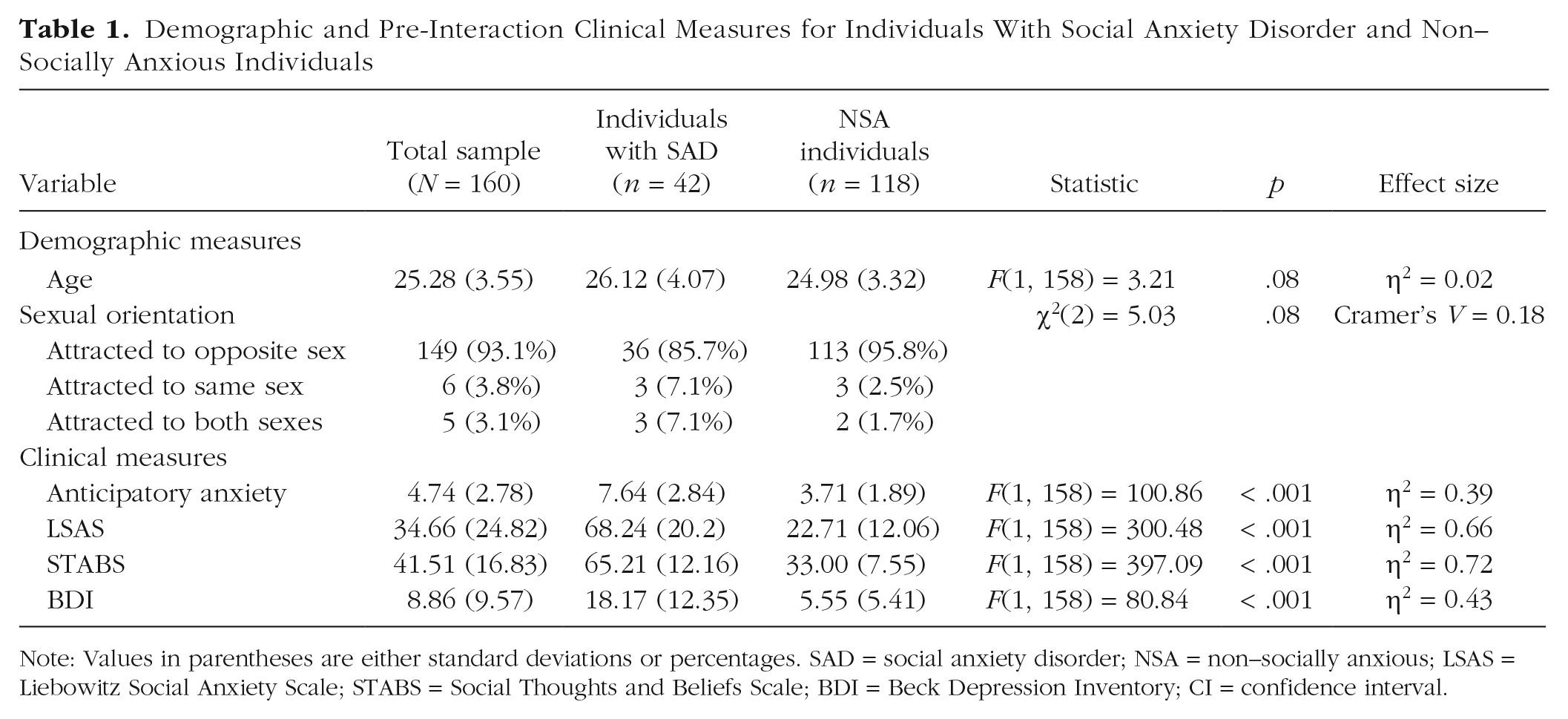
Note: Values in parentheses are either standard deviations or percentages. SAD = social anxiety disorder; NSA = non–socially anxious; LSAS = Liebowitz Social Anxiety Scale; STABS = Social Thoughts and Beliefs Scale; BDI = Beck Depression Inventory; CI = confidence interval.
Hypothesis 1: diagnosis
We examined the effect of diagnosis (individual-level variable: individuals with SAD vs. NSA individuals) on momentary social anxiety. We found a significant effect for diagnosis in predicting momentary social anxiety, β = 1.73, SE = 0.21, p < .001, 95% bootstrapped confidence interval, or CI = [1.31, 2.16]. This effect was such that momentary social anxiety ratings of individuals with SAD were significantly greater than those of NSA individuals. More specifically, momentary social anxiety ratings of individuals with SAD were significantly greater than those reported by their interaction partners (i.e., NSA individuals interacting with individuals with SAD), β = 1.64, SE = 0.23, p < .001, 95% bootstrapped CI = [1.19, 2.11] and also significantly greater than those of NSA individuals interacting with NSA individuals, β = 1.78, SE = 0.22, p < .001, 95% bootstrapped CI = [1.35, 2.22]. Momentary social anxiety ratings of NSA individuals interacting with individuals with SAD and NSA individuals interacting with NSA individuals were not significantly different from each other, β = 0.28, SE = 0.26, p = .29, 95% bootstrapped CI = [−0.24, 0.80]. Thus, according to our first hypothesis, individuals with SAD reported greater momentary social anxiety compared with NSA individuals.
We also examined the effect of diagnosis on desire for future interaction. The effect for diagnosis was nonsignificant, β = −1.94, SE = 1.17, p = .097, 95% bootstrapped CI = [−4.23, 0.45], indicating that desire for future interaction rated by partners of individuals with SAD was not significantly different from that rated by NSA individuals in the control dyads. However, this effect was in the direction of the hypothesis, such that desire for future interaction of partners of individuals with SAD was lower than that of NSA individuals in the control dyads, albeit not reaching statistical significance.
Hypothesis 2: context among individuals with SAD
We examined the effect of time (measurement-level variable: T1 vs. T2 vs. T3), context (dyad-level variable: small talk vs. closeness-generating conversation), and their interaction on momentary social anxiety. We found a significant effect for time, β = −0.99, SE = 0.26, p = .001, 95% bootstrapped CI = [−1.48, −0.48], such that momentary levels of social anxiety declined over the course of the interaction. We also found a significant effect for context, β = 0.59, SE = 0.20, p = .003, 95% bootstrapped CI = [0.17, 1.15], such that the closeness-generating conversations resulted in higher levels of momentary social anxiety compared with small-talk conversations. Finally, we found a significant Time × Context interaction, β = −0.51, SE = 0.26, p = .012, 95% bootstrapped CI = [−1.02, −0.02]. This interaction was such that the time effect was nonsignificant for small-talk conversations, β = −0.48, SE = 0.33, p = .165, 95% bootstrapped CI = [−1.17, 0.21], but was significant for closeness-generating conversations, β = −1.50, SE = 0.40, p = .001, 95% bootstrapped CI = [−2.33, −0.67]. Thus, momentary social anxiety was significantly reduced in closeness-generating conversations (but not small-talk conversations).
We examined the effect of context (dyad-level variable: small talk vs. closeness-generating conversation) on desire for future interaction. We found a significant effect of context, β = 1.71, SE = 0.80, p = .031, 95% bootstrapped CI = [0.10, 3.33], indicating that NSA partners of individuals with SAD reported more desire for future interaction in the closeness-generating condition compared with the small-talk condition. Thus, according to our second hypothesis, we found that compared with small-talk conversations, closeness-generating conversations resulted in more momentary social anxiety overall but also in greater reductions in social anxiety along the course of the interaction and in greater partner desire for future interaction.
Hypothesis 3: exploring gender among individuals with SAD
We examined the effect of time (measurement-level variable: T1 vs. T2 vs. T3), context (dyad-level variable: small talk vs. closeness-generating conversations), and gender (individual-level variable: male vs. female), as well as all possible interactions on momentary social anxiety. Table 2 presents the results of this multilevel model. Most importantly, we found a significant three-way interaction between time, context, and gender, β = 0.47, SE = 0.26, p = .012, 95% bootstrapped CI = [0.07, 0.99]. This three-way interaction was such that the two-way interaction between time and context reported in Hypothesis 2 (i.e., reductions in anxiety in the closeness-generating condition but not the small-talk condition) was not significant for women, β = −0.06, SE = 0.40, p = .830, 95% bootstrapped CI = [−0.83, 0.70], but was significant for men, β = −1.01, SE = 0.38, p = .001, 95% bootstrapped CI = [−1.75, −0.14]. Simple-slopes analyses indicated that for women, reductions in momentary social anxiety were nonsignificant in both contexts, β = −0.63, SE = 0.52, p = .257, 95% bootstrapped CI = [−1.78, 0.53]; β = −0.75, SE = 0.57, p = .220, 95% bootstrapped CI = [−2.04, 0.54] for small-talk and closeness-generating contexts, respectively, whereas for men, reductions in momentary social anxiety were nonsignificant in small-talk conversations, β = −0.32, SE = 0.42, p = .469, 95% bootstrapped CI = [−1.26, 0.62], but significant in closeness-generating conversations, β = −2.33, SE = 0.42, p = .001, 95% bootstrapped CI = [−3.29, −1.37]. This suggests that men (but not women) with SAD experienced reductions in levels of momentary social anxiety in the closeness-generating condition (see Fig. 1).
Multilevel Model Predicting Momentary Social Anxiety and Desire for Future Interaction
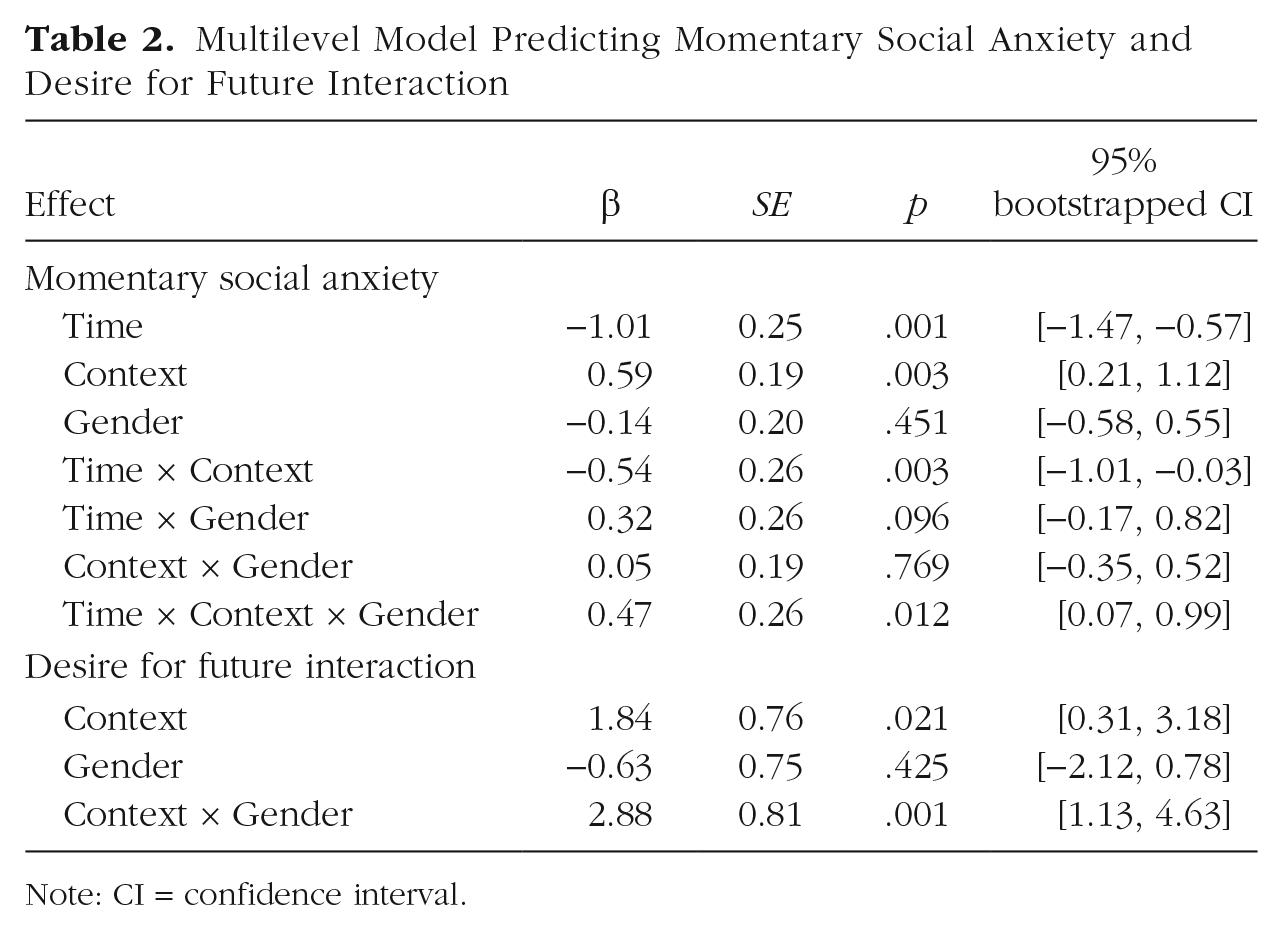
Note: CI = confidence interval.
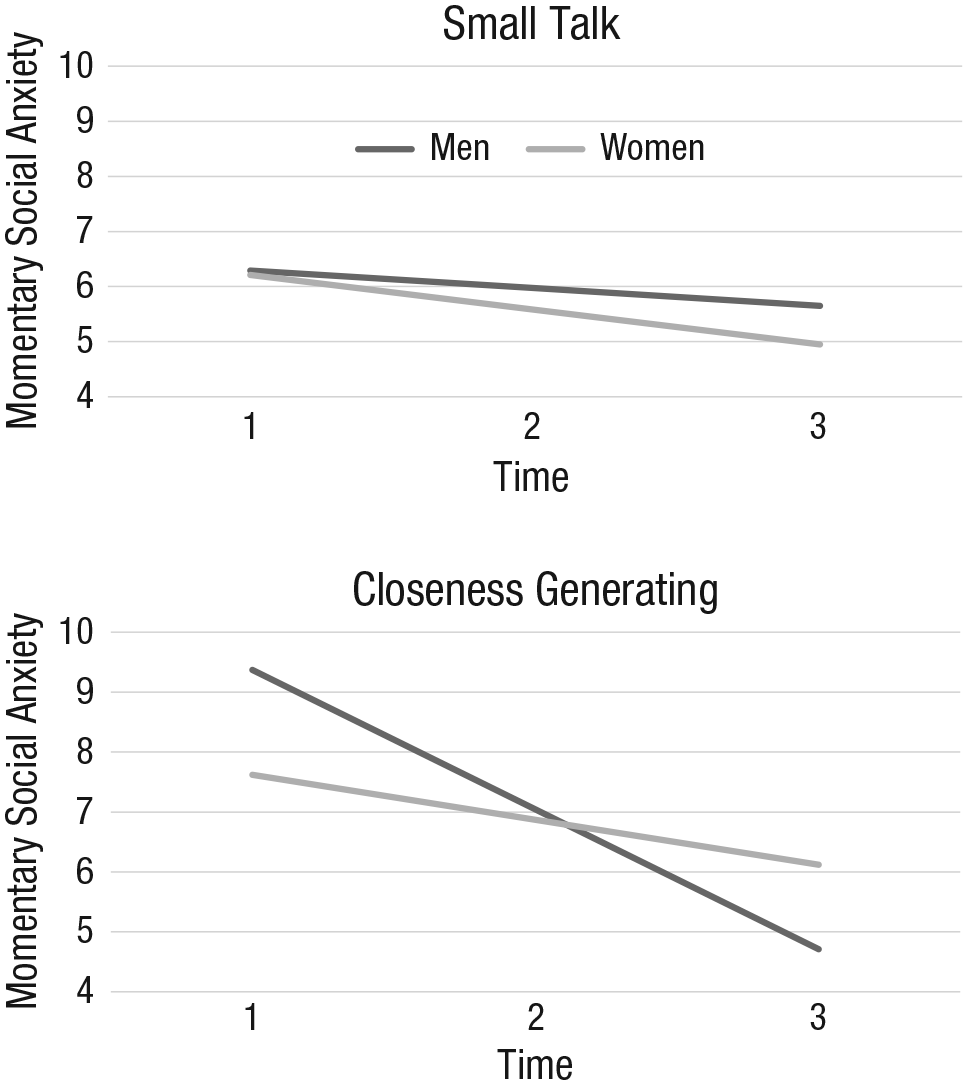
Momentary social anxiety among individuals with social anxiety disorder.
We examined the effect of context (dyad-level variable: small talk vs. closeness-generating conversations), gender (individual-level variable: male vs. female), and their interaction on desire for future interaction. Table 2 presents the results of this multilevel model. Most importantly, we found a significant effect for the context × gender interaction, β = 2.88, SE = 0.81, p = .001, 95% bootstrapped CI = [1.13, 4.63]. This interaction was such that the effect of context described in Hypothesis 2 (i.e., greater desire for future interaction in the closeness-generating condition compared with the small-talk condition) was nonsignificant for women, β = −1.04, SE = 1.10, p = .343, 95% bootstrapped CI = [−3.08, 0.98], but significant for men, β = 4.73, SE = 1.06, p = .001, 95% bootstrapped CI = [2.58, 7.01]. This suggests that men (but not women) with SAD experienced greater desire for future interaction from their partners in the closeness-generating condition (see Fig. 2).
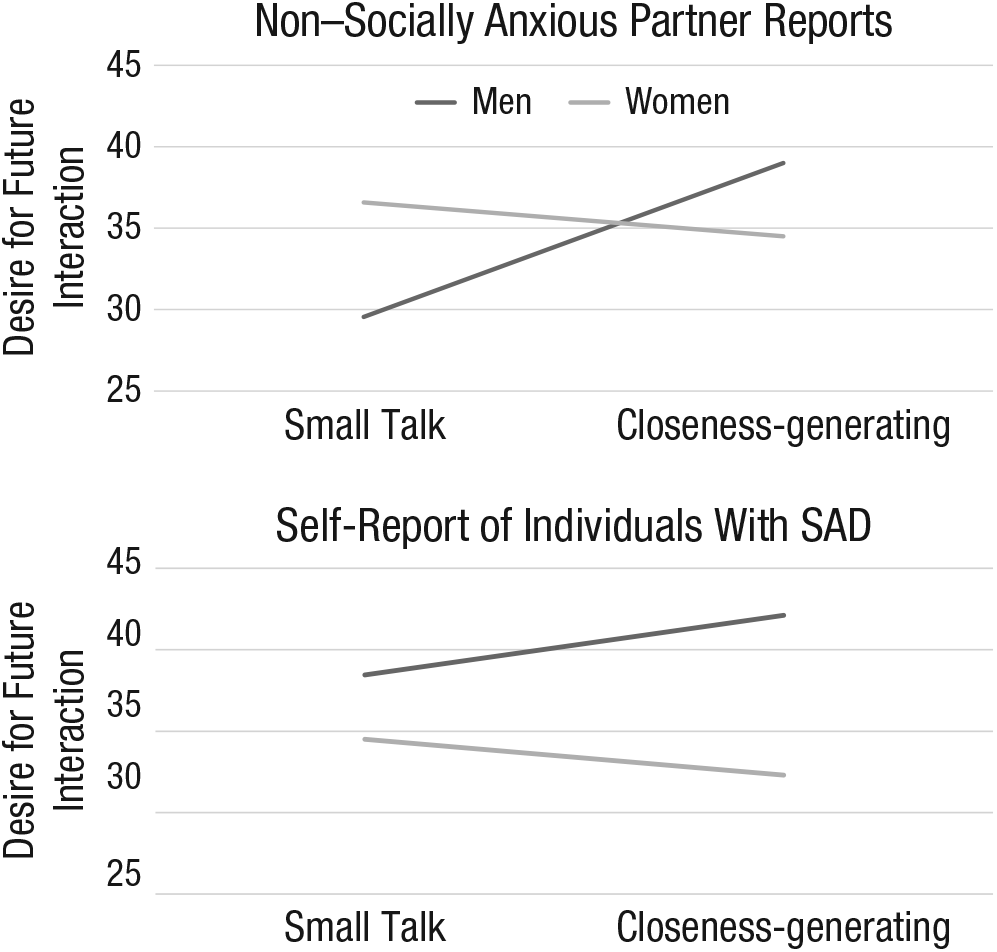
Desire for future interaction in social-anxiety-disorder dyads.
Additional analyses
We repeated the analysis examining desire for future interaction in Hypothesis 3 using self-reports (rather than partner reports). We found a similar context × gender interaction, β = −1.46, SE = 0.61, p = .019, 95% bootstrapped CI = [−2.72, −0.37]. This interaction was such that men with SAD reported greater desire for future interaction in the closeness-generating condition compared with the small-talk condition, β = 1.83, SE = 0.93, p = .048, 95% bootstrapped CI = [0.04, 3.77], but women with SAD did not, β = −1.10, SE = 0.81, p = .173, 95% bootstrapped CI = [−2.71, 0.46]. Taken together with the findings of Hypothesis 3, our analyses indicate that both men with SAD and their interaction partners (but not women with SAD and their interaction partners) had increased desire for future interaction in the closeness-generating condition (see Fig. 2).
We also examined whether levels of depressive symptoms were associated with the dependent variables in the present study. We found that among individuals with SAD, depressive symptoms were not significantly associated with momentary social anxiety during the interaction, β = 0.11, SE = 0.09, p = .202, 95% bootstrapped CI = [−0.06, 0.32], nor with desire for future interaction, β = 0.08, SE = 0.10, p = .434, 95% bootstrapped CI = [−0.10, 0.27].
Discussion
In the present study, we experimentally examined the processes occurring during opposite-sex “getting-acquainted” interactions of individuals with SAD. Specifically, we investigated gender and context (small-talk conversations vs. closeness-generating conversations) and their effects on momentary social anxiety, as well as on participants’ desire for future interaction. Importantly, both partners completed study measures that allowed us to examine partner reactions to individuals with SAD.
Consistent with our first hypothesis, individuals with SAD reported higher levels of momentary social anxiety throughout the interaction compared with individuals without SAD. This finding is not surprising, given that meeting new people in general and dating situations in particular are considered to be very common and prominent social fears for individuals with SAD (e.g., Ruscio et al., 2008). Moreover, our findings are consistent with previous studies that reported greater state social anxiety among individuals with SAD compared with NSA individuals in lab-based interactions (e.g., Kashdan et al., 2014). Interestingly, our findings also indicate that momentary-social-anxiety ratings of NSA individuals interacting with individuals with SAD did not differ from ratings of NSA individuals interacting with NSA individuals. Some researchers have suggested that social anxiety may be “contagious” and that interaction partners of socially anxious individuals may experience higher levels of anxiety when interacting with individuals with SAD (Park, Sharp, & Ickes, 2010). Our findings do not support this contagion hypothesis and instead suggest that partners’ anxiety remains similar whether interacting with individuals with SAD or NSA individuals. The discrepancy in findings is likely due to the fact that the contagion hypothesis was derived from studies on nonclinical samples, with no evidence from studies on individuals with SAD (Park et al., 2010).
On the basis of previous studies that found heightened rejection among interaction partners of individuals with SAD (e.g., Vöncken et al., 2008), we hypothesized that NSA individuals interacting with individuals with SAD would report a lower desire for future interaction compared with NSA individuals interacting with NSA individuals. Contrary to this hypothesis, we found no significant differences in desire for future interaction despite the fact that results were in the direction of the hypothesis. This null finding may be the result of methodological differences between studies. For instance, Vöncken et al. (2008) found that interaction partners of individuals with SAD rejected them more, but partners in that study were confederates, whereas partners in the present study were participants. In addition, Vöncken et al. (2008) did not manipulate context, whereas in the present study, half of the participants conducted closeness-generating interactions, which were found to increase desire for future interaction and may have led to this null finding.
According to our second hypothesis, we found that individuals with SAD reported higher levels of momentary social anxiety in closeness-generating conversations compared with small-talk conversations. This is in line with previous studies that found closeness-generating conversations to be more threatening compared with small-talk conversations (Kashdan et al., 2014). Moreover, our findings are also consistent with cognitive and interpersonal models of SAD (e.g., Alden & Taylor, 2010; Clark & Wells, 1995; Moscovitch, 2009), which suggest that core components in SAD are a perception of the self as flawed and a fear that this flawed self will be exposed to others. Thus, the closeness-generating condition in the present study (which included a substantial degree of self-disclosure) is likely to have activated the fear that the self would be exposed to others and led to increased social anxiety.
We found that reductions in momentary social anxiety were greater in closeness-generating conversations compared with small-talk conversations, consistent with our second hypothesis. As individuals with SAD experienced higher levels of social anxiety in closeness-generating conversations, it was to be expected that their reductions in anxiety would be greater (i.e., regression to the mean). Our findings are consistent with those of Hayes, Hope, and Heimberg (2008), who examined anxiety during within-session exposures of individuals with SAD receiving cognitive behavioral treatment (CBT). They found that individuals who began within-session exposures with higher levels of anxiety tended to experience greater reductions in anxiety, and these reductions have been linked to treatment outcome (Norton, Hayes-Skelton, & Klenck, 2011). However, it is important to note that greater reductions in anxiety in closeness-generating conversations cannot be solely attributed to regression to the mean, as they occurred for men but not women (see discussion of gender effects, below).
We found that partners of individuals with SAD reported greater desire for future interaction in closeness-generating conversations compared with small-talk conversations, in accordance with our second hypothesis. This is in line with previous studies, which found that reducing self-concealment behaviors and enhancing self-disclosure among individuals with SAD leads to positive intrapersonal and interpersonal outcomes (e.g., McManus, Sacadura, & Clark, 2008; Plasencia et al., 2016; Taylor & Alden, 2011). For instance, Plasencia et al. (2016) found that reducing safety behaviors intended to conceal the self from others resulted in reduced SAD-related impairment and enhanced interpersonal functioning. Importantly, Plasencia et al. examined participant–confederate interactions, whereas we examined interactions between 2 participants. Thus, the replication of this finding in a different type of interaction increases our confidence in its robustness and generalizability.
We did not have an explicit, a-priori hypothesis regarding gender effects because of the paucity of studies, as well as mixed findings. However, we found that for individuals with SAD, reductions in momentary social anxiety in closeness-generating conversations were significant for men but not for women (see Fig. 1). Thus, men with SAD benefited significantly from self-disclosure (in terms of experiencing reductions in momentary social anxiety), whereas women with SAD did not. We also found that men with SAD reported more desire for future interaction in closeness-generating conversations compared with small-talk conversations, and so did their partners (NSA women). However, women with SAD did not report a significant difference in desire for future interaction between small-talk conversations and closeness-generating conversations, and neither did their partners (NSA men; see Fig. 2). Taken together, findings on momentary social anxiety and desire for future interaction converge to suggest that the closeness-generating conversations led to more positive interpersonal and intrapersonal effects for men with SAD but not for women with SAD.
Because these gender effects were not a priori hypothesized, we can only speculate as to the reasons behind them. One possible factor that may have led to our findings is gender stereotypes that depict women as more communicative and disclosing compared with men (e.g., Haines, Deaux, & Lofaro, 2016; Löckenhoff et al., 2014; Schmitt, Realo, Voracek, & Allik, 2008). Importantly, gender stereotypes about women (and men) are usually internalized by both men and women (Bell & Burkley, 2014; Guimond, Chatard, Martinot, Crisp, & Redersdorff, 2006). Thus, both women with SAD and their male NSA partners could have been influenced by this stereotype and could have set exceedingly high standards for self-disclosure for women. Women with SAD, who may have perceived themselves to fall short of this high standard, could have experienced high levels of anxiety and a low desire for future interaction. In addition, men who interacted with women with SAD may have also experienced the discrepancy between expected and actual self-disclosure for women, and this may have led to lower levels of desire for future interaction among these NSA men. Conversely, the lower standards set for men on the basis of these stereotypes may have allowed them to experience reductions in anxiety and increased desire for future interaction in the closeness-generating interaction. Much research needs to be done in order to draw firm conclusions regarding the reasons behind these gender effects.
An additional lens through which we can view the present study’s findings is related to data from initial versus later in-session exposures for individuals with SAD during CBT (Norton et al., 2011). Norton et al. found that reductions in social anxiety during the first in-session exposure in CBT predicted treatment dropout. Specifically, individuals who experienced lower reductions during this first exposure had a greater likelihood of dropping out of treatment compared with individuals with more pronounced reductions. This mirrors the findings of the present study, which demonstrate that lower reductions in momentary social anxiety among individuals with SAD during an initial interaction are associated with less desire for future interaction (i.e., greater likelihood to drop out of the relationship). Thus, it is possible that creating the conditions for experiencing reductions in anxiety during initial interactions is important for longer-term relationships.
The present study has a number of clinical implications. First, our findings can inform psychoeducation. For instance, informing clients that even though they may feel very anxious during an interaction, their partner’s desire for future interaction is not likely to be adversely affected may help them to accept anxiety in such interactions. Second, findings from the present study can inform exposure interventions to initial getting-acquainted interactions, and specifically to dating. Planning protracted exposures (up to 30 min) rather than briefer ones may be beneficial because clients are more likely to experience reductions in anxiety (and we found no indication of anxiety increasing at later stages). In addition, our findings on the beneficial effects of self-disclosure for men (i.e., resulting in reduced social anxiety and enhanced desire for future interaction of both partners) suggest that clinicians should emphasize dropping self-concealment safety behaviors, especially for male clients in initial interactions.
The present study also has several limitations. First, our findings are based on self-report measures and may be vulnerable to reporting bias. Future studies can use implicit measures (e.g., physiological data) to enhance our understanding of the process occurring during opposite-sex “getting-acquainted” interactions. Second, the interactions in our study were semistructured, using a set of predefined questions. Whereas this experimental manipulation contributed to internal validity, it remains possible that our findings would not generalize to “free-flowing” conversations. However, the fact that our findings are in line with those from studies examining the interactions of individuals with SAD and confederates reduces the concern that specific design features are primarily responsible for our results. Third, we focused on the temporal dynamics of a single opposite-sex interaction. Thus, our ability to draw conclusions regarding longer-term processes that may occur between interactions with the same individuals over time is limited. Future studies can examine repeated interactions over time to tap additional longer-term processes.
These limitations notwithstanding, this is the first study to experimentally examine the processes occurring during opposite-sex interactions among individuals with SAD and their interaction partners, using a series of repeated measures over time. Our findings can shed light on the difficulties experienced by individuals with SAD in initial opposite-sex interactions and on the conditions that may help ameliorate such difficulties.
Footnotes
Acknowledgements
All materials used in the present study can be obtained from the authors upon request.
Action Editor
Erin B. Tone served as action editor for this article.
Author Contributions
M. Asher and I. M. Aderka developed the study concept and contributed to the study design. Data collection was performed by M. Asher. I. M. Aderka performed the data analysis and interpretation. M. Asher drafted the manuscript and I. M. Aderka provided critical revisions. Both authors contributed to the revisions, and both authors approved the manuscript for submission.

Declaration of Conflicting Interests
The author(s) declared that there were no conflicts of interest with respect to the authorship or the publication of this article.