



Abstract
People vary in their emotion preferences (i.e., desired emotional states). No study, however, has examined the nature of emotion preferences in anxiety. In the current study, we used a 14-day ecological momentary assessment paradigm to investigate the daily dynamics of emotion preferences and state emotion as they relate to individual differences in trait anxiety and anxiety symptom severity. Individuals with higher levels of trait anxiety and with more severe anxiety symptoms reported greater preferences for state anxiety compared with their low-anxiety counterparts. Relations between anxiety preferences and subsequent anxiety vary as a function of trait anxiety and symptom severity, and different associations are observed between the two measures of anxiety. The current findings suggest that aberrant emotion preferences may contribute to emotion dysfunction in anxiety and highlight emotion preferences as a novel treatment target for interventions that aim to improve emotion functioning among people with elevated levels of anxiety.
Emotions differ in their hedonic value; some emotions are thought to be generally pleasant, whereas others are thought to be generally unpleasant. It is often assumed that people prefer to experience pleasant over unpleasant emotions (Larsen, 2000). However, theoretical models and empirical evidence show that people vary in their emotion preferences (Tamir, 2009b, 2016). Emotion preferences refer to the emotional states that people want to experience, and according to emotion-preference frameworks, people attempt to experience emotions that are congruent with their preferences. 1 Prior work highlights that there are individual differences in emotion preferences that may be linked to psychopathology. For example, individuals with major depression endorse relatively greater preference for negative emotion and relatively less preference for positive emotion than individuals without a history of depression (Millgram et al., 2015, 2019; Yoon et al., 2019). No study, however, has examined the nature of emotion preferences in anxiety. This empirical gap is particularly critical because people with elevated levels of anxiety also exhibit emotion dysfunction, including elevated levels of negative emotion and reduced levels of positive emotion (Brown, 2007; Kashdan, 2007; Watson et al., 1988). Furthermore, clinically significant difficulties with anxiety are the most common clinical phenomenon, as illustrated by the high prevalence rates of anxiety disorders (Kessler et al., 2012). In the current study, we therefore sought to examine the relation between emotion and emotion preferences as they relate to anxiety.
Emotion Preferences
Within an emotion-preference framework (Tamir, 2009b, 2016), preferences are driven by two factors: pleasure and utility. People prefer emotions that are either prohedonic (i.e., maximally pleasant and minimally unpleasant) or emotions that are perceived to be useful, independent of hedonic principles. Although most people typically want to feel good and avoid feeling bad (Elliot & Thrash, 2002), people may elect to forgo pleasurable emotional states and instead want to experience less pleasurable emotion states because of the perceived utility of those emotional states. For example, if people have the goal of achieving a good grade on an exam, then they may want to feel anxiety to increase motivation to study. Enhanced preference for anxiety in lieu of more pleasurable states is driven by a preference for a useful, albeit less hedonic, emotional state because it is congruent with the goal of performing well on an exam.
Emotion preferences, and the perceived utility of emotional states, vary as a function of both state factors and trait factors. For instance, individuals prefer anger when anticipating confrontation with others (Tamir et al., 2008; Tamir & Ford, 2009). Anger may be deemed useful given that anger promotes aggressiveness and competitiveness and may yield better negotiation outcomes (van Dijk et al., 2008; van Kleef et al., 2004). In contrast, participants who expect to encounter collaborative social interactions exhibit a greater preference for happiness because happiness is both prohedonic and, in this particular context, useful in that it promotes sociability and friendliness and fosters cooperative attitudes (Forgas, 1998). At the trait level, individuals who exhibit high levels of neuroticism report increased motivation to avoid threatening situations (Elliot & Thrash, 2002). Furthermore, participants who report high levels of extraversion exhibit increased preferences for happiness before stressful events (Tamir, 2009a). Note that people may exhibit persistent irrational beliefs, whether consciously or unconsciously, regarding the expected utility of certain emotional states (Tamir et al., 2007), and there are instances in which people may consistently forgo prohedonic emotional states in favor of unpleasant emotions because they perceive negative emotional states to be useful despite actually being disadvantageous. Illustrations of this process are seen in recent work on the nature of emotion preferences as they relate to clinical phenomena (Millgram et al., 2020).
Emotion Preferences in Clinical Contexts
Prior research documents differences in emotion preferences between individuals with psychiatric disorders (e.g., major depression) and individuals with no history of psychopathology. Millgram et al. (2015), for instance, found that individuals with major depression report relatively greater preference for negative emotions and relatively reduced preference for positive emotions relative to participants with no history of psychopathology. Depression-related emotion preferences have been replicated in subsequent work (Millgram et al., 2019; Yoon et al., 2019). Furthermore, individuals with major depression attempt to elicit emotional states that are congruent with their emotion preferences. Among individuals with depression, greater preference for negative emotion relates to tendencies to select negative stimuli in a situation-selection task (e.g., choosing to listen to sad music instead of happy music), and a relatively reduced preference for positive emotion relates to a decreased likelihood of selecting positive stimuli (Millgram et al., 2015, 2019). Taken together, recent evidence shows that emotion preferences vary as a function of psychopathology and that people with major depression pursue emotional states that are congruent with their preferences. Despite these advances, the majority of research on emotion preferences has focused on the function of emotion preferences in depression, and research has yet to expand emotion-preference models to other clinical phenomena, in particular to the study of emotion in anxiety. Anxiety, too, is characterized by elevated levels of negative affect and reduced levels of positive affect (Brown, 2007; Kashdan, 2007; Watson et al., 1988). Therefore, the primary aim of the current study is to examine the relation between emotion and emotion preferences to better understand emotion dysfunction in anxiety.
Emotion Preferences and Anxiety
Anxiety is a complex construct that has been operationalized in a variety of ways. Lewis (1970), for example, described anxiety as an unpleasant, negative emotion that involves future-oriented, subjective aspects as well as physiological disturbances and likened anxiety to a closely related emotion, fear. Lang and Cuthbert (1984) reported that anxiety is characterized by “verbal reports, fear-related behaviors, visceral and somatic activation.” Cutting across the many operationalizations is the multifaceted nature of anxiety; it consists of subjective experience, physiological activation, negative appraisals of specific stimuli or future events, and behavioral responses (e.g., avoidance). In addition to the experience of state anxiety, which involves responding to specific situations that are perceived as dangerous, some people consistently experience subjective, physiological, cognitive, and behavioral aspects of anxiety over time, a concept known as trait anxiety (Spielberger, 1966). Furthermore, persistent difficulties with anxiety that result in significant psychological distress and/or social or occupational impairment are conceptualized as anxiety disorders (American Psychiatric Association, 2013), which represent the most prominent form of psychopathology (Kessler et al., 2012).
Given that anxiety is operationalized in multiple ways, in the current study, we took a comprehensive approach toward the examination of anxiety as it relates to emotion preferences. Specifically, we examined the relation between emotion, including state anxiety, and emotion preferences as they relate to both trait anxiety and clinical symptoms of anxiety. Consistent with research showing that anxiety exists along a continuum and may be best captured when measured dimensionally (Brown & Barlow, 2009), we focused on individual differences in trait anxiety and anxiety symptom severity.
Various theoretical models may help to understand the nature of emotion preferences in anxiety. Behavioral models of anxiety implicate avoidance as a key feature of both anxiety experiences and anxiety disorders (Foa & Kozak, 1986; Hayes et al., 1996; Mowrer, 1960). The two-factor theory of avoidance learning postulates that, first, situations become feared through classical conditioning and that, subsequently, the fear of said situation is maintained via avoidance or escape of the feared stimulus (Mowrer, 1960). Of particular relevance to the present study, avoidance extends beyond a specific situation and to emotional experiences themselves. For example, the fear of fear concept entails direct avoidance of the subjective and physiological components of anxiety and is implicated, in particular, in agoraphobia (Goldstein & Chambless, 1978). Researchers postulate that people with elevated levels of anxiety also want to avoid cognitive and behavioral manifestations of anxiety states (Foa & Kozak, 1986). Research on anxiety sensitivity emphasizes that people may avoid anxiety not only because of the distress surrounding its experience but also because of beliefs that the experience will have negative implications, such as causing illness, embarrassment, or additional anxiety (Reiss, 1991; Reiss & McNally, 1985). In addition to the avoidance of feared situations, Hayes and colleagues (1996) described experiential avoidance as involving the avoidance of mental representations of feared situations given that such representations elicit similar emotional, behavioral, and physiological reactions as those provoked by the feared situations themselves. The aforementioned etiological models of anxiety converge in defining avoidance as a central aspect of anxiety disorders. Thus, one would predict that greater levels of anxiety would be associated with relatively reduced preferences for state anxiety. In this context, reduced preferences for negative emotions are driven by principles of pleasure (i.e., avoid pain) and, possibly, principles of utility if anxiety is believed to result in negative consequences.
Theoretical models of worry—a cognitive process putatively associated with anxiety—yield different predictions about the nature of emotion preferences in anxiety. Worry consists of negatively valenced cognitions, generally regarding the future, and is thought to involve verbal thought activity rather than imagery (Borkovec & Inz, 1990). Engagement in worry is thought to foster the discovery of strategies to avoid future stressful events and to increase feelings of preparedness should one be unable to avoid worst-case scenarios (Borkovec & Roemer, 1995). Furthermore, worry is thought to aid in the cognitive avoidance of emotional information processing, thereby limiting changes to emotional states (Borkovec, 1994). However, despite its short-term goal of limiting emotion processing, worry is thought to maintain anxiety in the long term, and greater elaboration on the effects of worry on experiential anxiety is described in contrast avoidance models (Llera & Newman, 2014; Newman & Llera, 2011). Developed to characterize the nature and function of worry in generalized anxiety disorder (GAD), the contrast avoidance model suggests that individuals with a diagnosis of GAD fear large upward shifts in negative emotions and, in turn, engage in worry to avoid feeling vulnerable to negative emotional contrasts. Worry, however, produces and sustains low levels of anxiety in the service of inhibiting additional increases in negative emotions following stress. In this context, individuals with GAD may prefer higher levels of state anxiety compared with those without GAD given the perceived utility of mild anxiety states in protecting from larger spikes in negative emotions.
Models grounded in basic affective science and social psychology also shed light on the nature of emotion preferences in anxiety. In brief, in a recent review article on emotion preferences and psychopathology, Millgram and colleagues (2020) hypothesized that individuals with elevated levels of anxiety would endorse relatively increased preference for negative emotions and relatively decreased preference for positive emotion; their prediction is based on the notion that people may prefer emotions that are familiar, even if unpleasant (Ford & Tamir, 2014). Relatedly, one may prefer to experience emotions that verify one’s identity, which is consistent with self-verification theory (Swann et al., 1992). People with elevated levels of anxiety may hold the belief that chronic anxiety is a core feature of their identity or sense of self and thus may have greater preferences for anxiety states to maintain this self-image. Given the differing hypotheses that are generated by the aforementioned models, in the current study, we took an exploratory approach toward the examination of emotion preferences in anxiety.
The Current Study
In the current study, we sought to examine state emotion and emotion preferences across dimensions of trait anxiety and anxiety symptom severity. Emotions are dynamic and vary as a function of multiple factors that change over time (Kuppens & Verduyn, 2017). Thus, an ecological momentary assessment (EMA) framework was used to investigate the dynamics of emotions and emotion preferences over time in real-world settings. Given prior research showing that anxiety is associated with dysfunction across multiple emotion categories (Brown, 2007; Kashdan, 2007), a broad approach toward the measurement of emotional experiences was used in the current study. Separate models were run to assess the role of emotion preferences in understanding anger, fear, sadness, and happiness as they relate to individual differences in trait anxiety and anxiety symptom severity. This approach afforded us the possibility of exploring whether emotion preferences and state emotion effects were general or emotion specific.
Specific aims
The first aim was to document the nature of emotion preferences in anxiety. Relatively reduced preferences for negative emotions among individuals with elevated levels of anxiety, at both trait and symptom levels, would be consistent with predictions derived from avoidance-based models of anxiety (Foa & Kozak, 1986; Goldstein & Chambless, 1978; Hayes et al., 1996; Mowrer, 1960; Reiss & McNally, 1985). Conversely, relatively enhanced preferences for negative emotion (particularly for anxiety) and relatively lower overall preferences for positive emotion, compared with participants with low levels of anxiety, would be consistent with predictions based on models of worry in anxiety (Borkovec, 1994; Newman & Llera, 2011) as well as hypotheses stemming from both social psychology (Swann et al., 1992) and affective science frameworks (Ford & Tamir, 2014; Millgram et al., 2020).
The second aim of the study was to examine directionality of relations between emotion and emotion preferences. We tested whether emotion preferences predicted subsequent changes in state emotion and, conversely, whether state emotion predicted subsequent changes in emotion preferences. In line with theoretical models of emotion preferences, we hypothesized that individuals would exhibit subsequent increases in state emotion that were congruent with their preference (e.g., greater preference for negative emotion would be associated with elevations in negative emotion). We did not have specific hypotheses for the reverse relation (i.e., state emotion predicting subsequent changes in emotion preferences).
Finally, we aimed to investigate whether relations between emotion and emotion preferences were moderated by anxiety levels. Again, given the exploratory nature of this question, we did not register specific predictions regarding the degree to which anxiety may enhance or dampen the effects of preferences on emotion.
Method
Participants
In the current study, we used a community sample to examine transdiagnostic processes in anxiety. Individuals with varying levels of anxiety symptoms were recruited to investigate relations between emotions and emotion preferences as they relate to individual differences in anxiety. Participants were recruited using flyers and online advertisements in the New Haven, Connecticut, area. To be included in the current study, all participants had to be between 18 and 30 years old and were also required to have access to a mobile device with Internet capabilities. Exclusion criteria included (a) cognitive impairment (Full-Scale Intelligence Quotient < 80); (b) history of head injury or concussion; (c) history of chronic medical illness or neurological disorder; (d) lifetime history of psychotic disorders, autism spectrum disorder, bipolar disorder, conduct disorder, nonalcohol or nontobacco substance use disorder, current alcohol or tobacco use disorder, current primary diagnosis of attention-deficit/hyperactivity disorder or major depressive disorder; (e) acute suicidal ideation; (f) current use of psychotropic medication; (g) color blindness; (h) visual impairment that cannot be corrected; and (i) hearing impairment. Contraindications for an MRI scan (e.g., braces, metal implants) and left-handedness were also exclusionary given that a separate component of the study involved an MRI scan. Consistent with sample sizes from prior EMA research on emotion processes (Thompson et al., 2012; Wu et al., 2017), a sample of 78 individuals was used for all subsequent analyses.
The majority of the sample (70.1%) identified as female. Participants’ ages ranged from 18 to 30 years old (M = 23.15, SD = 3.31). Half of the participants were White, 18.42% were Asian/Asian American, 15.79% were African American, 11.84% were Hispanic, and 3.90% identified as mixed race. On average, participants had completed 14.96 years of education (SD = 2.08, range = 12–20 years). Participants exhibited variable levels of trait anxiety and anxiety symptoms. Indeed, total scores on the trait anxiety subscale of the State-Trait Anxiety Inventory (STAI; Spielberger et al., 1983) ranged from 22 to 68 (M = 37.34, SD = 10.77). Total scores on the Beck Anxiety Inventory (BAI; Beck et al., 1988) ranged from 0 to 37 (M = 7.49, SD = 7.72). Twenty participants met criteria for a current anxiety disorder, and an additional seven participants met criteria for a past anxiety disorder according to criteria from the Anxiety Disorders Interview Schedule for DSM-5 (ADIS-5; Brown & Barlow, 2014).
All study procedures were approved by the Institutional Review Board at Yale University, and all participants provided informed consent before participating in the current study. Participants were compensated $25/hr for the laboratory session. Informed by prior EMA research (Thompson et al., 2012; Wu et al., 2017), we created a compensation structure based on survey completion for the EMA portion of the study. Participants were compensated $60 if they completed at least 50% of surveys or $90 if they completed at least 80% of surveys.
Materials
Measures used for assessing study eligibility
The ADIS-5 (Brown & Barlow, 2014) was used to assess for presence of current or past psychiatric disorders. Trained doctoral students and research assistants administered the ADIS-5 during an in-person laboratory session and were supervised by a clinical psychologist. The Wechsler Abbreviated Scale of Intelligence (WASI; Wechsler, 2011) was used to assess general intellectual functioning.
Beck Anxiety Inventory
The BAI (Beck et al., 1988) is a 21-item measure of anxiety symptom severity and is one of the most widely used measures of anxiety severity in both clinical and nonclinical populations. It was originally developed to uniquely measure anxiety given the high correlation between measures of anxiety and depressive symptoms, and thus, the BAI has better discriminant validity than do many other anxiety measures (Fydrich et al., 1992). Given the primary aim underlying the development of the measure, the BAI consists of items that are specific to the physiological and cognitive symptoms of anxiety and independent of symptoms of depression (Leyfer et al., 2006). Consequently, most items reflect the physiological aspects of anxiety, and the BAI is highly correlated with panic symptoms (Cox et al., 1996). Furthermore, BAI scores among individuals with a diagnosis of panic disorder are higher relative to those of people with a diagnosis of GAD or specific phobia (Leyfer et al., 2006). Participants are asked to rate the extent to which they have been bothered by a variety of symptoms (e.g., “numbness or tingling,” “unable to relax,” “fear of losing control”). Items are rated on a 4-point Likert scale ranging from 0 (not at all) to 3 (severely—it bothered me a lot). Higher scores indicate more severe levels of anxiety symptoms. In the current study, anxiety symptom severity was measured using the BAI total score. Prior research has demonstrated that the BAI has adequate internal consistency and satisfactory levels of convergent and discriminant validity (Beck et al., 1988; Beck & Steer, 1991; Osman et al., 1997). In the current study, the BAI total score demonstrated high internal consistency (Cronbach’s α = .90), and participants reported a mean BAI total score of 7.47 (SD = 7.78).
State-Trait Anxiety Inventory
The trait subscale of the STAI (Spielberger et al., 1983) was used to assess trait anxiety, which refers to an individual’s tendency to appraise situations as threatening, to avoid anxiety-provoking situations, and to demonstrate elevated physiological arousal at baseline. Trait anxiety is considered a vulnerability factor for greater frequency and intensity of anxiety experiences and of anxiety disorders (Elwood et al., 2012). Given the construct that it measures, the STAI focuses less exclusively on the physiological components of anxiety and instead assesses general patterns of cognitive, emotional, physiological, and behavioral responding. To this end, there is relatively greater correlation between STAI scores and measures of depressive symptoms compared with the BAI, and prior research suggests that the STAI may assess constructs that are implicated across multiple forms of internalizing psychopathology (Knowles & Olatunji, 2020). The trait subscale of the STAI is composed of 20 items. Sample items include “I worry too much over something that really doesn’t matter” and “I feel nervous and restless.” Participants were asked to rate each item using a 4-point scale ranging from almost never to almost always. Higher scores indicate greater levels of trait anxiety. Total STAI scores were used to index trait anxiety within the current study. The STAI has been shown to have sufficient internal consistency, test-retest reliability, and construct validity (Spielberger et al., 1983). In the current study, the STAI total score demonstrated high internal consistency (Cronbach’s α = .92), and participants reported a mean STAI total score of 37.19 (SD = 10.79).
Ecological momentary assessment measures
Measures of state emotion and emotion preferences were included within the EMA paradigm. The current study was part of a broader EMA study. Only items that are relevant to the current study are described below. To preserve brevity of EMA surveys and to ensure study compliance, we constructed single-item measures to assess state emotion and emotion preferences, consistent with numerous previous EMA studies (Starr, 2015; Starr et al., 2017).
State emotion
To assess a breadth of emotional experiences, participants rated state levels of anxiety, anger, sadness, and happiness. Participants were asked, “How [emotional state] do you feel right now?” for each of the four emotions. Multiple descriptors were provided when assessing each emotional state. Specifically, “anxious, scared, or nervous” were descriptors used to describe anxiety; “mad or angry” were used to describe anger; “sad or down” were used to describe sadness; and “happy or joyful” were used to describe happiness. Ratings were collected using a slider scale ranging from 0 (not at all) to 100 (very much). Higher scores indicated greater levels of the given emotional state.
Emotion preferences
Participants rated their current preference for experiencing each emotion. Participants were asked to rate, “How [emotional state] do you want to feel right now?” Ratings were collected using a slider scale ranging from 0 (not at all) to 100 (very much). Higher scores indicated greater preference for the given emotional state.
Procedure
Participants first completed a laboratory session in which they completed a demographics questionnaire, the BAI, the STAI, the ADIS-5, and the WASI. Following this initial visit, participants enrolled in a 14-day EMA component of the study using a mobile device. All participants first completed a standardized onboarding process with a trained researcher. During the onboarding process, they were informed that they would receive four surveys across the course of each day for a total of 14 days. Participants were instructed to respond as soon as possible (and, at a minimum, within 1 hr) after receiving each survey prompt. All replies to the surveys were stored on a HIPAA-compliant platform (i.e., REDCap; Harris et al., 2009) and were deidentified for participant confidentiality.
EMA surveys assessed daily real-time data on state emotions and emotion preferences. Participants received four daily SMS surveys over the course of 14 days; however, given that the final survey of each day did not assess state emotion and emotion preferences, those time points were not used in the current study. Thus, a total of 42 time points were used for each participant. Surveys were delivered across the morning, midday, and afternoon times, and there were at least 2 hr in between each survey. Surveys prompted participants to provide ratings of state emotion and emotion preferences. On average, participants completed 91.36% of surveys (SD = 7.23, range = 61.90%–100.00%).
Data analysis
To address the first study aim (i.e., document the nature of emotion preferences in anxiety), we constructed multiple regression models to examine how overall emotion preferences are related to trait anxiety and anxiety symptom severity. Regression models were tested separately for baseline STAI and BAI scores as dependent variables. In each model, overall emotion-preference scores for anxiety, sadness, anger, and happiness preferences were simultaneously entered into the regression equation. Overall emotion-preference scores were computed by averaging the individual ratings for each discrete emotion for each completed EMA survey across the 14-day survey period. Bias-corrected bootstrapped 95% confidence intervals (CIs) with 10,000 resamples were generated for the regression coefficients. Intervals that do not contain zero indicate significant effects.
The second and third research aims were to document the directionality of associations between state emotion and emotion preferences and to investigate whether anxiety moderated the relations between state emotion and emotion preferences, respectively. To address these aims, we fitted multilevel models to examine relations between emotion and emotion preferences. 2 Multilevel modeling accounts for the nested structure of the data (i.e., measurement probes; t: 1–42 EMA surveys) nested within persons (j: 1–78 participants). Analyses were conducted using the R software environment (Version 3.6.3; R Core Team, 2020) and the lme4 package (Version 1.1-23; Bates et al., 2015).
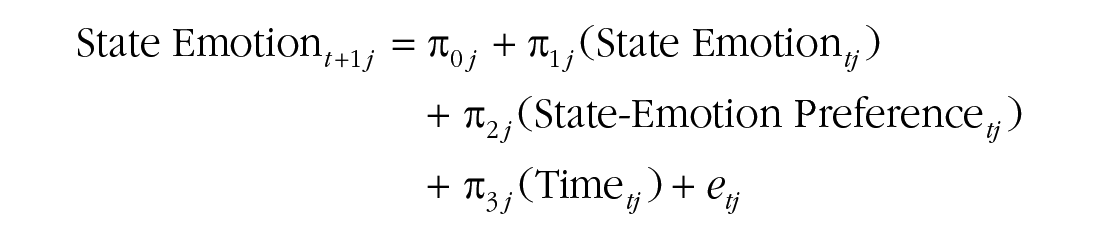
A first series of multilevel models tested whether state-emotion preferences predicted subsequent changes in state emotion and whether trait anxiety and anxiety symptoms moderated this relation. Separate multilevel models were fitted for each discrete emotion (i.e., anxiety, anger, sadness, and happiness). At Level 1, we constructed a model in which state-emotion preference at occasion t was associated with the change in state emotion from occasion t to t + 1. Level 1 predictors were person-mean centered. At Level 2, we modeled the random intercept and slope of state-emotion preferences as a function of individual differences in trait anxiety (STAI) and anxiety symptoms (BAI). Both STAI and BAI total scores were grand-mean centered. In addition, a grand-mean centered, time-invariant component of state-emotion preference (i.e., a person’s mean score across measurement probes) was included as a predictor of the random intercept to obtain unbiased estimates of the effects of state-emotion preferences on the outcome (Hamaker et al., 2015). In each model, a first-order autoregressive covariance structure accounted for higher correlations among assessments that were more proximal in time and for lower correlations among assessments that were more distal in time (Singer & Willett, 2003). All analyses controlled for the growth curve of each state emotion (by adding the time variable and its random slope to the models). The general Level 1 and Level 2 models were as follows:


Next, a second series of multilevel models tested whether state emotion predicted changes in state-emotion preferences and whether trait anxiety and anxiety symptoms moderated this relationship. Again, separate models were fitted for each discrete emotion. At Level 1, we constructed a model in which state emotion at occasion t was associated with the change in state-emotion preference from occasion t to t + 1. All Level 1 predictors were person-mean centered. At Level 2, we modeled the random intercept and slope of state emotion as a function of grand-mean centered STAI and BAI scores as well as the grand-mean centered, time-invariant component of state emotion (i.e., a person’s mean across measurement probes). These models used a first-order autoregressive covariance structure and controlled for the growth curve of each state-emotion preference. The general Level 1 and Level 2 models were as follows:



Results
Overall emotion preferences and individual differences in trait anxiety and anxiety symptom severity (Research Aim 1)
Table 1 presents statistics for each tested model. The results of the regression on STAI scores showed that the overall emotion preferences for anxiety, sadness, anger, and happiness explained a significant amount of the variance, F(4, 72) = 3.09, p = .021, adjusted R2 = .10. Overall anxiety preference (95% bootstrap CI = [0.16, 1.77]) was uniquely associated with trait anxiety levels. Overall emotion preferences regarding anger, sadness, and happiness did not explain a significant portion of the variance in trait anxiety.
Regression Models Predicting Trait Anxiety and Anxiety Symptoms

Note: For all t-test results reported, the degrees of freedom was 72. STAI-T = State-Trait Anxiety Inventory–Trait version (Spielberger et al., 1983); BAI = Beck Anxiety Inventory (Beck et al., 1988); CI = confidence interval.
Furthermore, the second regression analysis indicated that overall emotion preferences explained a significant proportion of the variance in BAI scores, F(4, 72) = 3.26, p = .016, adjusted R2 = .11. Overall anxiety preference (95% bootstrap CI = [0.26, 1.72]) was uniquely associated with variation in anxiety symptom levels. Overall emotion preferences for anger, sadness, and happiness did not explain a unique proportion of variance in anxiety symptom severity.
Dynamics of state emotion and emotion preferences and individual differences in trait anxiety and anxiety symptom severity (Research Aims 2 and 3)
Table 2 provides the means, standard deviations, and intraclass correlation coefficients for state emotion and state preferences for anxiety, anger, sadness, and happiness. The results from the multilevel analyses examining changes in state emotion and state-emotion preferences are presented in Tables 3 and 4, respectively.
Descriptive Statistics and ICCs for Study Variables

Note: ICC = intraclass correlation coefficient.
Estimated Parameters From Multilevel Models Examining Changes in State Emotion

Note: Values in parentheses are standard errors; values in brackets are 95% confidence intervals. STAI-T = State-Trait Anxiety Inventory–Trait version (Spielberger et al., 1983); BAI = Beck Anxiety Inventory (Beck et al., 1988).
Estimated Parameters From Multilevel Models Examining Changes in State-Emotion preferences

Note: Values in parentheses are standard errors; values in brackets are 95% confidence intervals. STAI-T = State-Trait Anxiety Inventory–Trait version (Spielberger et al., 1983); BAI = Beck Anxiety Inventory (Beck et al., 1988).
Predicting changes in state emotion
With respect to state anxiety, no significant association was found between state anxiety preference at time t and change in state anxiety between time t and t + 1. The results showed that a person’s average anxiety preference and both STAI and BAI scores were related to the person’s average level of reported state anxiety. Specifically, higher average levels of state anxiety preferences, trait anxiety, and anxiety symptom severity were related to higher levels of state anxiety.
The cross-level interactions between state anxiety preference at time t and both STAI and BAI were statistically significant, suggesting that trait anxiety and anxiety symptom severity moderated the relation between state anxiety preferences and changes in state anxiety. Simple slope tests were conducted to examine the relation between state anxiety and state anxiety preferences at time t at each level of STAI and BAI. With respect to STAI scores, the relation between state anxiety preferences at time t and state anxiety at t + 1 was −0.22 and not significant, t(2609) = 1.85, p = .065, at −1 SD of STAI (STAI = −10.72). At +1 SD of STAI (STAI = 10.72), the relation between state anxiety preferences at time t and state anxiety at t + 1 was 0.26 and significantly different from zero, t(2609) = 2.42, p = .016. These findings suggest that state anxiety preferences predict subsequent increases in state anxiety for individuals reporting relatively higher, but not relatively lower, levels of trait anxiety. With regard to BAI scores, the relation between state anxiety preferences at time t and state anxiety at t + 1 was 0.30 at −1 SD of BAI (BAI = −7.72), t(2609) = 2.65, p = .008, and −0.26 at +1 SD of BAI (BAI = 7.72), t(2609) = 2.68, p = .008. This result suggests that state anxiety preferences predict subsequent increases in state anxiety for individuals reporting relatively lower anxiety symptoms but decreases in state anxiety for individuals reporting relatively higher anxiety symptom levels.
With respect to state anger, the results showed that a person’s average anger preferences, as well as STAI and BAI scores, were related to the person’s average level of state anger. Specifically, relatively higher levels of average state anger preferences, trait anxiety, and anxiety symptom severity were related to higher levels of average state anger. No significant relationship was found between state anger preference at time t and the change in state anger between time t and t + 1. There were no cross-level interactions, indicating that STAI and BAI scores do not moderate the relation between state anger preferences and changes in state anger.
Analyses of state sadness revealed that individuals’ average sadness preferences, as well as STAI and BAI scores, were related to their average level of state sadness. Relatively higher levels of sadness preferences, trait anxiety, and anxiety symptom severity were related to higher levels of average state sadness. There was no significant relationship between state sadness preference at time t and the change in state sadness between time t and t + 1. However, there was a cross-level interaction between sadness preference at time t and BAI (but not STAI) scores. Simple slope tests showed that the relation between state sadness preferences at time t and state sadness at t + 1 was −0.43 at −1 SD of BAI (BAI = −7.72), t(2605) = 2.57, p = .010, and 0.05 at +1 SD of BAI (BAI = 7.72), t(2605) = 0.39, p = .699. This finding suggests that state sadness preferences predict subsequent decreases in state sadness for individuals reporting lower, but not higher, severity of anxiety symptoms.
Finally, regarding state happiness, results showed that participants’ average happiness preferences, as well as STAI and BAI scores, were related to their average level of state happiness. Specifically, higher levels of state happiness were related to greater preferences for happiness but lower levels of trait anxiety and anxiety symptom severity. No significant association was found between state happiness preference at time t and the change in state happiness between time t and t + 1. Neither STAI nor BAI scores moderated the relation between state happiness preferences and changes in state happiness.
Predicting changes in emotion preferences
With respect to state anxiety preferences, a significant association was observed between state anxiety at time t and change in state anxiety preferences between time t and t + 1. Relatively higher levels of state anxiety at time t were associated with subsequent increases in state anxiety preferences. Moreover, a person’s average level of state anxiety was related to their average level of state anxiety preferences; higher average levels of anxiety were related to a greater preference for anxiety. Neither STAI nor BAI scores moderated the relation between state anxiety and changes in anxiety preferences.
For state anger preferences, results indicated that a person’s average state anger was related to their average level of state anger preferences. Specifically, higher levels of anger were related to higher levels of anger preferences. No significant association was found between state anger at time t and the change in state anger preferences between time t and t + 1, and STAI and BAI scores did not moderate the association between state anger and changes in state anger preferences.
Analyses of state sadness preferences revealed that a person’s average sadness levels were related to their average level of state sadness preferences such that higher levels of sadness were related to higher levels of state sadness preferences. There was no significant relationship between state sadness at time t and the change in state sadness preferences between time t and t + 1. There were no cross-level interactions with STAI or BAI scores, suggesting that trait anxiety and anxiety symptom severity do not moderate sadness–sadness preference relations.
Finally, regarding state happiness preferences, results indicate that a person’s average reported state happiness and STAI scores were related to their average level of state happiness preferences. Relatively higher levels of happiness and trait anxiety were related to greater preferences for happiness. No significant association was found between happiness at time t and the change in state happiness preferences from time t to t + 1. Neither STAI nor BAI total scores moderated the association between state happiness and changes in state happiness preferences.
Discussion
In the current study, we investigated the relation between state emotion and emotion preferences as they relate to individual differences in trait anxiety and anxiety symptom severity. The first research aim was to examine the nature of emotion preferences in anxiety. Findings indicated that trait anxiety and anxiety symptom severity were positively associated with preferences to experience anxiety in daily life. Anxiety measures were not consistently associated with preferences for sadness, anger, or happiness. The second research aim was to investigate the directionality of relations between emotion and emotion preferences. Results suggested that the association between emotion and emotion preferences is bidirectional. We discovered that individuals’ average level of a given emotion was positively associated with their preference for that emotion and that state anxiety positively predicted subsequent changes in one’s preference to feel anxious. Results also revealed that trait emotion preferences (i.e., one’s average preference for a given emotional state across the EMA period) were positively correlated with state levels of that emotion (e.g., greater levels of average anxiety preferences across the EMA period were associated with higher ratings of state anxiety at each time point). There was minimal evidence of state-emotion preferences predicting subsequent changes in emotion. However, in line with the third research aim, there were significant and differential relations between state preferences for anxiety and subsequent levels of anxiety as a function of trait anxiety and symptom severity. In particular, among individuals with high trait anxiety, greater state preference for anxiety was associated with subsequent increases in anxiety. An opposite pattern was found when assessing anxiety symptom severity. Among individuals with more severe symptoms, greater preference for anxiety was associated with less subsequent anxiety, whereas state anxiety preferences were positively correlated with subsequent anxiety among participants reporting relatively less severe symptoms of anxiety.
Relation to the extant literature
To our knowledge, the current study is the first to document that anxiety is associated with emotion preferences; higher levels of both trait anxiety and symptom severity are linked to relatively greater preference for anxiety. These findings are consistent with predictions stemming from worry-based models of anxiety (Borkovec, 1994; Newman & Llera, 2011), self-verification theory (Swann et al., 1992), and hypotheses related to emotion preferences put forth by Millgram and colleagues (2020). Although each of these aforementioned models implicate different underlying reasons, they converge in offering support for the notion that individuals with greater levels of anxiety exhibit relatively elevated preferences for state anxiety because that emotional state is perceived to be useful. Exploration of the relation between anxiety preferences and anxiety-related functions specific to each model—facilitating preparedness, avoidance of emotional instability, preferring familiar emotions, desiring emotions that verify one’s sense of self—is needed to further elucidate the primary factors contributing to the enhanced preferences for anxiety among individuals with relatively more severe anxiety symptoms and high trait anxiety.
Evidence that individual differences in trait anxiety and anxiety symptom severity are associated with emotion preferences extends a growing body of research on emotion preferences as they relate to clinical phenomena. Indeed, prior research has demonstrated that individuals with major depression report relatively greater preferences for sadness and relatively lower preferences for happiness (Millgram et al., 2015, 2019; Yoon et al., 2019). The current findings also complement recent work documenting associations between anxiety symptoms and ideal affect, specifically, that individuals with relatively higher anxiety symptom severity value both high arousal positive and negative emotional states to a greater degree relative to individuals with less severe anxiety-related symptoms (Swerdlow et al., 2019).
The current data demonstrate that only anxiety preferences explain unique variance in trait anxiety and anxiety symptom severity when considering all emotion preferences simultaneously. Although anxiety is characterized by broad emotion dysfunction (Brown, 2007; Kashdan, 2007), this unique relation may reflect the notion that state anxiety is the predominant emotional experience for people with high trait anxiety or greater anxiety symptom severity; thus, those individuals may have stronger thoughts, attitudes, and feelings about that emotional state. Regardless of the underlying reason, the present results suggest that emotion preferences may play an important role in helping to understand the elevated levels of state anxiety, in particular, among individuals with greater trait anxiety or more severe anxiety symptoms.
The current study is also among the first to document the bidirectional relation between emotion and emotion preferences. Theoretical models of emotion preferences (Tamir, 2009b, 2016) often conceptualize preferences as a temporal predecessor of state emotion, and the relation between preferences and emotion is thought to be mediated, at least in part, by the ways in which people attempt to modify their emotions, a concept known as emotion regulation (McRae & Gross, 2020). Consistent with these models, we find that greater trait preferences are associated with higher levels of a given emotional state. However, results also suggest that an individual’s emotional state plays an important role in what the individual subsequently wants to feel. Specifically, participants report greater preferences for emotional states that they typically experience. Furthermore, the present data reveal that variability in state anxiety is associated with subsequent changes in anxiety preferences such that when people feel anxious, their desire to feel anxious increases. The concept of state emotion influencing emotion preferences complements the affect-as-information theory (Scott & Cervone, 2002). This theory posits that people may consider current emotional states as being reflective of important information that can support decision-making, and in this sense, people may desire to feel more of that emotion given its perceived value in aiding decision-making. Further exploration of the mechanisms underlying how and why state emotions influence emotion preferences is an important direction for future research.
Although results of the present study suggest that state-emotion preferences do not generally predict subsequent changes in emotion, this is not the case when examining whether individual differences in trait anxiety and anxiety symptom severity moderate the relation between anxiety preferences and state anxiety. Indeed, this study is the first to show that individual differences in anxiety may influence the ways in which preferences are associated with experienced emotion. Unexpectedly, we see a divergence in the association between emotion preferences and subsequent emotion states across the two measures of anxiety. For individuals reporting relatively high trait anxiety, greater state preference for anxiety is associated with greater subsequent increases in anxiety. The relation between state anxiety preference and state anxiety among individuals with high trait anxiety is consistent with research on the relation between emotion preferences and emotion in depression (for a review, see Millgram et al., 2020). Furthermore, this finding supports the possibility that relative increases in preferences for anxiety may help to explain the elevated levels of anxiety that commonly characterize individuals with high trait anxiety.
In contrast, preference for anxiety is associated with subsequent decreases in anxiety among people reporting relatively greater anxiety symptom severity. Although unexpected, the inverse relation between emotion preferences and state anxiety in this group may reflect an underlying third variable or mechanism, such as a habituation process. The highly arousing nature of anxiety is difficult to sustain for prolonged periods of time and, instead, tends to habituate over time (Epstein, 1971). Thus, for people who experience chronically elevated levels of anxiety, further increasing anxiety, even when desired, may prove difficult given habituation processes. In contrast, individuals reporting lower BAI scores—those who do not experience chronic elevations in anxiety—show increases in state anxiety when they want to feel anxious. The notion that habituation of anxiety following enhanced preferences for state anxiety may be observed among people who report higher BAI scores, but not higher STAI scores, is further supported by the inherent differences between the measures. As described previously, compared with the STAI, the BAI more exclusively assesses physiological manifestations of anxiety, which are most sensitive to habituation. Note that this possibility is merely speculative and requires further research. Although more work is needed to better understand the differential relations between emotion and emotion preferences across various manifestations of anxiety (trait anxiety, symptom severity), the current results highlight the importance of measuring anxiety comprehensively.
Limitations
The current study is not without limitations. In line with research showing that anxiety is a dimensional construct (Brown & Barlow, 2009), we examine the primary variables of interest as they relate to individual differences in trait anxiety and anxiety symptom severity. However, individuals with clinically diagnosed anxiety disorders often exhibit the greatest level of emotion dysfunction, and thus, it is important to investigate whether the current findings extend to treatment-seeking clinical samples. Although the current study included participants who met criteria for a current or past anxiety disorder, replication in a sample of individuals seeking treatment for anxiety disorders would provide greater support for the notion that emotion preferences play an important role in understanding emotion dysfunction in anxiety.
In addition, in line with previously published EMA protocols, the current study relied on single-item measures of emotion and emotion preferences to mitigate participant burnout (Starr, 2015; Starr et al., 2017). It is commonly assumed that it is advantageous to use multiple items to measure a given variable because doing so minimizes threats to construct validity. However, there is evidence that single-item and multi-item measures of similar constructs do not necessarily differ in their validity (Bergkvist & Rossiter, 2007). Furthermore, other researchers have argued that using more items to measure a construct can actually undermine construct validity (Burisch, 1997). Nevertheless, future research comparing multi-item measures with single-item measures of state emotion and emotion preferences is needed to investigate the degree of divergence between both types of measurement and to document the strengths and limitations of each approach, particularly in the context of EMA-based research.
Finally, the current study includes data from a sample with a restricted age range and limited racial and ethnic diversity. These limitations are important given prior research showing that demographic and cultural factors are related to emotion preferences and similar constructs. Specifically, desires to maintain, or enhance, negative emotion and to decrease positive emotion are more prevalent among adolescents, whereas older age is associated with greater desires to maintain positive emotion and to decrease negative emotion (Riediger et al., 2009). Moreover, Tsai, Miao, and colleagues (2007) demonstrated that Americans placed more cultural value on high-arousal positive-emotion states (e.g., excitement) relative to low-arousal positive-emotion states (e.g., serenity), in contrast to Chinese and other East Asian cultures. Future research with a more diverse developmental and cultural sample is certainly needed to better understand how anxiety may interact with age and culture to understand emotion preferences and their role in explaining emotion dysfunction within anxious samples.
Future directions and clinical implications
Having begun to document the nature of emotion preferences in anxiety, we believe a critical avenue for future research is to explore the association between emotion preferences and emotion regulation among anxious and nonanxious samples. As previously mentioned, emotion-preference frameworks suggest that preferences influence emotional states through emotion-regulation strategies (Tamir, 2009b, 2016). An abundance of empirical research documents emotion-regulation dysfunction across a variety of anxious samples (Hofmann, Sawyer, et al., 2012; Mennin et al., 2009; Wirtz et al., 2014). Elevated levels of anxiety are maintained, in part, by the tendency to use certain emotion-regulation strategies that typically maintain, or enhance, negative emotion (Cisler & Olatunji, 2012). However, to date, no study has examined whether enhanced preference for anxiety predicts engagement in regulatory strategies that serve to maintain or upregulate anxiety over time. Moreover, investigation as to how interindividual factors, such as affective style (i.e., one’s belief that an emotional state is tolerable) and emotion-regulation flexibility (i.e., the tendency to adjust strategy use to fit a given situation), may modulate associations between emotion preferences and emotion regulation among individuals with and without anxiety disorders represents an exciting and promising next step in this line of research (for a comprehensive model, see Hofmann et al., 2012).
The present findings raise important treatment implications. In particular, they highlight a potential new treatment target (i.e., emotion preferences) for interventions aimed at addressing emotion dysfunction among individuals with significant anxiety. Cognitive behavioral therapy (CBT) is widely considered the gold-standard treatment for anxiety (Norton & Price, 2007; Otte, 2011; Roshanaei-Moghaddam et al., 2011). CBT largely focuses on enhancing skills designed to tolerate or downregulate the experience of anxiety and to disrupt behavioral processes (e.g., avoidance) that serve to maintain or increase anxiety over time. Although the exact relation between preferences and emotion regulation remains unclear, training individuals to use strategies aimed at downregulating anxiety may be a moot point if that regulation attempt is not aligned with their preferences. Thus, given the current data, treatments for emotion dysfunction in anxiety may benefit from addressing emotion preferences in conjunction with enhancing cognitive and behavioral skills for managing anxiety and modifying processes that maintain anxiety.
Footnotes
Acknowledgements
We gratefully acknowledge Haley Hegefeld, Alexis Hopkins, Landon Allen, Daphne Zhu, and Sarah McCauley for assistance with study materials and data collection for ecological momentary assessment (EMA) and Aaron Heller for helpful discussions regarding EMA implementation. The current data will be provided to researchers upon request. R code is publicly available via the Open Science Framework ( ).
).
Transparency
Action Editor: Stefan G. Hofmann
Editor: Kenneth J. Sher
Author Contributions
C. Caballero, E. M. Cohodes, and D. G. Gee designed a larger ecological momentary assessment study and collected the data for that study; a subset of data from that project was used for the present study. W. M. Vanderlind, J. Everaert, and D. G. Gee identified the primary aims of the current study. W. M. Vanderlind and J. Everaert analyzed the data and wrote the first draft of the manuscript. C. Caballero, E. M. Cohodes, and D. G. Gee reviewed the manuscript and assisted in making revisions. All of the authors agree to the order in which they are listed. All of the authors approved the final manuscript for submission.