



Abstract
A major question in clinical and moral psychology concerns the nature of the commonly presumed association between psychopathy and moral judgment. In the current preregistered study (N = 443), we aimed to address this question by examining the relation between psychopathy and responses to moral dilemmas pitting consequences for the greater good against adherence to moral norms. To provide more nuanced insights, we measured four distinct facets of psychopathy and used the CNI model to quantify sensitivity to consequences (C), sensitivity to moral norms (N), and general preference for inaction over action (I) in responses to moral dilemmas. Psychopathy was associated with a weaker sensitivity to moral norms, which showed unique links to the interpersonal and affective facets of psychopathy. Psychopathy did not show reliable associations with either sensitivity to consequences or general preference for inaction over action. Implications of these findings for clinical and moral psychology are discussed.
Keywords
A major question at the intersection of clinical and moral psychology concerns the nature of the commonly presumed association between psychopathy and moral judgment (Borg & Sinnott-Armstrong, 2013; Larsen et al., 2020; Marshall et al., 2018; Yoder et al., 2015). One line of research has attempted to provide insight into this question by examining whether people with elevated levels of psychopathy differ from other people in their resolution of moral dilemmas pitting overall consequences for the greater good (utilitarianism) against moral norms and duties (deontology). Although findings from early investigations have been mixed (see Marshall et al., 2018), a growing body of research using a formal modeling approach to disentangle different determinants of moral-dilemma judgments suggests that people with elevated levels of psychopathy may be (a) less sensitive to consequences for the greater good, (b) less sensitive to moral norms and duties, and (c) less action averse in their responses to moral dilemmas compared with others (Gawronski et al., 2017; Körner et al., 2020; Luke & Gawronski, 2021a).
Although earlier research has provided valuable insights into the relation between psychopathy and moral-dilemma judgments, it has predominantly relied on a conceptualization that treats psychopathy as a general, unitary construct. However, a considerable body of research supports a four-factor model of psychopathy (e.g., Neumann et al., 2007, 2015), in which psychopathy is conceptualized as a multifarious construct comprising interpersonal, affective, lifestyle, and antisocial facets (Hare & Neumann, 2008). Given that these facets have been differentially associated with individual differences in cognitive and emotional processing (e.g., Garofalo et al., 2020; Vitacco et al., 2005), it is possible that different facets of psychopathy contribute in unique ways to the complex associations between psychopathy and different aspects of moral-dilemma judgments.
The purpose of the current research was to investigate this possibility by examining the relation between psychopathy and moral-dilemma judgments at the facet level. To this end, we conceptualized and measured psychopathy according to the four-factor model (Hare & Neumann, 2008), which allowed us to examine how interpersonal, affective, lifestyle, and antisocial facets uniquely contribute to disagreements about the appropriate resolution of moral dilemmas. In line with past research (Gawronski et al., 2017; Körner et al., 2020; Luke & Gawronski, 2021a), we used the CNI model to independently quantify sensitivity to consequences (C), sensitivity to moral norms (N), and general preference for inaction over action (I) in responses to moral dilemmas. Our main question was whether previously obtained associations between psychopathy and the three aspects of moral-dilemma judgments are driven by different facets of psychopathy.
Psychopathy and Moral-Dilemma Judgment
A major line of research in psychology has examined how people resolve moral dilemmas that pit the maximization of consequences for the greater good against adherence to moral norms and duties. One of the best known examples of this type of dilemma is the trolley problem, a scenario in which a runaway trolley is set to collide with and kill five workers. In a version of this scenario called the switch dilemma (Foot, 1967), it is possible to pull a lever that would redirect the trolley onto a track with one worker instead of five. In another version of this scenario called the footbridge dilemma (Thomson, 1985), it is possible to push a large man in front of the path of the trolley, which would result in his death but halt the progress of the trolley toward the five workers. Judgments in favor of these actions have been described as utilitarian in the sense that they maximize consequences for the greater good (e.g., save the most lives possible), whereas judgments opposing these actions have been described as deontological in that they conform to applicable moral norms and duties (e.g., prohibitions against murder; Conway et al., 2018).
Using this paradigm, a large body of research has examined the relation between psychopathy and moral-dilemma judgment. Findings across this research have been mixed; some studies suggest no relation between psychopathy and moral-dilemma judgments (e.g., Cima et al., 2010; Glenn et al., 2009), and other studies suggest a positive association between psychopathy and preference for utilitarian over deontological judgments (e.g., Bartels & Pizarro, 2011; Glenn et al., 2010). A recent meta-analysis provided some clarity into this relation. It suggests a small to moderate positive association (r = .26) between psychopathy and preference for utilitarian over deontological judgments (Marshall et al., 2018).
Limitations of the Traditional Moral Dilemma Paradigm
Although meta-analytic evidence suggests a positive association between psychopathy and preference for utilitarian over deontological judgments, several methodological issues limit the interpretation of this finding. One issue is that the moral dilemmas traditionally used in past research pit consequences for the greater good against adherence to moral norms and duties. As a result, responses to moral dilemmas reflect relative preferences for utilitarian judgment over deontological judgment rather than absolute preferences for either. Because the processes underlying utilitarian and deontological judgments are presumed to be independent, confounding utilitarian and deontological judgment in a forced choice of one over the other leaves unclear whether differences in moral-dilemma judgments reflect differences in the tendency to make utilitarian judgments, differences in the tendency to make deontological judgments, or differences in both (Conway & Gawronski, 2013). A second issue in traditional moral-dilemma research is that maximization of consequences for the greater good usually entails action (e.g., pulling the lever, pushing the large man), whereas adherence to moral norms and duties usually entails inaction (e.g., not pulling the lever, not pushing the large man). As a result, preference for utilitarian judgment is further confounded with a general preference for acting, whereas preference for deontological judgment is further confounded with a general preference for not acting (Crone & Laham, 2017).
Taking these issues together, it is unclear whether differences in responses to traditional moral dilemmas reflect (a) differences in the tendency to maximize consequences for the greater good, (b) differences in the tendency to adhere to moral norms and duties, or (c) differences in general action preferences. Applied to the case of psychopathy, the meta-analytic finding that people with elevated levels of psychopathy show greater preference for utilitarian judgment over deontological judgment compared with other people could therefore reflect (a) a stronger tendency to maximize consequences, (b) a weaker tendency to adhere to moral norms, (c) a weaker level of action aversion, or (d) a more complex pattern of differences. To distinguish between these possibilities, a recent line of research has used the CNI model of moral decision-making (Gawronski et al., 2017) to separately quantify the distinct factors underlying moral-dilemma judgments.
The CNI Model
The CNI model is a multinomial model (see Hütter & Klauer, 2016) developed to separately quantify sensitivity to consequences, sensitivity to moral norms, and general preference for inaction over action in responses to moral dilemmas. Each of these determinants is quantified using patterns of responses to moral dilemmas that differ in terms of consequences (the action described in the dilemma either produces greater or smaller benefits than costs) and relevant moral norms (the action described in the dilemma is either prescribed or prohibited by a relevant moral norm). As shown in Figure 1, each determinant is represented by a parameter in the model and is associated with a unique pattern of responding across dilemma variations. Sensitivity to consequences is captured by the C parameter, which reflects the tendency to favor action in dilemmas in which the benefits of the action are greater than the costs and to favor inaction in dilemmas in which the benefits of the action are smaller than the costs (see the first row in Fig. 1). Sensitivity to moral norms is captured by the N parameter, which reflects the tendency to favor action in dilemmas in which action is prescribed by a moral norm and to favor inaction in dilemmas in which action is prohibited by a moral norm (second row in Fig. 1). General preference for inaction over action is captured by the I parameter, which reflects the tendency to generally favor inaction rather than action in moral dilemmas (third and fourth rows in Fig. 1).

CNI model of moral decision-making predicting action responses and inaction responses in moral dilemmas with proscriptive and prescriptive norms and consequences involving benefits of action that are either greater or smaller than costs of action. Copyright © 2017 by American Psychological Association. Reproduced with permission. Gawronski, B., Armstrong, J., Conway, P., Friesdorf, R., & Hütter, M. (2017). Consequences, norms, and generalized inaction in moral dilemmas: The CNI model of moral decision-making. Journal of Personality and Social Psychology, 113, 343–376.
Previous research using the CNI model has provided valuable insights into how psychopathy is associated with differences in sensitivity to consequences, sensitivity to moral norms, and general preference for inaction over action. In an initial investigation, Gawronski and colleagues (2017, Studies 4a and 4b) examined moral-dilemma judgments among participants with psychopathy scores that placed them in either the lowest or highest quartile in the sample. Across two studies, participants with high psychopathy scores were found to be less sensitive to moral norms than participants with low psychopathy scores. In addition, participants with high psychopathy scores tended to be less sensitive to consequences and less action averse than participants with low psychopathy scores, but these differences were only marginal in one of the two studies. Körner and colleagues (2020) further investigated these relations using an individual-difference design that considered the full range of psychopathy scores. Across four studies, psychopathy showed reliable negative correlations with individual differences in sensitivity to consequences, sensitivity to moral norms, and general preference for inaction over action. Finally, Luke and Gawronski (2021a) replicated the negative correlations between psychopathy and the three factors underlying moral-dilemma judgments and further showed that psychopathy was associated with differences in both personal and perceived societal standards. Collectively, this line of work suggests that elevated levels of psychopathy are associated with (a) a weaker sensitivity to consequences, (b) a weaker sensitivity to moral norms, and (c) a weaker general preference for inaction rather than action.
Four Facets of Psychopathy
Although previous research using the CNI model has provided valuable insights into the relation between psychopathy and different aspects of moral-dilemma judgments, this work has exclusively examined psychopathy as a general, unitary construct. However, there is substantial evidence for a broader conceptualization that treats psychopathy as a superordinate, multifarious construct underpinned by distinct interpersonal, affective, lifestyle, and antisocial facets (Neumann et al., 2007, 2015). The interpersonal facet includes characteristics such as pathological-lying tendencies and manipulativeness, the affective facet includes characteristics such as remorselessness and callousness, the lifestyle facet includes characteristics such as irresponsibility and impulsivity, and the antisocial facet includes characteristics such as delinquency and behavioral issues (Hare & Neumann, 2008). These facets have been shown to have differential relations with a range of individual-difference measures including intelligence (Vitacco et al., 2005), behavioral activation/inhibition (Hoppenbrouwers et al., 2015), executive functioning (Baskin-Sommers et al., 2015), and emotion regulation (Garofalo et al., 2020).
Given this body of findings, it is possible that the obtained associations between psychopathy and the three factors of moral-dilemma judgments reflect distinct relations with different facets of psychopathy. Although the obtained association with sensitivity to consequences may be driven by one specific facet of psychopathy, the obtained association with sensitivity to moral norms may be driven by a different facet, and the obtained association with general action tendencies may be driven by yet another facet. The available data from previous studies are not suitable to address this question for several reasons. With the exception of one study by Gawronski et al. (2017, Study 4a), all previous studies using the CNI model to investigate associations between psychopathy and moral-dilemma judgments have used the primary psychopathy subscale of Levenson’s Self-Report Psychopathy Scale (LSRP; Levenson et al., 1995). Although this subscale captures an important subset of features comprising psychopathy (e.g., interpersonal manipulativeness, lack of remorse), it does not capture other significant aspects of the construct (e.g., impulsivity, behavioral issues; see Hare & Neumann, 2008). The latter aspects are captured by the secondary psychopathy subscale of the LSRP, which was not included in any of the CNI model studies that investigated associations between psychopathy and moral-dilemma judgments (Gawronski et al., 2017, Study 4b; Körner et al., 2020; Luke & Gawronski, 2021a). The only study that used a measure capturing multiple facets of psychopathy (Gawronski et al., 2017, Study 4a) relied on the Self-Report Psychopathy Scale–III (Paulhus et al., 2009). Although this measure permits a more nuanced analysis at the facet level, participants in this study were preselected according to whether they showed psychopathy scores that placed them in either the lowest or highest quartile in a prior survey. Because the preselection occurred at the level of aggregate psychopathy scores and because preselection at the aggregate level can lead to distorted outcomes at the facet level, the extreme-groups approach adopted in this study undermines the possibility of more nuanced analyses at the facet level. Thus, although previous research using the CNI model has provided valuable insights into the relation between psychopathy and different aspects of moral-dilemma judgments, it remains unclear whether the obtained associations with different aspects of moral judgments are driven by different facets of psychopathy.
The Current Research
The purpose of the current research was to investigate whether the four facets of psychopathy show differential associations with specific determinants of moral-dilemma judgments. To this end, psychopathy was conceptualized according to the four-factor model (Hare & Neumann, 2008) and measured using the Self-Report Psychopathy Scale–Short Form (SRP-SF; Paulhus et al., 2017), a well-validated instrument assessing the interpersonal, affective, lifestyle, and antisocial facets of psychopathy. To disentangle the different factors underlying moral-dilemma judgments, we used the CNI model (Gawronski et al., 2017) to independently quantify sensitivity to consequences (C parameter), sensitivity to moral norms (N parameter), and general preference for inaction over action (I parameter) in responses to moral dilemmas. Because there is evidence for gender differences in both psychopathy (Cale & Lilienfeld, 2002) and moral-dilemma judgments (Friesdorf et al., 2015), we conducted analyses both with and without controlling for gender.
Given past research using the CNI model to investigate associations between psychopathy and moral-dilemma judgments (Gawronski et al., 2017; Körner et al., 2020; Luke & Gawronski, 2021a), we expected general psychopathy to be negatively associated with the C parameter, N parameter, and I parameter (Hypotheses 1a–1c) and that these associations would remain statistically significant even when controlling for gender (Hypotheses 1d–1f).
Expanding on these hypotheses, extant evidence suggests several nuanced hypotheses regarding associations between specific facets of psychopathy and factors underlying moral-dilemma judgments. Both the interpersonal and affective facets have been linked to lower empathic tendencies and agreeableness (Lishner et al., 2015; Lynam et al., 2018; Seara-Cardoso et al., 2012, 2013, 2020). Given that both empathy and agreeableness have been positively associated with sensitivity to moral norms in responses to moral dilemmas (Körner et al., 2020; Luke & Gawronski, 2021b), we expected that the interpersonal and affective facets would show significant negative zero-order correlations with the N parameter (Hypotheses 2a and 3a) and be uniquely predictive of the N parameter after controlling for other facets of psychopathy and gender (Hypotheses 2b and 3b).
The lifestyle facet of psychopathy involves impulsivity and stimulation seeking (Hare & Neumann, 2008), which may translate to reduced action aversion (i.e., reduced general preference for inaction over action) in the context of moral dilemmas. Therefore, we expected that the lifestyle facet would show a significant negative zero-order correlation with the I parameter (Hypothesis 4a) and be uniquely predictive of the I parameter when controlling for other facets of psychopathy and gender (Hypothesis 4b).
Finally, the antisocial facet of psychopathy has been uniquely associated with violence and aggression (Hill et al., 2004; Krstic et al., 2018; Vitacco et al., 2005). Given that sensitivity to moral norms reflects unconditional adherence to relevant norms (e.g., prohibitions against murder), we expected that the antisocial facet would show a significant negative zero-order correlation with the N parameter (Hypothesis 5a) and be uniquely predictive of the N parameter when controlling for other facets of psychopathy and gender (Hypothesis 5b). Moreover, to the extent that sensitivity to consequences is driven by a motivation to maximize well-being for the collective, we also expected that the antisocial facet would show a significant negative zero-order correlation with the C parameter (Hypothesis 6a) and be uniquely predictive of the C parameter when controlling for other facets of psychopathy and gender (Hypothesis 6b).
To test these hypotheses, we aimed to recruit 500 participants. Given past research, we anticipated that approximately 15% of the sample would fail an attention check designed to screen for inattentive participants (see Oppenheimer et al., 2009), which would leave a final sample of approximately 425 participants. A sample size of 425 participants provides a power of 80% in detecting a correlation of |.14| (two-tailed), which is equal to the smallest effect size obtained in past work that examined associations between psychopathy and moral-dilemma judgment using the CNI model (Körner et al., 2020). All power analyses were conducted using GPower 3.1 (Faul et al., 2007). The protocols for the current research received proper Institutional Review Board ethical approval. We report all data, all measures, and all data exclusions. The materials, data, and analysis codes can be accessed at https://osf.io/vmduz/.
Method
Participants
All participants were recruited through Prolific Academic in July 2020 (Peer et al., 2017). Participants were eligible to participate if they (a) were over the age of 18, (b) were from the United States, (c) had completed at least one prior assignment on Prolific, (d) had an approval rating of at least 95% on past assignments on Prolific, and (e) had not completed a prior assignment posted by the lab of B. Gawronski using the dilemma battery in the current research. Of the 504 participants who completed the assessment in its entirety, 1 61 participants were excluded from analyses because they failed a reading-intensive attention check (see Procedure). After applying this preregistered exclusion criterion, the final sample consisted of 443 U.S. participants (54.40% female, 43.12% male, 1.58% other, 0.90% prefer not to answer; mean age = 32.24 years, SD = 11.95), of whom 75.17% identified as White, 12.87% identified as Black, 13.09% identified as Asian, 2.48% identified as Native American, 1.13% identified as Pacific Islander, and 3.16% identified as other. 2 Consistent with previous research with nonclinical samples (Seara-Cardoso et al., 2020; Walsh et al., 2019), a substantial percentage of participants (16.70%) showed normatively elevated levels of psychopathic traits (i.e., SRP-SF ≥ 70). Participants were compensated $4.00 for their participation.
Procedure
Consenting participants were first asked to complete the SRP-SF (Paulhus et al., 2017), a 29-item measure of psychopathy comprising four subscales: Interpersonal (seven items; e.g., “I have pretended to be someone else in order to get something”), Affective (seven items; e.g., “People sometimes say that I’m cold-hearted”), Lifestyle (seven items; e.g., “I enjoy doing wild things”), and Antisocial (eight items, e.g., “I have threatened people into giving me money, clothes, or makeup”). For each item, participants indicated their agreement with the statement using a 5-point rating scale ranging from 1 (disagree strongly) to 5 (agree strongly).
After completing the SRP-SF, participants were asked to a complete a moral-dilemma battery developed for research using the CNI model (Körner et al., 2020). The battery comprises 12 basic scenarios with four variations on each, resulting in 48 moral dilemmas. An example of a scenario in its four variants is presented in Table 1. Variations on each scenario reflect the independent manipulations of consequences (the benefits of the action described in the dilemma were either greater or smaller than the costs) and moral norms (the action described in the dilemma was either proscribed or prohibited by a moral norm). For each dilemma, participants were asked whether they would perform the action described using a “yes” or “no” dichotomous answer choice. All dilemmas were presented in a fixed random order.
Examples of Moral Dilemmas Involving Either a Proscriptive or a Prescriptive Norm in Which the Benefits of Action Are Either Greater or Smaller Than the Costs of Action
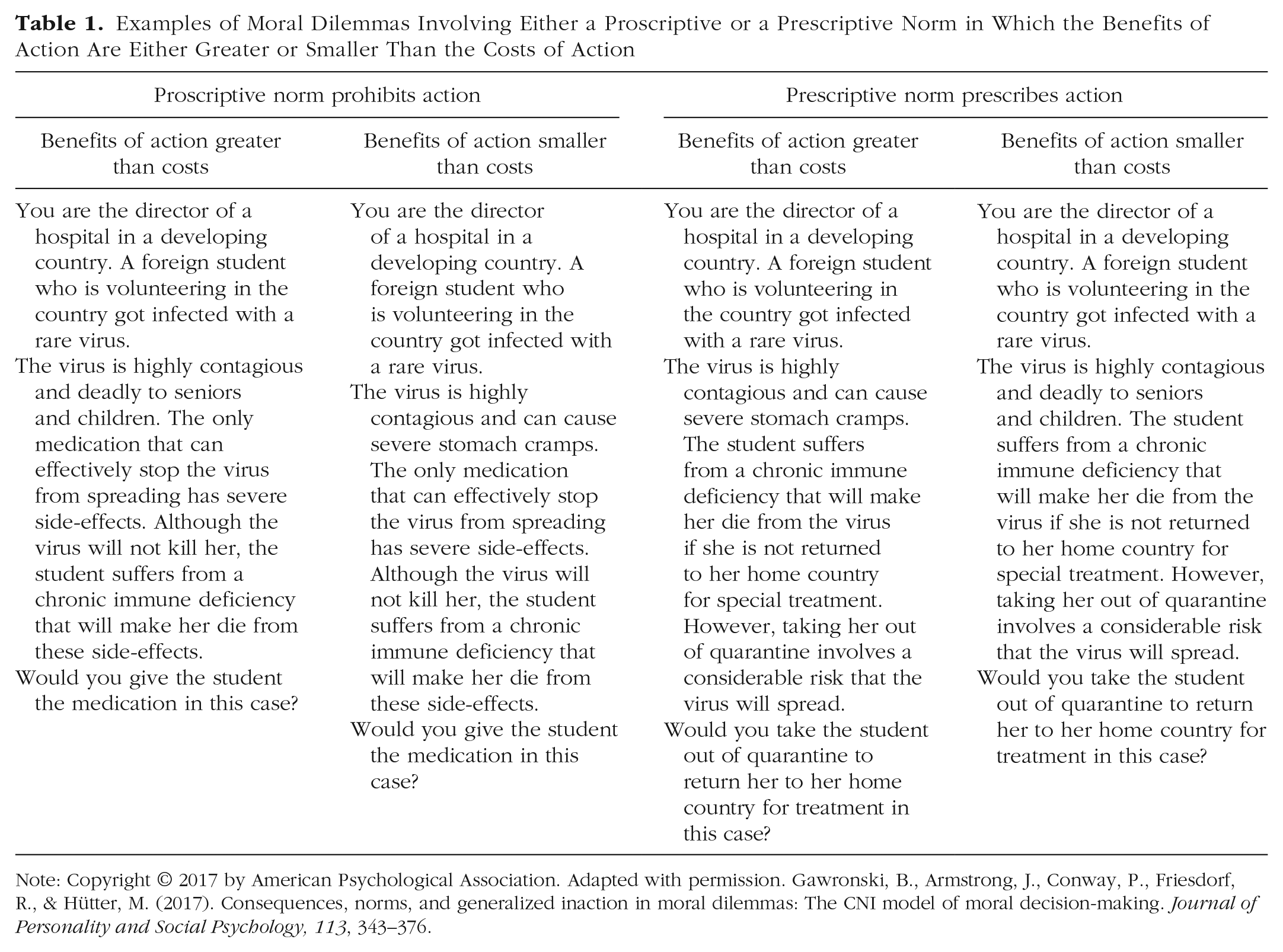
Note: Copyright © 2017 by American Psychological Association. Adapted with permission. Gawronski, B., Armstrong, J., Conway, P., Friesdorf, R., & Hütter, M. (2017). Consequences, norms, and generalized inaction in moral dilemmas: The CNI model of moral decision-making. Journal of Personality and Social Psychology, 113, 343–376.
After finishing the dilemma battery, participants were asked to complete a set of demographic questions about their gender, age, ethnicity, and political ideology and a reading-intensive instructional attention check, which read as follows: Many variables can greatly impact decision-making. In order to facilitate our research on decision-making we are interested in knowing certain factors about you, the decision maker. Specifically, we are interested in whether you actually take the time to read the directions; if not, then some of our manipulations that rely on changes in the instructions will be ineffective. So, in order to demonstrate that you have read the instructions, please ignore the sports items below. Instead, simply continue on to the next page after the options. Thank you very much. Which of these activities do you engage in regularly? (check all that apply)
Answer choices for the attention check included “football,” “soccer,” “dancing,” “watersports,” “triathlon,” “running,” “volleyball,” and “I don’t play sports.” Given that the attention check instructed participants to ignore the question, participants who selected any of the answer choices were considered inattentive and excluded from further analyses (see Oppenheimer et al., 2009). After completion of the attention check, participants were thanked for their participation, debriefed, and redirected for compensation.
Analytic plan
To obtain a general psychopathy score, responses to the 29 items of the SRP-SF were averaged across all items. To obtain specific facet scores, item scores were averaged for each subscale, which resulted in separate scores for the interpersonal (INT), affective (AFF), lifestyle (LIF), and antisocial (ANT) facets. One item in the Antisocial subscale was reverse-framed (“I have never been involved in delinquent gang activity”), so it was reverse-coded for the purpose of quantifying general and facet-level psychopathy.
Moral-dilemma judgments were aggregated using two different approaches. In line with much of past research (e.g., Bartels & Pizarro, 2011; Cima et al., 2010), moral-dilemma judgments were first aggregated as the relative preference for action on dilemmas in which breaking a proscriptive norm (e.g., killing one person) leads to better overall outcomes (e.g., saving five people). Toward this end, we calculated for each participant the number of action responses to this dilemma variant, which could range from 0 to 12. The resulting score (which we refer to as the traditional score) has typically been interpreted as preference for utilitarian over deontological judgment. To investigate associations between psychopathy and preference for utilitarian judgment over deontological judgment, we analyzed zero-order and partial correlations (controlling for gender) between psychopathy scores and traditional scores. To quantify the unique contribution of each facet of psychopathy, we simultaneously regressed traditional scores on all facet scores while controlling for gender.
In addition to aggregating moral-dilemma judgments according to the traditional approach, moral-dilemma judgments were also aggregated using the CNI model (for a detailed explanation of the data analytic steps, see Gawronski et al., 2017; Körner et al., 2020). According to the processing tree depicted in Figure 1, it is possible to obtain four (nonredundant) equations that include the empirically observed probability of action (vs. inaction) responses to each dilemma variant as known values and the three model parameters as unknown values. Using maximum likelihood statistics, numerical scores for the three parameters are estimated such that the discrepancy between the observed probability of action (vs. inaction) responses across dilemma variants and the predicted probability of action (vs. inaction) responses across dilemma variants are minimized. The resulting parameter estimates can range from 0 to 1. Higher values on the C parameter indicate a greater sensitivity to consequences in dilemma responses. Higher values on the N parameter indicate a greater sensitivity to moral norms in dilemma responses. Values higher than 0.50 on the I parameter indicate a general preference for inaction in dilemma responses, whereas values lower than 0.50 indicate a general preference for action. In the current research, CNI model analyses were conducted by fitting the model to the aggregated moral-judgment data of each participant (see Körner et al., 2020). Following Gawronski et al. (2017), all analyses were conducted with the freeware multiTree (Moshagen, 2010) using a fixed estimation algorithm with random start values, two replications, and a maximum of 90,000 iterations. To analyze associations between psychopathy and determinants of moral-dilemma judgments, we calculated zero-order and partial correlations (controlling for gender) between psychopathy scores and each CNI model parameter. To quantify the unique contribution of each facet of psychopathy, we further regressed each CNI model parameter on all facet scores while controlling for gender. 3
Results
Descriptive statistics for psychopathy scores and CNI model parameters are presented in Table 2. Zero-order correlations between psychopathy scores and moral-dilemma judgment variables are presented in Table 3. 4
CNI Model Parameters and Psychopathy Variables

Note: Cronbach’s α values for CNI model parameters were calculated by estimating two scores for each parameter, one based on responses to dilemmas with odd item numbers and one based on responses dilemmas with even item numbers. MIIC for CNI model parameters reflects correlation between these two scores. CI = confidence interval; MIIC = mean interitem correlation; SRP = Self-Report Psychopathy Scale score.
Zero-Order Correlations Between Psychopathy and Moral-Dilemma Judgment Variables

Note: Trad = traditional dilemma score; SRP = Self-Report Psychopathy Scale score.
p < .05. ***p < .001.
Traditional approach
Following the approach traditionally used in past research, we first examined the association between psychopathy scores and traditional scores. Traditional scores showed a significant positive association with general psychopathy scores, r(441) = .30, p < .001, 95% confidence interval [CI] = [.21, .38], which remained statistically significant after controlling for gender, r(429) = .26, p < .001, 95% CI = [.17, .34]. In line with past research using the traditional approach (Marshall et al., 2018), these results suggest that participants with elevated levels of psychopathy show a greater preference for utilitarian judgment over deontological judgment in comparison with others.
Breaking down psychopathy by facet, traditional scores showed significant positive associations with all four facets: INT scores, r(441) = .28, p < .001, 95% CI = [.19, .36]; AFF scores, r(441) = .29, p < .001, 95% CI = [.20, .37]; LIF scores, r(441) = .17, p < .001, 95% CI = [.08, .26]; and ANT scores, r(441) = .22, p < .001, 95% CI = [.13, .31]. When simultaneously regressed on psychopathy facets and gender (see Table 4), traditional scores continued to show significant positive associations with INT scores, β = 0.14, t(426) = 2.18, p = .030, and AFF scores, β = 0.15, t(426) = 2.30, p = .022, but were no longer significantly associated with LIF scores and ANT scores (ps > .176). Taken together, these results suggest that the interpersonal and affective facets of psychopathy have unique associations with preference for utilitarian judgment over deontological judgment, whereas the lifestyle and antisocial facets have only shared associations.
Multiple Regression Analyses Regressing Moral-Judgment Variables on Psychopathy Facets and Gender
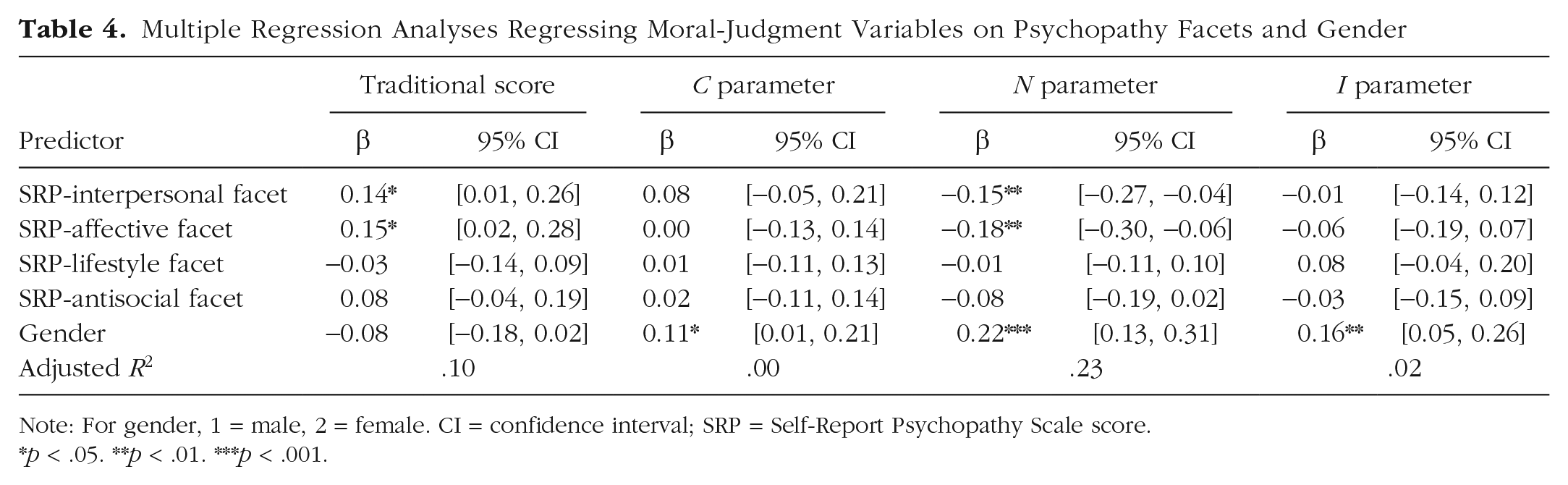
Note: For gender, 1 = male, 2 = female. CI = confidence interval; SRP = Self-Report Psychopathy Scale score.
p < .05. **p < .01. ***p < .001.
CNI model
Using the CNI model to disentangle the different determinants of moral-dilemma judgments, we next examined associations between psychopathy scores and sensitivity to consequences, sensitivity to moral norms, and general preference for inaction over action.
C parameter
Counter to the expected association between the C parameter and general psychopathy scores (Hypotheses 1a and 1d), the C parameter was not significantly associated with the general psychopathy scores either before controlling for gender, r(441) = .05, p = .279, 95% CI = [−.04, .14], or after controlling for gender, r(429) = .08, p = .080, 95% CI = [−.01, .18]. These results conflict with prior research that used the CNI model (Gawronski et al., 2017; Körner et al., 2020; Luke & Gawronski, 2021a) and suggest that participants with elevated levels of psychopathy do not differ from other participants in terms of their sensitivity to consequences.
Breaking down psychopathy by facet, the expected correlation between the C parameter and ANT scores (Hypothesis 6a) was not obtained, r(441) = .03, p = .540, 95% CI = [−.06, .12]. In addition, the C parameter did not show significant correlations with any other facets of psychopathy (ps > .174). When simultaneously regressed on psychopathy facets and gender (see Table 4), the expected unique association between sensitivity to consequences and ANT scores (Hypothesis 6b) was not obtained, β = 0.02, t(426) = 0.25, p = .804. As in the correlational analyses, the C parameter also did not show significant unique associations with any other facets of psychopathy (ps > .220). Taken together, these results suggest that participants with elevated levels in specific facets of psychopathy do not differ from other participants in terms of their sensitivity to consequences.
N parameter
Consistent with the expected association between the N parameter and general psychopathy scores (Hypotheses 1b and 1e), the N parameter showed a significant negative association with general psychopathy scores, r(441) = −.42, p < .001, 95% CI = [−.49, −.34], which remained statistically significant after controlling for gender, r(429) = −.34, p < .001, 95% CI = [−.43, −.26]. These results are consistent with prior research that used the CNI model (Gawronski et al., 2017; Körner et al., 2020; Luke & Gawronski, 2021a) and suggest that people with elevated levels of psychopathy are less sensitive to moral norms in comparison with other people.
Breaking down psychopathy by facet, the expected correlation between the N parameter and INT scores (Hypothesis 2a), r(441) = −.37, p < .001, 95% CI = [−.45, −.28]; AFF scores (Hypothesis 3a), r(441) = −.40, p < .001, 95% CI = [−.48, −.32]; and ANT scores (Hypothesis 5a), r(441) = −.31, p < .001, 95% CI = [−.39, −.22], were obtained. The N parameter also showed a significant correlation with LIF scores, r(441) = −.26, p < .001, 95% CI = [−.34, −.17]. When simultaneously regressed on psychopathy facets and gender (see Table 4), the expected unique associations between the N parameter and INT scores (Hypothesis 2b), β = −0.15, t(426) = −2.64, p = .009, and AFF scores (Hypothesis 3b), β = −0.18, t(426) = −3.03, p = .003, were obtained, but not the expected unique association with ANT scores (Hypothesis 5b), β = −0.08, t(426) = −1.57, p = .118. The N parameter also did not show a significant unique association with LIF scores, β = −0.01, t(426) = −0.16, p = .870. Taken together, these results suggest that the interpersonal and affective facets of psychopathy have unique associations with sensitivity to moral norms, whereas the lifestyle and antisocial facets have only shared associations.
I parameter
Counter to the expected association between the I parameter and general psychopathy scores (Hypotheses 1c and 1f), the I parameter was not significantly associated with general psychopathy scores either before controlling for gender, r(441) = −.07, p = .138, 95% CI = [−.16, .02], or after controlling for gender, r(429) = −.01, p = .855, 95% CI = [−.10, .09]. These results conflict with prior research that used the CNI model (Gawronski et al., 2017; Körner et al., 2020; Luke & Gawronski, 2021a) and suggest that people with elevated levels of psychopathy do not differ from other people in terms of their general action preferences.
When we broke psychopathy down by facet, the expected correlation between the I parameter and LIF scores (Hypothesis 4a) was not obtained, r(441) = .00, p = .991, 95% CI = [−.09, .09]. However, the I parameter did show a significant negative correlation with AFF scores, r(441) = −.10, p = .038, 95% CI = [−.19, −.01]. The I parameter did not show significant correlations with any other facets of psychopathy (ps > .135). When simultaneously regressed on psychopathy facets and gender (see Table 4), the expected unique association between the I parameter and LIF scores (Hypothesis 4b) was not obtained, β = 0.08, t(426) = 1.30, p = .194. In addition, the significant association between the I parameter and AFF scores obtained in the correlational analysis was not significant anymore, β = −0.06, t(426) = −0.91, p = .363. The I parameter did not show significant unique associations with the other facets of psychopathy (ps > .637). Taken together, these results suggest that people with elevated levels in specific facets of psychopathy do not reliably differ from other people in terms of their general action preferences.
Exploratory analyses
During the review of our manuscript, we were encouraged to explore potential relations between latent psychopathy and CNI domains, in part because of the strong correlations among the SRP facets. 5 Given our current sample size and to ensure adequate power, we relied on the four SRP facet scores to model psychopathic propensities and two sets of CNI parameters estimated from either even-numbered or odd-numbered dilemmas to model the latent moral-judgment factors. 6 Technically, at least two manifest variable indicators are required to model a latent variable, but there are only four SRP scales. Thus, we were not able to model all four SRP domains as latent variables. However, there are two structural equation models (SEMs) that are applicable. Seara-Cardoso et al. (2012, 2013) used the traditional two-factor psychopathy model (Hare & Neumann, 2008) and found that interpersonal/affective traits (Factor 1 [F1]) were associated with disturbances in moral functioning, whereas lifestyle/antisocial traits (Factor 2 [F2]) did not show such an association. This two-factor model allowed us to examine the associations among latent F1 and F2 variables with the three CNI parameters. In contrast, the syndrome of psychopathic personality can be represented by a superordinate factor with the four psychopathy domains as indicators (Neumann et al., 2007). This is a viable model to test given the strong intercorrelations among the SRP facets. In addition, this model fits with the tradition of assessing individuals in terms of total psychopathy scores and allowed us to explore how individuals elevated on all four SRP facets respond to moral dilemmas. For latent variables with two indicators, factor loadings were specified to be equal to avoid local underidentification. Maximum likelihood was used for parameter estimation provided by Mplus (Version 8; Muthén & Muthén, 2017).
Figure 2 displays the results for the two SEMs and their standardized parameters (all factor loading ps < .001). The models had acceptable fit: two-factor model, χ2(30) = 99.93, adjusted Bayesian information criterion [BIC] = 2,963, comparative fit index [CFI] = .93, root mean square error of approximation [RMSEA] = .06; superordinate model, χ2(32) = 88.69, adjusted BIC = 2,945, CFI = .93, RMSEA = .05; although, the superordinate model had slightly better fit, χ2(2) = 11.24, p < .05; BIC difference > 10. Nevertheless, both models revealed a strong negative relation between psychopathic traits and the latent N variable. Moreover, both models highlighted the role of interpersonal/affective traits (i.e., F1 effect in the two-factor model and stronger loadings of the interpersonal and affective scales compared with the lifestyle and antisocial scales in the superordinate model). Note that the superordinate model provided some evidence for a positive association between psychopathic traits and the C latent variable.

Structural equation models of psychopathy and CNI moral-judgment associations. P = Superordinate psychopathy factor; F1 = interpersonal-affective traits; F2 = lifestyle-antisocial traits; C = consequences latent variable; N = norms latent variable; I = inaction latent variable.
Discussion
The purpose of the current research was to provide more nuanced insights into the relation between psychopathy and moral-dilemma judgments. To this end, we drew on the four-factor model of psychopathy to separately quantify the interpersonal, affective, lifestyle, and antisocial facets underpinning psychopathy (Hare & Neumann, 2008). To disentangle the distinct determinants of moral-dilemma judgments, we used the CNI model (Gawronski et al., 2017) to separately quantify sensitivity to consequences, sensitivity to moral norms, and general preference for inaction over action in responses to moral dilemmas. Overall, the findings of the current research provide mixed support for the hypothesized relations between specific facets of psychopathy and determinants of moral-dilemma judgments.
In support of our hypotheses, general psychopathy scores and a superordinate latent variable (representing the broad syndrome of psychopathy) showed significant negative relations with sensitivity to moral norms, which suggests that people with elevated psychopathic traits were less sensitive to moral norms in their responses to moral dilemmas in comparison with other people. Further analyses at the facet level suggested that sensitivity to moral norms was uniquely associated with the interpersonal-affective facets of psychopathy. Both of these findings persisted when controlling for gender. As predicted, the antisocial facet showed a negative zero-order correlation with sensitivity to moral norms, but this association fell to nonsignificance when controlling for other facets of psychopathy and gender. At the manifest variable level, neither general psychopathy scores nor the four facets showed reliable relations with either sensitivity to consequences or general preference for inaction over action.
Together with prior research that used the CNI model (Gawronski et al., 2017; Körner et al., 2020; Luke & Gawronski, 2021a), the current findings suggest that people with elevated psychopathic traits show the strongest and most consistent deviations in moral judgment in terms of their conformity to moral norms and duties. In contrast, differences in the maximization of consequences and general action preferences are less reliable across studies and may depend in part on the measurement of psychopathy. Past research that used the CNI model (Gawronski et al., 2017, Study 4b; Körner et al., 2020; Luke & Gawronski, 2021a) has obtained reliable negative associations between psychopathic traits and sensitivity to consequences as well as action preferences (albeit weaker than associations with moral norms). However, these studies relied on the Levenson primary psychopathy subscale, and modeling research has shown that the items from this scale can be represented in terms of two factors (Salekin et al., 2014), with one factor (Egocentricity) containing items that reflect little interest in consequences (e.g., “What’s right is whatever I can get away with”). In contrast, and in line with the current findings, such associations have not been obtained when using other measures (Gawronski et al., 2017, Study 4a). Moreover, previous research has relied on manifest variables, and our exploratory latent variable modeling results suggest that some psychopathy domains may be positively associated with sensitivity to consequences. Taken together, the findings stress the importance for future research to examine how different conceptualizations and measurement of psychopathy can influence associations with consequence maximization and action preferences in responses to moral dilemmas. Future research might employ SEMs to precisely gauge associations between psychopathy and other constructs (Roy et al., 2020), including moral judgments.
More broadly, the current findings have important implications for both clinical and moral psychology. For clinical psychology, our findings speak to ongoing questions about whether people with elevated levels of psychopathy exhibit disturbances in moral judgment. In a recent review of the literature on psychopathy and moral judgment, Larsen et al. (2020) claimed there was “no consistent, well-replicated evidence of observable deficits in . . . moral judgment” (p. 305). However, a notable limitation of this review is that its analysis of moral-dilemma research focused exclusively on studies that used the traditional approach. Consistent with past research using the CNI model (e.g., Gawronski et al., 2017; Körner et al., 2020; Luke & Gawronski, 2021a) and in contrast to Larsen et al.’s conclusion, the current findings indicate substantial deviations in moral-dilemma judgments among people with elevated psychopathic traits, particularly conformity to moral norms.
In addition to contributing to this ongoing debate, the current findings also shed further light on the nature of psychopathic traits and their links to construct-relevant personality traits. A robust finding in prior work is an inverse association between psychopathy and agreeableness and honesty-humility traits (Howard & Van Zandt, 2020; Lee & Ashton, 2005; Lynam et al., 2018). Because sensitivity to moral norms has been linked to these same personality traits (Kroneisen & Heck, 2020; Luke & Gawronski, 2021b), it is possible that associations between psychopathy and low agreeableness/honesty-humility involve a shared insensitivity to moral norms. Another common finding in prior work is the relation between psychopathy and violent or criminal behavior (Olver et al., 2020), which is particularly linked to affective (Neumann & Pardini, 2014; Vitacco et al., 2005) and interpersonal (Vitacco et al., 2006) psychopathic traits. Given the clear association of interpersonal-affective traits and sensitivity to moral norms in the current study, it is possible that the increased criminality found among people with elevated psychopathic traits may be in part attributable to greater acceptance of norm violations.
More generally, the current study builds on a growing body of research in clinical psychology examining relations between moral-dilemma judgments and different psychological disorders. By using the CNI approach, our work illustrates the value of disentangling the determinants underlying moral-dilemma judgments, which may also provide more nuanced insights into the nature of other psychological disorders (Patil et al., 2020). For example, research using the traditional approach suggests that preference for utilitarian judgments over deontological judgments is positively related to alexithymia (e.g., Gleichgerrcht et al., 2015; Patil et al., 2016; Patil & Silani, 2014) and to manic and depressive states in bipolar disorder (e.g., Gago et al., 2019; Kim et al., 2015). Although these relations might reflect a common deficit in moral judgments across disorders, it is also possible that the obtained associations are driven by distinct determinants of moral-dilemma judgments, which are concealed in the traditional approach. Relatedly, research that used the traditional approach has provided mixed evidence for relations between preference for utilitarian judgments over deontological judgments and anxiety-related disorders (e.g., Patil et al., 2020; Whitton et al., 2014), schizophrenia (e.g., de Achával et al., 2013; Koelkebeck et al., 2018; McGuire et al., 2017), and autism spectrum disorder (Dempsey et al., 2020; Gleichgerrcht et al., 2013; Patil et al., 2016). Although the mixed findings regarding these disorders may suggest that they are not reliably associated with differences in moral-dilemma judgments, it is also possible that these disorders show a complex pattern of differences with multiple determinants of moral-dilemma judgments. Because these determinants are confounded in the traditional approach, measures of moral-dilemma judgments may have been noisier in past research, which resulted in unreliable findings. Thus, future research in clinical psychology could benefit from dissociating the different factors contributing to moral judgments (e.g., Zhang et al., 2020), which may shed further light on the commonalities and differences across psychological disorders.
Turning to moral psychology, the current findings further demonstrate the value of the CNI model for understanding individual differences in moral judgment. According to the traditional analyses, general psychopathy and its constituent facets showed positive relations with preference for utilitarian judgments over deontological judgments. However, analyses with the CNI model provide more nuanced insights into the underpinnings of these associations, which suggests that greater preference for utilitarian judgments over deontological judgments among individuals with elevated levels of psychopathy is related to a weaker adherence to moral norms and duties. These findings illustrate the unavoidable ambiguities in the interpretation of results from traditional analyses (Conway & Gawronski, 2013; Crone & Laham, 2017) and underscore the importance of approaches that overcome these methodological limitations (Gawronski et al., 2017).
Moreover, by investigating these relations at the facet level, the current research provides novel insights into the mental processes that may underlie such judgments. Specifically, given the unique links between sensitivity to moral norms and the interpersonal-affective features of psychopathy, this research provides evidence for a role of emotional processes in norm-adhering moral judgments (Garofalo et al., 2020). In particular, it is possible that reduced norm adherence in the moral judgments of people with elevated psychopathic traits results from lack of remorse and reduced care for others. This idea is broadly consistent with prior research linking norm-adhering judgments to empathic concern (Körner et al., 2020) and feelings of regret (Goldstein-Greenwood et al., 2020).
Before concluding, it is worth addressing some potential objections to the findings of the current research. One set of potential objections pertains to the use of the CNI model. In a recent critique, Baron and Goodwin (2020) raised several conceptual and methodological concerns about the CNI model that may bear on the current findings. Although some of these concerns are based on misunderstandings of the model and flawed reanalysis of existing data (see Gawronski et al., 2020), a valid conceptual point regards the theoretical meaning of the I parameter. As already acknowledged by Gawronski et al. (2017) and discussed in more detail by Baron and Goodwin, this parameter can be interpreted as an instance of deontological responding in the sense that it captures a pattern of inaction responses that conforms to the broad principle of “first, do no harm.” Given this alternative interpretation, note that the obtained relation between psychopathy and the N parameter reflects reduced adherence to proscriptive norms (e.g., prohibitions against harm) and prescriptive norms (e.g., prescriptions to provide care) among people with elevated psychopathic features. This relation does not reflect differences in adherence to the broad principle “first, do no harm,” which should be reflected in different levels of general action aversion on the I parameter.
A valid methodological question raised by Baron and Goodwin (2020) is whether the manipulations of consequences and moral norms are equally successful across the basic scenarios in the moral-dilemma battery for research using the CNI model. In response to this criticism, Gawronski et al. (2020) conducted an item-based analysis, which identified one dilemma (abduction dilemma) for which the manipulation of moral norms was unsuccessful. Although this dilemma was included in our primary analyses in accordance with our preregistered analytic plan, we conducted supplemental analyses with this dilemma excluded. Overall, results of these analyses were entirely consistent with the reported findings and do not qualify their interpretation (see Tables S3 and S4 in the Supplemental Material available online).
A second methodological criticism raised by Baron and Goodwin (2020) concerns the hierarchical ordering of the model parameters in the processing tree (see Fig. 1), which they argued could influence relations with external variables. Addressing this issue, Liu and Liao (2021) developed a linear, nonhierarchical algorithm that algebraically calculates the three model parameters concurrently rather than hierarchically. A reanalysis of our data using this algorithm revealed results entirely consistent with those of our primary analyses (see Tables S5 and S6 in the Supplemental Material), which suggests that our findings are robust when the three parameters are calculated in a linear, nonhierarchical manner.
Finally, it is worth noting that the current research relied on a nonclinical sample, which may raise questions regarding the generalizability of the obtained results to people with clinical levels of psychopathy. In response to this concern, note that a substantial percentage of participants (16.70%) did display normatively elevated levels of psychopathic traits (i.e., SRP-SF ≥ 70). Moreover, past research provides clear evidence for psychopathy as a dimensional construct that varies continuously in the population (Hare & Neumann, 2008). For example, psychopathic traits are associated with disturbances in the limbic system structure and function in nonclinical samples (Carré et al., 2013; Pardini et al., 2014), just as is seen in clinical samples (Baskin-Sommers et al., 2016; Seara-Cardoso & Viding, 2015). Consistent with these findings, results from exploratory analyses examining differences in moral-dilemma judgment between people with elevated psychopathic traits compared with people without elevated psychopathic traits were entirely consistent with the results of our primary analyses. The two groups differed in their sensitivity to moral norms but not in terms of their sensitivity to consequences or general action preferences (see Table S7 in the Supplemental Material). Therefore, although the majority of our participants did not reach the threshold for clinical psychopathy, the current research still provides valuable insights into how psychopathic traits are associated with differences in moral judgment.
Conclusion
The purpose of the current research was to conduct a more fine-grained investigation of the relation between psychopathy and moral-dilemma judgments by conceptualizing psychopathy at the facet level. Findings from this research provide support for a strong relation between psychopathy and sensitivity to moral norms, which showed unique associations with the interpersonal-affective facets of psychopathy. In contrast to prior research, we did not find robust evidence for relations between psychopathy and sensitivity to consequences and between psychopathy and general preference for inaction over action. Thus, these findings provide more nuanced insights into the relation between psychopathy and moral-dilemma judgments with important implications for both clinical and moral psychology.
Supplemental Material
sj-pdf-1-cpx-10.1177_1049732320931430 – Supplemental material for Psychopathy and Moral-Dilemma Judgment: An Analysis Using the Four-Factor Model of Psychopathy and the CNI Model of Moral Decision-Making
Supplemental material, sj-pdf-1-cpx-10.1177_1049732320931430 for Psychopathy and Moral-Dilemma Judgment: An Analysis Using the Four-Factor Model of Psychopathy and the CNI Model of Moral Decision-Making by Dillon M. Luke, Craig S. Neumann and Bertram Gawronski in Clinical Psychological Science
Footnotes
Transparency
Action Editor: Aidan G. C. Wright
Editor: Jennifer L. Tackett
Author Contributions
All of the authors contributed to the study design. D. M. Luke prepared the study materials and collected the data. Data analysis and interpretation was performed by D. M. Luke under the direction of C. S. Neumann and B. Gawronski. An initial version of the manuscript was drafted by D. M. Luke and reviewed and revised by C. S. Neumann and B. Gawronski. Revisions in response to peer review were completed by D. M. Luke, C. S. Neumann, and B. Gawronski. All of the authors approved the final manuscript for submission.

Notes
References
Supplementary Material
Please find the following supplemental material available below.
For Open Access articles published under a Creative Commons License, all supplemental material carries the same license as the article it is associated with.
For non-Open Access articles published, all supplemental material carries a non-exclusive license, and permission requests for re-use of supplemental material or any part of supplemental material shall be sent directly to the copyright owner as specified in the copyright notice associated with the article.
