



Abstract
The COVID-19 pandemic has been a demanding caregiving context for parents, particularly during lockdowns. In this study, we examined parental mentalization, parents’ proclivity to consider their own and their child’s mental states, during the pandemic, as manifested in mental-state language (MSL) on parenting social media. Parenting-related posts on Reddit from two time periods in the pandemic in 2020, March to April (lockdown) and July to August (postlockdown), were compared with time-matched control periods in 2019. MSL and self–other references were measured using text-analysis methods. Parental mentalization content decreased during the pandemic: Posts referred less to mental activities and to other people during the COVID-19 pandemic and showed decreased affective MSL, cognitive MSL, and self-references specifically during lockdown. Father-specific subreddits exhibited strongest declines in mentalization content, whereas mother-specific subreddits exhibited smaller changes. Implications on understanding associations between caregiving contexts and parental mentalization, gender differences, and the value of using social-media data to study parenting and mentalizing are discussed.
In the beginning of 2020, an outbreak of the SARS-CoV-2 virus and the spread of the coronavirus disease 2019 (COVID-19) started changing the lives of individuals around the world. On March 11, 2020, the World Health Organization declared COVID-19 a global pandemic. Physical distancing and/or lockdown restrictions were implemented, which forced people to stay at home, work from home, and socially isolate. This pandemic introduced a new caregiving context for many parents, including increased caregiving responsibilities because of day-care and school closures, difficulty balancing caregiving and working from home, and adjustment to online learning (American Psychological Association [APA], 2020; Chartier et al., 2021; Gassman-Pines et al., 2020). Parental well-being is determined by the balance between positive rewarding parenting experiences (e.g., pride and joy) and parenting demands and stressors (Nelson et al., 2014; Nomaguchi & Milkie, 2020). The myriad of caregiving changes and demands introduced by the COVID-19 pandemic may “tip the balance” between rewards and demands in parenting and increase the risk for parental burnout (Mikolajczak et al., 2021). Moreover, physical distancing has reduced the availability of external social support, one of the main protective factors that help buffer against the hardships of parenting demands (Nelson et al., 2014; Nomaguchi & Milkie, 2020). Indeed, as a group, parents reported higher rates of negative daily mood, stress, anxiety, and depression compared with nonparents during the pandemic and/or prepandemic levels (APA, 2020; Cameron et al., 2020; Gassman-Pines et al., 2020; Patrick et al., 2020; Racine et al., 2021), although parents’ experiences of emotional distress may vary at an individual level (Brown et al., 2020). Consequently, parenting during the COVID-19 pandemic can be contextualized as high in caregiving demands and stress. Thus, the pandemic may have a noticeable impact on family functioning.
Parenting stress and contexts of high caregiving demands are thought to interfere with parents’ attunement to their children (Deater-Deckard, 2005; Yatziv et al., 2018), an ability supported by parental mentalization—parents’ proclivity to consider their child as a psychological agent and reflect on their own and their child’s mental states (Sharp & Fonagy, 2008). The change in caregiving context evoked by the COVID-19 pandemic may make it harder for parents to focus on their child’s and/or their partner’s minds, perhaps because they are more occupied with their own worries or feel overloaded with managing increased caregiving demands. As a global event affecting parents on a large scale, the pandemic can inform on the effects of stressful and demanding caregiving contexts on parenting in general and mentalizing in specific. In this study, we examined whether social-media content pertaining to parental mentalization changed during the COVID-19 pandemic by analyzing the content of parenting social-media posts during the pandemic (2020) and equivalent periods in the year before the pandemic (2019). Specifically, as our measure of parental mentalization content, we focused on mental-state language (MSL), which refers to language encapsulating mental states and internal processes (although not necessarily about the child).
The Potential Impact of the COVID-19 Pandemic on Parental Mentalization
Mentalizing plays an essential role in people’s social lives (Gilead & Ochsner, 2021). In the parenting domain, parental mentalization, often referred to as parental reflective functioning (Slade, 2005) or parental mind-mindedness (Meins, 2013), is considered one of the core components of positive parent–child relationships (Sharp & Fonagy, 2008). Specifically, parental mentalization captures the inner processes enabling sensitive caregiving attuned to the child’s needs (Meins, 2013; Slade, 2005) and is robustly associated with parent–child attachment (Zeegers et al., 2017). Highly mentalizing parents actively attempt to account for their child’s behavior in terms of internal mental states, reflecting on the emotions and cognition motivating their child’s observed behavior and connecting it to their own mental states as parents (Slade, 2005). This ability is also reflected in parents’ explicit verbal references to their child’s mental states (Meins, 2013). Parental mentalization is conceptualized as playing a role in the development of the child’s social cognition and self-regulation abilities and has been linked with various positive child-developmental outcomes (Aldrich et al., 2021), including theory of mind (e.g., Meins et al., 2003) and executive functioning (e.g., Bernier et al., 2017).
Parents’ ability to understand their child and model mentalizing during the COVID-19 pandemic may facilitate family adaptation, and yet, concurrently, the pandemic may also challenge parents’ ability to mentalize. Challenges to parental mentalization are particularly important to understand given their multigenerational implications. Demanding contexts are thought to dampen mentalizing and lead to higher focus on external behavior rather than the emotions and cognitions motivating actions (Luyten & Fonagy, 2015). However, the impact of demanding caregiving contexts on levels of mentalizing in normative parenting remains unclear. For example, demanding parenting contexts are often confounded with other risk factors for adversity, such as childhood trauma, abuse, or substance use. Although some researchers have measured parental mentalization in stressful laboratory settings (Borelli et al., 2017; McMahon & Newey, 2018), because of ethical considerations, research cannot involve manipulation of prolonged stressful/demanding conditions. The COVID-19 pandemic presents a unique opportunity to examine the effect of an ecologically valid prolonged “manipulation” of caregiving demands on parents’ mentalization ability.
Outside the parenting context, mentalization can be considered across four dimensions that may be affected by the COVID-19 pandemic: (a) automatic mentalization versus controlled mentalization, (b) cognitive mentalization versus affective mentalization, (c) mentalization about oneself versus mentalization about other people, and (d) mentalizing based on internal features of experiences versus external features of experiences (see Luyten & Fonagy, 2015). In this study, we focused on the affective–cognitive and self–other dimensions—which generally map onto the automaticity versus control dimension, respectively, wherein high load (i.e., caregiving demands in this context) and stress are thought to affect primarily controlled aspects of mentalizing in general (Luyten & Fonagy, 2015) and specifically in parenting when thinking about others (i.e., the child; Yatziv et al., 2018; Yatziv, Kessler, & Atzaba-Poria, 2020).
The affective–cognitive dimension of mentalizing refers to the differentiation between emotional aspects of mental states and rational aspects of mental states (Luyten et al., 2020; Tamir et al., 2016). Cognitive mental states include mental capacities, epistemic states, desires, thoughts, and perspective taking (e.g., a parent may infer that the child finds it hard to concentrate during online classes), whereas affective mentalizing refers to the emotional features of experiences, such as joy and distress (e.g., a parent may realize that the child feels overwhelmed by remote learning). Engaging in cognitive mentalizing generally requires more control, whereas affective mentalizing may be more salient and partially rely on low-level processes, although effective mentalizing is likely to incorporate both cognitive and affective aspects (Luyten et al., 2020; Schurz et al., 2021; e.g., the child may not be able to concentrate in class because they feel overwhelmed by remote learning). Current measures of parental mentalization do not differentiate between affective or cognitive states and instead aggregate them, and the differential impact of stress on parental mentalization has not been examined separately for cognitive and affective mental states.
The self–other mentalizing dimension refers to a distinction between recognizing and reflecting on one’s own thoughts and feelings (e.g., a parent recognizing that they are worried about the impact of the pandemic on the child’s education) and reasoning on other people’s mental states (e.g., a parent inferring that the child feels overwhelmed by remote learning). Whereas one’s own experiences are relatively directly accessible, other people’s mental states are opaque and thus require indirect reasoning (Fonagy et al., 1998). Although self-mentalizing and other-mentalizing may recruit overlapping neural circuitry, mentalizing about one’s own mental states is faster and more precise than mentalizing about other people’s mental states (Kevin et al., 2021; Thornton et al., 2019), which indicates that other-mentalizing may require more control than self-mentalizing (Luyten et al., 2020). In parenting, mentalization has been shown to have parent-focused (self) and child-focused (other) components (e.g., Borelli et al., 2016). However, to our knowledge, the effect of stress on parent-focused mentalizing and other-focused mentalizing has yet to be examined.
Studying Parental Mentalizing Through Social Media
To study changes in parental mentalization following the COVID-19 pandemic, we leveraged the accessibility of social-media data. The increased use of social-media platforms has sparked interest in research on social-media behavior (Ledford, 2020). Specifically, online and social-media content can be used to examine the impact of social events on psychological outcomes (Cohn et al., 2004). For example, Simchon and colleagues (2020) investigated the effect of the 2016 U.S. presidential election on population-level depression among liberal and conservative Americans by analyzing Twitter and Google Search data. Recently, studies have also started examining social-media behavior to understand parenting, for example, attitudes toward vaccinations and behaviors such as spanking (Lee et al., 2020; Reich, 2020). In this study, we examined parental mentalization by analyzing parents’ posts on Reddit, a bulletin-board social-media platform composed of communities, termed subreddits, dedicated to specific topics. Parenting subreddits, in which communities of parents engage together in pseudonymous online discussions, can inform on parents’ experiences. Before the pandemic, parenting subreddits included discussions on a range of topics across multiple domains of parenting, including birth and developmental milestones (e.g., sleep and potty training), food preparation, parenting norms and judgment, discipline, play and activities, product suggestions, religion and the family, and parent/infant health-related issues (Ammari et al., 2018). As dynamic parenting communities, parenting subreddits can be used to study the impact of global societal events on parenting, including the COVID-19 pandemic.
Parental mentalization is commonly measured through interviews with parents or recordings of parent–child interactions with the goal of tapping into parents’ mental representations via their discourse on mental states (Meins, 2013; Slade et al., 2007). The underlying assumption is that the way parents speak about their child’s mental states provides a window into how they internally represent their child and their relationship (Meins, 2013; Slade et al., 2007). In representational mind-mindedness assessment, for example, parents are invited to describe their child, and their spontaneous use of terms relating to the child’s mind and mental states are tallied to capture the parent’s representations of the child as a psychological agent (Meins & Fernyhough, 2015). Both mental-state descriptions and in-depth interviews in which reflective functioning is coded have similar associations with maternal sensitivity and mother–child attachment (Zeegers et al., 2017). Furthermore, parental mind-mindedness when asked to describe the child, parental mind-minded comments during real-time interactions with the child, and general use of MSL during parent–child conversations have been linked with children’s theory-of-mind development (Devine & Hughes, 2018; Meins et al., 2003; Ruffman et al., 2002), which speaks to the validity of assessing explicit parental use of MSL in the context of parenting and child outcomes.
To measure mentalizing in a big-data setting, spanning tens of thousands of posts, we examined parental use of MSL on social media. The main difference between previous studies on parental mentalizing or MSL and the present investigation is that we focused on parental communication with other parents. We suggest that through parenting social media, parental representations of mental states can be assessed ecologically as manifested in parents’ spontaneous, naturalistic discourse on parenting experiences with other parents. Whereas traditional assessments of mentalizing are focused on a specific relationship (with a particular child), parenting discussions on social media would likely refer to parenting more broadly—about one child, several children, partners, or what other parents have shared about their parenting experiences. Previous research indicates that parents’ mentalizing is generally consistent across close personal relationships (e.g., Borelli et al., 2020; Illingworth et al., 2016), and therefore, studying parental mentalization through parenting social media may tap into mentalizing in the context of parenting across varying family relationships. Note that our approach in analyzing MSL through parental social-media content as applied to big data here is more limited than traditional measures of parental mentalization in the ability to take context into account and detect nuances in the plausibility of mental-state attribution.
The Present Study
Because of the heightened caregiving burden during the COVID-19 pandemic, parents may find it harder to focus on other people’s mental states. This demanding caregiving context may overload parents and elicit excessive focus on external features of behavior at the expense of understanding the mental states giving rise to behavior. Therefore, the aim of the present study was to examine whether the COVID-19 pandemic is related to decreased parental mentalizing content posted on parenting social media.
Aims and hypotheses
We hypothesized that during the pandemic, parental posts would contain less MSL compared with the year before the pandemic. Specifically, because demanding and stressful parenting contexts are theorized to primarily affect effortful forms of mentalizing, including cognitive mentalizing (vs. affective) and other-focused mentalizing (vs. self-focused), we expected that during the COVID-19 pandemic, posts would exhibit decreases primarily in cognitive MSL and in use of third-person pronouns as indicating other-focused content. As exploratory aims, we also examined (a) the impact of different time periods during the pandemic, (b) parent gender differences, and (c) changes in the specific mental states parents referred to.
Time periods of interest during the COVID-19 pandemic
We initially planned to compare content posted between March 1, 2020, and April 30, 2020 (COVID-19), and the same time period in 2019 as a time-matched control period. March 2020 through April 2020 marked the beginning of the pandemic and lockdown period: 40 U.S. states and the UK and Canadian governments imposed COVID-19-related lockdowns, restrictions, or stay-at-home orders during March 2020 or by April 1, 2020, and the United Kingdom and most U.S. states started easing restrictions during May 2020 (Ballotpedia.org, n.d.). Although the nature of the restrictions families faced varied across different locations during the time period between March 2020 and April 2020, given the large-scale implementation of stay-at-home orders across the United States, the United Kingdom, and Canada, we refer to this initial phase of the pandemic hereafter as the “lockdown” period for simplicity and brevity. As the pandemic continued and public discussions of prolonged parenting burden emerged (e.g., Bariola & Collins, 2021), we decided to also analyze content posted between July 1, 2020, and August 31, 2020 (hereafter referred to as “postlockdown”), and compare it with the same time period in 2019. At this time, most U.S. states had enabled school reopening (Ballotpedia.org, n.d.; The Hunt Institute, 2021); nevertheless, most children were either still learning remotely or dividing their time between remote and in-person learning (Kapteyn et al., 2020).
Mothers and fathers during the pandemic
We examined the role of parental gender as a potential moderator of the effect of the COVID-19 pandemic on parental MSL by sampling posts from general-parenting subreddits, mother-specific subreddits, and father-specific subreddits (given the pseudoanonymity of Reddit users, gender was operationalized through the subreddits parents posted in). As groups, both mothers and fathers experienced increased distress during the pandemic; initially, stress estimates generally appeared larger among mothers than fathers (Dunatchik et al., 2021; Wade et al., 2021; Zamarro & Prados, 2021), but some researchers have found greater parenting stress among fathers (Taubman-Ben-Ari et al., 2021). Although the uniform shift to working from home was initially discussed as a potential “equalizer” in gender roles, over time, the pandemic seems to have amplified existing gender disparities (Carlson et al., 2020; Fisher & Ryan, 2021), and mothers continued to carry most of the caregiving, homeschooling, and household-maintenance burden (Bariola & Collins, 2021; Dunatchik et al., 2021; Wade et al., 2021; Zamarro & Prados, 2021). Consequently, although we expected the COVID-19 pandemic to affect both maternal and paternal mentalization during lockdown, we anticipated that the accumulation of caregiving burden, particularly among mothers as the pandemic progressed, would evidence a stronger postlockdown decrease in mentalizing in mother-specific subreddits than in father-specific subreddits.
Method
Sample
Data were posts collected from Reddit, one of the 20 most visited websites in the world (Alexa.com, 2021b). Reddit (2020) had 430 million users worldwide in 2019; 40% to 50% of traffic originated from the United States, followed by the United Kingdom (≈8%) and Canada (≈7%–8%; Alexa.com, 2021a; Statista.com, n.d.). American Reddit users are primarily White, male, under the age of 49, and have at least some college education (Pew Research Center, 2016). Because Reddit data are publicly available, Yale University’s Institutional Review Board exempted this study from annual ethics review.
We searched for English-language subreddits whose primary audience were parents (mothers, fathers, and parents in general). The search was conducted mainly during July 2020 via Reddit’s search bar and by following relevant suggestions made by the platform. Subreddit communities that were primarily about pregnancy or breastfeeding, specific to sharing activities with children, centered around making fun of children or parents, or inactive in 2020 were excluded. Twenty-three subreddits met our inclusion criteria (see Table S1 in the Supplemental Material available online): 16 general-parenting subreddits (e.g., r/Parenting; hereafter referred to as “general”), three mother-specific subreddits (e.g., r/Mommit), and four father-specific subreddits (e.g., r/Daddit). At the time of search, most communities had a few thousand members, and r/Parenting had the largest community of 2.4 million members.
Posts were sampled during the initial phase of the pandemic, characterized by large implementation of lockdowns and stay-at-home orders (March–April 2020); postlockdown (July–August 2020) period during the COVID-19 pandemic in 2020; and the equivalent times in 2019 as control periods, which indexed time-matched prepandemic parental discourse. Reddit posts were sampled using the rreddit package (Version 0.0.1; Kearney, 2018) for the R software environment (Version 4.1.0; R Core Team, 2021). This package is based on the Pushshift API (Baumgartner et al., 2020). Initially, 93,510 posts were identified; raw data were cleaned to remove URL addresses, emoticons, symbols, and invalid utf8 content, which resulted in a final sample of 77,254 posts. Posts were lemmatized and transformed to lowercase for analyses.
Measures
MSL
We measured parents’ use of MSL using two measures: (a) frequency of mental-state terms based on a new MSL dictionary created for this study and (b) the Mental-Physical Verb Norms Scale (Orr & Gilead, 2021). As described below, these measures were created by employing two different measure-development approaches, which resulted in different outcome variables and, ultimately, data-analytic approaches. Therefore, the use of these two measures provided the opportunity to assess both the robustness and convergent validity of our findings in this first examination of parental mentalizing on social-media posts.
Mental-state terms
A dictionary containing 198 cognitive mental-state terms (e.g., “curious,” “prefer”) and 135 affective mental-state terms (e.g., “happy,” “upset”) was created on the basis of multidisciplinary mentalizing research (see the Supplemental Material). Mental-state terms were collected from (a) the mind-mindedness coding manual (Meins & Fernyhough, 2015); (b) the “desire,” “emotion,” “think and know,” and “other mental state” categories from the MSL measure described in Ruffman et al. (2002); (c) the full list of mental-state terms reported in Tamir et al. (2016); and (d) the CogProc and Affect categories from the Linguistic Inquiry and Word Count (LIWC2015; Pennebaker et al., 2015). In keeping with conceptualizations of parental mentalization, primarily the mind-mindedness manual (Meins & Fernyhough, 2015), only words referring to aspects of internal experiences were included; terms that referred to physical states (e.g., “thirst”) or to behavioral manifestations of mental states (e.g., “crying”) were excluded (for full documentation, see https://osf.io/psbm7/). Two-word phrases were excluded from the list for computational reasons. Affective MSL, cognitive MSL, and total MSL (cognitive and affective MSL) were measured by summing the number of MSL terms in each post by category using document-feature matrices created using the quanteda package (Version 2.12; Benoit et al., 2018) for R.
Mental-physical verb norms
We applied the Mental-Physical Verb Norms Scale devised by Orr and Gilead (2021). The scale contains the 250 most frequently used verbs in the English language (about 80% of all verbs used in typical corpora), each rated by English speakers on a scale from 0 (strictly physical activity) to 100 (strictly mental activity). Mean ratings across participants represent the norm value of the extent to which English speakers perceive each verb as mental on a continuous scale. Higher scores represent the perception of the verb as more mental than physical. For example, the verb “run” received a mean rating of 7.17, which indicates that it was largely perceived as a physical activity. In contrast, the verb “understand” received a mean rating of 93.78, which indicates that it was largely perceived as a mental activity. The frequency of each verb in each post was weighted by its corresponding norm rating, and mean mental-physical scores were computed for each post by summing the weighted norms and scaling the sum by the number of verbs in the post.
Thirty-six of the verbs (14.4%) overlapped with terms included in the MSL dictionary (Mnorm = 82.44, SD = 10.59, range = 54.63–93.78); most overlapping words appeared in the cognitive MSL dictionary (as would be expected given the focus on actions), and only four verbs appeared in the affective MSL dictionary. Spearman’s rank correlations between the mental-physical and cognitive and affective MSL scores (correlation with MSL proportion out of the total word count in parentheses) were r = .33 (r = .59) and r = .12 (r = .16), respectively.
Pronouns: references to oneself and to others
As a proxy for self- and other-focused mentalizing, we measured parents’ use of pronouns using two types of analyses: (a) counting the number of first- and third-person pronouns in posts and (b) computing the proportion of third-person (other-focused) mental attributions. In this context, first- and third-person pronouns can reflect whether parents engaged in thinking about themselves or about nonpresent others.
Number of pronouns
To measure self-focused and other-focused mentalizing, we assessed the number of singular first-person pronouns (e.g., “I,” “me”) and the number of third-person pronouns (e.g., “they,” “she”), respectively, derived from the LIWC2015 (Pennebaker et al., 2015).
Proportion of other-focused mental attributions
To better understand whether mental states were ascribed to nonpresent others, we employed sentence parsing: a syntactic analysis of sentences, resulting in the full syntactic properties of the sentence’s elements, including the tagging of part of speech, morphological features, and dependency relation. We used the udpipe (Version 0.8.5; Wijffels, 2020) package for R, powered by the UDPipe parser (Straka & Straková, 2017) and its English model (English-ewt; Version 2.5-191206).
Posts were sliced into sentences using the tidytext (Version 0.3.0; Silge & Robinson, 2016) package for R. All sentences that included MSL were then parsed to (a) tag sentences for which a pronoun was used as their subject (nominal subject) and (b) mark their grammatical person, that is, whether the subject pronoun was first person, second person, or third person. For sentences with pronouns as nominal subjects, we calculated the proportion of each grammatical person appearing in a subject position (in some cases, there may be more than one nominal subject, e.g., compound sentences).
Other-focused mental attributions were measured as the proportion of sentences containing MSL with a third-person pronoun as the subject. We focused on third-person pronouns because of the dependency in assignment to pronoun categories and our specific interest in the impact of stress and caregiving demand on other-focused mentalizing. For example, the sentences “she . . . came to her conclusion all by herself” and “he hates me and my fiancé” each received a score of 1, whereas the sentences “I just feel so powerless . . . ” and “as a parent, I am concerned” each received a score of 0. Sentences in which there were several pronouns were considered to be predominantly third person if the proportion of third-person pronouns was larger than the proportion of first-person pronouns. Sentences that did not have a nominal subject and posts that did not contain any MSL were coded as 0 because both were taken to convey a lack of other-focused mentalizing.
Analytic plan
For the code and analyses, see the OSF repository at https://osf.io/psbm7/.
Main analyses
A series of general linear models (GLMs) were conducted with MSL measures as dependent measures and year (2019 vs. 2020), time period (lockdown/March–April, postlockdown/July–August), and subreddit gender focus (general, mothers, fathers; hereafter, “subreddit gender”) as independent variables (all effect-coded). Post hoc pairwise comparisons were conducted when main effects or interactions were significant. For count dependent variables (total/affective/cognitive MSL, first-person/third-person pronouns), we examined whether data met Poisson GLM assumptions. Fitting indicated significant overdispersion in all models (ps < .001), and therefore, negative binomial models were fitted to count data using the MASS (Version 7.3-53.1; Ripley et al., 2021) package for R. Total word count was entered as a covariate (mean-centered) to control for posts’ length. Analyses of deviance of the negative binomial models were conducted to examine main effects and interactions over and above simple effects, and simple effects are reported as incidence rate ratios (IRRs). To examine the impact of the COVID-19 pandemic on MSL as measured by mental-physical scores, we conducted an analysis of variance (ANOVA). To test the impact of the COVID-19 pandemic on the proportion of other-focused mental attributions, we conducted an analysis of deviance of a quasibinomial GLM. Because the mental-physical and the other-focused mentalizing attributions scores were already scaled for number of verbs or sentences, we did not control for word count in these analyses.
Exploratory “keyness” analyses of MSL terms
To examine whether a qualitative change in the specific mental states parents referred to occurred during the pandemic, we conducted exploratory “keyness” analyses examining the relative frequency of each word in the full MSL dictionary between 2019 (control period) and 2020 (COVID-19 pandemic) separately for each time period (lockdown, postlockdown). To account for multiple comparisons, only χ2 values that remained significant following Bonferroni correction (p < .00015) were considered to reflect statistically significant differences in frequency.
Results
Descriptive analyses of parental posts
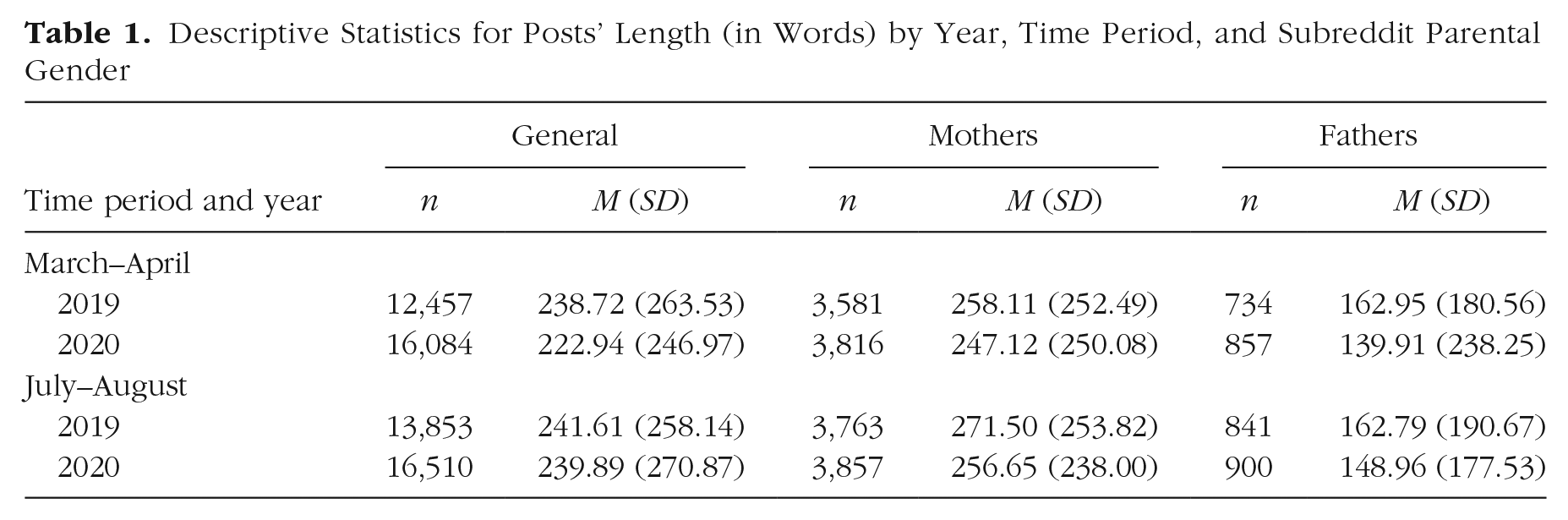
We first sought to characterize the sampled content. The number of posts by year, time period, and subreddit gender and the corresponding means and standard deviations of the number of words per post are presented in Table 1. Parents posted more content during 2020 (N = 42,024) than 2019 (N = 35,229). Content posted during the pandemic was shorter than content posted during 2019, χ2(1, N = 77,254) = 46.07, p < .001, and posts posted during March–April were shorter than posts posted during July–August across both years, χ2(1, N = 77,254) = 51.10, p < .001. Furthermore, word count varied by subreddit gender, χ2(2, N = 77,254) = 873.05, p < .001; maternal posts contained more words than posts from general subreddits, and fathers posted the shortest posts on average (|z|s > 11.40, ps < .001).
Descriptive Statistics for Posts’ Length (in Words) by Year, Time Period, and Subreddit Parental Gender
Word clouds depicting commonly used terms are shown in Figure S1 in the Supplemental Material. As would be expected, during 2020, parents’ posts dealt with pandemic-related issues, including virus-related words (“COVID,” “virus”) and pandemic-related experiences (“masks,” “quarantine,” “distance,” “online”). Furthermore, family terms during the pandemic were more related to parents (“dad,” “mom,” “parent”), whereas in 2019, they were generally more related to children (“son,” “daughter”).
Content also varied between lockdown and postlockdown periods of 2020 (see Table S2 and Fig. S1 in the Supplemental Material). During lockdown, parents referred more to “stress,” “panic,” and “crisis”; during postlockdown, they mentioned the words “trauma” and “horrible” more. Parents also discussed school-related terms more during lockdown (“teacher,” “school,” “homework”). Although the word “online” was more frequent during lockdown, during postlockdown, parents mentioned the terms “remote” and “virtual” more frequently, perhaps relating to remote learning. Parents also referred to “normal” activities (“vacation,” “beach,” “camp”) during the postlockdown (summer) period.
Main analyses: parental mentalization during the COVID-19 pandemic
MSL
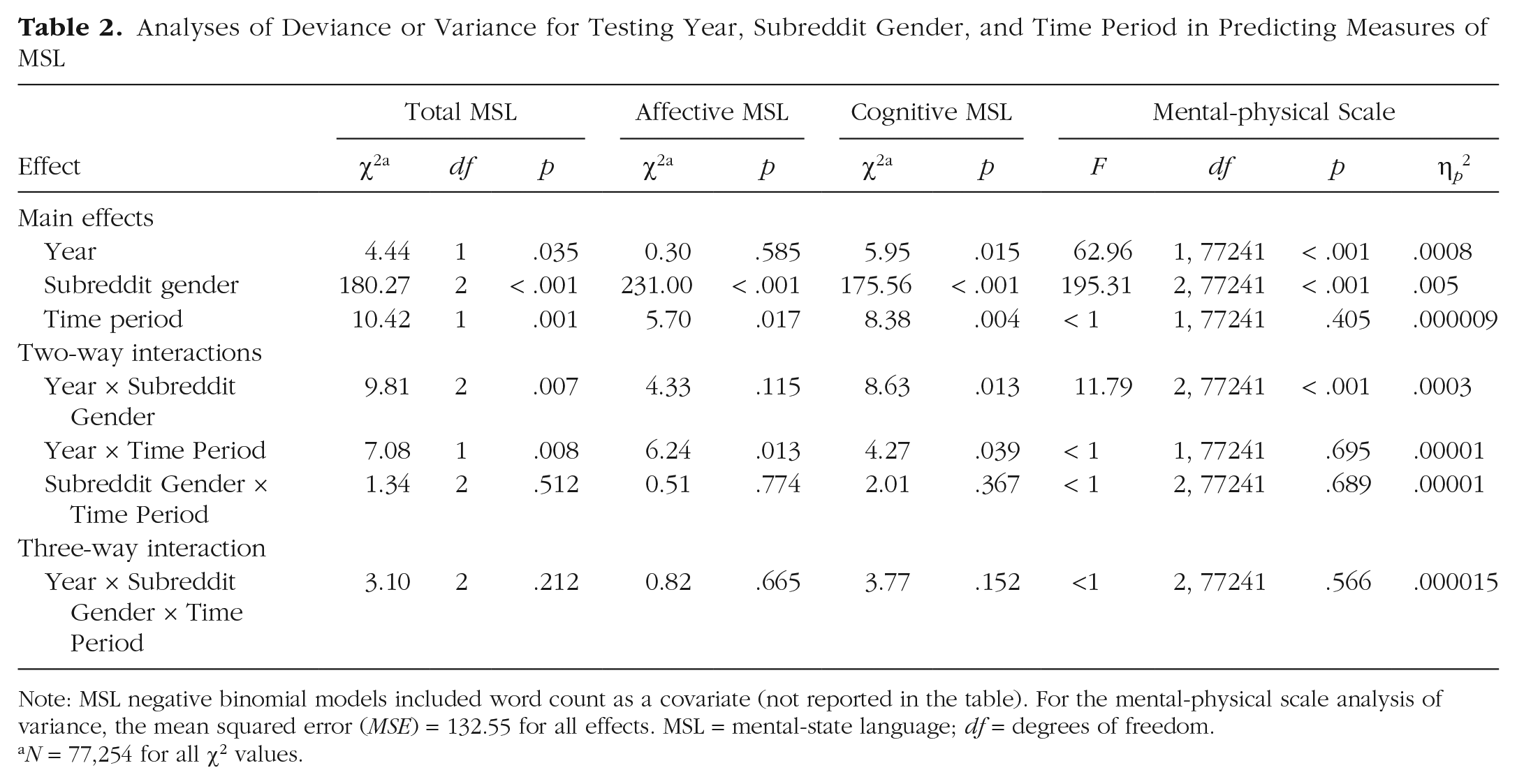
The median of the total MSL measure was 6 mental-state terms per post (M = 8.83, SD = 10.22). Parents used more cognitive MSL (Mdn = 4, M = 6.24, SD = 7.28) than affective MSL (Mdn = 1, M = 2.59, SD = 3.67), t(77,253) = 189.86, p < .001. Posts that contained more cognitive MSL also tended to contain more affective MSL (Spearman’s r = .61, p < .001). Table 2 presents the results of the analysis of deviance of the negative binomial models examining the effects of year, time period, and subreddit gender on MSL. Mean affective and cognitive MSL by levels of independent variables, controlling for word count, are presented in Figure 1.
Analyses of Deviance or Variance for Testing Year, Subreddit Gender, and Time Period in Predicting Measures of MSL
Note: MSL negative binomial models included word count as a covariate (not reported in the table). For the mental-physical scale analysis of variance, the mean squared error (MSE) = 132.55 for all effects. MSL = mental-state language; df = degrees of freedom.
N = 77,254 for all χ2 values.
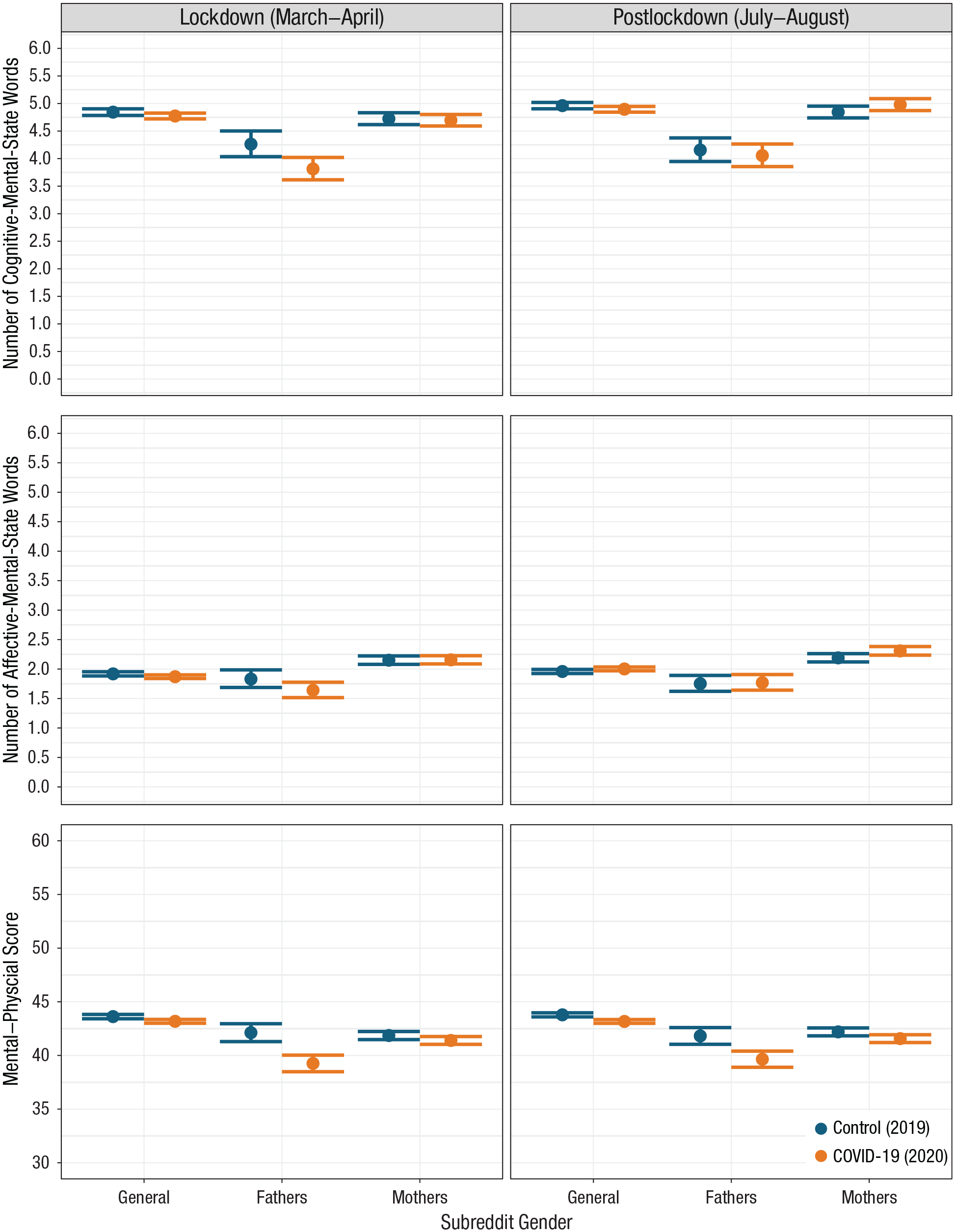
Mean number of cognitive mental-state words (top), mean number of affective mental-state words (middle), and mean mental-physical scores (bottom) as a function of subreddits’ primary gender focus (general, fathers, or mothers), separately for each time period (lockdown, March–April, left; postlockdown, July–August, right). The data presented at the top and middle are controlled for posts’ word count (centered). Error bars represent 95% confidence intervals.
Total MSL
Results revealed main effects for year, time period, and subreddit gender, qualified by Year × Time Period and Year × Subreddit Gender interactions.
To probe the Year × Time Period interaction, we compared the simple effect of year (2020, 2019) in each time period. MSL was lower during COVID-19 lockdown compared with March–April 2019, z = 3.25, p = .001 (2020-to-2019 ratio = 0.96, SE = 0.013, 95% confidence interval [CI] = [0.93, 0.98]). The difference between July–August 2019 and 2020 was nonsignificant, z = −0.40, p = .691 (2020-to-2019 ratio = 1.005, SE = 0.013, 95% CI = [0.98, 1.03]). That is, MSL decreased only during the lockdown period.
We next probed the Year × Subreddit Gender interaction. In general subreddits (mothers and fathers), the IRR between 2020 and 2019 was 0.99 (SE = 0.0055, 95% CI = [0.98, 1.00]) and did not reach statistical significance, z = 1.94, p = .053; however, note that (as suggested by the Year × Time Period interaction) the effect of the COVID-19 pandemic in general-parenting subreddits was significant when considering only the lockdown period (z = 2.25, p = .024, 2020-to-2019 ratio = 0.98, SE = 0.008, 95% CI = [0.97, 0.998]). MSL decreased significantly during the pandemic among fathers, z = 2.49, p = .013 (2020-to-2019 ratio = 0.94, SE = 0.024, 95% CI = [0.89, 0.99]). However, the pandemic did not have a significant effect on MSL in maternal subreddits, z = −1.42, p = .156 (2020-to-2019 ratio = 1.015, SE = 0.011, 95% CI = [0.99, 1.04]).
Affective MSL
Results indicated a main effect of subreddit gender and time period, qualified by a Year × Time period interaction.
We first probed the effect of the COVID-19 pandemic by time period. Affective MSL was lower during lockdown compared with March–April 2019, z = 2.07, p = .039 (2020-to-2019 ratio = 0.96, SE = 0.020, 95% CI = [0.92, 0.998]). The difference between July–August 2019 and 2020 (postlockdown) was nonsignificant and in the opposite direction, z = −1.40, p = .162 (2020-to-2019 ratio = 1.03, SE = 0.021, 95% CI = [0.99, 1.07]).
As to gender differences in affective MSL, maternal subreddits had significantly more affective MSL terms compared with both general-parenting subreddits, z = 13.64, p < .001 (mothers-to-general ratio = 1.14, SE = 0.011, 95% CI = [1.11, 1.16]), and paternal subreddits, z = 10.67, p < .001 (mothers-to-fathers ratio = 1.26, SE = 0.027, 95% CI = [1.20, 1.325]). General subreddits contained more affective MSL than paternal subreddits, z = 5.05, p < .001 (general-to-fathers ratio = 1.10, SE = 0.023, 95% CI = [1.06, 1.16]).
Cognitive MSL
Results indicated significant main effects for all variables, qualified by Year × Time Period and Year × Subreddit Gender interactions, which indicates that the effects observed for total MSL were mainly driven by cognitive MSL.
We first examined the simple effect of year by time periods. Cognitive MSL was significantly lower in March–April 2020 compared with March–April 2019, z = 3.07, p = .002 (2020-to-2019 ratio = 0.96, SE = 0.014, 95% CI = [0.93, 0.98]). The difference between July–August 2019 and 2020 was nonsignificant, z = 0.27, p = .788 (2020-to-2019 ratio = 0.996, SE = 0.0135, 95% CI = [0.97, 1.02]), which indicates that cognitive MSL decreased only during lockdown.
We next probed the Year × Subreddit Gender interaction. Cognitive MSL significantly decreased during the pandemic on general-parenting subreddits, z = 2.42, p = .016 (2020-to-2019 ratio = 0.99, SE = 0.006, 95% CI = [0.975, 0.997]), and paternal subreddits, z = 2.54, p = .011 (2020-to-2019 ratio = 0.93, SE = 0.025, 95% CI = [0.89, 0.985]), but not on maternal subreddits, z = −0.94, p = .348 (2020-to-2019 ratio = 1.01, SE = 0.011), 95% CI = [0.99, 1.03]).
Mental-physical scores
Parents’ mean mental-physical score was 42.97 (SD = 11.55), which indicates that, on average, parents tended to use verbs that reflected more physical activity than mental activity. ANOVA results predicting mental-physical scores are reported in Table 2, and mean scores by year, time period, and gender are presented in Figure 1, bottom. Results indicated main effects for year and subreddit gender qualified by a Year × Subreddit Gender interaction. Pairwise comparisons indicated that mental-physical scores were significantly lower during the COVID-19 pandemic compared with 2019 at all subreddit-gender-focus levels, but the differences between the years varied in effect sizes. The effect was strongest in paternal subreddits, mean difference = −2.52, t(77,241) = −6.29, p < .001, Cohen’s d = 0.05, followed by general-parenting subreddits, mean difference = −0.53, t(77,241) = −5.52, p < .001, Cohen’s d = 0.04, and maternal parenting subreddits, mean difference = −0.54, t(77,241) = −2.89, p = .004, Cohen’s d = 0.02.
Pronouns
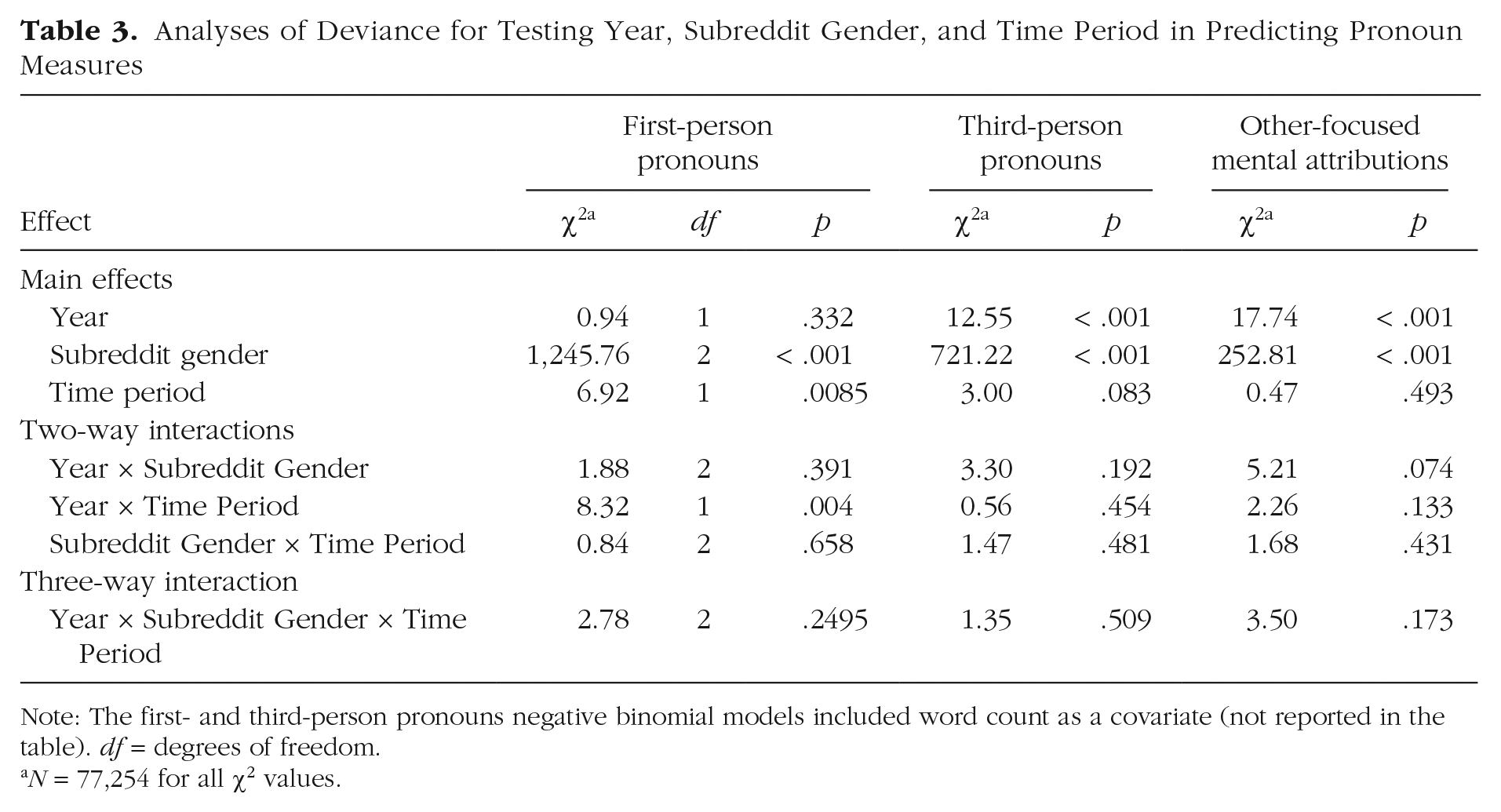
Parents used more first-person pronouns (Mdn = 9, M = 14.63, SD = 18.7) than third-person pronouns (Mdn = 6, M = 11.04, SD = 15.56), t(77,253) = 68.48, p < .001. Table 3 presents the effect of the pandemic on first-person and third-person pronoun usage and the proportion of other-focused mental attributions. Means by levels of independent variables are presented in Figure 2.
Analyses of Deviance for Testing Year, Subreddit Gender, and Time Period in Predicting Pronoun Measures
Note: The first- and third-person pronouns negative binomial models included word count as a covariate (not reported in the table). df = degrees of freedom.
N = 77,254 for all χ2 values.
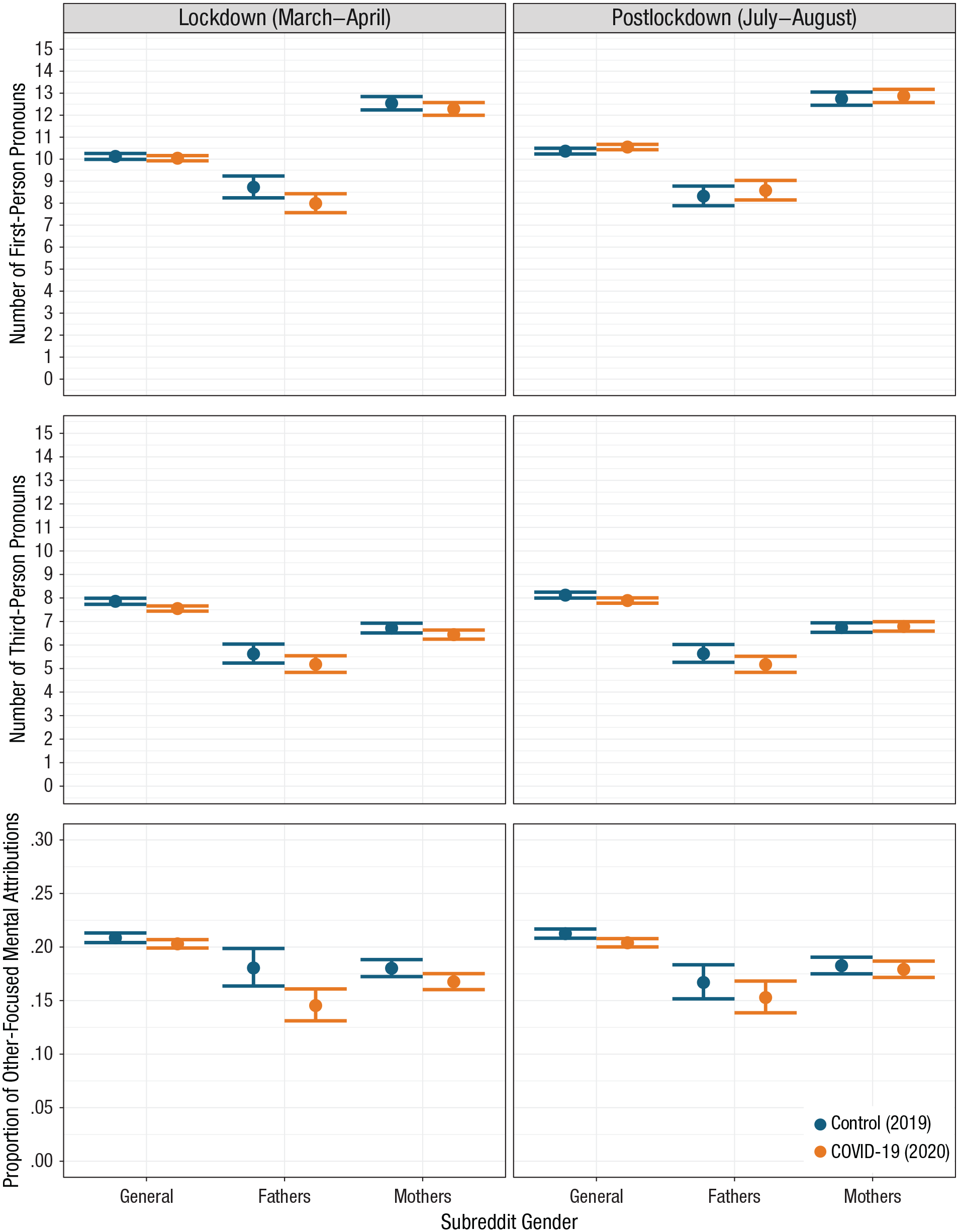
Mean number of first-person pronouns (top), mean number of third-person pronouns (middle), and mean proportion of other-focused mental attributions (bottom) as a function of subreddits’ primary gender focus (general, fathers, or mothers), separately by time period (lockdown, March–April, left; postlockdown, July–August, right). The data presented at the top and middle are controlled for posts’ word count (centered). Error bars represent 95% confidence intervals.
First-person pronouns: self-mentalizing
Results indicated significant main effects of gender and time period and a Year × Time Period interaction.
We first probed the Year × Time Period interaction. Use of first-person pronouns was significantly lower in March–April 2020 compared with March–April 2019, z = 2.63, p = .008 (2020-to-2019 ratio = 0.96, SE = 0.014, 95% CI = [0.93, 0.99]). However, the difference between July–August 2019 and 2020 was nonsignificant and in the opposite direction, z = −1.37, p = .171 (2020-to-2020 ratio = 1.02, SE = 0.014, 95% CI = [0.99, 1.05]). That is, self-references decreased only during lockdown.
Posts on maternal subreddits contained more first-person pronouns than posts on general subreddits, z = 30.21, p < .001 (mothers-to-general ratio = 1.23, SE = 0.008, 95% CI = [1.21, 1.25]), and posts on paternal subreddits, z = 26.95, p < .001 (mothers-to-fathers ratio = 1.50, SE = 0.02, 95% CI = [1.45, 1.56]). General subreddits contained more first-person pronouns than paternal subreddits, z = 14.20, p < .001 (general-to-fathers ratio = 1.23, SE = 0.02, 95% CI = [1.18, 1.26]).
Third-person pronouns: other-mentalizing
Results indicated significant main effects for year and subreddit gender in predicting the number of third-person pronouns. Parental posts during the COVID-19 pandemic contained significantly fewer references to nonpresent others compared with 2019 (2020-to-2019 ratio = 0.96, SE = 0.012, 95% CI = [0.93, 0.98]). Posts on general subreddits contained more third-person pronouns than posts on maternal subreddits, z = 18.93, p < .001 (general-to-mothers ratio = 1.18, SE = 0.01, 95% CI = [1.15, 1.20]), and posts on paternal subreddits, z = 21.01, p < .001 (general-to-fathers ratio = 1.455, SE = 0.03, 95% CI = [1.39, 1.52]). Paternal subreddits contained fewer third-person pronouns than maternal subreddits, z = −11.12, p < .001 (fathers-to-mothers ratio = 0.81, SE = 0.015, 95% CI = [0.77, 0.85]).
We next examined the proportion of other-focused mental attributions (M = .20, SD = .25). The quasibinomial model revealed a similar pattern, which indicates main effects for year and subreddit gender. The proportion of other-focused mental attributions was significantly lower during the pandemic compared with 2019 (2020-to-2019 odds ratio [OR] = 0.91, SE = 0.02, 95% CI = [0.87, 0.95]). General subreddits had significantly higher proportion of other-focused mental attributions compared with paternal subreddits, z = 10.11, p < .001 (OR = 1.36, SE = 0.041, 95% CI = [1.27, 1.46]), and maternal subreddits, z = 12.83, p < .001 (OR = 1.21, SE = 0.018, 95% CI = [1.17, 1.25]). Paternal subreddits had a lower proportion of other-focused mental attributions than maternal subreddits, z = −3.56, p = .001 (OR = 0.89, SE = 0.03, 95% CI = [0.82, 0.96]).
Relative-frequency keyness analyses
A relative-frequency keyness analysis was conducted to explore whether the use of individual mental-state terms in the MSL dictionary varied as a function of the COVID-19 pandemic. Considering the MSL differences between the lockdown and postlockdown periods reported above, we examined changes in word frequency separately for each time period and then compared between the two periods during the pandemic.
Lockdown: March–April 2019 compared with 2020
Significant changes in mental-state terms between March–April 2019 and 2020 and their χ2 values are presented in Figure 3a. During lockdown, parents referred more to words related to stressful experiences (“stress,” “uncertain,” “craziness”) and to mental states that likely related to caregiving challenges (“respect,” “boredom,” “creative”). Words indicating positive experiences (“happy,” “relax,” “amaze”) were more frequent in 2019. However, some words that appeared more during 2019 also had negative valence, possibly relating to experiences that may be more likely to arise in social situations (“nervous,” “resent,” “shy”).
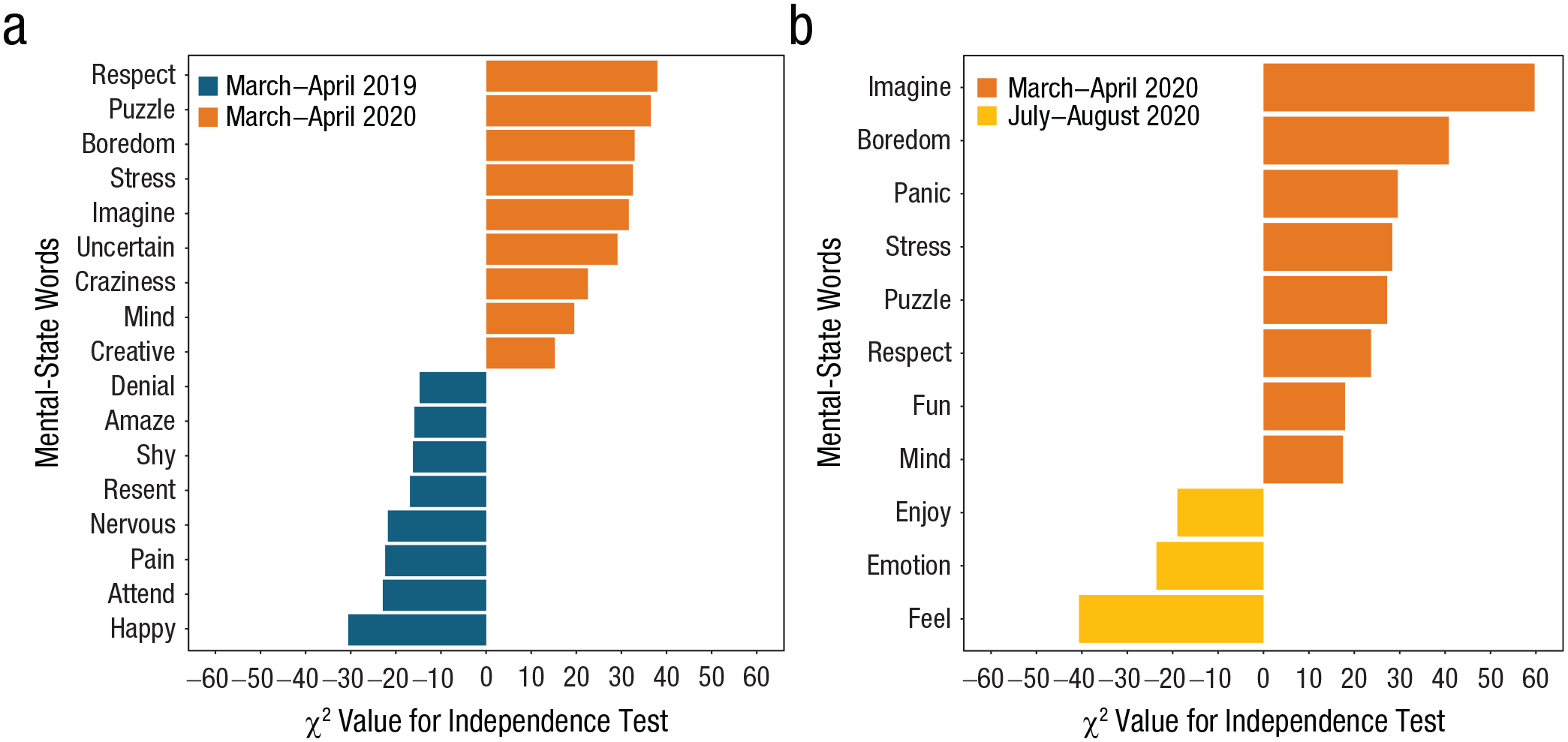
Results of the relative frequency (“keyness”) analysis, examining the differences in the use of mental-state words from the mental-state language (MSL) dictionary collapsed across gender. The graph in (a) shows a comparison between the lockdown period (March–April 2020) and the time-matched control period (March–April 2019), collapsed across genders. Positive values indicate higher frequency during the COVID-19 pandemic lockdown (March–April 2020), and negative values indicate higher frequency during the control period (March–April 2019). The graph in (b) shows a comparison between the lockdown period (March–April 2020) and the postlockdown period (July–August 2020); positive values indicate higher frequency during lockdown, and negative values indicate higher postlockdown frequency. Only words that had significant χ2 values after correcting for multiple comparisons are presented.
Postlockdown: July–August 2019 compared with 2020
Consistent with the general similarity in MSL between the two periods, only two mental-state terms differed in their frequency between July–August 2019 and 2020: “Feel” was used more during the postlockdown period of 2020, χ2(1, N = 28,710) = 15.87, p < .001, whereas “fun” was used more in 2019, χ2(1, N = 2,148) = 18.26, p < .001.
Lockdown versus postlockdown during the pandemic
During postlockdown, parents referred more to the words “feel,” “emotion,” and “enjoy” than during lockdown (Fig. 3b). Mirroring the difference between March–April 2019 and 2020, during lockdown, parents used more words related to stress and to caregiving challenges than during postlockdown (although “fun” was more frequent during lockdown).
Discussion
The aim of the present study was to examine whether the COVID-19 pandemic, as a demanding caregiving context, was related to changes in parental mentalization by characterizing the use of MSL in parenting social-media content before and during the pandemic. Specifically, we examined parental MSL and use of first-person and third-person pronouns in approximately 77,000 posts from parenting-related Reddit communities. During the initial phase of lockdown or stay-at-home restrictions (March–April; lockdown) and postlockdown (July–August) periods of 2020, parents used verbs reflecting more physical activities than mental activities and referred less to nonpresent others in their posts compared with the corresponding periods in the prior year, 2019. During lockdown, parents used less cognitive MSL, affective MSL, and self-references. Results also revealed gender differences in baseline levels of MSL and in pandemic-related changes in MSL. Although most effects were evident in general-parenting subreddits, including both mothers and fathers, the strongest effects were found in father-specific subreddits. In maternal subreddits, only the use of pronouns and the mental-physical scores decreased during the COVID-19 pandemic. Contrary to our hypothesis, maternal mentalization content was not lower during the postlockdown period compared with 2019. Taken together, these findings relating to mentalizing content on social media suggest changes in parental mentalization during the COVID-19 pandemic, especially among fathers, which may potentially have significant implications for caregiver behavior beyond social-media platforms into the family setting.
Demanding caregiving contexts and dimensions of parental mentalization
The COVID-19 pandemic can be contextualized as a demanding time for parents characterized by caregiving burden or as a natural manipulation of caregiving contexts in (normative) parenting. Two time periods that may represent different types of pandemic-related caregiving changes and challenges were examined: (a) the beginning of the pandemic and lockdown period (March–April 2020), when many around the world, including parents, experienced the highest levels of emotional distress (e.g., APA, 2020; Markovic et al., 2021), and (b) postlockdown (July–August 2020), after accumulation of caregiving burden and a period during which schools began reopening, mostly remotely, and families were facing another transition. Our results reveal that although some measures of mentalizing content were lower during both time periods (relative to the equivalent periods in 2019), the frequency of MSL decreased mainly during lockdown.
Our findings suggest that the initial phase of the pandemic and lockdown period (which we term “lockdown” for simplicity) was a qualitatively different experience for parents compared with both the postlockdown period included in our analysis (summer 2020) and the control periods in 2019. The largest decrease in MSL was evident during the lockdown period, and when parents did mention mental states, they tended to convey an experience of stress, struggling with uncertainty and child-rearing difficulties. In contrast, mental states that were more frequently mentioned during the parallel period in 2019 conveyed a more well-rounded and complex experience, with a mixture of positive and negative experiences, perhaps reflecting more sophisticated mentalizing (e.g., “denial”) and more socially driven mental states experienced less under social isolation (“shyness,” “resentment”). Parents’ posts were generally shorter during the pandemic compared with 2019, which possibly reflects a similar decrease in complexity, although other reasons may affect this finding as well (e.g., limited time to post), and this should be further explored.
July–August 2019 and 2020 did not differ as much in the frequency of mental-state terms. A similar pattern also emerged in the descriptive content analyses: Whereas lockdown posts were characterized by acute stress reactions and managing school closures or work adjustments, the postlockdown period appeared to be a mixed experience, characterized by a combination of normal summer activities on the one hand and trauma on the other. One of the stressors that parents have reported experiencing before the pandemic was guilt over not spending enough time with their families (Nomaguchi & Milkie, 2020); across the pandemic, research has indicated independent increases in both parenting demands and satisfaction from family life (Rudolph & Zacher, 2021), and undisrupted child care was related to perception of increased family time as a positive aspect of the pandemic (Calarco et al., 2020). Therefore, there may be heterogeneity in how stressful the summer of 2020 was for parents, perhaps depending on when and how schools reopened, child age, and/or socioeconomic status.
The decrease in parental mentalization during the COVID-19 pandemic, especially during the lockdown period, may be driven by the increased parenting demands and stressful caregiving context elicited by the pandemic. Although stress and demands were not directly measured or manipulated, our content analyses support the saliency of challenging, demanding, and stressful experiences in parents’ posts, particularly under lockdown. Previous research on the links between emotional distress and parental mentalization has been largely inconsistent (e.g., Cordes et al., 2017; Luyten et al., 2017; McMahon & Meins, 2012; Yatziv, Gueron-Sela, et al., 2020). Differently from past studies, which focused on trait-level individual differences, in this study, we examined group differences in state-level mentalizing across two dimensions—affective–cognitive and self–other mentalizing—following a global event that affected family lives.
Our findings are only partially in line with predictions derived from the hypothesis that stress and load primarily dampen cognitive (vs. affective) mentalizing and other-focused (vs. self-focused) mentalizing (Luyten et al., 2020; Luyten & Fonagy, 2015). Cognitive MSL was lower during lockdown compared with March–April 2019 in general and paternal subreddits, and mental-physical scores were lower during both lockdown and postlockdown periods compared with content posted during 2019 across subreddit gender focuses. However, we also observed a decrease in affective MSL during lockdown, which is considered less susceptible to the dampening effect of stress and load (Luyten & Fonagy, 2015). As for the self–other mentalizing dimension, we found a decrease in other-mentalizing content during the COVID-19 pandemic in the two other-focused measures across both time periods; during lockdown, there was also a decrease in use of first-person pronouns.
The decreased affective-mentalizing and self-mentalizing content under lockdown raise the possibility that for parents, these aspect of mentalizing could be somewhat effortful, perhaps only when demands and stress are particularly high. Although the Gender × Year interaction was nonsignificant, descriptively, the decrease in affective mentalization content appears to be mainly driven by paternal posts such that there may be gender differences in the need for effortful control in affective mentalizing. Parents generally referred less to affective terms than to cognitive terms, and there was a median of 1 affective term; thus, it is also possible that a floor effect added to this pattern.
A possible alternative explanation for the decrease in references to others may be related to the social isolation the pandemic imposed, which rendered parents’ external social interactions narrower. Parents posted more during the pandemic compared with 2019, which perhaps implies increased use of social media to compensate for the decreased social interaction. Nonetheless, the descriptive content analysis we conducted also showed that during the pandemic, family-related terms referred more to parents and less to children compared with 2019, which indicates that a particular change within the family setting is possibly driving the decrease in references to others and their mental states. It is possible that parents’ posts dealt more with issues related to themselves and their partners and perhaps included more distancing language (e.g., talking about oneself in second person or as “mom” or “dad” and citing conversations verbatim), which could be related to low mentalizing (Slade et al., 2007) but also to emotion regulation (Orvell et al., 2019).
Implications on understanding parenting and family functioning in the pandemic
The observed decrease in parental mentalization content during the pandemic was with small effect sizes (e.g., 4% decrease in MSL during lockdown across subreddit gender focuses, 2% in general-parenting subreddits), which is consistent with the smaller effect sizes observed in large-scale or multisite studies (e.g., Funder & Ozer, 2019; Owens et al., 2021). According to Funder and Ozer (2019), small effect sizes may be meaningful if they have the potential to accumulate over events. The effects reported here reflect changes in MSL in short posts with a mean length of about one paragraph; over several interactions with other parents and family members, this effect has the potential to accumulate in shaping changes in mentalizing, especially given the intensity of family relationships during the COVID-19 pandemic.
Although in the present study mentalization was not measured at home and thus cannot speak directly to family interactions, it is plausible that the average decrease in parental mentalization observed here in online parental content may have also manifested in the home environment. Decreased parental mentalizing at home has the potential to negatively affect family adjustment to the pandemic. Maintenance of high levels of mentalizing when adapting to the acute change in everyday life evoked by the pandemic could facilitate the child in coping with and adjusting to the uncertainty, changing routines, and limited social interactions while maintaining psychological resilience (Luyten et al., 2020). Previous studies have associated higher parental mentalization with child socioemotional functioning and adjustment (e.g., Londono Tobon et al., 2020), especially in contexts of adversity (Ensink et al., 2017; Meins et al., 2013), including during the pandemic (Cohodes et al., 2021). Parental mentalization has also been associated with cooperative coparenting and positive marital relationships (Jessee et al., 2018; Marcu et al., 2016), which may assist the entire family unit adjusting to the COVID-19 pandemic. Increased instances of abusive behaviors such as calling the child “stupid” or other degrading names have been reported during lockdown (Sari et al., 2021), an effect that may be related to distortions in understanding of the child’s intentions and motivations (often termed “prementalizing”). The less pronounced effect of the pandemic on mentalization content after the initial lockdown paints a more optimistic picture, which perhaps suggests a trend toward recovery after restrictions were lifted. Nevertheless, even if this effect was only temporary in most families, this intensive period in family life could continue to affect subsequent interactions, and this should be further investigated.
Gender differences in parental mentalization and the pandemic
We also observed robust differences between mothers and fathers (determined according to subreddit-gender-focus category) such that posts on paternal subreddits exhibited the lowest levels of mentalizing. Previous findings on gender differences in parental mentalization have been mixed. Some studies have reported lower levels of mentalizing among fathers compared with mothers (e.g., Ruiz et al., 2020; Salo et al., 2021), and other studies have reported no differences (e.g., Borelli et al., 2016; Gershy & Gray, 2020). Our study adds to the literature by documenting consistent gender differences in spontaneous online discourse while communicating with other parents of the same gender identity.
Unexpectedly, paternal subreddits exhibited the strongest decline in mentalizing content during the pandemic, whereas declines in mentalizing were only partially evident in maternal subreddits. However, mentalizing was lower during the pandemic on general subreddits, the majority of sampled posts, which likely included both mothers and fathers. Therefore, maternal mentalizing may have also decreased during the COVID-19 pandemic, but to a smaller extent or not in the context of maternal-specific posts. We did not have a directional hypothesis with respect to gender differences in the effect of the COVID-19 pandemic during lockdown given that both mothers and fathers reported increased emotional distress and increased caregiving demands (Carlson et al., 2020; Dunatchik et al., 2021; Taubman-Ben-Ari et al., 2021; Wade et al., 2021; Zamarro & Prados, 2021). Considering the accumulating caregiving burden on mothers as the pandemic progressed, we hypothesized that mothers would show a larger decrease in mentalizing over time, primarily during postlockdown. However, the results did not support this hypothesis.
Why did fathers exhibit a stronger decline in mentalizing on social media during the pandemic? One possibility is that fathers are more reactive to changes in stress levels than mothers such that maternal mentalization may be less affected by stress. For example, men may tend to exhibit stronger cortisol reactivity to stress (Liu et al., 2017), which may render their mentalization capacities more susceptible to stress (Tollenaar & Overgaauw, 2020). Furthermore, although mothers have carried most of the caregiving burden during the pandemic (e.g., Wade et al., 2021; Zamarro & Prados, 2021), because mothers have been the primary caregiver in most families before the pandemic, it is possible that the mere increase in fathers’ participation in caregiving created a qualitatively different change for fathers.
Patterns of social-media use and the topics discussed on gender-specific subreddits may have also affected the differential change in mentalizing by gender. Before the COVID-19 pandemic, some topics of discussion were common across the three largest parenting-related subreddits (r/Parenting, r/Mommit, and r/Daddit), whereas other content differed between Mommit and Daddit (Ammari et al., 2018). For example, mothers discussed child health-related issues and household maintenance, whereas fathers discussed custody battles and Halloween costumes (likely less relevant to the time points we sampled). The inclusion of our pronoun analysis evidenced that mothers wrote longer posts and tended to refer to themselves more in their posts compared with fathers. Mothers were using social media for support during stressful times before the pandemic (Haslam et al., 2017; Lupton et al., 2016), and the topics discussed before the pandemic relate to caregiving demands, such that it is possible that the COVID-19 pandemic has increased their use of these platforms for support but not necessarily their usage patterns or discussion topics. For fathers, it is possible that the aims and use of social media have qualitatively changed during the pandemic, also manifesting in MSL changes. Finally, fathers who engage in online discussions on parenting, specifically on father-specific subreddits, may represent fathers who are more involved in caregiving and have experienced greater COVID-19 pandemic-related stress. Conversely, given the saliency of custody issues on Daddit (Ammari et al., 2018), it is also possible that some fathers participating in paternal-specific online discussions have faced new difficulties in navigating custody-related problems during lockdowns. Therefore, some of the observed changes may reflect the impact of the pandemic on topics already discussed on more general subreddits compared with father-specific subreddits rather than gender differences per se in response to the pandemic. We encourage future studies to explore demographic and personality correlates of parents’ use of Reddit to gain more insights on who, how, when, and why mothers and fathers use gender-specific and general-parenting subreddits.
Strengths, limitations, and future directions
This study highlights the usefulness of social-media behavior for gaining insights into parents’ experiences in general and specifically their mentalizing. Despite the importance of the community in family functioning and in families’ reactivity to stress (Bronfenbrenner, 1986; Deater-Deckard & Panneton, 2017), parents’ interactions with other parents have rarely been examined. Social-media data on parenting provide access to ecological sources of natural parental discourse within the parenting community at a significant scale that may not be possible in other research settings.
Use of MSL in natural discourse has high face validity for assessing mentalizing (see Meins & Fernyhough, 2015; Ruffman et al., 2002). We used several operationalizations to assess MSL in parental posts, from counting mental-state terms to use of verbs on a mental-physical dimension, and the generally converging findings in the theoretically expected directions strengthen their validity. However, although MSL is a valid proxy for the existence of spontaneous mentalizing in general, the extent to which this type of mentalizing also generalizes to the home environment and the parent–child relationship is yet to be determined. In light of prior indications that the content of parenting subreddits deals directly with issues related to parenting practices and problems (Ammari et al., 2018) and that parents report using social media for support (Haslam et al., 2017), it is likely that effects observed on social media either reflect past occurrences at home or would later manifest in the family context. Nonetheless, future research is needed to examine whether MSL is indeed associated with other parental mentalization assessments and parenting behavior.
Analysis of MSL in natural language produced outside of a research setting can provide an objective measure of mentalization that is potentially less susceptible to biases compared with other assessment types. MSL on social media is also likely to be more focused on state-level mentalizing given that it reflects discussion topics parents choose to engage in. Nonetheless, there are aspects of parental mentalization that an automated dictionary-based measure may overlook and thus be less accurate than manual coding, particularly of nuanced mental-state misattributions (although machine-learning-based algorithms may detect nuances given enough exemplars). However, note that most measures of parental mentalization capture only some dimensions of mentalizing, and no current measure captures all dimensions (see Yatziv, Kessler, & Atzaba-Poria, 2020). Moreover, some words in the MSL dictionary reflect mental states in some contexts but not in others (e.g., “affect”); however, we believe that these instances are not likely to substantially affect time-based group comparisons, and this aspect has also been accounted for in analyzing the norm-based mental-physical scores. Relatedly, our measures of other-focused mentalization cannot discern who parents were mentalizing about. Because subreddits were dedicated to parenting, we assume that, on average, most posts concerned their family. Because parental mentalization is generally consistent across close relationships (e.g., Borelli et al., 2020; Illingworth et al., 2016), we view our assessment as tapping into mentalization in the parenting context in general across specific dyads within the family.
The aggregation of data originating from a large international forum of parents is both a strength and a weakness. This sample is likely to capture organic discourse from a wide range of locations, primarily across locations in North America and the United Kingdom. The comparison of the effects of global events on parenting-related constructs via social media can provide insights on state, rather than trait, changes in normative parenting among parents at large. Given the many confounds that accompany other contexts of highly stressful and demanding family contexts, such as childhood trauma exposure, neglect, or substance use, this approach may better isolate the effects of stressful caregiving contexts in normative parenting and development. Likewise, social-media discourse can be used to advance the field’s understanding of subgroups of parents. For instance, subreddits dedicated to pregnancy can be used to study the emergence of parental mentalization and other representational constructs (e.g., coherence) throughout the perinatal period.
Nevertheless, the pseudoanonymity of social-media users also introduces some limitations. First, we did not have information on, and could not control the representativeness of, (a) the socioeconomic and ethnic composition of our sample and (b) the locations of users, which likely varied in caregiving situations because of different restrictions in reaction to the pandemic, both within North America and the UK (from which the majority of Reddit traffic typically originates; Alexa.com, 2021a; Statista.com, n.d.) and in other countries, especially during postlockdown (Ballotpedia.org, n.d.). Thus, selection biases may be present because the sample may be more likely to include primarily White Americans with some college education (Alexa.com, 2021a; Pew Research Center, 2016). Given evidence for higher risk for pandemic-related stress among non-White mothers (Brown et al., 2020), the effect of the pandemic on maternal mentalization may be underestimated. To better understand the specific effects of lockdowns and school closures/reopening, future studies should consider sampling social-media data originating from specific locations according to the local time course of the pandemic.
Second, we did not have information on the levels of stress and parenting demands that parents had experienced while interacting online. Although increased rates of distress have been reported among parents during lockdown at the group level (APA, 2020; Cameron et al., 2020; Gassman-Pines et al., 2020; Patrick et al., 2020; Racine et al., 2021), there are also individual differences in parents’ stress response to the pandemic (e.g., Brown et al., 2020; Taubman-Ben-Ari et al., 2021). Our analyses have focused on group-level changes in a large community of parents and thus likely capture the average experience of parents. The keyness analysis supported the saliency of stress- and challenges-related terms specifically during the lockdown period, which is consistent with the premise that COVID-19 pandemic-related caregiving demands and stress could drive at least some of the change in parents’ mentalization content. Nonetheless, individual-level stress reactivity patterns may interact with the identities of parents posting online. Furthermore, other alternative mechanisms may have driven the effect as well, including a lack of social interactions.
Clinical implications
From a clinical perspective, our findings corroborate the assumption that mentalizing is compromised under demanding or stressful caregiving contexts. Parent–child interventions have targeted parental mentalizing abilities as means to foster positive parent–child relationships through improving parents’ understanding of their own and their child’s minds (e.g., Slade et al., 2019). The present findings further highlight the importance of understanding and addressing the demands of parenting within interventions that focus on parental mentalization, perhaps even before addressing mentalizing itself. Our findings add that this may be especially important when working with fathers—especially when there tend to be many barriers to fathers’ participation in parenting interventions and preventive programs (Panter-Brick et al., 2014). Furthermore, during global events such as the current pandemic, public services providing resources to parents on ways to maintain a mentalizing stance could potentially help families adjust to these events and prevent psychopathology (Luyten et al., 2020).
Summary and conclusions
The findings of the present study indicate that parents’ ability to mentalize and consider mental states, especially concerning others, decreased during the COVID-19 pandemic and particularly during lockdown. Given the importance of mentalizing for family relationships and adjustment, this may have potentially exacerbated the negative impact of the COVID-19 pandemic on the daily lives of parents and children. Note that fathers using paternal subreddits exhibited the lowest baseline levels of mentalizing content and the highest decreases in mentalizing content during the COVID-19 pandemic, which emphasizes the importance of paying more scientific and clinical attention to understanding fathers’ experiences, especially under contexts of high family stress and caregiving demands.
Supplemental Material
sj-pdf-1-cpx-10.1177_21677026211062612 – Supplemental material for Parental Mentalizing During a Pandemic: Use of Mental-State Language on Parenting Social Media Before and During the COVID-19 Pandemic
Supplemental material, sj-pdf-1-cpx-10.1177_21677026211062612 for Parental Mentalizing During a Pandemic: Use of Mental-State Language on Parenting Social Media Before and During the COVID-19 Pandemic by Tal Yatziv, Almog Simchon, Nicholas Manco, Michael Gilead and Helena J. V. Rutherford in Clinical Psychological Science
Footnotes
Acknowledgements
We thank Amanda Lowell for consultations on the mental-state dictionary and Ram Isaac-Orr for his help with the mental-physical scale. We also thank the Before and After Baby Lab members, especially Kimberly Streater, for helpful feedback and insights on parents’ experiences in the community over the course of the pandemic and around school reopening.
Transparency
Action Editor: Cindy Liu
Editor: Jennifer L. Tackett
Author Contributions
T. Yatziv and H. J. V. Rutherford developed the study concept. All authors contributed to the study design and creation of measures. T. Yatziv, N. Manco, and A. Simchon acquired the data. T. Yatziv and A. Simchon conducted the data analysis and interpretation in consultation with H. J. V. Rutherford and M. Gilead. The manuscript was drafted by T. Yatziv and H. J. V. Rutherford, and M. Gilead and A. Simchon provided critical revisions. All of the authors approved the final manuscript for submission.

References
Supplementary Material
Please find the following supplemental material available below.
For Open Access articles published under a Creative Commons License, all supplemental material carries the same license as the article it is associated with.
For non-Open Access articles published, all supplemental material carries a non-exclusive license, and permission requests for re-use of supplemental material or any part of supplemental material shall be sent directly to the copyright owner as specified in the copyright notice associated with the article.
