



Abstract
Parents of young children were a subgroup of the population identified early in the pandemic as experiencing significant mental-health symptoms. Using a longitudinal sample of 3,085 parents from across the United States who had a child or children age 0 to 5, in the present study, we identified parental mental-health trajectories from April to November 2020 predicted by pre–COVID-19 cumulative risk and COVID-19-specific risk factors. Both growth-mixture modeling and latent-growth-curve modeling were used to test the relationship between risk factors and parent mental health. Pre–COVID-19 cumulative risk and COVID-19-specific risks of financial strain, decreased employment, and increased family conflict were salient risk factors predicting poor mental-health trajectories across both modeling approaches. These finding have public-health implications because prolonged exposure to mental-health symptoms in parents constitutes a risk factor for child development.
An estimated 18.2% of parents with children 0 to 18 years old in the United States have a mental disorder, and mothers shoulder a disproportionate burden of diagnosis (Stambaugh et al., 2017). Poor mental health in parents, especially when occurring with young children in the home, is a risk factor to many facets of child development, including emotional and behavioral issues (Goodman & Brand, 2008). Although various socioeconomic, psychological, and familial factors have been shown to predict parental mental-health symptoms, findings typically have been produced from at-risk samples (i.e., low income, clinic referred), have relied on correlational designs, and have assessed a narrow range of predictors (Pelham et al., 2021).
COVID-19 has been associated with increases in parental mental-health problems (Cameron et al., 2020; Patrick et al., 2020), which presents an opportunity to advance the field’s understanding of what predicts changes in parental mental-health symptoms in several ways. First, COVID-19 represents a “universal introduction of risk” (i.e., an experiment of nature that the vast majority of a population encounters; Thapar & Rutter, 2019). It is well documented that COVID-19 abruptly and dramatically altered numerous aspects of daily living for all parents with young children (Cluver et al., 2020; Newby et al., 2020; Pierce et al., 2020). Even parents living without previous risk factors linked to poor parental mental health were apt to experience some of these risk factors (e.g., changes in employment, loss of child care or school supports). Evidence of increased mental-health problems among parents was documented early in the pandemic by two different studies that reported rates of worsening or clinically significant mental-health problems in parents with young children at 27% (Patrick et al., 2020) and roughly between 30% and 40% (Cameron et al., 2020).
Differentiating between an accumulation of pre–COVID risk factors from those occurring during the pandemic may allow us to glean greater causal inference as to how new or worsening risk relates to parental mental health. To account for prepandemic risk factors, a cumulative risk model can be used to quantify the degree to which an accumulation of risk has on parents’ trajectories of mental-health symptoms. Such models have the potential to address the fact that risk factors frequently co-occur for individuals and that the burden of experiencing multiple simultaneous risk factors affects health (Evans et al., 2013). The pre–COVID-19 cumulative risk index included risk factors previously identified as relevant to parental mental health and economic burden, including being a young parent, being a single parent, having a child with disabilities, having a greater number of children, and living in poverty (Agnafors et al., 2019; Crosier et al., 2007; Dhiman et al., 2020; MacFadyen et al., 1996; Wickham et al., 2017).
A second way in which the pandemic stands to advance the field of parental mental health is that there are challenging factors that uniquely affect parents of young children and that have rarely been considered in relation to parental mental health. For example, understanding the relationship between loss of child care and parental mental health has important public-health implications beyond the pandemic, particularly for mothers who are disproportionality tasked with child-care obligations (Lachance-Grzela & Bouchard, 2010) and who experience higher rates of internalizing symptoms compared with men (Kuehner, 2017).
Note that Rosenfeld and colleagues (2022) recommended that researchers go beyond main effects of the pandemic on the population as a whole and instead consider individual differences. Specifically, they wrote that “the pandemic has affected everyone, but not everyone has been affected equally” (Rosenfeld et al., 2022, p. 316). This recommendation complements existing trajectory-model approaches that have been used in the postnatal-depression literature to identify subgroups of mothers whose postnatal depression remits versus whose has a chronic course (Vliegen et al., 2014). Guiding the present study is the idea that it is informative to examine how individual differences in parents’ exposure to new or worsening risk factors can be used to predict divergent classifications of parental mental-health trajectories.
Specifically, in the present study, we used both person- and variable-oriented approaches to examine how risk factors that occurred during COVID-19 were associated with mental-health trajectories above and beyond risk existing before the pandemic, indicated by a cumulative risk index. Person-oriented methods, such as growth-mixture modeling (GMM), can characterize distinct subgroups of parents who appear to show meaningful variation in mental-health symptoms over 8 months of the pandemic (Bergman & Trost, 2006) that is lost when simple linear associations are analyzed. In addition, to guard against known limitations of group-modeling approaches that can erroneously reify group trajectories, latent-growth-curve modeling (LCGM) was used to further examine the risk factors predicting parent mental-health trajectories (Sher et al., 2011). Integrating both person-centered and variable-centered approaches can provide a richer understanding of the longitudinal trajectories of parental mental-health symptoms and increase the robustness of findings (Bates, 2000; B. Muthén & Muthén, 2000).
We hypothesize that although the majority of parents would be classified as having low mental-health problems, a sizable minority would be characterized by poor mental health, as noted in other reports published early in the pandemic (Cameron et al., 2020; Patrick et al., 2020). Although parental mental-health-trajectory studies have found a decreasing symptom trajectory (Madigan et al., 2017), we do not have a priori hypotheses that an improving trajectory class will emerge because the context of the pandemic differs so greatly from those studied in previous work and because typical longitudinal work in this area has used fewer repeated assessments sampled over longer durations. Furthermore, we hypothesize that the pre–COVID-19 cumulative risk index would predict any classification characterized by high mental-health symptoms (either chronically high or trajectories that increased over time). In addition, simultaneous examination of several pandemic-specific risk factors was expected to clarify which factors were most relevant to parental mental-health trajectories across the first 8 months of the pandemic (April 2020 to November 2020).
Method
Participants and procedures
This study employed data from the Rapid Assessment of Pandemic Impact on Development–Early Childhood (RAPID-EC) project, an ongoing study that assesses the impact of the pandemic Please specify which school’s IRB.on households with young children across the United States with biweekly surveys. All the study procedures have been approved by the institutional review board at the University of Oregon. Participants were recruited through community organization email-list software, Facebook ads, and panel services. Eligibility criteria for parents include (a) speaking English or Spanish fluently, (b) being older than 18, (c) having at least one child ages 0 through 5, (d) currently living in the United States, and (e) being willing to be recontacted for follow-up surveys. RAPID-EC sampling included two types of surveys—an initial recruitment assessment (i.e., baseline) and multiple ongoing follow-up assessments. Baseline and follow-up surveys were distributed on a weekly (April 6, 2020, through July 30, 2020) and then biweekly (July 30, 2020, through November 19, 2020) basis. During each baseline survey, parents first completed the eligibility screening. Eligible parents continued to answer a set of core questions, provided consent for further follow-up assessments, and were enrolled into a participant pool. The goal of each baseline survey was to recruit 500 families using convenience sampling. Then, during follow-up assessments, research assistants randomly selected 2,000 participants from the pool (stratified by race/ethnicity, prepandemic poverty level, and region) and invited them to answer the follow-up survey through emails; the goal was to obtain 1,000 responses per follow-up survey. The participant pool was not intended to be nationally representative, but the research team made extensive efforts to include more racially/ethnically diverse groups (especially Black and Hispanic/Latino[a]) families) and lower income families.
Because of this sampling strategy, the number and date of follow-up responses vary by family: The total number of weekly responses of each family ranged from 1 to 25 and had an average of 3.12 (SD = 3.51). For assessment time points and the sample size of each survey, see the Supplemental Material available online. Attention-check questions were used to monitor data quality. Given recommendations from research articles, data from each baseline and follow-up surveys were manually and systematically inspected to detect and remove fraudulent responding (Ballard et al., 2019; Pozzar et al., 2020; Storozuk et al., 2020). Fraudulence was determined on the basis of (a) multiple responses with duplicated email addresses, IP addresses, and dates of birth; (b) short survey duration; and (c) completely wrong responses to attention-check questions. Each family received $5 as an incentive for each completed survey. Individual and household demographics were reported by the survey respondent.
In the current study, we used RAPID-EC data collected between April 6, 2020, and November 19, 2020. After data cleaning, 85.9% of responses from a total of 8,390 families remained in the data set. Because of the large percentage of missing data introduced by the sampling strategy (90.7% on average, 1 according to weekly data), we further aggregated parents’ responses on mental-health symptoms to five time points: before COVID-19, April/May 2020, June/July 2020, August/September 2020, and October/November 2020. When a parent provided multiple responses for one time point, the average was calculated to reflect his or her mental-health symptoms. The mean number of nonmissing bimonthly time points was 2.57 (out of 5 time points; SD = 0.88), and the missing data rate was still substantial (60.6% on average). To reduce missing rate, we selected for analyses in this study a subsample of 3,085 unique families who provided at least three time points of data on parents’ mental-health symptoms. The mean number of nonmissing bimonthly time points in this subsample was 3.56 (SD = 0.74), and the mean number of total weekly responses in this subsample was 6.29 (SD = 4.10). The average missing data rate of the five mental-health-symptoms variables was significantly reduced to 35.93%. The majority of responding parents in this sample were female (n = 2,960, 96.1%). Their ages ranged from 18 to 63 (M = 34.84 years, SD = 6.00). The racial/ethnic composition of the sample was 75.4% (n = 2,324) White, 7.7% (n = 238) Black, 4.3% (n = 132) Asian, 0.7% (n = 23) American Indian/Alaska Native, 0.2% (n = 6) Native Hawaiian/Pacific Islander, 4.7% (n = 144) biracial, and 7.0% (n = 217) other racial/ethnic groups. In addition, 17.9% (n = 550) of parents reported being Latinx. Using reported household income in 2019, we found that 26.5% of families (n = 768) were at or below 200% of the federal poverty level (FPL, calculated on the basis of reported household income in 2019 and household size). Participants all resided in the United States: 17.6% in the Northeast, 31.2% in the South, 23.8% in the Midwest, and 27.3% in the West.
Measures
This section briefly summarizes the measurement tools. For survey questions mentioned in this section, see Table S2 in the Supplemental Material.
Parental mental health
Parents retrospectively reported their prepandemic mental-health symptoms in baseline surveys and reflected on their during-pandemic mental-health symptoms in baseline and each follow-up survey. The parent mental-health-symptom score was a composite of depressive symptoms (two items from the Patient Health Questionnaire; Kroenke & Spitzer, 2002), anxiety symptoms (two items from the Generalized Anxiety Disorder 7-Item Scale; Spitzer et al., 2006), stress (a single-item measure; Elo et al., 2003), and loneliness (one item from the National Institutes of Health Toolbox item bank [Version 2.0; Gershon et al., 2013]). Scores of the four constructs were based on different response sets. To ensure that the four constructs were equally weighted in a composite score, we first transformed these scores to a range of 0 to 100 using a percentage of possible maximum total score. Then, an average score across the four constructs was calculated to indicate the total mental-health symptoms before COVID-19 and during COVID-19. The reliability of the mental-health items was high (before COVID-19: α = .85; during COVID-19 across all assessments: α = .89).
Risk factors
All predictors, including the prepandemic cumulative risk factor, risk factors during the COVID-19 pandemic, and covariates, were coded in the direction that higher scores indicated elevated risk. The pre–COVID-19 cumulative risk factor was a composite of five dichotomous variables, including being a young parent (i.e., age ≤ 24 years), being a single parent, having children with a disability, having four or more children, and living in poverty (below 200% of the FPL for 2019 income). The main COVID-19 predictors were loss of child care, decreased employment, financial strain, increased family conflict, and lack of health care. We also scored COVID-19 diagnosis as a risk factor; however, so few parents in our sample reported that they were diagnosed with COVID-19 that we did not include this in our analysis but, rather, entered it as a covariate. We also included racial/ethnic status as a covariate and coded it into three binary (0/1) variables—non-Hispanic Black/African American, Hispanic/Latino(a), and other minorities (including Asian, American Indian/Alaska Native, Native Hawaiian/Pacific Islander, biracial, and other categories—combined because of the small sample sizes).
Data-analysis strategies
All analyses were conducted using Mplus (Version 8.3; L. K. Muthén & Muthén, 2017). The average missing data rate of all study variables was 12.66%. To use all data available from all participants, we employed full-information maximum likelihood to address missing data, which has been proven to yield unbiased estimates even when data missingness was substantial (Enders & Bandalos, 2001; Mccartney et al., 2006).
Using a person-centered approach, we first conducted GMM procedures to determine the optimal number of trajectories (Wickrama et al., 2016), in which the fit of two to six trajectories were estimated. This procedure considered multiple model fit indices for the solutions’ parsimony (i.e., Akaike information criterion [AIC] and Bayesian information criterion [BIC]), reliability (i.e., entropy), class sizes, and theoretical interpretability (Nylund et al., 2007). We also accounted for results from the Vuong-Lo-Mendell-Rubin likelihood and the parametric bootstrapped likelihood ratio tests, in which significant statistics indicated significant model fit improvement from the previous (N − 1 classes) to the current (N classes) solution. After determining the optimal GMM class solution, we used multinomial logistic regression in which risk factors were examined as auxiliary variables that predicted the trajectories of parents’ mental-health symptoms using the three-step approach (Asparouhov, 2012; Vermunt, 2010). All predictors were entered into the GMM together. This three-step approach allows us to model predictors without modifying the trajectory solution.
To test the validity and robustness of the prediction findings and to guard against known limitations of group-modeling approaches that can erroneously reify group trajectories (Sher et al., 2011), we also conducted LGCM analyses using a variable-centered approach. An unconditional LGCM analysis (without covariates/predictors) was first performed to examine the mean starting levels (i.e., intercept), changes over time (i.e., slope), and curvilinear trends (i.e., quadratic term) in parents’ mental-health symptoms. Then, we examined how risk factors predicted the parameters (i.e., intercept, slope, and quadratic term) of the trajectories of parents’ mental-health-symptom in a conditional LGCM. All predictors and covariates were entered into the conditional LGCM together as well.
Results
GMM results
See Table 1 for the fit indices of GMMs with two to six trajectories in (Wickrama et al., 2016). AIC and BIC decreased with the increase of class numbers, which reflects increasing model parsimony with each subsequent class. Using the “elbow criterion” (Petras & Masyn, 2010), the pronounced angle at which AIC and BIC values dropped fell on the three- or four-class solutions. Entropy, as a measurement of classification reliability, was the highest for the four-class solution. Although the Vuong-Lo-Mendell-Rubin likelihood ratio test and the parametric bootstrapped likelihood ratio test showed significant model fit improvement from four- to five-class solutions, the five-class solution had a lower entropy and exhibited two overlapping trajectories that were theoretically redundant. Therefore, after considering fit indices, sample sizes in each trajectory class, and the theoretical interpretability and parsimony (Langeheine et al., 1996; Nylund et al., 2007; Ram & Grimm, 2009), we chose the four-class solution as the optimal solution. In order of the percentage of parents fitting each class, the four classes were persistently low mental-health symptoms (Class 1; 72.29%, n = 2,330), increasing mental-health symptoms (Class 2; 15.75%, n = 486), chronically high mental-health symptoms (Class 3; 10.02%, n = 309), and decreasing mental-health symptoms (Class 4; 1.95%, n = 60). Figure 1 graphs the four trajectories and their parameters.
Model-Fit Comparison on Class Solutions With Different Trajectories (N = 3,085)

Note: Boldface type highlights the class solution selected. AIC = Akaike information criterion; BIC = Bayesian information criterion; VLMR = Vuong-Lo-Mendell-Rubin likelihood ratio test; PBLR = parametric bootstrapped likelihood ratio test; SCN = smallest class number.
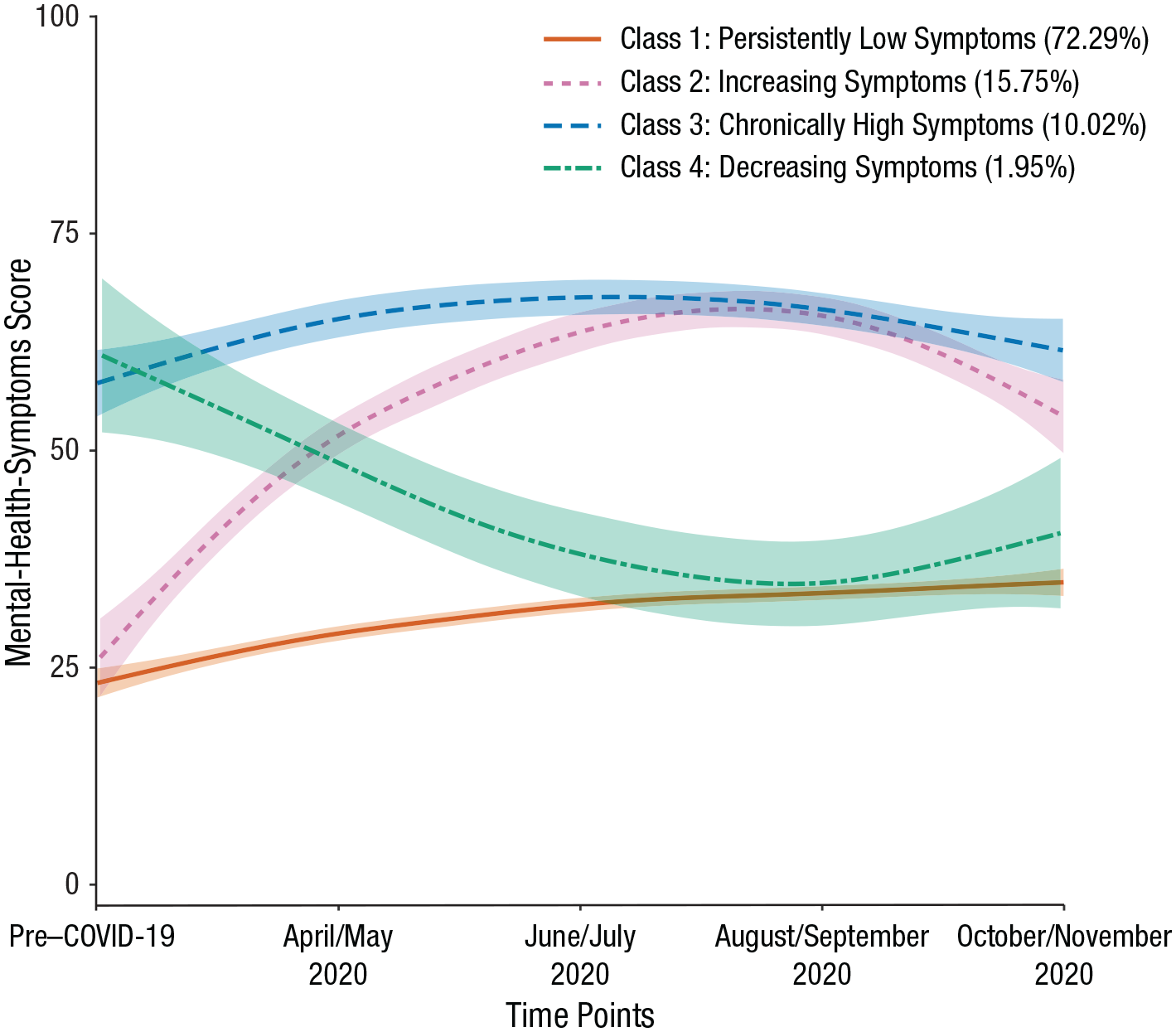
Four-class solution using model-estimated means (N = 3,085). Mental-health-symptom scores are graphed as a function of time point, separately for each class. The shaded areas around each curve are 95% confidence intervals. Class 1: intercept = 21.94, slope = 7.22, quadratic term = −1.07); Class 2: intercept = 25.04, slope = 32.97, quadratic term = −6.50; Class 3: intercept = 59.46, slope = 7.995, quadratic term = −1.85; Class 4: intercept = 62.95, slope = −21.70, quadratic term = 4.21. All values are statistically significant (p < .001).
To examine the associations between risk factors and the four trajectories of mental-health symptoms, we added predictors and covariates to the conditional GMM. Descriptive statistics of predictor variables in the four trajectory classes are presented in Table 2 (for correlations between the predictor variables and class assignment probabilities, see Table S3 in the Supplemental Material). Results from the multinomial logistic regression (i.e., between-trajectories comparisons) on predictors and covariates are presented in Table 3.
Descriptive Statistics of Predictors in Different Classes (N = 3,085)

Note: All the predictors were coded so that higher scores indicated elevated risk. COVID-19 diagnosis was coded as 1 = diagnosed, 0 = not diagnosed. Black, Latinx, and other-minority status were coded as three binary (0/1) variables. Prepandemic cumulative risk factor was calculated by adding five dichotomous variables, including young-parent status (1 = parent 24 years old or younger, 0 = parent older than 24 years), single-parent status (1 = single parent, 0 = dual parent), children’s disability status (1 = household of children with disabilities, 0 = household without children with disabilities), having four or more children in the household (1 = having four or more children in the household, 0 = having fewer than four children in the household), and 2019 poverty level (1 = household income ≤ 200% of the federal poverty level, 0 = household income > 200% of the federal poverty level). Loss of child care during the pandemic, decreased employment since COVID-19, increased family conflict since COVID-19, and lack of health care during the pandemic were all coded as 1 = yes, 0 = no.
Multinomial Logistic Regression Odds Ratios and Confidence Intervals for Time-Invariant Predictors (N = 3,085)

Note: In each pairwise comparison, the second class was used as the reference. COVID-19 diagnosis was coded as 1 = diagnosed, 0 = not diagnosed. Black, Latinx, and other-minority status were coded as three binary (0/1) variables. Prepandemic cumulative risk factor was calculated by adding five dichotomous variables, including young-parent status, single-parent status, children’s disability status, having four or more children in the household, and poverty (i.e., household income below 200% federal poverty level). Loss of child care during the pandemic, decreased employment since COVID-19, increased family conflict since COVID-19, and lack of health care during the pandemic were all coded as 1 = yes, 0 = no. OR = odds ratio; CI = confidence interval of logit.
p < .05. **p < .01. ***p < .001.
Prepandemic cumulative risk factor
The prepandemic cumulative risk factor significantly (a) distinguished the persistently low mental-health-symptoms trajectory from the increasing mental-health-symptoms trajectory and the chronically high mental-health-symptoms trajectory and (b) distinguished the increasing mental-health-symptoms trajectory from the chronically high mental-health-symptoms trajectory. Compared with parents in the persistently low mental-health-symptoms trajectory, parents in both the increasing mental-health-symptoms trajectory (odds ratio [OR] = 1.30, p < .05) and the chronically high mental-health-symptoms trajectory (OR = 2.00, p < .001) reported higher levels of prepandemic cumulative risk factor. Parents in the increasing mental-health-symptoms trajectory had a lower level of cumulative risk (OR = 0.65, p < .05) than did those in the chronically high mental-health-symptoms group.
Risk factors during the pandemic
Loss of child care
Losing child care during the pandemic significantly distinguished the increasing mental-health-symptoms and persistently low mental-health-symptoms trajectories. Compared with the persistently low mental-health-symptoms trajectory, parents in the increasing mental-health-symptoms trajectory were more likely to lose child care (OR = 2.08, p < .01).
Decreased employment
Employment decrease during the pandemic significantly distinguished the increasing mental-health-symptoms trajectory from the persistently low mental-health-symptoms and the chronically high mental-health-symptoms trajectories. Parents in the increasing mental-health-symptoms trajectory were more likely to have decreased employment compared with parents in both the persistently low mental-health-symptoms trajectory (OR = 1.61, p < .05) and the chronically high mental-health-symptoms trajectory (OR = 2.52, p < .01) during the pandemic.
Financial strain
Household financial strain during the pandemic significantly distinguished the persistently low mental-health-symptoms trajectory from the increasing mental-health-symptoms and the chronically high mental-health-symptoms trajectories. Compared with parents in the persistently low mental-health-symptoms trajectory, those in the increasing mental-health-symptoms trajectory (OR = 2.06, p < .001) or the chronically high mental-health-symptoms trajectory (OR = 2.27, p < .001) were both more likely to experience financial strain during the pandemic.
Increased family conflict
Increases in family conflict during the pandemic significantly distinguished the increasing mental-health-symptoms trajectory from the persistently low mental-health-symptoms trajectory and the decreasing mental-health-symptoms trajectory. Compared with parents in the persistently low mental-health-symptoms trajectory, those in the increasing mental-health-symptoms trajectory were more likely to experience increased family conflict during the pandemic (OR = 3.81, p < .001). Compared with parents in the increasing mental-health-symptoms trajectory, those in the decreasing mental-health-symptoms trajectory were less likely to experience family conflict (OR = 0.20, p < .01) during the pandemic.
Lack of health care
Lack of health care during the pandemic did not significantly distinguish different mental-health-symptoms trajectories in the GMM.
Covariates
COVID-19 diagnosis
COVID-19 diagnosis significantly distinguished the chronically high mental-health-symptoms trajectory from the persistently low mental-health-symptoms trajectory and the increasing mental-health-symptoms trajectory. Parents in the chronically high mental-health-symptoms trajectory reported a higher COVID-19 diagnosis rate (OR = 2.39, p < .01) than did those in the persistently low mental-health-symptoms trajectory. Parents in the increasing mental-health-symptoms trajectory had a lower rate of COVID-19 diagnosis (OR = 0.46, p < .05) than did those in the chronically high mental-health-symptoms group.
Race/ethnicity
Race/ethnicity groups did not significantly distinguish different mental-health-symptoms trajectories in the GMM.
LGCM results
The unconditional LGCM with intercept, slope, and quadratic terms had acceptable fit indices, χ2(6) = 451.85, comparative fit index = .93, standardized root-mean-square residual = .08, which was a significant improvement from the LGCM with only intercept and slope parameters, χ2(4) = 922.06, p < .001. The LGCM revealed significant (p < .001) mean levels of intercept (b = 28.14), slope (b = 11.06), and quadratic (b = −1.98) terms, which suggests a curvilinearly increasing trajectory of parental mental-health symptoms during the pandemic. The variances for the intercept (s2 = 193.51), slope (s2 = 85.88), and quadratic term (s2 = 3.49) were significant (p < .001), which indicates large heterogeneity in parental mental-health-symptoms trajectories. A conditional LGCM was constructed to examine the associations between risk factors and parents’ mental-health-symptoms trajectories; results are presented in Table 4.
Associations Between Time-Invariant Predictors and Latent-Growth-Curve Model Parameters (N = 3,085)

Note: All the predictors were coded so that higher scores indicated elevated risk. Model fit was acceptable: χ2(26) = 486.80 (p < .001), comparative fit index = .95, standardized root-mean-square residual = .03. COVID-19 diagnosis was coded as 1 = diagnosed, 0 = not diagnosed. Race/ethnic (Black, Latinx, other minority) were all coded as dichotomous (0/1) variables. Prepandemic cumulative risk factor was calculated by adding five dichotomous variables, including young-parent status (1 = parent 24 years old or younger, 0 = parent older than 24 years), single-parent status (1 = single parent, 0 = dual parent), children’s disability status (1 = household of children with disabilities, 0 = household without children with disabilities), having four or more children in the household (1 = having four or more children in the household, 0 = having fewer than four children in the household), and 2019 poverty level (1 = household income ≤ 200% of the federal poverty level, 0 = household income > 200% of the federal poverty level). Loss of child care during the pandemic, decreased employment since COVID-19, increased family conflict since COVID-19, and lack of health care during the pandemic were all coded as 1 = yes, 0 = no.
p < .10. *p < .05. **p < .01. ***p < .001.
Prepandemic cumulative risk factor
The prepandemic cumulative risk factor was positively and significantly associated with higher levels of mental-health symptoms at the starting point (i.e., intercept; β = 0.28, p < .001). However, this prepandemic cumulative risk factor was not significantly associated with parents’ changes in mental-health symptoms (i.e., slope) or the curvilinear trend (i.e., quadratic term).
Risk factors during the pandemic
The conditional LGCM finding suggested that losing child care during the pandemic did not significantly predict the intercept or the slope of parents’ mental-health-symptoms trajectories. Decreased employment was related to significantly higher levels of mental-health symptoms at the starting point (i.e., intercept; β = 0.06, p < .05) but was not significantly associated with parents’ changes in mental-health symptoms (i.e., slope). Financial strain significantly predicted higher levels of mental-health symptoms at the starting point (β = 0.32, p < .001) and marginally predicted the increases of mental-health symptoms during the pandemic (β = 0.25, p < .10). Increased family conflict was not significantly associated with the intercept but significantly predicted the slope of mental-health symptoms during the pandemic (β = 0.49, p < .01). Lack of health care was positively and significantly associated with the LGCM intercept (β = 0.07, p < .01) but was not linked to the slope. None of these during-pandemic risk factors was significantly related to the curvilinear trend (i.e., quadratic term) of parents’ mental-health-symptoms trajectories in the LGCM.
Covariates
The COVID-19 diagnosis was positively and significantly associated with higher levels of the mental-health-symptoms intercept (β = 0.14, p < .001) but was not significantly associated with the slope or quadratic term in the LGCM. Compared with White families, Black families were less likely to exhibit the increased mental-health-symptoms trajectory (i.e., slope; β = −0.51, p < .01) and presented a less pronounced curvilinear trend (β = −0.44, p < .05). Hispanic/Latino/Latina) parents did not show significant differences in the mental-health-symptoms trajectories compared with White parents. Finally, parents in other minority groups exhibited marginally lower levels of mental-health-symptoms intercept than did White parents (β = −0.05, p < .10).
Discussion
Scientific understanding about parent psychopathology can be advanced during the pandemic because an unprecedented number of parents were exposed to new or worsening risk factors for mental-health problems. The widespread yet differential impact of risk families faced provided an unusual context to test how new risk introduced by the pandemic beyond families’ preexisting levels of risk were related to unique classifications of parental-mental-health trajectories during the first 8 months of the pandemic. The relationship between risk factors was further examined in relation to baseline and linear trajectories of parent mental-health symptoms to further understand these patterns.
LGCM with a variable-centered approach indicated that, on average, parents of young children showed an increasing trajectory of mental-health symptoms during the pandemic. When we took individual heterogeneity into account and used a person-centered method, the GMM identified four distinct parental-mental-health trajectories. Of the four trajectories, approximately 72% of parents were identified as having low mental-health symptoms throughout the pandemic. This is reassuring from a public-health perspective. However, equally noteworthy—or perhaps more noteworthy—is the finding that approximately 26% of the sample reported mental-health symptoms either persistently high or increasing during the pandemic. The rates in the present study were within the range of rates published by other studies on parental mental health early in the pandemic (Cameron et al., 2020; Patrick et al., 2020). Support for these rates being an increase from prepandemic rates comes from a large national cohort study (United Kingdom Household Longitudinal Study; Pierce et al., 2020) that has monitored trends in mental health years before the pandemic. What is unknown, given the previous lack of repeated intensive sampling of parental mental health during the pandemic, is the extent to which the trajectories and associated rates of trajectory membership would be observed beyond the context of the pandemic. Employing similar RAPID-EC methodology after the pandemic stands to significantly advance knowledge on both risk factors to parent mental health and how acute presentations versus chronic presentations of mental-health symptoms affect child outcome (Hammen & Brennan, 2003).
Person-oriented (GMM) and variable-oriented (LGCM) approaches were also used to examine how risk factors predicted parental mental-health trajectories, which is a main focus of this work. Overall, although there were more significant predictors found using the GMM than the LGCM, the pattern of significant results was largely consistent across the two models. As hypothesized, an accumulation of risk factors predating the pandemic differentiated the two mental-health trajectories characterized by higher mental-health symptoms (either persistent or increasing) from the other trajectories. Findings from the LGCM approach corroborate these results in that greater accumulation of pre–COVID risk significantly predicted higher baseline parent mental-health symptoms. Note that although the cumulative risk index was labeled “pre–COVID-19,” undoubtedly there were unique ways in which these preexisting factors became more challenging during the pandemic—for example, caring for a child with a disability without typical supports or services has led to increased parental stress (Asbury et al., 2021; Dhiman et al., 2020).
Among the risk factors occurring during COVID-19, financial strain was associated with the increasing mental-health-symptom trajectory even when decreases in employment were accounted for. To differentiate between the two poor-mental-health profiles, we note that one risk factor occurring during COVID-19—decreased employment—uniquely and prospectively predicted the trajectory characterized by an increase of mental-health symptoms throughout the pandemic. These results were corroborated with the LGCM results in that financial strain and decreased employment were associated with baseline parent mental-health symptoms; furthermore, there was a trend in which financial strain predicted linear growth in parental mental-health symptoms. Together, our findings slightly differ from the economically vulnerable Chicago sample (Kalil et al., 2020), in which it was the combination of job and income loss that led to poorer parental mental health. However, in that sample, parents all had lower incomes, whereas the present sample recruited families from the full range of income backgrounds. Thus, some parents in the present sample experienced job loss without incurring financial strain, and the results indicate that financial strain was the most salient factor in understanding parental mental health. Of course, conclusions about a causal association cannot be made. Nonetheless, it is reasonable to suggest that these experiences serve as useful signals that the mental health of parents of young children may worsen if those conditions are not remedied.
Increased family conflict was an important predictor of poorer parent-mental-health trajectories across both analytic approaches. Previous work has shown that maternal depression is associated with increased family conflict (Madigan et al., 2017). We acknowledge that a bidirectional relationship between family conflict and poor parent mental health is likely to exist.
Loss of child care was a significant predictor differentiating parents with increasing symptoms from those with persistently low mental-health symptoms only in the GMMs. In addition, lack of health care was a significant predictor of parent-mental-health trajectories only in the LGCM. The few inconsistencies in the results between the two approaches might be induced by the individual heterogeneity in parents’ mental-health-symptoms trajectories, which is accounted for only in the GMM. Nonetheless, to our knowledge, this is one of the first studies to assess and find evidence that loss of child care predicts poorer parental mental health (even after accounting for other risk factors). Future work on parental psychopathology should assess access of child care because it may have been a previously underappreciate risk variable within this field. In addition, data collected very early in the pandemic also demonstrated that lack of health care was a predictor of worsening parent mental health (Patrick et al., 2020) such that these results are consistent with other samples.
Finally, it is important to note that a COVID-19 diagnosis, although included as a covariate, was associated with worse parental mental health in both the GMM and LGCM, an association consistently reported by others (Wu et al., 2021). Regarding our findings that Black parents had less of an increase in mental-health symptoms over time, related work found that the difference in depression between Black and White pregnant women during the pandemic was partially accounted for by age, marital status, and socioeconomic status and that Black women reported higher emotion regulation and self-reliance (Gur et al., 2020). In addition, in a prepandemic-existing large and longitudinal cohort of Canadian mothers, White mothers had greater increases in anxiety scores than non-White mothers during the early phases of the pandemic (Racine et al., 2021). More work is needed to understand how parental race and ethnicity are related to mental health during the pandemic.
An important implication of this work is that given the wide range of predictors of parental mental health, an array of prevention and intervention strategies will need to be employed, going beyond the field’s standard approaches. These include but are not limited to use of interventions developed outside of clinical psychology but that improve mental health; use of brief, mass-delivered interventions; and use of lay providers (Gruber et al., 2021). Reducing the risk to parental mental health is important not only to parents but also, critically, to the many children our survey and others indicate are being exposed to significant parental anxiety and depression (Goodman et al., 2011; McLaughlin et al., 2012; van der Bruggen et al., 2008).
There are several limitations to this study. First, the parent-mental-health measure included only depression, anxiety, loneliness, and being stressed. Although these are highly prevalent symptoms, other important indicators of parental mental health, including substance use (Clay & Parker, 2020) and suicidal ideation (Czeisler et al., 2021), were not measured even though they are documented to have increased during the pandemic. Parents’ previous history of mental health was also not assessed. Second, despite the extensive effort to recruit families from diverse backgrounds, RAPID-EC is a convenience sample. Thus, the generalizability of study findings is limited. Third, this sample was largely composed of mothers. Caution should be used in extrapolating results to fathers because there are some reports of different pandemic-related experiences of mothers versus fathers (Russell et al., 2020). Finally, the GMM has been shown to have a tendency to produce artificial four-class solutions with one consistently high trajectory, one persistently low trajectory, one increasing trajectory, and one decreasing trajectory (i.e., the “cat’s cradle” pattern; Sher et al., 2011). This subgroup pattern was identified in this work, so caution should be used to not reify these groups or assume these subgroups would be identified again if a longer pandemic follow-up had been used. To guard against these known limitations, we included the prediction results from the LGCM (i.e., a variable-centered approach) because understanding the relationship among risk factors for parent-mental-health trajectories is the most salient contribution of this study. Because the RAPID-EC study is ongoing, these trajectories should be modeled again and incorporate time-varying predictors to further determine whether parent mental-health symptoms change as the pandemic wanes.
Poor parental mental health is just one of an extensive number of life-threating and life-altering risk factors facing parents and children in the United States, and likely many other areas of the world, during the pandemic. Although parental mental health is often not considered a basic need, it is generally responsive to treatment, which renders it as one lever society has to offset some of the anticipated poorer outcomes in children and, furthermore, to reduce suffering in adults who are parents. Beyond the pandemic, cumulative risk models and repeated intensive sampling of parental mental health should be used to advance the field’s understanding of the most significant risk factors contributing to poor mental health in parents with young children.
Supplemental Material
sj-pdf-1-cpx-10.1177_21677026221083275 – Supplemental material for Mental-Health Trajectories of U.S. Parents With Young Children During the COVID-19 Pandemic: A Universal Introduction of Risk
Supplemental material, sj-pdf-1-cpx-10.1177_21677026221083275 for Mental-Health Trajectories of U.S. Parents With Young Children During the COVID-19 Pandemic: A Universal Introduction of Risk by Maureen Zalewski, Sihong Liu, Megan Gunnar, Liliana J. Lengua and Philip A Fisher in Clinical Psychological Science
Footnotes
Transparency
Action Editor: Jennifer L. Tackett
Editor: Jennifer L. Tackett
Author Contributions
M. Zalewski and S. Liu are co-first authors. M. Zalewski was involved in the conceptualization and design of the study; drafted the abstract, the introduction, and the Discussion section; and revised and reviewed the entire manuscript. S. Liu carried out data analyses and drafted the Method and Results sections. M. Gunnar and L. J. Lengua provided constructional directions on the conceptualization and design of this study, reviewed and revised the manuscript, and provided input from theoretical and methodological perspectives. P. A. Fisher is the primary investigator of the Rapid Assessment of Pandemic Impact on Development–Early Childhood project and was involved in the conceptualization and design of the study, directed the design of data collection instruments, and reviewed and revised the manuscript. All of the authors approved the final manuscript for submission.

Notes
References
Supplementary Material
Please find the following supplemental material available below.
For Open Access articles published under a Creative Commons License, all supplemental material carries the same license as the article it is associated with.
For non-Open Access articles published, all supplemental material carries a non-exclusive license, and permission requests for re-use of supplemental material or any part of supplemental material shall be sent directly to the copyright owner as specified in the copyright notice associated with the article.
