



Abstract
Background:
Numerous studies have demonstrated that bariatric and metabolic surgery (BMS) is a safe and effective option for obese patients. In Japan, national health insurance has covered laparoscopic sleeve gastrectomy (LSG) since 2014, increasing the number of procedures performed. This study analyzed 31 patients who underwent LSG at Okayama University Hospital, a regional core medical institution, between 2017 and 2024, focusing on safety and efficacy.
Results:
The findings revealed no severe complications and indicated significant weight loss and improvements in various metabolic diseases. However, challenges such as weight regain and interruptions in patient follow-up were identified. The remission rates for type 2 diabetes, hypertension, and dyslipidemia were 25%, 28.6%, and 56.3%, respectively. The study also noted potential pitfalls in surgical techniques, highlighting the importance of experienced medical teams.
Conclusion:
Although the weight loss rate in this study was slightly lower than the national average, the results remained promising. A multidisciplinary approach, encompassing thorough preoperative evaluations and consistent postoperative follow-up, was essential for success. BMS is highly effective and stands out as one of the key treatments for obesity. The study concludes that our facility has successfully introduced safe and effective BMS in the regional hub hospital by adhering to established guidelines.
Introduction
The safety and efficacy of bariatric and metabolic surgery (BMS) have been scientifically proven,1,2 and the total number of surgeries performed worldwide is approaching 700,000. 3 In Japan, the national health insurance first covered laparoscopic sleeve gastrectomy (LSG) in April 2014. Although the number of cases was initially small, due to predecessors’ efforts, the number of surgeries has increased in recent years, with more than 700 BMS cases performed annually. 2 Furthermore, in June 2024, the national health insurance covered laparoscopic sleeve bypass surgery. The number of surgeries is expected to increase in the future. It is estimated that there are 256,000 patients with diabetes and severe obesity in Japan (population of approximately 125.8 million in 2020), and 29,000 patients for whom bariatric surgical treatment should be considered. 4 This data implies that the number of patients requiring BMS is still higher than the actual number of surgeries, and this treatment method is predicted to be in even greater demand in the future. As the population of Okayama Prefecture is approximately 1,836,000 (October 2024), it is estimated that 423 patients are eligible for BMS in Okayama Prefecture by a simple calculation. Focusing specifically on Okayama Prefecture, two issues stand out. First, both men and women in Okayama Prefecture have a higher body mass index (BMI) than the national average of 23.8 for men and 22.6 for women, with men averaging 24.2 and women averaging 23.3 (according to 2016 data from the Ministry of Health, Labour and Welfare). Okayama Prefecture is located in the Chugoku region (Fig. 1a), which includes five prefectures: Tottori, Shimane, Yamaguchi, Hiroshima, and Okayama. Among these, Okayama Prefecture has the highest BMI for both men and women (Fig. 1b), indicating a need for improvement. The second issue is the low rate of participation in specific health checkups. These checkups are a crucial system in Japan for preventing lifestyle-related diseases and contribute to maintaining Japan’s high health standards on a global scale. While the national average is 37.9%, Okayama Prefecture stands at 32.8% (according to 2023 data from the Ministry of Health, Labour and Welfare), ranking 43rd out of 47 prefectures nationwide (Fig. 1c). This low participation rate suggests that there may be a significant number of residents in the prefecture who have undetected metabolic-related complications. This situation makes efforts to promote participation in specific health checkups paramount. BMS is expected to increase in regional areas, but whether such a unique operation can be introduced safely in regional areas where the number of cases is small is an issue that needs to be considered. It is essential to clarify the problems specific to the initial introduction stage in regional hospitals with a limited number of patients and to introduce safe and effective BMS.
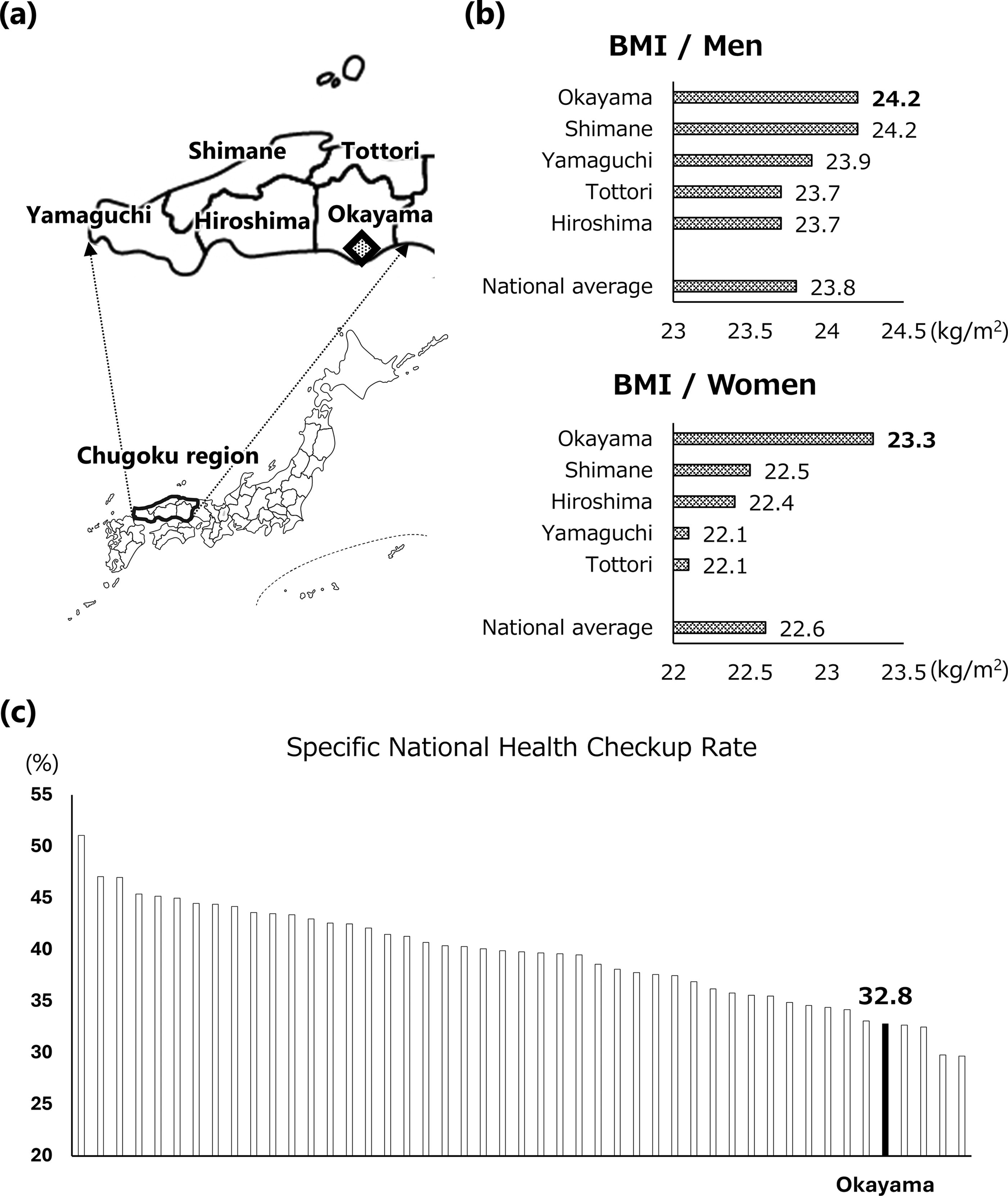
Average BMI and specific health examination participation rate among Okayama Prefecture residents. Okayama Prefecture is a central city located in the Chugoku region of western Japan, which consists of five prefectures. The diamond shape filled with dots indicates the location of our hospital
Materials and Methods
Study design and patients
Patient data were collected retrospectively. Thirty-one patients undergoing the procedure between 2017 and 2024 were analyzed. The study’s main objective was to assess the safety and efficacy of LSG performed at Okayama University Hospital. The inclusion criteria were Body mass index (BMI) 35 ≥ kg/m2 according to “Comprehensive Obesity Treatment Guidelines for Bariatric and Metabolic Surgery” by the Japanese Society for Treatment of Obesity. We invited an external advisor for the first five cases, and only patients with a BMI <37 kg/m2 were included; from the sixth case onwards, patients with a BMI ≥37 kg/m2 were also included. Cases with high BMI were judged to be difficult to operate on and to have a high risk of perioperative complications, so initially, cases with a BMI that was not too high were selected to perform the surgical procedure safely and reliably. Although there was no clear evidence, the hospital committee discussed the matter and set the BMI cutoff value at 37. Surgical treatment complied with the guidelines’ six institutional and five surgeon requirements (Table 1).
Requirements Mentioned in the Guidelines for Bariatric and Metabolic Surgery by the Japanese Society for Treatment of Obesity

Ethical application
The internal ethics committee of the Okayama University Hospital approved the study.
Data management
Data on patient demographics, age, sex, weight, and BMI were aggregated.
Preoperative medical treatment
A diabetes physician performed the initial consultation and started the enrolment of a dietitian from the first day. The patient was appropriately prescribed exercise therapy, diet, behavioral therapy, diabetic medications, and incretin, insulin, as determined by the diabetes physician. Before surgical treatment, we held a multidisciplinary conference to discuss the suitability of surgical treatment. Diabetes physicians, surgeons, anesthesiologists, psychiatrists, perioperative management center and operating room nurses, dietitians, and coordinators attended the conference. If the patient is female, a gynecologist also attends the conference.
Safety assessment of surgical procedures
Operation time, blood loss, and postoperative length of hospital stay were tabulated. Intraoperative complications were assessed using the Common Terminology Criteria for Adverse Events (CTCAE) v3.0. Postoperative complications were evaluated according to the Clavien–Dindo (CD) classification v2.0.
Postoperative follow-up methods
Following surgery, patients are generally required to visit our outpatient clinic monthly for weight measurement and blood chemistry tests. During each visit, patients must consult with a diabetes specialist and a registered dietitian. Any increase in weight since the previous measurement, even if minimal, is classified as weight regain (weight regain since the last measurement), and the number of times weight has increased is recorded. Additionally, if there is a 5% increase from the minimum weight achieved after surgery or a return to the presurgery weight, this is recorded as “5% weight regain.” Surgeons do not examine patients every month, but they do so every six months, as well as when internists determine that a surgeon’s examination is necessary or perform upper gastrointestinal endoscopy and abdominal computed tomography scans.
A psychiatrist always examines patients with psychiatric disorders, but even patients without psychiatric disorders undergo consultations with a psychiatrist every few months.
Statistical analysis
Statistical analysis was performed using JMP® Pro version 17.0.0 (SAS Institute Inc.). Descriptive statistics comprised absolute frequencies, relative frequencies, means, and standard deviations. Differences between groups were compared for differences using one-sample Wilcoxon tests or paired t-tests (continuous parameters). The relationship between continuous variables was measured using Spearman’s rank correlation coefficient, and results with a two-sided p value <0.05 were considered statistically significant. Asterisks in the figure indicate significant differences (p value <0.05).
Surgical efficacy
The effectiveness of surgery was assessed in 23 patients who had been postoperative for at least three years. It was determined according to the percentage of total weight loss (%TWL), percentage of excess weight loss (%EWL), and change in BMI. Efficacy rates for obesity-related complications were assessed as follows. For diabetes mellitus, complete remission was defined as postoperative hemoglobin A1c (HbA1c) < 6.0% and no longer requiring insulin and oral diabetes medications. Partial remission was defined as postoperative HbA1c < 6.5% and no longer require insulin and oral diabetes medications. For hypertension and dyslipidemia, cure was defined as postoperative patients who no longer required oral medications and whose blood pressure, low-density lipoprotein cholesterol (LDL-C), high-density lipoprotein cholesterol (HDL-C), total cholesterol (Total-C), and triglycerides (TG) had normalized. 1 All other adverse events were recorded.
Surgical procedure
Four gastrointestinal surgeons performed surgical procedures. Preoperative upper gastrointestinal endoscopy was performed to ensure that the residual stomach could be formed without problems, without a tumor or deformity. Anesthesiologists performed general anesthesia. The first port was inserted using the optical method with a 12 mm port from 13 cm caudal and 2 cm left of the xiphoid process. A 15 mm port was inserted from the right abdomen. We determined the position visually to facilitate the first suture of gastrectomy. A 12 mm port was inserted 10 cm caudal to the left midclavicular rib arch, and a 5 mm port was inserted slightly cephalad left of the 12 mm port. Another 5 mm port was added under the rib arch on the cephalic right side from the inserted 5 mm port if necessary. The extrahepatic area was raised using an instrument such as the Nathanson retractor, a Penrose drain, or a silicone disc. The gastric mesentery was incised before gastrectomy was performed. An automatic suture device starts the dissection 5 cm from the pyloric ring. A gastric tube is prepared 2.5 cm from the gastric angle. The automatic suture device is used about 6 times while visually maintaining a distance from the lesser curvature to complete the gastric tube. The most proximal part of the tube is dissected at 1.5–2 cm from the angle of His. The proximal end of the dissection is sutured with burial sutures (Fig. 2a). The resected stomach is removed through a 15 mm port wound. The gastric tube is sutured to the transverse colonic mesentery to prevent postoperative herniation of the residual stomach. 15 Fr Blake drain is placed dorsal to the residual stomach. Postoperatively, the patient is managed according to the clinical path. Fluid intake starts the day after surgery, and a liquid diet starts on the second postoperative day. Proton pump inhibitors and ursodeoxycholic acid are started postoperatively. Patients are discharged after receiving nutritional guidance from a dietitian.
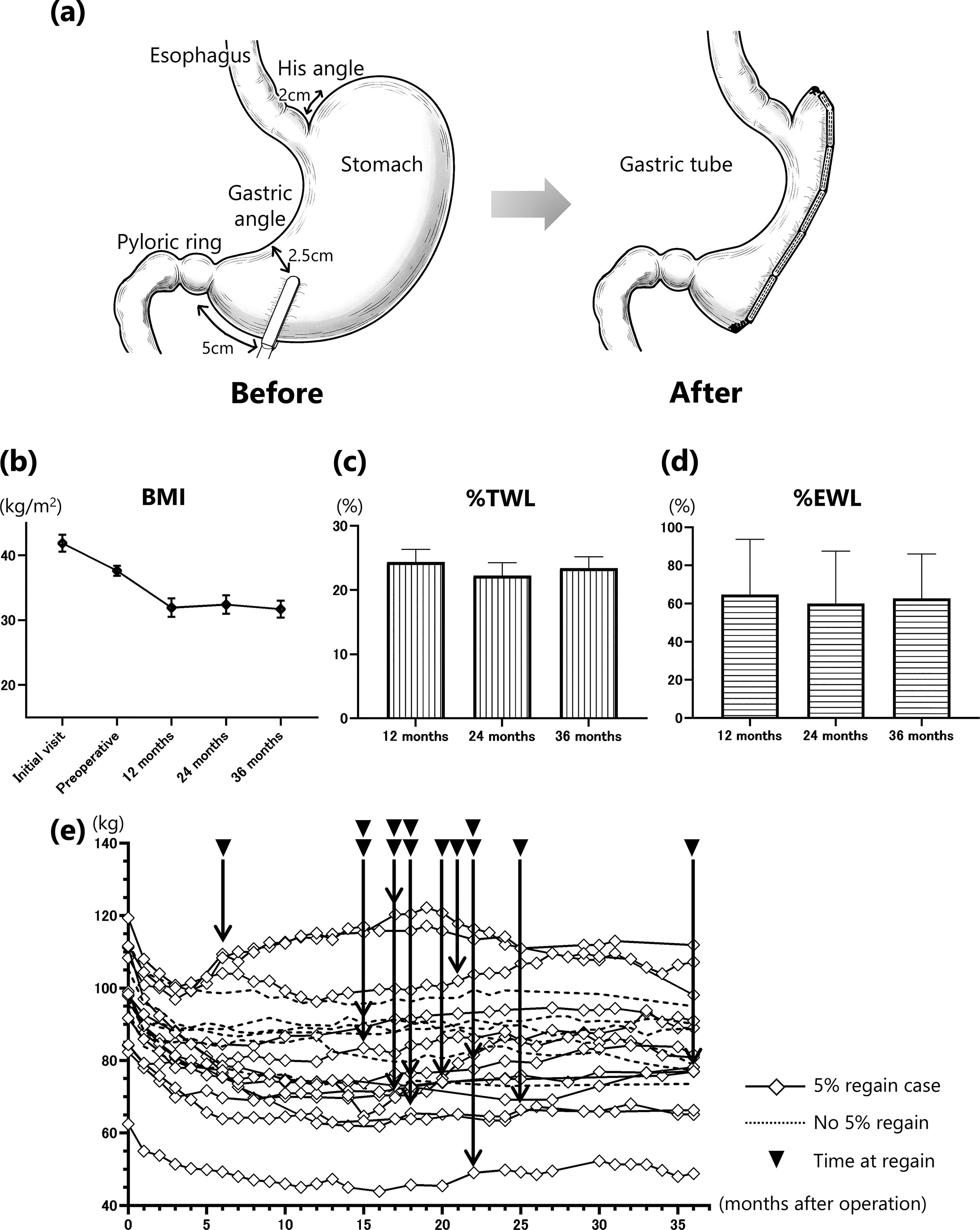
Changes in BMI, %TWL, and %EWL. Schematic of laparoscopic sleeve gastrectomy
Results
Patients who underwent LSG between 2017 and 2024 were retrospectively analyzed. For a total of 31 patients, we analyzed surgical outcomes for safety assessment (Table 2). In 23 patients who had undergone the procedure more than 3 years after surgery, weight change and obesity-related diseases were also analyzed to evaluate the efficacy of the treatment (Table 3). The mean age of the 31 patients was 45.3 (24–60) years, 17 were female, and 14 were male. Body weight and BMI at the initial examination were 111.8 (72.4–145.3) kg and 42.4 (33.8–59.7) kg/m2. Body weight and BMI just before surgery were 101.0 (62.5–119.4) kg and 38.2 (32.5–37.6) kg/m2. Short-term postoperative outcomes were as follows: mean operative time was 188.1 (150–243) minutes, mean blood loss was 16.6 (0–450) mL, there were no surgical complications of CD category III or higher, and postoperative hospital stay was 10 (7–17) days. Intraoperative complications included one case of 450 mL bleeding due to mesenteric injury during port insertion and bleeding from the splenic hilum, although not comparable to CTCAE grade 3. No case resulted in a change of surgical procedures or conversion to laparotomy.
Short Term Results of Laparoscopic Sleeve Gastrectomy (N = 31)

CD, Clavien–Dindo; CTCAE, Common Terminology Criteria for Adverse Events.
Effects of Laparoscopic Sleeve Gastrectomy on Obesity-Related Diseases 3 Years After Surgery

DPP4, dipeptidyl peptidase 4; GIP, glucose-dependent insulinotropic polypeptide; GLP-1, glucagon-like peptide-1; SGLT2, sodium-glucose co-transporter 2.
For the 23 patients who had been postoperative for more than 3 years, the mean weight was 110.0 kg, the mean BMI was 41.9 kg/m2 at the initial visit, the mean weight was 99.1 kg, and the mean BMI was 37.6 kg/m2 before surgery. BMIs at 1, 2, and 3 years postoperatively were 31.9 kg/m2, 32.4 kg/m2, and 31.7 kg/m2, respectively (Fig. 2b). %TWL and %EWL at 1, 2, and 3 years postoperatively were 24.3%, 22.3%, and 23.4% for %TWL (Fig. 2c) and 64.8%, 60.0%, and 62.8% for %EWL (Fig. 2d), respectively. Regarding the regain evaluation, all trackable cases recorded weight gain since the last measurement in three years. The average number of rebound episodes per case over three years was 10.2. The average time to the first rebound episode was 7.6 months postsurgery. When evaluating “5% weight regain,” 13 out of 19 cases (68.4%) showed weight regain (Fig. 2e). The median time to “5% weight regain” in these cases was 24.6 months. Preoperative prevalence of metabolic-related diseases was 69.6% for type 2 diabetes, 60.9% for hypertension, and 69.6% for dyslipidemia. The preoperative HbA1c of patients with diabetes mellitus was 6.64. Still, the values at 1, 2, and 3 years postoperatively were 6.18% (p = 0.02), 6.31%, and 6.21%, respectively (Fig. 3a). The complete remission rate of type 2 diabetes was 25.0%, and the partial remission rate was 31.3%. 56.3% of the patients improved, including those with normal HbA1c and those in remission despite oral diabetes medications. In the case of hypertension, six patients did not require antihypertensive medicines after surgery, and the remission rate was 28.6%. Preoperative systolic blood pressure (sBP) for patients with hypertension was 130.1 mmHg, and diastolic blood pressure (dBP) was 82.4 mmHg. At 1, 2, and 3 years postoperatively, sBP values were 136.2 mmHg, 133.9 mmHg, and 131.4 mmHg (Fig. 3b); dBP values were 83.7 mmHg, 80.5 mmHg, and 84.5 mmHg (Fig. 3c). Before surgery, 12 patients took antihypertensive medication, but after surgery, six patients were able to stop taking them. Four patients achieved normal blood pressure without medication, resulting in a remission rate of 28.6%. For patients with dyslipidemia, preoperative LDL-C was 106.4 mg/dL, HDL-C was 47.5 mg/dL, Total-C was 177.7 mg/dL, and TG was 159.4 mg/dL. At 1, 2, and 3 years postoperatively, LDL-C values were 107.0 mg/dL, 110.1 mg/dL, and 101.5 mg/dL (Fig. 3d); HDL-C values were 66.0 mg/dL (p < 0.0001), 64.1 mg/dL (p < 0.0001), and 63.2 mg/dL (p = 0.0003) (Fig. 3e); Total-C values were 188.7 mg/dL, 188.2 mg/dL, and 180.1 mg/dL (Fig. 3f); TG was 97.8 mg/dL (p = 0.0005), 115.6 mg/dL (p = 0.02), 131.4 mg/dL (Fig. 3g). Eight patients were in remission, and the remission rate was 50.0%. The improvement rate was 81.3%, including 13 cases in remission, and LDL-C, HDL-C, Total-C, and TG were all within the normal range despite continued medical treatment. Of the 23 patients evaluated for weight loss at 3 years postoperatively, 19 were still attending outpatient clinics, and four had discontinued. Four patients had voluntarily stopped attending outpatient clinics, and the reasons for this were unknown. The hospital attempted to contact the patients by telephone, but the attempts were unsuccessful.
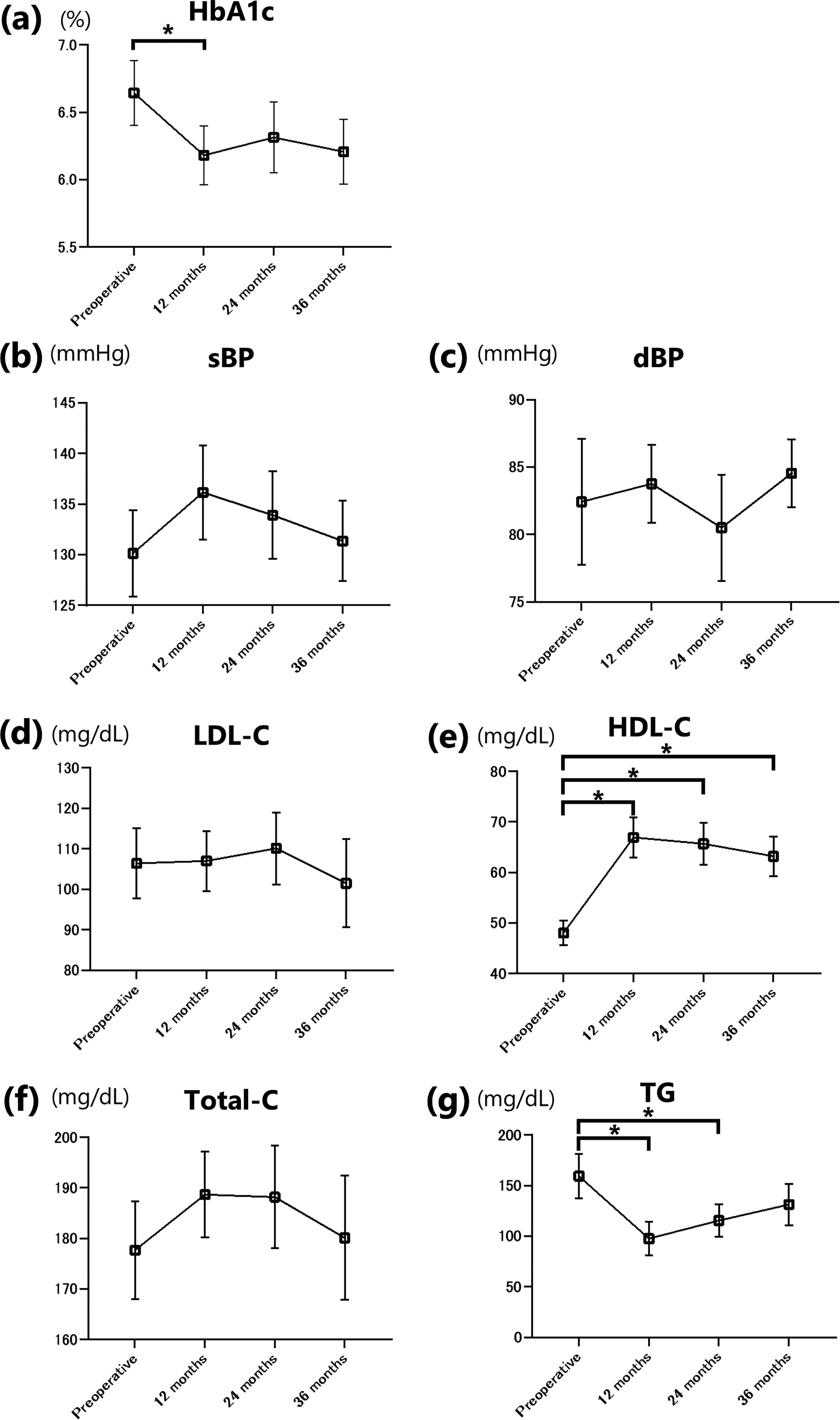
HbA1c, sBP, dBP, LDL-L, HDL-C, Total-C, and TG values at preoperative and 1, 2, and 3 years postoperatively. The figure shows HbA1c
Discussion
The “Guidelines for Safe and Outstanding Surgical Treatment of Severe Obesity in Japan” set strict requirements for institutions, surgeons, and patient selection. We have provided safe and effective treatment at our hospital by following these guidelines, emphasizing safety and effectiveness. Furthermore, in 2021, the Japan Diabetes Society, the Japan Society for the Treatment of Obesity, and the Japan Obesity Society jointly issued a “Consensus Statement on bariatric and metabolic surgery for Japanese Patients with Type 2 Diabetes Mellitus,” which devised surgical standards for Japanese patients based on scientific evidence. 5 Comparing the treatment results at our hospital with those of metabolic surgeries performed in Japan between 2000 and 2019, they are entirely comparable and safely conducted. In the previous report, 21 (0.7%) of 2865 LSGs were reported to have bleeding requiring reoperation, and 14 (0.5%) to have anastomotic leakage. 2 There were five cases of open conversion (0.2%) and one case of operative death. 2 Although we have only had a small number of patients (31 cases), we have not had a single case of CD Class III or higher complication, including reoperation and open conversion. Although gastric stricture and reflux esophagitis are possible complications that may occur sometime after LSG surgery, we have not experienced any of these complications so far. However, intraoperative complications include mesenteric injury during port insertion and bleeding at the splenic hilum, which could have resulted in serious complications if a wrong decision had been made. Obese patients have thick abdominal walls, so special care is required for the insertion of the first port.6,7 We also used the optical method to insert the port while checking each layer, but we misjudged the layers and damaged the mesentery. In addition, it is difficult to obtain a clear view of the deep splenic hilar region, and obese patients have a large amount of visceral fat, so care must be taken to avoid vascular injury. 8 Assistants and laparoscopists need to share information in advance, not only on the normal intra-abdominal anatomy but also on how to develop the surgical view specific to obese patients. Assigning the same team members in facilities where residents and part-time physicians work is difficult, so a thorough preoperative discussion and simulation may be useful. 9 Fortunately, after this, no bleeding problems have occurred during port insertion or in the splenic portal area. It is essential to prepare well and form a mature surgical team to perform safe and effective surgery without pitfalls, even in a few cases in rural areas.
The excess weight loss rate in the study was 64.8% in 1 year, 60.0% at 2 years, and 62.8% at 3 years postoperatively. Although these results were slightly lower than those reported in Japan (75% at 1 year, 72% at 2 years, and 68% at 3 years postoperatively), 2 they were still good results. The reason for the slightly lower rate of weight loss is that some patients had a larger-diameter gastric tube. We are concerned about the risk of stricture and have created a gastric tube slightly larger than the typical diameter. As the diameter of the gastric tube increases, the amount of food intake physically increases, raising the risk of weight gain. In addition, insufficient resection of the fundus may fail to suppress ghrelin secretion, leading to uncontrollable appetite. We are considering the following measures to address the slightly large gastric tube diameter issue. Currently, we only measure the distance from the gastric angle. Since there is no guide inside the tube lumen during resection, we are considering inserting a guide tube or endoscope. This will allow us to resect at the measured distance and prevent narrowing due to excessive deviation toward the lesser curvature. Regain should be a crucial factor in postoperative weight management. 10 In our study, over the three years, BMI decreased, but all cases experienced weight gain since the last measurement during the course. The average number of months postsurgery at which weight regain since the last measurement occurs is 7.6 months, so particular attention is required from around six months onward. However, in this evaluation method, even a weight gain of just 0.1 kg from the last measurement is recorded as a regain, so it cannot be considered a perfect evaluation method. In other words, even during several months when weight loss is progressing smoothly, a weight gain of 0.1 kg is counted, making this method unsuitable for evaluating long-term weight regain. We have adopted the “5% weight regain” criterion to evaluate regain over a specific period. This evaluation method reveals that there is a 68.4% risk of regaining even in the long term. Additionally, since it takes 24.6 months to reach “5% weight regain,” it is necessary to closely monitor patients around two years postsurgery and consider appropriate additional treatment interventions as needed. Fortunately, at the time of 3 years after surgery, the patient has not gained any more weight, and we are confident that this is due to the support system of our hospital’s multidisciplinary team, including nutritional guidance. In addition, many of the patients have always consumed high-calorie junk food and snacks, and if they are not followed up postoperatively, their eating habits may become disordered again. In other words, the follow-up rate is also essential to the outcome after BMS. 11 Of the 23 patients who had undergone surgery for more than 3 years, four patients were not followed up because they were unreachable. The percentage of outpatient interruptions in patients who underwent sleeve gastrectomy at 1 year postoperatively is 16.5%, 12 and at 10 years postoperatively, it is as high as 30%, 13 so our result of 17.4% is almost the same as the previous study. However, no matter how carefully we select patients and provide education and guidance for follow-up, some patients leave the clinic. One of the challenges is managing the team so as not to increase this number if possible, and to reduce the withdrawal rate.
The remission rate of metabolic diseases with surgical therapy has been reported to range from 46% to 52%.14,15 In reports from outside Japan, the definition of remission may differ from that in Japan, and there is a slight range in remission rates. In our hospital, the complete remission rate of type 2 diabetes at 3 years was 25%, the partial remission rate was 31.3%, and the improvement rate was 56.25%. The age, BMI, C-peptide, and duration of diabetes score, a measure of diabetes improvement by weight loss metabolic surgery, 14 was compared between the diabetes remission and nonremission groups. Still, there was no difference between the two groups. Although these results were inferior to those reported previously, one reason may be that there are several cases where the HbA1c is below 6%, but only improvement due to continued oral diabetes medication. As reported in the previous study, the rate of diabetes improvement is also poor in patients with low weight loss; 16 the rate of weight loss and diabetes improvement may be related in this study.
Furthermore, we cannot deny that this may be due to the slightly larger diameter of the gastric tube, as mentioned above. However, the fact that more than half of the refractory patients showed improvement is a significant merit and may be one of the treatment options. In 2024, national health insurance also covered laparoscopic sleeve bypass surgery. Although there are some problems to overcome, such as procedural complexity and postoperative complications, the diabetes improvement rate is better than that of sleeve gastrectomy, 17 and the number of cases is expected to increase. Recently, however, glucagon-like peptide-1 (GLP-1) receptor agonists and glucose-dependent insulinotropic polypeptide/GLP-1 receptor dual agonists have been introduced, and their weight loss rate and diabetes improvement are remarkable. Weight loss was 11.51 kg, and HbA1c reduction was 1.49%. 18 Although we cannot ignore the adverse events and medical-economic problems associated with the medication, many patients benefit from it, and appropriate use of the medication is important.19,20 Sometimes, a combination of medical and surgical treatment may be effective.
Our study’s remission rate of hypertension was 28.6%. Our results were also slightly inferior to those of previous reports, which ranged from 45.5% to 71%.21,22 Regarding this issue, we believe that the definition of remission for hypertension, which includes “no medication,” is a contributing factor. In other words, even in cases where blood pressure has been steadily decreasing to a certain extent, there are instances where a small amount of antihypertensive medication is continued as a matter of routine. In such cases, if we actively aim to discontinue medication once blood pressure reaches normal levels and achieve medication-free status, the remission rate might improve further. In fact, in this study, there were six cases where antihypertensive medication was continued postoperatively. Four cases had an average sBP of 129.2 mmHg and an average dBP of 78.7 mmHg while taking a small dose of antihypertensive medication. If these cases were to become medication-free, the remission rate would be 57.1% (8/14), which is comparable to the national average.
For dyslipidemia, the remission rate of our study was 50%. Several studies have shown an ameliorative effect of LSG on dyslipidemia. 23 The accumulation of visceral adipose tissue and insulin resistance promotes lipoprotein production from the liver. Lipoprotein lipase’s activity is decreasing, and the decline in turnover of triglyceride-rich lipoprotein is one cause of dyslipidemia in obesity.24,25 The values of each lipid test showed that LDL-C did not change much from 106.4 mg/dL to 101.5 mg/dL after 3 years. Still, HDL-C, the so-called good cholesterol, increased continuously after surgery, from 47.5 mg/dL initially to 63.2 mg/dL, and this was difficult to obtain with medical treatment and may be due to some change in the metabolic mechanism. Although TG is still decreasing, it gradually increased from 97.8 mg/dL at 1 year postoperatively to 131.4 mg/dL at 3 years, which was not a significant decrease from the preoperative level. Previous reports have shown that dyslipidemia improves in 27.4% and 64.1% of patients.26,27 We should pay attention to weight rebound and the recurrence of metabolic-related diseases. Other obstacles that we must overcome after BMS include exacerbation of orthopedic diseases such as fractures and arthritis, nutritional disorders, and psychiatric disorders.28,29 These also require comprehensive team management involving surgeons, internists, psychiatrists, nurses, nutritionists, pharmacists, and other professionals. We have formed a BMS team to manage these secondary obstacles, so they do not occur. If problems happen, we have a system to respond quickly and solve them.
Finally, by adhering to guidelines and accumulating cases in collaboration with multiple disciplines, we introduced safe and effective BMS even in a regional center hospital with limited patients. However, the surgical technique has its pitfalls, so sharing sufficient information with the surgical team before surgery is essential. In terms of patient follow-up, the effectiveness of surgical treatment is supported by the intervention of a multidisciplinary team from the preoperative to the postoperative period and by providing ongoing support. Although some challenges exist, LSG, as BMS, is one of the most effective weight loss and metabolic improvement methods.
Authors’ Contributions
H.K.: Writing—original draft, review and editing, conceptualization, and formal analysis. S.Ka.: Writing—review and editing and conceptualization. Y.K.: Writing—review, resources, and data curation. S.Ki.: Writing—review, conceptualization, resources, and data curation. S.Ku.: Writing—review, resources, and validation. J.K.: Writing—review and resources. Y.M.: Writing—review and resources. M.T.: Writing—review, resources, and validation. A.K.: Writing—review, resources, and investigation. A.T.: Writing—review, resources, and investigation. I.N.: Writing—review, resources, and investigation. A.N.: Writing—review, resources, and investigation. J.E.: Writing—review, resources, and investigation. J.W.: Writing—review, validation, and supervision. T.F.: Writing—review, validation, supervision, and project administration.
Footnotes
Acknowledgment
The authors want to express their deepest gratitude to the perioperative patient support center members, the clinical nutrition department, the general rehabilitation department, and the coordinator, Ms. Tomoko Kageyama, for supporting this study. The authors also would like to acknowledge the valuable assistance of Gemini 2.0 in generating the illustration on which  was based.
Author Disclosure Statement
No competing financial interests exist.
Funding Information
No funding was received for this article.
Ethics Approval and Consent to Participate
According to Okayama University Hospital’s guidelines, the Institutional Review Board approved the study. The study number is 2104-004.
Data Availability Statement
The data supporting this study’s findings are available from the corresponding author upon reasonable request.