



Abstract
Background:
Bariatric surgical interventions lead to some nutritional changes in individuals in the postoperative period. This study aimed to determine the experiences of individuals undergoing bariatric surgery regarding their nutritional behaviors.
Methods and Patients:
This study was conducted as qualitative research with purposal sampling method in hermeneutical phenomenological design. Data were collected using a semi-structured interview form through in-depth interviews with 13 participants at a public hospital in Türkiye between November 2021 and March 2023. Face-to-face interviews were audio-recorded and conducted until data saturation was reached. MAXQDA 2022 software was utilized to analyze the data. The study adhered to the consolidated criteria for reporting qualitative research checklist for reporting.
Results:
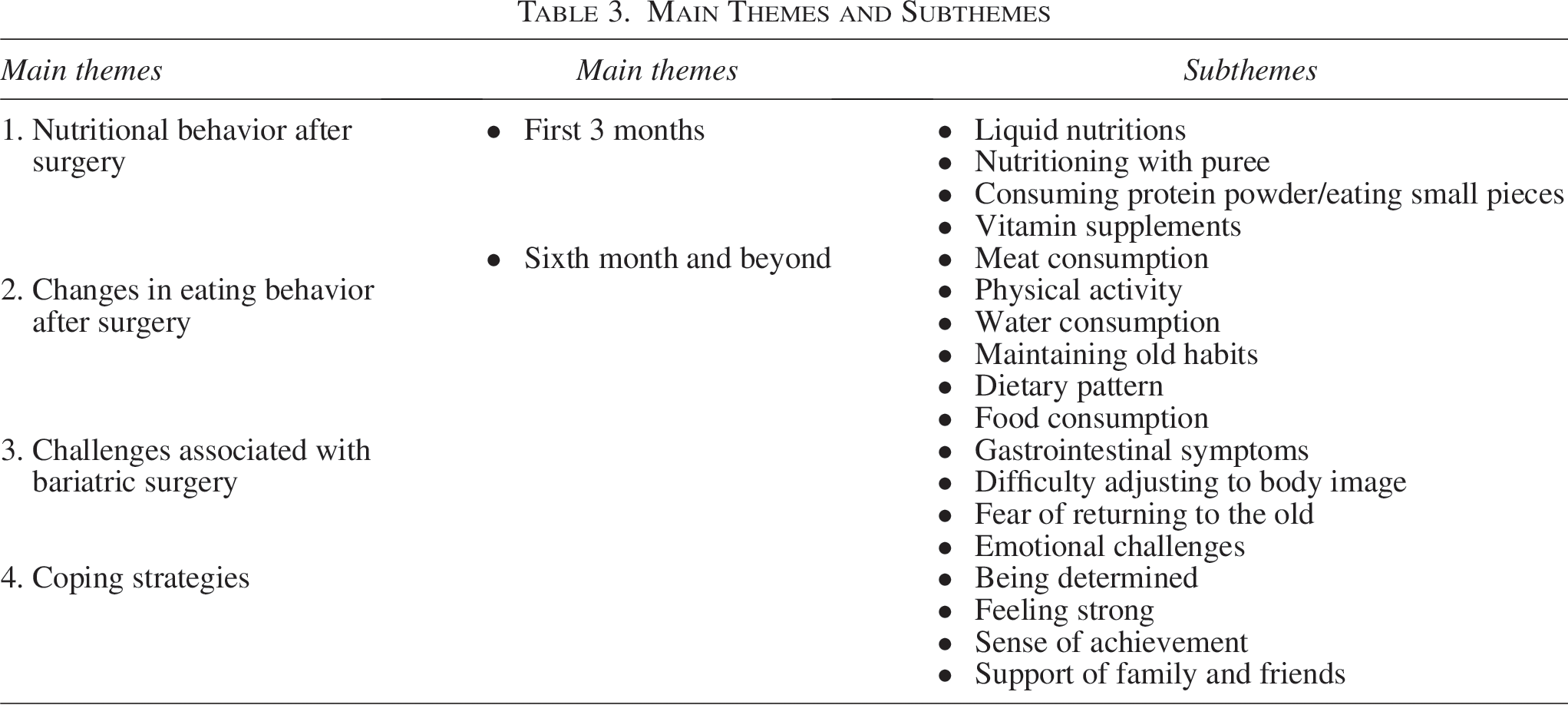
Through data analysis, four main themes (nutritional behavior after surgery, changes in eating behavior after surgery, challenges associated with bariatric surgery, and coping strategies) were created. The first main theme had two main themes and five subthemes. The second main theme had five subthemes. The third and fourth main themes had four subthemes.
Conclusion:
Our study highlights the changes in nutritional behavior, difficulties getting used to a new life, and coping mechanisms after bariatric surgery were clarified. Despite many changes and negative experiences, individuals developed coping strategies.
Introduction
Obesity is a serious and chronic disease that has environmental and psychological interactions, is genetic, brings many medical problems,1,2 causes premature deaths, and needs to be treated. 1 Due to its rising prevalence globally, obesity has become a major public health concern and is classified by the World Health Organization among the top 10 most hazardous diseases. 3 Obesity is defined as a body mass index (BMI) above 30,3–5 which is characterized by excessive food intake or excess energy intake over energy expenditure. 3
In the treatment of obesity, in addition to traditional methods such as medical nutrition therapy, behavior modification, physical activity, and medication, there are also cutting-edge surgical options like bariatric surgery.1,6,7 Bariatric surgery has become a widely used treatment method in the world and in our country, day by day, due to the effective results in a short time, when the desired result cannot be achieved with traditional methods of treating obesity for a long time.2,8–11 Surgical treatment for obesity is based on modifying the gastrointestinal system to restrict calorie intake and reduce absorption, thereby promoting weight loss.1,3,12 For this purpose, malabsorption surgeries that inhibit nutrient absorption, restrictive surgeries that limit nutrient intake, and combined surgeries that both restrict nutrient intake and impair nutrient absorption can be performed.1,8,10 This surgical intervention not only facilitates significant weight reduction2,13 but also often leads to remission of chronic conditions, including diabetes, hypertension, hyperlipidemia, and sleep apnea. 11 Bariatric surgery patients must have their diets planned meticulously before and after the procedure. 3 Modifying eating habits helps control appetite and fosters beneficial eating habits. 13
Previous studies conducted in this direction have been quantitative, descriptive studies examining the effects of bariatric surgery on food intake.1,3,10,13 However, there are no in-depth interviews or qualitative studies examining individuals’ views on their eating habits, their feelings, and behavioral changes following bariatric surgery. In this context, the dietary changes and confusion caused by bariatric surgery in individuals require a close examination of their experiences. The objective of this study, which constitutes the inaugural qualitative research to be conducted in order to procure further information pertaining to the opinions, feelings, experiences, and behavioral changes of individuals with regard to their eating habits subsequent to bariatric surgery, was to ascertain the experiences of individuals who have undergone bariatric surgery with respect to their eating behaviors.
Materials and Methods
Study design
In this study, phenomenology, a qualitative research method, was used within the framework of the concept of “nutritional behaviors.”14,15 This approach is an inductive method that explains an event that is noticed in daily life but whose details are not understood, based on human experiences. This qualitative study utilized a hermeneutic phenomenological design and a criterion sampling strategy from among purposeful sampling methods to explore the experiences of individuals who underwent bariatric surgery regarding their nutritional behaviors.
Participants and setting
The study sample consisted of 35 individuals who had received sleeve gastrectomy (SG) at least 6 months prior to the study and were reachable via contact information. Inclusion criteria were: (a) volunteering to participate in to study, (b) aged 18–65, (c) literate, and (d) having undergone SG at least 6 months before the study. Exclusion criteria were: (a) unwillingness to participate in the study, and (b) SG surgery performed less than 6 months prior to the study. All potential participants were contacted by phone to confirm their willingness to participate. Participants who did not consent to having their voices recorded during the study and who did not attend when invited to the interview were excluded from the study. Data saturation was reached after six interviews, and the final sample consisted of 13 participants who provided consent.
Data collection
The research data were collected from patients who underwent bariatric surgery and were followed up at the Obesity Center of an Education and Research Hospital in Türkiye between November 2021 and March 2023, and who agreed to participate in the study after the initial telephone interview.
Data were collected through individual in-depth interviews using a semi-structured questionnaire developed based on existing literature and prepared with expert input.11,15,16 A data collection form prepared for the characteristics of the participants was also used. A pilot interview was conducted with one participant (excluded from the study) to refine the questions. Following the pilot interview, the in-depth interview questions were modified accordingly (Table 1). Participants were asked warm-up questions to observe their behavior, and notes were taken during the interview, while audio recordings were made. Interviews were held at a time and place convenient for participants, following verbal and written consent. Each participant interview was conducted separately with each patient, with audio recordings made in quiet, calm interview settings at times convenient. Each interview lasted 55–70 min. The interviewer, an experienced nurse trained in qualitative research, facilitated a comprehensive understanding of participants’ experiences.
Interview Guide

Data analysis
Data were analyzed using MAXQDA 2022 software with inductive qualitative content analysis.
17
This method involved analyzing both overt and latent content in participants’ statements to identify concepts and relationships.
18
Creswell’s qualitative data analysis steps were followed
19
:
Audio recordings were transcribed within 24 h, and transcripts were repeatedly read to holistically evaluate participants’ experiences. Data were segmented, coded, and compared, with notes taken to identify meaningful patterns. Codes were grouped into subthemes, categories, and main themes based on conceptual relationships. All researchers reviewed the themes and categories to enhance the rigor of the findings.
Rigor
In qualitative research, rigor is assessed through consistency, credibility, transferability, and confirmability.17,20 In this regard, the conversion of audio recordings was into text after 24 h. To ensure consistency, data were collected by a single researcher and coded by both researchers, and the codes were independently reviewed. Discrepancies were resolved through discussion. Credibility was enhanced through prolonged engagement, member checking, and expert review. 21 One participant was interviewed to confirm whether they had experienced the main themes and subthemes identified. Transferability was achieved through purposive sampling and detailed descriptions of the research process and participant statements.17,21 Confirmability was ensured by consulting an external expert to review the data, codes, and themes. 21 The consolidated criteria for reporting qualitative research checklist was used to enhance reporting quality.
Ethics approval
Ethical approval was obtained from the Clinical Research Ethics Committee of Health Science University (approval number: 2021/16, date: September 23, 2021), and institutional approval was also obtained from the institution where the study was to be conducted. Following the provision of information regarding the objectives of the study, its methodology, the utilization of audio recordings, and the confidentiality of data, participants provided written, signed, and verbal consent using an “Informed Consent Form” prepared in accordance with the Helsinki Declaration. They were assured of the confidentiality of their identities and informed of their right to withdraw without penalty at any stage.
Results
Demographic and surgical characteristics
The mean age of the participants was 33.23 ± 6.78 years. Ten of the participants were female, nine were married, six were undergraduate graduates, and five were civil servants. The mean preoperative BMI of the participants was 44.81 ± 4.78 kg/m2, and the mean postoperative BMI was 27.52 ± 3.14 kg/m2. The mean postoperative weight loss was 50.19 ± 12.94 kg. The demographic and surgical characteristics of the 13 participants (identified as K1–K13 to maintain confidentiality) are presented in Table 2. Table 3 summarizes the main themes and subthemes from the interviews.
Demographic and Surgical Intervention Characteristics of the Participants

*Mean: abbreviation.
BMI*, body mass index; SD*, standard deviation.
Main Themes and Subthemes
Main theme: Nutritional behavior after surgery
Participants’ postoperative nutritional behaviors were examined across two main themes (“first 3 months” and “sixth month and beyond”) and five subthemes (liquid nutrition, nutritioning with puree, consuming protein powder/eating small pieces, vitamin supplements, and meat consumption):
First 3 months: Most participants reported consuming only liquid nutrition during the first 2 months (K2, K12). Participants transitioned to pureed foods, protein powder, and small portions of unprocessed meat and used vitamin supplements in the third month (K2, K5, K11, K13).
“It is a challenging situation.” It is a memory that will forever be etched in my mind. I had already been on a liquid nutritional regimen for approximately one week. In the second week, the dietary restrictions were particularly challenging. The regimen consisted of solely liquid soups, excluding grains. So, think about it, I used to eat and drink whatever I wanted…” (K12)
“I previously consumed pureed food at two-to-three-hour intervals. For instance, if I ingested a protein-based puree, I was unable to consume any other food for approximately four hours. However, if I consumed fruit puree, I experienced hunger again after two hours. The type of puree was a determining factor in this regard. I would process the chicken meat in a food processor or boil the red meat with a small quantity of water…” (K11)
“…My diet consisted solely of tomato soup. Additionally, protein milk proved beneficial. I was also taking vitamin supplements, with one pill per day…” (K2)
Sixth month and beyond: Participants began consuming meat but continued to face challenges in transitioning to solid foods (K2, K4).
“After three months, I was only able to consume milk and cheese… I was unable to consume eggs due to the presence of nausea. It has only been approximately six months since I began incorporating chicken and meat into my diet. I have also started to consume fish in half and half…” (K2)
“The protein support I currently receive is derived from chicken and meat. Fish, however, remains a challenging food for me as it causes discomfort when consumed…” (K4)
Main theme: Changes in eating behavior after surgery
Five subthemes emerged: “physical activity,” “water consumption,” “maintaining old habits,” “dietary pattern,” and “food consumption.”
Physical activity: Participants engaged in activities such as walking, swimming, pilates, and Zumba to support weight loss and dietary changes (K6, K8, K13).
“Every day, walking, 2 hours. There is not much opportunity to walk in winter, but I walk…” (K13)
“I engage in a variety of activities, including zumba, pilates, fitness, swimming. I used to go every day of the week…” (K6)
Water consumption: Most participants consumed at least 1.5 L of water daily, though some substituted water with tea or coffee (K9, K7).
“I consume at least 1.5 litres, you know, sometimes it passes…” (K9)
“Sometimes I don’t drink water at all, because I can’t eat when I drink water. I realize that I don’t drink water when I consume tea, Nescafe, filter coffee… I drink 2 cups of Turkish coffee without sugar, 2 cups of filter coffee, and probably more than 10 cups of tea per day…” (K7)
Maintaining old habits: Some participants occasionally reverted to old habits, such as consuming snacks, junk food, or desserts, and eating at night/grazing (K1, K2, K3, K8).
“At the moment, I only eat almonds, hazelnuts and walnuts … I used to consume a lot of sunflower seeds and pumpkin seeds; I have eliminated them. I like dessert, but if I eat chocolate, I prefer dark chocolate…” (K1)
“Sometimes, I don’t eat dinner, or I eat very little. When I eat little, I get hungry. At night, I don’t eat after waking up, I eat before going to bed…” (K2)
“I eat too much bread. Recently, I ate a plate of roasted meat, two meatballs, three portion desserts, and two pieces of cake. I ate more than the average person would normally consume. I had a grazing” (K3).
Dietary pattern: Participants faced dietary limitations and adjusted their eating to avoid overburdening their digestive systems. Participants reduced portion sizes, avoided simultaneous solid and liquid intake, and some stopped nighttime eating (K4, K5, K7, K9, K11, K12).
“My stomach does not allow it. For example, even if I inclined to consume more, or if the food in question is particularly appetizing or a personal favorite, the stomach will not permit more than four spoonfuls. Anyway, my stomach immediately gives a warning and makes a squeeze…” (K7)
“If I eat something solid food, I will eat the liquid half an hour later. If I eat something liquid food, I can eat the solid half an hour later. When I consume both food at the same time, I still experience discomfort and a sensation of heaviness…” (K4)
“… I know that I used to roast halva and ate it at night…(laughs) I don’t have such things now, thank God. I think it is because of the operation.” (K9)
Food consumption: Participants avoided fizzy drinks, packaged snacks, pastries, and fatty foods, prioritizing protein-based nutrition (K1, K4, K6, K12).
“I absolutely could not drink fizzy drinks after the operation; I could not drink them for 1 year. I was able to drink 4 times in the last 3 months, but I had 1 sip of cola, 3 sips, that’s it…” (K6)
“Dough bothers me very, very much and I try not to consume pastries, and I don’t consume them anyway…” (K1)
Main Theme: Challenges Associated with Bariatric Surgery
Participants reported difficulties such as “gastrointestinal symptoms,” “difficulty adjusting to body image,” “fear of returning to old habits,” and “emotional challenges.”
Gastrointestinal Symptoms
The majority of patients found it challenging when they experienced stomach cramps. Some foods triggered nausea and a feeling of disgust postsurgery. Vomiting provided relief from nausea, discomfort, and abdominal pain (K2, K4, K5, K10, K11).
“I vomited at first when I ate after surgery. To illustrate, I did not consume half of a lahmacun, half of a doner. I ate the meat, but it caused pain. I consumed only half of the pastry. The chicken meat was particularly indigestible and caused gastric distress, resulting in feelings of nausea.” (K10)
“My digestive system does not respond well to certain foods such as bulgur pilaf and meatballs made with bulgur, causing symptoms such as indigestion, cramps, and pain…” (K11)
Difficulty Adjusting to Body Image
Patients have experienced psychological difficulties due to changes in their physical appearance (especially sagging skin) associated with weight fluctuations (K5, K9).
“I feel negatively about my appearance. I d o not like my appearance…. (condescending tone) When I was overweight, my physique did not sag. Now I have sagging, I am not comfortable…” (K5)
Fear of Returning to Old Habits
Participants paid attention to their dietary choices and lifestyle adjustments in order to avoid regaining the weight they had lost (K4).
“I engage in swimming three days a week. I do not make any program for those days; I undertake the training spontaneously on those days. My only fear is the possibility of gaining weight, I have finished 1.5 years…” (K4)
Emotional Challenges
Some participants experienced sadness and difficulty coping with emotional changes postsurgery (K2).
“I experienced crying, sadness, withdrawal, I experienced it all. I experienced it all in a complex way. I cried when my husband was with me, I would get up and leave while he was sleeping in bed and I would cry…” (K2)
Main theme: Coping strategies
Participants described coping strategies across four subthemes: “being determined,” “feeling strong,” “sense of achievement,” and “support of family and friends.”
Being Determined
Participants emphasized determination as a key factor in their weight loss success (K12).
“I say I have achieved this. I will lose these 15 kilos in a healthy way, God willing, and I will continue my life in this way. I don’t use elevators, I don’t drive a car, I’m definitely not lazy. You know, I have mostly removed harmful things from my life. I mean, I think about the pros most of the time, look, you have achieved these, you can achieve more… I try to motivate myself. I lost 47 kilos…” (K12)
Feeling Strong
Participants felt psychologically and physically strong, which motivated them during their weight loss journey (K8).
“Those with this disease should go into the surgery saying that I will be fine, I will succeed, in other words, they should go into the surgery by whipping themselves… In fact, patients exaggerate some things too much. You should not let yourself go just because you have had this surgery…” (K8)
Sense of Achievement
Weight loss was associated with a strong sense of accomplishment (K1).
“I have been successful in the fight against this disease, the difficulties of life and by protecting my health. I did not run away from success, was not afraid. I was successful because I was able to overcome my fears…” (K1)
Support of Family and Friends
Positive reactions from family and friends reinforced participants’ efforts (K1, K12, K13).
“My husband is a great source of support for me without judgment, so if he did not support me, I would be depressed …” (K12)
“I have always had the support of my family, really … They have never lacked anything for me in everything, under all circumstances.” (K13)
Discussion
This study examined and clarified the nutritional behaviors and dietary changes experienced by individuals following bariatric surgery. The four main themes identified are detailed below.
Nutritional behavior after surgery
SG entails the surgical removal of about 80% of the stomach, which results in accelerated gastric transit and delayed emptying. 22 This results in reduced calorie intake due to decreased levels of appetite-suppressing hormones. 22 Studies indicate that a high-protein liquid diet begins on the second or third day and lasts for 10–12 days, and that this period can be shortened or extended depending on the patient’s tolerance. 10 In addition to the patients’ diet, it is stated that unsweetened apple or grape juice, plain yogurt, soy milk with protein powder, low-fat, low-carbohydrate, high-protein beverages, and whey or skim milk (1% fat) can be added. 23 Consistent with these studies,10,23 participants in Aydin’s study reported starting with liquid nutrition for the first 15 days postsurgery, followed by a transition to pureed foods. 24 These findings align with the challenges reported by our participants, such as reduced food intake and difficulties adapting to new dietary patterns.
The “puree diet” emphasizes high-protein, low-fat foods in a soft or ground consistency, such as egg whites, minced beef, lean sauces, boiled legumes, low-fat cheese, and yogurt. Patients who tolerate high-protein foods can also include peeled fruits and well-cooked soft vegetables. 10 Participants in our study reported successfully consuming these foods during the puree phase. However, challenges such as prolonged reliance on pureed foods and fatigue despite vitamin supplementation were noted, consistent with findings from Aydin’s study. 24
Postoperative nutrient deficiencies, including vitamin B12, calcium, folate, vitamin D, and iron, are common due to reduced absorption, decreased intake, and poor nutrition. 1 The mitigation of these issues is recommended by Liu and Irwin through the practice of slow and measured eating, in addition to smaller bite sizes. This recommendation aligns with the experiences of our participants. 25
Gungor emphasizes the importance of a balanced and varied diet during the postoperative phase, recommending a daily protein intake of 60–80 g or 1.1 g/kg.10,26 Consistent with this, one participant in Aydin’s study reported prioritizing high-protein foods. 24 In our study, participants initially consumed pureed meat in small quantities during the first 3 months, transitioning to whole meat by the sixth month. They also incorporated protein-rich foods such as eggs, cheese, milk, and yogurt into their diets. These findings align with existing literature on postoperative nutritional practices.
Changes in eating behavior after surgery
Physical activity is crucial for maintaining weight loss after bariatric surgery.27,28 Research indicates that 57.8% of women and 60.2% of men participate in physical exercise after surgery, commonly preferring walking and swimming.18,28,29 Our findings align with these results.
Adequate hydration is equally important, with literature recommending a daily fluid intake of at least 1.5 L. 30 Participants in our study adhered to this guideline, consistent with previous research.
Grazing, nighttime eating, and sweet consumption are linked to weight regain and reduced quality of life postsurgery.30,31 In Aydin’s study, participants reported conscious eating but occasionally reverted to old habits, such as consuming junk food or sweets. 24 Sweet eating behaviors are prevalent in 36.4–60% of bariatric patients, particularly after SG.30,32,33 Our participants also occasionally exhibited these behaviors, reflecting the challenges of maintaining new dietary patterns.
Post-SG, the stomach’s reduced capacity necessitates small, well-chewed meals to prevent nausea and vomiting.10,22,25 Studies recommend three main meals and three snacks daily, with fluid intake avoided 30 min before, during, and immediately after meals.18,24,26,34 Yuksel emphasizes avoiding simultaneous solid and liquid consumption to prevent vomiting. 35 These studies align with our participants’ experiences.
Reduced hunger sensations postsurgery is attributed to decreased hormone levels that stimulate appetite and the brain–gut connection. 30 Pepino et al. found that bariatric patients reported fewer food cravings and reduced appetite, 36 consistent with our participants’ decreased eating frequency and cessation of nighttime eating.
Bariatric surgery promotes healthy eating and increased physical activity, regardless of the surgical technique.37,38 Participants in our study, like those in Dizlek and Catal’s and Bayraktaroglu’s studies, avoided pastries, fatty foods, sugary drinks, and carbohydrates while adopting healthier cooking methods.18,39 These findings highlight the importance of dietary and lifestyle modifications in postoperative success.
Challenges associated with bariatric surgery
As a restrictive procedure, SG may result in complications including malnutrition, reflux-gastritis, persistent vomiting, gastric stenosis, bleeding, thrombosis, staple line leaks, and atelectasis. 22 Participants in Aydin’s study reported side effects such as nausea, vomiting, weakness, hair loss, cold intolerance, and stomach issues. 24
Dumping syndrome, affecting 85% of patients with gastric restriction, manifests as sweating, dizziness, tachycardia, nausea, flushing, abdominal fullness, diarrhea, and cramps within 10–30 min postmeal, lasting up to 60 min. 30 These symptoms were observed in many of our participants.
Postoperative adaptation challenges include skin sagging, which can affect self-esteem, physical appearance, and sexuality.18,40 A participant in Dizlek and Catal’s study expressed dissatisfaction with body sagging. 18 In addition, reduced food intake due to stomach restriction and fear of weight regain are also common.31,41 Dysphagia or obstruction may further limit dietary intake. 30 Besides, overeating often leads to intense vomiting, as reported by Aydin and Yuksel, particularly when solid and liquid foods are consumed together.24,35 These findings align with our participants’ experiences.
Psychosocial improvements, including body image, self-esteem, and quality of life, often emerge within the first few years after surgery, though this recovery process can take time. 42
The emotional responses observed in our participants, such as crying, align with typical coping strategies reported in the literature. 43
Coping strategies
Participants in our study reported feeling content and motivated as they lost weight, adopting healthy coping mechanisms to achieve their ideal lives. Themes such as “happiness, achievement, rebirth, gaining a second chance at life, and escaping the past,” 18 “a new life,”44,45 and “getting my life back” 45 are well-documented in the literature.
Aydin’s study highlighted the importance of social support in sustaining weight loss, noting that while some participants received strong support, others, particularly women, struggled with isolation. 24 Support of family and friends is crucial for long-term success postsurgery. 45 Our participants also emphasized the role of family and friends support in overcoming challenges, though they occasionally experienced emotional difficulties, such as crying, when faced with negativity.
Strengths and limitations
The study’s strengths include employing a hermeneutic phenomenological approach, offering rich insights into the nutritional practices and lived experiences of individuals’ postbariatric surgery. The inclusion of 13 participants with diverse demographic characteristics allowed for a rich exploration of various perspectives, and data saturation was achieved, enhancing the reliability and validity of the findings. The results align with existing literature, offering valuable contributions to understanding postoperative dietary behaviors, challenges, and coping mechanisms. Ethical approval and participant consent further strengthened the study’s credibility. Nonetheless, several limitations should be acknowledged. The limited sample size constrains the generalizability of the results, and the necessity of audio recordings may have discouraged some individuals from participating. Additionally, the single-center design limits the broader applicability of the results, and the lack of long-term follow-up prevents an assessment of sustained dietary and lifestyle changes. Future studies with larger, multicenter samples and longitudinal designs are recommended to address these limitations.
Conclusion
This study demonstrates the dietary practices and the changes in eating behaviors among individuals who underwent bariatric surgery. People frequently struggled to adjust to new living situations and conditions during this difficult weight reduction process. Those who were happy with their weight loss outcomes created coping mechanisms to deal with the mental and physical difficulties they encountered. With perseverance, they overcame dietary obstacles despite the adversities. Support from their environment helped them transform negative circumstances into more positive experiences.
The results of this study indicate that nurses should provide patients with information regarding the nutritional behaviors and lifestyle changes they will experience prior to discharge. In addition, it will be very important for nurses to include topics such as postbariatric surgery nutrition, prevention of weight regain, and psychological coping in the content of programs organized for public education. It is recommended that future studies in this area be planned with the aim of helping patients develop healthy lifestyle behaviors in their nutrition after discharge.
In conclusion, it is believed that it will help other individuals who have undergone bariatric surgery to develop nutritional and behavioral strategies and serve as a guide for those facing similar situations.
Authors’ Contributions
K.O.Y.: Conceptualization, methodology, software, validation, formal analysis, investigation, resources, data curation, writing—original draft, writing—review and editing, visualization, supervision, and project administration. I.C.: Conceptualization, methodology, formal analysis, investigation, writing—original draft, writing—review and editing, visualization, supervision, and project administration.
Footnotes
Acknowledgments
The authors would like to thank the participants who participated in this study and shared their life experiences on this subject. This article is based on research performed for K.O.Y.’s doctoral dissertation.
Author Disclosure Statement
No potential conflict of interest was reported by the authors.
Funding Information
No funding was received for this article.
Data Availability
Data are available upon reasonable requests.