



Abstract
Introduction:
Despite surging interest in glucagon-like peptide-1 receptor agonist (GLP1RA), there are few data regarding how preoperative GLP1RA impacts postoperative outcomes after bariatric surgery.
Methods:
This is a retrospective cohort study comparing early and long-term total weight loss (TWL%) between adult patients with and without preoperative GLP1RA before bariatric surgery.
Results:
A total of 902 patients were included, with 561 (62.2%) patients having gastric bypass and the rest having sleeve gastrectomy. Among these, 19 patients had liraglutide and 10 had semaglutide before surgery. Patients who received GLP1RA experienced slightly greater preoperative weight loss (6.7 ± 7.0% vs. 4.8 ± 9.9%, p = 0.30). A trend toward higher 1- to 2-month weight loss with preop GLP1RA, which was only significant among sleeve gastrectomy patients, was observed, with TWL% being 17.6 ± 7.4% vs. 11.4 ± 6.4% (p < 0.01) and 21.9 ± 7.6% vs. 17.1 ± 7.0% (p = 0.03) at 1 and 2 months, respectively. This difference gradually diminished at 6 months (27.5 ± 6.7% vs. 24.3 ± 7.6%, p = 0.15), 1 year (31.8 ± 7.7% vs. 28.3 ± 9.5%, p = 0.23), and 2 years (30.2 ± 8.2% vs. 28.2 ± 10.3%, p = 0.23).
Conclusions:
Greater early weight loss after sleeve gastrectomy was observed among patients who had preoperative GLP1RA. It is worth considering continuing GLP1RA after sleeve gastrectomy for patients who are at high risk for insufficient weight loss.
Introduction
In 2014, the U.S. Food and Drug Administration approved the first glucagon-like peptide-1 receptor agonist (GLP1RA) drug, liraglutide, for weight loss indication. 1 Since then, several other GLP1RAs, most notably semaglutide, 1 have also become available. In contrast to prior antiobesity medications, GLP1RAs were distinguished by their superior weight-loss efficacy in randomized clinical trials.2,3 Since then, there has been an exponential increase in patient interest for GLP1RA, even among those planning to have bariatric surgery.4,5 In fact, the rise of GLP1RA has contributed to a significant decline in bariatric surgery volume. 6
However, there remains a certain proportion of patients who preferred bariatric surgery due to its cost-effectiveness and permanence. 7 The incorporation of GLP1RA into bariatric surgical practice has thus become an area of intense research interest. While studies suggested a synergistic weight loss effect between postoperative GLP1RA and bariatric surgery, 8 it is unclear if preoperative GLP1RA makes a difference in postoperative weight loss outcomes.
In this pilot observational study, we have identified a small group of real-world patients that have received continuous GLP1RA as weight loss treatment before planned bariatric surgery and compared their early and long-term weight loss outcomes against control patients who had bariatric surgery without preoperative GLP1RA.
Methods
This is a retrospective cohort study evaluating the impact of preoperative GLP1RA on postoperative weight loss after bariatric surgery. We included adults above 18 years of either sex who underwent a gastric bypass or a sleeve gastrectomy at one of two bariatric centers of excellence within our health system between January 2020 and November 2022 with a starting body mass index (BMI) of 35 kg/m2 or above. Those with less than 2-year follow-up were excluded. Baseline demographics, surgery type, date, 30-day readmission and serial weight data were collected.
The exposure variable of interest is preoperative GLP1RA, defined as continuous use of liraglutide or semaglutide for at least 30 days. According to guidelines from the American Society of Anesthesiologists, GLP1RA was held at least 7 days before surgery. 9 Other obesity-related conditions include hypertension, diabetes, and dyslipidemia, which are identified using the ICD9 code from the electronic medical database. GLP1RA was routinely discontinued after bariatric surgery.
The primary outcome is postoperative weight loss, expressed as total weight loss percentage (TWL%), calculated as (weight loss in kg divided by initial weight in kg × 100), at 1 month, 2 months, 6 months, 1 year, and 2 years. All included patients had weight data available at the 2-year postoperative mark; missing values in intermediate time points were handled by substituting with interval weight data between the preceding and following time points. As such, there was less than 5% missing value in all five time points. The only perioperative outcome variable assessed was readmission rate, as other complications are considered too rare for our sample size to detect.
The study was conducted in accordance with the 1975 Declaration of Helsinki and approved by the Allina Health Human Research Protection Program Institutional Review Board (reference no. 2229578-1), which also exempted written patient informed consent due to the retrospective nature of the study.
All treatment and follow-up occurred at one of the 12 hospitals and 90 clinics within our weight management program, conducted by either a bariatric surgeon or physician assistant. All bariatric surgery patients had received complementary preoperative dietitian counseling and a postoperative lifestyle maintenance program, regardless of whether preoperative GLP1RA was prescribed.
Data were retrieved from electronic medical records and collated into a computer-based database in March 2025. Chart review was performed by providers of the weight management program.
No power calculations were performed to determine necessary sample size because no prior literature is available for estimation of expected effect size. For descriptive analysis, we first assessed normality in each continuous variable using a histogram and the Shapiro-Wilk test. If distribution conformed to normal distribution, the variable was reported as mean (standard deviation). Skewed continuous variables were reported as median (interquartile range, IQR). Patients were separated into two groups: those that had received preoperative GLP1RA and those that had not. The two-sample t-test was used to compare normally distributed continuous variables. The Mann–Whitney test was used for continuous variables not conforming to normal distribution. The chi-square test was used to compare categorical variables. A two-tailed p value of 0.05 was used as a threshold to denote significance. All analyses were performed using Stata 13.1 (StataCorp LP, College Station, TX).
Results
A total of 902 patients received bariatric operations during the study period. The median initial BMI was 43.9 kg/m2 (IQR: 9.9 kg/m2). Most were females (86.6%), with an average age of 44.3 years (SD: 11.9 years). In total, 561 (62.2%) patients received gastric bypass, and the rest had sleeve gastrectomy.
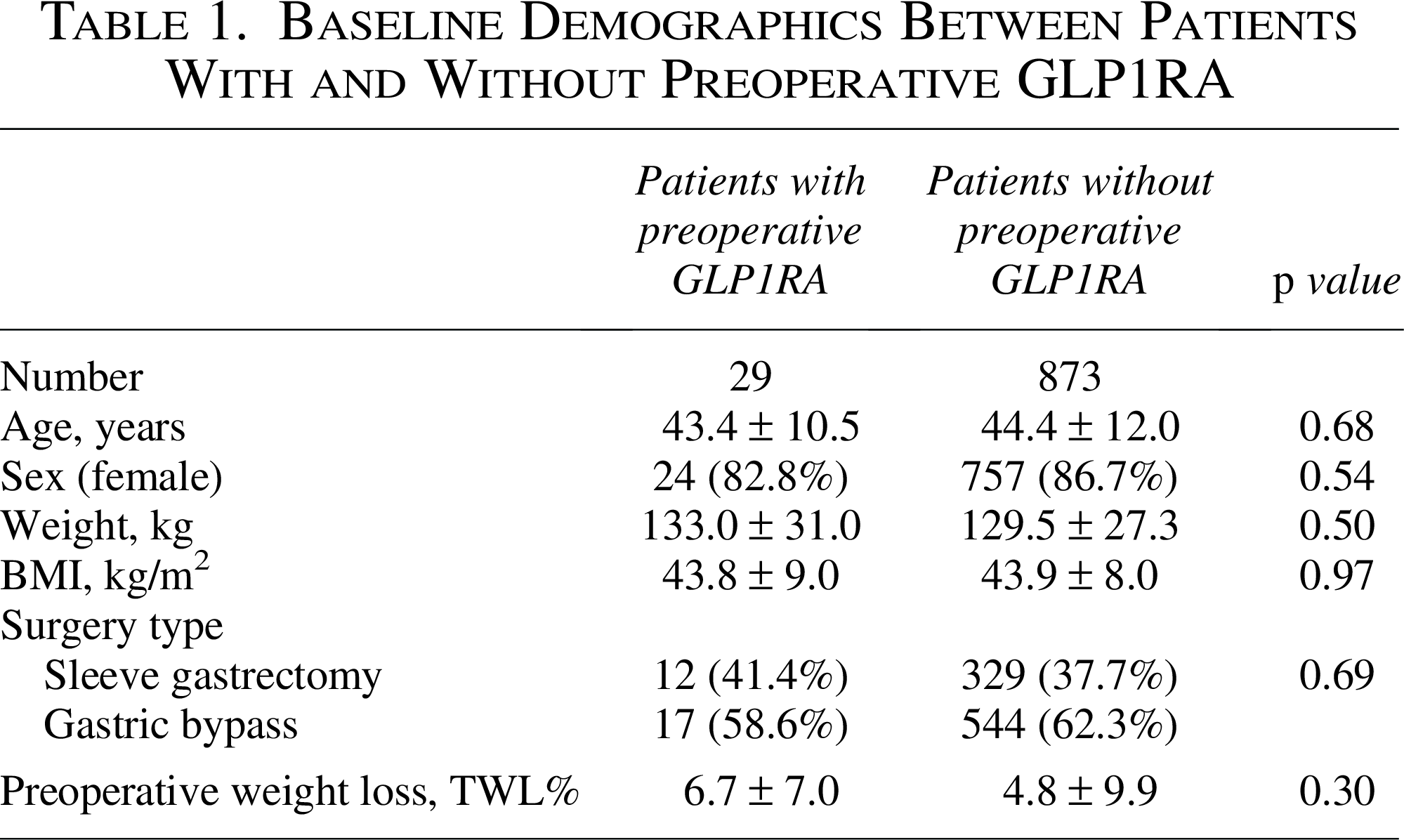
A total of 29 patients received preoperative GLP1RA, with 19 patients on liraglutide and 10 on semaglutide. Of these, 19 patients (65.5%) have received the maximal therapeutic dose by the time their GLP1RA was discontinued before surgery, i.e., 3.0 mg daily for liraglutide and 2.4 mg weekly for semaglutide. There was no significant difference in the preoperative weight loss between semalutide and liraglutide users (6.4 ± 7.6% vs. 7.3 ± 6.1%, p = 0.74). The median GLP1RA duration was 477 days (IQR: 303 days). The time to surgery, i.e., from initial entry to the bariatric program to the surgery date, was similar between patients with and without GLP1RA (512.9 ± 256.1 days vs. 741.1 ± 1046.2 days, p = 0.24). Of note, a large standard deviation was observed in both comparison groups, likely due to varying insurance requirements for preoperative dietitian counseling and surgery scheduling difficulties from the COVID-19 epidemic. Baseline demographics and obesity-related conditions were similar between the two groups (see Table 1).
Baseline Demographics Between Patients With and Without Preoperative GLP1RA
Patients who received preoperative GLP1RA lost slightly more weight before surgery, although this difference was not significant (6.7 ± 7.0% vs. 4.8 ± 9.9%, p = 0.30). In our program, GLP1RA was routinely discontinued a week before surgery. After surgery, patients who were on preoperative GLP1RA experienced a trend towards higher weight loss at 1 month (15.3 ± 7.1% vs. 12.4 ± 9.2%, p = 0.12), 2 months (19.5 ± 6.9% vs. 17.5 ± 9.3%, p = 0.32), 6 months (26.4 ± 5.5% vs. 25.3 ± 9.7%, p = 0.54), 1 year (33.8 ± 6.9% vs. 29.9 ± 11.5%, p = 0.09), and 2 years (32.6 ± 8.8% vs. 30.3 ± 11.8%, p = 0.42). No significant difference in 30-day readmission (6.9% vs. 5.3%, p = 0.70) was observed between the two groups.
When stratified by procedure, the 17 gastric bypass patients with GLP1RA experienced no additional weight loss than others at any time point after surgery, whereas the 12 sleeve gastrectomy patients with GLP1RA experienced significantly higher weight loss than others at one (17.6 ± 7.4% vs. 11.4 ± 6.4%, p < 0.01) and 2 months (21.9 ± 7.6% vs. 17.1 ± 7.0%, p = 0.03). This difference gradually washed out as time went by at 6 months (27.5 ± 6.7% vs. 24.3 ± 7.6%, p = 0.15), 1 year (31.8 ± 7.7% vs. 28.3 ± 9.5%, p = 0.23) and 2 years (30.2 ± 8.2% vs. 28.2 ± 10.3%, p = 0.23) (see Fig. 1).

Weight Loss Curves Preoperative GLP1RA is associated with greater early postoperative weight loss after sleeve gastrectomy, but this difference diminishes over time (error bars denote standard errors) (Fig 1a). On the other hand, preoperative GLP1RA is not associated with different weight loss outcome after gastric bypass (Fig 1b).
Discussion
In this pilot observational study, we evaluated the impact of preoperative GLP1RA on weight loss after bariatric surgery. We found a trend towards higher early postoperative weight loss among patients who had preoperative GLP1RA. The effect is particularly pronounced after sleeve gastrectomy, although this difference faded away after 1 year.
In our cohort, we found no significant difference in the preoperative weight loss between patients that did and did not receive preoperative GLP1RA. This discrepancy with the known efficacy of GLP1RA10,11 can likely be explained by a self-selection process by patients. A previous report 5 found that patients are less likely to go through with surgery if they lost more than 15% TWL with GLP1RA. In other words, our study only captured patients unsatisfied or unresponsive to the effects of GLP1RA, rather than all patients who are candidates for preoperative GLP1RA. Patients who achieved significant weight loss with GLP1RA preoperatively may have opted to cancel surgery 12 and not captured in the current cohort. As such, the effect of preoperative GLP1RA might be different when it is offered to all patients before bariatric surgery, regardless of their response to the medication.
Despite a growing interest in combining surgical and medical weight loss, there is little literature on the impact of preoperative GLP1RA in bariatric patients. In a study of patients with BMI above 50 kg/m2, 13 the authors reported a higher preoperative weight loss and similar complication rate. However, the researchers did not report on long-term weight loss after surgery. In another study, the authors reported no difference in 30-day readmission and 1-year TWL%. 14 In other words, existent literature so far is mixed on the benefits of preoperative GLP1RA, generally suggesting an absence of long-term weight benefit. Besides corroborating these reports, our study discovered that the use of GLP1RA before sleeve gastrectomy is associated with significantly higher early postoperative weight loss. This may be explained by the fact that sleeve gastrectomy is known to cause a less marked rise in postprandial GLP-1 level than gastric bypass. 8 While no difference in weight loss was observed after gastric bypass, preoperative GLP1RA may complement the effect of sleeve gastrectomy more than other surgery types. We hypothesized that this may be because GLP1RA can make up for the relatively lower endogenous GLP1 after sleeve gastrectomy, whereas in gastric bypass patients the endogenous GLP1 rise is already high, so adding a GLP1RA has a less pronounced effect.
While we have observed greater early weight loss with preoperative GLP1RA in sleeve gastrectomy patients, such difference diminished over time. While previous studies have shown that the effects of GLP1RA often diminish after discontinuation,15,16 our study does not definitively elucidate whether the convergence in weight outcome is entirely attributable to the washout of GLP1RA or whether other factors may be at play, e.g., the dominant effect of surgery. This also raises the importance of research into the role of continuing GLP1RA after bariatric surgery in appropriate patients.
One of the main limitations of our study is our small sample size. In order to capture long-term weight loss outcome, our patient cohort needed to have received GLP1RA in the early 2020’s, a time when GLP1RA was relatively novel. Furthermore, due to a lack of relevant literature, most weight management programs, including ours, separated both patients and providers between medical and surgical treatment. As a result, only a small number of patients were available that both received the full course of GLP1RA treatment and went through with bariatric surgery. As such, our results reflect a conservative approach to combination therapy at that time. Centers with a more integrated approach might observe different outcomes. After surgery, as with most studies, long-term follow-up is challenging due to the high postoperative drop-out rate. 17 Taken together, these factors resulted in a very small sample size for the GLP1RA group. In addition, the inclusion of only patients with available long-term outcome may imply that our findings may not be generalizable to patients with shorter follow-up, whose outcomes may be less ideal. The other limitation is the timeframe our data were collected from, which may narrow the generalizability of our conclusions. Our cohort from the early 2020’s represented early adopters of GLP1RA in a bariatric pathway. More recent patients may represent a broader sampling of the bariatric population and may exhibit a more diverse response to the same medication. Another limitation of the current study pertains to the fact that we only examined the effects of liraglutide and semaglutide, but did not include other GLP1RAs like exenatide, dulaglutide, or newer agents like tirzepatide. Finally, due to the retrospective nature of this study, we were not able to capture behavioral and compliance issues that may confound the causality between preoperative GLP1RA use and postoperative weight change.
In conclusion, we found that preoperative GLP1RA is associated with a greater early postoperative weight loss after bariatric surgery, especially among sleeve gastrectomy patients. However, this difference gradually diminishes within a year, consistent with prior studies showing that the effects of GLP1RA cease upon discontinuation.18,19 Future research is needed to explore the impact on metabolic and weight outcomes with continued GLP1RA after bariatric surgery and combining newer, more efficacious medications with surgery.
Authors’ Contributions
Study conceptualization: M.A.-B., A.B., P.-J.Y., J.D., J.B.-T., C.S., and Y.-Y.J. Data curation: M.A.-B., A.B., and Y.-Y.J. Methodology: J.D., J.B.-T., C.S., and Y.-Y.J. Formal analysis and Validation: P.-J.Y. and Y.-Y.J. Writing—original draft: P.-J.Y. and Y.-Y.J. Writing—review and editing: M.A.-B., A.B., P.-J.Y., J.D., J.B.-T., C.S., and Y.-Y.J. Writing—revision: M.A.-B., A.B., and Y.-Y.J.
Footnotes
Author Disclosure Statement
No competing financial interests exist.
Funding Information
No funding was received for this article.