



Abstract
The democratization of space exploration has been transformed by CubeSat technology, allowing access to low Earth orbit (LEO) through significantly reduced costs and broader access from educational institutions, small companies, and emerging nations. Introduced in the early 2000s, CubeSats, which are standardized, low-cost satellites ranging from 1 U (10 cm cube, ≤ 2 kg) to 12 U configurations, have leveraged off-the-shelf components and rideshare launch opportunities to lower barriers to entry. Educational centers, particularly universities, have been pivotal, encouraging and fostering innovation through student-led programs that design, build, and launch CubeSats for relatively nominal costs. This article examines the geographic factors of U.S. university CubeSat programs, identifying leading states such as California (42 launches), Colorado (18), and Florida (14), and exploring aspects behind their success. By analyzing historical data and launch trends from 1970 to 2023, this study highlights how CubeSats have shifted the space industry from an elite domain to an accessible platform, empowering new entrants and supporting applications like Earth observation. The findings underscore the role of education in driving the Education Space Race and predict continued growth in CubeSat deployments, potentially reshaping space exploration and governance in the coming decades.
INTRODUCTION
The landscape of space exploration has experienced a fundamental transformation in recent decades. From the First Space Race, characterized by nation-states investing billions of dollars over decades to achieve Low Earth Orbit (LEO), to a period of unprecedented accessibility at reduced costs and readily available components, a fundamental transformation is underway. This change in the democratization of space has allowed previously excluded organizations, nation-states, and companies to participate in satellite development and deployment. A key enabler was the introduction of CubeSats as small, low-cost commercial platforms that are more accessible from cost, operational, and launch perspectives. 1
The introduction of CubeSats in the early 2000s, coupled with new entrants, increased rocket launches while reducing costs to fundamentally change the aerospace industry. Education centers have led much of the industry’s innovation by pioneering the use of low cost, off-the-shelf components with reusable rockets, which enabled broader participation in space exploration and democratized access.
While the category of SmallSats includes numerous form factors and weights, this paper focuses specifically on CubeSats. Small satellites can range from femtosatellites at 0.001 kilograms to minisatellites at up to 180 kgs, but CubeSats are standardized sizes of one unit (1 U), based on a 10-centimeter cube weighing 2 kilograms of less per unit. 2 By combining multiple units, CubeSats can range from 1 U to 12 U configurations to increase the complexity, capabilities, or payload.
Education centers, primarily universities, have been instrumental in bridging “the Stratospheric divide” through SmallSat platforms, including CubeSats. 3 The capability for education centers to produce and launch their own CubeSats has democratized space exploration and experimentation. Further, CubeSats support emerging national space programs in countries excluded from the First Space Race. While costs vary by the CubeSat size (1–12 U), weight, fragility of the cargo, and other factors, this expansion has been driven by satellites deployed into LEO that are now affordable enough for education centers to operate at costs as low as $5,000 to build and $30,000 to launch. 4 At these levels, CubeSat technology has brought satellite capabilities within reach of many smaller companies and nations. 4
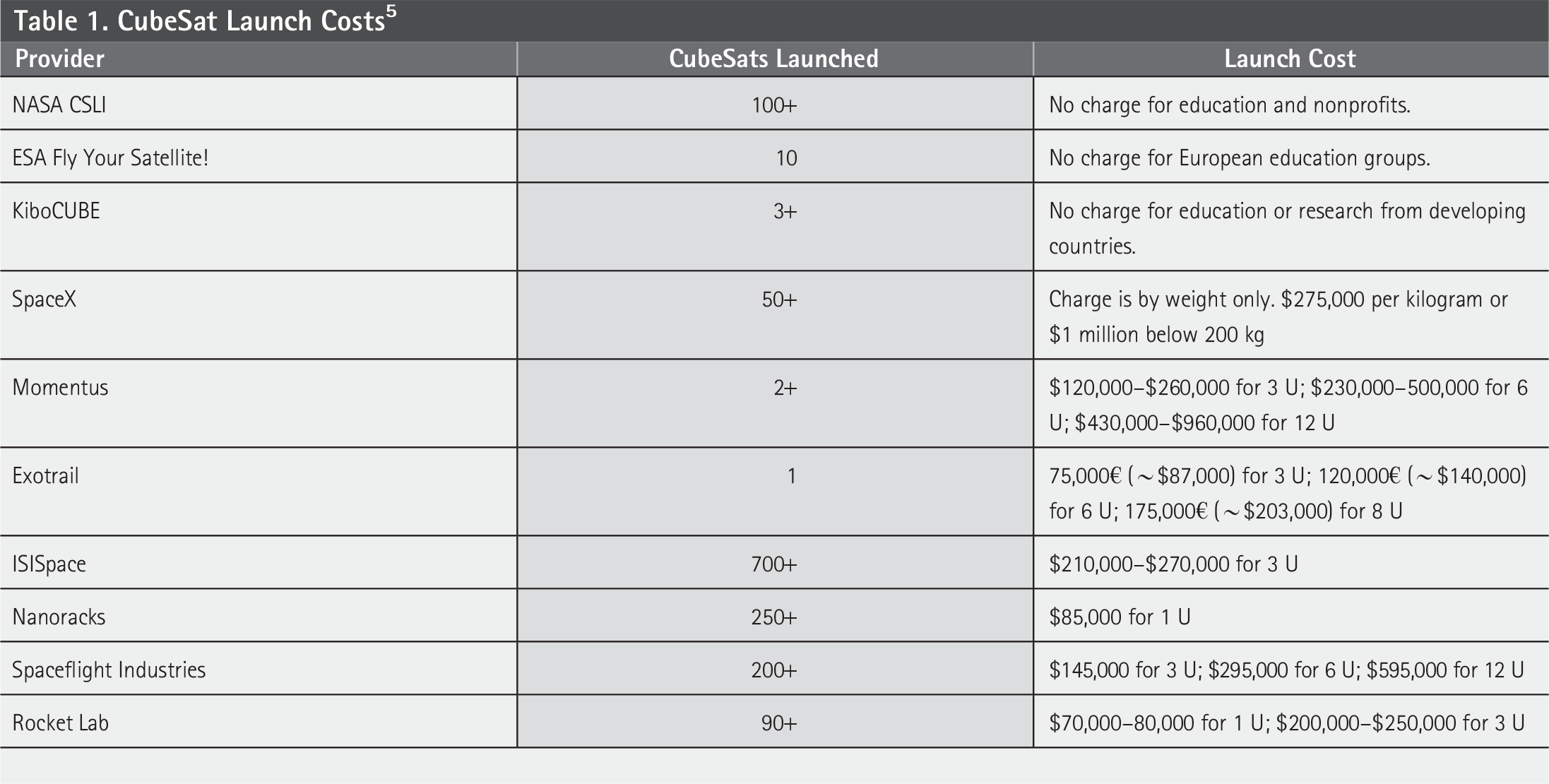
While less expensive than previous satellites, launch costs vary greatly depending on the provider. Actual costs can also vary based on the complexity of the equipment, size, destination (LEO or higher), and experiments being performed. For comparative purposes, Table 1 below provides data points on CubeSat launch costs from various providers:
CubeSat Launch Costs 5
To understand the depth of this movement, it is beneficial to understand the industry that CubeSats transformed. The First Space Race was dominated by a limited number of nations and corporations with significant budgets and large teams with a focused mission—in some cases, entire nations or economies rallied behind the effort. The level of resources required to support such efforts created a significant imbalance in access. As Leloglu and Kocaoglan observed, “Statistics of satellite manufacturing and ownership can be used as a rough indicator of space capability and can give an idea of the unequal use of space.” 3 The rise of the CubeSat has changed this pattern with newer players, such as the private company SpaceX, controlling approximately one-quarter of the total satellite population. Discussing this concentration, it was noted that “the population of large artificial satellites in orbits below 600 km is undergoing rapid change and is now dominated by the Starlink system.” 6
The broader deployment of CubeSats has benefited geographers as well. Geography researchers traditionally utilized Landsat imagery; however, these systems are large, expensive to operate, and suffer from limited availability. Increasingly accessible commercial applications such as the BlackSky Pathfinder-1 program offer more affordable, timely alternatives. It is reasonable to anticipate that future Landsat generations will incorporate design elements like contemporary CubeSats to help reduce costs and provide greater accessibility. It is also foreseeable that some education centers could produce their own CubeSat imagery system. In addition to improved access, this technology also enables new capabilities, such as weekly (or even daily) image archives of the entire planet.
It is plainly evident that a revolution is underway. Just as the printing press transformed access to information some 800 years ago, CubeSat technology is democratizing access to space. While we have seen several innovative outcomes, the reduced cost and complexity will deliver additional future benefits as this platform becomes more prevalent.
RESEARCH QUESTIONS
This article addresses four primary research questions: (1) What factors led to the current geographic distribution of satellite-focused programs in select education centers? (2) Which education centers sent the first satellites into orbit? (3) What factors caused the leading education center to launch significantly more spacecraft than other institutions? (4) What is the history behind the development of satellite production within the education sphere?
By examining these questions, this study aims to understand how these innovative space technologies are disseminated through American education centers. Additionally, it will explore how education has fostered the hobbyist community enabling it to grow into a notable segment of the space tech industry, driving wider and more affordable access to satellite technology and the related benefits. Furthermore, this study will focus on American institutions that utilized CubeSat applications to send small satellites into the LEO over the past 50 years.
PAPER STRUCTURE
This article begins with a literature review examining the historical context of satellites before analyzing university-supported small satellite programs. Subsequently, it evaluates the commercial and educational proliferation of CubeSats and the cost reductions they introduced, outlining the evolving cost structure from small satellite introduction in 1970 through launches as recent as summer 2023. This article also explores the costs of building, launching, and operating CubeSat satellites. Following these analyses, the methodology is detailed, concluding with observations on the near-term future of small satellites in educational and commercial contexts.
LITERATURE REVIEW
Universities have historically served as the main suppliers or important participants in the aerospace manufacturing supply chain for space-bound objects.7,8 In the past three decades, since the 1990s, this procurement has evolved significantly to the point where universities and other education centers have launched spacecraft designed on campus by students.9–11 These programs have encompassed the launching of CubeSats and other small satellites equipped with communication systems.9,12,13 Unfortunately, some projects suffered from weak security practices, but the contributions are notable and democratized access in new and innovative ways. 14
Many programs started in university engineering departments under the management of academic advisers.15,16 These programs provided both undergraduate and graduate students with hands-on training for future careers in the space economy.17–19 With more programs being established and new lessons being learned, it allows for greater interest in the field and unleashed new potential and expanded curiosity within the university system.20–22 This fostered a cross-discipline approach involving design and social scientists, including geographers.23,24
Within student-led programs, an advantage exists: their satellites can fail without experiencing the consequences that most in the professional space industry would face with many professional operators. 9 This article examines the geographic expansion and consolidation of American university-class missions, identifying which states produce the most missions. 25 Small satellite programs are expanding to academic institutions across the nation.
METHODS
This article used content analysis of previous research to formulate the historical overview of education centers and their space-oriented programs. Sources were evaluated using Google Scholar, the Wayback Machine, the University of Melbourne special archives, and the University of North Carolina’s Walter Clinton Jackson Library resources. Additional data were collected from industry reports: PayloadSpace, Nanosat database, and Orbiting Now. Documentation from the United Nations, NASA archives, and the European Space Agency’s (ESA) Space Debris Office were also consulted. Some of the relevant data were also gathered from industry white papers, while supporting information was gathered from university press releases and local media reports of university launches. These were collected to track the trajectory of the space industry in the immediate future.
The principal dataset utilized in this article was Michael Swartwout’s CubeSat launches dataset, released in June 2023. 26 This data source has the most current public non-paywalled information on the number and frequency of education center launches. This data will be used to generate charts and maps that show which American states, schools, and regions have conducted the most and least launches.
A BRIEF HISTORY OF SATELLITES
Since launching the first Sputnik satellite in 1958, the space industry has transformed human society in terms of communication, travel, defense, and aspiration for life beyond Earth. Education centers, especially university-based programs, have played an integral and vital role in this transformation and the evolution of the industry. The most notable changes stem from significant technological enhancements achieved over the past six decades. Whether sending a communication, getting news updates, or traveling, virtually every aspect of daily life has been touched by the advances and efficiencies gained by satellite technology.
The first satellites were large, bus-sized, mission-oriented objects primarily launched by either the United States or the Soviet Union due to the complexity and expense of such an operation. During the 1960s and 1970s, commercial satellites began to be deployed for weather monitoring and communication purposes. These large satellites were positioned in geosynchronous orbit, which limited their capabilities but enabled continuous visibility and supported a wide coverage area. 27 By the 1980s, more satellites were being used in commercial communication and entertainment, such as the original MTV (Music Television). However, the costs and protective measures for these satellites remained substantial, placing the technology out of reach for most. At the time, satellites cost more than 100 million dollars and took more than a decade to build. 1 The significant time, cost, and complexity required to build satellites greatly limited their practical applications. As Myers noted, once a satellite is finally launched, the technology is more than a decade old and potentially out of production. 1
A revolution in the industry occurred during the 1990s as new programs developed around early small-scale satellite technology. In the early 1990s, the average cost of a small satellite neared $20 million. 28 This lowered cost was possible through the introduction of smaller satellites with the ability to operate in lower orbits than the earlier bus-sized systems. 27 These new satellites helped form the original IRIDIUM network, the first satellite-based phone service. These small satellites were “long and slender, and triangular in shape, approximately two meters high, and weigh approximately 700 kg,” representing a significant size reduction compared with other active devices in space. 29 The reduced cost and complexity resulted in decreased development time, from an original timeline of 10–15 years to approximately 3–4 years. 28
While much change persists, it was also important to ensure that the earlier lessons learned in space technology development were incorporated into new systems. Heritage and experience remain critical in the development and manufacture of space-bound devices such as satellites. Billing and Bryson explain that companies that develop satellites base the “tangible measure of their heritage [on] component flight history or the number of successful satellite missions involving a firm’s products or employees.” 30 They also explain that heritage is an integral factor in a firm’s “reputational assets” and improves their ability to receive new projects and funding. 30 Viable project history served as the most common measure used since a firm’s history is seen as imperative for active service in space. While experience and heritage are valuable, there is also the potential for limiting new entrants and can promote stagnation in terms of suppliers and ideas. 30 Trust in equipment is essential, as are relationships based on that trust, which can foster lasting and stable partnership for decades; however, this must be balanced with a focus on innovation and improvement to avoid stagnation.
By 2007, there were five dominant satellite manufacturers: Boeing (USA), Lockheed Martin (USA), Space Systems/Loral (USA), Alcatel Alenia (France), and Astrium (France). 31 Many of these companies owe their strength and position to long-term, high-value government contracts. This select group was instrumental in building the legacy space industry and large satellites, which gave them credibility. In addition to these legacy providers, Orbital Sciences (USA) and Mitsubishi Electronics (Japan) were strong commercial industry providers. 31 Beyond these commercial providers, there were four notable state-backed providers seeking to expand into the commercial sphere. These companies included: Israel Aircraft Industry (Israel), Krunichev State Research (Russia), India Space Research Organization (India), and Great Wall Industry (China). 31
Despite the involvement of trusted companies, satellites may not work properly or as expected once deployed. Historically, satellites were uninsured since they had “no direct revenues associated with them” and any risks were “retained by governments and the Space Agencies that financed [the programs].” 30 In recent years, as more experience has mounted and reliability improved, interest among insurance firms covering the space sector has emerged. Primary coverage falls into two types of satellite insurance: liability insurance and damage insurance for commercial property. 30
Historically, aerospace manufacturing was concentrated in a few locations: Washington, Alabama, and Florida with a few other facilities in the Southwestern United States. Florida is home to the original U.S. space program with the Kennedy Space Center. Alabama hosts the U.S. Space Command and is home to Redstone Arsenal, which is vital to rocket and engine development. These locations are closely tied to the history of America’s space program and the military–industrial complex. One particularly active region is the Puget Sound region of Washington, home to Boeing’s long-running dominance in the aerospace and space industries. As the space industry grows, so does Boeing’s financial impact on the region. Between 2018 and 2023, for example, Boeing’s economic impact grew from $1.8 billion with 6,200 employees to more than $4.6 billion with 13,000 employees. 32 Much of this growth is driven by new space firms such as Blue Origin, Black Sky, and others. The region also hosts a significant level of industry knowledge, which benefits local education centers, though it is surprising that the region does not lead in educational CubeSat launches.
HISTORY OF SMALL SAT PROGRAMS
Production and development of small satellites can be traced to the early 1960s when radio amateurs (known as AMSAT) in Europe and the United States initiated the “production of small satellites.” 33 The next significant phase occurred in 1981 when the University of Surrey Department of Electric Power (UK) developed a telecommunications satellite known as “UoSAT” that was developed using “highly innovative features (in terms of cost and performance).” 33 By the 1990s, influential figures such as NASA’s Dan Goldin (the then-current administrator), sought to steer the satellite industry toward building and launching what he described as “faster, better and cheaper” missions. 33
While a vibrant industry to develop space technology was emerging, it relied heavily on education centers as their source of emerging technologies and talent. Universities have been building and launching satellites for more than 50 years. The first university-class mission occurred in 1970 during the height of the Apollo era, when the University of Melbourne launched Australis-OSCAR 5. 26
Since then, interest at the university level has grown exponentially. From one university in 1970, almost 300 universities in dozens of countries developed and launched 720 satellites over the following six decades. 25 University missions serve many purposes that advance space exploration and contribute to its improvement. These missions are proving grounds used to train, recruit, and strengthen both engineers and scientists pursuing careers in space technology. 25 However, in the early decades, very few training programs existed, which resulted in few engineers and fewer missions before the advent of CubeSats due to the expense. 25 Swartwout identified three groups handling most missions from production to launch:
“a. Flagship universities, whose satellites are the most reliable and have the most significant missions. These flagships fly a new spacecraft every few years; b. Prolific independent universities, who have developed their string of successful missions, often using a sequence of missions to study specific science phenomena; c. Hobbyists, who are still learning how to build successful missions, and have low flight rates and high rates of on-orbit failure.” 25
University programs have expanded since the 1980s, especially with the rise of CubeSats in the early 2000s, enabling more colleges to build and launch their own devices. In fact, in the years between 1980 and 1994, only nine university-class space launches occurred; conversely, 344 have launched in the past 30 years, which is a 380% increase. 25 During that timeframe, 128 education centers launched at least one university-class mission. 25 Benson describes the CubeSat as being “far cheaper to launch than traditional satellites due to their size, making such projects more accessible for universities.” 34
This progression led to the development of the first CubeSats in the early 2000s when recent Stanford graduates designed the first device. The first CubeSat launch in 2003 was described as “a Sputnik moment for CubeSat.” 1 Some early University-led small satellite projects, “yielding a satellite about the size of a hatbox, had taken six years to complete.” 1 As of 2022, there have been more than 1,600 “successful deployments” of CubeSats with the industry predicted to be worth more than $7.4 billion by 2026. 1 As of 30 April 2025, “2,730 CubeSats” and “2,956 nanosats” have been launched. 5 Kulu also predicts that over 1,900 nanosats are to be launched in the next 5 years, with most originating from various New Space firms and nation-states, though an increasing number are emerging from the education space as universities begin to launch smaller nanosats alongside normal CubeSats. 5
In 2023, Swartwout reported that of the 720 university-class spacecraft launched with a majority launching their first project between 2018 and 2023, with continued growth as more university-class spacecraft develop through national space offices and with assistance from United Nations programs. 26 While increased interest at the university level exists, that does not always lead to more success. Increased participation has resulted in a decline of successful launches, which fell from approximately 65% to near 40% during less than a decade. 26 Additionally, one successful launch does not indicate an ongoing, successful program. Swartwout’s report noted that less than 33% of first launch education centers in recent years failed to support additional launches. 26 Despite these setbacks, there is a reason for optimism: the average number of launches has grown to 32 education-class missions annually as compared with 8–10 just a decade ago. 26
THE RISE OF THE CUBESAT
CubeSat technology became the backbone of small manufacturing due to its relative cost-effectiveness and convenience to design, develop, and launch. One factor contributing to increased small satellite development has been the adoption of computer-aided design software, which reduced the cost and time required to develop complex systems such as satellites. 35 CubeSat designers intentionally made them accessible. A key design consideration for CubeSats is that they use readily available, low-cost components (computer chips, sensors, solar arrays, etc.) as opposed to custom-made components from earlier generation satellites. The relatively quick and affordability of CubeSats provided a quick design turn around allowing developers to build functional units using minimal budgets in less than a year. 1
This growth can be clearly demonstrated by examining launch patterns over time. From the first satellite launch in 1957 to May 3, 2025, the ESA lists 21,620 satellite launches. 36 However, prior to November 7, 2022, the ESA listed only 14,450 launched satellites with only 6,800 being active. 37 Starlink has been a strong contributor to this growth with more than 4,500 satellites in LEO and 99% in operation. 37
Since 2003, CubeSats have transformed the satellite market by becoming the preferred design for new space firms. The Space Economy Report in 2023 found that SmallSats represented 97% of recent satellite launches and 62% of the mass placed into space. 38 By 2024, the total mass increased to 81%. 38 Most active spacecraft in the LEO region are now classified as small satellites, which includes CubeSats. 38
A major supplier of funding for universities and other education centers has been NASA’s CubeSat Launch Initiative. This program provides “low-cost access to space for U.S. educational institutions, informal educational institutions such as museums and science centers, nonprofits with an education/outreach component, and NASA centers for early career workforce development.” 39 Since the start of this program in 2010 at the conclusion of the space shuttle program, NASA supports more than 200 CubeSat projects in more than 100 education centers in 44 different states or territories. 39 Notably, eight states have not launched a CubeSat through this program: Delaware, Mississippi, Nevada, North Carolina, Oklahoma, South Carolina, South Dakota, and Wyoming. 39 North Carolina launched a nanosatellite in 2018 through commercial and governmental partnerships. 40 Wyoming’s Newcastle High School launched a satellite in 2023; however, the rocket exploded shortly after takeoff. 41 Looking forward, Delaware is expected to launch its first CubeSat in 2026 followed by South Carolina in 2027 and Mississippi in 2028, making Mississippi one of the last states to launch such a spacecraft.4,42,43
PRODUCTION AND COSTS
One factor that plagues any innovative technology is the level of resources of adoption (money, time, and expertise, for example), but CubeSats overcome many of these challenges. During the transition from the end of the First Space Race in the 1990s to the Second Space Race in the mid-2010s, the cost of building and launching satellites decreased substantially. High upfront costs in time and materials gave way to streamlined processes that allowed devices to be designed, developed, and launched in less than 2 years. Davis and Filip noted that government satellites in 2015 took more than 10 years on average: 7½ years to develop the first launched vehicle and more than 3 years for additional craft. 44 On the commercial side, since the 1990s, the best timeframe required just under 3 years for typical commercial programs to build and launch a satellite. 44
Reducing the design phase timeline allowed for significant production increases. Eugeni et al. (2022) wrote, “Producing thousands of satellites of high quality and with tighter deadlines then becomes the top priority, thus requiring an innovative approach to manufacturing processes, which made Smart Manufacturing and its related technologies the best available solutions.” 45 In addition to reducing costs, satellite manufacturing is shifting toward a universal approach. This means taking advantage of global competition in sourcing components and materials to establish production facilities that offer faster manufacturing speeds, simpler maintenance processes, and improved ability to upgrade systems. 45
One of the most active and dominating New Space firms in this sector is SpaceX. The company’s ride-share program has made SpaceX “the leading provider of rideshare launches through transporter and other launches.” 46 Since the program began in 2019 with the start of the Starlink Launches, SpaceX has “flown 682 spacecraft to date through its rideshare program, with the vast majority-664-going to Sun-synchronous orbits, which are in high demand for Earth observation and other applications.” 46 As of March 2025, the program has expanded to have launched over 1,200 payloads for over 130 customers. 47 The cost of these missions has become more attainable at a cost of $5,500 per payload kilogram with an annual increase of $500 per kilogram. 46
LOW EARTH SPACE UNIVERSITY
With the rise of CubeSats in the early 2000s, many universities and education centers produced and launched their satellites. Programs have reached a point where it is now more affordable and faster than ever before for an education center to access space. For example, as early as 2016, a grade school launched the first student-developed and deployed CubeSat to reach space. 48 More than 400 students in preschool through eighth grade participated in the design, development, and launch of a small satellite at the St. Thomas More School. 48 For approximately $50,000, the students achieved spaceflight. 48 These programs in America have been supported by NASA’s CubeSat Program. 49
While this article is focused on the United States, the technology has grown globally. Universities and schools worldwide have been active in space exploration. The University of Saskatchewan (Canada) recently launched their RADSAT-SK CubeSat, developed over a 5-year period. 34 This formed the Canadian CubeSat Project, initiated in 2018 and designed to increase participation from students in STEM areas (science, technology, engineering, and mathematics) using actual space missions. 34 In recent years, other nations, such as Israel, have initiated CubeSat programs in their high schools. In 2022, students from schools in the Israeli cities of Sha’ar Hanegev, Givat Shmuel, Kiryat Ata, Ma’aleh Adumim, Nazareth, Ofakim, Taybe, and Yeruham spent three years building and launching their first satellite. 50 In 2024, students at the Pakistani Institute of Space Technology launched a CubeSat by ridesharing the payload on the Chinese Chang’e 6 moon lander. 51 Through the collaborative KiboCUBE initiative, a sustained partnership between the United Nations Office for Outer Space Affairs and the Japan Aerospace Exploration Agency, a joint team comprising researchers from the Dar es Salaam Institute of Technology (Tanzania) and the Institut National Polytechnique Félix Houphouët-Boigny (INP-HB, Côte d’Ivoire) deployed CubeSat missions from the International Space Station beginning in 2024. 51 This launch follows previous CubeSat missions by universities in Kenya, Guatemala, Mauritius, Moldova, and Indonesia. 52
Collegiate programs can serve as pathway programs into the global space industry. University satellite programs have expanded as more join what might be labeled the ‘Education Space Race.’ 53 Many of these small student-made satellites are equivalent in size to a lunchbox. 53 Programs range from major universities, such as Auburn University’s 2011 launch of AubieSat-1 and the University of Arkansas’s 2023 launch to high schools that include Thomas Jefferson High School for Science and Technology, which launched its first device in 2022 (Galvez 2023).54,55 Education center programs can take anywhere from 7 years (Thomas Jefferson High School for Science and Technology) to 3 years (University of Alabama) in most cases, though some have been completed in as little as 18 months. 53 These launches occur in various geographies from New Zealand’s Mahia Peninsula, Florida, Britain, and even the International Space Station.55–58
The number of students working on these programs can range from a few dozen to several hundred over the course of a project. Auburn’s program, for example, involved over 100 undergraduate students working on AubieSat-1. 54 Some institutions have begun offering minor and major degrees in this discipline. Ferris State University, for example, has students work in their Satellites and Space Cybersecurity class to build a picosatellite, which is smaller than a CubeSat. 58 Other schools offer classes that combine geosciences, small satellite construction, and other space-related fields. 53
FINDINGS
When looking at the map of the total launches per state, most states have only launched 1–2 university-class missions. These launches are relatively new and were among the first projects out of a university space program. Few states are home to more than 11 launches, with most of said launches coming from states with long histories with either NASA (Maryland, Florida) or the military–space complex (California, New York). However, there are a few major commercial and military space states that have less than 10 launches, such as Texas, home to various new space firms (SpaceX, Blue Origin), and Washington State, home to traditional aerospace companies like Boeing. Even the new space states of the American Southwest (Oklahoma, Arizona, and New Mexico) have a baker’s dozen of launches between them all.
When looking at the timeline of the university space race, it did not really start until 2006, when seven new programs were added all on one launch in late June. The next major addition of programs was in 2013, with 11 education centers entered. Then, a few years later, in 2018, another 10 schools were added. As most of the data set ended in 2023, the most recent growth of the university and high school space programs was in 2021, with eight such programs launching and building mostly CubeSats.
Of the 300 education centers that have launched satellites into outer space since 1970, 86 American colleges, schools, and clubs have launched 227 of the 720 missions around the world. American institutions represent 28.67% of all education centers that have launched satellites and account for 41.38% of all missions. Satellites have been launched from at least 36 American states and territories per Swartwout’s 2023 data. Since then, nearly all states have launched or have plans to launch satellites within the next 5 years.
As shown in the following charts (Fig. 1, Fig. 2, Fig. 3, Fig. 4, Fig. 5 and Fig. 6) based on Michael Swartwout’s 2023 data, most states have launched at least one to two satellites. A second tier of states, including Virginia, Utah, Texas, Kentucky, and Georgia, has launched at least five satellites each. The five states with the highest number of launches are California (42), Colorado (18), Florida (14), Montana (13), and New York (13).
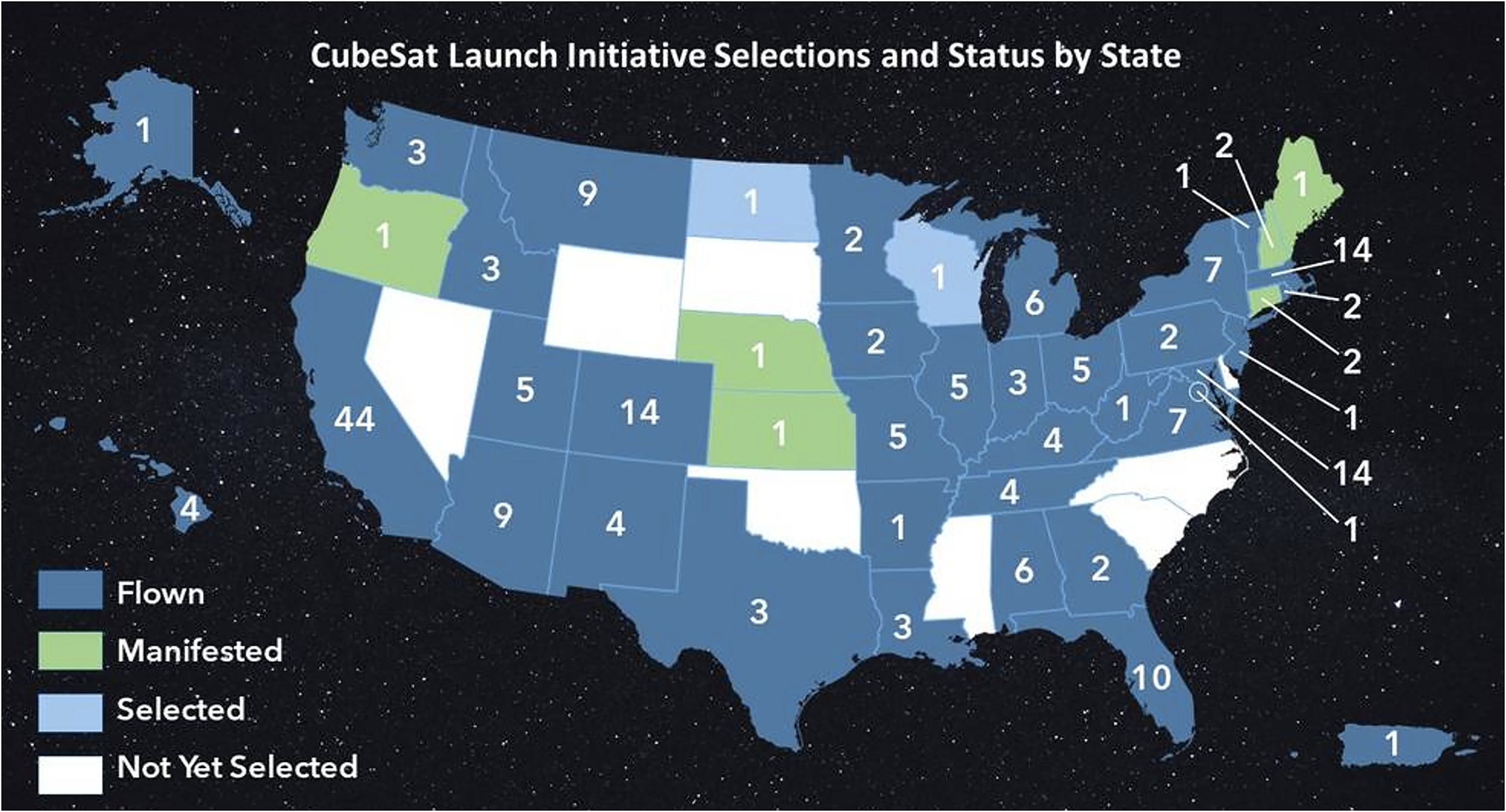
A map showing launches by state. 29
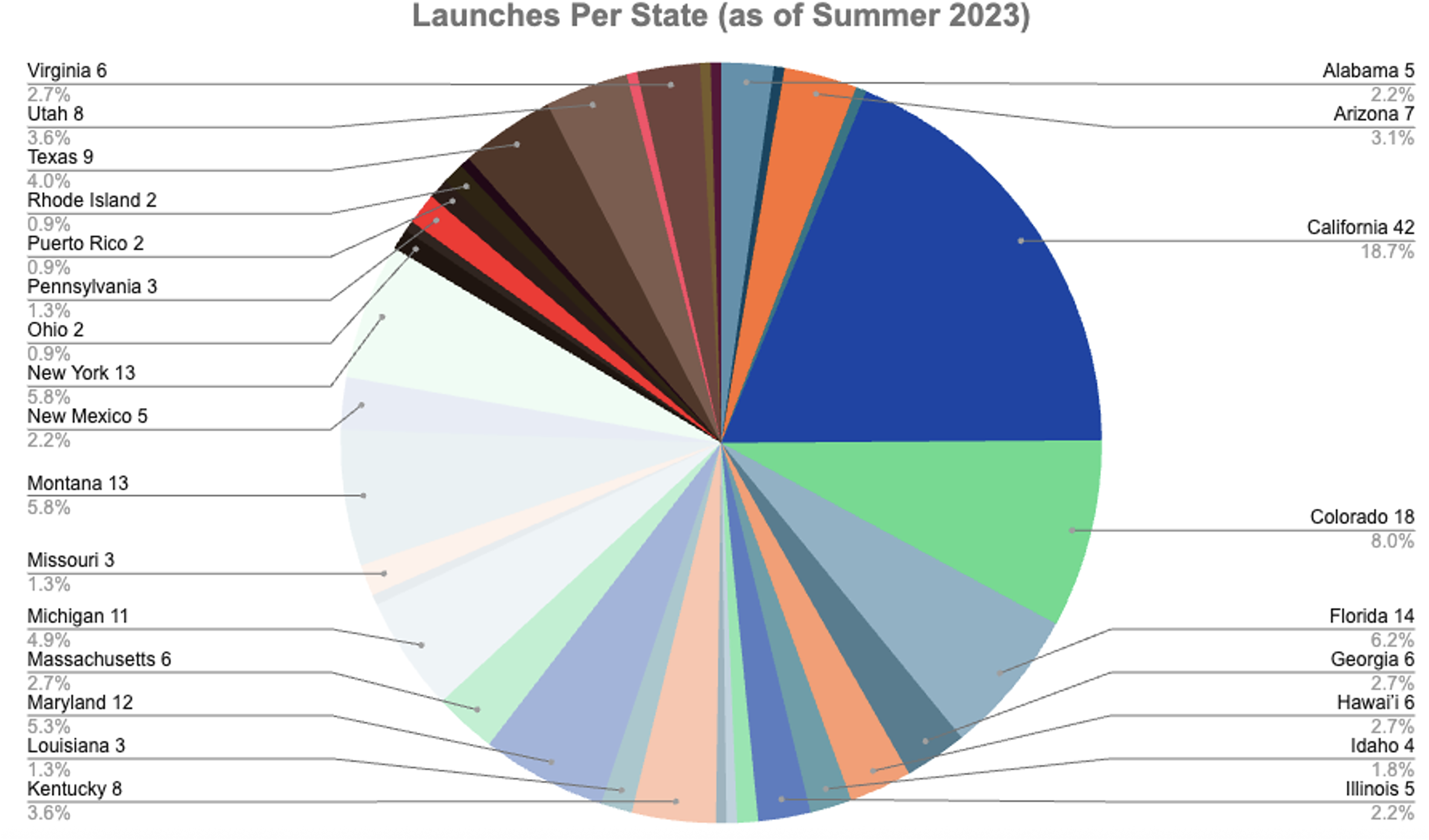
A pie chart showing launches by state. 26
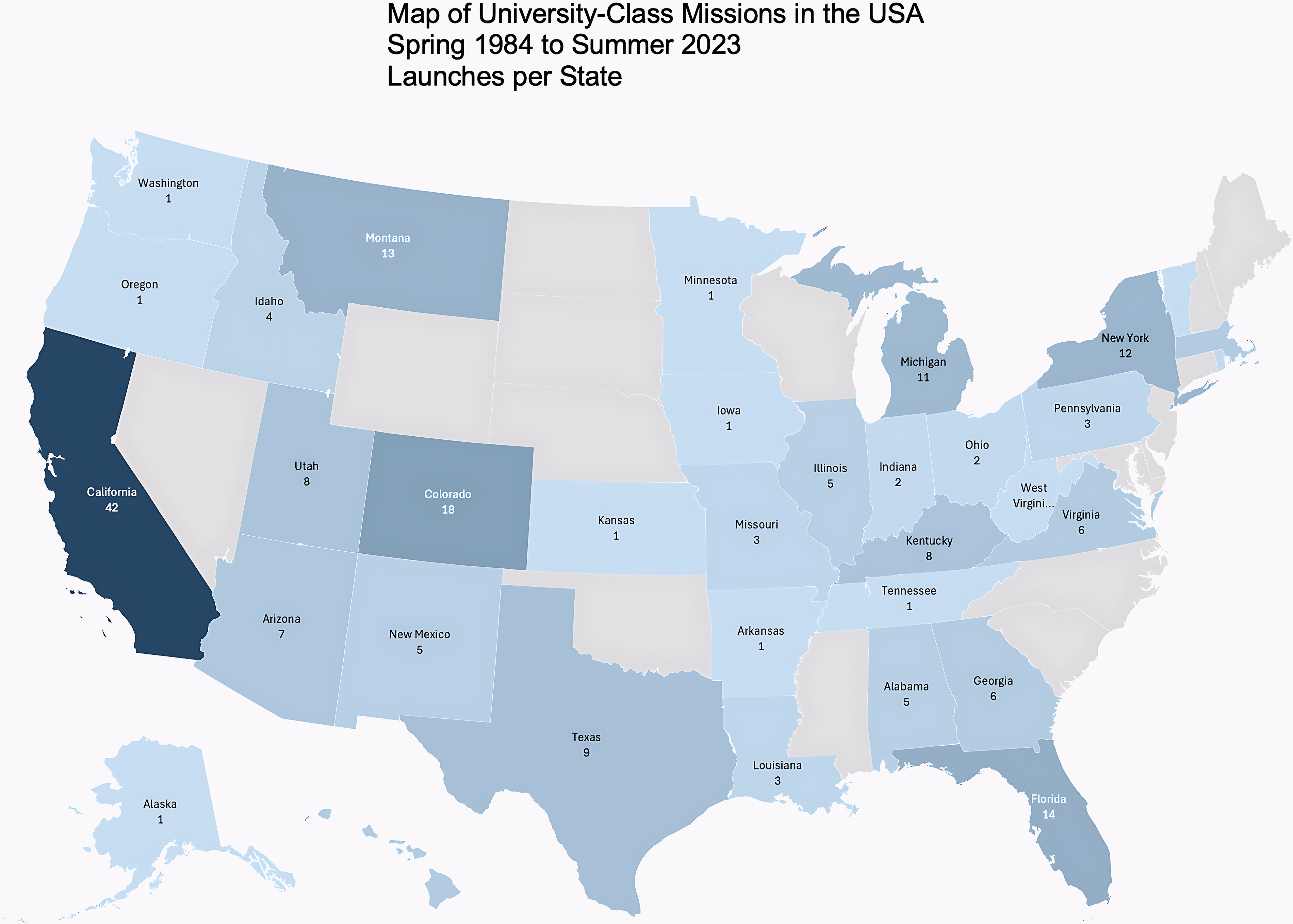
A chart showing launches by state.
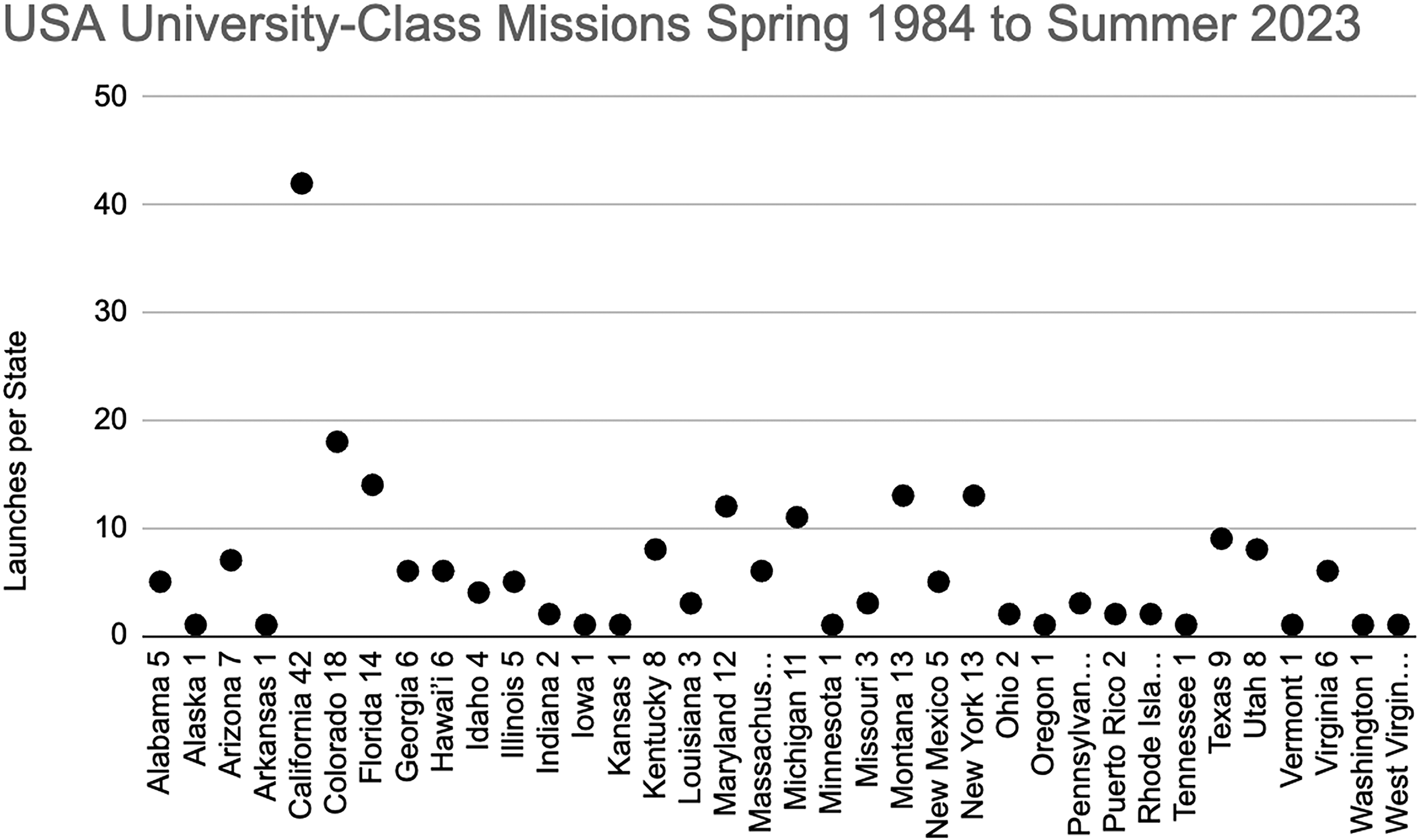
A plot chart showing University-Class Missions from 1984 to 2023 in the United States.
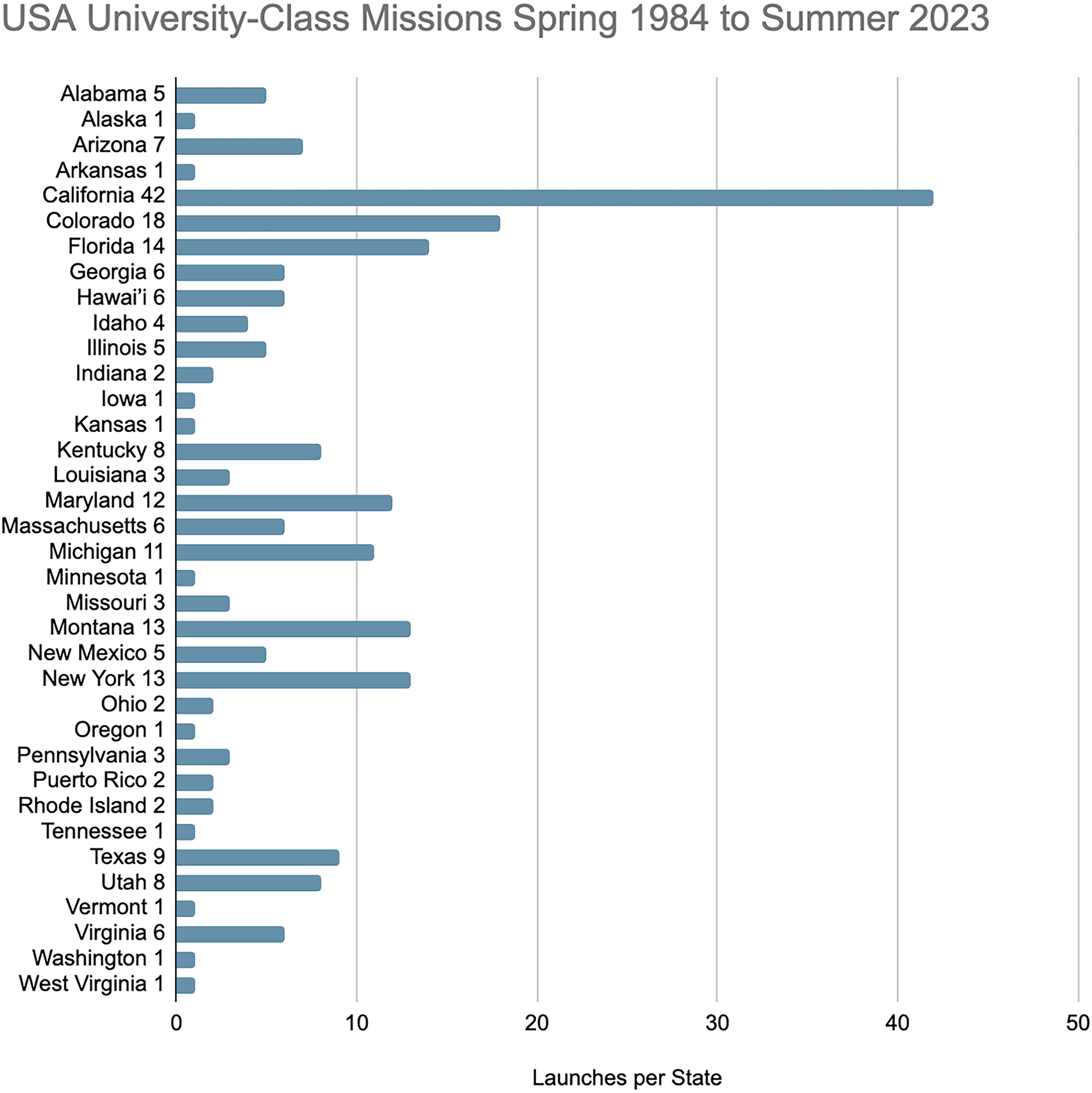
An alphabetical list of University-Class Missions from 1984 to 2023 in the United States.
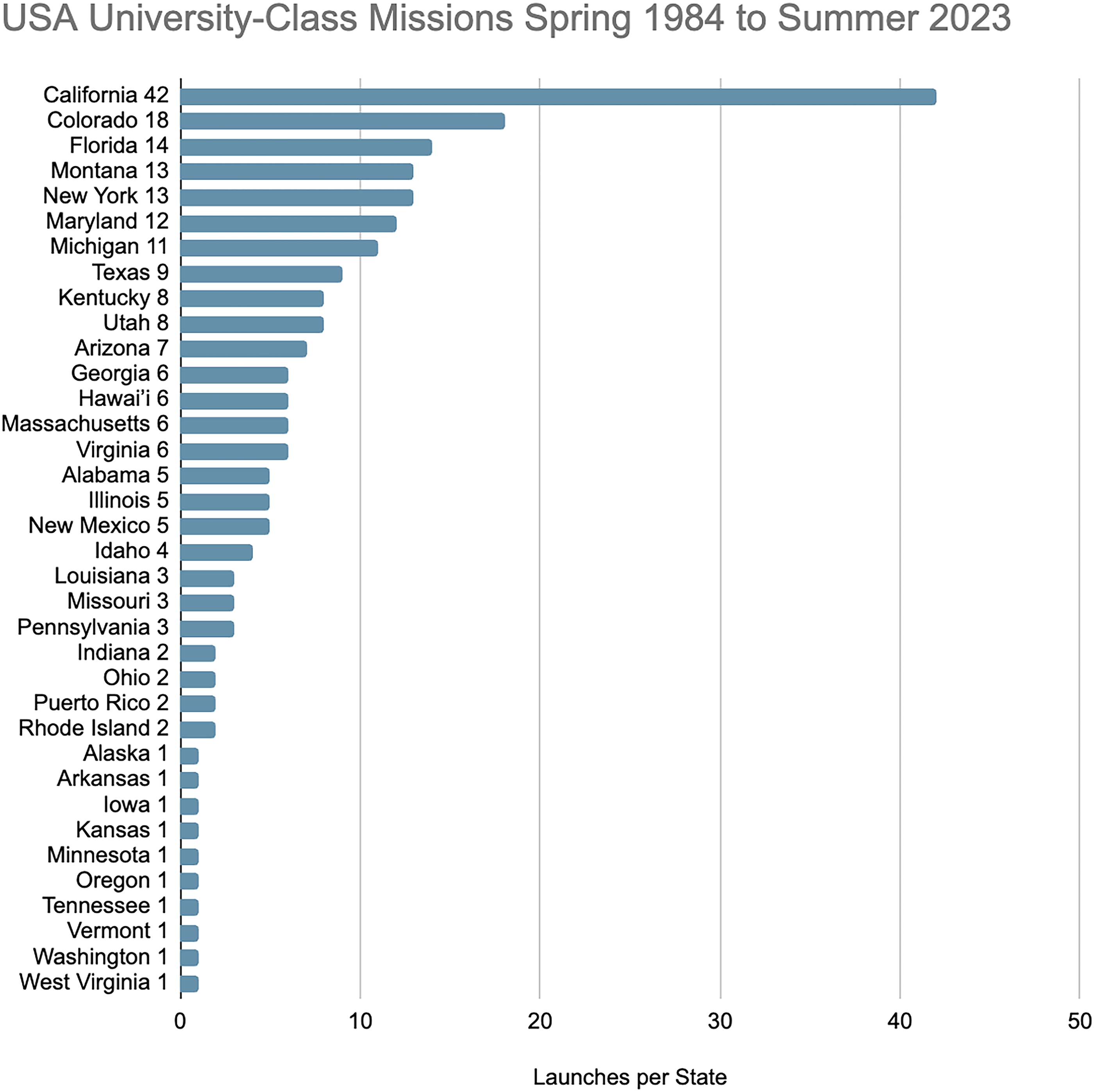
A list of university-class mission launches by state from 1984 to 2023 in descending order.
The American Northeast only has two space-producing states within the university space race with more than six launches, which include Massachusetts (6) and New York (13). Other states in this region include Pennsylvania with three launches, Vermont with one and Rhode Island with two launches. New York’s launch total is boosted by Cornell University, which began in 2006 and has launched at least nine satellites.
The American South has more active states with university space programs, with most states boasting more than five launches each. For example, Texas and Florida have historical aerospace industries and include major NASA facilities. Aerospace companies headquartered in Maryland and Virginia provide regional infrastructure and knowledgeable industry professionals, which contributed to their 41 combined launches. The states of Kentucky and Georgia benefit from one aerospace-focused university. Kentucky has eight launches with the majority being provided by Morehead State University (5). The Georgia Institute of Technology produced five of Georgia’s six launches.
The American Midwest shows relatively modest launch activity, with most states recording fewer than five launches. North Dakota and Wisconsin have each conducted a single launch, while Minnesota and Iowa have completed only two launches. Michigan leads the region with 11 launches, which is boosted by the University of Michigan’s 9 launches. The Midwest also represents one of the final frontiers for space launches, as South Dakota and Nebraska remain among the last states yet to join the space race, but have launches planned.
These state-level launches form part of the broader network of the space industry. Many of these states that launch satellites are within the key areas of the space industry infrastructure, from the Jet Propulsion Lab (JPL) in California to launch facilities in Florida’s Kennedy Space Center to United States Government bases in Colorado and Montana. States experiencing growth in launches, such as Texas, and New Mexico, are connected to the history of aerospace and both the centers of old and new space races of today.
Western states dominate launch activity, with California leading with 42 launches. Colorado and Montana follow as runners-up, each with approximately a dozen launches. Montana’s 13 launches are particularly noteworthy, yet 12 came from a single institution (Montana State University), making it the second most active program since entering the space race in 2006. Montana’s inaugural launch occurred alongside that of California Polytechnic State University, the current leader, on the same late June date.
California Polytechnic State University presents a remarkable case study: all its launches stem from a single engineering program that maintains roughly an annual launch cycle. Despite enrolling fewer than 10,000 students, this institution alone has launched more satellites than the average U.S. state. Since 2006, they have launched 16 satellites that range from CubeSats to smaller nanosatellites. They represent one of the most active education centers for university class missions with at least one launch per year throughout the past 17 years.
Smaller states like Montana have emerged as leaders with more than 10 launches in the past decade. These university space programs have unleashed significant potential as more students reach into the pipeline from university design centers into the private and governmental sectors. Many American states have only launched two or less satellites thus far, but once these programs are established, more launches are expected to occur in the near future.
In less than two decades, the rate of university-class missions has increased from two to three test launches annually to more than 10–15 university-backed missions today. Since the first American university-class mission launched from Utah’s Weber State in the mid-1980s and the introduction of CubeSat and later nanosatellite technologies, these programs have expanded across American education centers to reach a point where most American states have achieved or are developing active university-backed space programs. In recent years, more institutions have announced ambitious plans to launch additional CubeSats and smaller nanosatellites as material procurement costs, timeline management, and launch expenses decrease due to near-daily launch frequency and increased opportunities through rideshare, United Nations, and International Space Station programs.
CONCLUSION
Space education is becoming increasingly active and accessible as more satellites achieve operational orbit. University CubeSats are becoming integral to human exploration and expansion into outer space. CubeSats are contributing in several ways: “types of observation”, “observatories”, and at certain “times of [the] year.” 27 Unfortunately, however, observations become obstructed as the presence of thousands of satellites can obscure views. Nations and entities that dominate the space realm are beginning to wield significant influence in corridors of power, as exemplified by SpaceX’s Elon Musk, whose influence is “unlikely to be equaled any time soon.” 33
CubeSats have transformed human space development, bringing the once inaccessible heavens that were owned by an oligarchy of legacy space firms and nations to those with significantly less resources and smaller missions. Outside the United States, some countries in Africa and Asia are exploring the use of small satellites as an alternative to building land-based telecommunications networks. 33 The expansive vision of CubeSat democratization is now being realized. Just as the rise of the internet spread across the world from internet cafes in the early 2000s and the introduction of the smartphone, space has been democratized for the next generation of explorers.
From the first launch of a university-built spacecraft in 1970 from Australia and the first American-built spacecraft in 1985, education centers have had a long and significant presence in the space sector. Numerous active programs at American universities today, with California Polytechnic State University with 16 launches, Montana State University with 12 launches, and the United States Air Force Academy with 9 launches. Most of these active programs have extensive developmental histories with connections to the American government and defense sector, spanning from missile development (Montana) to Space Command operations (Colorado) to human spaceflight programs (California). Virginia exemplifies this network relationship most clearly, as demonstrated by the case of St. Thomas More Cathedral School in Arlington, Virginia, where a parent employed by NASA facilitated the school’s enrollment in the CubeSat program. 48
Several seemingly small universities have achieved notable launch records, including California State Polytechnic University, Pomona and Morehead State University. Their success stems from factors. First, key personnel likely play a crucial role, as these programs benefit from individuals with substantial space science experience leading their working groups. Second, interdepartmental collaboration, particularly with Engineering departments, may provide essential technical expertise and resources. Third, external funding through grants from civilian space agencies like NASA or contracts with the U.S. Department of Defense and other government entities could provide vital financial support. Finally, the explanation may be as straightforward as institutional momentum with their ‘we did it last year, let’s do it again’ mentality that develops once a program establishes itself, creating a heritage of space activity within the college system that sustains continued launches. The university’s research level also plays a role in their program. Most of the schools that are universities are the premier R1 state schools, but slowly over time, more R2 (California Polytechnic University at Pomona) and a few R3 (Morehead State University) are becoming leaders in this new educational space race.
Educators and student-built CubeSats are now integral to discussions concerning space governance, as these students are the next generation of engineers, dreamers, and planners to join the space technology sector. This industry is experiencing remarkable growth, transforming from an $80 billion sector in North America to a $600 billion sector in 2024, with projections reaching $944 billion by 2033.59,60 In the foreseeable future, universities may maintain hundreds of satellites in both LEO and GEO akin to having meal/room access cards today. Within the next 20–30 years, these student-built spacecraft may reach the Martian land and contribute to the exploration of the solar system. The vision that began in 1970 will become part of the next phase of humanity’s exploration of outer space, as opportunities primarily facilitated by American university programs will democratize access to outer space.
Footnotes
AUTHOR DISCLOSURE STATEMENT
No competing financial interests exist.
FUNDING INFORMATION
No funding was received for this article.
Appendix
List of all American education centers that have launched craft into outer space.
Name of institution, state, and number of missions sent up as of June 2023.
1. Weber State University, Utah April 29, 1985 2 (first American launch)
2. US Air Force Academy, Colorado October 25, 1997 9
3. University of Alabama-Huntsville, Alabama October 24, 1998 2
4. US Naval Postgraduate School (NPS), California October 29, 1998 3
5. Arizona State University (ASU), Arizona January 27, 2000 5
6. Stanford University, California January 27, 2000 8
7. Santa Clara University, California February 10, 2000 3
8. United States Naval Academy, Maryland September 30, 2001 10
9. New Mexico State University, New Mexico December 21, 2004 2
10. University of Kansas, Kansas July 26, 2006 1
11. University of Arizona, Arizona July 26, 2006 2
12. Montana State University, Montana July 26, 2006 12
13. University of Illinois (UIUC), Illinois July 26, 2006 5
14. Cornell University, New York July 26, 2006 9
15. California Polytechnic State University, California July 26, 2006 16
16. University of Hawai’i at Manoa, Hawai’i July 26, 2006 5
17. University of Louisiana at Lafayette, Louisiana April 17, 2007 3
18. Texas A&M University, Texas July 15, 2009 2
19. University of Texas-Austin, Texas July 15, 2009 7
20. University of Michigan, Michigan November 20, 2010 9
21. University of Southern California, California December 8, 2010 1
22. Kentucky Space Consortium, Kentucky March 4, 2011 3
23. University of Colorado, Colorado March 4, 2011 6
24. Auburn University, Alabama October 28, 2011 1
25. University of California, Berkeley USA September 13, 2012 2
26. Morehead State University, Kentucky September 13, 2012 5
27. Colorado Space Grant Consortium, Colorado September 29, 2013 2
28. Utah State University, Utah September 29, 2013 4
29. Drexel University, Pennsylvania November 20, 2013 1
30. University of New Mexico, New Mexico November 20, 2013 1
31. Vermont Technical College, Vermont November 20, 2013 1
32. West Point Military Academy, New York November 20, 2013 1
33. Saint Louis University, Missouri November 20, 2013 3
34. University of Florida, Florida November 20, 2013 5
35. Thomas Jefferson High School for Science and Technology, Virginia November 20, 2013 2
36. University of Maryland, Baltimore County, Maryland November 21, 2013 1
37. City University of New York (CUNY), New York December 6, 2013 1
38. Taylor University, Indiana April 18, 2014 1
39. Salish Kootenai College, Montana October 8, 2015 1
40. University of Alaska Fairbanks, Alaska October 8, 2015 1
41. St Thomas More Cathedral School, Virginia, December 6, 2015 1
42. Cal State Northridge, California April 18, 2017 1
43. Universidad del Turabo, Puerto Rico April 18, 2017 1
44. Pennsylvania State University (PSU), Pennsylvania August 14, 2017 1
45. MIT SSL (Space Systems Laboratory), Massachusetts August 14, 2017 3
46. Embry-Riddle Aeronautical University (ERAU), Florida November 18, 2017 1
47. Northwest Nazarene University (NNU), Idaho November 18, 2017 3
48. University of Iowa, Iowa May 21, 2018 1
49. Colorado State University, Colorado May 21, 2018 1
50. The Ohio State University, Ohio May 21, 2018 1
51. Brown University, Rhode Island May 21, 2018 2
52. University of California, Los Angeles (UCLA), California September 15, 2018 2
53. University of Central Florida (UCF), Florida September 15, 2018 2
54. Irvine Public Schools Foundation (IPSF), California November 11, 2018 2
55. Georgia Institute of Technology (Georgia Tech), Georgia December 3, 2018 5
56. The Weiss School, Florida December 3, 2018 2
57. University of Southern Indiana, Indiana December 5, 2018 1
58. New Mexico Institute of Mining and Technology, New Mexico December 16, 2018 1
59. North Idaho STEM Charter Academy, Idaho December 16, 2018 1
60. West Virginia University, West Virginia December 16, 2018 1
61. Old Dominion University, Virginia April 17, 2019 1
62. University of Virginia (UVA), Virginia April 17, 2019 1
63. Virginia Polytechnic Institute (Virginia Tech), Virginia April 17, 2019 1
64. Merritt Island High School, Florida June 25, 2019 1
65. Michigan Technical University, Michigan June 25, 2019 2
66. University of Minnesota, Minnesota November 2, 2019 1
67. University of Washington, Washington November 2, 2019 1
68. The University of New Mexico (COSMIAC), New Mexico December 5, 2019 1
69. Sonoma State University (SSU), California December 5, 2019 1
70. Boston University (BU), Massachusetts June 13, 2020 2
71. Ohio University, Ohio October 3, 2020 1
72. University of Georgia (UGA), Georgia October 3, 2020 1
73. Brigham Young University (BYU), Utah January 17, 2021 2
74. Capitol Technology University, Maryland January 17, 2021 1
75. University of South Florida (USF), Florida January 24, 2021 3
76. Oak Ridge High School, Tennessee 6/3/2021 1
77. Universidad Interamericana de Puerto Rico, Puerto Rico August 29, 2021 1
78. University of Massachusetts-UMASS, Massachusetts August 29, 2021 1
79. Hawaii Science and Technology Museum, Hawaii September 3, 2021 1
80. Teachers in Space Inc, New York September 3, 2021 2
81. Carnegie Mellon University, Pennsylvania January 13, 2022 1
82. University of Alabama (UA)-UASpace Lab, Alabama February 10, 2022 1
83. Portland State University (PSU) Oregon March 15, 2022 1
84. University of South Alabama, Alabama July 15, 2022 1
85. University of Arkansas (UArk), Arkansas March 15, 2023 1
86. Bronco Space (Cal Poly Pomona), California May 25, 2022 3
American States with Number of Launches by Education Centers
Alabama 5
Alaska 1
Arizona 7
Arkansas 1
California 42
Colorado 18
Florida 14
Georgia 6
Hawai’i 6
Idaho 4
Illinois 5
Indiana 2
Iowa 1
Kansas 1
Kentucky 8
Louisiana 3
Maryland 12
Massachusetts 6
Michigan 11
Minnesota 1
Missouri 3
Montana 13
New Mexico 5
New York 13
Ohio 2
Oregon 1
Pennsylvania 3
Puerto Rico 2
Rhode Island 2
Tennessee 1
Texas 9
Utah 8
Vermont 1
Virginia 6
Washington 1
West Virginia 1