



Abstract
In a delicate balancing act between improving public relations and enhancing functionality and safety, law enforcement agencies often revisit the standards for their uniforms. Many experiments have been conducted over the years in reference to uniform color, but comparatively little research has been conducted relating to the implementation of accessories. In this study, we demonstrate that the use of “formal accessories” (as worn on a Class A uniform) may impact the public’s perception of police, particularly in reference to their perceived professionalism, authority, competence, and approachability.
Introduction
Amid the steady militarization of the police in the United States in the last several decades, many politicians, academics, and members of the general public have begun to criticize the appearance of some police uniforms on the account that they are overly militaristic and deter the growth of police-citizen trust (Lawson, 2018; Moody, 2022). This is important to note, as law enforcement officers take an oath “to protect and to serve” the civilian population. Garnering an overly- militarized image may diminish an officer’s or a department’s ability to effectively carry out this commitment (Quill, 2016). Different designs and variants of equipment, such as firearm slide augments, can also directly impact an officer’s error rate (Stone et al., 2022). If an agency uniforms its officers in a more militarized way, previous research indicates that this evokes negative feelings from citizens (Blaskovits et al., 2021; Cooke, 2004). Previous research has also shown that agencies adopting a more casual uniform may undermine the public’s respect for their officers (Simpson, 2017; Johnson, 2001). And other research has found that various shoe styles impact the confidence and capability of the wearer, emphasizing that uniform design is important from head to toe (Fales et al. 2020). Thus, adopting a uniform that ensures officers (1) are able to carry all of the equipment needed for their job, (2) are afforded respect, and (3) are not viewed as overly aggressive or unapproachable appears to be a delicate balancing act.
This study aims to build upon prior research by determining the extent to which two variants of commonly-worn police uniform styles influence the perception of professionalism, authority, respect, competence, approachability, honesty, fairness, and intelligence of police officers.
Previous Research Related to the Perception and Impression of Police Uniforms
Association Between Clothing and Perception
Prior research has revealed clothing as one of the most important influences considered when forming an initial impression (Lennon & Davis, 1989; Radeloff, 1990). Clothing type and color shape perceptions of competence, professionalism, and skill in the workplace (Lawrence & Watson, 1991). For example, lighter colors (white, yellow, gray) are most often associated with weakness and goodness (Adams & Osgood, 1973); darker colors tend to increase the likelihood of an assessment of aggressiveness (Alias & Bahron, 2019; Zegar et al., 2022). Adams and Osgood demonstrated that these associations appear to be generally independent of location and culture and arise in Europe, Asia, and Africa.
Perception of Police Uniforms
Several studies have investigated the effects of color, a disheveled appearance, accessories, and militarized gear on the perception of police officers.
The largest of these studies aimed at understanding the impact of uniform color was conducted by Johnson (2005), who assessed a sample of 737 citizens and their perceptions of four commonly-worn uniforms. In this study, Johnson found that darker uniforms (black pants and shirt) were rated as more “mean, cold, forceful, unfriendly, aggressive, and corrupt.” Lighter uniforms were associated with more positive impressions. Contrary to the findings of (Johnson, 2005; Nickels, 2008) found that 150 college students associated darker uniforms with more positive qualities.
Appearance and Accessories
Other research has focused on an officer’s disheveled appearance (i.e., dirty, wrinkled uniforms) or use of accessories. It has been found that offenders are more likely to seek out and attack officers who appear complacent and unprofessional and that disheveled uniforms convey unprofessionalism (Pinizzotto & Davis, 1999; Johnson, 2001). The influence of accessories such as sunglasses, vests, gloves, hats, and batons has also been investigated. When officers wore dark sunglasses, longstick batons, or black gloves, public opinion of the officer dropped (Boyanowsky & Griffiths, 1982; Simpson, 2017). It has also been suggested that hi-vis vests are perceived as less aggressive (Simpson, 2018). Some older research has indicated that hats increase the perception of authority, although a more recent study with a larger sample size has contradicted this finding (Johnson et al., 2014; Volpp & Lennon, 1988). Johnson et al. (2014) also found that neckties do not improve or worsen impressions.
Field-Tested Results
To conclude this section, it may be instructive to review a historical case study involving the wholesale reinvention of the police uniform by over 400 departments in the 1970s. In an attempt to improve community relations, this nontraditional uniform consisted of a blazer worn over black slacks, a white shirt, a black tie, and weapons concealed underneath the coat (Johnson, 2001). While conflicts between police and civilians declined in the first 18 months, it is generally believed that this new uniform resulted in a loss of legitimacy, authority, and respect over time. This is because eight years after the change, conflicts were occurring at more than double their pre-uniform-change rate (Johnson, 2001; Mauro, 1984).
Literature Gaps and Contribution of the Present Study
There are various reasons why the study of the public perception of police apparel remains relevant.
Firstly, the majority of empirical research on this topic is significantly outdated. Only a few experiments have been conducted in the last decade, and the vast majority of research on this subject originated over twenty years ago. Public perceptions, preferences, and predilections have likely changed in this time.
In keeping with the possibility that the public opinion of police has likely changed with time, recent events, notably the 2020 Black Lives Matter protests, have significantly influenced the public as it relates to the general perception of policing. To our knowledge, only one empirical study on this topic has been conducted since the protests of 2020, which investigated color differences in a Canadian context (Jenkins et al., 2021).
The results of this study may aid police department executives in selecting a uniform that is both functional and well-received by the public.
Methods
Thirty-three participants from population centers across the Midwest were administered a survey gauging their perception of differences between “Class A” and “Class B” uniforms via a survey. “Class A” uniforms were formal uniforms sporting neckties, epaulets, and metal badges. In contrast, “Class B” uniforms were more casual and did not include the adornments of Class A. Examples are shown below in Figure 1 , designed by the research team. These uniforms are based on the standards that local police departments would typically follow (Hamilton, n.d.).
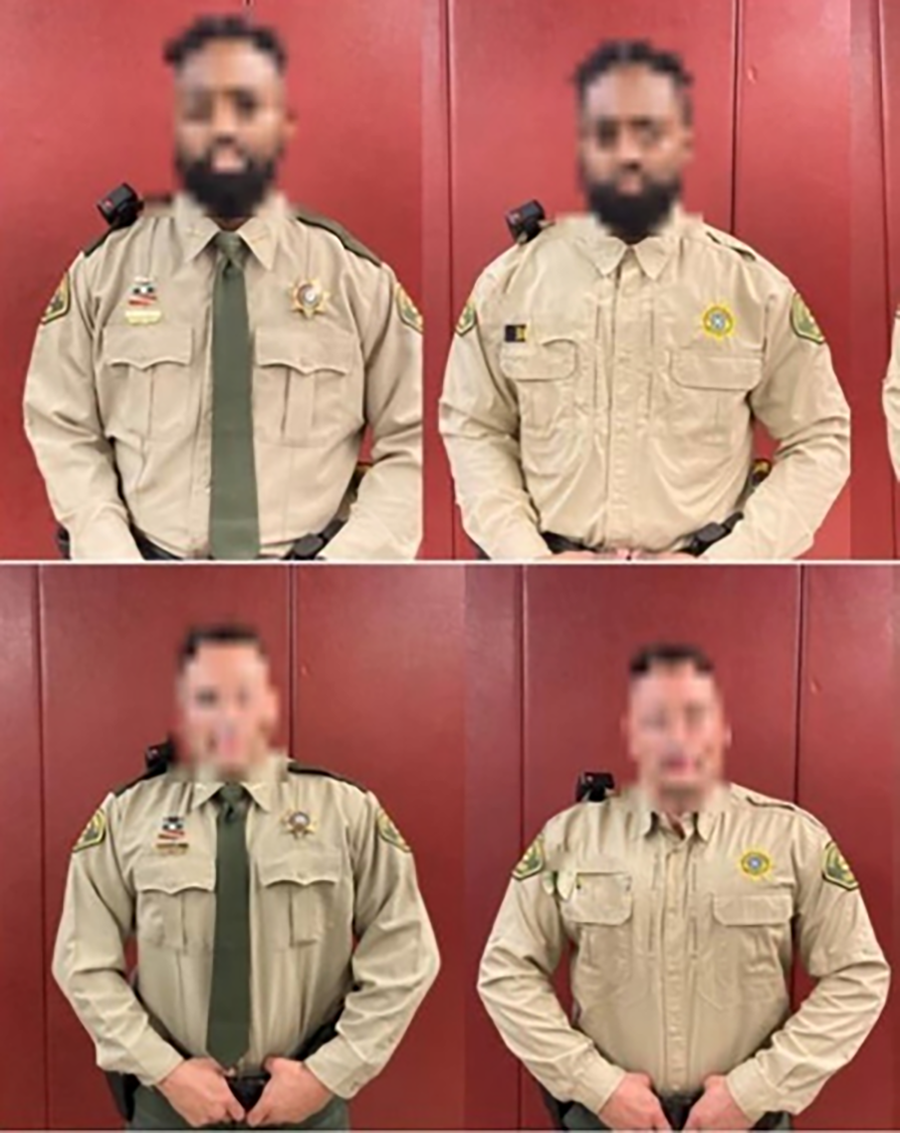
Class A (Left), Class B (Right).
The study participants were all university undergraduates or members of public service/law enforcement groups from a medium-sized (population: 70,000) midwestern towns. The participants were 36.4% men (12), 51.5% women (17), and 12.1% non-binary (4). In addition to gathering demographic information, the survey presented one officer in one uniform style at a time and asked participants to gauge their observations of each style. They then rated these observations on a Likert scale from 1 to 5, with one corresponding to strong disagreement with a statement and five corresponding to a strong agreement. Questions were asked about the uniforms’ ability to convey each of eight qualities: professionalism, authority, respect, competence, approachability, honesty, fairness, and intelligence.
Results
Once the data was gathered, it was analyzed using JMP statistical software and a series of chi- squared tests comparing the Likert scale scores received by each uniform for the given quality. The results can be seen below in Table 1 .
Chi-square tests across uniform scores.
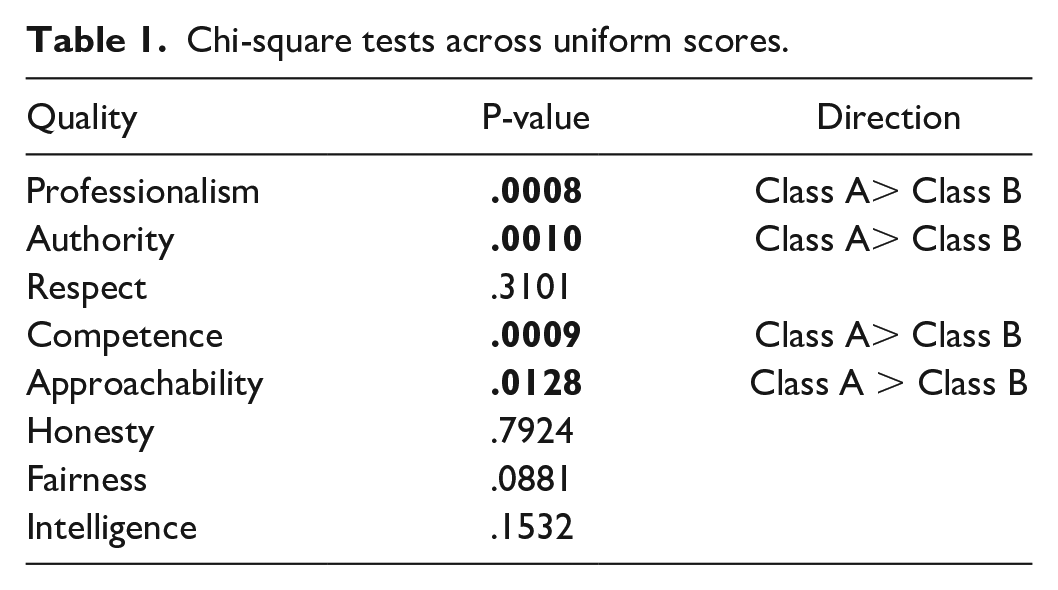
Figure 2 through Figure 5 shows mosaic plots of the four qualities (professionalism, authority, competence, and approachability) for which a statistically significant difference was demonstrated. In these plots, the proportion of responses is shown on the left, while the Likert scale score is shown on the right.
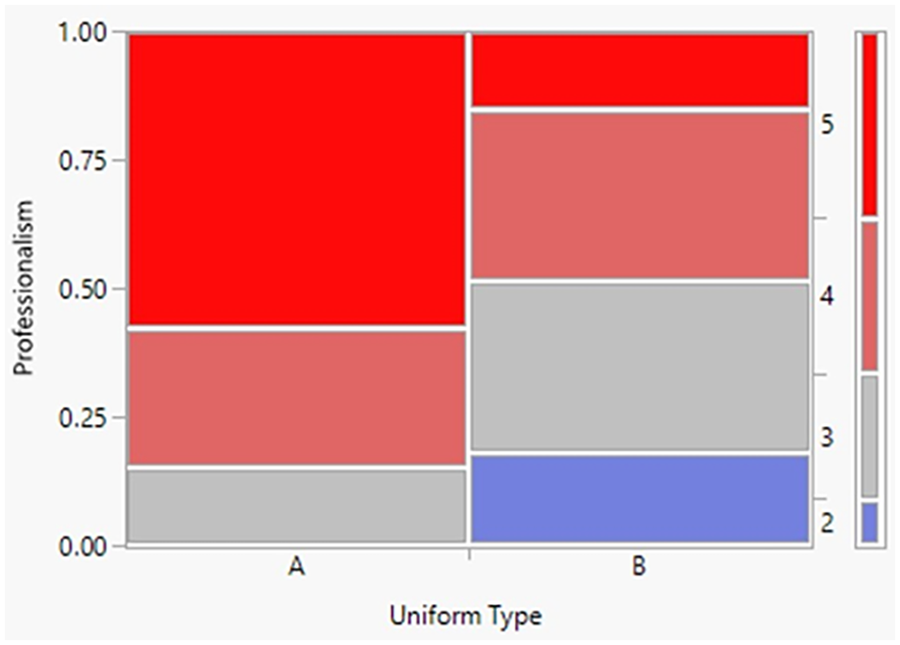
Mosaic Plot of Professionalism Scores.
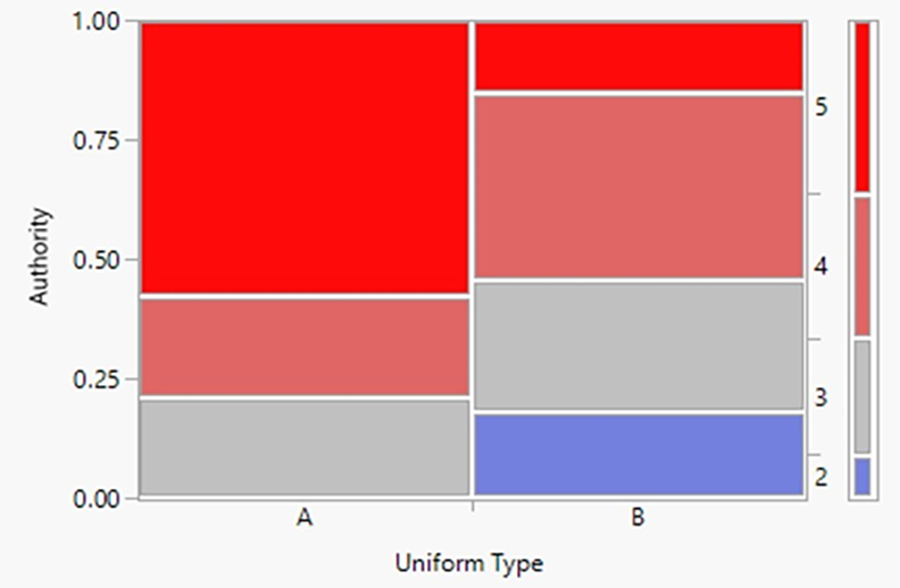
Mosaic Plot of Authority Scores.
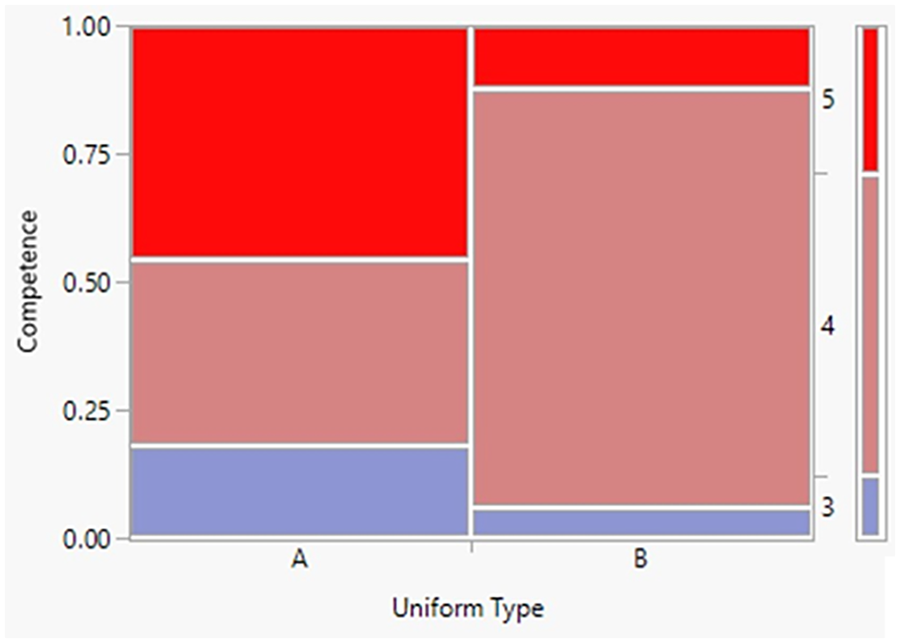
Mosaic Plot of Competence Scores.
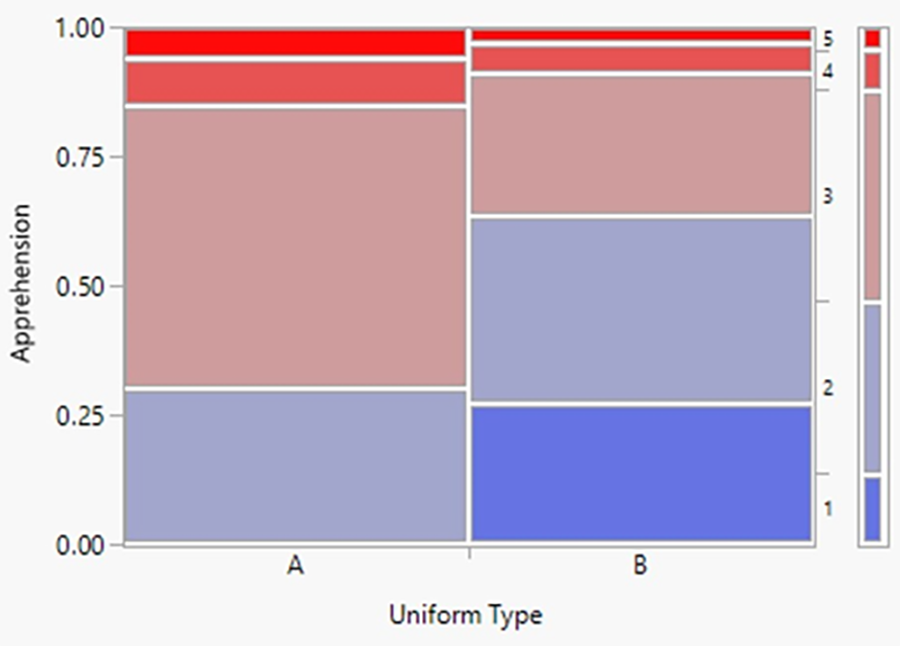
Mosaic Plot of Approachability (also called “Apprehension”) Scores.
Discussion
The results indicate statistically significant differences between survey participants’ impressions of the Class A and Class B uniforms regarding professionalism, authority, competence, and approachability. The Class A (formal) uniform was viewed more favorably in each case. The survey results revealed no statistically significant differences concerning intelligence, fairness, honesty, or respect.
The mosaic plots reveal the degree to which participants agreed or disagreed with the uniform’s ability to convey a certain quality. For example, in the cases of professionalism and authority, over half of the participants “strongly agreed” that the Class A uniform conveyed this quality, whereas only about 20% thought the same way about the Class B uniform. Several participants “disagreed” that the Class B uniform conveyed professionalism and authority. In contrast, no participants found this to be true for the Class A uniform. Similar statements could be made about the quality of competence. Regarding approachability, a quarter of participants “strongly disagreed” that the Class B uniform made the officer seem approachable; no participants had the same thought when viewing the Class A uniform.
The differences between the Class A and Class B uniforms were purely accessory-based. The Class A uniform included a metal badge, epaulets, and a tie, while the Class B uniform did not. Previous research has demonstrated that removing “formal” accessories does not appear to impact the public’s perception of the police (Johnson et al., 2014). In the case of Johnson et al., 2014, the presence or absence of a tie or a tie and hat did not affect the perceptions of citizens with whom officers interacted. In the present study, analysis of the results reveals that removing three accessories affected the respondent’s perception of the police in reference to their perceived professionalism, authority, competence, and approachability.
Limitations and Future Work
Although these results appear to contradict the conclusions of Johnson et al., 2014, that removal of accessories does not affect public perception; this study enjoys neither the large sample size nor the sophisticated study design of that work. Thus, it is unlikely that those results could be overturned. What may be more likely is that there is a certain point at which the removal or addition of more formal accessories does indeed impact a citizen’s positive or negative perception of law enforcement officers. However, the point at which a citizen’s perception changes is uncertain.
This pilot study was limited by a relatively small sample size. Additionally, it is possible that the sample, comprised mostly of university students and members of law enforcement groups, was not wholly representative of the population of the towns surveyed. Nonetheless, the results demonstrate that adding some or a certain number of accessories may influence the positive/negative perception of police. Further research is needed to determine which and what number of accessories are best suited for improving the public’s perception. Further research can also be done to see how standards compare to real experience, as studies into that interaction in the past have found that occasionally standards are excessive when compared to what people do on their own (Stone et al. 2022). As appropriately asked by Johnson et al., 2014: “officers apparently need to wear some sort of uniform for citizen recognition, so where is the line drawn regarding which accessories are necessary and which are not?”
Conclusions
The results of this study indicate that officers that wear more formal attire (as seen in the Class A uniform) are more likely to enjoy an improved perception from the public, particularly in reference to professionalism, authority, competence, and approachability. Law enforcement agencies should consider these findings when deciding which type of uniform they select for their officers.