



Abstract
Academic literature and safety organizations have documented challenges women face with personal protective equipment (PPE) sizing and fit. The major contributing factor for these challenges is relevant anthropometric data and how that data is applied to product blueprints. For example, in order to draft an accurate blueprint for pants, 33 specific anthropometric measures are needed. When considering a highly referenced standard and anthropometric databases utilized for PPE pant development - ISO (2017), CAESAR (2002) and ANSUR (2012), only 6%, 21%, and 21% of the measures depicted were included, respectively. This research will demonstrate what anthropometric measures are needed to draft a functional PPE pant blueprint, while highlighting issues when these measures are not included.
Objective
Personal Protective Equipment (PPE)
OSHA defines Personal Protective Equipment (PPE) as footwear, apparel, and accessories worn to minimize exposure to hazards that cause injuries and illnesses (U.S. Department of Labor Occupational Safety and Health Administration, 2023). For activities and occupations that require PPE, human performance and safety can be affected by poor sizing and fit, especially for women. This research will focus on how relevant anthropometric measures could improve blueprints to develop more functional and inclusive PPE pants.
Background
Pant Sizing and Fit Challenges for Women
Sizing is defined as the list of measurements and classifications provided by manufactures and standardization organizations to assign products to bodies. Fit is the procedure used to confirm how sized products should interface with the body and other products. Academic literature and safety organizations have documented challenges women face with personal protective equipment (PPE) sizing and fit, especially pants.
Examples of these challenges have been reported internationally. In the United States (U.S.), Sokolowski et. al. (2022) reported that female firefighters could not find pants in small enough sizes, and there was a lack of size access. Lengthwise, they described how firefighters reported their pants to be too long in the legs and crotch. In the same study they documented circumferentially that pants were too wide, bulky, and oversized around the waist and legs. In addition, pocket and suspender placement was reported to be challenging, effecting performance and safety for women.
In the United Kingdom, the Trades Union Congress (TUC) surveyed over 5,000 women who wore PPE for jobs in emergency services, retail, manufacturing and engineering. Of the women surveyed, 57% reported that their PPE hindered their work “sometimes” or “significantly.” Specifically they found 41% of respondents said their protective pants were inappropriate.
The Canadian Standards Association reviewed scientific, grey literature, PPE regulations, interviews, and survey of nearly 3000 women, and the most common challenges reported were fit (50%), lack of comfort (43%), and lack of women-specific PPE (35%) (Keefe, 2022). While in Australia, similar findings to the U.S. study were described by Oo et. al. (2020), where 32% of the women studied made alterations or adjustments to their PPE pants – because the hems were too long and/or the waist was too wide.
PPE Development Process
To understand the root cause of the PPE pant sizing and fit challenges faced by women, it is important to know how PPE pants are developed. To start, most manufacturers work on a seasonal cadence where new products are launched. This can occur between one to four times a year and is dependent on the size and scope of the manufacturer. This “market need” is often led by the product line manager or merchandiser at the manufacturer, where a product brief is created. From the brief the PPE pant is designed. During the design process, new material(s) or performance technology(s) can be created in tandem. Once the new design is “bought-in” by the business side of the manufacturer, the new PPE pant will be developed at the factory. It is at this point where a manufacturer can inform sizing and fit with anthropometric data, or they can on rely existing products or the factory and their sizing practices to determine sizing/fit.
Specifically, when it comes to anthropometric data, most PPE manufacturers do not collect their own, as it is not their area of expertise and the length of time involved to establish and analyze this type of data is quite timely. Data is either bought or provided from existing databases that have free access. From the data, it is up to the manufacturer to determine how it is used and interpreted. As blueprint drafting is a “dying art,” many U.S., developers may not know how to interpret the data or even define if it is usable. This is where sizing and fit challenges exist for women. Therefore, this paper will attempt to bring awareness to the types of anthropometric data needed to draft an accurate PPE pants blueprint, so future products can perform better and be safer, for women.
Blueprint Measures Needed
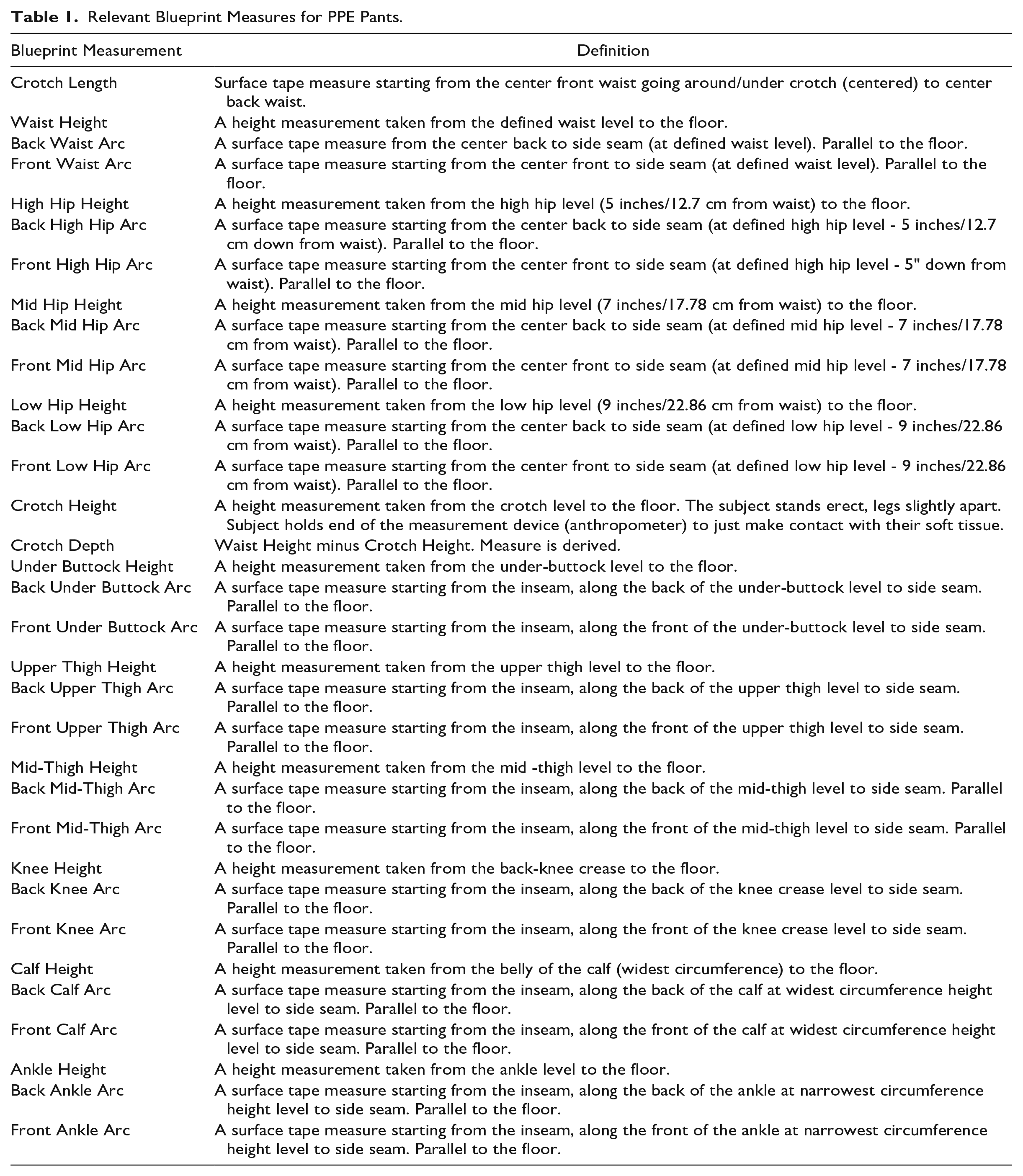
To develop a well-fitting, PPE pant blueprint, 33 anthropometric measures are needed. These measurements were identified by the researchers from their experience researching, designing and developing PPE pants, for over 30 years. The measures and their definitions are presented in Table 1.
Relevant Blueprint Measures for PPE Pants.
Method
From the measures identified in Table 1, a detailed PPE pant blueprint can be created, with fit considerations from the waist to the ankle. For this study the researchers wanted to demonstrate how well a frequently referenced standard and anthropometric databases used in the PPE field could provide relevant measures to develop pant blueprints. The International Organization for Standardization (ISO) standard 7250-1:2017 Basic human body measurements for technological design — Part 1: Body measurement definitions and landmarks (2017), was evaluated as the ISO provides guidelines on how to collect anthropometric data for product design. The databases evaluated for the study included the 2002 Civilian American and European Surface Anthropometry Resource (CAESAR), and the 2012 Anthropometric Survey of US Army Personnel II (ANSUR II). A dichotomous evaluation method where Table 1 was used as a framework to organize information was devised. Through the evaluation percentages were calculated to determine how well the anthropometric measurement standard and databases were suited to develop PPE pant blueprints.
Results
Utilizing Table 1 as a framework for comparison, the researchers evaluated the ISO measurement standards and measures from CAESAR and ANSUR, to determine how well they could inform a reliable PPE pant pattern. Table 2 presents the results.
Measurement Availability.
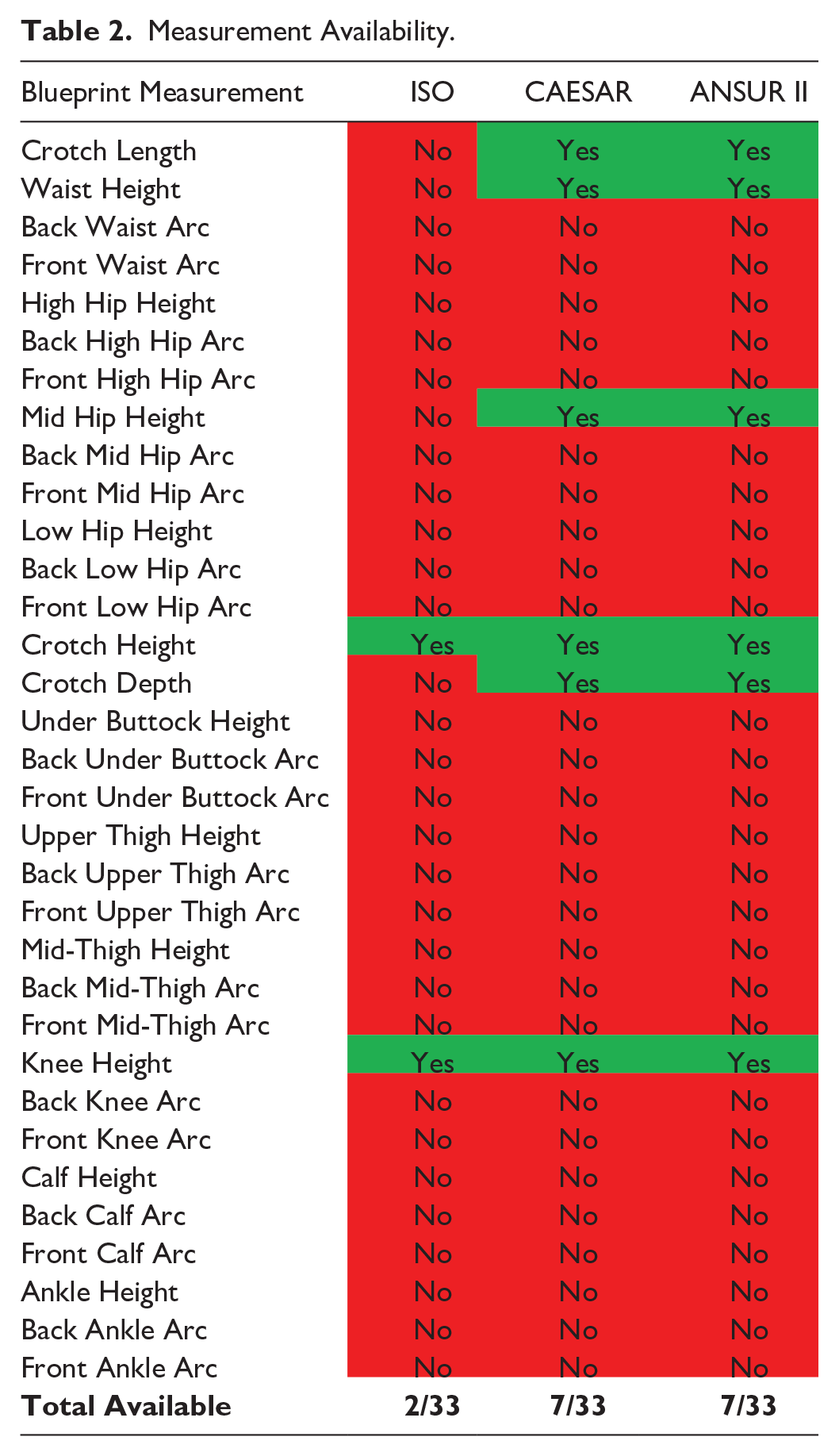
From the evaluation, 2/33 (6%) of the required measures were described in the ISO standard. 7/33 (21%) of the required measures were available from the CAESAR database, and 7/33 (21%) of the required measures were available from the ANSUR database. The most critical measures missing from the standard and databases were heights of key fitting zones – areas of the body that are variable due to muscle or fat tissue composition and/or areas that need to flex while working, and the separate circumferential front and back body measures, as the body is not shaped symmetrically.
Conclusion
From the dichotomous evaluation, it is not surprising women have issues with PPE pant sizing and fit, as many of the required measures needed to draft an accurate blueprint are missing. Without the specified anthropometric measures, key fit challenges explained in the literature cannot be addressed effectively and women will continue to face performance and safety challenges.
Application
The method and knowledge gained from this study can be used to improve measurement standards and assist organizations that conduct future anthropometric studies, to ensure relevant measurement data is collected to develop PPE pants. Similar studies can be conducted for other PPE categories, including tops, coveralls, helmets, face masks, gloves and footwear, for women and users of other demographic characteristics.
