



Abstract
As a result of increasing availability, Helicopter Emergency Medical Services (HEMS) operations have become an important part of the healthcare system within the United States; however, this growth has come at a cost to the pilots and crew members who provide these services. For several decades, the largest contributing factor to HEMS accidents and fatalities has been flight into degraded conditions. Flying in dark night conditions as well as continued and inadvertent flight into IMC persist as the biggest risk factors for HEMS crews. Using the Human Factors Analysis and Classification System (HFACS), our analysis investigates the active failures which increase risk in HEMS operations and lead to accidents continuously occurring in degraded conditions.
Introduction
On March 26, 2016 in Enterprise, Alabama, a Helicopter Emergency Medical Services (HEMS) flight departed the scene of a motor vehicle accident (MVA) with the intent of transporting a patient to the hospital. Operating under visual flight rules (VFR), the helicopter took off in dark night instrument meteorological conditions (IMC) at around 12:18 am. Weather conditions at the MVA site included fog and mist which resulted in limited visibility. The helicopter crashed a mere half mile from the departure location. Though the helicopter had sufficient instrumentation and a night vision imaging system, the pilot experienced spatial disorientation after entering IMC, causing him to lose control of the helicopter. The pilot, two crew members, and the patient all received fatal injuries.
Investigation by the National Transportation Safety Board (NTSB) revealed that the accident pilot had about 265 hours of experience flying in IMC and had received training in the past on inadvertent IMC loss of control recovery; however, the pilot was not instrument current at the time of the accident and had not been trained or qualified by the operator to fly in IMC at the time of the accident. Accidents such as this one illustrate the complexity of the environment within which HEMS pilots and crew operate and the role that pilots and operators play in mitigating risk.
HEMS operations have become an integral part of the healthcare system in the United States; however, the increasing availability of helicopter transport has not come without a cost to those individuals who provide these services and the patients who count on them. Working within HEMS operations is recognized as one of the most dangerous occupations in the world (Ruskin, 2019), and the consequences of errors that occur within these operations tragically fall on crew and patients. For decades, the most common factors in fatal HEMS accidents are degraded environmental conditions. Helicopter Emergency Medical Service accidents that occur in degraded conditions are more likely to result in fatalities than HEMS accidents that occur in “normal” conditions (Baker et al., 2006). In many cases, the term “degraded conditions” refers to low-light conditions and the presence of instrument meteorological conditions (IMC) or other degraded weather and environmental conditions.
Despite new safety rules implemented by the Federal Aviation Administration (FAA) in 2014 to mitigate risk for HEMS operations when flying in degraded conditions (Nix, et al., 2014), these accidents continue to happen. Pertinent rulings are outlined in Table 1. This trend in accidents is illustrated in figure 1.
New FAA Rulings.

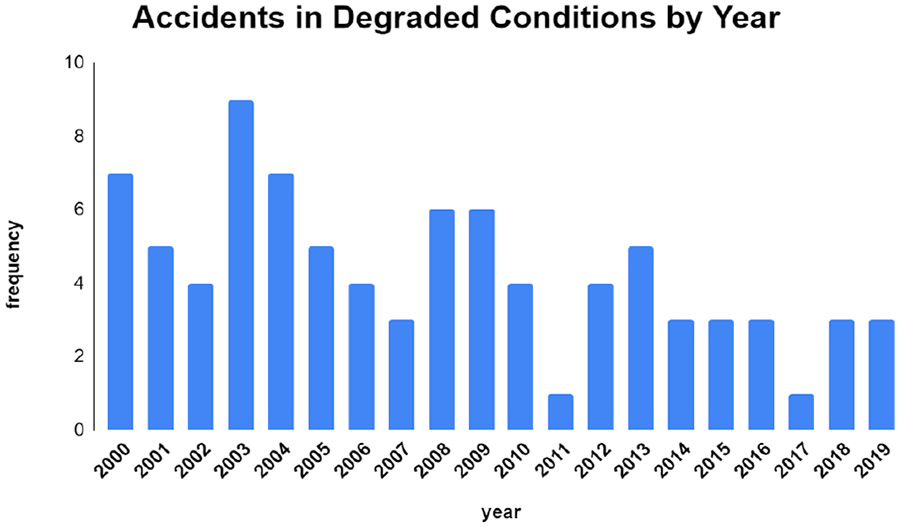
Accidents in Degraded Conditions by Year.
This paper aims to explore the human errors which are associated with accidents occurring in these conditions these conditions.
HFACS
The Human Factors Analysis and Classification System (HFACS), depicted in figure 2, is an error classification framework based on Reason’s Swiss Cheese model, which similarly classifies human errors into four categories: Unsafe Acts, Preconditions for Unsafe Acts, Unsafe Supervision, and Organizational Influences. These tiers provide a method of classifying the active and latent failures that contribute to errors and accidents (Shappell & Wiegmann, 2000). Given that many HEMS operations take place in conditions such as darkness, fog, and inclement weather, HFACS allows an examination of the human factors associated with accidents occurring in these conditions.

HFACS Framework.
Methods
FAR Part 91 and Part 135 Helicopter Emergency Medical Service accident reports from years 2000-2019 were pulled from the National Transportation Safety Board (NTSB) accident database (N=132). Accidents were coded using the Human Factors Analysis and Classification System (HFACS) by examining the descriptive information and narratives in each NTSB report and classifying each error identified in the NTSB findings using HFACS. Each accident report was analyzed by a team of four HFACS certified coders. Accidents identified to be the cause of mechanical failures and reports lacking sufficient detail to determine accident cause were excluded from the analyses. Additionally, our analysis for this study focuses predominately on the Unsafe Acts and Preconditions for Unsafe Acts tiers as there was typically not sufficient detail within the NTSB reports to definitively identify errors within the Supervisory Factors and Organizational Influences tiers. Analyses were conducted using IBM SPSS to obtain frequencies. Only those factors associated with Unsafe Acts will be reported for this paper.
Results
Results indicated that the largest contributors to fatal accidents within HEMS operations were nighttime flying and flight into IMC or degraded weather conditions. A much larger proportion of fatal accidents occurred in dark night conditions than during the day. Of accidents occurring in dark night conditions, 50% resulted in fatalities, whereas 18.8% of accidents occurring during the day resulted in fatalities. A similar relationship can be seen regarding flight into IMC. Of accidents occurring in IMC, 82.6% resulted in fatalities, whereas 29.4% of accidents occurring in visual meteorological conditions (VMC) resulted in fatalities. The difference in proportion of fatal vs non-fatal accidents for each condition can be seen in figure 3.

Fatality by Condition.
An HFACS analysis of Unsafe Acts that occurred in HEMS accidents involving flight into inclement weather indicated that non-fatal accidents occurring in VMC were mostly attributed to Skill Based Errors 53.3% while fatal accidents occurring in VMC were equally due to Perceptual Errors 30% and Skill Based Errors (30%). For non-fatal accidents occurring in IMC, Perceptual Errors (42.9%) and Skill Based Errors (28.6%) were most common; however, for fatal accidents occurring in IMC, Decision Errors (35.5%), Perceptual Errors (32.3%), and Violations (29%) were the largest contributors. These error profiles can be seen in figure 4.

Weather and Unsafe Acts.
An HFACS analysis of Unsafe Acts that occurred in HEMS accidents involving flight in poor lighting conditions, or dark night, indicated that non-fatal accidents occurring in daylight were primarily attributed to Skill Based Errors (55.3%), and fatal accidents occurring in daylight were also primarily due to Skill Based Errors (46.2%). Non-fatal accidents occurring at night, in dark lighting conditions, were mostly attributed to Skill Based errors; however, in fatal accidents occurring at night, Perceptual Errors (34.5%), Decision Errors (32.8%), and Violations (20.7%) comprised the largest contributing Unsafe Acts contributing to these accidents. These error profiles can be seen in figure 5.
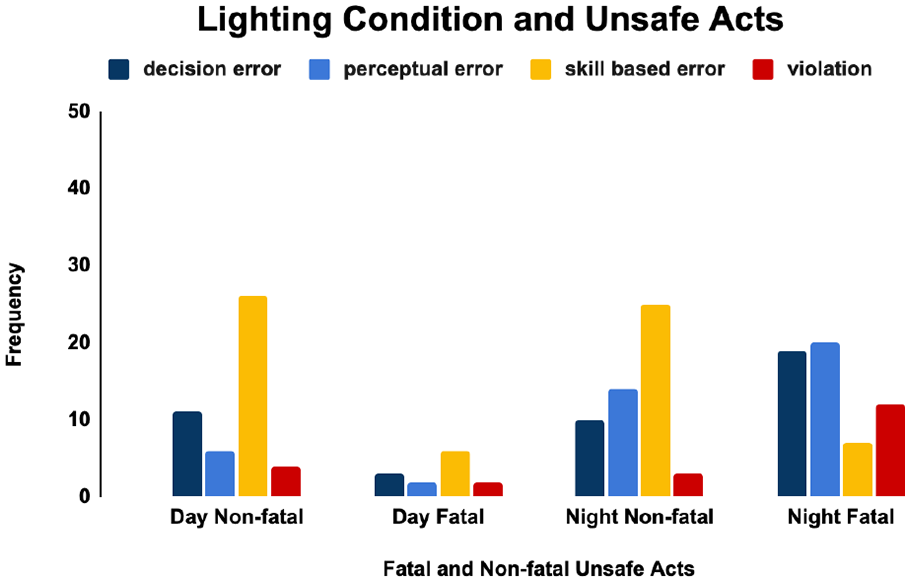
Lighting Condition and Unsafe Acts.
Discussion
Helicopter emergency medical services have become an increasingly important partner in the delivery of healthcare services in the in the U.S. The growth and the importance of the HEMS industry has unfortunately seen an increase in the number of accidents with dire consequences to aircrews, healthcare providers, and patients who find themselves the victims of these accidents.
Consistent with previous literature on HEMS accidents over past decades, our results indicate that flight in degraded environmental conditions still presents the largest risk to HEMS operations. Namely, while more accidents occur in VMC overall, the likelihood of fatalities and serious injuries is markedly higher when the conditions are less than optimal. Our results indicated that a much higher proportion of fatalities occur from accidents occurring in degraded conditions such as poor lighting and instrument meteorological conditions. Expanding on that literature, this paper examines the human factors that lead to flight into degraded conditions and subsequent crashes.
By examining the distribution of Unsafe Acts for fatal and non-fatal accidents in poor lighting conditions and in inclement weather, we are able to create an error profile which demonstrates the types of errors that are most likely to contribute to fatal outcomes as well as the factors and preconditions that precede these events. This error profile indicates that the most common Unsafe Acts which precede fatal accidents in degraded environmental conditions are Decision Errors, Perceptual Errors, and Violations. It is worth noting that the occurrence of violations is much higher for fatal accidents occurring in degraded environmental conditions than for any other condition. Meanwhile, Unsafe Acts which precede non-fatal accidents and accidents occurring in optimal conditions are more likely to be the result of Skill based errors. Given this information, further interventions and efforts to mitigate risk within HEMS operations may benefit from directing focus to policies and regulations which address these errors which occur in degraded flying conditions. Subsequent studies using this data set will include analysis of nano-codes, or specific events, associated with the Unsafe Acts and Preconditions for Unsafe Acts identified within this study. This review will also involve a closer examination of errors within the Supervisory Factors and Organizational Influences tiers that have been identified.
Conclusion
HEMS operations, while growing in availability, remain one of the most dangerous occupations in the world. For decades, the most significant threat to HEMS operations and crews has been flying in degraded environmental conditions such as dark night and inclement weather. With tragic consequences falling on the crews of these operations and the patients under their care, it becomes increasingly crucial to define the errors which lead to fatal accidents occurring within these conditions. The HFACS framework provides a structured method with which we can classify these errors and the factors that contribute to their occurrence. By determining how and why these accidents happen, especially in degraded flying conditions, we are better able to develop data-driven interventions targeted to mitigating the risk factors which contribute to undesirable outcomes within HEMS operations.