



Abstract
The National Institute for Occupational Safety and Health (NIOSH) is developing a National Strategy for Equitable Personal Protective Equipment Protections for All U.S. Workers. This paper describes several formative components of the strategy that have been completed and are ongoing. These efforts clearly indicate the need for human factors/ergonomics (HF/E) contributions to overcome current limitations and barriers to equitable PPE protection for some workers. Fundamental ergonomics approaches are needed to contribute to more equitable PPE protections for all members of the workforce for whom PPE is required. This will ensure that all workers that require PPE are adequately protected from hazards while minimizing negative consequences (e.g., discomfort, reduced perceptual capabilities, performance decrements) while also allowing workers to safely and comfortably work as productively as when not wearing PPE.
Introduction
Personal protective equipment (PPE) is worn to minimize exposure to hazards when other controls in the hierarchy of controls (Figure 1) are not available or do not adequately reduce exposure (NIOSH, 2023). Although PPE is the least effective control in the hierarchy, PPE is required and used by workers in a variety of occupations across all sectors. These occupational contexts are diverse, as is the workforce that uses the PPE.
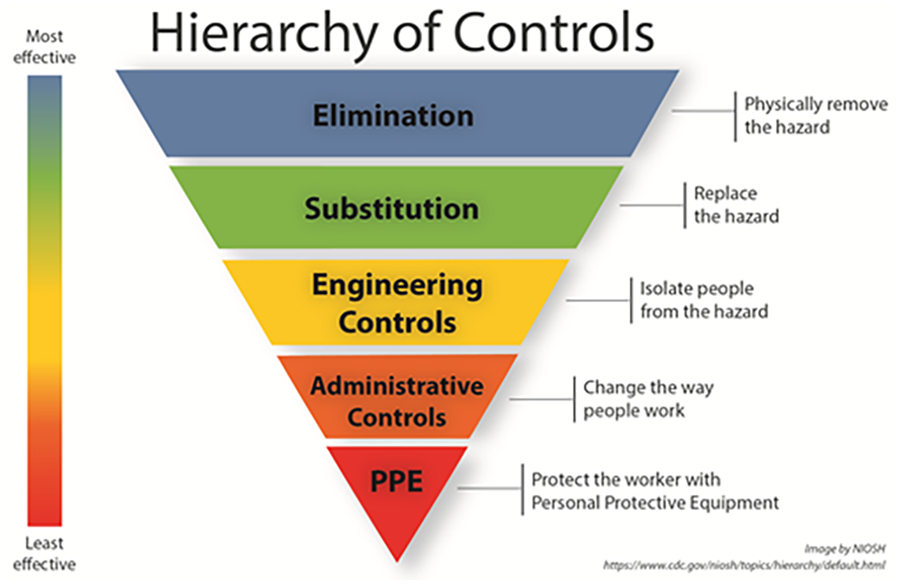
Hierarchy of controls (NIOSH, 2023).
Human factors/ergonomics (HF/E) focuses on the design and engineering of systems that humans interact with for the purpose of optimizing human performance and well-being. Given that PPE is body-worn, there can be a number of effects on human performance and well-being. Examples of performance effects include increased time to complete tasks, reduced endurance due to added physiological burden, and increased errors due to reduced sensory capabilities. Well-being can also be affected due to factors such as pain or discomfort associated with extended wear, increased thermal stress, and potential injuries associated with slip and fall risk from improperly sized PPE.
To ensure that PPE provides adequate protections to all members of the U.S. workforce, NIOSH initiated efforts to develop a strategy for equitable PPE protections. Key components of this strategy will be discussed with an emphasis on the implications for the application of HF/E that have been determined from the outcomes of these efforts. The remainder of the paper will provide a proposed approach to addressing those aspects of PPE design and use that can help to optimize performance and well-being when workers are wearing PPE while performing their jobs. While there have been many HF/E contributions to PPE, feedback and input received thus far suggests there are more opportunities to contribute.
Equitable PPE Protections Strategy
In order to address barriers to and gaps in equitable PPE protections, NIOSH is developing a National Strategy for Equitable Personal Protective Equipment Protections for All U.S. Workers. Several of the key formative components of the strategy will be described. The strategy is centered around five constructs that affect equitable PPE protections:
(a) Use – Use refers to the user being protected from the intended hazards while not creating other risks.
(b) Acceptability – Acceptability refers to PPE designs that are sensitive to social, cultural, comfort, and physiologic considerations so the PPE is acceptable to the user.
(c) Accessibility – PPE needs to be located at the point of use at the time it is needed.
(d) Availability – Availability refers to being able to procure PPE without undue burden or challenge. This includes, for example, factors such as the appropriate size being manufactured as well as the appropriate size being available for purchase through wholesale or retail channels.
(e) Knowledge – Knowledge refers to the factors that impact the correct selection, use, and maintenance of PPE.
The five constructs above were chosen to represent a high percentage of the broad range of factors that influence the protection of workers requiring PPE. While HF/E cannot address all factors related to equitable PPE protections, there are clear opportunities for HF/E to contribute to multiple barriers and gaps identified.
Federal Register Notice
As a first step to understand and further define needs and challenges for equitable PPE protections, NIOSH published a Federal Register Notice (FRN) in 2021 to request input related to PPE use, availability, accessibility, acceptability, and knowledge issues for underserved PPE user populations (Federal Register, 2021). The FRN defined underserved users as PPE user populations that may include, but are not limited to, workers who are of an atypical size; who are members of a gender, racial, ethnic, or linguistic minority group; who conduct non-traditional worker activities; or who are members of sub-disciplines that are not the primary focus of the current PPE activities within their larger field.
The FRN requested information related to several major areas. The primary area of interest was asking respondents to describe their experiences related to PPE use, availability, accessibility, acceptability, and knowledge issues for underserved PPE user populations. The second major area asked respondents to describe any PPE gaps/barriers with respect to PPE use, availability, accessibility, acceptability, and knowledge issues that need to be addressed. Information on gaps and barriers related to research, service, and policy was requested.
A total of 39 submissions were received from interested parties from government (n=5), professional associations (n=12), academia (n=7), industry (n=9), and manufacturers (n=6). Quite a few responses mentioned issues with the size and fit of PPE, including challenges with accommodating larger and smaller workers, workers of varying shapes including pregnant women, as well as differing facial features that can lead to challenges with respirator fit. A number of challenges concerned specific issues accommodating workers with certain religious and cultural practices that interfere with PPE and the interference of hair (including facial hair) with PPE. The types of PPE mentioned were extensive, and issues were raised across multiple sectors with healthcare and public safety being prominent. There were also needs expressed for additional training and information tailored to different user groups such as materials in languages other than English.
Equitable PPE Protections Workshop
In Nov. 2022, NIOSH held a two-day “Equitable Personal Protective Equipment (PPE) Protections Workshop.” The workshop was open to all interested parties and was designed to confirm the barriers and gaps that had been identified, receive input on additional barriers or gaps, and develop further partnerships. The workshop drew considerable attendance, with over 700 attendees joining the workshop during the first day and 1,000 the second day. The first day began with an overview of NIOSH perspectives and activities ongoing and planned to address PPE equity. These perspectives were followed by panel sessions with experts that discussed equitable PPE standards initiatives, manufacturer perspectives on PPE equity, and labor perspectives on PPE equity. The second day was primarily comprised of facilitated discussions of policy, market dynamics, and research gaps arranged by sector. A proceedings document will be published with summaries of all sessions and more detailed descriptions of the equitable PPE challenges and barriers discussed.
Crowdsourcing Challenges
NIOSH has initiated several crowdsourcing innovation challenges, including two with direct relevance to increasing equity of PPE protections. The first challenge was titled “The NIOSH Protective Clothing Challenge – Leaving No Body Unprotected.” The Challenge sought solutions that consider the broad spectrum of U.S. workers in relation to factors that may influence fit such as body size and shape, gender, race, ethnicity, religious or cultural practices, or specific work tasks (NIOSH, 2022). The challenge drew 35 submissions. The first-place entry (Omni-Fit PPE Gown with Contamination Indicator) involved the design of a gown that can adapt to different body types and sizes with accordion-style adjustable waistband and length adjustments. The second-place entry (Apples-2-Apples Measures + Pattern Drafting Method) paired anthropometric measures with a pattern drafting method to develop more inclusive designs for firefighter turnout gear. Three third-place entries covered the design of a surgical sleeve to increase protection of the upper extremities from liquid contaminants, a concept for a fit certification program to assist employees with selecting PPE that fits properly, and a proposed unisex sizing system for coveralls.
A second challenge (“The NIOSH Respirator Fit Evaluation Challenge”) that is ongoing was initiated to crowdsource novel technologies and innovative approaches that deliver immediate evaluation and feedback to end users about the fit of filtering facepiece respirators (FFRs) during use. The challenge requested solutions that consider how to provide immediate feedback to a diverse group of end users, including faces within the NIOSH anthropometric grid (NIOSH, 2020) as well as faces of under-represented populations or those falling on the edges of the NIOSH anthropometric grid. Solutions to the challenge have the possibility to increase utilization of respirator fit evaluation in a broad range of occupational settings and by diverse users. The solutions may also offer efficiency gains over currently used approaches to fit evaluation.
HF/E Opportunities
Through the National Academy of Sciences (NAS), the Institute of Medicine (IOM) and the National Research Council (NRC) (IOM and NRC, 2008) convened a committee of experts to review the NIOSH Personal Protective Technology (PPT) Program to evaluate the relevance of its work to improvements in occupational safety and health and the impact of its work in reducing workplace illnesses and injuries. One recommendation of the committee was to increase research on the use and usability of PPT. Specific suggestions included intensifying research on barriers and facilitators of PPT use by workers, including investigations using HF/E approaches. The report also stated that “[u]nderstanding that comfort is fundamentally a safety issue is a necessary prerequisite to improvement of the materials, design, and engineering of PPT in such a way that critically important human factors are taken into account.”
HF/E methods continue to be used to contribute to the design and use of PPE, but substantial advances are still required to address barriers to and gaps in equitable PPE protections. HF/E is uniquely positioned to contribute to solutions of many of the barriers and gaps that have been identified or that are being identified through ongoing efforts. Fundamental HF/E concepts and analyses will be discussed in the context of PPE to illustrate the components of a proposed approach to assessing the impact of PPE on a given work scenario.
It should be noted that equitable PPE may require a different approach from the classical view that work systems should be designed to accommodate at least 95% of the population. While this has been perhaps most commonly applied in the context of anthropometry and workplace design, equitable PPE protections will require that all workers requiring PPE are appropriately accommodated.
Figure 2 illustrates PPE in the context of a classical human:machine interface representation (c.f., Grandjean, 1988; Singleton, 1974). Since PPE use is not restricted to workers interacting with machines, Figure “workplace” was chosen to replace “machine” and represents the range of interactions PPE users have with the workplace (e.g., machines, patients, tools, etc.). Notably, PPE forms a direct interface between a worker and the workplace. The task being performed and PPE worn determine whether or not there will be resultant effects on the worker’s ability to interact with the work system.
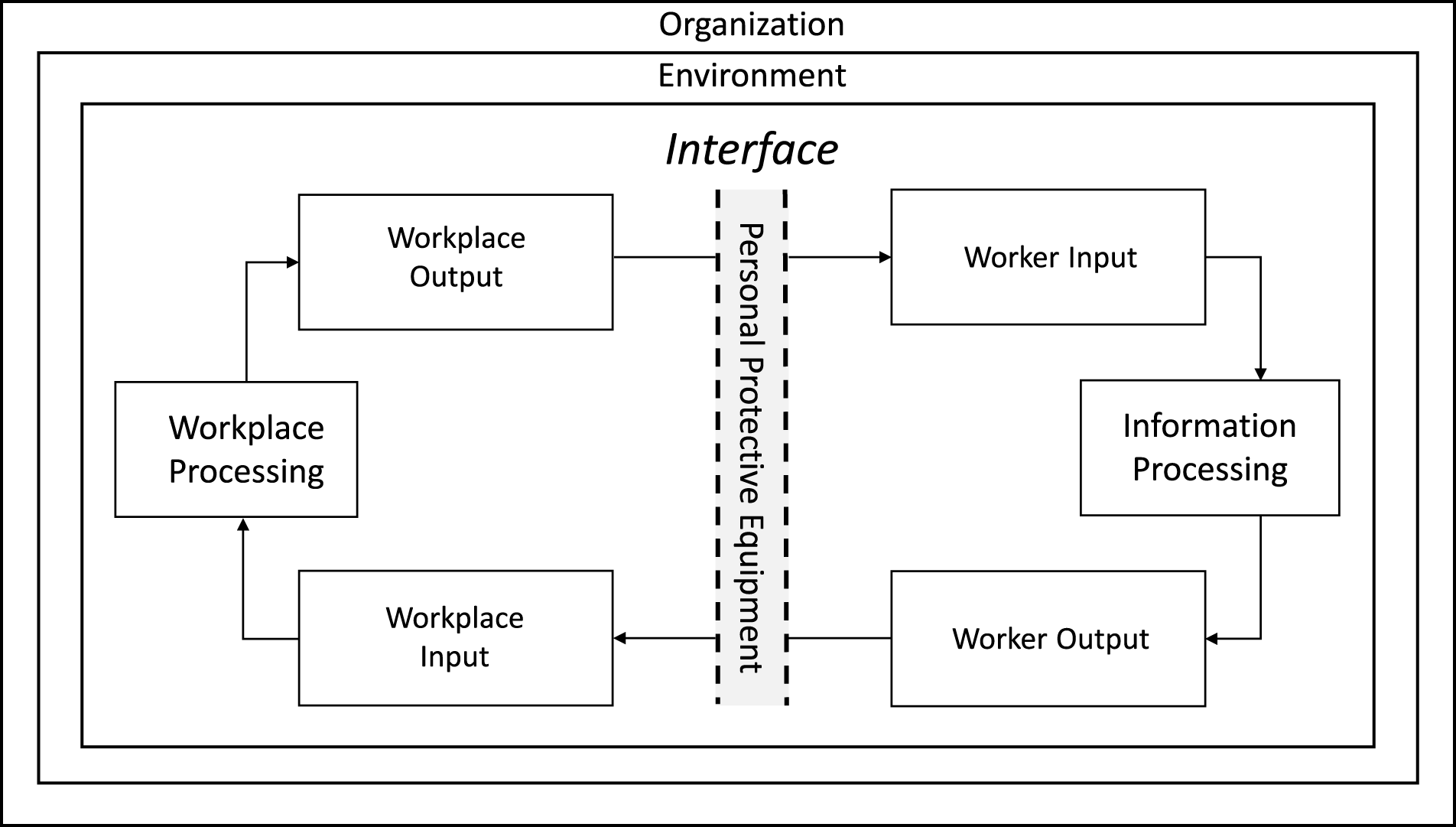
Worker:workplace interface model showing PPE.
An important consideration that Figure 2 suggests is that PPE can affect the interaction between a worker and the workplace. More specifically, PPE can affect the ability of the worker to receive input from the workplace when the PPE worn interferes with the modality of the input. Examples include hearing protection interfering with auditory signals and eye protection negatively impacting the ability to receive visual input. Similarly, PPE may interfere with a worker’s ability to interact with the workplace. Examples include reduced tactile sensitivity associated with wearing gloves and reduced speech intelligibility when speaking to others in the environment or using voice-activated technology while wearing a respirator.
Extending these concepts to specific work contexts allows for a more systematic analysis. Task analysis offers a method that can be used to systematically identify potential mismatches between task demands and worker capabilities. Following a task description that describes each element, the analysis can proceed and include potential PPE effects when determining potential mismatches.
Table 1 provides examples of different types of PPE and potential impacts on task demands and worker capabilities. In order to extend this classical approach to analysis, consideration should also be given to effects on the worker including possible performance decrements as well as user experience concerns. Likewise, potential equity issues can be identified and documented. A more comprehensive version of Table 1 could also be used to inform designers, researchers, and users of the potential effects of PPE. This will require identifying relevant research as well as cataloging equity issues. Identifying potential negative consequences of wearing PPE as well as potential equity issues could also assist practitioners with selecting PPE to minimize the challenges. Generalizable findings for specific types of PPE or PPE users may also facilitate designers and manufacturers with a better understanding of user-centered needs. One advantage of using this task analytic approach is that it is extensible to a range of work environments, tasks, jobs, and user groups.
Examples of PPE effects from an HF/E perspective.
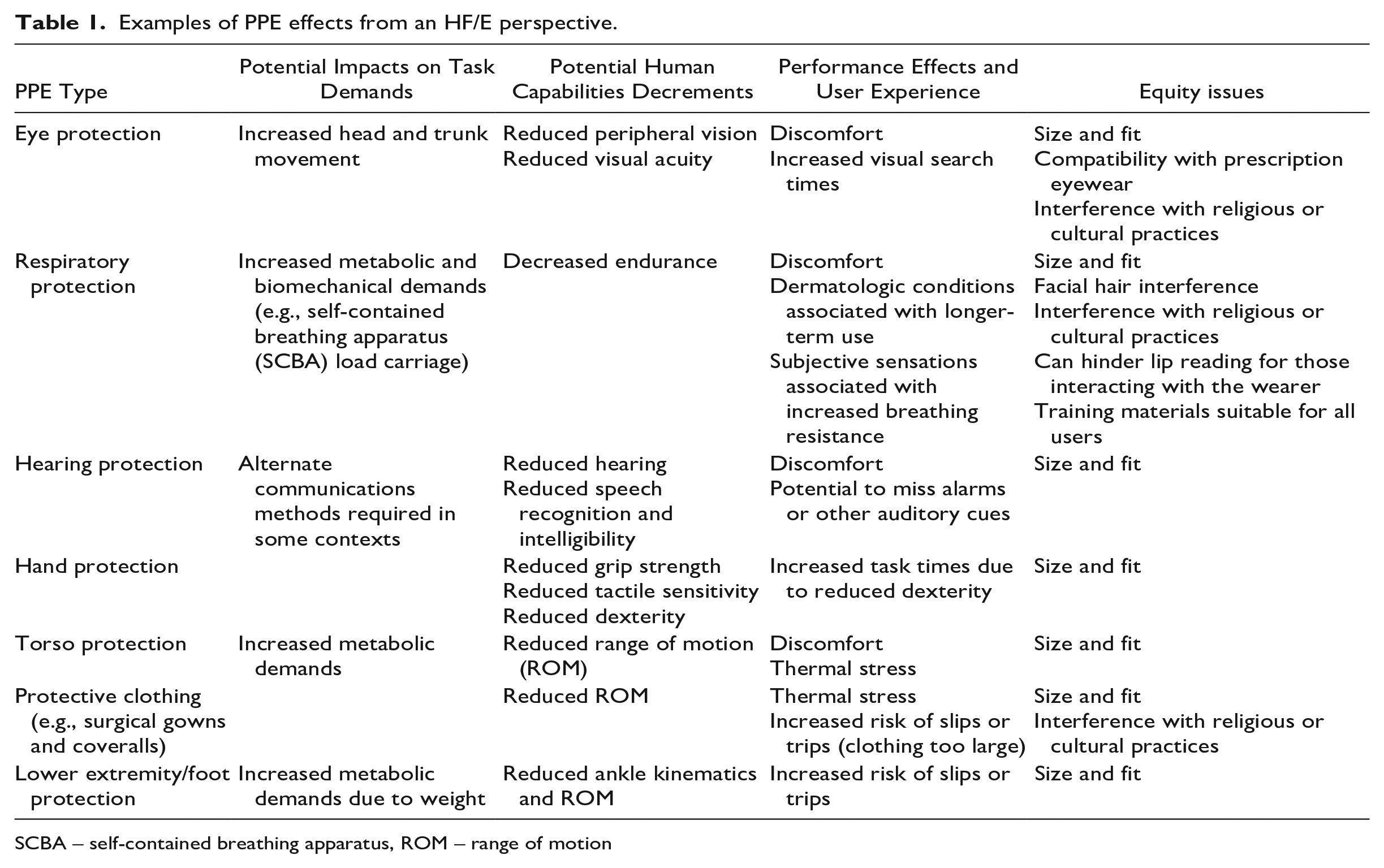
SCBA – self-contained breathing apparatus, ROM – range of motion
Discussion
Based upon the efforts completed by NIOSH to understand the challenges to equitable PPE protections and the barriers and gaps (e.g., lack of anthropometric data on a population) that permit these inequities to exist, PPE users face a range of issues that can have negative health and safety consequences. Size and fit are key challenges that need to be further addressed so that all workers have access to properly fitting PPE. There are also a range of other equity issues that do not affect as many users but are just as important for those that face barriers.
Given the goal of HF/E to optimize human performance while maintaining well-being, increasing application of HF/E approaches to PPE design and assessment has the potential to address PPE more holistically. Ensuring that PPE adequately protects against a given hazard is critical, as is workers being able to perform their jobs with the same level of performance and comfort when not wearing PPE.
It should be noted that some of the issues in Table 1 may need to be addressed through higher-level sociotechnical systems analyses. For example, there is a lack of availability of properly fitting PPE for some workers due to limited sizes being stocked by retailers or wholesalers. Similarly, less frequently used sizes may be more expensive if quantities required for bulk discounts are not practical. Research that supports the benefits of properly fitting PPE can be helpful to justify purchases. Similar analyses may also be needed to understand how to address equity issues that involve multiple organizations, potentially including organizations responsible for regulations and standards.
