



Abstract
Patient-doctor communication is a critical element of healthcare interactions that can have a direct impact on the occurrence of medical errors, treatment decisions, and outcomes. Common barriers to patient-doctor communication include patients’ feeling unable to share information, cognitive impairment in patients, and the dominating nature of the biomedical culture in healthcare. The emergence of new healthcare technologies presents an opportunity to improve healthcare communication through both new tools and shifts in practices. Combined with patient-centered care models of communication, user experience design and operational implementations can be leveraged to improve the quality of the relationship between patient and medical provider, information exchange in the dyad, and shared decision-making. The present research adopts a person-centered care model of communication approach to propose design and operational implementations of eHealth technology to improve patient-doctor interactions, resulting in higher quality healthcare and a reduction in negative health outcomes.
Keywords
Introduction
Communication within healthcare systems serves as an underlying factor in shaping healthcare quality and outcomes. While effective communication could increase the rate of satisfaction, medical adherence, and health resolution, miscommunications between healthcare providers and patients account for 80% of medical errors, leading to adverse, and even lethal consequences (Commission, 2017). In fact, medical errors, which contribute to approximately 251,000 annual deaths, are among the top three leading causes of death in America (Anderson & Abrahamson, 2017). The prevalence of communication failures indicates an emergent and constant need to assess and improve healthcare communication.
Theoretical Background
Patient-Doctor Communication Problems
Patients’ barriers to communication predominantly stem from their discomfort in healthcare settings. Negative experiences communicating with primary care physicians primarily result from patients perceiving disrespect, time constraints, as well as the dominating and complex nature of biomedical culture in healthcare environments (Wei et al., 2020; Johansson et al., 1996; Nguyen et al., 2008; Vickers et al., 2006; Ziviani et al., 2004). Consequently, patients reported feeling helpless during consultations, unable to share vital information, voice their concerns, or ask for clarifications (Abdulhadi et al., 2007; Lowe et al., 2007; Moffat et al., 2006).
Other studies suggest that reduced cognitive ability and motivation in certain populations present other prominent challenges in patient-physician communication (Cuijpers et al., 2010; Enns et al., 2000; Tada et al., 2014). Impaired cognition can negatively impact healthcare assessment accuracy and treatment quality with an increased tendency from patients to engage in satisficing, or minimum-effort, behaviors. These and other communication problems limit the ability of the patient and doctor to effectively interact, resulting in suboptimal care and outcomes.
Person-Centered Communication Model of Care
The person-centered communication model of care (PCCMC) is a theoretical framework suggesting effective communication is influenced by the ability of patients and providers to engage in a sequence of establishing rapport to exchange necessary information needed for subsequent shared decision-making (Tran, 2020). The quality of communication between a patient and provider is based on the sequential process of rapport, information exchange, and shared decision. Patient-centered care encourages providers to design a care plan that is based on the patient’s specific health needs and desired health outcomes (Catalyst, 2017; Reynolds, 2009). At a national level, healthcare practices including patient-centered care have been on the rise over the last decade (Davis, Schoenbaum, & Audet, 2005; Greene, Tuzzio, & Cherkin, 2012). Thus, the future of healthcare includes patient-centered practices supported by technological innovations that tailor patient care based on their needs.
The implementation of technology in healthcare has changed the relationship dynamic between patients and healthcare providers. Models such as the PCCMC can be incorporated into the design of technological systems used to exchange communication between patients and providers. Nowadays, health information is easily accessible through tools such as electronic health records, mobile health (mHealth) apps, and eHealth communication. The integration of these technologies makes it easier to share and access information about patients yet does not directly solve all problems in communication between patients and providers.
This paper aims to (1) provide an overview of eHealth technologies and (2) utilize the PCCMC model to identify mechanisms through which eHealth can help bridge the communication gap between doctors and patients.
eHealth Technology as a Potential Solution
eHealth technologies encompass a wide range of digital tools and platforms that can help improve communication between patients and healthcare providers. The ability to exchange information quickly and efficiently is a critical component of effective healthcare communication, and eHealth technologies can help facilitate this process by enabling seamless information exchange between healthcare providers and patients.
Electronic health records (EHRs) have emerged as a leading health information technology that aims to manage unstructured, complex data in a way that increases healthcare quality and efficiency (Chaudhry et al., 2006). EHRs store medical information in computer databases and employ data-analyzing software that helps automate detection and classification systems. EHRs function to support decision-making and improve physicians’ performance. Nonetheless, this technology is not one without flaws. A large amount of information in EHRs is yet unstructured, potentially causing inaccurate interpretations and decisions. Additionally, studies have found that interacting with EHRs could lead to burnout in physicians, due to persistent limitations (Gardner et al., 2019).
The development of machine learning has offered to not only increase the accuracy of physicians’ decision-making but also reduce the cost to manage complex data in healthcare settings. As a major element in healthcare analytics, machine learning can produce meaningful insights from collected data that enhance physicians’ performance (Sarwar et al., 2018). The utilization of machine learning also enables the detection of early symptoms and the prediction of disease(s).
Sensing technologies, on the other hand, allow physicians to collect real-time physiological and environmental data remotely (Angelov et al., 2019). Sensors are integrated into mobile devices or attached to the patient’s body, where they continuously measure their immediate surroundings or the patient’s medical signals. Today, mHealth applications have become increasingly prevalent due to their self-monitoring approach (Stoyanov et al., 2015). With the utilization of embedded sensors, mHealth applications allow patients to track, monitor, report, and access their health status through their smartphones. This system can also provide means of communication between patients and doctors without the need for in-person interactions. Such promising benefits have attracted bodies of research for further development.
Data Collection and Sensors as a Service (DCSaaS) has the potential to transform healthcare by enabling real-time monitoring and analysis of patient data. With DCSaaS, healthcare organizations can deploy a range of sensors and other IoT devices to collect data on patient vitals, medication adherence, and other important health metrics. This data can then be aggregated, analyzed, and visualized in real time, providing healthcare providers with valuable insights into patient health and enabling them to deliver more personalized and effective care. Additionally, DCSaaS can help healthcare organizations more easily manage their medical device infrastructure, reduce the risk of device downtime, and stay compliant with regulatory requirements.
As healthcare organizations adopt new technologies to improve patient outcomes, eHealth plays an increasingly important role in the delivery of modern, data-driven healthcare services. Companies like Labfront, Cogstate, and NeuroUX are among the leaders in leveraging wearable devices and mobile applications to integrate sensors and computerized test systems for real-time data collection in cognition impairment. Parallel efforts exist in academia, seeking to make cognitive assessment scalable and integrated into other platforms (e.g., NIH Mobile Toolbox; https://www.mobiletoolbox.org/about-us). Despite offering numerous profound benefits, healthcare mobile applications possess a few limitations that need further development (Kharrazi et al., 2012). For example, low adaptability and retention have been reported to challenge long-term self-monitoring practices (Swendeman et al., 2015).
One of the big problems in healthcare are the short-duration patient visits. Technology makes the medical interaction continuous through constant monitoring and tech interactions. It also improves the effectiveness of the typical medical visit because both the doctor and patient are now better informed, and can use the time to discuss key points.
New technologies like eHealth, passive sensing, and DCSaaS have the potential to significantly enhance healthcare communication through improvements in information availability and data access. However, to be fully effective in improving patient-doctor communication, it is crucial to integrate patient-centered design into these technological implementations.
User-Centered Technology As The Basis For Patient-Centered Care
Technology that utilizes user-centered and user-experience principles can help form the underlying basis for patient-centered care communication improvements. As illustrated in Figure 1, frameworks such as the PCCMC (Tran, 2020) can be integrated with UX user-centered practices to guide technology implementation and use towards positive patient-provider communication and healthcare outcomes. Such an approach would incorporate design and use practice elements to drive rapport building, information exchange, and shared decision making and ultimately, overall better healthcare.
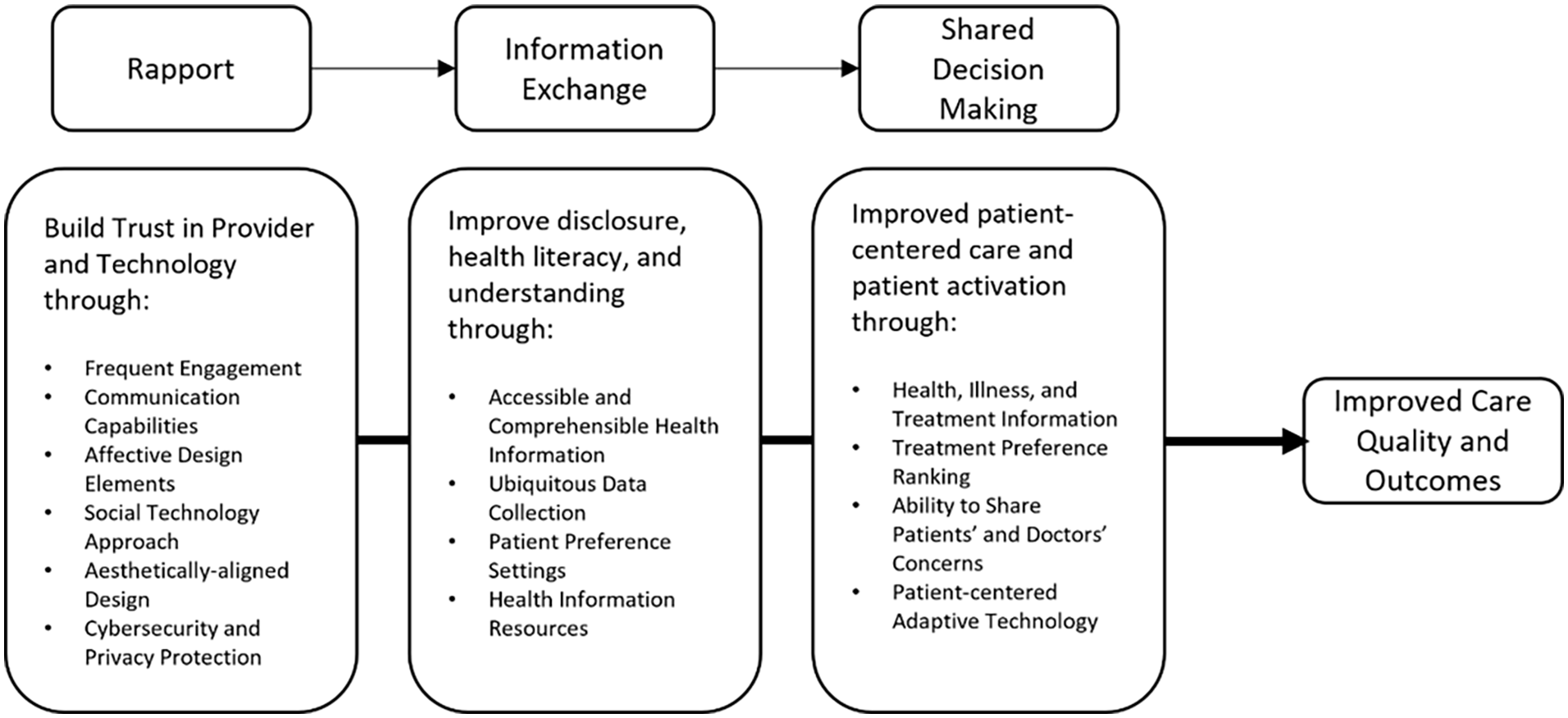
Recommended technology implementations to incorporate user-center technology in the person-centered communication model of care (Tran, 2020) to drive improvements in patient-centered care.
Rapport Building
Building rapport involves providing empathy, compassion, emotional and social support, and physical comfort, with the goal to cultivate trust in patients by making them feel heard and valued. User-centered design principles can compensate for the limited interaction with the healthcare system to consistently foster a supportive environment, ultimately empowering patients to partake in their healthcare treatment.
The app or technology should incorporate design features, such as communication capabilities (e.g., text, call, or video chat) and emojis, for patients to use as responses or to share feedback. Features that allow patients to express their level of concern can help in promoting effective communication and prevent conflicts that can harm the relationship between the patient and provider. Moreover, it will give the provider time to evaluate the concern and implement any changes needed. To help reduce user concerns of lower provider interactions, the technology should deliver a sense of engagement through notifications and reminders. These design features can help establish rapport mechanisms by building an emotionally-capable affective environment.
Allowing patients to use their personal pronouns, name, and gender in apps is important, since it helps establish a sense of respect and inclusivity. It also allows patients to feel seen and validated, which can foster trust and rapport between patients and doctors. Moreover, it reduces the chances of discriminating against a patient by misgendering them (Dolan, Strauss, & Winter, 2020). Giving patients the freedom to express their identity creates a welcoming and supportive environment.
Regularly reaching out and checking on a patient can foster rapport between patients and providers. These checks can include questions related to how the patient is feeling, concerns they may have, or if assistance is needed. Additionally, the incorporation of affective-based inputs and outputs can help create a more personalized and empathetic interaction between patients and health providers. eHealth should also provide tailored support that matches the patient’s emotional needs by adjusting based on the patient’s affective state. An example would be providing mental health information that can help support patients with symptoms of poor mental health.
Emotive language that resembles human conversation can leverage social thinking, which may improve usability and the sense of rapport in eHealth. An example of a socially oriented design to affect a patient’s mHealth app user experience is the use of a pop-up message that says, “Hi, welcome to the eHealth app! Let me help you set up your patient portal. First, Dr. Summers would like to know a little bit about your preferences as a patient. Let’s look at some of the topics she would like to know about more.” Technical jargon should be avoided in both the design and implementation phases.
In addition to human-like language, aesthetic design elements that can evoke feelings related to rapport (i.e., friendliness, concern expressions, caring, and physical proximity) are highly feasible to drive affective experiences. The use of peacefulness-evoking colors and interfaces along with frequent check-ins and feedback can drive a calming, reassuring, and good user (patient and provider) experience.
Finally, eHealth technologies should ensure a secure and safe environment for both patients and providers. Cybersecurity should be a top priority. The technology should adhere to HIPAA regulations and ensure protection against malware. Moreover, encrypted messaging and video consultations can enhance security by ensuring that patient data is protected from unauthorized access. Lastly, patients should be provided educational tips on current protections of their data, the importance of protecting it, and ways to ensure it is secured.
Information Exchange
Effective information exchange is necessary for delivering high-quality healthcare since it ensures that healthcare providers have access to the information they need to make informed decisions. To facilitate effective information exchange, it is important to consider patient disclosure, comprehension, competence, and health literacy. Patients should be encouraged to disclose their preferences, personal values, and outcome expectations to healthcare providers and in return, providers should respect these preferences and values to communicate information that is tailored to the patient’s individual needs.
For example, doctors and clinical staff may better understand patient preferences if eHealth applications include ways for the patients to provide this information. An example of such an application can be seen in rideshare services’ apps, which include ways for passengers to inform drivers of their preferences in driver-passenger conversations (Uber, 2023). In healthcare applications, such preference indications can include choices relating to the way the patient-provider interaction should go, patient preferences in end-of-life care, cultural and social values, and specific needs a patient may want a doctor to be aware of.
Patient preferences can be collected by utilizing the ability to set interaction settings, patient questionnaires about values, and other similar means. Such information will help providers respect patients’ preferences, values, and needs which will help drive significant improvements in the quality of provided healthcare services (Bastemeijer et al., 2017). Technology can provide information outside of the typical medical encounter which ultimately helps match the healthcare provider-patient interaction to the temporal nature of medical care and even the temporal nature of communication, as depicted in the person-centered care model of communication (Tran, 2020).
Some important facets of communication include comprehension, transparency, and access. Without comprehension, patients may be left feeling confused and uncertain about their care. This is where transparency comes in, which allows patients to understand important information that can help them make informed decisions about their health. Additionally, incorporating visibility into data and providing ubiquitous feedback from medical interactions can enhance transparency and comprehension. With the help of eHealth implementations, including symptom trackers, educational videos, and even virtual consultations with their providers, patients can gain access to resources that can help them understand their health.
Healthcare technologies can help improve patient-centered care models by providing physicians with access to continuously collected patient data, including biomarkers, digital markers, and subjective measures. The combination of these measures allows healthcare providers to gain a better understanding of patients’ individual experiences and tailor their care accordingly. Moreover, eHealth allows physicians to gain more understanding of a patient’s individual experiences, not only continuously collected patient data, but also allows physicians to improve their understanding of patients’ individual experiences of disease by providing access not just to continuously collected patient data, but also allowing for surveys and understandings of the patients’ lived environment. Similarly, patients have improved access to their healthcare data, which, when supplemented with health literacy, can improve the shared patient-doctor interaction.
Such improvements in health literacy, information flow, and ability to identify preferences provide an adequate environment for shared decision-making. For these reasons, eHealth technology should be used to facilitate information exchange between patients and providers as it provides information beyond a temporal face-to-face encounter at a medical facility.
Shared Decision-Making
In the modern healthcare landscape, shared decision-making can be facilitated through the implementation of technology. One way to achieve this is through mHealth apps that include a dedicated page with treatment information to inform patients about treatment options, pros and cons associated with each option, and costs. An example is Planned Parenthood’s page on birth control, which provides an informative comprehensive breakdown of different birth control methods and options available (Planned Parenthood, n.d.).
mHealth apps should also include a feature that allows patients to rank and choose treatment preferences. This feature would allow providers to review and validate the patient’s choice and proceed accordingly, rather than making decisions on their own. A platform where patients can express their treatment preferences will benefit providers to better understand their patients’ needs and concerns. This approach would also strengthen a collaborative relationship between patients and providers where both parties are involved in the decision-making process. As a result, eHealth technologies can be used to foster collaborative decision-making, which may result in improved patient and physician interaction and better health outcomes (Adams & Drake, 2006).
Shared decision-making is bidirectional, requiring both the patient and the provider to be equally invested in the process. While patients can provide valuable information on their opinion and preferred treatment, it is also crucial for healthcare providers to be receptive to this input and use it appropriately. The responsibility for improving communication should not lie solely on the patient, as they often lack health literacy and are the least informed party in healthcare interactions (Kreps, 2018; O’Leary et al., 2010). eHealth should provide a platform where providers can inform patients of treatment options. Patients, in return, should be given the option to voice their opinions or the ability to point out their concerns. Consequently, eHealth technology provides a means by which “I wish I could…” statements can be turned into “Let me tell my provider…” or “Let me tell my patient about …”
Conclusion
Just like patient-centered care advocates for a holistic and biopsychosocial approach, so too should the technology used to achieve it be grounded in the sociotechnical and healthcare system under which it operates. Technological implementations alongside the PCCMC model, such as the one proposed in Figure 1, can be used to augment healthcare communication, leading to improvements in consultation, clinical, and systemic aspects of the healthcare environment. In accordance with the model, communication and information exchange through eHealth technologies offer the means to aid emotion regulation, adherence (i.e., activated patients), and care continuity while removing temporal limitations and reducing the burden on providers. Improvements and higher engagement in the interaction will likely improve patient satisfaction, adherence, and care continuity. With greater information dissemination, such an in-depth technological approach and transparency will increase the quality of care and patient trust in medicine. Ultimately, through increased rapport between providers and patients, higher quality and broader information exchange, and better-informed shared decision-making, eHealth technologies can improve reduce medical errors and healthcare outcomes.
