



Abstract
Flexible work arrangements (FWA) widely proliferated around the world during the covid pandemic lockdown. A new multi-dimensional taxonomy was proposed in this paper to classify different forms of FWA according to the degree of autonomy that a policy offers to employees with respect to their spatial mobility, temporal flexibility, and the degree of freedom from supervision. This taxonomy reflects the defining features of contemporary flexible working. It enables researchers and business decision-makers to categorize different forms of FWA, meaningfully compare their impacts on organizational and individual performance metrics, and support an evidence-based approach to inform the establishment of post-pandemic FWA policies.
Introduction
Flexible work arrangements (FWA) reflect an organizational objective to provide employees with flexibility in the scheduling and location of work (Olson, 1983). According to the Canada Labour Code, FWA is defined as changes to a worker’s terms and conditions of employment for the purpose of achieving better work and home life balance. Since their introduction in 1970s, the popularity of modern FWA has been gradually growing over the past half-century. In the past three years, the covid-19 pandemic has forced numerous organizations around the world to adopt some form of FWA, particularly remote working from home during the widespread global lock-down. This scale of FWA adoption was unprecedented and has helped to accelerate a shift of opinion about FWA from both managers and employees. From the earlier perception as primarily an accommodation policy, for example, to allow employees meet their dependent care responsibilities, reduce commute cost, or improve work-life balance (Crossan & Burton, 1993), FWA has now been widely discussed as a solution to attract global talents, boost employee retention, develop a resilient organization, and reduce greenhouse gas emissions (Monroe & Haug, 2021). Many consider FWA an important cornerstone to create an agile organization in which a competitive advantage is achieved by a flexible workforce that can overcome traditional organizational constraints of work time and location (Williamson, Colley, & Hanna-Osborne, 2020). Although it is not clear what the future way-of-work will eventually look like post covid, many envision the employment landscape will differ significantly, at least in rich countries, with FWA such as telework playing an important role.
There exist many forms of flexible working and a variety of vocabularies used in the literature to describe them, including telecommute, telework, work-from-home, remote work, and more recently, hybrid work, cybercommute, e-work, virtual work. To assist organizational decisions on future FWA policies, we propose a new taxonomy to categorize different forms of work arrangements. This taxonomy provides a set of terminologies for assisting theoretical discussion, allows an ordered classification of FWA and a meaningful comparison of empirical study results, and ultimately supports managerial decisions on FWA policies.
The Need For A New Taxonomy
Many attempts have been made in the past to classify FWA. Fritz, Higa, and Narasimhan (1995) proposed a taxonomy for telework based on their spatial, coordination, and temporal structures. A unique feature of this taxonomy is the consideration of the coordination structure among workers, which differentiates hierarchical versus market coordination, commonly adopted by work-from-home teleworkers and homeworking entrepreneurs. Qvortrup (1998) classified FWA into three categories (electronic homeworking, telecommuter, flexi-workers) by considering their work locations and organizational affiliations. Standen, Daniels, and Lamond (1999) provided a set of terminologies to describe flexible workers according to their different work locations. With the availability of new information technologies for supporting remote working, Garrett and Danziger (2007) introduced Information and Communication Technologies (ICTs) and contractual relationships into a taxonomy, and made a distinction between fixed-site and mobile telework. The most recent effort was reported by Henry, Le Roux, and Parry (2021) in which a conceptual framework for classifying remote working was developed based on virtuality and distributedness.
These existing taxonomies reflect an evolution of the defining features for FWA over the years. While work location has generally been considered in most taxonomies, earlier frameworks considered employee contractual relationship as it was a significant factor at the time to qualify who was eligible for flexible working. With the growth of information technologies, ICTs became a significant enabler for FWA and recent taxonomies included this determinant due to its impact on subjective experience of remote workers.
Given the shifting global trends in flexible labour, we argue that these existing taxonomies need to be revised. Employment contractual relationships are less critical for determining FWA eligibility any more. Advancements in cloud-based productivity and interaction software platforms have made ICTs a less significant feature in shaping remote working experience. On the other hand, the past a few years have witnessed an explosive growth of a new crop of technologies for supervising and monitoring remote workers. Such technologies have become a new enabler and can potentially expand FWA to industries or job families that were traditionally less amenable to flexible working. While such a trend promotes employee autonomy, the intrusiveness associated with such technologies will significantly affect employees’ work experience. Due to the large variability of such technologies in terms of their capabilities, we argue that it will be an important managerial decision to select an appropriate supervision model based on the organization’s need. The result of such decisions, including the selected monitoring tools (or a lack thereof), can shape various subjective and objective measurements of FWA outcome. It is under this context, we propose a new taxonomy to classify FWA according to its spatial, temporal, and supervision characteristics.
Three Dimensions Of Flexible Working
One of the important characteristics of modern employment relationships is the management control of the labour process. While the scope of control is broad, the following fundamental questions are applicable to all organizations regarding their flexible work arrangements.
Where can work activities be performed? How much spatial mobility are employees allowed to choose their work locations?
When can employees conduct their work and how much temporal flexibility do employees have to manage their work schedules?
How much supervision is required? What aspect of the labour process, including employee activities, that managers need to oversee or monitor?
The answers to these questions shed light on the spatial, temporal, and supervision flexibilities that can be afforded by an organization. In this paper, we regard them as the three dimensions of flexible working. Different work arrangement models for each dimension will be explained in the rest of this section and they form the basis of a new taxonomy for post-covid organizational work planning.
Spatial mobility
The first dimension in our taxonomy is spatial mobility, which is concerned with the degree of flexibility employees are allowed to choose their work locations (Hardill & Green, 2003). With the digitization of work processes and rapid expansion of computer networks, gone are the days for many professionals whose work needs to be tethered to a specific location. For many jobs nowadays, their regular tasks can be effectively performed on a networked computer and with adequate communication devices. This means that technically work locations for such jobs could be expanded to any place where a stable internet connection or communication network is available, including employee residences. However, policies on such work arrangements differ significantly across organizations, as there is an array of other factors that need to be considered in addition to technical feasibility. Such policies determine the acceptable work locations and affect employees’ spatial mobility.
In this taxonomy, three models are proposed to indicate varying levels of employee spatial mobility. They are referred to as on-site, remote-site, and off-site work arrangements respectively depending on the spatial relationship between an individual’s personal workstation and an organization’s dedicated worksites.
On-site work arrangements refer to organizational policies where employees are geographically collocated at common shared worksites such as central offices, factories, or warehouses. Such policies reflect a centralized workplace strategy and are suitable for businesses that are bounded by geographical constraints, for example, due to the use of equipment or facilities that are only accessible at the worksites. The colocation of employees enables in-person supervision and facilitates social interactions. On-site working employees can have either a fixed workstation or a dynamically assigned one (such as in the case of hot-desking or office hoteling). Generally, on-site work arrangements are not considered as FWA and employees are considered to have limited spatial mobility.
Remote-site arrangements allow employees to perform their work tasks at facilities away from an organization’s central worksites, for example at a satellite office or a telework center. These remote facilities are created to reduce the number of employees at central worksites and help employees who live far away from the main office to reduce commute time. Topologically these arrangements enable a decentralised workplace model. Each satellite office or telework center reflects a regional hub that provides a shared workplace to a subset of employees and such a setup move an organization away from a single administrative centre. They provide a standard infrastructure for remote workers to complete their work activities, interact and socialize with colleagues. This model offers remote working employees the benefit of increased spatial mobility while at the same time reducing the risk of professional isolation. Dedicated remote facilities do come with an infrastructure cost. Traditionally this model is affordable only by large companies or public sector organizations. However, the recent emergence of co-working spaces enables smaller businesses to adopt a decentralised workplace model by allowing their employees to remotely work from shared facilities managed by third-party entities.
Off-site arrangements refer to distance working policies that allow employees to perform their task activities at worksites that do not belong to the organization, such as employee residences. Organizations that support off-site work arrangements are considered to adopt a distributed workplace model. This solution is suitable for businesses where their employees’ work activities are geographically independent and business processes are not bounded by spatial constraints. Mobile workers who can perform their tasks while on the move also belong to this model. Off-site working employees are deemed to have the highest level of spatial mobility, but they are often more susceptible to the negative impact of professional isolation and work/family activity conflicts.
In the proposed taxonomy, we suggest to represent an employee’s spatial mobility as a continuum, and use on-site and off-site working as two anchors for indicating minimal and maximal spatial mobility, shown in Figure 1. Remote-site working represents an intermediate state on this continuum and its relative position on the axis depends on the number of remote worksites that are allowed. These anchors reflect three distinctive workplace models from the organization’s perspective (centralised, decentralised, and distributed workplaces) and their impacts on employees’ spatial flexibility are qualitatively different.

FWA categorization according to spatial mobility.
Temporal flexibility
Temporal flexibility refers to the amount of freedom employees are granted to control their own work schedules (Van der Wielen, Taillieu, Poolman, & Zuilichem, 1993). Commonly, flexibility is manifested in their ability to determine the following temporal characteristics of their daily work hours, such as: start time, end time, and the schedule variability across different work days. From an organization’s standpoint, employees’ temporal flexibility is closely related to the level of interdependency among the organization’s business processes. Fundamentally such interdependencies are a result of the modern division of labour. Given individual employees are specialised in a specific set of tasks, interdependent collaborative work is required to generate organizational outputs. One consequence of such interdependencies is the temporal synchronization of employees’ work schedules. Generally, high job interdependencies are associated with a strong need for task synchronization and consequently reduced employee temporal flexibilities.
Our proposed taxonomy categorizes work arrangement programs into three models based on their temporal flexibility: fixed-time, flexi-time, and fully self-paced.
Fixed-time programs refer to work arrangements where employees work according to standardized schedules with no ability for individual customization. They reflect a tight temporal coupling among jobs and imply that employees are required to work concurrently during fixed work hours. Nine-to-five jobs are a common example of such a program, so are shift works with fixed start and end times. As a conventional model, these programs ensure a full overlapping of employee work schedules, which facilitates collaborative interactions, minimises task handover delays, and supports managerial supervision. They are suitable for organizations that rely on highly synchronised business processes, reflected by strong job interdependencies among employees and a limited tolerance for delay in handover transactions. Such programs also provide flexibility on an organizational level to deal with urgent non-routine tasks. However, from an individual employee’s standpoint, fixed-time programs offer the least amount of temporal flexibility.
Flexi-time programs include several forms of FWA policies that offer increased freedom to employees for controlling their work schedules. Some programs let employees extend their standard daily work hours so that the number of working days can be reduced; others allow them to choose when their working day begins and/or ends. Part-time jobs also belong to this model since they reflect a form of employment that requires fewer weekly hours than full-time jobs. In the proposed taxonomy, a distinctive feature of flexi-time programs is the introduction of a ‘core work hours’ concept, which is defined as a period of daily hours that all employees are required to be working. At the organisational level, synchronised working is enabled within core work hours, identical to fixed-time programs. Outside of core work hours, employees are allowed to control their own work schedule to some extent. Typically, the shorter the core work hours, the greater the employees’ temporal flexibility.
Fully self-paced programs represent an extreme work scheduling policy that allows employees complete control of their work time, as long as they fulfil their designated work hours and/or produce the required work outputs. Traditionally, self-paced working is primarily available to loosely affiliated workers (e.g., contractors) whose jobs involve explicitly defined deliverables. In theory, such programs are feasible for organizations whose key business processes lack interdependency and thus can be executed asynchronously. Employees have maximal temporal flexibility under these programs and generally can be considered to be able to work at any time.
Figure 2 depicts this dimension of flexible working as a continuum, with fixed-time and fully self-paced programs indicating minimal and maximal temporal flexibilities respectively. Flexi-time programs situate between two extreme conditions, and its degree of flexibility is inversely associated with the duration of core work hours required by each specific program.
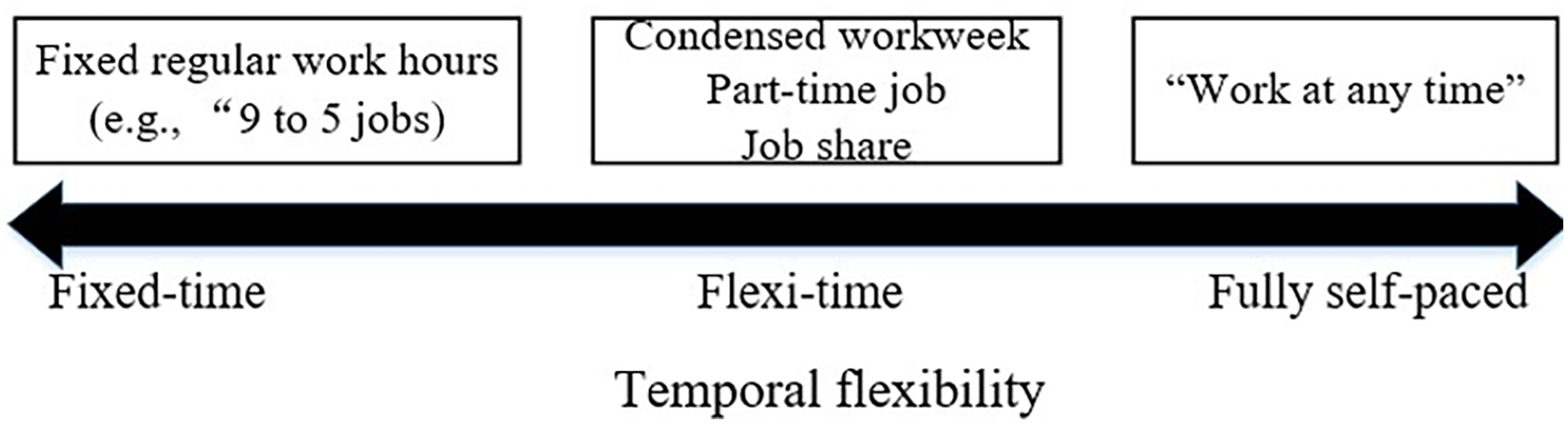
FWA categorization according to temporal flexibility.
Freedom from supervision
The third dimension in the proposed taxonomy pertains to the intensity of supervision that employees are subject to in their work processes. The term “supervision” describes an interactive relationship between managers and employees that involves both monitoring and control (Dimitrova, 2003). It allows managers to closely monitor work activities for those under their supervision and direct their actions as needed. In this paper, we suggest that the intensity of supervision is determined by the nature of data managers acquire, and the methods used to analyze it for supervision purposes. The following three models are examined in this taxonomy.
First, results-based supervision emphasizes the outputs of an employee’s work activities, with minimal monitoring and control of how these activities are performed. Employees under this supervision model are not subject to direct surveillance over their mode of working. Commonly this model is considered suitable for knowledge workers with clearly defined work deliverables. This was traditionally regarded as one of the prerequisites for remote working approval due to the lack of tools in the past to implement an alternative mode of supervision. From the perspective of FWA, results-based supervision provides employees with the most amount of freedom from surveillance and monitoring.
Second, behaviour-observation based supervision focuses on overt observable actions taken by employees. It is the most common form of supervision that allows managers to directly monitor the process of work and control how job actions are performed. In a conventional setup where managers and employees are spatially collocated, this model is manifested by direct in-person interactions. With the adoption of surveillance and monitoring software, it is now possible to implement this form of supervision for remote workers. For example, some companies ask teleworkers to join a video conference during the entire work period; others rely on software tools that take webcam pictures of employees and upload the images for management scrutiny. Compared with results-based supervision, this model reflects a more intensive mode of surveillance and monitoring.
Third, data analytics based supervision is a term proposed in this paper to indicate an emerging model that is characterized by multi-source employee data tracking and algorithmic performance assessment. With the technological advancement of big data analytics and machine learning algorithms, a new category of digital tools become available to not only record employees’ behaviour, but also analyze their physical, mental, and potentially emotional states. Some companies routinely use such tools to log and examine employees’ time sheets, email content, meeting records, social media posts, and workspace utilization. It is foreseeable that sensors which track workers’ physical (e.g., geo-location) and physiological (e.g., fatigue levels) states could be introduced to satisfy an organization’s supervision needs for reasons such as safety and productivity. While there remain many important concerns regarding personal privacy and data security, the proliferation of such tools is likely, especially if employees are allowed more autonomy to control when/where to conduct their work as a result.
In the proposed taxonomy, three models of supervision are positioned on a continuum to indicate an increase of surveillance and monitoring intensity. As shown in Figure 3, the models reflect an expansion of monitoring scope and an elevation of data intrusiveness from results-based to data analytics based models.
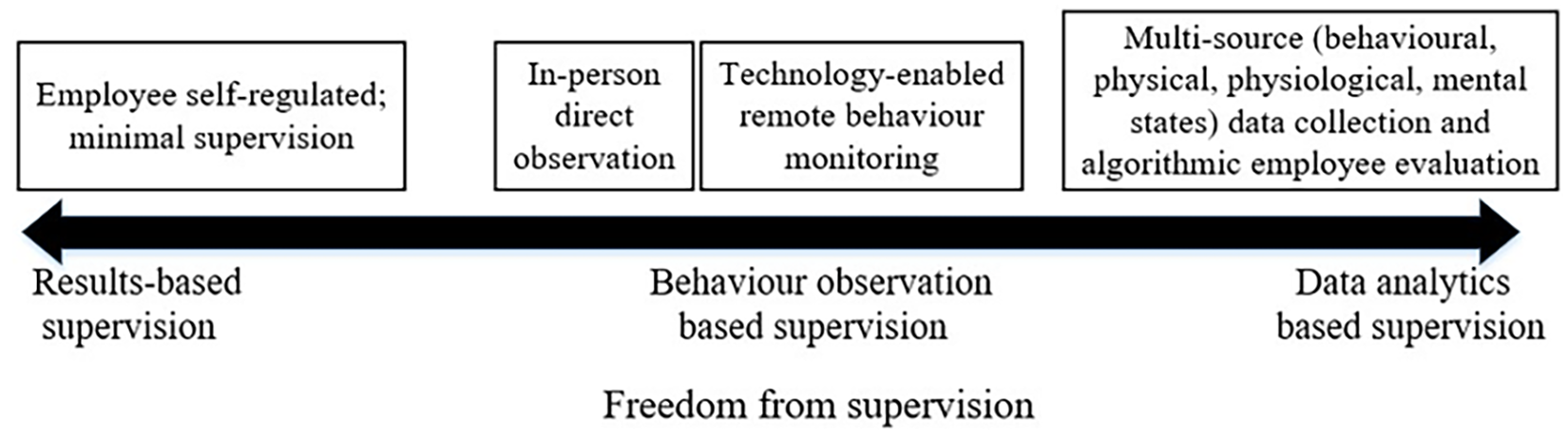
FWA categorization according to their freedom from supervision.
A Three-Dimensional Taxonomy
FWA has long been recognised as a multi-dimensional phenomenon (Standen et al., 1999). So far in this paper, we have explained three factors for classifying FWA programs according to their spatial, temporal, and supervision flexibilities. These three factors are generally independent from one another. For example, a centralised on-site work policy can be coupled with either fixed- or flexi-time work schedules; vice versa, a particular work scheduling policy can be associated to any workplace model regardless of its geographical dispersion. With respect to the mode of supervision, three models can be adopted for any combination of work location and schedule, facilitated by an increasing array of supporting tools. As a result, the three factors are considered orthogonal to one another and a three-dimensional taxonomy is constructed by treating each factor as an independent dimension. Figure 4 provides a graphical illustration of this taxonomy in the form of a three-dimensional cube.
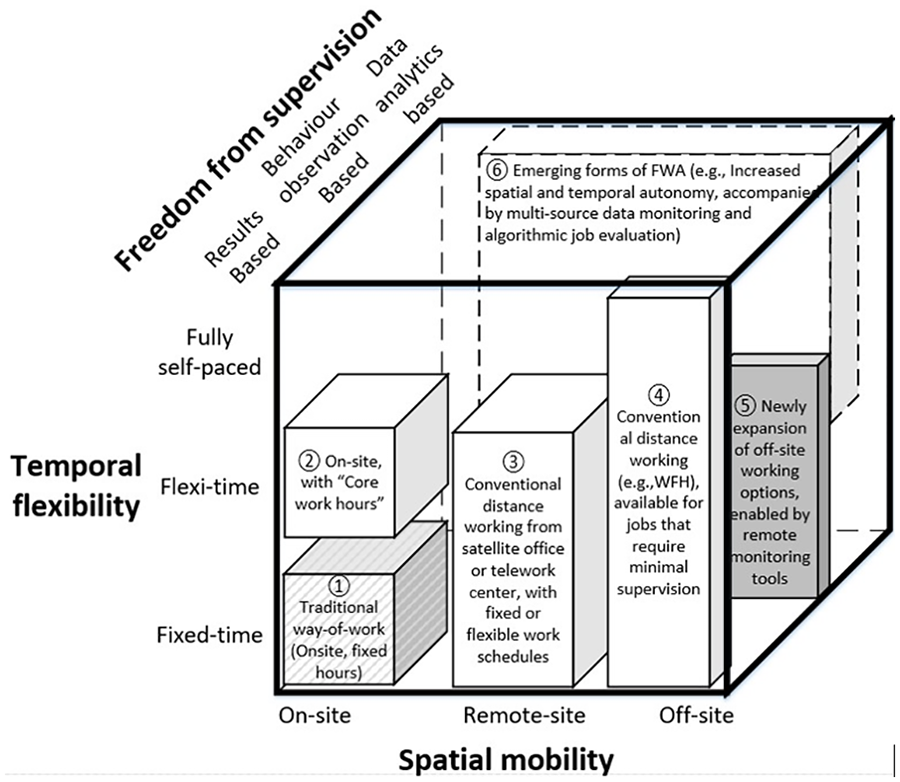
A three-dimensional taxonomy for FWA.
To demonstrate the utility of this taxonomy, six work arrangement examples are added in this cube to enable human factors researchers and practitioners examine traditional, emerging, as well as future way-of-work.
The traditional way-of-work, characterized by limited employee spatial and temporal autonomy, is depicted at the bottom left corner of the cube (i.e., example #1, the lightly shaded shape). Depending on the nature of work activities, employees may be subject to either results-based and/or behavioral observation based supervision.
Conventional FWAs that provide increased temporal flexibility (i.e., #2) and spatial mobility (#3 and #4) are depicted as white shapes in Figure 4. In these cases, behaviour observation based supervision is commonly applicable only to on-site and remote-site workers. Due to the lack of supervision means, off-site distance workers are typically limited to job families for which the monitoring of work process is deemed not necessary. For these conventional off-site workers, their freedom from supervision means that a wide range of temporal flexibility is possible (from fixed to fully self-paced) as long as work deliverables are timely produced.
New forms of FWA (#5, the dark shaded shape) expand off-site working options (particularly work-from-home) to employees whose jobs conventionally were not considered suitable for distance working. Many such work arrangements are enabled by digital surveillance tools that support remote behaviour monitoring and tracking. Their adoption by organizations around the world has been accelerated by the covid pandemic lockdown.
Lastly, emergent forms of FWA offer employees a heightened level of spatial and temporal autonomy, coupled with intensive data-analytics based supervision (#6, the white shape with dotted outlines). This type of work arrangement provides us a glimpse of the future way-of-work. Although ethical concerns abound, more employees may be willing to tolerate a more invasive form of supervision (especially after policy guardrails for using such surveillance tools are properly put in place) for the benefit of gaining increased flexibilities to control their work location and schedule.
Conclusion
The covid pandemic has drastically accelerated the adoption of FWA in numerous businesses and organizations around the globe. As the world is transitioning into a post-covid new normal, many organizations are recalibrating their FWA policies. In this paper, we propose a new multi-dimensional taxonomy to classify different forms of work arrangement according to the degree of autonomy that a policy offers to employees with respect to their spatial mobility, temporal flexibility, and the degree of freedom from supervision. This taxonomy reflects the defining features of contemporary flexible working. It enables researchers and business decision-makers to categorise different forms of FWA, meaningfully compare their impacts on organizational and individual performance metrics, and support an evidence-based approach to inform the establishment of post-pandemic work arrangement policies.
