



Abstract
Youths are in the stage of developing their social identity and are susceptible to life challenges that influence their well-being level. Resilience and family resilience play a crucial role in maintaining well-being once youth emerge into young adulthood. This study investigated the contributors to well-being among Malaysian youth using family resilience, resilience, and gender. Utilising convenience sampling, 325 youths aged 15 to 24 years old (M = 20.23, SD = 2.92) completed surveys on family resilience, resilience, and well-being. Data collected were analysed using hierarchical multiple regression in SPSS. Results showed that resilience and family resilience were significantly associated with well-being. Precisely, resilience was reported as the biggest contributor to well-being, followed by family resilience. This study supported the roles of resilience and family resilience in improving Malaysian youths’ well-being and advocated for resilience upskilling programmes that are customised and personalised to youths’ preferences to enhance their well-being.
Introduction
In this era of globalisation, youths (according to the World Health Organisation, n.d., individuals that are between 15 to 24 years old) face numerous life challenges that may impact their well-being. A study conducted by the Khazanah Research Institute (2018) reported that Malaysian youths’ primary goal in life is to be successful at work. However, youths nowadays face challenges in finding employment due to the lack of job opportunities and competition in the labour markets alongside migrants and expatriates, which poses a threat to their declining well-being. A systematic review studying youths globally reported that youths who are still studying both in secondary school and tertiary institutions face different kinds of challenges than transition youths, such as academic and career issues, adjusting to work, social relationships, health and physical development, and home and family matters (Warner et al., 2016). The reported issues for youths globally are similar to the issues currently faced by Malaysian youths (Jailani et al., 2020).
These challenges have been associated with youths’ impulsivity (i.e., engaging in substance abuse), poor sleep quality, and a reduction in physical and mental health (Bartelink et al., 2020; Orben et al., 2020; Pascoe et al., 2020). This is evident as recent studies have shown that youths reported challenges with well-being and mental health (Chin & Wu, 2020; Woon, 2020; Zainudeen et al., 2021). The declination rate of well-being among youths is alarming and requires urgent measures to prevent future mental health problems. Moreover, youths have yet to reach full maturation in their brain development and are involved in emotional control and self-regulation skills (Steinberg, 2014; Steinberg et al., 2018). They are at the stage of absorption and exploration, whereby their brain's plasticity is high and allows for easier development of mental skills to face life challenges (Blakemore & Choudhury, 2006). Due to this, they are also susceptible to the negative effects of life challenges. Hence, youths are at the optimal stage of development to build up strategies to buffer the negative effects of life challenges and to maintain well-being.
Well-being is a central component of mental health. The well-being paradigm primarily encompasses two approaches: the hedonic approach and the eudemonic approach (Ryan & Deci, 2001). The initial method posits that well-being is essentially centred around contentment and enjoyment, encompassing assessments of overall life satisfaction, the existence of pleasant emotions, and the lack of negative emotions. This approach defines well-being as subjective well-being. Conversely, the latter concept defines well-being as a more intricate concept, highlighting the significance of life and the pursuit of self-actualization by individuals. This method is alternatively referred to as psychological well-being, as it places greater emphasis on the psychological elements of well-being.
This study is based on Diener's theory of subjective well-being (Diener et al., 1999). The theory posits that well-being is made up of three components, which are life satisfaction, positive emotion, and negative emotion. Diener emphasizes that well-being is not solely determined by external conditions, but also by individual differences, such as personality traits, cognitive evaluations, and emotional responses. This theory is then well-suited as fundamentals to measure well-being among youths who primarily base their happiness on emotions (Erikson, 1968).
One of the contributing factors to well-being is resilience, which has been extensively studied in recent years. Resilience is the process and result of successfully adjusting to difficult or challenging life situations (American Psychological Association, n.d.). Resilience is in general an important asset for every individual to be able to become stronger and overcome life adversities with positive outcomes. Adversities come in many forms, including natural disasters, poor home and neighbourhood environments, physical disabilities, poverty, discrimination, and traumas. Youths then must possess a significant level of resilience to overcome adversities in life (Ganaprakasam et al., 2020). Furthermore, stronger resilience builds up durability to deal with life challenges (Ali et al., 2018), and has been shown to result in healthier overall well-being (Andreou et al., 2020).
Moreover, family is one of the most important factors that determine youths’ social and emotional well-being, as they spend most of their time at home, after school on weekdays, and during the weekends. The family relationship serves as a basis for other social relationships among youths that gradually build up their social, emotional, and personality development, and happy parents develop children with little emotional and behavioural issues (Shimazu et al., 2020). A strong family relationship demonstrated enhances youths’ well-being through stronger resilience, a more coherent worldview, greater self-compassion, greater optimism, greater overall self-efficacy, and higher self-esteem (Chuan et al., 2022; Grevenstein et al., 2019).
According to Garmezy's theory of resilience (Garmezy, 1991), resilience is the result of constant adaptive behaviour in response to a danger or stressful event. Youths demonstrate resilience when they show “functional adequacy” as they maintain competent functioning despite experiencing conflicting emotions when stressed. Their longitudinal study found a greater number of protective factors in resilient children compared to those who are non-resilient (Garmezy, 1987). This theory asserts that promotive factors including assets or resources aid youths in preventing the adverse effects of risks and enhancing well-being. Individual elements that contribute to an individual's success, such as competence, coping skills, and self-efficacy, are assets. Resources, on the other hand, are extrinsic elements that assist youth in overcoming risk and stimulate healthy well-being, such as parental support, adult mentoring, and community organisations (Fergus & Zimmerman, 2005). This theory then asserts the importance of having both resilience and family resilience to ensure better well-being through adaptation to life challenges.
Additionally, studies have shown that well-being levels differ between genders. Past studies have shown that male youths reported greater levels of well-being and resilience than females (Andreou et al., 2020; Basta et al., 2022; Khoshaim et al., 2020). The lower resilience and well-being level of female youths could influence their low participation in the labour force and a higher unemployment rate when compared to male youths (Khazanah Research Institute, 2018). In contrast, for boys and younger pupils, a higher level of resiliency appeared to be associated with a more positive state of well-being (Andreou et al., 2020). This is also evident in the National Health and Mobidity Survey (2019), whereby girls reported lower well-being than boys (Institute for Public Health, 2019). However, the current National Health and Morbidity Survey (2023) has not distinguished gender differences in well-being status. Thus, it is crucial to identify the current well-being status according to gender in order to design a comprehensive strategy on building up resilience, family resilience, and well-being that is personalised and customised according to the needs of each gender.
The Present Study
According to the National Health and Morbidity Survey (2023), depression among individuals above 16 years old has doubled from 2019 to 2023, while the largest age group associated with mental health problems were among youths aged 16–29 years old (Institute for Public Health, 2024). Thus, the well-being of youths in Malaysia is currently at risk. Past literature has associated resilience and family resilience with better well-being outcomes; hence, it is vital to determine their impact on well-being among youths in Malaysia. Besides that, it is important to identify the well-being status according to gender in order to strategize appropriate interventions on strengthening resilience, family resilience, and well-being following the requirements of both female and male youths. For these reasons, this study is significant because it has the potential to improve our understanding of how individual and family resilience affects youth well-being, as well as measure gender-specific well-being outcomes. By investigating these factors, the study hopes to inform the development of customised interventions and support programmes that address the distinct needs of male and female youths on their well-being and a comprehensive programme to strengthen resilience and family resilience. This study is intended to assist policymakers, educators, and mental health practitioners develop effective measures to promote resilience and increase youth well-being. Furthermore, it emphasises the value of sturdy family support systems, which can lead to family-centred interventions that benefit both the children and their families. Finally, the study's findings will add to the scholarly literature and assist in addressing gaps in youth well-being, supporting healthier and more resilient future generations.
Noteworthy, personality traits, cognitive evaluation and emotional responses which were associated with well-being are also critical for youths. According to Erikson's lifespan development theory, younger youths are in the stage of identity versus role confusion while older youths are in the intimacy versus isolation stage (Bishop, 2013). Hence, younger, and older youths may experience different life challenges related to their personality development and daily living. Identity versus role confusion is the stage where younger youth strive to distinguish themselves from others and create an identity that is not only acceptable to them but also to society and social circles. Meanwhile, older youths who are in the intimacy versus isolation stage face challenges in forming an intimate social relationship that identifies with their developed self-identity.
Besides that, older youths might have a better awareness of these mental health issues, leading to overinterpretation and identification with mental health problems (Foulkes & Andrews, 2023) as compared to younger youths. For these reasons, this study used age as a control variable to adjust for its significant impact on well-being, which could affect the relationships between the predictors (gender, resilience, and family resilience) and well-being. By accounting for age as a variable, this study eliminates any potential bias caused by age-related factors when examining the impact of gender, resilience, and family resilience on well-being. This enhances the reliability and consistency of the findings, emphasising the unique impact of gender, resilience, and family resilience on well-being.
To sum up, this study aims to investigate gender, resilience, and family resilience in predicting social and emotional well-being among youths in Malaysia, while controlling for the effects of age. In particular, this study is interested to test the following hypotheses:
Method
Participant
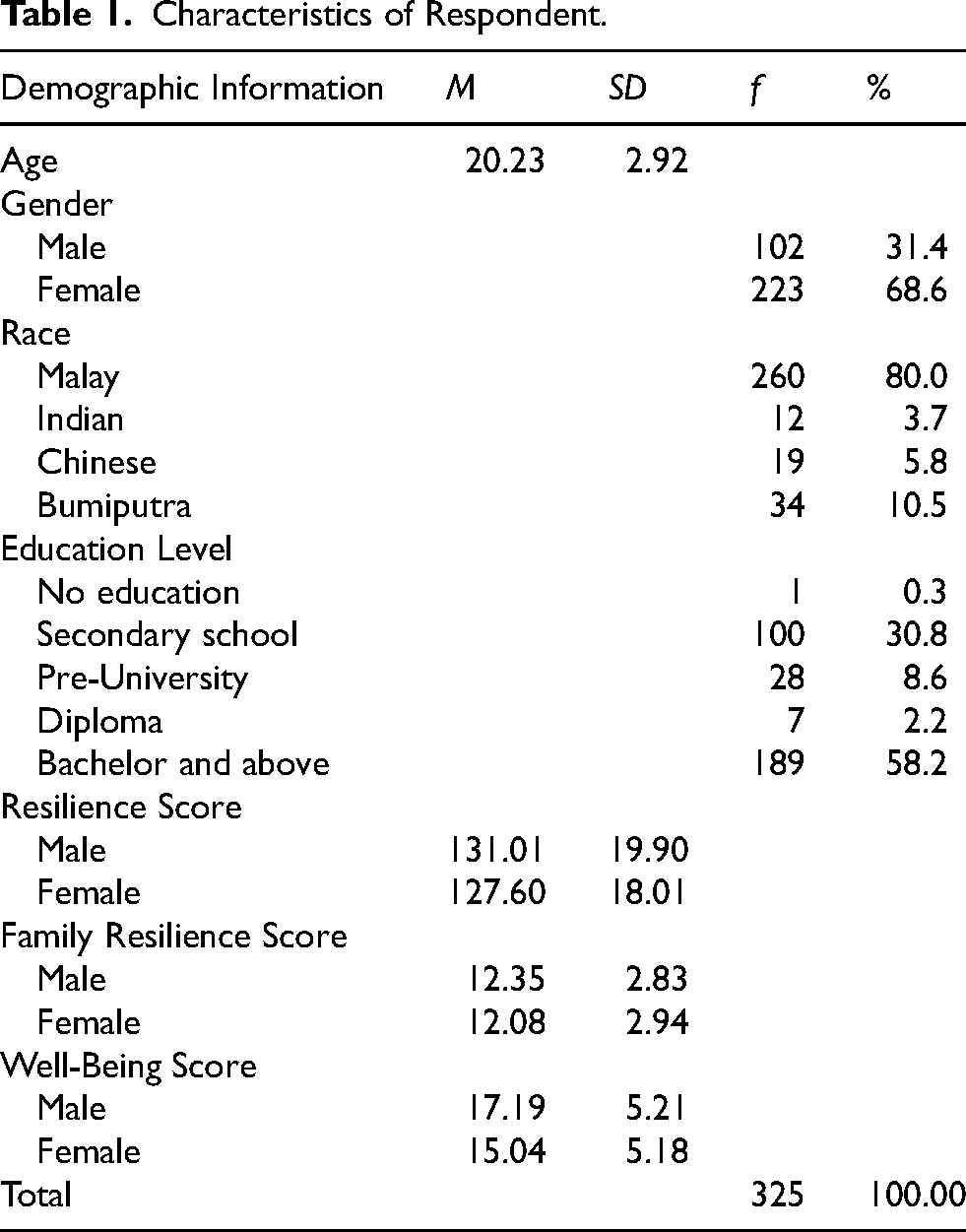
The sample size was calculated using the software G*power version 3.1 (Faul et al., 2007). The total number of predictors was 3, medium effect size, f2 = .15, and 95% power, the minimum number of participants needed was 119. Utilising convenience sampling, a total of 325 youths participated in the study by completing the demographic information and measures of resilience, family resilience, and well-being. Malaysian youths consisting of young people from 15 to 24 years old (M = 20.23, SD = 2.92), who understand the Malay language were included in the study.
The inclusion criteria for eligibility were as follows: (a) individuals between 15 to 24 years old (World Health Organisation, n.d.) (b) have basic literacy in the Malay language as the survey questions were in Malay, and (c) of Malaysian nationality. The included youths in this study were mainly female (68.6%), Malay (80.0%), and currently in a higher education institution studying bachelor's degree and above (58.2%). Table 1 shows the characteristics of the participants recruited in this study.
Characteristics of Respondent.
Measure
The survey consisted of four sections; demographic information, the Resilience Scale (Wagnild & Young, 1993), the Family Resilience Scale (Zhang et al., 2021), and the Malay Version of the WHO-5 Well-Being Scale (Suhaimi et al., 2022). The resilience and family resilience scales underwent an adaptation to the Malay language through a back-to-back translation process (Sperber, 2004). The Resilience scale by Wagnild and Young (1993) consists of 25 statements. Examples of items include “When I make plans I follow through with them” (Apabila saya membuat perancangan, saya mengikuti perancangan tersebut), and “I can be on my own if I have to” (Saya boleh berdikari ketika perlu). Youths completed the scale on a 7-point Likert scale, ranging from 1 (disagree) to 7 (agree). Higher scores indicate that these youths are more resilient. The scale obtained a reliability value of α = 0.90. The Family Resilience scale by Zhang et al. (2021) consists of only 4 questions. Following the instruction, “When your family faces problems, how often are you likely to do each of the following,” the examples of items were: “Talk together about what to do,” (Berbincang tentang perkara yang hendak dilakukan) and “Work together to solve our problems” (Menyelesaikan masalah bersama-sama). The response option uses a 4-point Likert scale and ranges from 1 (All of the time) to 4 (None of the time). All items are reverse-scored and averaged to obtain the total mean score for family resilience. The scale obtained a reliability value of α = 0.83. Lastly, this study utilizes the Malay version of the WHO-5 Well-Being scale, translated by Suhaimi et al. (2022), containing a total of 5 items that measure youths’ emotional well-being. Examples of items include “Felt cheerful and in good spirits” (Saya rasa ceria dan bersemangat) and “Felt calm and relaxed” (Saya rasa tenang dan relaks). Youths answered on a 6-point Likert scale, ranging from 0 (none of the time) to 5 (all of the time). Higher scores indicate better well-being among youths. The scale obtained a reliability value of α = 0.90.
Procedure
This research has received approval from the Ministry of Higher Education Malaysia under the Fundamental Research Grant Scheme (code: FRGS/1/2022/SS09/UPSI/02/4; 2022-0062-106-02) and institutional approval from Sultan Idris Education University, coded: UPSI/PPPI/PYK/ETIKA(M)/010 (643). This research complied with the Helsinki Ethical Declaration and the American Psychological Association's ethical standards. This research was entirely financed by the Ministry of Higher Education Malaysia.
Data collection occurred by circulating surveys through both online and offline methods, whereby, the online survey was circulated through social networking platforms, such as Facebook, WhatsApp, Telegram, and Instagram, and the offline survey was distributed manually to the surrounding community. The overall data collection process occurred from November until the end of December 2022. Fortuitously, the response rate for both offline and online surveys was 100%, with no rejection to complete the survey from the offline approach, and no missing or incomplete data obtained from the online approach. Before completing the questionnaires, participants were provided with information on the research's introduction, purpose, research team background, informed consent, ethical assurances of data anonymity and confidentiality, the right to withdraw from the questionnaire at any time, consent for publication of findings, and an agreement statement indicating their consent upon completion of the questionnaire. All subjects participating in this study provided informed consent.
The data collected were analysed using hierarchical multiple regression. Analysis of data was conducted using the Statistical Package for Social Science (SPSS) Version 24. The hierarchical multiple regression analysis was conducted to identify the predictors of well-being using resilience, family resilience, and gender while controlling for the effects of age.
Result
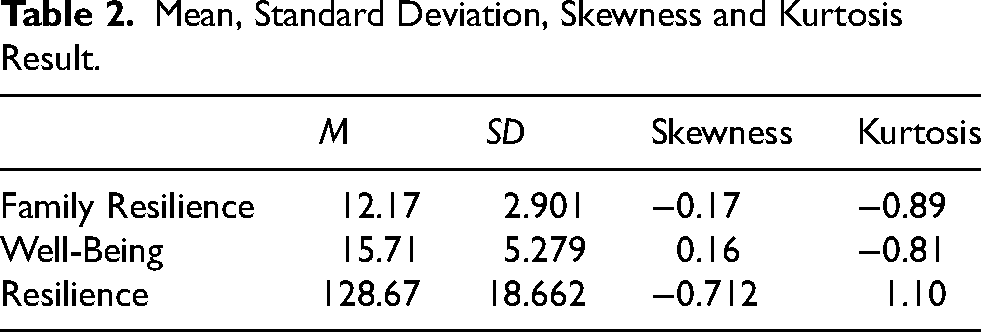
Before proceeding to multiple regression, preliminary analyses were conducted to test the assumptions for regression. These analyses included the normality assessment using skewness and kurtosis, as well as multicollinearity assumptions. All predictors showed values of skewness and kurtosis that were within the ranges of −1 to +1 (Garson, 2012), except for resilience which reported slightly above the range for kurtosis with a value of 1.10. In general, the values of skewness and kurtosis indicated no violation of normality assumptions. Table 2 shows the mean, standard deviation, skewness, and kurtosis calculated in this study.
Mean, Standard Deviation, Skewness and Kurtosis Result.
Next, multicollinearity was checked using the correlation matrix between the variables, with values of more than .90 indicating the presence of multicollinearity (Pallant, 2016). The correlation matrix showed all correlations below .90, with the highest correlation between resilience and well-being with a value of .63. Thus, no multicollinearity exists in this study. Table 3 shows the correlation matrix between all variables included in this study.
Correlation Between Variables.
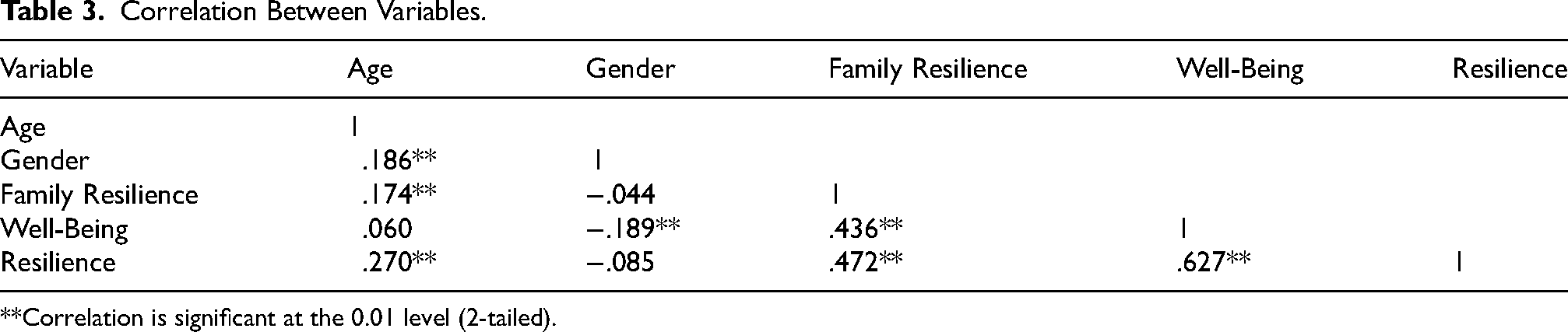
Correlation is significant at the 0.01 level (2-tailed).
A two-step hierarchical multiple regression was used to assess the role of resilience and family resilience in predicting levels of well-being, after controlling for the influence of age. Preliminary analyses were conducted to ensure no violation of the assumptions of normality, linearity, multicollinearity and homoscedasticity. Age was entered in Step 1, explaining only 1.3% of the variance in well-being, F (1, 349) = 4.74, p = .030. After the entry of the resilience, family resilience and gender in Step 2, the total variance explained by the model as a whole was 44.5%, F (4, 346) = 69.41, p < .001. Resilience, family resilience, and gender explained an additional 43.2% of the variance in well-being, after controlling for age, R squared change = .43, F change (3, 346) = 89.76, p < .001. In the final model, resilience, family resilience, and gender significantly affect well-being, with resilience showing the highest beta value (β = .52, p < .001), followed by family resilience (β = .22, p < .001), and gender (β = −.12, p = .003). For gender, during data analysis, male was coded as 1, while female was coded as 2, as such, the analysis showed that male is associated with better well-being than female. Hence, the findings of this study show support for all hypotheses H1a, H1b, and H1c. Table 4 shows the contributions of each variable to well-being.
Result of Hypothesis Testing Between Resilience, Family Resilience, Gender, and Well-Being.
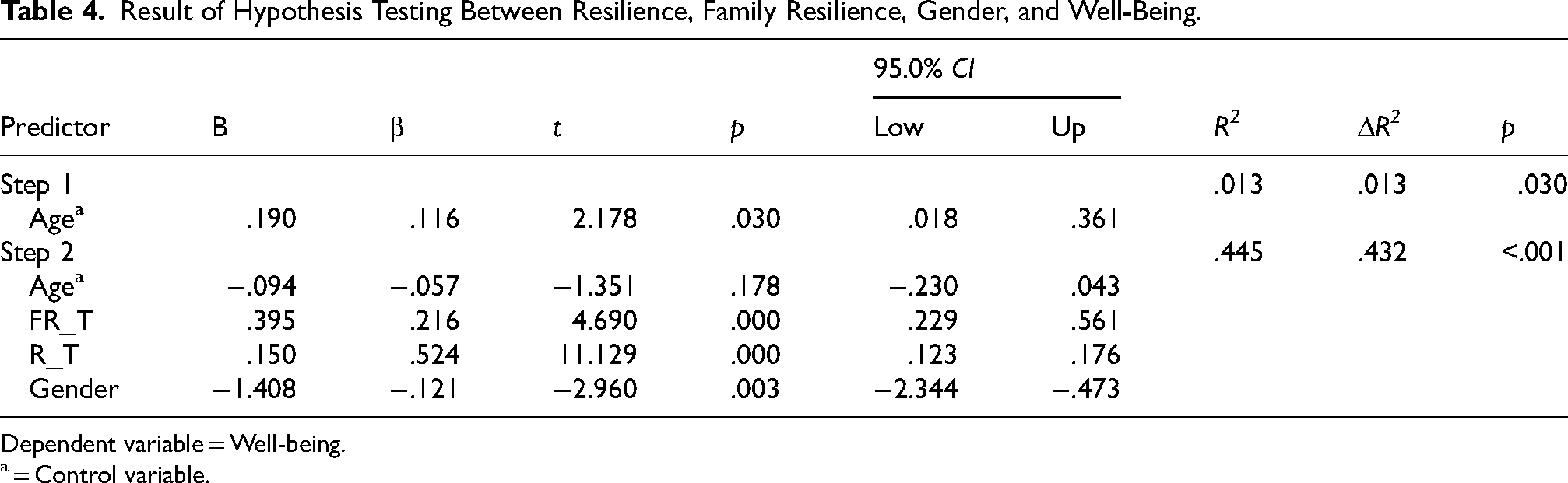
Dependent variable = Well-being.
= Control variable.
Discussion
This study investigates the predictors of well-being among youths in Malaysia using gender, resilience, and family resilience. Regression analysis results testified resilience, family resilience, and gender as significant predictors of well-being. Specifically, this study found resilience as the strongest contributor to well-being, whereby an increase in resilience increases well-being levels. The finding is supported by past studies suggesting that resilient youths scored lower on psychosocial issues and higher on life satisfaction and subjective happiness (Hatano et al., 2023). In line with past research, among juvenile youths, resilience was found to be a strong direct determinant of mental well-being (Konaszewski et al., 2021).
In general, youths transitioning towards living independently face life challenges in terms of safety and security, overwhelming emotional experiences, communication barriers, financial matters, and adjustment to cross-cultural differences (Syuhada et al., 2022). To maintain their levels of well-being, they must experience promotive factors of resilience such as receiving guidance in preparing for their personal needs, particularly about finances and expenditures from trusted adults (Syuhada et al., 2022). According to Erikson (1968), self-identity is characterised by making sense of one's own identity and values. In this stage, youths question and explore their identities and relationships with family members, friends, and society. Resilience then plays a role by acting as a prerequisite and determinant for positive youth development, in such a way that the development is highly dependent on resilience. Attainment of resilience comes from the fulfilment of needs and success in overcoming developmental tasks (Lee et al., 2012), in this case, their development of self-identity. By the end of this stage, resilience is embodied in youth that has established their self-identity which leads to an overall improvement in well-being.
For those who are facing challenges in social relations, resilience is central to establishing relational strength, overcoming obstacles, and successfully managing relationships (Connolly, 2005). Resilience is exemplified by youth's innate response-ability to their social circle, or their capacity to respond to adversity that affects their social relationship by having qualities such as sturdiness, circumstantial adaption, adaptive coping, and self-correcting ability (Venter & Snyders, 2009). In this stage, resilient youths overcome life challenges by engaging in positive social relationships with others and avoiding social isolation, enhancing their well-being status.
Next, this study finds that family resilience significantly predicts well-being with a small percentage of variances. In simpler terms, family resilience only minimally contributes to well-being among youths. This finding is in line with past research reporting similar interactions between family resilience and well-being and its dimensions including anxiety, depressive, somatic, and internalizing symptoms (Bethell et al., 2019; Ramos et al., 2022). As youths spend most of their lives at home, family dynamics play a significant role in structuring their growth and development. Parental traits, such as mental health, self-efficacy, parenting satisfaction, and self-assurance, might influence parental resilience and well-being, further influencing youths’ growth and well-being (Twum-Antwi et al., 2020).
The family resilience framework (Walsh, 2003) suggests that adversity inside the family has a domino effect, affecting everyone, particularly the young ones. Walsh argues that when young people contribute to achieving a shared goal through family interactions, these relationships enable them to develop social virtues, prosocial behaviours, a sense of belonging that surpasses the home environment, adaptability, and collaborative skills with other people. There are two main tenets of resilience in families; first, the ability to bounce back from adversity, and second, the growth in efficiency (resourcefulness), confidence, and health resulting from stress. In other words, a resilient family is able to overcome trials in life and make full use of their opportunities to grow and develop through adversities (Patterson, 2002). These trials that families go through together build up their family resilience, which in return, results in better family well-being, as well as individual well-being for each family member.
Lastly, the result of this study showcased that the gender factor significantly contributed to well-being, with male youths identified as having higher well-being than female youths. This finding aligned with many past works of literature which found that females have poorer well-being than their male counterparts (Basta et al., 2022; Khoshaim et al., 2020), and opposed other studies reporting females having higher well-being than males (Abd Razak et al., 2019). Interestingly, findings between gender and well-being are diverse and inconsistent (Das et al., 2020). Recent research among youths argued that there is no significant difference between females’ and males’ well-being levels (Lai et al., 2022; Tang et al., 2019).
However, in this study, males reportedly have higher well-being than females. The reason could be due to females having a higher risk of acquiring mental health disorders due to hormones, gender-based violence, and biological factors such as puberty and hormonal changes (Riecher-Rössler, 2017). Furthermore, female youths tend to internalise their emotions and prefer to keep them to themselves as opposed to male youths (Hoertel et al., 2015). Furthermore, there is a consensus that women are more prone to experiencing extreme emotional reactions as they tend to report higher levels of both negative and positive emotions compared to males in similar circumstances. Gender disparities in specific personal attributes, such as self-efficacy, self-esteem, thankfulness, optimism, and susceptibility to conditions like depression and anxiety, have been found to contribute to variations in emotional experiences (Das et al., 2020).
Limitation and Implication
Several limitations in this study need to be taken into consideration when interpreting the results. Firstly, this study did not differentiate youths with and without traumatic experiences or life adversities, evaluating resilience among the general population. Future studies may benefit from more interesting findings when focusing directly on youths who have experienced significant life challenges such as traumatic events, adverse early childhood experiences, natural disasters, and other external factors that may require extensive resilience skills. Secondly, this study only included youths from 15–24 years old. Hence, findings are restricted to generalization for this age group only. Future studies may widen the age gap and study resilience among primary school children, adolescents less than 15 years old, and adults more than 24 years old.
Accordingly, this study did not incorporate socioeconomic background and other sociodemographic characteristics such as family composition. Thus, this study could not provide information on resilience and family resilience of low-income, middle-income, and high-income youths as well as results regarding different family compositions. Future studies may find it interesting to identify the role of resilience and family resilience on the well-being of youths from different socioeconomic and family composition backgrounds and how they play a role in developing resilience, family resilience, and well-being.
Finally, this study adopted both online and offline approaches to data collection. Although online data collection has been associated with cost-effectiveness and less time taken when compared to offline methods (Follmer et al., 2017), there are several drawbacks to online data collection. Online data collection has challenges with representativeness, as participants on online social networking platforms tend to be biased towards specific demographic groups. Consequently, the data collected is unlikely to be generalizable due to validity concerns (Newman et al., 2021). In addition, because the survey relies on self-reporting, the online data collection only included individuals who were interested in participating, leading to a higher likelihood of sampling bias due to the absence of random selection in the data-collecting process (Stritch et al., 2017). Hence, forthcoming investigations could address these concerns by guaranteeing an equitable representation of the online samples through data collection from diverse online platforms and geographical regions, implementing time constraints on the online survey website, and providing a moderate level of compensation solely to participants who successfully completed the survey (Newman et al., 2021).
Overall, based on our findings that resilience, family resilience, and gender were associated with youths’ well-being, we advocate for interventions and upskilling programmes promoting resilience among youths that are long-term. The reason for long-term programmes is that resilience takes a longer period to develop, thus, long-term exposure and education on resilience will ensure resilience instillation within these youths. Furthermore, programmes for increasing resilience may help with can focus on how to develop resilience characteristics and expand their focus on family aspects as well since we find that family resilience plays a small but significant role in maintaining well-being among this sample of youths. Finally, it would be effective to separate well-being programmes and interventions for male and female youths, as this study found that gender, particularly female is associated with better well-being than male.
Conclusion
This study recognizes resilience as the main contributor, followed by family resilience, and finally, gender with male youths reporting better well-being than female youths. Generally, we recommend a comprehensive intervention to both youths and their families on the promotion of resilience in terms of programmes and educational awareness as early intervention to enhance well-being that can be sustained across their lifespan and prevent the development of any future mental health issues. We encourage the participation of family members to strengthen their family resilience to further enhance youths’ well-being and customise the intervention programmes specifically for female and male youths.
Footnotes
Acknowledgements
This paper is published as an output for the Fundamental Research Grant Scheme (code: FRGS/1/2022/SS09/UPSI/02/4) approved and funded by the Malaysian Ministry of Higher Education. The authors are grateful to the Ministry of Higher Education and Sultan Idris Education University for their contributions to the research project.

Ethical Consideration
This research has received approval from the Ministry of Higher Education Malaysia under the Fundamental Research Grant Scheme (code: FRGS/1/2022/SS09/UPSI/02/4; 2022-0062-106-02) and institutional approval from Sultan Idris Education University, coded: UPSI/PPPI/PYK/ETIKA(M)/010 (643). This research complied with the Helsinki Ethical Declaration and the American Psychological Association's ethical standards. This research was entirely financed by the Ministry of Higher Education Malaysia.
Consent to Participate
Before completing the questionnaires, participants were provided with information on the research's introduction, purpose, research team background, informed consent, ethical assurances of data anonymity and confidentiality, the right to withdraw from the questionnaire at any time, consent for publication of findings, and an agreement statement indicating their consent upon completion of the questionnaire. All subjects participating in this study are considered to have provided informed consent by completing and submitting the questionnaire.
Consent for Publication
The authors confirmed that participants have read and agreed on the consent for publication regarding the results of the study using the questionnaires. The statement regarding consent for publication of findings was written on the first page of the questionnaire. All subjects participating in this study are considered to have provided informed consent by completing and submitting the questionnaire.
Funding
The authors disclosed receipt of the following financial support for the research and publication of this article: This work was funded by the Ministry of Higher Education Malaysia [FRGS/1/2022/SS09/UPSI/02/4; 2022-0062-106-02]. The funder plays no role in any opinions, findings, conclusions or recommendations expressed in this article.
Declaration of Conflicting Interest
The authors declared no potential conflicts of interest with respect to the research, authorship, and/or publication of this article.
Data Availability Statement
The datasets used and/or analysed during the current study are available from the corresponding author upon reasonable request.