




Abstract
Internet gaming disorder (IGD) has emerged as a significant concern among adolescents. Family factors have been associated with increased risk of developing IGD. This study examined research investigating the relationship between family factors and adolescent IGD. A total of 77 articles are included. Majority of the studies have focused on the role of negative family functioning, poor parents’ mental health, weak parental attachment, negative parenting behavior, and negative parental attitude and behaviors towards internet on adolescent IGD. The studies conducted among adolescents from various cultural backgrounds and in various countries have shown conflicting results, prompting discussion of cultural influences on IGD as highlighted in Ecological Theory.
Introduction
Since the evolution of digital gaming industry in the early 1950s, digital gaming has become an integral part of our lives for various purposes such as entertainment, education, social interaction, and even financial gain (Bartle, 1996). Presumably, the increasing penetration of affordable mobile phones has aided the expansion of digital gaming industry. Moreover, the range of digital games has expanded exponentially, encompassing everything from traditional board games to fighting games and beyond. This diversity ensures that individuals of all ages and interests can find a game that suits their preferences (Cairns et al., 2021). The increasing choices have led people to spend more time on digital games.
Internet gaming disorder (IGD) has been placed by the DSM-5 (American Psychiatric Association, 2013) within the “conditions for further study” section in. Additionally, the World Health Organization (WHO, 2017) described gaming behavior disorder under the category of “disorders due to addictive behaviour” in the 11th edition of the International Classification of Diseases (ICD-11). Although the concept may be used with different definitions in internet gaming research, this study includes only research that specifically examines the concept of IGD.
Adolescents and Internet Gaming Disorder
Adolescence is a period marked by numerous changes across various life domains. For example, during adolescence, an increase in risky behaviors and a greater desire for autonomy often precede and contribute to changes in both the quality and quantity of adolescents’ relationships with their parents (Blakemore & Mills, 2014; Zimmer-Gembeck & Colins, 2003). Additionally, research has indicated that sensation seeking is associated with engaging in risk-taking behaviors, including gaming-related problems (Kim et al., 2022; Stevens et al., 2020).
Given the expansion and wide accessibility of digital gaming in recent years, accumulative number of studies have explored the prevalence of IGD among adolescents in numerous countries. Studies have reported the prevalence rates of IGD to vary between 3.1% to 13% among adolescents (Chiu et al., 2018; Yang et al., 2020). IGD is associated with a wide range of psychosocial, physical and neurological problems. Some systematic reviews highlighted the relationship between IGD and negative mental health outcomes (Pallavicini et al., 2022), social problem (Gioia et al., 2022), physical problems (Byeon et al., 2022) as well as attention problems (Bender et al., 2020).
Family Factors and Internet Gaming Disorder
Influenced by the Family Ecological Model (FEM), which is based on Bronfenbrenner's Ecological Systems Theory (1979) and emphasizes how contextual factors shape parental behaviors, thereby impacting the health outcomes of both children and families (Davison et al., 2013), numerous studies have examined the role of the family environment in various aspects of children's lives. Family environment is the most crucial proximal microsystem, exerting a profound and enduring impact on adolescents’ lives (Bronfenbrenner & Morris, 1998). Both theories highlight the bidirectional influence between adolescent characteristics and the family environment. Indeed, research has highlighted that family environment shapes adolescents’ developmental features and, versa visa (Branje, 2022; Krauss et al., 2020; Roza et al., 2023).
More recently, studies have examined the role of family environment in relation to IGD, ranging from providing adolescents with technological devices to controlling their gaming time and content. Family environment is broad and can be divided into various domains all of which are linked to adolescent IGD, including: (1) parent demographic characteristic such as parent's age, family income, family education level and family type (Colasante et al., 2022; She et al., 2022); (2) parental mental health such as depression and anxiety (Jeong et al., 2021); (3) family functioning which include family intimacy, power and style of relationships, support and monitoring (Gan et al., 2024; Wartberg et al., 2020); (4) parenting style which encompassed various types of parenting styles and behaviours such as authoritarian, democratic, permissive emotional warmth, psychological control, physical abuse (Areshtanab et al., 2021; Chen et al., 2020); (5) parental attachment (Warburton et al., 2022); and (6) parental behaviors and attitudes about IGD (Sun et al., 2023).
Numerous studies have examined the role of family factors in IGD, including systematic reviews that highlight the effects of specific family-related aspects on IGD (e.g., family sociodemographic characteristics, parental health, family interaction). However, there is a lack of research focusing on the bidirectional relationship between various family characteristics and adolescents’ IGD. Given the importance of family factors in understanding IGD among adolescents, it is crucial to examine the reciprocal relationship between IGD and family factors in order to inform the development of parent education programs and IGD prevention initiatives. There is a necessity to conduct a comprehensive study that examines multiple characteristics related to families and parents in reciprocal interaction with IGD. The aim of the present review is to explore the bidirectional relationship between various family characteristics and adolescents’ IGD. Specifically, the primary objective is to identify specific domains of family factors that both influence and are influenced by IGD in adolescents. The findings of this systematic review may provide critical information to develop interventions among adolescents with IGD and their family.
Methods
This research was carried out with the guidelines Preferred Reporting Items for Systematic Reviews and Meta Analyses (PRISMA, 2009) guidelines and was registered with the International Prospective Register of Systematic Reviews (PROSPERO; CRD42024573675). Articles were searched in three literature databases: Web of Science, PubMed and PsycINFO. The systematic search utilized keywords found in the titles and abstracts which were:
(“internet gaming disorder” OR “gaming” OR “game addiction” OR “gaming addiction” OR “gaming disorder”) AND (“parent” OR “mother” OR “father” OR “famil*” OR “couple” OR “caregiv*”) AND (“adolescen*” OR “child*” OR “young” OR “teen*” OR “youth”).
Eligibility Criteria
This study utilized original research and peer-reviewed journal articles in English published after 1995 because research in the field of IGD began to intensify in the early 1990s. Articles employing quantitative method and containing at least one measure of family factors that are linked to IGD were eligible. Studies focusing on IGD as well as those that examined gaming disorder, game addiction or problematic/pathological gaming were included. Studies that examined other internet-related problems (e.g., problematic internet usage, gambling, excessive smartphone use, social media addiction) examining and gaming-related features (e.g., gaming time, violent gaming behavior) were excluded. The focus of this review is on adolescence, which is defined by the WHO as the age that ranges between 10–19 years (WHO, 2015). The age of 9 can be considered the end of puberty and the beginning of independence from the family (Sawyer et al., 2018). Turning 18 legally marks independence in many countries, further supporting the process of separation from the family and reducing parental influence on the child. Therefore, this study was limited to young individuals aged 9–17.
Based on the above terms, 2263 articles were found. A total of 1033 articles were identified in at least two of the three databases. For articles that appeared in more than one database, only one of them was included, resulting in the removal of the other copy from 2263 articles. Articles without full text were eliminated (n = 8).
Articles were excluded if they fall under the following categories: articles written before 1995 (n = 20), books, book chapters, and thesis (n = 85), articles in other languages other than in English (n = 42), meta-analysis or systematic reviews (n = 88), case report or experimental design (n = 19), articles that did not include defined keywords in the main text (e.g., problematic internet usage, gambling, excessive smartphone use, social media addiction) (n = 181) and include just gaming frequency/features (n = 21), articles that did not meet the age criteria (n = 10), used qualitative method (n = 5) and articles related to different subject areas that are not relevant to the subject of this study (n = 1064).
Articles were selected separately by the authors of this study and then examined for inter-rater reliability. The agreement index was assessed with Cohen's Kappa and revealed almost perfect agreement, K = .81, p < .001 (Landis & Koch, 1977); the discrepancies among reviewers were deliberated upon and resolved through consensus.
The articles were analyzed using various methods. When interpreting the articles, priority was given to the findings of regression analysis in studies where both correlation and regression analyses were conducted. However, in studies where only the results of correlation analysis were presented, these findings were also considered. As the focus of this review was on the role of family factors on IGD, the findings related to other factors was not analysed.
Study Selection Process
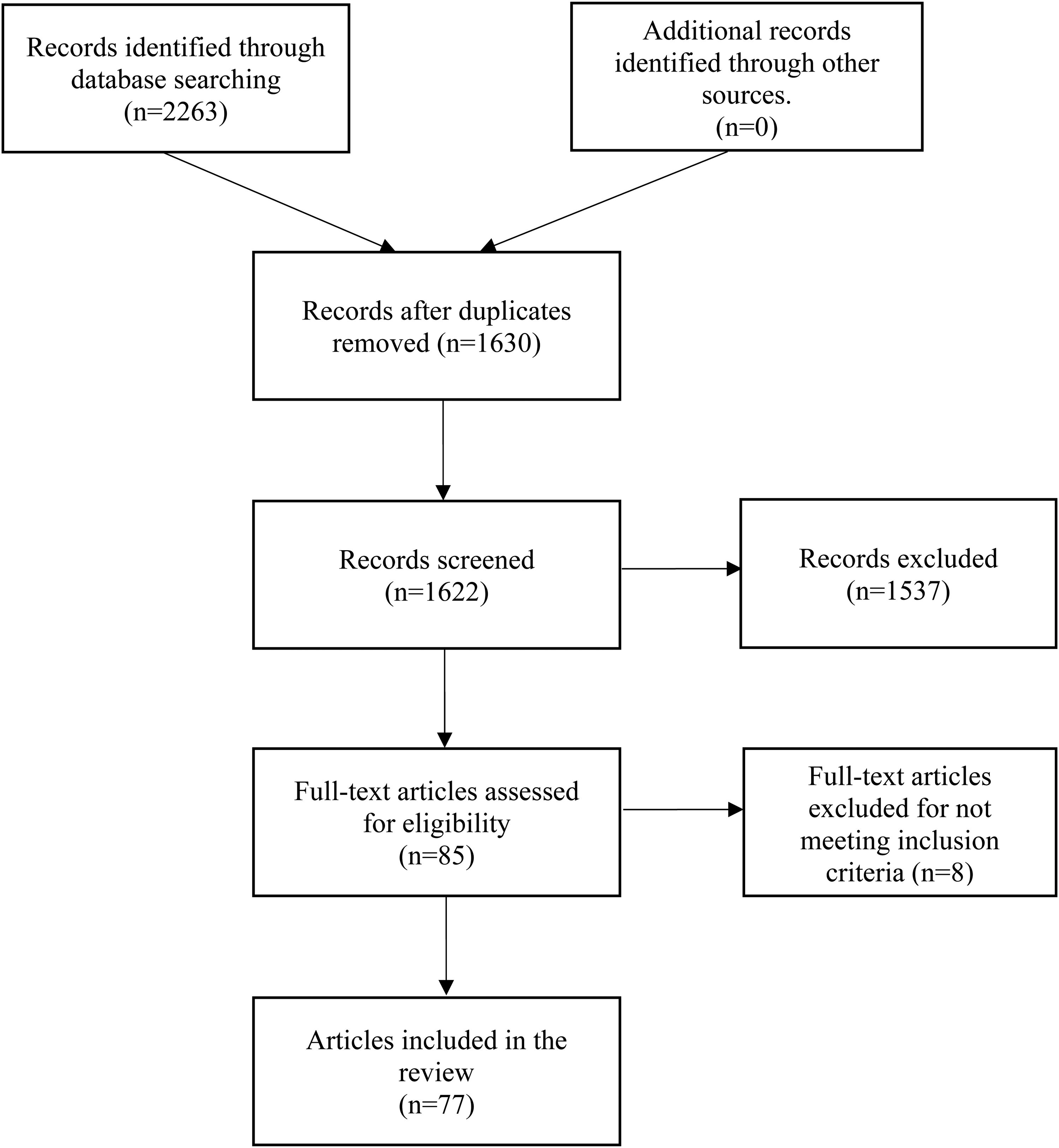
PRISMA Flow Diagram of Study Selection Process.
Results
Descriptive Characteristics of the Selected Studies
A total of 77 articles were included in the current review. Most of these studies used cross-sectional research design (N = 62, 80.51%) and used self-report questionnaires to assess IGD (N = 76, 97.43%). One of the remaining two studies was based solely on parent reporting, and another one involved both parental and adolescent reporting.
The studies were conducted across various regions, including Region of Americas (nBrazil = 2); Europian Region (nCzech Republic = 1, nEuropian Countries = 1, nFinland = 1, nFrance = 2, nGermany = 4, nIsrael = 1, nItaly = 2, nNetherland = 1, nRomania = 1, nSlovenia = 1, nSpain = 7, nTurkey = 9,: Eastern Mediterranean Region (nIran = 1), and Western Pacific Region (nChina/Hong Kong = 21, nSingapore = 4, nAustralia = 3, nKorea = 13, nVietnam = 1). Sample sizes across all 77 studies varied, ranging from 83 to 88,998 (for more information about included research, see Table S1 and S2 1 in Supplementary Materials).
To ensure clarity and consistency in presenting the findings, the results are structured as follows: First, we presented correlation and regression analyses that examine associations or predictive relationships. Second, we reported group differences in IGD and family factors using group comparison analyses. Finally, where available, we included findings from longitudinal studies to provide insights into causal relationships.
Parent Demographic Characteristics
One domain of family factors that have been widely examined was related to parents’ characteristics, such as age, family income, family education and family type. Studies that examined the role of family types have reported inconsistent findings. For example, some research identified that separated families or blinded families as risk factors (Lin et al., 2023; Rikkers et al., 2016); others did not show any significant differences in adolescents’ IGD levels based on family types (Spilková et al., 2017; Taş, 2019; Wang et al., 2014).
Most research found no significant association between IGD and parents’ education (Geniş & Ayaz-Alkaya, 2023; Nogueira-López et al., 2023; Vayisoglu et al., 2022; Wang et al., 2014; Zhou et al., 2022; Zorbaz et al., 2015). However, a longitudinal study revealed that lower maternal education predicted a higher level of IGD cross-sectionally, but this effect did not persist over time (She et al., 2022). Some research found no significant relationship between family income and IGD (Areshtanab et al., 2021; Geniş & Ayaz-Alkaya, 2023; Roza et al., 2023; Vayisoglu et al., 2022; Wang et al., 2014), but some other studies did find a significant association between these two variables (Liu et al., 2021; Muslu & Aygun, 2020; Zhu et al., 2021).
Parent Mental Health
Studies have shown a positive association between IGD and parental mental health problems such as anxiety and depression (Lam & Cheng, 2022; Lin et al., 2023; Wartberg et al., 2017, 2018). In addition, research examining differences in level of parental psychopathology between healthy group and IGD group has found that adolescents with IGD have higher levels of negative parental mental health outcomes (Chung et al., 2023; Koc et al., 2020).
Longitudinal findings have indicated that IGD predicted development of parental anxiety (Roza et al., 2023; Wartberg et al., 2018). Additionally, maternal depression (Roza et al., 2023) and anxiety (Zhu & Chen, 2021) have also been reported to predict the course and outcome of IGD.
Parenting Styles
Studies have also examined various dimensions of parenting styles such as neglect and protection or family atmosphere. Most of these studies have examined the role of parenting styles on IGD based on Parental Acceptance-Rejection Theory (Rohner, 1960), and Baumrind's parenting styles typology (Baumrind, 1991). Parenting styles play a significant role in shaping children's behaviour, including gaming, by influencing their perception of self, others and the world (Baumrind, 1991; Rohner et al., 2012).
Research have pointed out IGD was negatively associated with positive parenting styles such as parents’ affection and parents’ rationality (Jeong et al., 2021), mother-child mutual trust, alienation from parents and perception of parental rearing attitude (Kim & Kim, 2015), democratic parental attitude (Geniş & Ayaz-Alkaya, 2023). Some other studies have reported a positive correlation between IGD and negative parenting styles such as parents’ excessive interference (Jeong et al., 2021), parental neglect (Gan et al., 2023; Geniş & Ayaz-Alkaya, 2023; Xie et al., 2021), parental permission (Maftei & Enea, 2020), parental rejection and over-protection (Chen et al., 2020), authoritarian, authoritative parenting (Areshtanab et al., 2021), oppressive family atmosphere (Vayisoglu et al., 2022). Several other studies found no association between IGD and trust level with the father (Kim & Kim, 2015), inconsistency and reasoning (Jang & Ryu, 2016), and permissive parenting style (Areshtanab et al., 2021). Jang and Ryu (2016) emphasized age differences in the relationship between IGD and parental attitude. IGD was negatively predicted by affection and positively predicted by intrusiveness among elementary school students, but these relationships were not significant among middle and high school students.
Studies examining differences adolescents with IGD and without IGD found that the level of father-adolescent trust and communication is the same between two groups (Kim & Kim, 2015). Conversely, some studies have found adolescents with IGD exhibited higher levels of paternal alienation and lower levels of maternal acceptance (Kim & Kim, 2015), less acceptance/involvement and more mother's revoking privileges and father's indifference (Rodríguez-Ruiz et al., 2023). Furthermore, studies have shown that adolescents with IGD tend to come from families characterized by violent parenting style, lack of discipline and inadequate supervision compared to adolescents who receive supervision without violence (Cuong et al., 2021). They also experience less acceptance/involvement and more mother's revoking privileges and father's indifference (Rodríguez-Ruiz et al., 2023). In some other studies, adolescents without IGD have higher level of acceptance-involvement and psychological autonomy (Koc et al., 2020), and maternal affective, autonomic and controlling attitudes (Chung et al., 2023). However, Chung et al. (2023) did not demonstrate that there is any relationship between IGD and rejecting parenting style.
Longitudinal studies have pointed out that IGD is positively predicted by parental abuse (She et al., 2022) as well as by parental psychological control (Lin et al., 2020). Other studies have indicated that IGD is positively predicted by parental rejection (Zhu & Chen, 2021), parental restriction (Choo et al., 2014), parental abuse (She et al., 2022), and coerciveness (Li et al., 2018). Inconsistent to these findings, She et al. (2022) found no relationship between IGD and parental psychological control.
Parent Attachment
Children with secure attachment tend to exhibit positive mental health and functioning (Pearse et al., 2020). Contrary, insecure attachment is associated with impairments in functioning (Laczkovics et al., 2020). Individuals with insecure attachment may seek to fulfill tolerate their “self-object needs” (Kohut, 1971) by hooking on alternative sources such as game and drugs.
Indeed, higher level of parental attachment has been reported to be associated with lower level of IGD (Estevez et al., 2019; Jeong et al., 2020; King & Delfabbro, 2017). Warburton et al. (2022) has indicated that secure attachment is a protective factor for IGD risk. Moreover, a longitudinal study has shown that parental attachment negatively predicted IGD (Kim et al., 2023). King and Delfabbro (2017) found adolescents without IGD to have a higher level of attachment than adolescents who are at risk of developing IGD. However, Estevez et al. (2019) found parental attachment is not a significant predictor of IDG. Overall, most research seems to suggest secure attachment or high level of attachment as a protective factor for IGD.
Parental Attitude Towards Digital Behavior
Parents control their offspring's digital behaviour through various methods, including restriction, co-use, autonomy supported (Valkenburg et al., 2013). Parental attitudes toward children's digital media use, conceptualized as mediation strategies (Livingstone & Helsper, 2008), have been shown across cultures to serve a protective role (Ergin & Kapçı, 2019; Fikkers et al., 2017; Sonck et al., 2013).
IGD studies has explored both parental attitudes towards adolescent's digital gaming behavior and their own digital behavior. For instance, parental phubbing has positively predicted IGD (Xie et al., 2021; Zhou et al., 2022). However, a longitudinal study found that parental involvement in media is not a significant predictor of IGD (Liau et al., 2015). Studies on parental attitudes towards IGD have pointed out that IGD is negatively predicted and correlated by banning video games, rules about them (Bonnaire & Phan, 2017), parental active mediation (Sun et al., 2023), parental monitoring (Marinaci et al., 2021), and parental attitude toward internet (Jeong & Kim, 2011). In contrast, some studies have shown that parental mediation (Lee & Kim, 2017) and gaming activities with parents (Jeong & Kim, 2011) were not significant predictors of IGD.
Longitudinal studies have indicated that IGD is related to higher parental restriction of their children's video gaming (Choo et al., 2014), and less parental monitoring of internet usage (Su et al., 2018). Additionally, a higher level of IGD predicted a lower level of parental monitoring in long-term (Su et al., 2018); although this relationship was not significant in each wave. Additionally, IGD was a significant predictor of less quality of communication about gaming in the long-term (Koning et al., 2018).
Some studies involving both IGD and non-IGD groups have suggested that parents of non-IGD adolescents are more likely to impose bans or rules compared to those with IGD (Bonnaire & Phan, 2017; Koc et al., 2020). Furthermore, parents of adolescents with IGD tend to have more negative parental attitudes towards gaming (Jeong & Kim, 2011).
Family Functioning
Family functioning refers to the balance of cohesion (emotional bonding) and adaptability (flexibility in roles and rules) that enables families to support and adjust to changing needs (Olson et al., 1979). Studies that examined the relationship between IGD and family functioning tend to differ in their operationalization of family functioning which could have explained for the inconsistent findings in this area (e.g., Bonnaire & Phan, 2017; Gan et al., 2024; Wartberg et al., 2020). For example, cross-sectional studies have reported a positive association between IGD and negative family functioning features such as low family functioning (Marinaci et al., 2021; Rikkers et al., 2016; Wartberg et al., 2019, 2020), family conflict (Bonnaire & Phan, 2017; Yuh, 2018), and family dysfunction (Gan et al., 2024). However, other research has reported a negative association between IGD and positive family functioning such as satisfying relationships (Lee & Kim, 2017), family cohesion and family relationship (Bonnaire & Phan, 2017; Cuong et al., 2021; Hwang et al., 2020; Lin et al., 2023; Wang, 2022; Yang et al., 2020), family connectedness (Warburton et al., 2022). Conversely, some studies found no relationship between IGD and parent-child closeness (Zhou et al., 2022), parental monitoring (Colasante et al., 2022), family conflict (Liang et al., 2023), communication with parents (Kim & Kim, 2015; Kim et al., 2023). The relationship between family functioning and IGD also differs by parent's gender and children's age. For example, a study by Kim et al. (2018) showed IGD to be associated with father-child communication but not with mother-child communication. In another study, parental support was found to be a significant predictor of IGD among primary school students, while there is no protective role for secondary school students (Zhu et al., 2021). A study by Irmak and Erdogan (2019) found family environment as a significant predictor for female, but the relationship was not significant for males.
Studies that compared family functioning between adolescents with IGD and without IGD have found adolescents with IGD to have lower level of family functioning, such as less adaptation, resolve and partnership (Fumero et al., 2020), less family cohesion (Yuh, 2018), more family conflict, poorer family relationship (Bonnaire & Phan, 2017; Cuong et al., 2021; Hwang et al., 2020), poorer understanding (Macur & Pontes, 2021), less affection-communication (Esteve et al., 2022), less family support (Jeong et al., 2018; Zhu et al., 2021), lower level of quality of communication (Efrati, 2023), and less social activities with parents (Jeong & Kim, 2011).
According to several longitudinal studies, IGD is positively predicted by parental conflict (Jeong et al., 2020) and family dysfunction (Zhou et al., 2023). Furthermore, some studies have pointed out protective effect of and parent-child closeness (Choo et al., 2014), positive parent-child relationship (Su et al., 2018; Zhu et al., 2015), and parental support (She et al., 2022). Moreover, adolescents with IGD had poorer family relationships and higher levels of negative perception of family environment than adolescents without IGD non-pathologic adolescents (Da Charlie et al., 2011). However, some studies have reported no association between IGD and family cohesion (Roza et al., 2023), and parental psychological control and parental relationship (She et al., 2022). Additionally, IGD was not a significant predictor of parental functioning over time (She et al., 2022).
Discussion
The aim of this systematic review was to investigate the reciprocal relationship between family environment and the development of IGD in adolescents. Unlike previous systematic reviews that focused on internet gaming research (Nielsen et al., 2020; Schneider et al., 2017), the present review focuses specifically on studies on IGD. Additionally, this systematic review offers a more comprehensive examination of various concepts related to parental and family factors in the context of IGD research, distinguishing itself from previous studies (Gao et al., 2022; Sugaya et al., 2019). A systematic search of the literature yielded 77 studies that met the inclusion criteria. Our review of these 77 studies found six dimensions of parental/family characteristics: parent demographic characteristics, parent mental health, parenting styles, parent attachment, parental attitude towards digital behavior and family functioning.
One of the most frequently studied factors is related to family functioning. According to Ecological System Theory (Bronfenbrenner, 1979), parents occupy a place in the microsystem, which directly influences children`s behaviors. More specifically, the Family Ecological Model (Davison & Campbell, 2005; Davison et al., 2013) highlights how family behaviors shaped by environments (e.g., culture, relationships of parents or features of historical period) affect the characteristics of children. Within this scope, studies have examined both positive (e.g., adaptation, understanding and support) and negative (conflict, discoursing relationships, dysfunction and disharmony) aspects of family functioning. Most studies have emphasized that positive family functioning had a protective role on IGD (Bonnaire & Phan, 2017; Chang & Kim, 2020; Choo et al., 2014; Colasante et al., 2022; Cuong et al., 2021; Esteve et al., 2022; Hwang et al., 2020; Kim & Kim, 2015; Lee & Kim, 2017; Lin et al., 2023; Rodríguez-Ruiz et al., 2023; She et al., 2022; Wang, 2022; Warburton et al., 2022; Yang et al., 2020; Zhu et al., 2015).
Additionally, numerous cross-sectional and longitudinal studies have emphasized that negative family functioning characteristics pose risks for the development of IGD (Bonnaire & Phan, 2017; Gan et al., 2024; Jeong & Kim, 2011; Jeong et al., 2020; Koc et al., 2020; Marinaci et al., 2021; Rikkers et al., 2016; Wang et al., 2014; Wang, 2022; Wartberg et al., 2019, 2020; Yuh, 2018; Zhou et al., 2023; Zorbaz et al., 2015). On the other hand, a few studies have shown no relationship between IGD and family functioning (Colasante et al., 2022; Kim & Kim, 2015; Kim et al., 2023; Liang et al., 2023; Roza et al., 2023; She et al., 2022; Zhou et al., 2022). These inconsistent results might be due to several reasons. Firstly, various types of scales were used to measure the same variables across different cultures. Differences in both scales and cultural features may have caused this discrepancy. Most studies that found no relationship between IGD and family functioning were conducted in Western Pacific Region, with two exceptions that encompassed multiple European countries and Brazil. Cultural norms and beliefs on parental attitude caused some differences in the relationship between parenting and adolescent outcome (Lansford, 2022). Therefore, cultural differences should be taken into consideration in the studies on parental behavior. The second reason might be related to the way in which the family functioning is being operationalized. For example, Marinaci et al. (2021) found a positive association between lower family functioning and IGD, operationalizing family functioning as the general state of well-being or malaise of the family which was measured using the McMaster Family Assessment Device (FAD) (Epstein et al., 1983). However, Bonnaire and Phan (2017) defined family functioning in terms of family relationships and measured it using The Family Relationship Index (Hoge et al., 1989). The differences in operationalization of family functioning led to the use of different measurement tools and may have resulted in varied findings regarding its relationship with IGD. Lastly, some studies have emphasized that adolescents’ gender and age may moderate the relationship between IGD and family functioning (Irmak & Erdogan, 2019; Zhu et al., 2021). This aligns with Ecological Systems Theory, which highlights the role of individual characteristics—such as age and gender—in shaping how children interact with their family environment and are affected by it. The present systematic review suggests that, further research is needed to give more consideration to the role of cultural and individual characteristics in the development of IGD.
Even though various types parenting behaviors and styles have been examined in the research, findings have shed light on the relationship between IGD and parenting styles and behaviors. Additionally, findings regarding parental attachment show consistent results. From a general perspective, adolescents with IGD often have parents who have careless, neglectful, or abusive towards their offspring (Areshtanab et al., 2021; Chen et al., 2020; Cuong et al., 2021; Gan et al., 2023; Geniş & Ayaz-Alkaya, 2023; Jeong et al., 2021; Lin et al., 2020; Pivetta et al., 2023; Quancai & Meng, 2023; Rodríguez-Ruiz et al., 2023; Taş, 2023; Vayisoglu et al., 2022; Xie et al., 2021; Yang et al., 2020). Conversely, adolescents whose parents provide care, support and warmth tend to have a lower risk of IGD (Chen et al., 2020; Chung et al., 2023; Geniş & Ayaz-Alkaya, 2023; Jeong et al., 2021; Kim & Kim, 2015; Kim et al., 2023; Koc et al., 2020; Pivetta et al., 2023). People may resort to digital environments such as games and social media as means of escaping from stressful life events and thoughts (Akyol et al., 2021). Additionally, longitudinal studies have highlighted the detrimental impact of IGD on parental behaviors (Choo et al., 2014; Li et al., 2018; She et al., 2022; Zhu & Chen, 2021). Similarly, parental attachment is also a protective factor for the development of IGD (Estevez et al., 2019; Jeong et al., 2020; Kim et al., 2023; King & Delfabbro, 2017; Warburton et al., 2022). In few studies, these findings were not supported, and no relationship was found (Areshtanab et al., 2021; Chung et al., 2023; Jang & Ryu, 2016; Kim & Kim, 2015; She et al., 2022). These studies conducted with Eastern Mediterranean Region (Iran), and Western Pacific Region (Korea and China). Similar to the results concerning family functioning characteristics, cultural differences may be associated with inconsistencies in the findings (Lansford, 2022). Moreover, parental practice might vary among children and adolescents (Jang & Ryu, 2016). Research have emphasized that parental practice can vary during the transition from childhood to adolescence in children at home (Hou et al., 2020; McGue et al., 2005). Current research included participants aged between 9 and 17, thus, encompassing various stages of development (i.e., late childhood, early and middle adolescence) (Santrock, 2018). Further research may consider cultural features and participant's age to identify potential differences they may cause.
Secific parenting mediation strategies (e.g., parental attitudes towards internet usage of their children (Livingstone & Helsper, 2008) that are linked with low levels of IGD include banning (Bonnaire & Phan, 2017; Koc et al., 2020), parental active mediation (Sun et al., 2023), and general mediation encompassing all types (Jeong & Kim, 2011; Marinaci et al., 2021). Additionally, Koning et al. (2018) emphasized that IGD predicts a decrease in the quality of communication about gaming over time. However, some studies did not corroborate these results. For instance, parental mediation (Lee & Kim, 2017), gaming activities with parents (Jeong & Kim, 2011) and parental involvement in media (Liau et al., 2015) were not linked to IGD. Additionally, Su et al. (2018) found that the effect of parental monitoring on IGD did not remain significant over prolonged period. Cross-cultural studies regarding parental mediation have emphasized cultural differences towards internet usage might affect parental attitude and their behaviors (Bayraktar, 2017; De Morentin et al., 2014). A meta-analysis (Wang et al., 2023) specified the necessity for additional parental mediation studies to address cultural differences. The results demonstrating no association between parental mediation and IGD conducted within Western Pacific Region. Additionally, Ecologic Theory advocates for considering culture when investigating individual development. Parental mediation, as a parental attitude and behavior, requires attention to cultural features and differences in further research.
Demographic characteristics of families, such as family type, income, parents’ education level, and employment status, are fundamental factors associated with their socio-economic status. Typically, studies have regarded demographic factors as covariates. However, they have also underscored the relationship between family demographics and IGD. Specifically, numerous studies have found that adolescents at risk of IGD often come from families that do not conform to the norm of consisting of parents and their offspring, such as blended families (Männikkö et al., 2018; Rikkers et al., 2016); separated families (Lin et al., 2023; Parlak et al., 2023) or single-parent families (Roza et al., 2023; She et al., 2022; Zhu et al., 2021). Moreover, studies have highlighted protective role of a traditional and stable family environment (Colasante et al., 2022; Nogueira-López et al., 2023). Nevertheless, a few studies have reported no significant association between IGD and family types (Spilková et al., 2017; Taş, 2019; Wang et al., 2014).
There are relatively fewer studies examining parental education level, income and employment status compared to studies on family types. Contrary to expectations, parent's education (Geniş & Ayaz-Alkaya, 2023; Nogueira-López et al., 2023; Vayisoglu et al., 2022; Wang et al., 2014; Zhou et al., 2022; Zorbaz et al., 2015) and family income (Areshtanab et al., 2021; Geniş & Ayaz-Alkaya, 2023; Roza et al., 2023; Vayisoglu et al., 2022; Wang et al., 2014) are not significant risk factors for IGD. Conversely, several studies have emphasized that lower levels of parent education as well as family income are risk factors for adolescents’ IGD (Lin et al., 2023; Liu et al., 2021; Muslu & Aygun, 2020; Parlak et al., 2023; Phan et al., 2020: Rikkers et al., 2016; Zhu et al., 2021). According to results on demographic characteristics of families, traditional families might be protective to adolescents from risk of IGD. However, income and education level may not be critical for development of IGD in adolescents. Nonetheless, several studies contain findings that contradict the above. Taking into account inconsistent findings, it is recommended to increase the number of IGD studies that also consider demographic characteristics of families. Thus, our understanding of the relationship between basic features of families and IGD can become even clearer. Furthermore, our knowledge regarding whether prevention and intervention programs are more crucial for families with certain characteristics (e.g., lower-income families) can be enriched.
IGD, as one of the negative behavioral mental health outcomes, typically has been found to be predicted by parental mental health (Chung et al., 2023; Koc et al., 2020; Lam & Cheng, 2022; Lin et al., 2023; Wartberg et al., 2017, 2018). Also, IGD predicted negative health of parents (Roza et al., 2023; Zhu & Chen, 2021). Research examining the transmission mental health outcomes between parents and children has underscored an interrelation between parents and their children's mental health (Akgül & Atalan Ergin, 2021; Stracke et al., 2023; Zhang et al., 2022). Additionally, Ecological System Theory and FEM propose reciprocal relationships between family members. Therefore, IGD studies have undoubtedly demonstrated the importance of parental mental health on adolescents’ IGD, and vice versa.
Limitations
This systematic review, while providing a comprehensive assessment of the relationship between IGD and family variables in adolescents, contains some limitations. First, like all systematic reviews, studies included in the current research were determined based on databases and specific keywords. Thus, findings from research conducted using other databases or unpublished studies were not considered in the current review. Second, we did not include any restrictions related to cultural characteristics and adolescents’ gender. Therefore, further research should endeavor to identify and comprehend the impact of cultural differences and gender on IGD development. Third, in the current review, we discussed the family environment as one of the primary microsystems. The role of peer relationships and school environment which represent other microsystems that are of importance to adolescents was not considered in our review. Therefore, further research should aim to compare the effects of these microsystems on adolescent's IGD. Additionally, we suggest considering parental demographic characteristics as primary variables to expand our understanding. While there is a significant number of cross-sectional studies, only a few longitudinal studies have contributed to the IGD literature. Therefore, longitudinal studies examining parental characteristics and IGD can provide more insights into the causal relationship between these variables.
Conclusion and Practical Implication
Studies in this review predominantly focus on family functioning. Their findings highlight the significance of positive relationships between parents and adolescents, as well as mediation strategies in the prevention of IGD. Various concepts, such as problematic internet use and problematic internet gaming, are related to the problematic use of digital media. However, this review specifically focused on research addressing IGD as defined in the DSM-5-TR. By summarizing current studies and identifying potential research gaps, this systematic review provides a comprehensive examination of IGD and its associations with various family factors.
The findings of this systematic review which showed positive family functioning to be associated with low IGD levels have important practical implication. These findings support the Family Ecological Model as an important framework for understanding the development of IGD in adolescents. Therefore, effective prevention efforts should focus on enhancing family functioning, especially the quality of parent–child interactions. Such programs should aim to equip parents with the knowledge, attitudes, and skills needed to foster positive parenting practices. In addition to improving parent-child interaction, parental monitoring which has been identified as a protective factor against IGD, should be integrated into such prevention programs. Knowing when, what, and with whom their children are gaming, parents are better positioned to intervene early when signs of IGD emerge. Parent-based program should also include a psychoeducation to provide parents insight into their children's motives in gaming and for parents to propose alternative activities tailored to meet those same needs and provide supportive structures around them. Future work should be devoted to creating parent-based programs to prevent the development of IDG in adolescents and to examine their effectiveness.
Supplemental Material
sj-docx-1-dev-10.1177_2192001X251352496 - Supplemental material for Family Factors and Internet Gaming Disorder among Adolescents: A Systematic Review
Supplemental material, sj-docx-1-dev-10.1177_2192001X251352496 for Family Factors and Internet Gaming Disorder among Adolescents: A Systematic Review by Derya Atalan Ergin and Cecilia A Essau in International Journal of Developmental Science
Supplemental Material
sj-docx-2-dev-10.1177_2192001X251352496 - Supplemental material for Family Factors and Internet Gaming Disorder among Adolescents: A Systematic Review
Supplemental material, sj-docx-2-dev-10.1177_2192001X251352496 for Family Factors and Internet Gaming Disorder among Adolescents: A Systematic Review by Derya Atalan Ergin and Cecilia A Essau in International Journal of Developmental Science
Footnotes

Ethical Considerations and Informed Consent
The procedure of the research was approved by the Ethical Committee of Cappadocia University (E-64577500-050.99-60841).
Funding
The authors disclosed receipt of the following financial support for the research, authorship, and/or publication of this article: This work was supported by the The Scientific And Technological Research Council Of Türkiye [TÜBİTAK, 2219 A; 1059B192203103, 2022].
Declaration of Conflicting Interests
The authors declared no potential conflicts of interest with respect to the research, authorship, and/or publication of this article.
Supplemental Material
Supplemental material for this article is available online.
Notes
Author Biographies
References
Supplementary Material
Please find the following supplemental material available below.
For Open Access articles published under a Creative Commons License, all supplemental material carries the same license as the article it is associated with.
For non-Open Access articles published, all supplemental material carries a non-exclusive license, and permission requests for re-use of supplemental material or any part of supplemental material shall be sent directly to the copyright owner as specified in the copyright notice associated with the article.
