A partial order admits a jump operator if there is a map that is strictly increasing and weakly monotone. Despite its name, the jump in the Weihrauch lattice fails to satisfy both of these properties: it is not degree-theoretic, and there are functions such that . This raises the question: Is there a jump operator in the Weihrauch lattice? We answer this question positively and provide an explicit definition for an operator on partial multi-valued functions that, when lifted to the Weihrauch degrees, induces a jump operator. This new operator, called the totalizing jump, can be characterized in terms of the total continuation, a well-known operator on computational problems. The totalizing jump induces an injective endomorphism of the Weihrauch degrees. We study some algebraic properties of the totalizing jump and characterize its behavior on some pivotal problems in the Weihrauch lattice.
Weihrauch reducibility is a notion of reducibility between computational problems that calibrates uniform computational strength. Despite growing interest in the Weihrauch degrees, their underlying structure remains relatively unexplored. Early work showed that the Weihrauch degrees form a distributive lattice with a bottom element; see Brattka et al. [1] for an overview.
In the context of classical computability theory, a central role is played by the Turing jump. It is therefore natural to ask whether there is an analogous operation in the Weihrauch lattice. An answer to this question requires a precise description of the desired properties of a jump operator.
Let be a partial order. A jump operator on is a function that is
strictly increasing, that is, for every , , and
(weakly) monotone, that is, for every , if then .
The structure is called a jump partial order.
This definition comes from Theorem 1.8 in Hinman and Slaman [2], which showed that every countable jump partial order is embeddable in the Turing degrees. Later, Theorem 10.1.2 in Lerman [3] extended this result to every countable jump partial order with least element preserved under the embedding; and Theorem 4.17 in Montalbán [4] extended this result by showing that every countable jump upper semilattice can be embedded in the Turing degrees preserving also the join operation.
Using the Axiom of Choice, it is not hard to show that every upper semilattice without maximum admits a jump operator: given a well-ordering of , we can define , where is least such that . It is straightforward to check that this map is indeed a jump operator on . However, this argument heavily uses the Axiom of Choice, and most likely, the defined jump operation will not be “natural.”
In the context of Weihrauch reducibility, Brattka et al. [5] defined the jump of a partial multi-valued function (see Section 2 for the precise definition). While this operator (which originally was also called the derivative) has some connections with the Turing jump, it fails to satisfy both properties (1) and (2) in the definition of a jump operator.
In this paper, we explicitly define a jump operator on computational problems which we call the totalizing jump. We show that, while the explicit definition may look technical, it has a natural connection with the totalization operator , a well-known operator on computational problems.
After recalling the necessary background notions in Section 2, we define and study the totalizing jump in Section 3. In particular, we show that the degree of the totalizing jump of a problem is the maximum degree of for (Theorem 3.3). We also show that the map is injective on the Weihrauch degrees (Theorem 3.7). This, in turn, implies that is an injective (but not surjective) endomorphism of the Weihrauch degrees into themselves. As a corollary, this induces two new embeddings of the Medvedev degrees into the Weihrauch degrees. In Section 4, we explicitly characterize the totalizing jump of specific well-known problems. We make some remarks on abstract jump operators in Section 5, and finally, in Section 6, we highlight some open problems.
Background
In this section, we provide a short introduction to the Weihrauch degrees, focusing on what will be needed in this paper. For a more thorough presentation, the reader is referred to Brattka et al. [1]
We let and denote Baire and Cantor space, respectively. Let and denote the sets of finite strings of natural numbers and of finite binary sequences, respectively. We write for the string of length . The length of is denoted . If is a finite or infinite string, we write for the prefix of of length . We use to denote the concatenation of and , and for the prefix relation.
We will use the symbol to denote a fixed computable bijection . An explicit definition for can be found in any basic textbook on computability theory. We assume that this map has all the standard computability-theoretic properties, for example, that is computable. For the sake of readability, we write in place of .
Often, the symbol is used to denote the join between two (finite or infinite) strings with the same length. The meaning of will be clear from the context. Moreover, if is a sequence of infinite strings, we define .
We write for a partial multi-valued function with domain contained in and codomain . For every , we say that is Weihrauch reducible to , and write , if there are two computable functionals and such that, for every ,
, and
for every , .
The functionals and are often called the forward functional and the backward functional, respectively. Unless otherwise mentioned, we will assume that is the name for the forward functional and is the name for the backward functional.
If need not have access to the original input , we say that is strongly Weihrauch reducible to , and write . Formally, if there are two computable functionals and such that, for every ,
, and
for every , .
Weihrauch reducibility is often formulated in the more general context of partial multi-valued functions on represented spaces, also called computational problems. However, if we are interested in the structure of the degrees, there is no loss of generality in assuming that computational problems have domain and codomain . Indeed, for every computational problem on represented spaces, there is a canonical choice for a Weihrauch-equivalent problem on the Baire space (see, e.g. Lemma 3.8 in Brattka et al. [1]). With a small abuse of notation, we can consider problems with other domains and codomains (e.g. , , and ). They can be identified with problems on using canonical representations (e.g. is represented by any with , and a tree is represented by its characteristic function). Unless otherwise mentioned, we will only consider problems on the Baire space.
We say that is a cylinder if for all , if and only if . The notion of cylinder is often useful to prove separation results (as proving the nonexistence of a strong Weihrauch reduction can be easier).
As mentioned in the introduction, the Weihrauch degrees form a distributive lattice, where join and meet are obtained by lifting the following operators to the degrees:
if and if ; and
.
There is a natural bottom element, which is the (degree of the) empty function. The existence of a top element is equivalent to the failure of some relatively mild form of the Axiom of Choice (see Section 2.1 in Brattka and Pauly [6]). In this paper, we work in , so we will assume that the Weihrauch degrees do not have a maximum element.
There is a plethora of operators defined on computational problems, each of which captures a specific (natural) way to combine or modify computational problems. Most (but not all) of them lift to Weihrauch degrees. It is beyond the scope of this paper to list them all; we will instead mention the ones that are relevant to this work.
The parallel product is defined as and captures the idea of using and in parallel. Its infinite generalization is called parallelization, and can be defined as the problem . In other words, given a countable sequence of -instances, produces an -solution for every -instance.
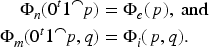
To capture the idea of using and in series, we introduce the compositional product: Let be an effective enumeration of all partial continuous functionals with domain. We define as the problem that takes as input an element of the set
and produces a pair with and . Historically, the compositional product is defined as a map on a pair of computational problems or Weihrauch degrees (see Brattka et al. [5]) that corresponds to . However, it is convenient to fix a specific representative of such degree (see Westrick [7] for a short proof of the fact that as defined above works). Recalling that the compositional product is associative (Proposition 11.5.6 in Brattka et al. [1]), we denote by the -fold compositional product of with itself (i.e. , , and so on).
All the operators mentioned so far are degree-theoretic. We now introduce a few operators that, despite not being degree-theoretic, still play an important role in the theory.
The jump of is the problem that takes as input a convergent sequence in and is defined as
Observe that, letting be the computational problem that computes the limit in the Baire space, . The converse reduction does not hold in general (take, e.g. a function that only has computable outputs).
As anticipated, this jump operation fails to be a jump in the abstract sense: A simple counterexample is the constant function that maps every to the constant string. Indeed, given that the input plays no role, it is apparent that . This shows that the operator is not strictly increasing. At the same, letting be the identity on the Baire space, we have
where is straightforward from the definition (see also Example 5.3(5) in Brattka et al. [5]).
One may think that the constant function is a somewhat weird exception, but this is not the case. For example, as mentioned, intuitively corresponds to using once, and then applying to the result. For any computational problem strong enough to be closed under compositional product with , the jump is not strictly increasing.
As a side note, we mention that, even though the jump is not weakly monotone on the Weihrauch degrees, it is weakly monotone on the strong Weihrauch degrees. It still fails to be a jump, as it is not strictly increasing on the strong Weihrauch degrees.
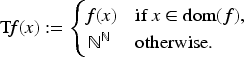
In the definition of the totalizing jump, a central role is played by the total continuation or totalization operator. For every partial multi-valued , its totalization is the total multi-valued function defined as
Again, the totalization is not a degree-theoretic operation: as a simple counterexample, it is enough to consider a total computable function and a partial computable function with no total computable extension.
We conclude this section by listing a few computational problems that will be useful in the rest of the paper. We already introduced the identity problem and the problem that maps a convergent sequence in to its limit. It is well-known that , where is defined as iff . It is convenient to think of as the answer to a single - (or -)question.
Some benchmark examples in the Weihrauch lattice are choice problems. The choice problem can be intuitively described as the problem of finding elements of non-empty subsets of given an enumeration of the complement of the subset. Their formal definition is usually given in the more general context of represented spaces, but for the sake of this paper, we can define them in a (strongly Weihrauch) equivalent way as problems on Baire space as follows:
: Given such that , find such that .
: Given such that , find such that .
: Given (the characteristic function of) an infinite subtree of , find a path through it.
: Given (the characteristic function of) an ill-founded subtree of , find a path through it.
The restrictions of the choice problems to instances with a unique solution are denoted with the symbol . It is known that (Theorem 3.8 in Brattka et al. [5]), (where the second equivalence follows from the fact that is computably compact, see, e.g. Corollary 6.4 in Brattka et al. [8]), and (Corollary 3.7 in Kihara et al. [9]).
The totalizing jump
We fix a computable enumeration of partial computable functionals from to . We now introduce the following new operator on computational problems:
Let be a partial multi-valued function. We define the totalizing jump (or tot-jump for brevity) of as follows: For every and every ,
This definition can be extended to problems on arbitrary represented spaces as follows. Let and be represented spaces and let . The realizer version of is the problem defined as . Observe that whenever and are subsets of (represented via the identity function). We define .
For some proofs, it may be convenient to use the following (strongly Weihrauch equivalent) definition for the tot-jump: For every partial multi-valued function and every , we define
To show that , observe that the only difference between the two problems is that in , the functionals and receive as input their own indices. In particular, to prove that , it suffices to notice that, given , we can uniformly compute so that and . The other reduction is proved analogously.
Intuitively, we can think of the tot-jump of as a problem that “collects all possible Weihrauch reductions to and totalizes.” In particular, the name “totalizing jump” is motivated by the following characterization of the Weihrauch degree of .
For every ,
if , then ;
there is such that and .
In other words, the Weihrauch degree of is the maximum of the Weihrauch degrees of the totalizations of the 's which are Weihrauch equivalent (equivalently, reducible) to .
Fix a problem . Assume that via . It is straightforward to see that is witnessed by the maps and . Indeed, if then and, for every , . In particular, . On the other hand, if then .
To conclude the proof, let us define
with . It is immediate from the definition of that and .
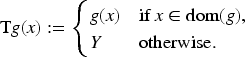
Observe that the previous theorem only deals with problems on the Baire space. In fact, if and are arbitrary represented spaces, the total continuation of a problem is defined as
In particular, choosing so that none of its elements has a computable name, we can easily construct a counterexample to the first item of the previous theorem.
While this could be an obstacle to lifting to the Weihrauch degrees, we defined the tot-jump of a problem on an arbitrary represented space as the tot-jump of its realizer version. Choosing a canonical representative for each degree allows us to focus only on problems in the Baire space. The next theorem shows that the tot-jump is a degree-theoretic operator that induces a jump operator on the Weihrauch degrees.
For every , . Moreover, for every , if then .
It is enough to show that the statement holds for problems on the Baire space. The reduction is straightforward (just map to , where are indices for the identity function and the projection on the second component, respectively), so we only need to show that .
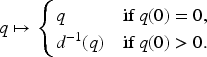
Let be the function defined as and . Observe first of all that (and hence ) is strongly Weihrauch equivalent to the multi-valued function that, on input , is defined as
Indeed, the reduction follows from the fact that, for every and every , . The converse reduction is witnessed by the maps and
It is therefore enough to show that . Assume toward a contradiction that is witnessed by the functionals and . Fix and let . Since is total, . Moreover, by definition of Weihrauch reduction, and for every , .
We have now reached a contradiction, as for every non-empty , (consider such that is minimal). In particular, taking , there is such that
contradicting the definition of Weihrauch reducibility (Without sufficiently strong choice axioms, we cannot prove the existence of witnessing the contradiction.).
To prove the last part of the statement, assume that via the functionals . Let be an input for . We can uniformly compute so that and . The reduction is witnessed by the functionals and .
Indeed, if and, for every , , then . In this case, by the definition of Weihrauch reducibility, and for every , . In particular, . In other words, . The other case (i.e. if or if there is such that ) is trivial as .
Notice that the same proof shows that induces a jump operator on the strong Weihrauch degrees. Indeed, the reductions and (when ) are both strong Weihrauch reductions. Moreover, as noticed, , hence .
Observe that the definition of is in the language of third-order arithmetic, that is, there is a -formula with parameter that says “.” Indeed,
is equivalent to , which is ;
is ;
hence the formula can be written as
No jump operator on partial multi-valued functions can be defined by a formula. To show this, we use the fact that (essentially proved in Theorem 3.11 of Kihara et al. [9]), where is the problem of finding elements in non-empty analytic subsets of . Assume that is an operator defined by a -formula. In particular, is a -formula , where may appear. Since “” is arithmetic in (in fact, is relative to ), any arithmetic formula involving it is arithmetic as well. This implies that is actually uniformly in and hence we can use to pick a point in . In other words, , so is not strictly increasing.
It is straightforward to see that the map is injective. More interestingly, it is injective on the Weihrauch degrees.
For every , if then . This implies that the map is an injective endomorphism on the Weihrauch degrees.
Let be two partial multi-valued functions and assume that via the functionals and . Consider a pair such that is an index for and is defined as follows: Let be the first number found such that . Then
To show that , let and consider the input for . Let be an input for . Observe that and for every , . Indeed, if not, then any is a valid solution for . In particular, we could take so that . This would lead to a contradiction as, by definition of , for every we have . In other words,
Hence, a solution for , and in turn for , can be uniformly obtained from any element of .
As we will discuss extensively later, is not surjective, even on the cone above . The previous theorem implies that there is a proper substructure of the Weihrauch degrees that is isomorphic to the Weihrauch degrees. Note that, using this endomorphism, we obtain two (and, by iterating, infinitely many) new embeddings of the Medvedev degrees into the Weihrauch degrees (see Hinman [10] for a survey on Medvedev reducibility, and see Theorem 9.1 in Brattka et al. [1] for the two known embeddings of the Medvedev degrees into the Weihrauch degrees).
Observe that, as a corollary of Theorem 3.3, we obtain that is never a cylinder. Indeed, we can prove something slightly stronger:
For every such that , is not a cylinder.
It is well-known that is a cylinder iff (see Corollary 3.6 in Brattka and Gherardi [11]). Assume toward a contradiction that is witnessed by the functionals . Notice that, for some computable and some , for some . Indeed, if this were not the case, then we would obtain , contradicting the hypothesis.
Since , for every we obtain for some . If we consider with and , we reach a contradiction, as .
Since, as proved in Theorem 3.3, for every there is such that , the previous proposition implies that is not a cylinder.
In the rest of the section, we prove several properties of the tot-jump, including various results that better describe the range of . We first provide an alternative characterization of . For this, we introduce the following computational problem:
Let us define as
In other words, lists the addresses of infinitely many zeroes of .
Notice that is uniformly computable (it can be solved by unbounded search) and partial, as . An important property of is that, for any given and any , it is c.e. to check if . This also motivates the choice of the notation, as is “translating a -question into a -question.” (It is probably more correct to say that translates a -question into a -question. We discuss this computational problem in Section 4.)
For every , .
Since is uniformly computable, , so, in light of Theorem 3.3, we only need to show that . For every input for , let be such that has infinitely many zeroes iff . Let also be such that for every and be such that has infinitely many zeroes iff . It is clear that are uniformly computable from . The forward functional of the reduction is the map . We define the backward functional as follows: A solution for is a string of the form . Given and , we compute and do the following operations in parallel:
check whether ;
check whether ;
compute .
Since it is c.e. to check if or , as long as and “appear to be correct,” the backward functional produces . If we see that or , we extend the partial output with .
Recall that, if and, for every , , then . It is straightforward to check that, in this case, , for every , and for every , has infinitely many zeroes (as ). In particular, every solution of is such that , , and . By definition, the backward functional will therefore compute .
On the other hand, if or if there is such that , then . Since and are total, the claim follows.
The following proposition shows that, in general, the compositions with on both sides are necessary.
There is such that and .
Let be such that . Let be the function with that maps to .
We first show that . Assume toward a contradiction that the reduction is witnessed by the maps . Let be an index for the projection on the second coordinate. Let also be such that searches for such that for some and then outputs . Since and is not computable, there is such that and . In particular, for every , , and therefore . On the other hand, it is immediate to check that . We have reached a contradiction, as would imply that , against the hypothesis on .
Let us now show that . To this end, assume toward a contradiction that the reduction is witnessed by the functionals and . The idea is to diagonalize by choosing an input for so that the output of is different from any output of . Let be an index for the identity functional and let .
To find , we use the recursion theorem. First, we define : In parallel, we compute for all possible until we find a pair such that
for some and then set . At least one such pair exists, otherwise, is never defined when the first input is , contradicting the definition of Weihrauch reducibility.
Since we are interested in defining the behavior of only when and , we describe a procedure for computing which on different inputs may not converge, or converge to an arbitrary string. Start from and use to check if there is a that satisfies all the following properties:
,
,
.
Intuitively, we are searching for an initial segment of a solution of . A solution for is of the form , where and . Since is constant , to obtain a prefix of a solution, we only need to search for a prefix of . To diagonalize, we require that is sufficiently long so that . Such a need not exist, as we do not know if has infinitely many zeroes. This is the reason why we use the oracle to check if such a search terminates.
If exists, then we can search for it and define . Otherwise, define .
For every and every and , define .
Notice that . If the input for has finitely many s or, for some , , then is the initial segment of a solution for , hence . Otherwise, is the prefix of a solution for , and therefore .
The previous result shows that, in general, the use of cannot be avoided on either side of . There are, however, many s such that . We now provide a sufficient condition for this to happen.
Fix a problem . If there are two total computable functions such that
for every , and are indices of total functionals and
whenever via (which might be partial), then via and ,
then .
By Theorem 3.3, we only need to show that . We let the forward functional of the reduction be defined by . Similarly, we let the backward functional be defined by . The proof is then straightforward: Notice indeed that if is an input for such that and for every , , then the functionals are witnessing the reduction for some problem (e.g. we can take to be the problem that maps to the set ). In particular, the second item in the hypotheses implies that and, for every , .
On the other hand, if or if there is such that , then , hence the claim follows by the totality of (guaranteed by the first item in the hypotheses).
Intuitively, the hypotheses of the previous result require that any reduction witnessed by is, in fact, witnessed by total functionals, and the indices for such functionals can be found uniformly in . Theorem 3.12 can be rephrased as follows:
Fix a partial multi-valued function . Assume there are total computable functionals and such that for every and every , if and for every , , then we have and .
Then .
This rewording, on top of showing a closer connection with the definition of the tot-jump, allows us to draw a connection with the notion of transparent functions, introduced in Brattka et al. [5] More precisely, a function is called transparent if for every computable there is a computable such that .
This notion can be naturally generalized to computational problems by requiring that given two (indices for) functionals witnessing , we can uniformly compute the index of a function such that the reduction is witnessed by the functionals and .
We can strengthen this “generalized transparency” by requiring that is a total functional. This strengthening implies that . Indeed, these conditions are equivalent to requiring that there is a total computable such that, for every and every , if and for every , , then
While many problems (including and its iterations) satisfy the above conditions, the assumption that the backward functional is exactly the projection on the second component is unnecessarily strong. In fact, any total computable function would serve the same purpose. Thus, we have the hypotheses of Corollary 3.13.
In Section 4, we will use Corollary 3.13 to describe the tot-jump of some natural problems.
There are such that for every and every , is Weihrauch equivalent to its restriction to .
We let be the indices of two universal functionals such that and where is least such that . It is obvious that any restriction of is Weihrauch reducible to . To prove that , we let the forward functional be the map , where are such that, for every ,
Clearly, such can be uniformly computed from . The backward functional is the projection on the second coordinate. Note that , and similarly . Thus, , which concludes the proof.
For every , is total and join-irreducible.
The fact that is total is apparent by definition. We show that if then there is such that , and thus . Assume that the reduction is witnessed by the functionals and and let and be as in Lemma 3.14. By the continuity of the forward functional, there exist and such that . In particular, for every , the functional produces an input for . Since, by Lemma 3.14, is equivalent to its restriction to , the claim follows.
We will show in Corollary 4.9 that the range of is a proper subset of the total, join-irreducible degrees.
For every , . Moreover, the reduction is strict iff .
The fact that follows by the monotonicity of and the fact that is the join in the Weihrauch degrees. Clearly, if then , hence . Conversely, if then by Theorem 3.7, and hence (by Theorem 3.15), which implies that .
For every , there is such that .
We distinguish three cases: If , then the claim immediately follows from the fact that the Weihrauch degrees are dense above (see Lempp et al. [12]).
If , then . Moreover, (as is total), hence . The fact that the reduction is strict follows from the fact that is join-irreducible (Theorem 3.15).
If , then we have by (Theorem 4.1 below) and the injectivity of the tot-jump proved in Theorem 3.7. Finally, if then by Theorem 4.1, and the existence of with is well known.
The range of is not dense, that is, there exist and such that , the set is non-empty and, for every , .
The claim follows immediately from the fact that the Weihrauch degrees are dense above and that there are (strong) minimal covers in the Weihrauch lattice (see Lempp et al. [12]). Indeed, it is enough to choose and such that is a minimal cover of . Since the tot-jump is always total, is contained in the cone above and there exists such that . By Theorem 3.7, if then , contradicting the fact that is a minimal cover of .
For every , . There exist and such that .
The first part of the statement is straightforward using the fact that is monotone and that is the meet in the Weihrauch lattice.
To prove the second part of the statement, let be two incomparable Turing degrees (i.e. for some Turing-incomparable , and are, respectively, the equivalence classes of and under ), and let and . Assume toward a contradiction that the reduction is witnessed by the functionals and . We claim that one of or is uniformly computable. This contradicts Theorem 4.1 below, which implies that is the only uniformly computable tot-jump.
Let be as in Lemma 3.14. Observe that, for every and every ,
Indeed, if we let be the input for given by the value , then as, by hypothesis, and are Turing-incomparable (in particular, does not compute any ). Analogously, by swapping the roles of and in the above argument, for every and , .
By continuity, there is such that commits to some . Without loss of generality, we can assume that , that is, the backward functional commits to producing a solution for . We therefore obtain that
that is, we can uniformly compute a solution for which, in turn, implies that is uniformly computable.
The previous proof can be generalized by letting be two incomparable Muchnik degrees (see Hinman [10] for the definition of Muchnik reducibility).
We conclude this section by providing some (relatively) weak sufficient conditions for not being in the range of .
We call a partial multi-valued function co-total if, for every problem , where and are represented spaces,
A problem is called Baire co-total if () holds for all problems .
The notion of co-totality was introduced in Definition 4.13 of Brattka and Gherardi. [13] Clearly, Baire co-totality is a weaker property, as ranges over a smaller family of problems. Intuitively, a problem is co-total when the totalization operator “cannot help” to solve it. To show that Baire co-totality is strictly weaker than co-totality, consider the following simple counterexample: let be the set of non-computable points, and define . Let also and be two represented spaces, where has a computable name while and only have non-computable names. Define as . Now observe that is not co-total, as , but . On the other hand, is Baire co-total: indeed, for every , if via , then the two functionals already witness . This is because if then , but .
We now observe that is Baire co-total exactly when the tot-jump does not give any useful information to solve .
For every , is Baire co-total iff for every ,
In particular, if is (Baire) co-total, then .
The proof is straightforward using Theorem 3.3. Indeed, assume that is Baire co-total and let be such that . Without loss of generality, we can assume that is a problem on the Baire space: if not, we can replace with its realizer version as, by definition, . Since for some problem on the Baire space with , we obtain and hence .
The converse implication is similar: Assume that for every , implies , and let be such that . Since , we immediately obtain .
Finally, if is Baire co-total and for some , then , against .
In Brattka and Gherardi [13], several problems are proved to be co-total including and , hence, we immediately have the following result:
The problems and are not in .
The next theorem leads to a sufficient condition for a function to be Baire co-total. Let be a fixed universal Turing functional. Let be the problem defined as
It is immediate from the definition that is total. In fact, for every , is either (if ) or . The problem was studied extensively in Brattka [14] and is one of the weakest discontinuous problems (In Brattka, [14] it was shown that, under , is a strong minimal cover of in the topological version of Weihrauch reducibility. Such a result cannot be transferred to the (plain) Weihrauch degrees, as the cone above is dense in the Weihrauch degrees under [12].). In particular, (see, e.g. Proposition 5.10 in Brattka [15]).
(with Arno Pauly)
If , then .
Let and witness the reduction . Let be the universal computable functional used in the definition of . By the recursion theorem, there is a computable such that is the first component of . Consider the reduction where the forward functional is given by and the backward functional maps to the second component of .
We claim that if , then and so it does not fall in the “otherwise” case. This implies that our reduction of to is essentially a Weihrauch reduction of to . To prove the claim, note that if , then . If , then must converge to an element . But must be different from , the first component of .
If , then is Baire co-total and hence it is not in the range of .
As mentioned, is quite weak and hence being closed under parallel product with is a rather weak condition satisfied by many natural problems, such as , , , , and .
is not Baire co-total.
Observe that , where . To show that is not Baire co-total, it is enough to show that . This follows from the fact that : indeed, for every such that , it is enough to consider .
Combining this result with Corollary 3.24, we immediately obtain:
.
is join-irreducible.
Without loss of generality, we can assume that . Let be such that and . Notice that , where (it is enough to map to , where is an index of ).
We show that if , then or . If witness the reduction (in particular, for every input for , produces a pair with ), then by continuity, there is such that . Observe that we can uniformly map any of the form to for some such that . The reduction is therefore witnessed by the maps and .
While being join-irreducible and not being Baire co-total are necessary conditions for a Weihrauch degree to be in the range of , we will show in Corollary 4.8 that they are not sufficient, as is not equivalent to the tot-jump of any problem. In other words, the range of the tot-jump is a proper subset of the set of total, non-Baire co-total, join-irreducible degrees.
The jump of specific problems
In this section, we explicitly characterize the tot-jump of various well-known problems. Let us start with a straightforward example.
.
The proof is trivial as for every , , as there are no such that . Therefore, is total and uniformly computable, and hence equivalent to .
To characterize , we first introduce the following problem.
Let us define as
Intuitively, transforms a -question into a -question. An alternate form of was introduced by Neumann and Pauly [16], who defined
It is immediate that .
.
For the left-to-right reduction, recall that, given , it is c.e. to check whether . In particular, given and , we can uniformly compute defined as if and , and otherwise. It is apparent that .
Similarly, for the right-to-left reduction, given and , we can compute a solution for as follows: Let . For every , if for all we check if . If it is, we define , otherwise we let . If instead for some , we let . It is straightforward to check that is uniformly computable from and and that .
.
For the left-to-right reduction, observe that can be written as follows:
Since the domain of a computable functional is a -set, we can uniformly compute such that
Given , we are able to uniformly compute a solution for as follows: In parallel, run and check whether there is such that . If no such is found then we are producing , which is the correct solution for . Otherwise, it means that , hence we can stop simulating and continue the output with .
For the right-to-left reduction, note that , so Theorem 3.3 and Proposition 4.3 give us .
With a more careful analysis, we can characterize the -th tot-jump of . Intuitively, we can think of as a problem capturing the following: You are allowed to ask many -questions serially. For every , you can see in finite time if the answer to the -th question is “yes,” and then you can ask the next question. However, if the -th answer is “no,” then the procedure hangs, and it is impossible to see the answers to the remaining questions.
For every , let . For every , let be defined as
Then .
By induction on : The base case is Theorem 4.4, as it is straightforward to see that . For the induction step, it suffices to show that .
Let us first prove that . Let be an input for . For every , we can uniformly compute so that and occurs infinitely many times in if and only if
This can be done because the displayed formula is uniformly in . Similarly, we can uniformly compute so that and occurs infinitely many times in if and only if
Let . We now claim that a solution for can be uniformly computed from any as follows: We compute as long as . If for some , we stop the computation and continue the output with .
Let us now show that this procedure correctly produces a solution for .
If , then for every , only has finitely many s. This implies that , hence . The procedure produces an eventually null string, which is clearly a valid solution as .
If and then for every and for almost all , ; moreover, occurs infinitely many times in if and only if, for all , . This, in turn, implies that if and then , while otherwise and the procedure computes an eventually null string.
Finally, assume that and . Let and notice that for every we have . Moreover, has infinitely many if and only if, for all , . If has infinitely many s, then we can just run the computation for any . Otherwise, and the described procedure is guaranteed to produce an infinite string (and therefore a valid solution).
Let us now show . Intuitively, the reduction works as follows: The forward functional maps an input for to , where is an index for the identity functional and is an index for the functional that, given , tries to produce a list of positions witnessing the fact that . More precisely, if is of the form for some and some , then produces a strictly increasing string such that for some strictly increasing sequence and for every ,
This can be done iteratively as follows: At stage , search for such that . At stage , we search for and such that . The sequence is the output of .
If instead is not of the form for any and any , we let .
Given , the backward functional is defined as and if and , and otherwise.
To conclude the proof we show that, for every , correctly produces a solution for . Observe that if , then . In particular, for every ,
for some and some strictly increasing , and hence is a correct solution for . On the other hand, if then, for every , . This implies that is of the form for some , and therefore is a valid solution for .
We now show that the set is a proper subset of .
Let and let is computable. If , then there is no such that .
By Theorem 3.7, if then , that is, for some (as the lower cone of is isomorphic to the dual of the Medvedev degrees, see, e.g. Section 5 in Higuchi and Pauly [17]). Notice that (and therefore ) does not have any computable point, as otherwise .
Assume via . Let be a computable input for and let . Observe that, since has no computable point, , hence . This implies that a reduction would yield a reduction of to the (uniformly computable) map , contradicting .
.
Let us first show that . For the reduction, let be an input for . By Theorem 4.4, we can use to compute such that if and only if . It is then straightforward to see that we can find an answer for by unbounded search (either there is a non-zero element in or a non-zero element in ). To prove that the reduction is strict, recall that (Theorem 4.4). The reduction would contradict (see Proposition 24(5) in Neumann and Pauly [16]).
The second reduction is immediate, and the reduction follows from the fact that .
Given that is parallelizable, to prove that it suffices to show that . To this end, we prove that , and the claim will follow from Theorem 4.4. Given , we can uniformly compute the converging sequence defined as if there is such that such that , and otherwise. Clearly, for each , if and only if there is some in after position . Therefore, .
Finally, the fact that follows from the fact that every computable input for has a computable solution, while this is not the case for .
Given that , combining Theorems 4.6 and 4.7, we obtain:
The problems and are not Weihrauch-equivalent to any problem in the range of .
Since we showed that is total, non-Baire co-total, and join-irreducible, we also obtain the following corollary:
The map does not induce a surjective operator onto the total, non-Baire co-total, join-irreducible degrees.
Next, we show that no lower cone is closed under tot-jump, that is, there are no tot-jump principal ideals in the Weihrauch lattice.
For every , there exists an such that .
If , then has the desired properties, while if we can set for any without computable elements (in this case, and we can use Theorem 3.7). We can now assume that and distinguish two cases.
The first one is when there exists with a finite domain such that . In this case, we claim that . Granting the claim, has the desired property by Theorem 4.7. To prove the claim, assume that and witness . Then, since every point in is isolated, there are and such that for every , . Besides, there is such that for some , . In particular, the string witnesses the fact that and do not witness the Weihrauch reduction.
Assume now that is not Weihrauch equivalent to any problem with a finite domain. We want to define such that and . To this end, we define a scrambling function. The desired will be defined as , with . Notice that, no matter which we choose, .
To define , we define a sequence of functions with finite domain, starting with .
At stage , we satisfy the requirement “ via .” To do so, we choose (in an ineffective way) some such that one of the following conditions holds:
;
produces the pair with or ;
produces the pair and there is such that ;
produces the pair with .
Such an must exist, as otherwise and witness , where with , contradicting the fact that is not Weihrauch equivalent to any problem with finite domain. In the first three cases, there is nothing to do, and we just define . In the last case, we let .
At stage , we satisfy the requirement “ via .” Let be an arbitrary computable extension of and let . Clearly , hence . In particular, there are witnessing via .
If or if there is such that then there is nothing to do and we can define . Otherwise, the fact that witnesses means that there is such that . In particular, this implies that , that is,
,
for all , ,
.
We define . Observe that, if then , so . This is enough to satisfy the current requirement: indeed, let be any extension of and let . In particular, , hence the triple witnesses via .
The desired scrambling function is the map . Since all the requirements are satisfied, the above-defined function satisfies and , which concludes the proof.
In light of Theorem 4.7, a natural question is how compares with (as . By Theorem 3.21, as is co-total, would imply that , which is a contradiction. On the other hand, . In fact, we have a slightly stronger result (as by Proposition 24 in Neumann and Pauly [16]).
.
We use the fact that (Theorem 4.4). As mentioned above, . But Proposition 24(5) in Neumann and Pauly [16] proved that .
The following result is folklore.
is a fractal, that is, for every , is Weihrauch equivalent to its restriction to .
Fix . To prove that , let . We can uniformly map to
Clearly, and for every , .
There is no such that .
Observe first of all that . Indeed, the reduction follows by Theorem 3.3, while the fact that the reduction is strict follows from the fact that (Proposition 4.11), whereas (by the monotonicity of the tot-jump).
This also implies that if then . To conclude the proof, it is enough to show that if then .
Assume now that the reduction is witnessed by the functionals . Consider the input for . By continuity, there are and such that, for some , . Let be an input for such that . Let also , which is an input of . By definition of Weihrauch reduction, and, for every , (as otherwise would be the initial segment of a solution for , hence would not produce a valid answer for ). This implies that
where are uniformly computable from . Since is a fractal (by the same proof as Lemma 4.12 or see Fact 3.2(1) in Brattka et al. [5]), is Weihrauch equivalent to its restriction to .
In other words, the reduction yields a reduction , which concludes the proof.
Notice that the above argument does not necessarily yield a reduction , as is still allowed to go in the “otherwise” case when every is in .
Notice that is another witness for Corollary 4.9. Indeed, it is total (trivially), a fractal (by Lemma 4.12), and not in the range of (by Theorem 4.13). Every fractal is join-irreducible (see Proposition 4.11 in Brattka et al. [1]), so all that is left is to show that is not Baire co-total. If it were, then would imply that , but we have already noted that .
.
In light of Theorem 3.3 and of the uniform computability of , it suffices to show that . Given the input for , let be such that has infinitely many zeroes iff
In other words, has infinitely many zeroes iff whenever is not enumerated by . Moreover, let be such that works by simulating and padding the output with zeroes (this ensures that is total and whenever ).
The forward functional of the reduction is then given by the map .
Given , we uniformly compute a solution for as follows: We run until we either see that or we see that (both conditions are c.e.). If this never happens, we know that is a valid solution for and . Otherwise, it means that , hence, we can just continue the output with .
Unlike , the fact that is computably compact implies that (see, e.g. Proposition 6.1 in Brattka and Gherardi [13]). However, a characterization similar to the one for the tot-jump of holds for .
.
As above, it suffices to show that . Let be an input for . Let be a tree such that
Observe that a tree as above can be uniformly computed from (as the formula defining is with parameters ) and that, if is the characteristic function of a subtree of , then . Moreover, is well-defined, even if does not converge or it is not the characteristic function of a tree. To compute an input for , we first observe that the set
is defined by a -formula with parameters . Intuitively, the first two rows of the definition capture “ is not the characteristic function of a subtree of ,” while the last two rows can be read as “ and .” The third row could have been written as “.” This is (in general) a statement, but it can be equivalently rewritten in a -way in light of the first row.
Since the projection of a -set over a computably compact set is (see, e.g. Lemma 3.9 in Marcone and Valenti [18]) and that checking if a subtree of is ill-founded is a -problem, this implies that the statement
is . Therefore, we can uniformly compute a string such that has infinitely many zeroes iff the above formula holds.
The forward functional of the reduction is the map that sends to . The backward functional is the map that works as follows: given and a solution for , outputs as long as appears to belong to . As soon as an error is found, extends the partial output with .
It is immediate from the definition of that an error is found only if does not define an ill-founded subtree of or if there is such that . In this case, , hence the computed string is a valid solution. On the other hand, if an error is never found, then and , which concludes the proof.
We conclude this section by showing that, as a consequence of Corollary 3.13, the tot-jump of each of the problems , , , and is the respective total continuation.
For every , .
Let us first prove the theorem for . Let be the family of all problems such that there is a total computable such that, for every and every , if and , then
By Corollary 3.13 (with the projection on the second coordinate), for every , , so it is enough to show that . Let be the map that, upon input , computes the sequence defined as follows: We read the output of as (an initial segment of) the join of countably many strings . Formally, if is the string produced by in steps, we define and, for every , define for all with . With this definition, for every , . We can uniformly compute the string defined as for the largest such that , and if no such exists. Observe that, if converges, then so does and . We define
where denotes the output produced by in steps. Clearly, the map is total and computable.
Assume that produces the sequence and that , where . By the continuity of , we immediately obtain
which shows that .
The general case follows by induction on , as the class is closed under composition and (by Example 4.4(1) in Brattka et al. [5] and the fact that is a cylinder). To prove that is closed under composition, we can use first and later, to conclude that .
More precisely, let and let and be the total computable witnesses. Fix and such that (i.e. and ) and . Let be such that and . Observe that
By the choice of , for every (which implies that and ),
In other words, letting be such that , we obtain
To conclude the proof, note that by the choice of , we have
In particular, the map witnesses the fact that .
and .
We only show that , as (with minor modifications) the same proof works for .
As in the previous proof, we show that satisfies the assumptions of Corollary 3.13, namely, there are two total computable functionals and such that, for every and every , if and , then and . Let be the map that sends to (the characteristic function of) a tree such that
As the set above is uniformly in , a tree as above can be uniformly computed from . Let .
To conclude the proof, notice that if and for every , then is ill-founded and, for every , .
Remarks on abstract jump operators
In this paper, we introduce and study a natural jump operator on the Weihrauch lattice, a natural partial order. The remarks in this section address a much more abstract question: under what conditions do arbitrary partial orders admit a jump operator in the sense of Definition 1.1? We show that, without additional structure, admitting a jump is not a first-order property.
We mentioned in the introduction that the existence of an abstract jump operator is easy to see in any upper semilattice without a maximum (using the Axiom of Choice). This result can be extended to countable upper directed partial orders (i.e. partial orders such that any finite number of elements have a common upper bound) without a maximum. Indeed, any such partial order admits a strictly increasing cofinal chain . This can be easily shown by letting be an enumeration of and defining and , where is least such that . The existence of a jump operator follows from the fact that every partial order with a strictly increasing cofinal chain admits a jump operator (it is enough to map every element of the poset to the first element in the sequence that is strictly above it).
We mention that the same strategy cannot be used to obtain the existence of a jump operator on the Weihrauch degrees. Indeed, the third and fifth authors will show in an upcoming paper that no chain in the Weihrauch degrees can be cofinal.
There is an upper-directed partial order with no maximum and size that does not admit a jump operator, which implies that the above observation cannot be generalized to larger partial orders. To show this, let be ordered as an antichain (each element is only comparable with itself). Let also be the partial order of all non-empty finite subsets of ordered by inclusion. Let be the union of and , where is defined as the transitive closure of
Assume toward a contradiction that admits a jump operator . Observe now that, for a fixed , is a non-empty finite set of ordinals such that at least one is . Let be such that . In particular, for every , we have and hence , that is, .
Define an increasing sequence of countable ordinals as follows: and, for every , . For every , let be such that . In particular, we obtain
which implies that all the are distinct.
By the above observation, for every and every , , hence is infinite, which is a contradiction with .
Finally, we consider the case of arbitrary countable partial orders (without a maximum). We show that the existence of a jump operator is as complicated as its naive definition suggests: it is -complete.
There is a computable map from the family of countable linear orders to the family of countable partial orders without maximum (where we represent a linear/partial order using its characteristic function) such that
To show this, let be the partial order defined as and iff and . Intuitively, consists of two incomparable copies of . We define , where is with the order reversed. We order as expected: in particular, every element of a given term is less than every element of the later terms. For the sake of readability, we write for the -th copy of in . Let also be the minimum of .
Assume that is ill-founded and let be an infinite descending sequence (i.e. an infinite ascending sequence in ). We can define a jump function on as follows:
;
for every such that , let ;
for every such that , let ;
for every such that for every , let .
It is immediate from the definition that is strictly increasing. Proving that is weakly monotone is also easy.
Conversely, if admits a jump operator , then we can define an ascending sequence in (i.e. a descending sequence in witnessing the fact that is ill-founded) as follows: We let be such that for some . To define , observe that, by the weak monotonicity of , we have . This, in combination with , implies that for some with . We can iterate this argument to obtain the desired strictly increasing sequence in .
This shows that the set of partial orders without maximum admitting a jump operator is a non-Borel -subset of the set of countable partial orders. In particular, the existence of a jump operator for countable partial orders without maximum cannot be characterized by an arithmetic formula. It would be interesting to obtain a similar result for non-countable partial orders. This would require a detour into the realm of generalized descriptive set theory, and it is possible that additional set-theoretic axioms (e.g. on the size of the continuum) would be needed.
Open questions
We mentioned in Section 3 that the tot-jump of can be defined via a -formula using as a parameter. Moreover, we showed that no jump operator on computational problems can be defined using a -formula (Remark 3.6). This leaves a gap, and therefore it is natural to ask the following question:
Is there a -definition for the tot-jump? More generally, is it possible to define a jump operator on the Weihrauch degrees using a -formula?
Despite our efforts, we could not obtain a satisfactory characterization for . A better characterization is especially desirable in light of Theorem 3.7, as that would give us a description of a sublattice of the Weihrauch degrees which is isomorphic to the full structure.
Find a “natural” characterization for . Is definable in the Weihrauch degrees?
While the “natural” condition is, of course, vague and informal, a satisfactory answer would allow us to promptly tell whether a given is in the range of the tot-jump. To this end, a powerful result is provided by Theorem 3.23, and especially by Corollary 3.24. As proved, closure under product with is a sufficient condition for Baire co-totality, and we showed that a Baire co-total problem can be Weihrauch-reducible to only in the trivial case . This raises the following question:
Does closure under product with characterize Baire co-totality?
We also showed that the range of is a (proper) subset of the join-irreducible degrees (Theorem 3.15 and Corollary 4.9). This allowed us to show that the tot-jump of and distributes over the join of and only when and are comparable. On the other hand, we do not know whether the same holds for the meet: While Proposition 3.19 shows that, in general, the jump does not distribute over the meet, we do not know whether this is always the case when and are not comparable.
Are there and such that but ?
Footnotes
Acknowledgements
The authors wish to thank Damir Dzhafarov, Jun Le Goh, Takayuki Kihara, Arno Pauly, and Dilip Raghavan for useful conversations on the topics of the paper. They also thank the anonymous reviewer for their careful reading of the paper.
ORCID iDs
Uri Andrews
Steffen Lempp
Alberto Marcone
Joseph S Miller
Manlio Valenti
Funding
The authors disclosed receipt of the following financial support for the research, authorship, and/or publication of this article: Steffen Lempp’s research was partially supported by AMS–Simons Foundation Collaboration Grant 626304. Alberto Marcone was partially supported by the Italian PRIN 2017 “Mathematical logic: models, sets, computability,”prot. 2017NWTM8R and by the Italian PRIN 2022 “Models, sets and classifications,” prot. 2022TECZJA, funded by the European Union—Next Generation EU. Joseph S Miller was partially supported by NSF Grant No. DMS-2053848.
Declaration of Conflicting Interests
The authors declared no potential conflicts of interest with respect to the research, authorship, and/or publication of this article.
References
1.
BrattkaVGherardiGPaulyA. Weihrauch complexity in computable analysis. In: Brattka V and Hertling P (eds) Handbook of computability and complexity in analysis. Cham: Springer International Publishing, 2021, pp.367–417.
2.
HinmanPGSlamanTA. Jump embeddings in the Turing degrees. J Symb Log1991; 56: 563–591.
3.
LermanM. A framework for priority arguments (Lecture notes in logic, vol. 34). La Jolla, CA: Association for Symbolic Logic; Cambridge: Cambridge University Press, 2010.
4.
MontalbánA. Embedding jump upper semilattices into the Turing degrees. J Symb Log2003; 68: 989–1014.
5.
BrattkaVGherardiGMarconeA. The Bolzano–Weierstrass theorem is the jump of weak König’s lemma. Ann Pure Appl Log2012; 163: 623–655.
6.
BrattkaVPaulyA. On the algebraic structure of Weihrauch degrees. Log Methods Comput Sci2018; 14: 1–36.
7.
WestrickLB. A note on the diamond operator. Computability2021; 10: 107–110.
8.
BrattkaVde BrechtMPaulyA. Closed choice and a uniform low basis theorem. Ann Pure Appl Log2012; 163: 986–1008.
9.
KiharaTMarconeAPaulyA. Searching for an analogue of in the Weihrauch lattice. J Symbol Log2020; 85: 1006–1043.
10.
HinmanPG. A survey of Mučnik and Medvedev degrees. Bull Symb Log2012; 18: 161–229.