



Abstract
Computability theory is a discipline in the intersection of computer science and mathematical logic where the fundamental question is:
Given two mathematical objects X and Y, does X compute Y in principle?
In case
Introduction
Motivation and overview
Computability theory is a discipline in the intersection of theoretical computer science and mathematical logic where the fundamental question is as follows:
Given two mathematical objects X and Y, does X compute Y in principle?
In case
In turn, Dag Normann and the author [4] have recently introduced a version of the lambda calculus involving fixed point operators that exactly captures S1–S9 and accommodates partial objects. In this paper, we use this new model to develop the computability theory of various theorems due to Baire and Volterra and related results. We show that these theorems are computationally equivalent from the point of view of our new model, as laid down by Definition 1.1. We stress that these theorems due to Baire and Volterra only require basic mathematical notions, such as continuity, open sets, and density. All non-basic definitions and some background may be found in Sections 1.2 and 1.3.
In more detail, consider the following three theorems proposed by Baire [5] and Volterra [6] from the 19th century. The notion of Baire 1 function is also by Baire [5] and means that the function is the limit of a sequence of continuous functions.
(Baire category theorem) Let (Volterra) There is no function that is continuous on the rationals and discontinuous on the irrationals. (Baire) For
The first item is well-studied in other computational approaches to mathematics such as computable analysis [7,8] or constructive mathematics Bishop [9, p.84] and Nemoto [10]). The second item is a mainstay of popular mathematics [11,12], and usually proved via the first item [13]. More detailed background may be found in Section 1.2.
The above theorems yield the following natural computational operations. A functional operating item (a) is called a Baire realiser [14].
On input a sequence of dense and open sets of reals On input a Baire 1 function from reals to reals, output a rational where it is discontinuous, or an irrational where it is continuous. On input a Baire 1 function from reals to reals, output a point of continuity.
We show in Section 2 that the operations in items (a)–(c), as well as a number of related ones, are computationally equivalent as defined in Definition 1.1. We emphasise that each of the items (a)–(c) should be viewed as a specification for a class of (possibly partial) functionals that produce certain outputs given certain inputs. The computational equivalence between two specifications
Let for any functional for any functional
Computational equivalence relative to
In most cases below, we can replace Kleene’s S1–S9 or our model from Normann and Sanders [4] by rather tame fragments of Gödel’s
Finally, to study continuous functions in computability theory (or constructive mathematics), such functions are usually given together with a modulus of continuity, that is, a constructive enrichment providing computational information about continuity (Intuitively speaking, a modulus of continuity is a functional that witnesses the usual ‘epsilon-delta’ definition of continuity. In this way, a modulus of continuity essentially outputs a suitable ‘delta’ on input any
Volterra’s early work and related results
We introduce Volterra’s [6] early work as it pertains to this paper. We let
First of all, Riemann’s [17] integral was groundbreaking in its day for a number of reasons, including its ability to integrate functions with infinitely many points of discontinuity. A natural question is then ‘how discontinuous’ a Riemann integrable function can be. In this context, Thomae [18, p.14, Section 20] introduced the following function
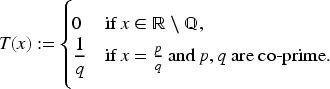
The perceptive student, upon seeing Thomae’s function as in (), will ask for a function continuous at each rational point and discontinuous at each irrational one. Such a function cannot exist, as is generally proved using the Baire category theorem. However, Volterra [6] already established this negative result about 20 years before the publication of the Baire category theorem, using a rather elementary argument.
Secondly, as to the content of Volterra’s [6], we find the following theorem on the first page, where a function is pointwise discontinuous if it has a dense set of continuity points.
There do not exist pointwise discontinuous functions defined on an interval for which the continuity points of one are the discontinuity points of the other, and vice versa.
Volterra then states two corollaries, of which the following is perhaps well-known in ‘popular mathematics’ and constitutes the aforementioned negative result.
Volterra [6]
There is no
Thirdly, we shall study Volterra’s theorem and corollary restricted to Baire 1 functions (see Section 1.3.3). The latter types of functions are automatically ‘pointwise discontinuous’ in the sense of Volterra.
Fourth, Volterra’s [6] results are generalised in Silva and Wu [19] and Gauld [20]. The following theorem is immediate from these generalisations.
For any countable dense set
Perhaps surprisingly, this generalisation is computationally equivalent to the original (both restricted to Baire 1 functions).
Fifth, the Baire category theorem for the real line was first proved by Osgood [21] and later by Baire [5] in a more general setting.
If
Based on this theorem, Dag Normann and the author [14] have introduced the following.
We shall obtain a number of computational equivalences (Definition 1.1) for Baire realisers in Section 2. To this end, we will need some preliminaries and definitions, as in Section 1.3.
Finally, in light of our definition of open set in Definition 1.8, our study of the Baire category theorem (and the same in Normann and Sanders [14]) is based on a most general definition of open set, that is, no additional (computational) information is given. Besides the intrinsic interest of such an investigation, there is a deeper reason, as discussed in Section 3.1. In a nutshell, in the study of Baire 1 functions, one readily encounters open sets ‘in the wild’ that do not come with any additional (computational) information. In fact, finding such additional (computational) information turns out to be at least as hard as finding a Baire realiser.
We briefly introduce Kleene’s higher-order computability theory in Section 1.3.1. We introduce some essential axioms (Section 1.3.2) and definitions (Section 1.3.3). A full introduction may be found in, for example, Section 2 in Normann and Sanders [22] or Longley and Normann [3]. Since Kleene’s computability theory borrows heavily from type theory, we shall often use common notations from the latter; for instance, the natural numbers are type
Kleene’s computability theory
Our main results are in computability theory and we make our notion of ‘computability’ precise as follows:
We adopt We adopt Kleene’s notion of higher-order computation as given by his nine clauses S1–S9 (see Chapter 5 in Longley and Normann [3] or Kleene [2]) as our official notion of ‘computable’ involving total objects.
We mention that S1–S8 are rather basic and merely introduce a kind of higher-order primitive recursion with higher-order parameters. The real power comes from S9, which essentially hard codes the recursion theorem for S1–S9 computability in an ad hoc way. By contrast, the recursion theorem for Turing machines is derived from first principles in Soare [23].
On a historical note, it is part of the folklore of computability theory that many have tried (and failed) to formulate models of computation for objects of all finite types and in which one derives the recursion theorem in a natural way. For this reason, Kleene ultimately introduced S1–S9, which were initially criticised for their aforementioned ad hoc nature, but eventually received general acceptance.
Now, Dag Normann and the author [4] have introduced a new computational model based on the lambda calculus with the following properties:
S1–S8 are included while the ‘ad hoc’ scheme S9 is replaced by more natural (least) fixed point operators, the new model exactly captures S1–S9 computability for total objects, the new model accommodates ‘computing with partial objects’, the new model is more modular than S1–S9 in that sub-models are readily obtained by leaving out certain fixed point operators.
We refer to Longley and Normann [3] and Normann and Sanders [4] for a thorough overview of higher-order computability theory. We do mention the distinction between ‘normal’ and ‘non-normal’ functionals based on the following definition from Section 5.4 of Longley and Normann [3] . We only make use of
It is a historical fact that higher-order computability theory, based on Kleene’s S1–S9 schemes, has focused primarily on the world of normal functionals; this opinion can be found in Section 5.4 of Longley and Normann [3]. Nonetheless, we have previously studied the computational properties of new non-normal functionals, namely those that compute the objects claimed to exist by:
covering theorems proposed by Heine-Borel, Vitali, and Lindelöf [24–26], the Baire category theorem [14], local–global principles such as Pincherle’s theorem [27], weak fragments of the axiom of (countable) choice [28], the uncountability of the Jordan decomposition theorem and related results [4,30].
In this paper, we greatly extend the study of the Baire category theorem mentioned in the second item; the operations sketched in Section 1.1 are all non-normal, in that they do not compute Kleene’s
Finally, we have obtained many computational equivalences in Normann and Sanders [4] and Sanders [31], mostly related to the Jordan decomposition theorem and the uncountability of
In Turing-style computability theory, computational hardness is measured in terms of where the oracle set fits in the well-known comprehension hierarchy. For this reason, we introduce some axioms and functionals related to higher-order comprehension in this section. We are mostly dealing with conventional comprehension here, that is, only parameters over
First of all, the functional



Secondly, the functional

Thirdly, the functional

In conclusion, the operations sketched in Section 1.1 are computable in
We introduce some definitions needed, mostly stemming from mainstream mathematics. We note that subsets of
Zeroth of all, we make use of the usual definition of a (open) set, where
Set
Subsets A subset A subset
The reader will find more motivation for our definition of open set in Section 3.1.
First of all, we study the following continuity notions, in part by Baire [5].
Weak continuity
For
In case the weak continuity notion is satisfied at each point of the domain, the associated function satisfies the italicised notion.
Secondly, Baire [5] introduces the hierarchy of Baire classes. We shall only need the first Baire class, defined as follows.
(Baire 1 function)
Thirdly, the following sets are often crucial in proofs relating to discontinuous functions, as can be observed in, for example, Theorem 0.36 in Appell et al. [36]
One problem with the sets
Fourth, we introduce two notions to be found already in, for example, the work of Volterra [6], Smith [37], and Hankel [15] .
A set A function A set
Fifth, we need the ‘intermediate value property’, also called ‘Darboux property’.
Let A real A point
By definition, a point of continuity is also a Darboux point, but not vice versa.
Baire category theorem and computational equivalences
In this section, we obtain the computational equivalences sketched in Section 1.1 involving the Baire category theorem and basic properties of Baire 1 and pointwise discontinuous functions (see Section 1.3.3 for the latter). We will always assume
Preliminaries
As discussed in Section 1.1, we shall study Baire 1 functions that are given together with their oscillation function (see Definition 2.1 for the latter). We briefly discuss and motivate this construct in this section.
First of all, the study of regulated functions in Normann and Sanders [4,29,30] is really only possible thanks to the associated left and right limits (see Definition 1.9) and the fact that the latter are computable in

Riemann [16] and Hankel [15] already considered the notion of oscillation in the context of Riemann integration. Our main interest in Definition 2.1 is that () is now equivalent to the arithmetical formula
Secondly, we sketch the connection between Baire 1 functions and the Baire category theorem, in both directions. In one direction, fix a Baire 1 function

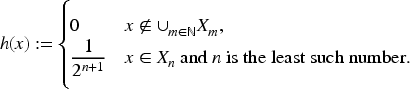
Thirdly, we list basic facts about Baire 1 and pointwise discontinuous functions.
Upper semi-continuous functions are Baire 1; the latter are pointwise discontinuous. Any For any Characteristic functions of subsets of the Cantor set (and variations) are pointwise discontinuous, but need not be Borel or Riemann integrable. The class of bounded Baire 1 functions
Proofs may be found in, for example, Section 7 of Oxtoby [40, pp 31–33], Baire [5], Myerson [38], and Kechris and Louveau [39].
We will tacitly use Theorem 2.2. We will need one additional property of
Let
Consider In case In case In case In case
In conclusion, we have
As it happens, functions that are their own oscillation functions have been studied in the mainstream literature (see, e.g. Kostyrko [41]). The previous theorem is still surprising: computing the oscillation function of arbitrary functions readily yields
In this section, we establish the computational equivalences sketched in Section 1.1. The function
In particular, we have the following theorem where we note that Volterra’s [6] original results (see Section 1.2) are formulated for pointwise discontinuous functions. Regarding Definition 1.1, we sometimes abuse notation by identifying a specification and the class of functionals satisfying this specification.
Assuming (Class of Baire realisers: Definition 1.6) On input a sequence On input (Volterra) On input (Volterra) On input (Baire, [5, p.66]) On input a sequence On input The previous items with ‘Baire 1’ generalised to ‘pointwise discontinuous’. The previous items with ‘Baire 1’ restricted to ‘upper semi-continuous’. The previous items with ‘Baire 1’ restricted to ‘small Baire class
First of all, many results will be proved using
For the implication (a)

For the implication (b)
Item (b) yields
For the implication (b)
For the implication (c)
Next, assume item (d) and recall Thomae’s function

For item (e), consider the following (nowhere dense and closed as for (2.2)) set:

For item (f), consider
Finally, regarding item (h), the function
The reader easily verifies that most equivalences in Theorem 2.4 go through for S1–S9 replaced by a small fragment of Gödel’s
Next, we isolate the following result as we need to point out the meaning of ‘countable set’ as an input of a functional. As in Normann and Sanders [4,30] and Sanders [31], we assume that a countable set
Given on input a countable dense
is computationally equivalent to the class of Baire realisers. The equivalence remains correct if we require a bijection from
For item (k), the latter clearly implies item (c) for
Note that item (k) in the corollary is based on the generalisation of Volterra’s theorem as in Theorem 1.4. We believe many similar results can be established, for example, by choosing different (but equivalent over strong systems) definitions of ‘countable set’, as discussed in Section 3.2.
We finish this section with some conceptual remarks, including potential generalisations of Theorem 2.4.
Secondly, pointwise discontinuous functions are exactly those for which
(Kleene’s quantifier
)
First of all, so-called Grilliot’s trick is a computability-theoretic device for computing
Secondly, to avoid the use of A subset
The coding of open sets via sequences of open balls amounts to taking
Related results
We discuss some results related (directly or indirectly) to Baire realisers.
Baire 1 functions and open sets
In this section, we motivate the study of the definition of open set from Normann and Sanders [14] and Definition 1.8 in Section 1.3.3, which amounts to (R.1). In particular, Theorem 3.4 below expresses that the closed sets
First of all, the following representations of open sets were reported in Section 7 of Normann and Sanders [14].
(Representations of open sets)
The open set The set we have if The set The set
We note that the (R.4) representation is used in frameworks based on second-order arithmetic (see, e.g. Section II.5.6 of Simpson [44]).
Secondly, assuming
The functional
Immediate from Theorem 7.1 of Normann and Sanders [14].
The (R.2) and (R.3) representations are not computationally equivalent. Indeed, the functional
Thirdly, we have the following main theorem, where
We note that
Together with A functional that on input
Combining the centred operation with
For the first part, the centred operation provides an (R.2) representation for the open and dense set
For the second part, let
Note that for the second part, we could restrict the centred operation to some fixed
We show that Baire realisers compute certain witnessing functionals for the uncountability of
First of all, we introduce the following notion of a countable set, equivalent to the usual definition over strong enough logical systems.
(Height countable)
The notion of ‘height’ is mentioned in, for example, Moll [45], Vatssa [46], and Royden [47] in connection to countability. The following remark is crucial for the below.
(Inputs and heights)
The following witnessing functional for the uncountability of
(Strong Cantor realiser)
Following Remark 3.6, a strong Cantor realiser takes as input a countable set
Next, we have the following theorem connecting some of the aforementioned functionals, including
Assuming any Baire realiser computes a strong Cantor realiser, the functional
Fix a height countable set
On a related note, the reader easily verifies that Corollary 2.5 goes through for ‘countable’ replaced by ‘height ountable’, keeping in mind Remark 3.6. We believe that many such variations are possible.
Finally, the study of the Baire category theorem in computability theory is closely related to its study in Kohlenbach’s higher-order Reverse Mathematics [32]. Before the completion of this paper, only very few results were known about the Baire category theorem in either discipline (see Normann and Sanders [14]). After the completion of this paper, the author undertook the study of the Baire category theorem in higher-order Reverse Mathematics [49,50], leading to numerous equivalences.
There is however a big difference between the Reverse Mathematics results and the results in this paper: most results about Baire 1 functions, such as the supremum principle, can be proved in Kohlenbach’s base theory
Footnotes
Funding
The author disclosed receipt of the following financial support for the research, authorship, and/or publication of this article: Our research was supported by the Klaus Tschira Boost Fund via the grant Projekt KT43.
Declaration of conflicting interests
The author declared no potential conflicts of interest with respect to the research, authorship and/or publication of this article.
Appendix A. Some details of Kleene’s computability theory
Kleene’s computability theory borrows heavily from type theory and higher-order arithmetic. We briefly sketch some of the associated notions.
First of all, Kleene’s S1–S9 schemes define ‘
Secondly, for variables
Thirdly, we introduce the usual notations for common mathematical notions, such as real numbers, as also can be found in Kohlenbach [32].
Natural numbers correspond to type zero objects, and we use ‘ Real numbers are coded by fast-converging Cauchy sequences We write ‘ Two reals Functions The relation ‘ Sets of type Furthermore, we denote by ‘