



Abstract
Abstract
The British search for the custom within tribes to reproduce their knowledge which could be used for the imperial expansion in the Naga Hills of North East India. Nagas practiced oral tradition, therefore the colonial court judgment was based on how it understood what the litigants testified orally in the court without any prior documented directives. This way customary tradition of the people was interpreted back to the people according to how the court identified and understood what was customary. This strategically established symbolic authority, namely, favouring of ‘custom’ in the dispensation of justice. In addition to the British expansionist mission, there was also a very strong contender in the form of American Baptist Missionaries in the Naga Hills. Village life underwent a huge change as the Missionaries introduced the system of separating the village communities into the ancient ones and the converts khels (colony/block), which further altered the space for the operation of custom. In the process, the significant differences lasted as long as the imperial rule in the Naga Hills as is evident from many cases that read ancients/heathens v Christians lodged in the colonial courts in the Naga Hills.
Introduction
Black’s Law Dictionary defines custom as ‘a usage or practice of the people, which, by common adoption and acquiescence, and by long and unvarying habit, has become compulsory, and has acquired the force of a law with respect to the place or subject-matter to which it relates’. 2
Henry Campbell Black, Black’s Law Dictionary (St. Paul, MN: West Publishing Co, 1891, Reprint, 1968), 461.
Neeladhri Bhattacharya, ‘Remaking Custom: The Discourse and Practice of Colonial Codification’, in Traditions, Dissent and Ideology: Essays in Honour of Romila Thapar, eds. R. Champalakhsmi and S. Gopal (New Delhi: Oxford University Press, 1996), 20.
Ibid., 21.
Ibid., 22.
By working out the customary practices of the villagers in Punjab, taking village elders as the authority, ‘the British hoped to discover the customs of India’s tribes and at the same time establish power over them’. 6
Ibid., 31.
Besides, the arrival of American Baptist Mission to the Naga Hills had hastened the process of change in the lives of Naga people in many ways. The problem of the converts and the non-converts began when Reverend Edward Winter Clark reached Dekha Haimong (Molungkimong), an Ao Naga village, on March 1876. Clark’s insistence on changing certain traditional and customary practices of the people broke the community life and brought about the beginning of segregating the village to establish a new settlement.
Both the British and the American Baptist Mission were fighting to cast their ideologies upon the Nagas. As a result, the complex power tussle between the British administration and the American Baptist Missionaries on the one hand and the Nagas, being divided into converts and the non-converts, on the other, became the order of the day. The article, in the light of the above, analyses the following two themes: (a) apotia and amungs, the ‘heathen’ and the convert in the colonial court and (b) the attempt to standardise custom.
Apotia and Amungs, the ‘Heathen’ and the Convert
The term apotia was used by the colonial writers in the Naga Hills to describe those deaths that occurred in unnatural ways. 7
J.P. Mills, The Rengma Nagas (Kohima: Government of Nagaland, 1937, Reprint, 1982), 221. See also, Mills, Ao, 283.
J.H. Hutton, The Angami Nagas (Kohima: Government of Nagaland, 2003), 189–90.
Milton Katz, ‘Genna in Southeastern Asia’, American Anthropologist, New Series 30, no. 4 (1928): 580.
R.G. Lieutenant, R.E. Woodthorpe, Assistant Superintendent, No. 6 Topographical Survey, Report on the Survey Operations in the Naga Hills, 1875–76, From, R.G. Lieutenant, R.E. Woodthorpe, Assistant Superintendent, Topographical Survey, To, Captain F. Badgley, in charge No. 6, Topographical Survey, para. 29 (Shillong: Assam Secretariat Press, 1876).
See Hutton, Angami, 216.
A close observation shows a severity in the customary rules of the Nagas, particularly those attached to apotia. This whole concept of taboo related to apotia death and its practices found relevance in the colonial court. However, in the proceedings of the cases related to apotia, the court had made no effort to give reason(s) on how it derived its judgment, let alone make some mitigating laws, against the most severe punishments people could suffer for no fault of them. The cases of apotia were treated in different ways; first, compared to the way people reacted and treated the apotia victims and their family, there was no such reaction when the case(s) were reported to the colonial court or the magistrate in person. Second, the colonial court capitalised on apotia both in terms of cash and converting it to labour for government establishments, which normalised the once ‘forbidden’ into something that was redeemable through temporary paybacks. Third, Christianity had an effect on the temperament and attitude of the people, particularly those who were now converts and formed a part of the population in a village and had moved away from traditional taboo practice of apotia.
No single factor can be alluded to as being the sole reason for the declining severity of punishments and taboos attached to apotia. Cases show that there were many factors that were emerging to undermine the customary practices associated with apotia. By the early twentieth century, cases pertaining to the utilisation of formerly tabooed property were being adjudicated in the Magistrate’s Court and gaining favourable verdicts. One of the earliest cases seen in this context is the case of Yangkosao of Changsi v Zikishe of Nantang (1903). In this case, Yangkosao, the complainant reported to the court that Zikishe, the defendant, came to Changsi village to take the cattle that belonged to a man who died apotia. The accused mistook one of the complainant’s cows for one of the deceased’s cows and killed it. The complainant wanted ₹50 as compensation. The magistrate made provisions for the accused to go back to Changsi and bring back all the cattle that belonged to the deceased so that the government would put them up for auction, by which the accused would be able to pay the dues. The defendant refused the court’s offer and chose to pay a sum of ₹45 to the complainant according to the court’s order. 12
Yangkosao of Changsi v Zikishe of Nantang, dated, 18 October 1903, Case Records, Nagaland State Archives (hereafter NSA).
The question arises as to why in the first place the court would be interested in helping out the defaulter-defendant as in the case of Yangkosao of Changsi v Zikishe of Nantang. In this case, the question of custom or customary practices of the people did not even arise. Instead, the administration was quick to encourage the defendant to gather all the tabooed cattle and make good his fine, not to mention what would have become of the position of the defendant in the community. The defendant was making an unusual venture by trying to make use of the apotia deceased’s property, which in normal circumstance was left wild and unclaimed by the village community and were made to perish in their own time. In his tryst with chance, the defendant accidently killed the complainant’s cow for which he was sued for a sum of ₹50. What makes the case interesting is the way the court tried to make provisions for the defaulter-defendant, asking him to go back to the location of the accident, ‘fetch the remaining cattle’ for auctioning it in the district sub-division and pay his fine. The court was willing to ‘repay ₹45 at once to the complainant’ and make the defendant ‘make his own arrangements to recover this amount by local sale’. The plan could not be carried out; to quote the magistrate, ‘he (defendant) raised all sorts of difficulties and will not settle one way or the other’, and therefore paid a fine of ₹45 to the complainant. On what basis did the court encourage the defendant to procure the tabooed animals? Would writing off taboo practices be the sole cause for the court to show favour to the defendant? Or was the court in some way interested in innovative application of customary practices of killing animals and eating it within a specific time and hence remaining lenient to the defendant, who wanted to use the tabooed cattle as food? Or was the court trying to incorporate certain native powers such as that of the village chief providing a ‘necessary sum’ to the person in need which was to be repaid later on? The significant action shown in the case of Yangkosao of Changsi v Zikishe of Nantang is the colonial court giving legitimacy to apotia animals by putting values upon the cattle heads and making it appear profitable and enterprising. It also indicates that the people retained the power of complying with court requests in the limited rather than the expansive punishments, thereby retaining a degree of power and agency, even if it undermined the customary practices on the question of taboo animals. Although the colonial court could not force the defendant to go back and procure all the cattle belonging to the person who died apotia, by the very act of negotiating with the defendant for a profitable enterprise, the once dreaded taboo practice was broken. With the settlement of the case the legitimisation of apotia had come into force.
(i) Court’s Ruling ‘According to Custom’
Colonial expansion and mission work progressed side by side, with major clashes between them surfacing over the issue of intent and conquest of the Nagas. As Reverend E.W. Clark started to live among the Nagas in 1876, mission work began in earnest; however, differences began to appear as Clark insisted on observing Sunday as a ‘day of rest’. This call for a day off in a week disrupted the ‘rhythm and routine’ of the village life of the Nagas, 13
Richard M. Eaton, ‘Comparative History as World History: Religious Conversion in Modern India’, Journal of World History 8, no. 2 (1997): 251.
Ibid.
Saurabh Dube, ‘Issues of Christianity in Colonial Chhattisgarh’, Sociological Bulletin 41, no. 1/2 (1992): 102.
John Thomas, Evangelising the Nation: Religion and the formation of Naga Political Identity (New Delhi: Routledge, 2016), 4.
Comparatively, the friendly approach of the missionaries helped garner the favours of the Nagas. The colonial military exploits and the subjugation of the people through imposition of punishments, fines (both cash and kind), revenues and endless extraction of coolie labourers was being challenged by the missionary activities which were different in its execution. What best explains the missionary system was, as Sidney Rivernburg, a missionary in the Naga Hills wrote, ‘When I go out to preach, a scripture portion, hymn book, pills, quinine, chlorodine and painkiller are my weapons of warfare’. 17
Richard M. Eaton, ‘Conversion to Christianity Among the Nagas, 1876–1971’, The Indian Economic and Social Review 21, no. 1 (1984): 31.
What remains the complex and interesting aspect of the clash between the colonial administration and the American Baptist Mission was, while the former bargained on the basis of traditional and customary practices of the people, the latter opposed the very practice of the traditions and customs of the people. As more people converted, resistance to village traditions was becoming a constant feature in the village life, with the converts refusing to associate with the rest of the villagers who were identified as ‘heathens’ or ‘ancients’. Cases of ‘Christians v Heathens’ varying from matters of genna, morung, field work, etc., came up frequently in the Magistrate’s Court for settlement. We may take the case of Gaonburas v Christians of Mobongchokit (1918), as one example. In this case, the Gaonburas (village elders) filed a suit against the Christians for neglecting to do any work in the morung (bachelor’s dormitory) or stack wood torches near the church. The case appeared to be of a repetitive one, and the sub-divisional officer was unhappy that his previous orders had been disobeyed. He therefore gave a stern order to Christians to work in the company of those of indigenous faith, and start involving themselves in contributing to the common stock of wood and torches at the morung ‘according to custom’. The sub-divisional officer further added that the Christians need not take any interest in any of the ceremonies that were connected with the morung, but they must fulfil their full measure of work. Since the Christians had breached the sub-divisional officer’s orders on the previous occasion, the Christians were ordered to supply 100 ‘punishment coolies’. 18
Gaonburas v Christians of Mobongchokit, dated, 25 May 1918, Case Records, NSA.
Eaton, ‘Comparative History’, 254.
‘The Assam Mission of the American Baptist Missionary Union, Papers and Discussions of the Jubilee Conference held in Nowgong, December 18–29, 1886’ (Calcutta: J.W. Thomas Baptist Mission Press, 1887), 180.
With the colonial court ready to hear any suit that was brought forth, people began to seek courtroom solutions than to resort to the old system of village dispute settlement. This tendency to press for colonial judgment was a product of various reasons; first, the mobility of the people was increasing people’s knowledge of what lay beyond the border of their villages. Second, at the village level, employment to posts of privileges such as Gaonbura, which in many cases was appointed by the government, was generating new power tussles within the village. Third, the influence of the missionaries whose preaching was opposed to customs and traditions saw a differently opinionated group in the form of Christian converts.
(ii) ‘Heathens’, Converts and the Sacred
The Christian convert’s rejection of the old ways of living—its traditional and cultural practices of work, food and life, its community collective nature and the close knitted family clan bond had its root in the missionary system that preached strict spatial and physical separation from the ‘heathens’. In this sphere, Thomas has clearly put to point the tenacity of the missionaries in separating the individual from the community: on how ‘insistent’ the missionaries were on ‘prioritising the individual over community’. 21
Thomas, Evangelising the Nation, 35.
In the system of the new religion, this belief of the old community life was rejected. All matters in the new religion rested on the will of the individual: the decision to reflect on personal actions which would eventually lead her/him to eternal life after death. ‘This focus on the individual’, Thomas laments, ‘prioritized the interests, experiences, feelings, interpretations and actions of the individual out of the community’. 22
Ibid.
Cases reveals that the anxiety of the ‘ancients’ in the village was increasing as the converts started to disassociate themselves from the ‘ceremonial practices’ which was vital for the existence of community living. The ancients, in order to retain the traditional and the customary practices of the village life took their case to the court and insisted on the court to record the amungs (gennas) to be kept by Christians in the village. Court judgment indicates that the ancients were triumphant in their case against the Christians who no longer wanted to associate with the old system of traditions and customs.
Table 1 is a comparative table showing the kinds of amungs and the number of days Christians were made to observe by the order of the court in 1918 and 1928:
The kinds of amungs and the number of days Christians were made to observe by the order of the court in 1918 and 1928

** GBs of Chare v Christians, dated, 6 December 1928, Case Records, NSA.
The approach of the non-Christians for the court to draw the days of amungs that the Christians of the village should observe 23
Aos of Longmisa v Christians of Longmisa, dated, 22 October 1929, ‘We want recorded the Amungs that the Christians of our village will do’, echoing the same with what the GBs of Chare in GBs of Chare v Christians, dated, 6 December 1928 asked the sub-divisional officer, ‘we want recorded the Amungs to be kept by Christians’, Case Records, NSA.
Eaton, ‘Comparative History’, 246.
Census of 1911 to 1931 showing the percent of Christian population
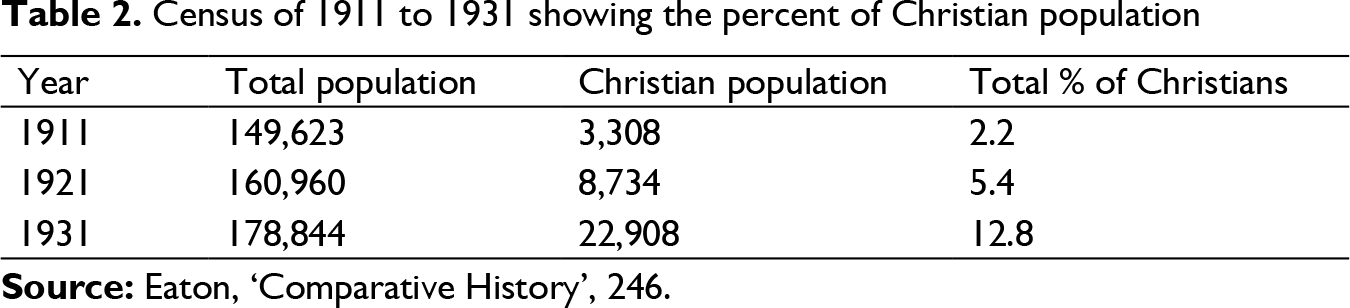
Now, data of Table 1 indicates that certain amung observation for the converts was raised from a day in 1918 to 4 days by 1928, while data of Table 2 shows the percentage of converts raised from 2.2 per cent in 1911 to 12.8 per cent by 1931. This confirms that a majority of the Nagas were practising traditional religion while also helped by the order of the court sanctioning the converts to observe certain amung(s) in accordance to traditional customs and practices. The explanation then reiterates the argument that each individual was responsible for the welfare and integrity of her/his community and therefore the obligation of a collective cooperation remains supreme in a village life although the converts were outwardly rejecting the idea of old practices. What can be understood is, the observation of amung was in the light of the ‘sacred’. But how far did the perception of the ‘sacred’ go on in the minds of the people in terms of how they perceived what was sacred in the ‘ancient’ belief and what was sacred in the Christian belief? The case of Chinirao Mungya v The Baptist of Mungya (1936), serves as an example of this question. In this case, the defendant used the stone that was considered sacred, as it was used as genna stone traditionally. Chinirao, the complainant, while pleading the case in the court, could not establish whether the stone belonged to any of his relations. However, his grievance was that the stone was ‘an ancient object’, and the defendant knowingly used the stone for the construction of the chapel which was a ‘desecration of genna stone’. The court ruled that Pichamo, a Baptist, knowing well that the stone was a genna stone, ‘uprooted it and used it in the building of the chapel’. That Pichamo had ‘no business to wound the feelings of the ancients who still hold to their own faith’ and was therefore fined ₹10, which was to be paid within one month. He was also ordered to replace the stone from where he took. 25
Chinirao Mungya v The Baptist of Mungya, dated, 27 February 1936, Case Records, NSA.
A powerful argument had been put forth by Saurabh Dube about whether the missionaries at times ‘lost the initiative’ when they came in contact with the traditional societies. In this, Dube was talking about the ‘scene’ where the Satnami guru and the missionary Oscar Lohr met at the home of the former in Bhandar in 1868. The epiphany of Lohr was how he was seated next to the guru and provided with refreshments, and given a warm welcome by ‘the great mass of the Satnamis’. Lohr further went on to reveal on how ‘the Satnamis stroked his beard to show him great honour and affection in their traditional way’. Dube considered that Lohr ‘inadvertently ventured into the realm of ethnographic representation and the pursuit of indigenous meanings’. He questioned whether stroking the beard of Lohr was ‘an enactment of a timeless, mysterious and customary ritual or was it a mere display of Satnami curiosity’? This is when Dube was critical of whether ‘the missionary lost the initiative’ and whether in the process ‘had unwittingly signified his acceptance of, and his incorporation as an affiliate in the domain of, the guru’s authority’. 26
Dube, ‘Issues of Christianity’, 99.
The whole purpose of dwelling in the above narrative is to bring home the point of the characteristic anonymity of what was traditional and what was not as seen in the case of Lohr among the Satmnamis and Pichamo in the case of Chinirao Mungya v The Baptist of Mungya discussed above. Lohr was a missionary whereas Pichamo was a Baptist convert, different in status but same in professed faith. Pichamo understood the auspiciousness of the genna stone and therefore wanted to incorporate it to the new religion he had moved on to, however, it cannot be ascertained that he understood the repercussion of his act being considered as affiliating his newfound religion in to the domain of the old religion. This situation then tantamount to how Lohr unwittingly accepted the guru’s authority by letting the Satanamis treat him like the guru he was visiting without realising the ‘incorporation’ and the ‘affiliation’ aspect of the tradition to the new religion. Moreover, there is no evidence of objection from the missionaries against Pichamo using a genna stone for the chapel. The case depicts no matter how huge the forces of outside/new influences might be, or how wilfully individualistic the converts appeared, to uproot the traditional practices wherein springs the identity of a community, was hard to bargain. The silence of the missionaries and the court’s open rebuke in this matter can be seen in the same light. To survive the test of time, both the agencies’ action was based on the practical approach of incorporating the old practices of the people and its continuity. The compromises and negotiations shown in the case above is a result of the interlocking of the traditional values of the local people through the agencies of the missionaries covertly and the colonial court vocally, meanwhile, upgrading their own vested interests.
Standardising Customs
The intervention of the colonial administration in the lives of the people dates back to the introduction and instituting of the Gaonbura system in to the Naga village system. The colonial administration taking over the traditional system of administration by recognising the chiefs followed by the mandatory election of a Gaonbura post Anglo-Naga War of 1879–80, offering them a symbolic red blanket, marked the beginning of a new order of village authority in the Naga Hills. The new system recognised village elders as the head while the real power rested with the colonial officials, who sat in the administrative headquarters drawing up plans on how effectively they could make use of these village power points. This whole process of creating and appointing Gaonburas was what Peter Robb called ‘the obvious social engineering and standardization in the interests of the state’. 27
Peter Robb, ‘The Colonial State and Constructions of Indian Identity: An Example on the Northeast Frontier in the 1880s’, Modern Asian Studies 31, no. 2 (1997): 261.
Ibid., 251.
(i) Swathed Position of the Village Authority and the Disparity of Colonial Justice
Despite the colonial administration’s convenient administrative arrangements, by way of appointing village headmen thus reducing the previously powerful chiefs/village elders to the order of the government, there are scholars like Richard Eaton who is convinced that the village authority was losing its grip over the villagers. Eaton attributed this shift in the traditional village authority, firstly, to the ‘rigid discipline’ in the village chief system and, secondly, the influence of Christianity. He emphasised that this ‘gradual erosion of traditional village authority’ to the ‘rigid discipline’ in the village chief system did not appeal to the ‘younger warriors’ who responded most readily to Christian teachings in the village school. 29
Eaton, ‘Conversion to Christianity Among the Nagas, 21.
Christianity no doubt was making an impact on people’s lives. However, Eaton’s argument of the rigid discipline of the village chief system losing out its younger warriors needs a closer examination. If we look back, we can see that American Missionaries were residing among the Sibsagar Nagas since the 1840s and opened a mission school where ‘many of the chiefs sent their sons for instruction’. 30
Gertrude M. Godden, ‘Naga and Other Frontier Tribes of North-East India’, The Journal of the Anthropological Institute of Great Britain and Ireland 26 (1897): 164.
Eaton, ‘Comparative History’, 246.
Ibid., 247.
Acknowledging the local system was a part of local management and hence the British, while negotiating their way into the region, began to highlight traditions and customs of the locality they encountered. This way they learned the local system in operation and interpreted it back to the people themselves. Herein lies the power of literacy. Nagas, coming from oral traditions, gave the British the satisfaction of being the harbingers of Naga customs and traditions. For example, the law of borrowing paddy in the Sema system was: the tally of paddy loans was kept by stringing sword-beans, one bean equal to three baskets of paddy that was lent. If the borrower could not pay back the same year, it multiplied to five baskets in the next harvest, and to 100 per cent in the following harvest, by way of interest. 33
Hutton, Sema, 160–61.
Practices like this were lived-out in visual and in memory, but when reproduced in writing, became a powerful tool that translated everyday practices into written documents which then became a source of knowledge. Indeed, one cannot rule out the fact that colonialism introduced local people to knowledge they were not aware of previously, and the colonial court was one important instrument. The law of borrowing as practised by the Sema was obviously good for those who could pay back within a harvest year since it was based on compound interest. But for those who could not, the interest multiplied to insurmountable amount as the years were added. With the introduction of the colonial court, the owners of bad debts dragged the debtors to court to realise their customary dues. Bad debts and court fights led to the establishment of a new law of debt among the Semas initiated by Inato, Chief of Lumitsami, who was also an interpreter at Mokokchung. In the new law of debt, the increase by interest after the second year was forbidden, this way the principal was doubled in the first year, and on the second year, the whole outstanding sum redoubled in the following year, if the principal was not fully repaid, and stopped on the third year. 34
Ibid., 161, in both the case of cash and grain this law was applied.
Nangpungshang of Muger and his clan v Pandangkemba Susu, dated, 20 July 1918, Case Records, NSA.
The case of Rephyim village—Inter Khel (1928) was another case that looked like it was settled for perpetuity. In this case, fishing rights at Lamktsao was brought to court because the four khels had trouble fishing in the waters of Lamktsao as their times of fishing clashed. C.R. Pawsey, the sub-divisional officer, after hearing the case divided the years each khel could fish. He stated, ‘The khels will take it in turns to enjoy the fishing.’ Thus he fixed the years as:
Nyamao to fish from 1 January 1929 to 31 December 1929 Zarenchi to fish from 1 January 1930 to 31 December 1930 Rensathung to fish for the year 1931 Sachamo to fish for the year 1932. The order held that the khels carried on in the same rotation.
36
Rephyim Village—Inter Khel, dated, 20 November 1928, Case Records, NSA.
The purpose of bringing in the metaphor of the Sema law of borrowing and the Ao case of land auctioning in the first two sections is to bring home the point that no uniformity was achieved in terms of drawing up specific laws and norms for the local people although in paper it looked like a precedent was created. In the second section regarding the division of fishing rights of the Ryphim village, it showcases how government acted on, as Peter Robb would say, ‘the assumption of state responsibility for the well-being of the people in a kind of contract between ruler and ruled’. 37
Robb, ‘The Colonial State’, 249.
(ii) Prejudices and Animosities
Initially, some colonial officers were of the opinion that Nagas could be brought to book through the help of the missionaries. Major John Butler was one among the early colonial officials who valued Christian Missionary activities to influence the ‘thoroughly primitive’ Nagas and ‘awaken in them a sense of the saving virtues of Christianity’. 38
John Butler, A Sketch of Assam (London: Smith, Elder and Co, 1847), 150.
John Butler, Travels and Adventures in the Province of Assam (London: Smith, Taylor and Co., 1854), 66–67, Camp: Hosang-Hajoo, dated, 28 December 1854.
John Butler, Travels and Adventure, 250–51.
However, over time, things were changing rapidly, and if John Butler, who in the 1840s and 1850s, was genuinely looking up to the missionaries to prepare the Nagas for the colonial government’s advantage, John Henry Hutton in the 1920s had a completely different thing to say about the same missionaries Butler was talking about with hope. On the reverse, Hutton thought of the missionary influences as denigrating, aloof, quarrelsome, double-standard, violent, all-in-all a bad influence. The very late influence of Christianity among the Semas with only two missionaries actively involving among the local people for seven years between 1948 and 1955 compared to her neighbours Aos and Angamis 41
Eaton, ‘Comparative History’, 247.
On the July 5th I met the Impur Missionaries. The new man, one Supplee, is I understand from Mr Mills, a terrible fellow who preaches hell fire, (literal) for all the unbaptized without exception, as well as for all baptized who disagree with his interpretation of scripture. As far as doctrine goes most Nagas’ views compare exceedingly favourably with this. I really think that it is very wrong to allow Medievalists of this sort to get loose among simple people who take them seriously—knowing no better. The fear of hell as an alternative to baptism has made many converts (one cannot call them converts) in the Mokokchung Subdivision already and Nagas ought to be protected against spiritual terrorism of this sort. As for myself, I take comfort in the thought that all the best company will be in hell, anyhow. 42
Tour Diary of J.H. Hutton, Esquire, CIE, Deputy Commissioner, Naga Hills, during the months of June and July, 1922, dated, 1–5 July 1922, Camp: Mokokchung, Oxford, Pitt Rivers Museum (hereafter PRM).
It was not only the attitude of the Christians that bothered Hutton. Physical appearance was something that came forth distinct and strong in his description of the Christians. In the winter of 1926, while on his way to Kohima, Hutton ‘met some unpleasant looking Angami of Chazubama’ and to put it in his own words he, ‘discovered were Christian converts, whence their untidy and generally dishevelled appearance’. 43
Ibid., January and February 1926, dated, 22 February 1926, Camp: Chazubama, PRM.
Ibid., July and August 1926, dated, 27 July 1926, Camp: Ghukiya, PRM.
The animosity between the colonial administration and the missionary activities was openly played out and as much as Hutton sees the Christians as the unwieldy, dishevelled and dissident lot, the Christians too had something to convey. As Hutton made way towards Mokokchung he met a group of Christians; he first met the male group followed by a female group. As soon as he arrived before them, they ‘broke into spiritual song’ to which he found the males sang very well. To his dismay, Hutton realised that the song was called ‘Have you been to Jesus’. Hutton wrote, ‘I cannot help suspecting that the Deputy Commissioner is regarded as not yet saved.’ However, as Hutton entered this singers village, Mukuli, a new settlement since Hutton’s time, he found it decent, clean and one at peace with the world. As always, Hutton had to add a concluding remark and it read: ‘It seemed to be Christian without being sophisticated or spoilt, a rare phenomenon in the Naga Hills.’ 45
Ibid., November and December 1926, dated, 15 November 1926, Camp: Mokokchung, PRM.
Thomas, Evangelising the Nation, 44.
Document testifies that the conflict between the ancients and the Christians was simmering in almost all the villages that Christianity had reached. With the passage of time, certain practices were becoming an important social and religious concern for both civil and religious societies, especially of the polygamous marriage practices. One of the important discussions that happened in a meeting on 9 February 1928 at Mongsemdi between the Deputy Commissioner, J.H. Hutton, and the Missionaries from Impur was the question of the evangelisation of the Semas. The Deputy Commissioner asked Dr James R. Bailey, a Medical Missionary, on how he proposed to deal with the question of a Sema who had several wives, and who wished to become a Christian. Dr Bailey suggested that he could baptise all of them—the man and his wives, and let them go on living together. Hutton pointed out how the New Testament forbade only bishops to have one wife, and therefore does not apply to other men who had wives to which Bailey agreed. However, Bailey was considering what J.P. Mills, another administrative officer, had told him about making the husband look like an accomplice were he to give baptism to all the wives and husband and make them dwell in the same house. Hutton assured Bailey that as long as the polygamists were not married under the ‘Christian Marriage Act’, they could not be convicted of any offence at all. Hutton also gave the concluding remark that, as no converts in the district were married under the Christian Marriage Act, it was satisfactory that the Mission do not propose to insist on monogamy in the case of polygynous converts. Hutton’s rather enthusiastic intervention in the issue of polygynous converts was because he objected to the ‘old game’ of men turning into a Christian in order to avoid responsibility for the aged wives, which he preferred to call the ‘more antique wives’. 47
Tour Diary of J.H. Hutton, Esquire, CIE, Deputy Commissioner, Naga Hills, for the months of January, February and March, 1928, dated, 9 February 1928, Camp: Mongsemdi, PRM.
Touring the district was one of the major duties of the Deputy Commissioner. Intimate knowledge of the local community would not have been possible if not for these tours and the records maintained in these tours. Official correspondences could not feature these close observations and sometimes a personal outburst, and to bridge the gap, tour diaries made the perfect stop gap. Cases discussed have depicted the rising tension between the non-Christians and the Christians that needed settlement through colonial court’s order in the administrative headquarters and the cases that were unresolved and raging through the tour diaries at the village level. Eventually it can also be seen by the 1940s, cases challenging historical facts were tried in the colonial court. Historical facts here would mean practices, beliefs, status and identity that the community had been carrying on in day-to-day living. In the case of Chamir Clan of Chuchulimbang v Village of Chuchulimbang (1946), the plaintiffs were heard singing, in one of their gennas, about liberating Chuchulimbang by contributing cattle, dao (machete) and cloth to Litam after Litam village was founded. Understandably, the Chuchulimbang inhabitants objected to this claim and clarified that it was the whole village of Chuchulimbang that gave the head of the cattle to Litam, and that Chamir clan contributed only a dao and a cloth. The court held that Chamir clan may ‘enumerate only dao and cloth in their song as liberators of Chuchulimbang village’, not including cattle, as the head of the cattle was given to Litam by the whole village. 48
Chamir Clan of Chuchulimbang v Village of Chuchulimbang, dated, 24 November 1946, Case Records, NSA.
Conclusion
The intensity of interest shown both by the British colonial administration and the American Baptist Missionaries shared the same zeal: to proselytise Nagas into their system. The missionaries preached about the total transformation of the existing life habits of the people. On the other hand, the colonial administration wanted to keep the Nagas frozen in time. One of the primary reasons was that the lack of commercial possibilities made a British presence economically unprofitable in the Naga Hills, and perhaps, British colonial officers posted were seen as ‘peripheral just like the Hills were considered on the edge of the empire’. 49
Andrew West, ‘Writing the Naga: A British Officers’ Ethnographic Tradition’, History and Anthropology 8, no. 1–4: 59.
One advantage the officials had was that they were able to perform official duties as well as pursue anthropological/ethnographical labours within the limits of governmental rules, and it opened the prospect of a prestigious career back in Britain after their retirement in the Hills. 50
J.H. Hutton and Christoph von Fürer-Haimendorf became Professors, J.P. Mills became a Reader and W.G. Archer a Museum Curator back in Britain.
Thomas, Evangelising the Nation, 49.
Moreover, as far as the colonial court was concerned, each village and each station’s lawsuits had to be dealt separate and different depending on the kind of cases that came up for hearing. Mired in this kind of situation the colonial court could not set up a uniform system or a codification of customary laws in the Naga Hills. Or, perhaps, past experiences in parts of India made the British realise that, ‘Codification was also a process of silencing and erasure’. 52
Bhattacharya, ‘Remaking Custom’, 50.