




Abstract
The Red Sea is a promising, underexplored habitat for the discovery of new bioactive marine natural products. This review provides a comprehensive survey of sesquiterpenes isolated from Red Sea organisms between 2015 and 2025. It emphasises chemistry, biological potential, and collection sites. A total of 115 compounds, including 30 new structures, were reported from 25 species across 17 genera. The reported findings demonstrated a broad spectrum of biological activities, including cytotoxic, antibacterial, antifungal, antiviral, anti-inflammatory, antimalarial, and antioxidant effects. However, the reported data and findings have stressed continued exploration of Red Sea organisms to support future drug discovery initiatives.
Introduction
Marine natural products are recognised with wide chemical diversity, 1 and interesting biological activities with unprecedented mechanisms of action. 2 Up to early 2024, there are more than 40,700 constituents reported (Marinelit), with more than 1,000 new compounds discovered each year.3,4 Since the approval of Cytarabine (Ara-C) in 1969, marine natural products have been leading the way in drug discovery. Many compounds have received pharmaceutical market approval, while more are progressing through early and preclinical studies.5–7 The worldwide marine pharmaceutical market was evaluated to be $6.47 billion by 2025, expected to reach $6.81 billion in 2026, and to be $10.26 billion by 2034, 8 which stressed the importance of marine natural products in drug discovery.
The Red Sea is a distinct semi-enclosed ecosystem that extends along a 2000-km shoreline and is characterised by high salinity, elevated temperatures, and extensive coral reefs. This unique environment supports exceptional biodiversity of 500 coral species, abundant macroalgae, and a wide range of invertebrates and microorganisms.9,10 Several reviews traced the publications on natural products from Red Sea marine organisms till the year 2023, focusing on chemical biodiversity and biological activity (alkaloids, sterols, peptides, macrolides and terpenes), with promising anticancer, anti-inflammatory, and antiviral properties,11–14 or tracing specific organisms such as seaweeds, sponges, and invertebrates.15–17 Nevertheless, none of these reviews focused on sesquiterpenes; our review was planned to provide a comprehensive survey of sesquiterpenes isolated from Red Sea organisms between 2015 and 2025. It emphasises chemistry, biological potential, and collection sites. Scientific publications have documented more than 435 natural products isolated from Red Sea organisms up to 2014, followed by 242 additional compounds reported from 2015 to 2019, with a proposed consistent rate of discovery averaging 48 new compounds per year.11,13,18 Sesquiterpenes represent a prominent class of Red Sea secondary metabolites, displaying diverse structural frameworks—such as guaianes, eudesmanes, aromadendranes, cadinanes, and nardosinanes sometimes conjugated with halogen substitution 19 and exhibiting varied biological properties, including acetylcholinesterase (AChE) inhibition,20,21 antiproliferative, 22 anti-inflammatory, antibacterial, antiviral activity against HIV-1 protease (HIV-1 PR), 23 and anti-dermatophyte effects. 24 Such varied biological activities are promising cytotoxic lead structures in anticancer drug discovery, anti-inflammatory agents in chronic disease management, and antimicrobial discovery in the era of resistance, as well as the significance of antimalarial compounds against resistant Plasmodium falciparum strains.
This review focuses on Red Sea marine sesquiterpenes reported from 2015 to 2025, providing an updated assessment of their chemical diversity, biological activities, and taxonomic distribution.
Methods
A literature survey was performed using PubMed, Scopus, Web of Science, SciFinder/CAS (Chemical Abstracts Service), and Google Scholar. The search covered peer-reviewed publications from January 2015 to 2025, applying database-specific filters (publication year 2015–2025, peer-reviewed articles). The search strategy employed a combination of keywords and Boolean operators. The primary search string was: (‘Red Sea’ AND ‘sesquiterpenes’). This was expanded using organism-specific terms, such as: (‘Red Sea’ AND ‘coral’ AND ‘sesquiterpenes’), (‘Red Sea’ AND ‘sponge’ AND ‘sesquiterpenes’), (‘Red Sea’ AND ‘Seaweed’ AND ‘sesquiterpenes’), and (‘Red Sea’ AND ‘marine fungi’ AND ‘sesquiterpenes’). These searches were complemented with terms related to bioactivity (e.g., ‘cytotoxic’, ‘antibacterial’, ‘anti-inflammatory’, ‘antimalarial’, ‘antiviral’, ‘antioxidant’ and ‘neuroprotective’) to capture pharmacological evaluations. Studies reporting the isolation, structural elucidation, or biological evaluation of new or known sesquiterpenes obtained from organisms explicitly collected in the Red Sea region were included. Articles published in non-peer-reviewed journals, studies written entirely in languages other than English, reports lacking primary compound data or adequate structural characterisation, and publications without sufficient chemical or biological information were excluded. For the dereplication, we applied manual cross-checking of titles, authors, DOIs, and removed duplicate entries across PubMed, Scopus, Web of Science, SciFinder, and Google Scholar.
Results and Discussion
Several classes of sesquiterpenes were reported from Red Sea organisms within 2015–2025 (Figure 1), where nardosinanes (18.2%), lemnanes/paralemnanes (13.2%), and eudesmanes (9.9%) appear to be the most abundant classes, primarily from corals, guaians (5%) are also well-represented and unique to soft corals. Meanwhile, lauranes (7.4%) and chamigranes (3%) were the major seaweed-derived compounds, and they were often halogenated, while the furanosesquiterpenes (9.1%) and bisabolanes (4.1%) are characteristics of sponges. The major classes and number of compounds in each class of the reported sesquiterpenes are listed in Table 1 and Figure 2 and 3.
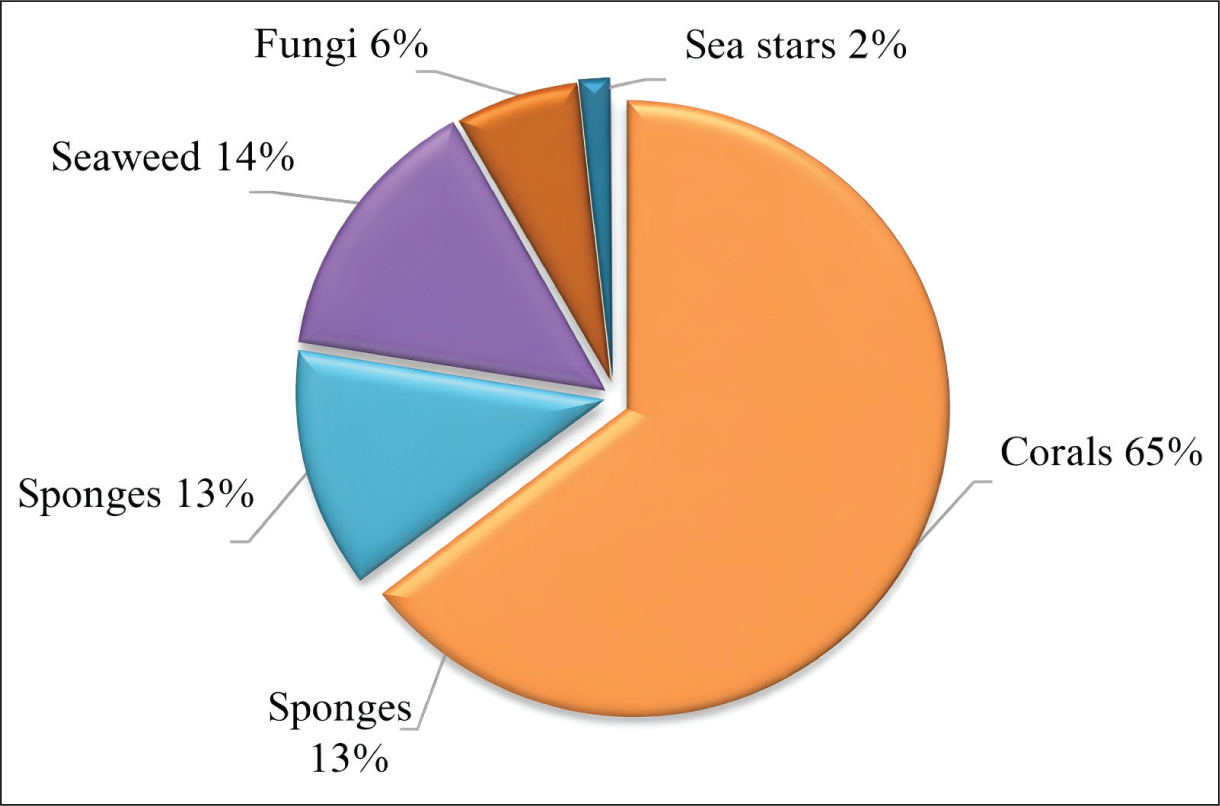
Source Organisms of the Reported Sesquiterpenes.
Major Classes of Sesquiterpenes Reported from Red Sea Organisms (2015–2025).

Major Classes of Sesquiterpenes Isolated from the Red Sea (2015–2025).

Number of Sesquiterpenes and New Compounds Reported from Each Class of Red Sea Organisms.

Coral-derived Sesquiterpenes
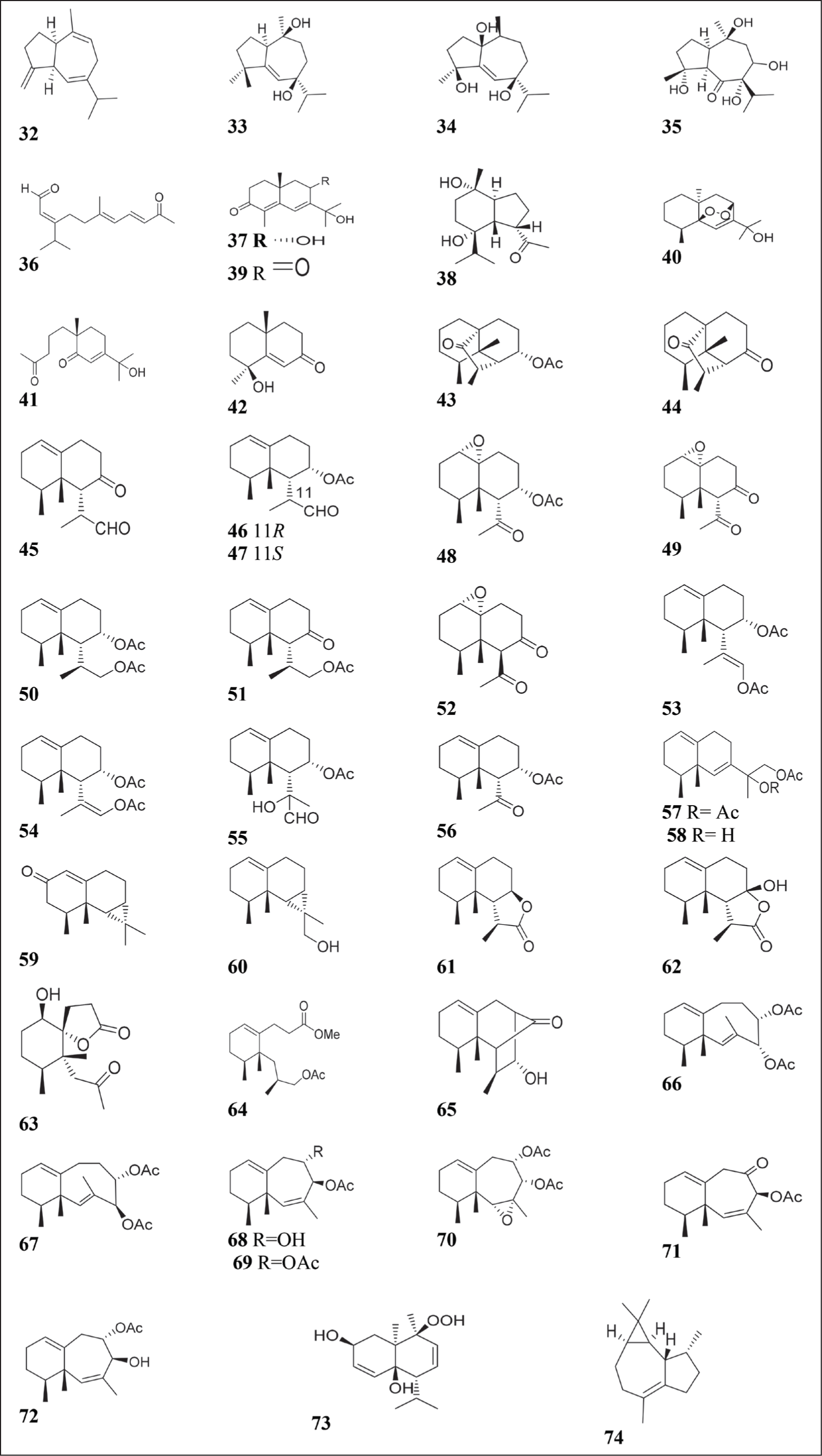
The Red Sea hosts approximately 346 Scleractinia coral species, with about 307 species documented in the northern and central regions. Moreover, 300 coral species are endogenous to the Red Sea.25,26 Corals represented the major source of sesquiterpenes, contributing 77 metabolites, including 17 novel structures. Structures of the reported sesquiterpenes, site of collection, and biological activities were listed in Figures 4 and 5 and Table 2.
Sesquiterpenes 1–31 Isolated from Red Sea Corals.

Sesquiterpenes 32–74 from Red Sea Corals.
Reported Biological Activities of Sesquiterpenes from Red Sea Organisms in 2015–2025.

Investigation of Sarcophyton glaucum collected near Saudi shores afforded new germacrane 6- oxo-germacra-4 (15),8,11-triene 1, and the known aromadendrene 2 and palustrol 3. Compound 1 showed cytotoxic activity against human colorectal carcinoma (HCT-116) cells with an IC50 of 29.4 ± 0.03 µM. Evaluation of antiproliferative activity of the compounds against HepG2, MCF-7 and HCT116 cell lines using Sulforhodamine B assay with reference to the standard doxorubicin. The data highlight considerable activity towards HepG2 cells in the range of 18.8–734.3 µM. 27 Alismoxide 4 and 10-O-methylalismoxide 5 were two guaianes isolated from Nephthea sp. collected off the Hurghada coast, Egypt. Compound 5 has a cytotoxic activity with an IC50 of 0.59 ± 0.3 µM against the breast cancer (MCF-7) cell line. 28 Ayyad has reported compounds 2 and 3 in addition to viridiflorol 6 from coral Xenia umbellata, collected off the Jeddah coast, Saudi Arabia. 23 In 2021, Althagbi reported cytotoxicity of compound 2 against MCF-7, HepG2, and HeLa cell lines (IC50 of 7.56 ± 0.20, 9.66 ± 0.14, 5.04 ± 0.05 µM, respectively). Meanwhile, compound 3 showed moderate activity against MCF-7 and HeLa cells (IC50 of 33.78 ± 0.50 and 98.2 ± 0.40 µM, respectively).23,29 Investigation of Litophyton arboretum collected off Jeddah, Saudi Arabia, afforded the new litopharbol 7, alismol 8, and alismorientol B 9, besides teuhetenone A 10, and calamusin I 11. 30 Compound 8 was previously reported from several Sinularia and Litophyton species as well.31,32 Both compounds 7 and 9 exhibited significant antibacterial activity against Bacillus cereus, with a minimal inhibitory concentration of 0.67 and 6.61 µM, in comparison to 0.20 µM of oxytetracycline, and weak activity against B. subtilis with a minimal inhibitory concentration of 29.1 and 24.9 µM (3.4 µM of oxytetracycline), respectively. Compound 10 showed activity against P. aeruginosa and Escherichia coli with MICs of 14.4 and 9.79 µM, respectively. Furthermore, compound 10 had moderate antifungal effects against C. albicans and A. niger (MIC 21.13 and 38.21 μM, respectively), in addition to potent activity against HepG-2 cells with an IC50 of 1.21 μM. Meanwhile, compound 7 exhibited activity against MCF-7 with an IC50 of 9.42 μΜ (IC50 of 0.72 ± 0.9 for Vinblastine sulfate). 30 The new sesquiterpene 3α,6α-epidioxyhimachal-1-ene 12 was isolated from another sample of L. arboretum, collected at Jeddah coast, Saudi Arabia. It showed weak antiproliferative activity of IC50 of 44.32 ± 0.032 and 51.43 ± 0.092 μM against MCF-7 and HCT116, respectively (0.97 ± 012 and 0.52 ± 0.15, respectively, for paclitaxel).25,33 Sinularia terspilli collected from a silted reef, at Hurghada, Egypt, afforded a new sesquiterpene 5,7-eudesm-11(13)-en-4-ol 13, the known alismol 8 and 1S,4S,5S,10R-4,10-guaianediol 14. Both 8 and 14 revealed strong antileukemic activity against the HL60 cell line, IC50 of 1.36 ± 0.05 and 0.88 ± 0.03 μM, respectively, and chronic myelogenous K562 cells, IC50 of 1.59 ± 0.02 and 1.46 ± 0.02 μM, respectively. Compounds 13 and 14 showed weak antileishmanial activity of IC90 >40.0 at 52.2 ± 0.03 μM, in comparison to an IC50 of 0.11 µM for amphotericin B. 32 The soft coral Rhytisma fulvum-fulvum collected at Jeddah coast, Saudi Arabia, afforded the two new 12-O-acetylnardosinan-6-en-1-one 15 and 6β-acetyl-1(10)-α-13-nornardosin-7-one 16 together with its co-existing 6α-acetyl-4β,5β-dimethyl-1(10)-α-epoxy-7-oxodecalin 17. In addition to the new 6,7-seco-13-nornardosinane 18, the known 12-Acetoxy-l(10)-aristolene 19 and 4-acetoxy-2,8-neolemnadien-5-one 20. Compounds 15, 19, and 20 showed strong cytotoxicity against NCI-H1299 with IC50 of 35.9 ± 0.008, 35.5 ± 0.001 and 35.5 ± 0.001, respectively (8.6 ± 0.004 µM of doxorubicin), and weak effect against HepG2 cells with IC50 of 82.7 ± 0.001, 71.7 ± 0.001 and 83.3 ± 0.009 µM (7.3 ± 0.005 µM of doxorubicin), meanwhile compounds 16 and 18 showed moderate effect against NCI-H1299 with IC50 of 97.4 ± 0.001 and 87.6 ± 0.001 µM, respectively, and weak effect against HepG2 with IC50 of 37.45 ± 0.009 and 24.62 ± 0.009 µM, respectively. 34 The S. glaucum collected at Hurghada, afforded two new rare hydroazulenes, calamusin J 21 and its hydroperoxide derivative calamusin K 22, in addition to the known 10α-hydroxyoplopan-4-one 23, prostantherol 24, and 10-epicubebol methyl ether 25. Compounds 21 and 22 showed cytotoxicity of 4.5% and 13% at a concentration of 50 ± 0.11 μM, respectively, against the MCF-7 cell line. In addition to antiangiogenic activity against Caco-2 and MCF-7 cells (IC50 of 0.28 ± 1.86 and 0.31 ± 2.12 μM, respectively). 35 The GC-MS study of the n-hexane fraction of the soft coral Nephthea sp. Egyptian collection (Hurghada) has identified the widdrene 26 and spathulenol 27 as major constituents, which showed significant antifungal activity against Microsporum gypseum (MIC 83.33 ± 20.83 μg/mL), Microsporum canis (MIC 104.2 ± 20.8 μg/mL), and Trichophyton mentagrophytes (MIC 125 ± 0.01 μg/mL). The antifungal effect was ascribed to spathulenol by molecular docking against the fungal CYP51 enzyme. 24 Three new eudesmans, eudesma1,2,15-trihydroxy-3-en-7-one 28, eudesma1,2,15-trihydroxy-5-ene 29, and nardosinanol J 30, were isolated from Paralemnalia thyrsoides collected at Jeddah, Saudi Arabia, in addition to the known lemnolin A 31. Biological evaluation of the coral total extract revealed an in vitro anti-inflammatory effect of IC50 of 88.3 ± 1.2 µg/mL and a strong histamine release inhibitory effect (IC50 of 17.94 ± 1.08 µg/mL), in addition to an antioxidant effect (157.5 ± 4.24 µg/mL against 14.2 ± 0.24 µg/mL for ascorbic acid). The cytotoxicity assay of the extract showed a strong effect against HepG2 (IC50 of 12.1 ± 1.1 µg/mL), moderate effects against HCT116 (IC50 of 13.4 ± 1.8 µg/mL) and PC3 (IC50 of 28.6 ± 2.7 µg/mL), and a weak effect against MCF7 (IC50 of 49.0 ± 3.9 µg/mL). 36
Litoarbolide A 32, a new guaiane in addition to the related guaians 4α,7β,10α-trihydroxyguai-5-ene 33, leptocladol B 34, nephthetetraol 35, alismoxide 4, alismol 8, as well as (2E,6E)-3-isopropyl-6-methyl-10-oxoundeca-2, 6-dienal 36, have been reported from L. arboretum, collected at Neweba, Egypt. Biological evaluation showed weak antimalarial activity of both 34 and 35 against W2 P. falciparum chloroquine-resistant strain (IC50 of 16.9 and 11.9 µM, respectively), meanwhile 36 was active against W2 chloroquine-resistant and D6 chloroquine sensitive strain with (IC50 of 9.2 and 11.3 µM, respectively), in comparison to IC50 of 0.02 µM of artemisinin. None of the compounds had a cytotoxic effect against the Vero cell line. 37 The Litophyton arboreum, Egypt (Hurghada), afforded the new 8α,11-dihydroxy-β-cyperon 37 and 5-epi-7α-hydroxy-(+)-oplopanone 38, together with the known 11-hydroxy-8-oxo-β-Cyperon 39, 5β,8β-epidioxy-11-hydroxy-6-eudesmene 40, chabrolidione B 41, 7-oxo-tri-nor-eudesm-5-en-4β-ol 42, and alismoxide 4. Testing the cytotoxic activity against A549, MCF-7, and HepG2 cell lines, and the anti-leishmanial potential against Leishmania major. Compound 4 exhibited potent cytotoxic activity against the A549 cell line (IC50 of 21.0 ± 2.5 μM in comparison to etoposide (29.7 ± 4.5 μM).38,39
The Lemnalia sp. collected near Al Lith coral reef, Saudi Arabia, afforded 31 sesquiterpenes amidst three new compounds, including two new rare neoafricanols, 1,9-dedihydroxylemnafricanol 43 and its 7-oxo-deacetoxy analogue 44, and the new iso-paralemnolin D 72. In addition to the known, linardosinene C-E 45-47, 7α-acetoxy-1(10)-α-epoxy-12-nornardosin-11-one 48, 6α-acetyl-1(10)-α-13-nornardosin-7-one 49, nardosinane 50, paralemnolins J-M 51-54 and paralemnolin O and P 55 and 56, paralemnolin C and its deacetyl derivatives 57 and 58. Together with 1(10)-aristolen-2-one 59, 1(10)-aristolen-12-ol 60, and 3 lactones lemnalactone 61, 2-deoxy-12-oxolemnacarnol 62, pathylactone A 63, lemnardosinane I 64, isoparalemnanone 65, lineolemnene G 66, paralemnolin H 67, lemnolin A 31, paralemnolins D-F 68-70, and 4β-acetoxy-2,8-neolemnadien-5-one 71. The cytotoxicity study did not show any activity when tested against the HeLa, MCF7, and BJ cell lines. Moreover, in vitro anti-inflammatory test showed reduction in interleukin-6 (IL-6) and cytokine IL-6 by 11%–25% of compounds 54, 57, 61, and 63, meanwhile compounds 54 and 57 have neuroprotective activity at 20 Μm. 40 The new heterofusceterpene A 73 was identified from Heteroxenia fuscescens, collected near Hurghada, Egypt, that showed moderate cytotoxic activity against MCF-7 and OVK-18 with IC50 of 86.57 ± 3.22 and 141.8 ± 2.63 μM, respectively, compared to vinblastine (65.2 ± 4.53 and 43.65 ± 2.35 μM, respectively). 41
GC-MS study of the ethyl acetate/hexane fraction of the Egyptian collection of Sarcophyton convolutum, has afforded aromadendrene 2, (+)-viridiflorol 6, and (+)-ledene 74. Biological evaluation of the total extract revealed strong antibacterial effects against P. aeruginosa (MIC 0.05 μg/mL), and cytotoxic effect against HepG2, CaCo2, MCF-7, and A549 (IC50 of 102.73, 100.62, 86.68, and 81.64 μg/mL, respectively), as well as antiviral activity against herpes simplex virus-1 (HSV-1) and hepatitis A virus (HAV), at 32.69% and 11.53%, respectively. 42
Sponge-derived Sesquiterpenes
The Red Sea is home to approximately 240 sponge species.43,44 Marine sponges have afforded more than 5,300 compounds so far, with an estimated identification of 200 new compounds each year and are considered one of the most prolific sources of bioactive marine natural products.45,46 Structures of the reported sesquiterpenes, site of collection, and biological activities are listed in Figure 6 and Table 2.
Sesquiterpenes 75–88 from Red Sea Sponges.
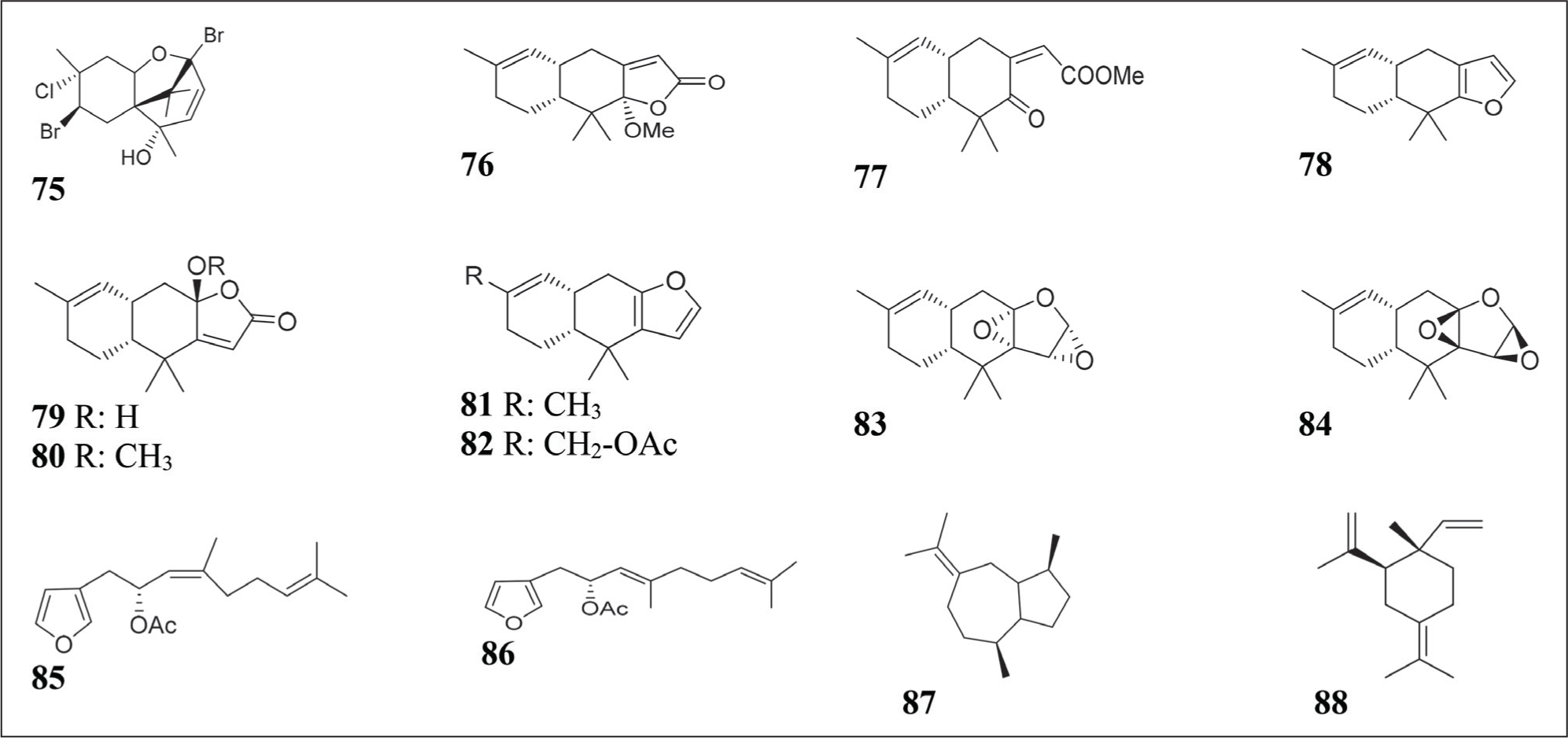
Chemical investigation of the Spongia sp. sponge collected off the Red Sea coast of Jeddah, Saudi Arabia, afforded the new trihalogenated chamigrane sesquiterpene, pacifenol 75 that showed a weak anti-inflammatory effect. However, it was inactive in the cytotoxicity assay against the Huh7 cell line and antibacterial activity against Staphylococcus aureus. 47
Two new sesquiterpene lactones: O-methyl-furodysin lactone dysidherbene A 76 and dysidherbene B 77, and a new linear furanosesquiterpene (5R,6E)-dendrolasin-5-acetate 86 were isolated from Lamellodysidea herbacea sponge collected from the coral reefs off Thuwal, Saudi Arabia. Beside the known furodysin 78, furodysinin lactone 79, O-methyl-furodysinin lactone 80, furodysinin 81, 15-acetoxy derivative 82, (1S,2R,3S,4R,6S,11R)-furodysinin lactone (bis-epoxide) 83, and (1R,2S,3R,4S,6S,11R)-furodysinin lactone (bis-epoxide) 84, and the linear furanosesquiterpene (5R,6Z)-dendrolasin-5-acetate 85. The metabolites showed no antibacterial activity when tested against S. aureus ATCC-25923 and E. coli NCTC-10418. 43 The furodysinin lactone 79 was previously isolated from a Lamellodysidea sp sponge, hand-picked off Thuwal, Saudi Arabia, as well. 49
The GC-MS analysis of the Negombata magnifica extract collected at Dahab, Gulf of Aqaba, Egypt, has identified β-guaiene 87, (-)-spathulenol 27 and γ-elemene 88 as major components. The antibacterial assessment of the extract showed mild activity against E. coli (4 µg) and MRSA (2.42 µg), as well as anticancer effect against MCF-7 (IC50 of 12.484 µg/mL), Caco-2 (IC50 of 10.52 µg/mL), and HepG2 (IC50 of 10.33 µg/mL). The anticancer activity was associated with G0/G1 cell cycle arrest with inhibition of CDK6, Cyclins D1 and E1, inducing apoptosis and activating reactive oxygen species (ROS) production in HepG2 cells. 50
Seaweed-derived Sesquiterpenes
There are 500 seaweed species endemic to the Red Sea, making it the most diverse seaweed ecosystem.13,51 Structures of sesquiterpenes, site of collection and biological activities are listed in Figure 7 and Table 2.
Sesquiterpenes 89–115 from Red Sea Seaweed, Fungi and Echinoderms.
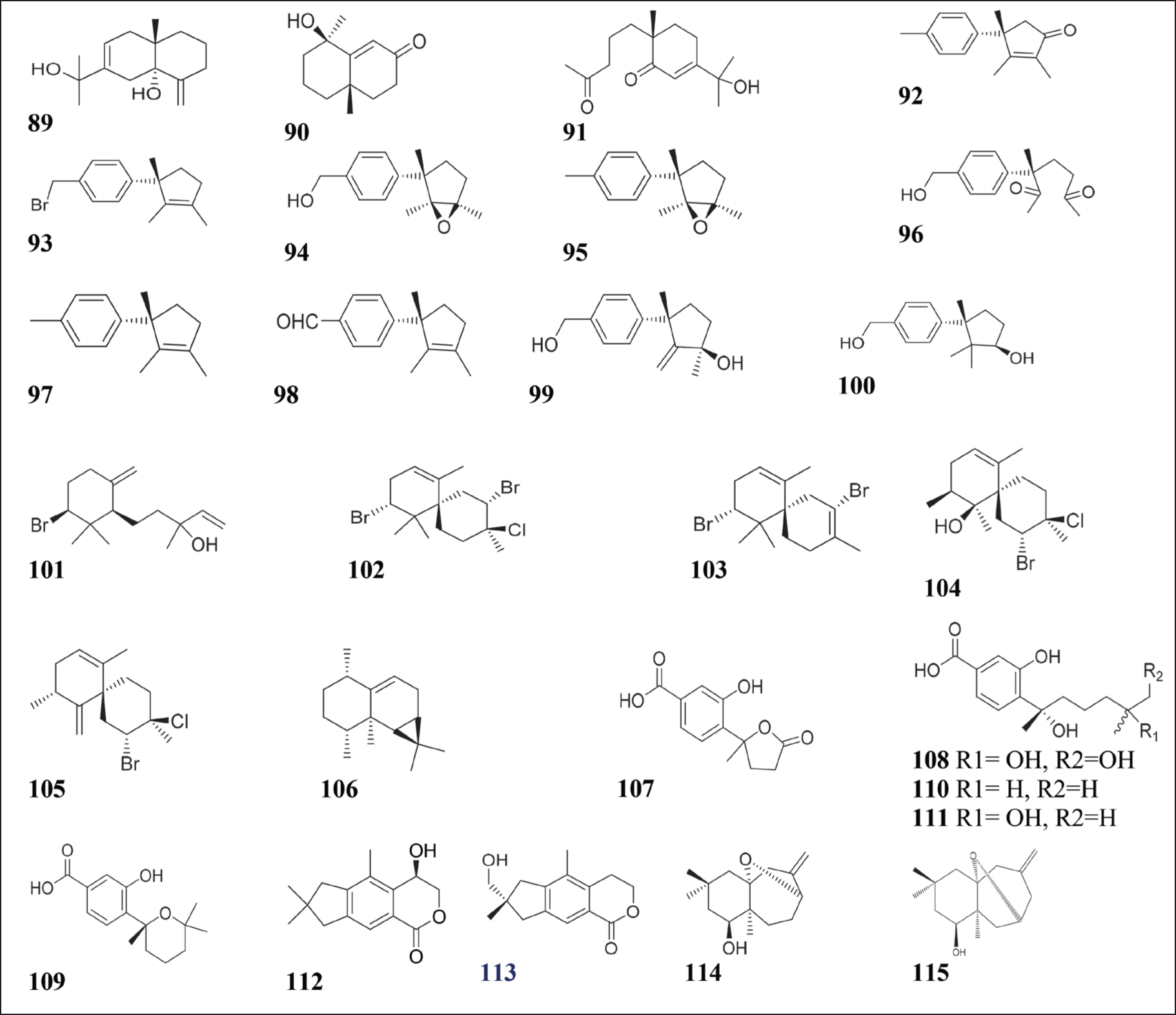
Seaweeds of the genus Laurencia were the most studied seaweeds collected off the Red Sea coast.52–54 Recent investigation of Laurencia obtusa collected off the coast of Jeddah, Saudi Arabia, has afforded the new eudesma-4(15),7-diene-5,11-diol 89 along with the known teuhetenone 90, and chabrolidione B 91. Compound 89 showed antifungal activity against C. tropicalis, C. albicans and A. flavus with MICs of 2.1, 2.9, and 2.92 µM, respectively. Meanwhile, compound 91 was active against C. albicans, A. flavus and C. tropicalis with MICs of 2.92, 3.0, and 4.10 µM, respectively (Amphotericin B MICs of 4.6, 5.2 and 4.6 µM). Compounds 89 and 90 were cytotoxic for MCF-7 cells (IC50 of 39.5 ± 0.18 and 22.8 ± 0.18 µM, respectively), in comparison to the cisplatin IC50 of 59.0 ± 0.045 µM. 55 The Laurencia majuscula, Egyptian coral reef collection, afforded 5 new lauranes: 4-oxoisolaurene 92, 15-bromoisolaurene 93, (1S*,2S*,3R*)-2,3-epoxy-15-hydroxydihydroisolaurene 94, (1S*,2S*,3R*)-2,3-epoxydihydroisolaurene 95, as well as 2,3-dioxo-15-hydroxy-seco-laurene 96. In addition to the known compounds isolaurene 97, isolauraldehyde 98 and laur-2-ene-3,12-diol 99, cuparene-3,12-diol 100, β-snyderol 101, 2,10-dibromo-3-chloro-achamigrene 102, laurecomin C 103, together with compositacin A 104, laurokamin A 105, and aristol-9-en-1a-ol 106. Evaluation of the anti-inflammatory activity, measuring suppression of nitric oxide (NO) release in TLR4-activated RAW 264.7 macrophage cell line, revealed strong effect of compounds 93, 102 and 104 (IC50 values of 6.92, 4.97 and 3.55 µM, respectively), in comparison to IC50 of 16 µM of celecoxib. In addition, compounds 99, 96, 100, and 106 showed moderate cytotoxic activity of IC50 of 20.46, 23.81, 22.73, and 10.51 µM, respectively, in comparison to colchicine (50.5 ± 6.2 µM). 48
Fungal-derived Sesquiterpenes
The solid rice culture of Scopulariopsis sp., which was isolated from Stylophora sp collected near Ain El-Sokhna, Red Sea, Egypt, afforded the new 1-hydroxyboivinianic acid 107 and 11,12-dihydroxysydonic acid 108, in addition to the known sydowic acid 109, sydonic acid 110, and 11-hydroxysydonic acid 111 (Figure 7). The reported compounds did not reveal any cytotoxic activity when tested against L5178Y cells. 57 A new illudalane, asperorlactone 112, was isolated from the culture of Aspergillus oryzae, collected from marine sediments at a depth of 50 m off Jeddah, Saudi Arabia, in addition to the known echinolactone D 113. Compound 112 showed moderate antiproliferative activity against A549, HepG2, and MCF7 with IC50 of 72.7 ± 1.1, 86.6 ± 3.2 and 106.5 ± 4.2 μM, respectively, meanwhile, compound 113 showed activities of 55.7 ± 2.5, 148.6 ± 5.6, and 128.0 ± 2.8 μM, respectively, against 2.1 ± 0.08, 2.2 ± 0.15 and 1.9 ± 0.05 μM for doxorubicin. 58
Echinoderms-derived Sesquiterpenes
The brittle sea star: Ophiocoma dentata, collected near Hurghada, Egypt, afforded the new O8-Ophiocomane 114 and O7-Ophiocomane 115 (Figure 7). Both compounds showed a dose-dependent reduction in MCF-7 cells viability with LC50 values of 103.5 and 59.5 µg/mL, respectively, in comparison to 47.4 µg/mL for cisplatin. 59
Emerging Trends in Bioactivities of Red Sea Sesquiterpenes
The Red Sea sesquiterpenes reported in this review showed a wide range of biological activities covering cytotoxic, antimicrobial, anti-inflammatory, antiparasitic, antiviral, antioxidant, and neuroprotective effects (Table 2 and Figure 8).
Activity-oriented Distribution of Red Sea Sesquiterpenes (2015–2025), Organised According to Major Biological Activities Rather than Structural Abundance Alone.

The distribution highlights cytotoxicity as the predominant investigated activity, followed by antimicrobial and anti-inflammatory effects, while antiparasitic, antiviral, antioxidant, and neuroprotective activities remain comparatively understudied. Interestingly, the activities vary significantly according to sesquiterpene skeleton and source organism; they could be summarised as follows:
Cytotoxic/anticancer activity The most commonly reported activity where around 40%–50% of all bioactivity research activities focus on cytotoxicity, the most promising compounds were 2, which showed potent activity against HeLa, HepG2 and MCF-7 cell lines with IC50 of 7.56 ± 0.20, 9.66 ± 0.14, 5.04 ± 0.05 µM, respectively, while 3 revealed moderate activity against HeLa line with IC50 of 33. 78 ± 0.40 µM. Both 14 and 8 showed strong antileukemic activity with IC50 of 0.88 ± 0.03 µM and 1.36 ± 0.05 µM against HL60, respectively. Compounds 10 and 11 revealed strong activity against MCF-7 with 4.32 ± 0.3 and 6.43 ± 0.15 µM, and 4 showed potent activity of 0.073 ± 0.05 µM against the A549 cell line, which was better than cisplatin (8–9 µM). According to these findings, the coral-derived compounds (especially guaianes, eudesmanes, and nardosinanes) lead the cytotoxic activity, and 2 and 14 represent the most promising anticancer lead compounds. Compound 4 showed selective activity against A549 lung cancer cells in comparison to other cells. Finally, the extract of N. magnifica (27 as the major component) induced G0/G1 cell cycle arrest, inhibited CDK6, cyclins D1/E1, and activated ROS production, showing a promising anticancer lead compound. Although several compounds (e.g., 4, 8, 10, and 14) demonstrated activities comparable to or approaching standard drugs in specific cell lines, their potency remains lower than that of clinically approved chemotherapeutics such as doxorubicin and cisplatin. These findings suggested that Red Sea guaianes, eudesmanes, and nardosinanes represent valuable lead scaffolds, warranting further optimisation and mechanistic investigation. Antibacterial activity The L. arboretum coral-derived compounds, especially 7–11, where both 7 and 9 revealed potent effect against B. cereus (MIC 0.67 and 0.61 µM vs. 0.2 µM for oxytetracycline), and moderate effect against B. subtilis (MIC 29.1 and 24.9 µM), while compound 10 revealed moderate effect against P. aeruginosa (MIC 14.4 µM). The extract of N. magnifica (87, 27 and 88) revealed significant activity against the MRSA resistant strain with MIC of 2.42 µg (Ciprofloxacin 0.25->1 µg/mL). When compared with the standard antibiotics, most tested sesquiterpenes demonstrated moderate antibacterial potency, with MIC values typically higher than those of reference drugs such as ciprofloxacin or oxytetracycline. Antifungal activity The seaweed-derived compounds (Laurencia spp.) showed the strongest and broadest antifungal activity. The new eudesmane 89 from L. obtusa is a potent antifungal agent with activity across three fungal species against C. tropicalis, C. albicans, and A. flavus, with MICs of 2.1, 2.9 and 2.92 µM, respectively, and teuhetenone 90 revealed potent activity against C. albicans and A. flavus, and moderate effect against C. tropicalis, with MICs of 2.92, 3.0 and 4.10 µM, respectively. In addition, compounds 10 and 11 were potent against C. albicans with an MIC of 0.015–0.021 µM. Anti-inflammatory activity The halogenated sesquiterpenes from Laurencia seaweeds are the most potent anti-inflammatory effect by inhibiting NO production in macrophages, compounds 93, 102, and 104 significantly exceeding the standard celecoxib. Both 102 and 104 reported from Laurencia majuscula revealed anti-inflammatory effect with IC50 of 4.97 ± 1.03 and 3.55 ± 0.80 µM, respectively, through NO inhibition in comparison to 13 ± 0.31 µM of Ibuprofen. Meanwhile, compound 93 has potent anti-inflammatory activity with an IC50 of 6.92 ± 0.71 µM through NO inhibition in RAW 264.7 (16 µM of celecoxib). The coral-derived compounds revealed mild to moderate anti-inflammatory effects, primarily through IL-6 reduction. The extract of P. thyrsoides (28–31) has moderate in vitro anti-inflammatory (IC50 of 88.3 ± 1.2 µg/mL). The Lemnalia sp. compounds 54, 57, 61 and 63 have a moderate effect of 11%–25% reduction through IL-6 inhibition. In comparison with standard anti-inflammatory (e.g., celecoxib and ibuprofen) drugs, several halogenated Laurencia-derived sesquiterpenes demonstrated comparable or superior inhibition of NO production in vitro. Such low micromolar IC50 values are within the potency range reported for other bioactive halogenated marine terpenoids. Antiparasitic activity The antimalarial activity of the reported Red Sea sesquiterpenes is generally weak to moderate. Both 35 and 36 from L. arboretum revealed moderate effect against P. falciparum W2 (IC50 of 11.9 and 9.2 µM), while 34 has a weak effect (IC50 of 16.9 µM) against P. falciparum W2 (CQ-resistant), in comparison to IC50 of 0.001–0.01 µM for artemisinin. Although the antileishmanial activity is poorly tapped for Red Sea sesquiterpenes, S. terspilli afforded antileishmanial sesquiterpenes, eduesmane 13, with a strong effect with IC50 of 0.41 ± 0.03 µM, making it a promising lead candidate, while the guaiane 14 has a weak effect of 26.2 ± 0.11 µM (0.11 µM amphotericin B). Despite demonstrating antimalarial and antileishmanial activities, the efficacy of Red Sea sesquiterpenes remains substantially lower than that of antimalarial drugs such as artemisinin. These compounds, therefore, represent promising structural templates for semi-synthetic modification rather than direct therapeutic candidates. Antiangiogenic activity The hydroazulenes 21 and 22 from the soft coral S. glaucum inhibit cancer cell migration (antiangiogenic effect) when tested against Caco-2 and MCF-7 cell lines, with IC50 ranges of 0.28 ± 1.86 and 0.31 ± 2.12 µM, respectively. Antiviral activity The antiviral activity of the reported Red Sea sesquiterpenes is poorly explored as well. Representative compounds of S. convolutum 2, 6, and 74 revealed moderate activity against herpes simplex virus with 32.69% inhibition, and weak inhibition of 11.53% against HAV. Antioxidant and neuroprotective activities An activity which is also poorly explored, although the extract of P. thyrsoides (28–31) has a moderate effect of 157.5 ± 4.24 µg/mL, in comparison to 14.2 ± 0.24 µg/mL of ascorbic acid. An emerging neuroprotective activity was reported for compounds 54 and 57 of Lemnalia sp. at a concentration of 10 µM.
Structure Activity Relationship
Based on the chemical characteristics of the bioactive compounds, key structural features responsible for biological selectivity and effectiveness are listed below:
Coral-derived sesquiterpenes Oxygenated functionalities and cytotoxicity. Compounds 10 (teuhetenone A) and 11 (calamusin I) showed potent activity against MCF-7 cells. The presence of ketone and hydroxyl groups in these eudesmane-type structures contributes to enhanced cytotoxicity compared to related compounds. Hydroperoxide derivatives and antiangiogenic activity. Compounds 21 (calamusin J) and 22 (calamusin K) differ only by a hydroperoxide group (H vs. OH), both showed antiangiogenic activity against Caco-2 and MCF-7 cells, suggesting the hydroperoxide moiety is not essential for this activity. Guaiane skeleton and cell line selectivity. Alismoxide (4) exhibited potent cytotoxicity against A549 cells (IC50 = 21.0 ± 2.5 μM) compared to etoposide (29.7 ± 4.5 μM), suggesting the guaiane skeleton may have inherent selectivity for lung cancer cell lines. Endoperoxide bridge and Antimalarial activity. The endoperoxide bridge of the sesquiterpene is essential for the antimalarial activity; cyclisation of the sesquiterpenoid structure may weaken the antimalarial activity. Seaweed-derived Sesquiterpenes Halogenation and anti-inflammatory activity. Laurane and chamigrane derivatives bearing bromine and chlorine substituents, such as compounds 93 (15-bromoisolaurene), 102 (2,10-dibromo-3-chloro-achamigrene), and 104 (compositacin A) showed strong anti-inflammatory activity, their IC50 values (6.92, 4.97, and 3.55 μM, respectively) were superior to resveratrol (19.4 μM), implies that the presence of bromine and chlorine atoms appears to enhance anti-inflammatory activity.
Eudesmane-type structure and antifungal activity. Compound 89 (eudesma-4(15),7-diene-5,11-diol) showed antifungal activity against C. tropicalis, C. albicans, and A. flavus (MIC: 2.1–2.92 µM). The presence of hydroxyl groups at positions 5 and 11 on the eudesmane skeleton may contribute to antifungal activity. The dihydroxylated eudesmane scaffold may enhance membrane interaction or enzyme binding in fungal systems, suggesting that strategic hydroxylation contributes to antifungal efficacy.
Conclusion
Research within the last 10 years has afforded a total of 121 sesquiterpenes, including 30 new compounds, most of which revealed biological activity as antimicrobial, antiviral, cytotoxic, antioxidant, antileishmanial, and antimalarial agents. This research has been conducted in Egypt and Saudi Arabia. According to the aforementioned data, the cytotoxic activity is the most studied and prominent biological property of Red Sea sesquiterpenes. Based on the studies covered in this review, corals represent a rich source of cytotoxic metabolites, particularly guaiane, eudesmane, nardosinane, and related oxygenated derivatives, while the seaweed genus Laurencia exhibited notable antifungal and anti-inflammatory properties that were frequently linked to halogenated structural features. Conversely, sesquiterpenes derived from sponges often exhibited unique structures, such as furanosesquiterpenes and halogenated chamigranes, but generally showed moderate biological activity; meanwhile, reported studies showed that fungal metabolites have moderate activity but a chemically distinct scaffold.
Despite the interesting biological activities of the reported sesquiterpenes, the number of research as well as identified compounds is still limited. The future research investigations should therefore focus on: (a) In vivo validation using relevant disease models (e.g., murine xenograft models for anticancer leads, or murine models of inflammation) to establish pharmacokinetic and toxicity profiles; (b) In-depth molecular mechanism of action studies employing techniques such as flow cytometry for cell cycle analysis and apoptosis detection, western blotting for protein expression (e.g., CDKs, caspases, Bcl-2 family), and reactive oxygen species (ROS) assays; (c) Biosynthetic and genomic investigations to identify the gene clusters responsible for the production of these complex molecules, which could enable sustainable production through heterologous expression; and (d) Targeted semi-synthetic modifications of lead structures, particularly the halogenated compounds from Laurencia, to improve potency and selectivity.
Although several compounds exhibited activities approaching those of reference drugs in vitro, most Red Sea sesquiterpenes display moderate potency similar to marine-derived terpenoids, emphasising their value as lead structures for further chemical optimisation rather than immediate clinical candidates.
Finally, according to surveyed reports, it was evident that oxygenation of eudesmane-skeleton compounds contributes to enhanced cytotoxicity compared to related compounds, and the guaiane skeleton may have inherent selectivity for lung cancer cell lines. Moreover, the presence of bromine and chlorine atoms appears to enhance anti-inflammatory activity.
Footnotes
Acknowledgements
None.
Authors’ Contribution
Sabrin R. M. Ibrahim, Gamal A. Mohamed, and Ehab S. Elkhayat conceived and designed the study. Sabrin R. M. Ibrahim, Hagar M. Mohamed and Gamal A. Mohamed were responsible for data acquisition. Mostafa M. Baker and Ehab S. Elkhayat performed data analysis and interpretation and contributed to drafting the manuscript. Sabrin R. M. Ibrahim, Hagar M. Mohamed and Gamal A. Mohamed critically revised the manuscript for important intellectual content. Administrative, technical and material support was provided by Sabrin R. M. Ibrahim, Hagar M. Mohamed and Gamal A. Mohamed. Supervision was carried out by Mostafa M. Baker and Ehab S. Elkhayat. All authors read and approved the final version of the manuscript.
Consent to Participate
Not applicable.
Consent for Publication
Not applicable.
Data Availability Statement
The data supporting the results of this research are accessible in standard research databases such as PubMed, Scopus, Web of Science, SciFinder/CAS (Chemical Abstracts Service), and Google Scholar.
Declaration of Conflicting Interests
The authors declared no potential conflicts of interest with respect to the research, authorship and/or publication of this article.
Ethics Approvals
This study does not involve experiments on animals or human subjects.
Funding
The authors received no financial support for the research, authorship and/or publication of this article.
Informed Consent
Not applicable.
Use of Artificial Intelligence-assisted Tools:
The authors state that they have not utilised artificial intelligence (AI) tools for writing and editing of the manuscript, and no pictures were modified using AI.