




Abstract
The Russian government has already introduced some advanced trade facilitation (TF) measures, following the experience of developed countries. However, there have been no serious attempts made yet to conduct a comprehensive study of the TF environment to show a whole picture of the issue in Russia and identify the bottlenecks in its development path. This study centers on the following three questions. First, what is the current status of TF in Russia? Second, what is the regulatory environment where TF is found? Third, what policy implications can we derive from the study? To this end, this study examines the processes connected with the importation, exportation and transit of goods in Russia. It also evaluates TF-related policies, regulations, and the challenges ahead for Russia, and finally suggests some policy recommendations for the Russian government. As part of the UNESCAP TF unit, we adopted the expert survey approach to collect the data because this method is particularly useful in providing some independent assessment on complex, technical and specialized issues for which data is not readily available. Our in-depth investigation finds that the de facto implementation of many general measures is lagging far behind the legislation. In practice, it is not clear for traders how some regulations and processes work for them, or how easily those measures can be applied to their transactions. Bureaucracy and corruption remain very harmful factors, entailing higher trade costs in Russia. The most serious challenges faced by Russia in implementing TF measures are indicated as the lack of coordination between government agencies and the deficiency of political will. It is possible that local government agencies can start to undertake local initiatives and promote TF, but without centralized coordination among local agencies by Moscow, backed up by a strong political will, successful implementation of TF policies may not be achieved. Increasing the consultations with stakeholders through a national TF body, establishment of national single window, including an electronic one, and other measures such as risk management to improve the procedures and works of customs, should be prioritized in Russia.
Introduction
Trade facilitation (TF) has received increasing attention in all Asia-Pacific countries. While China, the Republic of Korea and Japan are ranked as the Asian leaders regarding TF, Russia is lagging far behind its Asian partners in terms of its progress and regulatory environment. The United Nations Conference on Trade and Development (UNCTAD) defines TF as follows:
The main objective of TF is to create a business-friendly trading environment where traded goods are exchanged across borders in a timely, smooth and less costly manner. Therefore, in a broad sense, TF measures include not only the improvement of particular trade procedures and simplification of trade formalities, but also encompass the improvement of trade-related institutions, appropriate adjustment in legal systems, as well as the establishment of a system to support TF in the areas of physical infrastructure and legal environment.
As the majority of countries in the world have tried to liberalize trade through multi-layered (unilateral, bilateral, plurilateral, and multilateral) actions and negotiations during the past two decades, import tariffs now often account only for a small part of the total trade costs. Therefore, most countries recognize the importance of TF measures as an effective way to further reduce trade costs with or without eliminating the remaining tariffs. Moreover, the importance of TF is emphasized significantly in the complicated system of global supply chains, where goods cross borders multiple times to become final products. The World Trade Organization (WTO) notes that the gain in global trade from more effective border procedures could be higher than the gain from tariff reduction. According to WTO estimates, the cost of trading across borders amounts to some $2 trillion, two-thirds of which is a result of procedures on national borders (UNCTAD, 2013). In addition to the reduction of trade costs, attention to TF is rising as countries become aware that TF measures can significantly increase global and domestic welfare. The significance of TF in international trade was well recognized by WTO with the final conclusion of TF Agreement in December 2013. By improving the quality of trade and the business environment through TF measures, governments can attract more foreign investment and increase exports, improve relations with neighboring countries and find new trade partners (Grainger, 2011).
The Russian government has already introduced some advanced TF measures, following the experience of developed countries. However, there have been no serious attempts yet made to conduct a comprehensive study of the TF environment to show a whole picture of the issue in Russia and identify the bottlenecks in its development path. Most of the studies on the subject in Russia have focused on the technical issues of optimization of transport corridors and logistics networks in North East Asia and central part of Russia. For example, UNESCAP (2011) paid special attention to Central Asia and Russia and presented development trends and issues in railways, roads and highways, maritime ports and shipping. The joint study of UNESCAP and Korea Transport Institute (2006) pointed out the bottlenecks in selected transport corridors in North East Asia, and proposed development strategies for an international logistics system in the region. Vinokurov et al. (2009) analyzed the topic in detail, and suggested investment targets to integrate the CIS Eurasian transport system with other Asian countries. Several studies on customs improvements in Russia became available after the creation of a customs union among Russia, Kazakhstan, Belarus, and some other CIS countries. Tarr (2012) analyzed the customs union procedures and showed that substantial progress could be made in TF and reducing non-tariff barriers. Bryane et al. (2012) conducted a study on customs-related corruption and TF programs and found that TF plays a key role in corruption control but would require Big Bang reforms in Russia. Among the scarce research on TF in Russian, the work by Martynov (2011) stands out as a comprehensive study on the readiness of Russia to introduce a Single Window Environment (SWE). He analyzed the trade-related legal system and introduced a package of legal reforms in the TF area. The OECD focused on the impacts of TF on trade costs and trade, and showed that the Russian Federation performed better than the averages of non-OECD Europe and Central Asia in the areas of involvement of the trade community, and internal border agency cooperation and external border agency cooperation, but did worse for information availability, appeal procedures, fees and charges, simplification and harmonization of documents, automation, streamlining of procedures and governance and impartiality (Moïsé and Sorescu, 2013; Moïsé et al., 2011).
This study centers on the following three questions. First, what is the current status of TF in Russia? Second, what is the regulatory environment where TF is found? Third, what policy implications can we derive from the study? With this aim, the study examines the processes connected with the importation, exportation and transit of goods in Russia. It also evaluates TF-related policies, regulations, and the challenges ahead for Russia, and finally suggests some policy recommendations for the Russian government. This paper is organized as follows: Section 2 provides the survey methodology of the study. Section 3 analyzes the filed data we collected. In section 4, we interpret and discuss the major issues of the subject in detail. In section 5, we introduce the key challenges ahead for Russia, and derive some policy implications from the survey for the Russian government, and the final section draws conclusions. The subject of this study is timely for Russia, as it is actively looking for ways to diversify its trade and increase export competitiveness after the recent accession to the WTO.
Research methodology
Various UN bodies (UNCTAD, UNESCAP, UNECE, CEFACT), and major international organizations such as WTO, WCO, WB, ADB and OECD have made valuable contributions to TF research. UNESCAP and UNECE created a UN Network of Experts for Paperless Trade (UNNExT) with a comprehensive approach to assess countries’ TF level and propose necessary measures. Their works include Business Process Analysis Guide to Simplify Trade Procedures (UNESCAP, 2009), Data Harmonization and Modeling Guide for Single Window Environment (UNESCAP and UNECE, 2012), Single Window Planning and Implementation Guide (UNESCAP, 2012), and Designing and Implementing Trade Facilitation in Asia and the Pacific (UNESCAP and ADB, 2013). Numbers of case studies are available in the Studies in Trade and Investment and periodic journals published by UNESCAP Trade and Investment Division.
The UNESCAP analyzed a regional picture of the status of TF and showed that all countries are at different stages of TF (Tengfei and Duval, 2013). The UNESCAP TF Survey 2012 (UNESCAP, 2012) was the first attempt to create a comprehensive picture of the TF-related legal environment in the Asia-Pacific region. Although the survey concentrated on general TF measures, it revealed the level of regional TF implementation and identified some key areas on which Asian countries might need to focus. Following UNESCAP, we used the expert survey approach to collect the data, which means contacting selected experts in this particular field rather than a large number of respondents. This method is particularly useful in providing some independent assessment on complex, technical and specialized issues for which data is not readily available (Tengfei and Duval, 2013).
As part of the UNESCAP TF unit, we developed questionnaire suitable for Russia on the implementation of TF measures (see Appendix 1). Special attention was paid to measures of TF in which a lot of countries showed slow progress or wide gaps in the level of their implementation. We took into account the structure of the WTO TF Agreement in order to ensure the relevance of the constructed indicators for policy makers and implementing authorities (World Trade Organization, 2013). Guidelines in the Practical Manual for the Developing countries (International Trade Center, 2013) to the WTO Agreement on Trade Facilitation were also considered by the authors during the research and collecting of the information.
The questionnaire consists of four sections (A, B, C, D) with sets of TF questions. Depending on the section, the respondents were provided with options to answer or they were asked to write their own comments. Our research focus is on section B and section C.
Section A is about the information of the respondents. Although all of them are known as experts in TF and customs, their experiences are different. Probably because of that, answers were not always consistent among the experts. Therefore, the data had to be carefully collected and cross-checked by the authors, as sometimes respondents had different perspectives on a given trade and customs-related measure or issue.
Section B investigates TF policies and their availability in the country:
General TF measures. The goal of this part is to examine which of the main TF measures, proposed by the WTO, have been implemented. To this end, this part specially looks into the submission of customs declarations, establishment of TF bodies, other measures to enhance impartiality, nondiscrimination and transparency.
Paperless TF. This part measures the readiness of countries to implement and effectively utilize information technologies to conduct necessary procedures and prepare, submit documents in electronic form.
Towards cross-border electronic trade. Through this part, we investigate the progress of countries in using information technologies for cross-border trading. This section examines laws and regulations for electronic transactions, engagement of each country in trade-related cross-border electronic data exchange with other countries, and exchange of certificates electronically among countries.
Border agency cooperation. This is a small but important part to understand cooperation between agencies on the ground at the national level, and the extent of the alignment of formalities and procedures with neighboring countries at border crossings.
Transit facilitation. This part investigates TF measures for transit trade. The most important ones include availability of information on transit fees and charges, limitation of the physical inspections of transit goods, supporting pre-arrival processing for transit trade, and cooperation between agencies of countries involved in transit.
Section C—trade-related information availability—is a new section of the survey which was not present in the 2012 year survey by UNESCAP. According to the OECD research, availability of the trade-related information is quite divergent among countries (Moïsé et al., 2011). The organizers of the Asian TF Forum made this issue the main focus point during the Asia-Pacific TF Forum in Beijing (APTFF, September 10–11).
Section C includes three parts which examine the publication and availability of information, enquiry points and customs website availability. Availability of information—relevant trade-related legislation, trade procedures, fees and charges imposed by customs, penalty provisions and appeal procedures—is investigated according to its publication on paper, on the internet and in English.
The last section, D, is about key challenges and recommendations for TF and paperless trade. This section includes open-ended questions allowing the respondents to provide additional information on TF, especially the challenges and recommendations for further progressing TF, the important TF measures/initiatives implemented in the last year, and key challenges and recommendations for further TF.
Obtaining information from Russia is always a challenge, as it is difficult to get access and reach experts in the complicated area of TF. Following the expert survey approach, mentioned above, we collected fully filled survey responses from three different sources—two from customs officials working in Siberian regional customs departments and one from a representative of a private sector organization (a trade-related industry consulting company).
We have made all efforts to find the right respondents and ensure that they had enough expertise and knowledge in the area. However, their answers were used only as references. The final decision to choose F (fully implemented), P (partially implemented) or N (not implemented) was made by authors of the paper only after a careful examination and cross-checking of the data and documents relevant to the subject. This approach was also used by UN ESCAP in their working paper “TF and Paperless Trade Implementation 2013/2014”. In the UN ESCAP survey, each country provided answers from one to six respondents for the analysis.
Survey results
TF measures
As we can see in Table 1, a national trade facilitation body (NTFB) has not yet been established in Russia (Question 1). In practice, this means that all the tasks for TF policy development and implementation are undertaken within the framework of customs or relevant Ministries. As shown in Question 3, stakeholder consultations on new draft regulations (prior to their finalization) are at best limited to government agencies with Trade Chambers, but the views of small and medium-sized services providers and traders are not adequately represented.
Implementation of general TF measures.

F: fully implemented, P: partially implemented; N: not implemented.
Existing import–export regulations are available on several government portals (2); the main one is the Russian Customs website, followed by the websites of Ministry of Economic Development and Ministry of Industry and Trade. The main laws regulating movements of international goods and all customs procedures are the Customs Code of RF (2003) and Federal Law No.311 Customs Regulations in RF (2010), which are available at government websites. Although the customs officials in Russia state that new regulations are published in advance before their implementation (4), whether information about new regulations is actually notified in advance and updated regularly on the internet is subject to further investigation.
According to the latest customs regulations passed as Russian Federal Law No.311 on 27 November 2010, Russian Customs, along with China, the Republic of Korea and Japan, has fully implemented most general TF measures, which include advance ruling (on tariff classification) (5), risk management (as a basis for deciding whether a shipment will be or not physically inspected) (6), pre-arrival processing (7), post-clearance audit (8), separation of release from final determination of customs duties, taxes, fees and charges (10), establishment and publication of average release times (11), TF measures for authorized operators (12), and expedited shipments (13). Definitions of these measures are fully available in customs and international trade-related literature.
A National Single Window (NSW) (14) is a one-stop facility that allows exchange of information between traders and government to reduce the complexity, time, and costs involved in international trade (UNESCAP and ADB, 2013).
The study shows that in contrast to the Republic of Korea and Japan, Russia still had not implemented a NSW facility. Russia belongs to the second stage of development of a single window: 1) no single window or early stage of developing, 2) efforts are taken to develop this facility, 3) operational single window system. Over 80% of agencies involved in international trade and all ports and airports are connected to a NSW in the Republic of Korea and Japan (Tengfei and Duval, 2013). The NSW facility usually evolves to the electronic single window system.
Making trade paperless is one of the most important parts of the TF. Results of the survey on this issue are presented in Table 2.
Paperless trade.

F: fully implemented, P: partially implemented; N: not implemented.
The basis for paperless procedures and automatization is the implementation of electronic/automated customs systems, such as ASYCUDA, in practice and availability of internet connection to customs and other trade control agencies at border crossings. Respondents reported that these measures have already been fully undertaken by Russian customs.
A single electronic facility to manage trade transactions has still not been created (17). The situation here is de facto similar to those in other areas, such as engagement of Russia in trade-related cross-border electronic data exchange with other countries (27), exchange of certificates of origin electronically (28), and exchange of sanitary and phytosanitary certificates electronically between Russia and other countries (29).
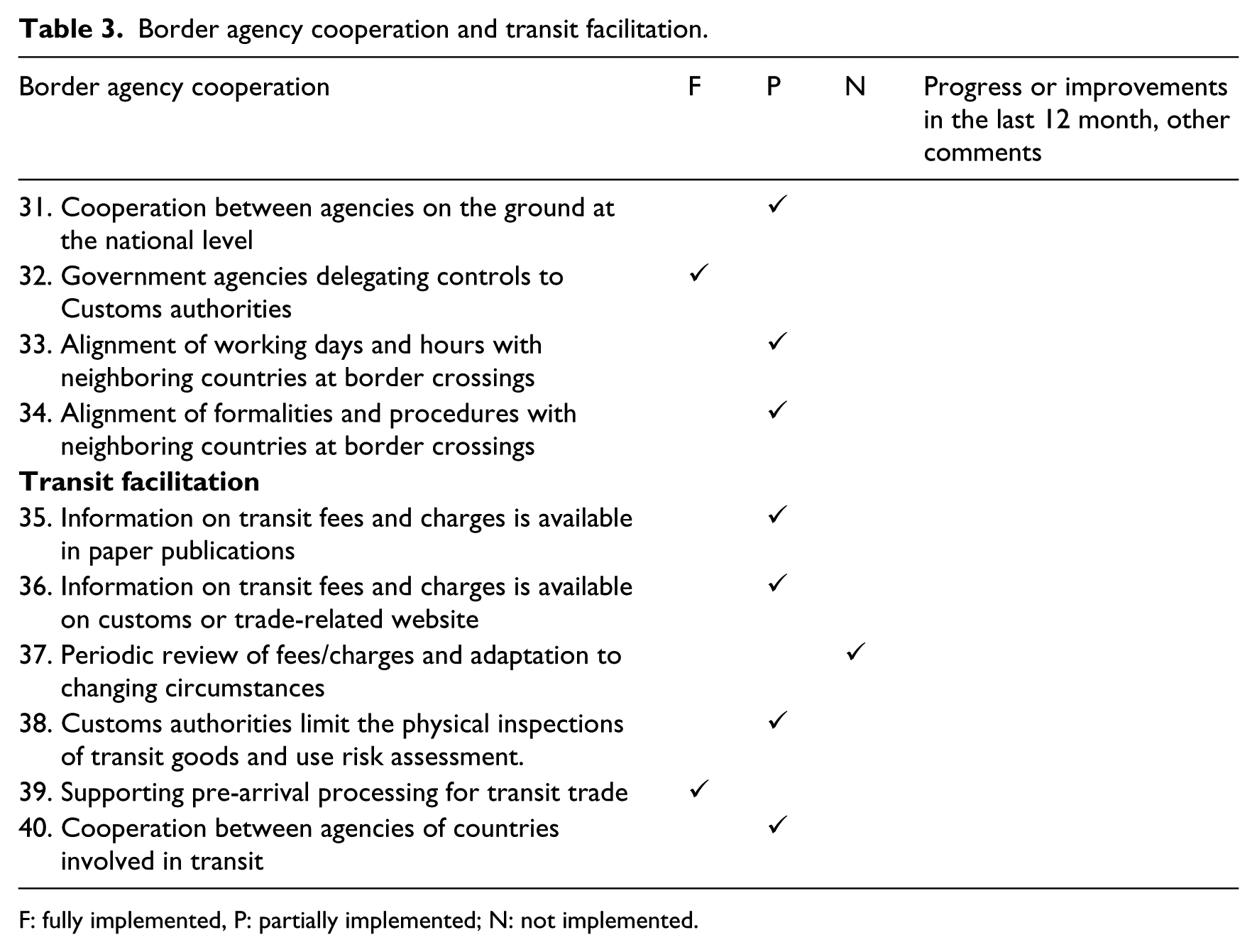
Last, but not the least, the most important aspects of TF are border agency cooperation and transit facilitation. The survey provides following results (Table 3).
Border agency cooperation and transit facilitation.
F: fully implemented, P: partially implemented; N: not implemented.
Border agency cooperation addresses the operational aspects of inter-agency cooperation inside the country together with agency cooperation of two countries across the border. When goods arrive at the border point, traders have to undergo multiple procedures with various agencies that check documentation and the physical condition of the goods, means of transport, and persons accompanying the goods. Agency cooperation helps to avoid duplication of inspection processes, such as the presentation of similar documents to several agencies. It is reported by Russian Customs that they are delegated with the necessary authority to provide cooperation with related agencies and avoid inefficiencies caused by government agencies’ lack of coordination.
For the other two measures of border agency cooperation—alignment of working days (33) and hours, formalities and procedures with neighboring countries at border crossings (34) —we can conclude from verifying the existing data that they are only partially implemented.
The survey results also show that the information on transit fees and charges (35) is either not published in Russia, or is difficult to find. The relevant information (36) is not available on the customs website, so traders have to make inquiries to trade-related websites, customs brokers or to various government departments or agencies to obtain information on the charges or prices for transit. Information about periodic reviews of fees/charges and adaptation to changing circumstances (37) is not identified.
Regulations for receiving permission for domestic customs transit, identified in Article 80-81 of Domestic Transit Procedures, are complicated and include lengthy procedures. Although Russia has implemented and supports pre-arrival processing for all incoming goods (39), including transit ones, further examination is required to confirm whether customs effectively limits the physical inspections of transit goods and uses risk assessment (38).
The extent of transit facilitation and cooperation between agencies of the countries involved in transit (40) usually depends on bilateral and multilateral agreements. These arrangements with special provisions have been basically prepared and operate between Russia and the European Union, and also among the members of Eurasian Economic Cooperation, which includes some members of CIS.
Trade-related information availability
As shown in Table 4, Russia, on a par with China, the Republic of Korea and Japan, has almost completely implemented measures to provide publication and availability of information on paper, on the internet, and in English, in addition to the local language. Indeed, Russia has made big efforts to provide publication and availability of access to regulations about various trade-related procedures. Relevant trade-related legislation (1), a summary description of importation, exportation and transit procedures (2), the forms and documents required for importation into, exportation from, or transit through the territory of that member (4), rules for the classification or valuation of products for customs purposes (7), laws, regulations and administrative rulings of general application relating to rules of origin (8), import, export or transit restrictions or prohibitions (9), penalty provisions against breaches of import, export or transit formalities (10), and appeal procedures (11) can be found on paper, on the internet, and in English. All of the above-mentioned legislations, provisions, and rulings are available on the consolidated Russian Customs website, which is updated regularly. The customs website also serves as a valuable place to answer enquiries on TF.
Trade-related information availability.

NP: not published, PP: published on paper, PI: published on Internet, IE: published in English.
We found it difficult to locate information on government websites about applied rates of duties and taxes of any kind imposed on or in connection with importation or exportation (C1–5). Moreover, information about procedures relating to the administration of tariff quotas or taxes is not identified for access (C1–13). We also tried to search for relevant information about fees and charges imposed by customs and other border/governmental agencies on or in connection with importation, exportation or transit (C1–6) in vain. The analysis of the customs website (C3) is presented in the next section.
Interpretations and observations
As we can observe from the survey results, Russia does not have a clear and standalone strategy for TF at national level. The plans and goals for TF and paperless trade development are embedded in various government programs and national projects, mostly in the concept of Customs Authorities Development Strategy until 2020 (2012). These programs include TF policies, but it is not clear in Russia whether such strategies are consistent and harmonized with the policy implementation framework. It remains subject to special concern in areas where there is no adequate coordination among different government departments. Going further, we have to be careful with conclusions about other general measures. Although the respondents from different Russian government agencies may claim that these measures are fully implemented, investigations of the details and effectiveness of implementation show that some of the measures exist only on paper, and in real terms trade procedures are still not simplified. For example, we analyzed more closely the implementation of risk management. Our survey shows that there is no country in Asia which would physically inspect all goods across the border. Sound risk management is fundamental to effective customs operations, reflected in the fact that all countries in Asia apply some form of risk management (Widdowson, 2005). The effectiveness of risk management can be evaluated by the rate of physical inspection. Rate of physical inspection (as % inspected out of shipments) is included in the World Bank Logistics Performance Index (Figure 1).

Rate of physical inspection.
A reduced rate of physical inspection is one of the main outputs of successful risk management. Countries with full implementation of risk management would not physically inspect more than 20% of goods—which is true for China, the Republic of Korea and Japan. A high rate of physical inspection in Russia shows that reasonable risk management is scarcely implemented. The main reason behind this lies in the unsystematic application of management procedures and practices provided by the customs and other relevant border agencies in Russia. Information on movements potentially presenting a risk is very limited. This kind of measure may have “punitive” characteristics, or may be caused by miscommunication and lack of data exchange between different agencies, which sometimes act in a separate manner. 1
Release time of goods stated in customs regulations (Federal Law No.311 Customs Regulations in RF (2010), Chapter 25: Release of Goods) is also subject to additional consideration. According to the opinions of the experts answering our survey, time of inspection and customs clearance often differ from that stated in the regulations, or may vary from one customs office area to another. This is also reflected in legislation itself: Article 220 of Chapter 25, Customs Regulations, provides a long list of reasons for why goods may be subject to prolongation of release time. For example, customs representatives in the office can make a decision to send goods for examination for the purpose of verifying declared information, with no permission to release the goods until the results of the examination. So, this kind of loophole in the legislation can create room for the frivolous interpretation of release times and other regulations.
Russia has fully implemented a mechanism to appeal the decisions and action/inaction of customs offices (Customs Code, Ch.7). However, this mechanism works under the framework of customs, and may suffer from biased and arbitrary decisions. A complaint may be lodged only in written form at the appellate body, while the answer to it may take up to 2 months. Further investigation is required to understand whether the traders are aware of the procedures to appeal, and to identify the numbers of satisfied and rejected complaints.
Paperless TF remains one of the biggest challenges in Russia’s trading system and customs. These measures have already been fully undertaken by Russian customs, but unfortunately the evidence provided from traders indicates very low efficiency of automatization at Russian border crossings—even with pre-arrival processing, the trucks have to wait in line for usually more than 3 hours (Korostelov, 2012). As mentioned earlier, an electronic single window facility is a logical evolution of the NSW. Russia is one of the slowest countries in Eurasia in implementing this measure.
Despite the existence of numerous regulations for electronic transactions, a single law for electronic trade has still not been created (Martynov, 2011). Art. 207 Chapter 5 of Federal Law No.311 Customs Regulations in RF vests the right of electronic declaration of goods. Regulations for electronic transactions, such as the process of issuance of digital certificates that certify the electronic identities of users and organizations and other requirements to be allowed for electronic circulation of documents, are embodied in the Federal Law of 06.04.2011 No.63 About Digital Signatures. This law describes all procedures to register and obtain a digital signature; these are very cumbersome, making it almost impossible for small traders to deal with, and leading them to work with customs through customs brokers.
The customs union among Russia, Kazakhstan, Belarus and some other CIS countries created prerequisites for the electronic single window (Martynov, 2011), but the system is not yet operating efficiently. De jure, it is possible to submit customs declarations, sea and air manifests and other certificates in electronic form, but only through multiple agencies which are not connected in one window. In practice, traders usually do not know how to use electronic systems and choose customs brokers to deal with complicated customs processes. Finally, traders have to prepare paper-based documents to submit to brokers, who pass this information to customs bureaus and other agencies. Therefore, Russia remains the least developed country in paperless cross-border trade in the North East Asia region, compared with China, the Republic of Korea and Japan, where over 90% of documents are submitted electronically (Tengfei and Duval, 2013).
Analyzing Border Agency Cooperation and Transit Facilitation, we find quite a high level of development in the legislation. However, in practice, complex clearance procedures have not yet been simplified and the time spent on this sufficiently reduced.
Information on the collaboration of border agencies with other countries for transit arrangements is limited. Russia has not concluded a transit agreement with China, or with Korea or Japan. Therefore, Russia is applying a general framework for transit operations, with them stipulated in the Customs Code of RF, Chapter 10, Domestic Transit Procedures. The simplified regulations are based on the TIR Convention, which Russia belongs to. However, the major winner from transit across Russia—China—is not the member of TIR, so the usefulness of this Convention is not fully materialized between them. Customs experts and traders often report that, even with transit permissions, they often become subject to all inspections for import cargo procedures and have to wait in the general line at border crossings (Korostelov, 2012). The issue of publication of existing import–export regulations has already been touched upon in Section B. The second part of the survey elaborated this area further for deeper understanding.
Given various aspects of international movements of cargo and the large number of import–export procedures, it is always a challenge for every country to provide all information about trade regulations in an easily accessible way. In recent years, Russia has almost completely overcome this challenge. However, further investigation is required to understand how easily information can be accessed at enquiry points and what the quality of consultations is.
Although the information on import and export procedures is fully published on the customs website, it has some weak points. First, the customs website is quite limited in terms of customs forms availability—only some documents and forms are available for downloading on the customs website. The customs website publishes only rules, but not examples, of customs classification—the traders have to inquire directly to customs and wait for the answer regarding their question. Second, the information about applied rates of duties and taxes of any kind imposed on or in connection with importation or exportation is mostly available in Russian on private trade portals, customs broker websites or by direct inquiry to customs officers. Reportedly, additional fees and charges imposed by customs may vary from one customs office to another, and depend on the interpretation of some procedures by customs officers. Obviously, the benefits associated with access to trade information on customs websites would be limited if the traders also faced similar difficulties in finding information on taxes and additional charges.
The last part of the survey also included three open questions about key challenges and recommendations for TF and paperless trade in Russia. The results indicate that Russia is making some progress towards implementation of NSW and increase of electronic documents turnover, but this progress is apparently slow. Unlike many developing countries in Asia, Russian challenges were not identified as “financial constraints” nor “limited human resource capacity”. Respondents noted that the most serious challenges faced by Russia in implementing TF measures are lack of political will, lack of cooperation between government agencies, and limited human resource capacity. Although the financial constraints for implementing new policies in Russia are not serious, the lack of political will and government reluctance to implement TF policies create serious impediments. Although Customs made significant efforts to improve information availability, the effectiveness of the information may be undermined by large gaps in some important aspects, or by being scattered across different government and private websites, caused by lack of communication among different agencies.
The analysis of the trade-related regulatory environment and TF measures in Russia cannot be absolutely comprehensive, as further in-depth investigation is required in some areas; this is beyond the scope of this paper. But generally, the results of the survey and key findings from the analysis can lead us to important policy implications for the Russian government.
Key challenges and policy implications
The reasons for the low effectiveness of TF measures are generally described by the poor working practices of Federal Russian Customs. Traders report low productivity of customs services and their inability to implement new regulations in the field. According to the Global Competitiveness Report 2012, Russia is ranked as 137 for the burden of customs procedures, out of 144 countries, which is lower than most developing countries included in the Global Competitiveness Index (World Economic Forum, 2012b).
Opaqueness of border administration is also one of the most serious issues in Russia. Corruption at the border and burdensome import procedures are in the top three most problematic factors for importing in Russia (World Economic Forum, 2012a). The Global Competitiveness Report 2012 ranked Russia number 120 out of 144 countries in terms of the extent of irregular payments and bribes (World Economic Forum, 2012b). Bryane et al. (2012) report that corruption in the Russian Customs Service costs about $223 million annually, with around 5% of companies claiming that they almost always (or always) pay bribes to representatives of the Russian Customs Service. As a result of the poor customs service, the number of days to complete import or export procedures in Russia is significantly longer than those of counterparts in North East Asia (see Figures 2 and 3).

Number of days necessary to complete import procedures.

Number of days necessary to complete export procedures.
Above is a detailed summary of the procedural requirements for exporting and importing a standardized cargo of goods in selected North East Asia countries. As we can see, preparation of documents for importing takes around 1 month in Russia, compared with half that in China and just several days in the Republic of Korea and Japan.
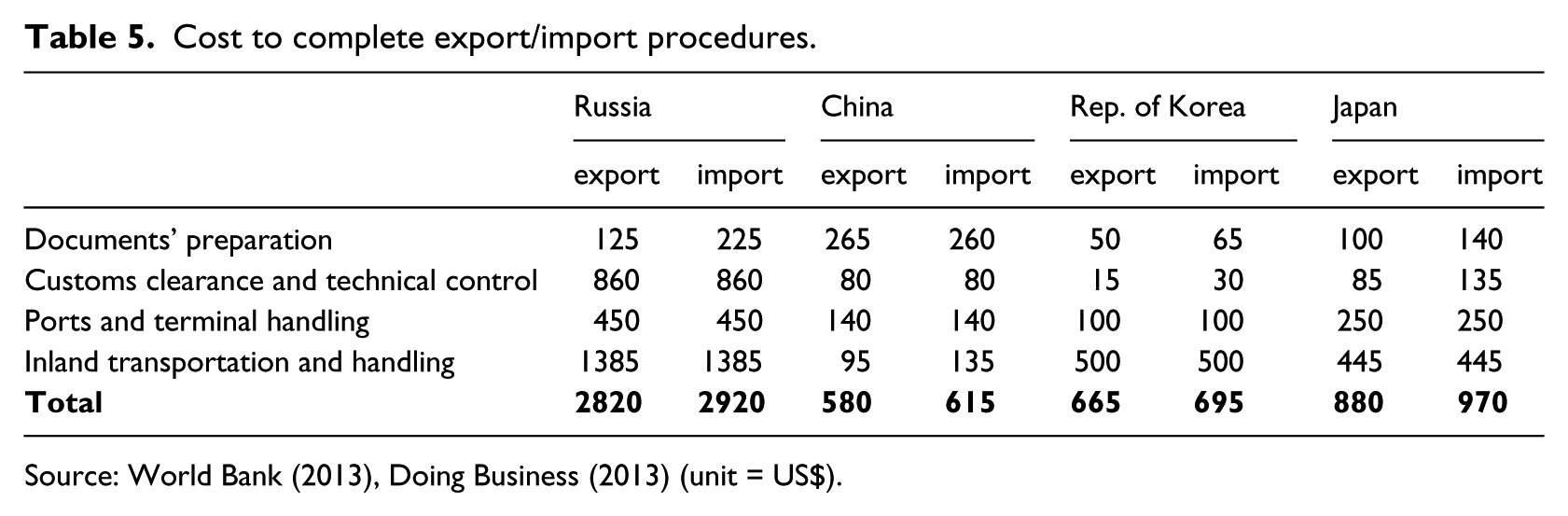
Not only are customs procedures burdensome and lengthy in Russia, but also their cost is very high. Below is the summary of export and import procedures costs in Russia, China, the Republic of Korea, and Japan (Table 5).
Cost to complete export/import procedures.
Source: World Bank (2013), Doing Business (2013) (unit = US$).
Costs of customs clearance and technical control in Russia are among the most expensive in Asia—860 US$, at least 10 times more expensive than in China, Japan, and Korea.
Taking into account of all the key challenges mentioned above, we can conclude that developing and implementing an effective and strong TF program is not an easy task in Russia. Progress with TF measures will require a strong political commitment from Russia, which we have not yet seen (Tarr, 2012). Our research confirms that inefficient government bureaucracy and corruption comprise a serious obstacle in securing freer trade with Russia. Without Big Bang reforms in Russia (Bryane et al., 2012), the attainment of TF seems unrealistic. To deal with these challenges, some policy suggestions are derived for the Russian government.
1. Full representation of the private sector in TF policymaking
UNESCAP and ADB (2013) recommend that, “after designating a leading agency for TF, the agency brings together all the diverse parties with interest in TF and provide an effective and coherent mechanism for identifying problems and developing solutions” (UNESCAP and ADB, 2013). However, the implementation of this recommendation may be quite complicated in Russia for the following reasons: First, it may be difficult to create a platform which will effectively represent all stakeholders from different locations in such a big country as Russia. Second, this body may remain inefficient because of possible bureaucratization of the body. In addition, some private sector providers of the service in Russia, e.g. transport providers or broker agencies, may not be supportive of TF consultations through simplified or automated trade procedures. One of the appropriate approaches for Russia may be the creation of a TF Forum bringing together all relevant sectors in an ad hoc working group format. This forum can be created at regional level in different districts of Russia, which then would bring ideas about TF to a central committee or body directly connected to customs.
2. Simplification and automatization of all trade-related procedures
Paperless trade and electronic automatization of procedures, including development of national or regional e-single windows, should become a main priority for TF in Russia. It is important to establish a single window platform at the national level which would provide an automated data exchange between Russian state agencies, so traders do not need to submit their documents more than once. To overcome challenges, the Russian central government needs to show its political will and commitment over several agencies to implement this measure and make it efficient. Use of modern information and communication technologies and the reduction of reliance on paper documents for trade transactions should be promoted vigorously by central authorities.
3. Nationwide re-enforcement of TF measures already adopted
The survey reveals that the majority of general TF measures, such as pre-arrival processing, post-clearance audit, or independent appeal mechanism, are already accepted and reflected in customs legislation but still not implemented effectively in practical way. It is also reported that procedures and the import/export process may vary significantly depending on the border crossing and customs office, even within one òblast (area). These findings recommend the central authorities re-enforce TF measures nationwide in Russia, and promote a change of mind-set among the officials of trade-related agencies in terms of the efficiency and importance of TF and their pivotal roles in it. A central authority can propose an agenda for further streamlining and harmonization of existing documents requirements, revision of regulations for dealing with discrepancies between statute and street, and correction of routine but wrong practices in the field.
4. Effective customs enforcement to improve customs inspections and control procedures
Russian Customs enforcement should focus more on the minimization of frequency and extent of physical inspections. All organizations involved in import–export processes are recommended to adopt more advanced risk management techniques and implement more restrictive guidelines for physical inspections at national level. Systematic use of risk management to determine which goods to examine, and development of clear criteria for “red” and “green” channels on border crossings are required. It also requires cooperation among all regulatory agencies upon creating a mutually recognized set of joint risk management procedures. Russia can take the example of New Zealand with its Joint Border Management System, which features a comprehensive approach for effective trade procedures including a common methodology for risk management, automated IT systems and agency-wide coordinating mechanism (New Zealand Customs, 2013).
5. Elimination of irregular payments, bribery and other unproductive practices
An objective assessment of the payment burden to traders for customs clearance needs to be conducted as a way to facilitate trade. The cost of customs procedures was found to represent one-third of the direct cost to complete export/import procedures. These payments are expected to be reduced after the introduction of NSW, risk management, and other advanced TF measures. Along with the reduction of regular payments, increased attention should be paid to the elimination of room for irregular payments, bribery, and other corrupt practices among officials. Simplified procedures along with local programs for promoting higher working moral standards among officials are recommended.
6. Harmonization of documentations based on international standards
Russia should give full consideration to signing and implementing relevant TF and transport-related treaties and conventions not yet joined by Russia. For instance, Russia can enforce implementation of the IMO Convention on Facilitation of International Maritime Traffic to simplify and harmonize maritime trade processes, which was ratified by the USSR in 1967, but not fully implemented in practice. In the context of international harmonization in Asia, the participation of Russia and countries from North East Asia in the promotion and development of these international standards can deepen cross-border collaboration and increase awareness of documents harmonization to build the capacity for implementation of further TF measures and standards across borders. The NTFB can help the government review existing conventions and their level of implementation to make suggestions for further improvements.
Conclusion
This paper investigates TF-related policies and the regulatory environment in Russia. The results of the survey show that many TF measures included in the WTO TF Agreement text have been already fully or partially implemented in Russia. However, our in-depth investigation finds that the de facto implementation of many general measures is lagging far behind the legislation. In practice, it is not clear for traders how some regulations and processes work for them, or how easily these measures can be applied to their transactions. For instance, seemingly and officially stated as fully implemented, the risk management measure does not work in the field, resulting in a high rate of physical inspections of import shipments to Russia.
Russia also remains one of the least developed countries in paperless TF and paperless cross-border trade in the North East Asia region, compared with China, the Republic of Korea and Japan, where over 90% of documents are submitted electronically (Tengfei and Duval, 2013). Although Russian Customs already support electronic submission of documents, traders still have to prepare most of the documents on paper. This study also confirms that trade-related legislation and information about relevant procedures are accessible through the national customs website. Russia has achieved quite a high level in trade-related information availability; however, the effectiveness of information services remains limited.
Key challenges for TF tasks in Russia are directly connected to or caused by the poor working practices of Federal Russian Customs. Government bureaucracy and corruption remain the most harmful factors entailing higher trade costs in Russia. Taking into account these challenges, we suggest the following six policy recommendations (Table 6).
Policy recommendations and proposed measures.

Increasing the consultations with stakeholders through NTFB, establishment of NSW, including an electronic one, and other measures such as risk management to improve the procedures and working practices of customs should be prioritized in Russia. Finally, unlike many developing countries in Asia, the most serious challenges faced by Russia in implementing TF measures are indicated as the lack of coordination between government agencies and the deficiency of political will. It is possible that local government agencies can start to undertake local initiatives and promote TF, but without a centralized coordination among local agencies by Moscow, backed up by a strong political will, successful implementations of TF policies may not be achieved.
Footnotes
Appendix
Questionnaire on TF measures and paperless trade in Russia.
| Section | Questions |
|---|---|
| Section A Information on Respondent | 1. Your organization is… |
| 2. Is your organization the lead agency for trade facilitation (i.e., assigned by the government to implement trade facilitation reform)? | |
| 3. How many years of experience do you have in trade facilitation? | |
| 4. What is/are your particular area(s) of expertise in trade facilitation? | |
| Section B: TF Measures | |
| 1. General TF measures: | 1. Establishment of a national TF body (NTFB). |
| 2. Publication of existing import-export regulations on the internet. | |
| 3. Stakeholder consultation on new draft regulations (prior to their finalization). | |
| 4. Advance publication/notification of new regulation before their implementation (e.g., 30 days prior). | |
| 5. Advance ruling (on tariff classification). | |
| 6. Risk management (as a basis for deciding whether a shipment will be or not physically inspected. | |
| 7. Pre-arrival processing | |
| 8. Post-clearance audit. | |
| 9. Independent appeal mechanism (for traders to appeal Customs and other relevant trade control agencies’ rulings). | |
| 10. Separation of release from final determination of customs .duties, taxes, fees and charges. | |
| 11. Establishment and publication of average release times | |
| 12. TF measures for authorized operators. | |
| 13. Expedited shipments. | |
| 14. National single window. | |
| 2. Paperless TF: | 15. Electronic/automated Customs System (e.g., ASYCUDA). |
| 16. Internet connection available to Customs and other trade control agencies at border crossings. | |
| 17. Electronic Single Window System. | |
| 18. Electronic submission of Customs declarations | |
| 19. Electronic Application and Issuance of Trade Licenses. | |
| 20. Electronic Submission of Sea Cargo Manifests. | |
| 21. Electronic Submission of Air Cargo Manifests. | |
| 22. Electronic Application and Issuance of Preferential Certificate of Origin. | |
| 23. E-Payment of Customs Duties and Fees. | |
| 24. Electronic Application for Customs Refunds. | |
| 3. Towards cross-border paperless trade: | 25. Laws and regulations for electronic transactions are in place (e.g. e-commerce law, e-transaction law). |
| 26. Recognized certification authority issuing digital certificates to traders to conduct electronic transactions. | |
| 27. Engagement of your country in trade-related cross-border electronic data exchange with other countries. | |
| 28. Certificate of Origin electronically exchanged between your country and other countries | |
| 29. Sanitary & Phyto-Sanitary Certificate electronically exchanged between your country and other countries. | |
| 30. Banks and insurers in your country retrieving letters of credit electronically without lodging paper-based documents. | |
| 4. Border agency cooperation: | 31. Cooperation between agencies on the ground at the national level. |
| 32. Government agencies delegating controls to Customs authorities. | |
| 33. Alignment of working days and hours with neighboring countries at border crossings. | |
| 34. Alignment of formalities and procedures with neighboring countries at border crossings. | |
| 5. Transit facilitation: | 35. Information on transit fees and charges is available in paper publications. |
| 36. Information on transit fees and charges is available on customs or trade-related website. | |
| 37. Periodic review of fees/charges and adaptation to changing circumstances. | |
| 38. Customs Authorities limit the physical inspections of transit goods and use risk assessment. | |
| 39. Supporting pre-arrival processing for transit trade. | |
| 40. Cooperation between agencies of countries involved in transit | |
| Section C: Trade-related information availability | |
| C1. Publication and Availability of Information | 1. Relevant trade-related legislation |
| 2. A summary description of importation, exportation and transit procedures | |
| 3. Importation, exportation and transit procedures (including port, airport, and other entry-point procedures) | |
| 4. The forms and documents required for importation into, exportation from, or transit through the territory of that Member | |
| 5. Applied rates of duties and taxes of any kind imposed on or in connection with importation or exportation | |
| 6. Fees and charges imposed by customs and other border/governmental agencies on or in connection with importation, exportation or transit | |
| 7. Rules for the classification or valuation of products for customs purposes | |
| 8. Laws, regulations and administrative rulings of general application relating to rules of origin | |
| 9. Import, export or transit restrictions or prohibitions | |
| 10. Penalty provisions against breaches of import, export or transit formalities | |
| 11. Appeal procedures | |
| 12. Agreements or parts thereof with any country or countries relating to importation, exportation or transit | |
| 13. Procedures relating to the administration of tariff quotas | |
| 14. Contact information on enquiry points (to answer inquiries on TF) | |
| C2. Enquiry Points | 1. Has your country established one or more enquiry points to answer reasonable enquiries of on TF? |
| C3. Customs website | 1. Has your country established a national Customs website? |
| 2. Is rate of duties published on Customs website? | |
| 3. Is information on import and export procedures published on Customs website? | |
| 4. Procedures of border agencies | |
| 5. Publication of rules and examples of customs classification | |
| Section D: Key challenges and recommendations for TF and paperless trade | 1. Referring to measures listed in Sections B and C, please list up to three trade facilitation measures for which your country has made the most progress in implementation |
| 2. Please describe any other important trade facilitation measures/initiatives implemented in your country in the last 12 months. | |
| 3. What are the most serious challenges faced by your country in implementing trade facilitation measures? | |

Acknowledgements
An earlier version of this paper was presented at Sogang IIAS Research Series in December 2014.
Funding
This research received no specific grant from any funding agency in the public, commercial, or not-for-profit sectors.