



Abstract
This article draws on a sample of recent legislative elections held in 43 countries of Sub-Saharan Africa in order to empirically estimate and explain the levels of party system nationalisation. The analysis demonstrates that the overall level of party system nationalisation in Africa is relatively low, but in this respect, Africa displays little difference from other developing regions of the eastern hemisphere. Within the set of explanatory variables, an important role is played by ethno-linguistic fractionalisation. However, the explanatory power of this factor is rather limited. A model of party system nationalisation, including electoral system effects, party system fragmentation and political regime characteristics, such as authoritarianism and presidentialism, is proposed and empirically validated. The model demonstrates that while the joint impact of the identified explanatory factors is strong and consistent, none of them can be singled out as the crucial determinant of party system nationalisation in Sub-Saharan Africa.
Introduction
Party system nationalisation, conventionally defined as the extent to which national parties receive similar vote shares across the territorial units of the state, is one of the fundamental party system properties. Unlike some other properties – such as fragmentation, ideological polarisation and institutionalisation – it has become focal in scholarship on political parties and party systems only recently, mostly in the course of the recent two decades. As of today, however, there is a large body of literature on party system nationalisation. Some of the studies are broadly comparative (Golosov, 2014b; Morgenstern et al., 2009), while others deal with specific regions of the world or groups of countries: Western Europe (Caramani, 2004; Lago-Peñas and Lago-Peñas, 2011), Latin America (Harbers, 2010; Jones and Mainwaring, 2003), post-communist countries (Bochsler, 2010b; Tiemann, 2012) and federal states (Chhibber and Kollman, 2004; Rodden and Wibbels, 2011). This literature clearly points to the paramount theoretical importance of party system nationalisation, as it unequivocally recognises that the formation of the national electorate, and thereby of a stable territorial pattern of party politics, is an essential prerequisite for the emergence and consolidation of liberal democracy. At the same time, recent research provides growing evidence that party system nationalisation is highly consequential for policy formulation and implementation (Castenada-Angarita, 2013; Cox and McCubbins, 2001; Riedl and Dickovick, 2014).
While research on the emerging party systems of Africa is rapidly gaining momentum, with the growing number of insightful studies involving general aspects of party formation and consolidation (Doorenspleet and Nijzink, 2014; Erdmann and Basedau, 2008; LeBas, 2011; Lindberg, 2006; Riedl, 2014) and the patterns of fragmentation, volatility and institutionalisation (Arriola, 2013; Kuenzi and Lambright, 2001, 2005; Lindberg, 2007; Mozaffar and Scarritt, 2005; Mozaffar et al., 2003; Mylonas and Roussias, 2008; Wahman, 2014; Weghorst and Bernhard, 2014), there are only two studies – both of them very recent – focused specifically on the dynamics of party nationalisation in the region. Wahman (2015) uses a dataset of disaggregate election results for 26 African countries to calculate nationalisation scores for individual parties and studies the correlates of party nationalisation, revealing that ethnic fractionalisation, the size of the geographical area and urbanisation affect party nationalisation, but only in the case of opposition parties. Incumbent parties, on the other hand, generally remain nationalised despite unfavourable structural conditions. Dealing with one of the possible determinants of party nationalisation in Africa, Bogaards et al. (2014) demonstrate that it is affected by ethnic party bans. A system-level perspective on party system nationalisation in Sub-Saharan Africa is absent in the literature. Meanwhile, the experience of comparative research on the formation of national political parties and electorates clearly suggests that such a perspective, while offering a necessary complement to individual-level studies, can provide additional insights into the phenomenon under investigation by viewing it from a different angle, both substantively and methodologically.
This gap in our knowledge is particularly undesirable in the light of the fact that one of the most protracted and fruitful debates on party formation in Africa is focused on the role played by ethnicity in determining the shape of party systems, with some scholars arguing that ethnicity is the primary basis of partisanship in the region (Horowitz, 2000; Mann, 2005; Posner, 2005), while others emphasise the importance of alternative explanations (Basedau and Stroh, 2012; Basedau et al., 2011; Franck and Rainer, 2012; Lieberman and McClendon, 2013; Lindberg and Morrison, 2008; Van de Walle, 2003). In particular, Elischer (2013) shows that in some of the countries, especially ones in which there is a large core ethnic group, political parties make fewer appeals based on ethnicity, instead defining themselves through economic and social policies or by rallying around a charismatic politician. Yet it is quite apparent that ethno-linguistic cleavages find one of their major expressions in the territorial patterns of party support, and especially so in Africa where ethnic populations are often territorially concentrated. In the context of this debate, therefore, it is essential to establish empirically whether the party systems of the region are nationalised, in which case the primacy of ethno-linguistic cleavages is questionable at best, or the levels of nationalisation are indeed very low.
The purpose of this article is twofold. On the one hand, I report empirical evidence on the levels of nationalisation attained by 43 party systems of Africa, including nearly all countries that have had party-structured elections, free or not free, in the course of the recent decade. On the other hand, I develop and test empirically, with a standard statistical technique, an explanatory model of party system nationalisation in Africa. The model, while embracing a limited number of factors – ethno-linguistic fractionalisation, electoral system effects, party system fragmentation and certain political regime characteristics – explains as much as 92 per cent of the observed variations in party system nationalisation. The analysis proceeds as follows. Firstly, I discuss the issues of measurement, provide detailed information about the data used in this study and, on this basis, report the empirical evidence. Secondly, I lay out my theoretical expectations regarding the factors of party system nationalisation in Africa, formulate a set of working hypotheses and operationalise the explanatory variables. In the third section, I report and discuss the empirical findings.
Measurement and the empirical evidence
For a long time, cross-national research on party system nationalisation had been hindered by the lack of reliable tools of measurement. In their breakthrough study, Jones and Mainwaring (2003) proposed a new measure, dubbed the ‘party system nationalisation score’ (PSNS), and operationally defined it as the inverse of the well-known Gini coefficient of inequality. It was soon generally acknowledged that the merits of the PSNS, speaking in terms of its ability to meet the theoretical requirements stipulated for the aggregate quantities of this kind, vastly exceeded those of earlier proposed indices (Bochsler, 2010a; Caramani, 2004). At the same time, the issues of measurement remain under discussion. Some scholars argue that for the PSNS and/or other available measures of party system nationalisation to better serve their purpose, they have to include information not only about the territorial unevenness of party support as such, but also about the varying sizes of territorial units, the numbers of electoral districts contested by individual parties and other aspects of party organisation and electoral systems. In accordance with this argument, they propose several ways of re-formulating the existing measures (Bochsler, 2010a; Kasuya and Moenius, 2008; Morgenstern et al., 2014).
In my view, the above-cited argument does not address the real problems in the ongoing research on party system nationalisation. On the one hand, it has to be recognised that the use of aggregate quantities inherently causes the loss of information, which practically means that even the primary target of measurement can be misrepresented. This tendency is well exemplified by one of the most widely used political science indices, the effective number of parties. Therefore, one must be extremely cautious when trying to pack information about different aspects of any phenomenon into a single quantitative indicator. A better approach, fully implemented in the mathematical build-up of the PSNS, is to concentrate on the main target of measurement (Taagepera and Grofman, 2003), leaving all other aspects for statistical controls.
On the other hand, as is quite apparent from the state of research, the main problem with the PSNS is that even with the limited number of information included, it is very difficult to calculate. One of the properties shared by it with its computational core, the Gini coefficient of inequality, is that the procedure of measurement involves rank-ordering all components from the largest to the smallest. The build-up of the PSNS is such that this procedure has to be performed for each of the parties in the system, sometimes numbering in hundreds. Given the lack of commonly available software, this makes it cumbersome to use wide cross-national samples and/or to include information about small parties, which is, however, necessary for proper estimation of party system nationalisation.
The main instrument of measurement used in this study is the index of party system nationalisation (IPSN), as developed by Golosov (2014a). The values yielded by the IPSN are very similar to those of the PSNS. The difference is that instead of the Gini coefficient, it employs as its computational core the Herfindahl–Hirschman index of concentration, a measure with conceptual credentials stemming from its closeness to one of the major statistical quantities, the standard deviation (Feld and Grofman, 2007). The Gini coefficient and the Herfindahl–Hirschman index are fundamentally related and can be presented in a generalised way (Taagepera and Ray, 1977), which provides the substantive basis for the possibility to use the PSNS and the IPSN interchangeably, without any significant loss of information.
The mathematical definition of the IPSN is thus:
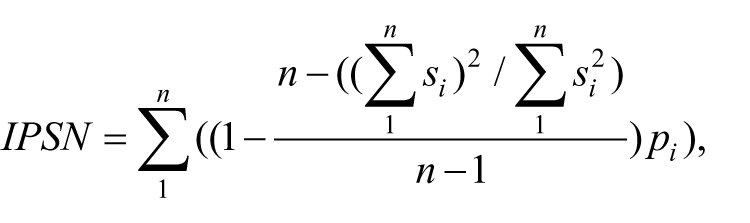
where sigma represents summation, n represents the number of electoral districts or other territorial units, si represents the percentage or fractional share of the vote received by the ith party in each of the territorial units and pi represents the fractional share of the vote received by the ith party nationally. The calculation of the IPSN does not require the rank-ordering of the components. The values of the index run from zero for those systems that completely lack institutionalisation, that is, each of the parties receives support in only one of many territorial units, to one for fully nationalised systems in which all parties enjoy equal support across all territorial units.
When building the set of observations for statistical analysis, I sought primarily to maximise its diversity by including as many country cases as possible. At the first step, the pool of potentially available cases was provided by 49 independent countries normally assigned to the geographical area of Sub-Saharan Africa. Four of these countries – Eritrea, Somalia, South Sudan and Swaziland – were excluded due to the fact that none of them had held any party-structured elections in the course of recent decades. Note, however, that South Sudan is indirectly included as a part of the 2010 Sudanese general elections. I also had to exclude three countries – Congo (Brazzaville), Gabon and Mauritania – due to the unavailability of district-level electoral data. My experimentation with the incomplete data on the three thus excluded cases, not reported below, demonstrated that their absence did not significantly affect the validity of the obtained statistical findings. At the same time, I found it possible to include one effectively independent but internationally unrecognised state, Somaliland, on the informed assumption that it has developed an autochthonous party system that owes little, if anything at all, to the disrupted party scene of Somalia. Thus the overall number of country cases in this analysis is 43.
As a rule, each of the 43 countries enters the sample with one of the three most recent elections to the lower or single chamber of its national legislature, selected on the basis of data availability, which generally restricts the chronological limits of inquiry to the decade of 2004–2015. As an exception, I included elections held in two countries, Equatorial Guinea and Sao Tome and Principe, in the first half of the 1990s. While the exception was necessitated by the unavailability of the sufficient data on later elections, my in-depth analysis of these cases suggests that the party systems developed in these small countries in the 1990s have not experienced any significant change over time, which makes the data from that period largely representative of the currents state of affairs. All numerical values presented and/or used in this study have been computed on complete electoral results, which means not only the availability of district-level electoral returns but also the absence of the ‘others’ category. This means, in particular, that any single political party, however small, has been taken into account in the computation of aggregate quantities. All independent candidates were counted as individual parties. I almost invariably used electoral districts as the basis for sub-national data aggregation. For the two countries that elect their assemblies in nationwide electoral districts, Namibia and Rwanda, the basis for data aggregation was provided by their upper-tier administrative units. The data sources used in this study are reported in the Appendix.
When reporting the empirical evidence on the levels of party system nationalisation in Sub-Saharan Africa, I find it useful to place the phenomenon into a wide comparative perspective by employing the cross-national dataset of Golosov (2014b). The mean IPSN of the African countries in the sample described above is 0.642 (n = 43). Quite expectedly, this is much lower than in Western Europe (0.827, n = 14), Latin America (0.838, n = 12) and Northern America and the English-speaking Caribbean (0.842, n = 12). However, the levels of party system nationalisation in Eastern Europe and the former Soviet Union (0.703, n = 12) and Asia and the Pacific (0.654, n = 15) are only slightly higher than in Africa, which implies that in this respect, the party systems of Africa are not very different from those of other developing regions of the Eastern hemisphere.
Table 1 reports the values of the IPSN for the 43 included country cases in the descending order of party system nationalisation. In order to provide a basis for cross-regional comparisons, the table also includes a number of non-African countries with broadly similar levels of party system nationalisation. As follows from the table, Africa’s party systems exhibit stunning diversity in terms of the observed homogeneity of party support. Some of these systems are highly nationalised even by international standards. If, as a rule of thumb, we take 0.700 as the threshold value that separates highly nationalised party systems from those in which regional political forces play an important role, then approximately half of the sample – 20 of 43 countries – pass the threshold. At the same time, party systems with levels of nationalisation below 0.500, which indicates that the national arena of party competition is severely underdeveloped, are relatively few. They form less than a quarter of the sample (10 observations). Of course, the observed diversity requires explanation, which is the subject of the remaining part of this article.
Party system nationalisation: Africa and the rest of the world compared.
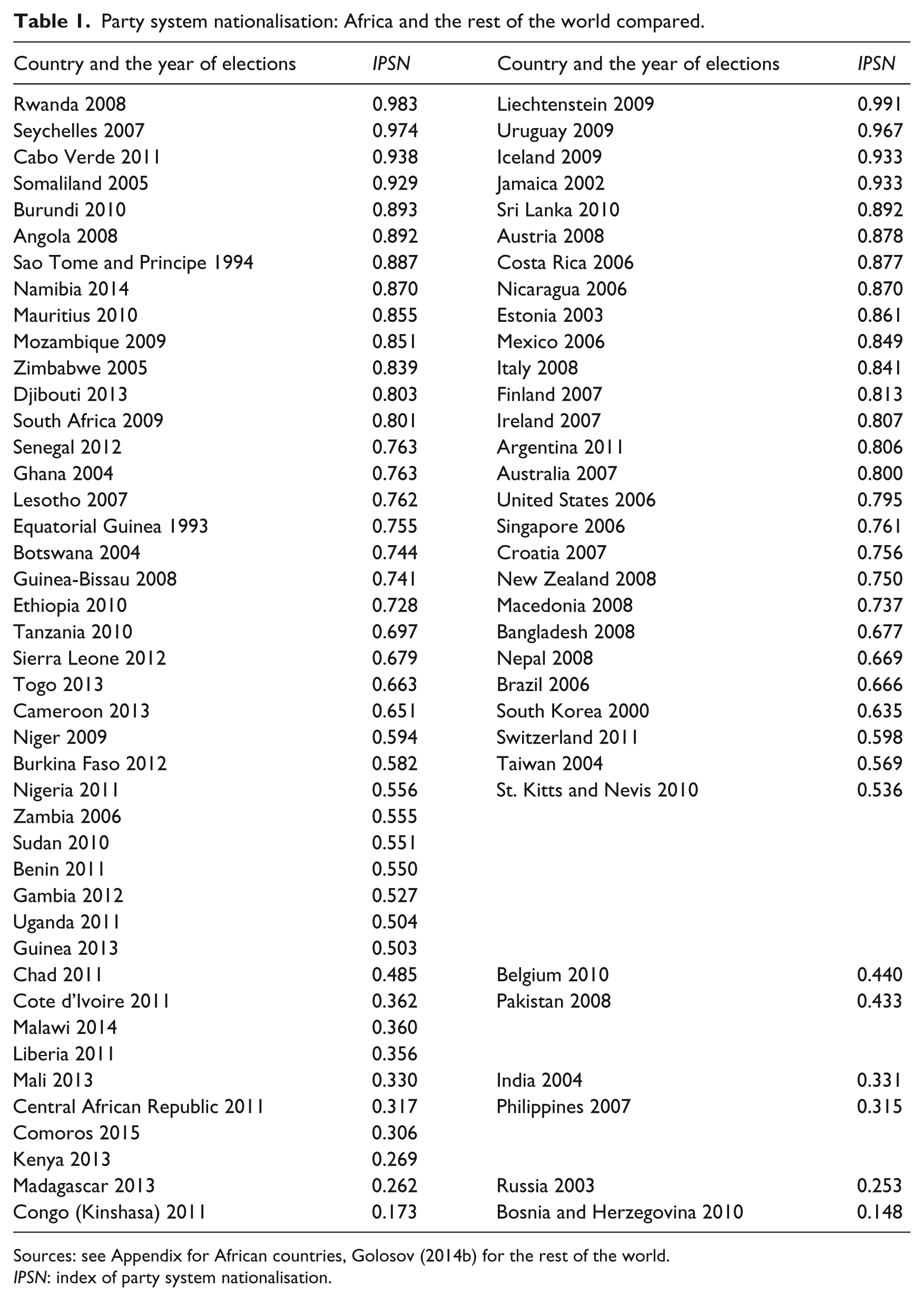
Sources: see Appendix for African countries, Golosov (2014b) for the rest of the world.
IPSN: index of party system nationalisation.
Theoretical expectations, working hypotheses and variables
As clearly suggested by the bulk of the previous literature on party system formation in Africa, one factor that certainly has to be entered into the explanatory model of party system nationalisation is ethnic diversity. Note that while the salience of this factor may be greater in Africa than it is elsewhere, which is a matter of empirical investigation, this causal linkage is by no means region-specific. In comparative research on political parties and party systems, it is traditional to explain their fundamental properties, such as fragmentation, with reference to the varying levels of societal diversity, among which ethno-linguistic diversity has always played a prominent role (Amorim Neto and Cox, 1997; Ordeshook and Shvetsova, 1994). In application to party system nationalisation, the negative association between the levels of ethnic and linguistic diversity and the territorial homogeneity of party support has been empirically validated by Golosov (2014b), even though the other cross-national analysis that includes a corresponding variable (Morgenstern et al., 2009) does not produce any strong evidence of such effects.
The related working hypothesis is quite unproblematic: the higher the level of ethno-linguistic diversity, the lower the level of party system nationalisation. In this study, ethno-linguistic diversity is operationalised as the index of ethno-linguistic fractionalisation (ELF), developed by Bruk and Apenchenko (1964) and updated by different scholars since then. The ELF, defined as the reverse of the Herfindahl–Hirschman index of concentration (1 – HH) in application to the decimal shares of all ethno-linguistic groups in the total population, had been widely used in previous research on political parties and party systems, often as a proxy for societal diversity in general. While the ELF has been criticised on different grounds, and viable alternative measures have been proposed in the literature (Fearon, 2003), there is no apparent reason to deny that within some limits of applicability, the ELF is a valid measure of ethno-linguistic diversity. The values of the ELF have been taken from the online appendix to Desmet et al. (2009).
The most influential theory of the institutional sources of party system nationalisation originates from the literature on party system fragmentation. According to one of the basic tenets of this massive literature, local political activism is strongly supported by electoral systems with low district magnitude, which is characteristic of plurality/majority electoral rules (Rae, 1967; Taagepera and Shugart, 1989). In some of the studies of party system fragmentation, the applicability of this approach to party system fragmentation in Africa has been put in question (Mozaffar and Scarritt, 2005), yet other studies made a rebuttal on methodological and substantive grounds (Bogaards, 2008; Brambor et al., 2007), which leaves the matter open for further empirical investigation. It is important to note, however, that the theory according to which there is a positive association between the permissiveness of the electoral system and party system nationalisation has been tested empirically and found to be entirely correct in the cross-national studies of Brancati (2008), Golosov (2014b) and Morgenstern et al. (2009).
Correspondingly, my second working hypothesis is that district magnitude (i.e. the number of representatives elected in the electoral district) is positively associated with party system nationalisation. The standard operationalisation of the related variable is apparent from the above: firstly, the average values are obtained by dividing the overall number of seats in the assembly (Ns) by the number of electoral districts (Nd); secondly, the resulting ratios are logarithmised: log(M) = log(Ns / Nd). The rationale for taking these values in a logarithmic form is explained in the literature (Lowery et al., 2010). In particular, the literature shows that despite its apparent simplicity, the log(M) measure serves quite efficiently as a numerical proxy for the complex concept of the electoral system.
At the same time, there is a long-standing argument according to which the specific effects of multimember plurality/majority rules cannot be captured by the log(M) measure (Benoit, 2001). Given the relatively wide spread of such systems in Africa (in Cote d’Ivoire, Djibouti, Mauritius and elsewhere), it has to be emphasised that while this argument may be intuitively appealing if applied to party system fragmentation, there is no apparent reason to extend it to party system nationalisation. Quite the reverse, there are theoretical grounds to believe that multimember districts undermine the territorial bases of party politics irrespective of seat allocation formulas. In fact, the formation of national electorates in Western Europe started in condition when multimember plurality/majority systems were no less widespread than in contemporary Africa (Caramani, 2004; Colomer, 2007), and those African countries that continue to employ such archaic electoral systems may well follow the suit. Thus, the operationalisation of the electoral system variable is generally unproblematic. One technical detail that has to be clarified at this stage is that when dealing with multiple-vote electoral systems, be it mixed systems (such as in Guinea or Sudan) or unlinked multitier proportional representation (such as in Burkina Faso), I invariably used the lowest tire as the basis for all calculations.
The idea that party system fragmentation is negatively related to the territorial homogeneity of party support has been present in the literature for a long time (Jones and Mainwaring, 2003). Indeed, it is intuitively self-evident and widely recognised in the literature (Cox, 1997; Katz, 1980; Powell, 1982) that small parties often survive due to the presence of stable territorial bases of support. Moreover, it can be argued that the relation between party system fragmentation and nationalisation in Africa is more straightforward than elsewhere. One of the major peculiarities of Africa’s political scene is a relatively wide spread of dominant-party systems (Bogaards, 2004; Doorenspleet and Nijzink, 2013; Randall and Svåsand, 2002; Van de Walle, 2003). Normally, such parties are built as wide multiethnic coalitions. Even if single-party dominance is absent, the small number of important parties still indicates that they receive cross-cutting support from different ethnic groups and territorial communities (Morrison and Jaw, 2006). The recent research of Wahman (2015) makes an important empirical contribution to this line of reasoning by demonstrating that the governing parties of African countries enjoy, ceteris paribus, much higher levels of nationalisation than opposition parties. Given that ethno-linguistic fractionalisation has been introduced into this explanatory model as a potentially decisive factor, it is therefore essential to establish the limits of its applicability by hypothesising that in low-fragmentation party systems, the levels of party system nationalisation will be higher than in the fragmented party system.
The standard operationalisation of the concept of party system fragmentation is the effective number of electoral parties (ENEP). As argued by several scholars (Bogaards, 2004; Erdmann and Basedau, 2008), the most widely used mathematical definition of the effective number of parties, as developed by Laakso and Taagepera (1979), is not entirely compatible with the outlook of Africa’s party systems because it does not adequately reflect low levels of fragmentation. Indeed, the value of the Laakso–Taagepera measure for a hypothetical constellation comprising one large party with 70 per cent of the vote and three small parties, each of them receiving just 10 per cent of the vote, is 1.92, which is obviously at odds with our intuitive understanding of this constellation. This makes me use an alternative index of party system fragmentation, developed by Golosov (2010) and defined as
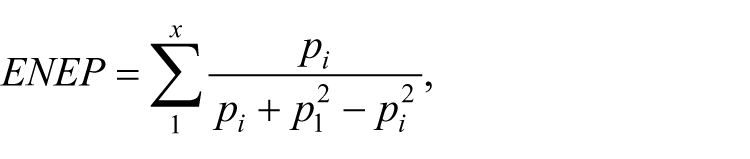
where pi and p1 represent the fractional shares of the national vote received by the ith and the largest parties, respectively. For a hypothetical constellation described above, this formula yields the value of 1.52, thus adequately characterising it as a dominant-party system. Note that while reducing the numerical values of the ENEP for low-fragmentation systems, the formula cited above does not produce unrealistically low scores for highly fragmented systems. To take another hypothetical example, the value of the Golosov index for a constellation of one party with 10 per cent of the vote and 18 parties with 5 per cent of the vote each is 16.65, while the Laakso–Taagepera index yields 18.18.
When started in the 1960s, contemporary research on party system nationalisation tended to conceive the formation of the national electorate in the USA as an important – perhaps even central – aspect of democratic institution-building in the country (Stokes, 1967). This tradition to link party system nationalisation to democracy was largely inherited by later streams of research, being well expressed in the above-cited literature on Western Europe, Latin America and the post-communist countries. While it is true that in the recent years, the focus of scholarship has markedly shifted to the causes of survival of regional political forces in well-established democratic polities (Gibson and Suarez-Cao, 2010; Schakel, 2013), there is no apparent reason to deny that some level of nationalisation of the vote is essential for democracy, especially in the early stages of democratic development. At the same time, the available empirical evidence – including some of the African cases – clearly suggests that in overtly authoritarian political contexts, territorial political cleavages may offer the only available venue for political contestation (Crook, 1997; Greene, 2007; Van de Walle, 2003). This makes me hypothesise that in more authoritarian regimes, the levels of party system nationalisation will be lower than in democracies.
In order to operationalise the concept of authoritarianism, I use the political rights scores (PRSs) assigned to individual countries by the Freedom House (2015). The values of the PRS run from one for full democracies to seven for overtly authoritarian regimes, which makes them suitable for measuring authoritarianism. Of course, I am aware that Freedom House’s procedures have been criticised on numerous grounds (Bollen and Paxton, 2000; Munck and Verkuilen, 2002). A detailed discussion of this subject is certainly beyond the scope of this inquiry. Suffice it to say, the alternative measures of democracy and/or authoritarianism are simply insufficient for this study in terms of their geographical and/or chronological coverage.
While I do expect that political regimes, as reflected in the values of political rights scores, exert a strong impact upon party system nationalisation in Africa, several conceptual clarifications and methodological improvements are in order. Even though it is clear that contemporary electoral authoritarianism is often associated with dominant-party systems, this is not necessarily the case. Historically, fragmented authoritarian party systems are not unusual. The major impetus for their emergence had been provided by the institutional weakness of legislative power (Anderson, 2000; Golosov, 2013; Jupp, 1971). In contemporary Africa, this factor is further aggravated in the ‘feckless pluralist’ regimes that, as convincingly argued by Rakner and Svåsand (2013), use formal democratic contestation involving a plethora of weak, ephemeral parties in order to consolidate the power monopoly of the political executive. In such regimes, the number of parties can be expected to interact with authoritarianism to the detriment of party system nationalisation. Hence, I hypothesise that in the presence of high fragmentation in the electorate, the negative association between authoritarianism and party system nationalisation is stronger than otherwise. The natural way to operationalise this hypothetical causal linkage is to use an interactive term, normalised by using the logarithm function and therefore defined as log(ENEP × PRS).
At the same time, there is no reason to expect that authoritarian regimes will be necessarily resistant to party system nationalisation. For instance, it has been argued that ethnic party bans, often, even if by no means necessarily, characteristic of authoritarian regimes, can be consequential for the territorial patterns of party support (Bogaards et al., 2014). In the literature, there is a tradition of relating the structural properties of authoritarian regimes to their longevity (Huntington, 1968). In particular, it can be plausibly hypothesised that in the long run, authoritarian regimes succeed in depriving opposition parties of their territorial bases of support. In this way, they contribute to the formation of highly nationalised patterns of party competition. As attested by the studies of party system formation in Africa (Riedl, 2014) and elsewhere (Hicken and Kuhonta, 2011), these patterns can even outlast authoritarianism.
The main problem here lies with identifying the empirical correlate for the notion of regime longevity. While the existing literature deals extensively with electoral authoritarian regimes that owe their longevity to rather high levels of institutionalisation, such as in pre-democratisation Mexico (Magaloni, 2006), the experience of many African countries demonstrates that for an authoritarian regime to last long, there is no need to maintain once-established institutional arrangements. Many autocrats safely survived transitions from single-party rule to electoral authoritarianism. Thus, the longevity of the political executive as such emerges as a factor that is likely to be positively associated with party system nationalisation in authoritarian regimes, which is the next hypothesis to be validated in this analysis. In line with this reasoning, the authoritarian executive longevity variable is defined as follows:

where Ye is the year of the legislative elections, Yp is the year of coming to power of the current holder of the chief executive position in the given political system and PRS is the political rights score for the year of the legislative elections. Division by 100 is performed in order to increase the numerical values of the coefficients for the sake of easier reporting. Note that when setting the values of Yp for the three effectively hereditary regimes – Congo (Kinshasa), Djibouti and Togo – I used the years of coming to power of the founders of these ‘dynasties’.
Speaking of the institutional characteristics of Africa’s political regimes that can be consequential for party system nationalisation, one factor that certainly needs to be addressed in this analysis is presidentialism. There is a small but steadily growing body of literature on the effects of presidentialism upon electoral fragmentation. The central concept of this research, the ‘coattail effects’, is built on the argument according to which a party’s prospects for success at the legislative level are contingent upon this party’s prospects in the presidential election (Jones, 1994; Shugart, 1995) and, therefore, there is a correlation between the effective number of parties in legislative elections and the number of important competitors in presidential elections (Golder, 2006; Williams-Wyche, 2014). At the same time, Golder (2006: 36) recognises that in party systems with low levels of institutionalisation, the temporal proximity between two types of elections may be less important than the very presence of a powerful presidency. This is certainly the case in Africa.
In application to party system nationalisation, this implies the following line of reasoning. If the number of important competitors in presidential elections is about the same as in legislative elections, then we can assume that both kinds of elections are structured along the same societal and/or programmatic divides, which is inconsequential for party system nationalisation. However, if we observe a significant discrepancy, it suggests that while appealing to national political forces in presidential elections, the dominant political groups leave the legislative electoral arena open for the expression of local political alignments. Of course, the influence of this discrepancy – further referred to as ‘presidential/parliamentary elections asymmetry’ (PPA) – can be properly assessed only if the overall level of legislative fragmentation is taken into account. Therefore, the related variable is operationally defined as follows:

where ENEP is the effective number of parties in legislative elections and ENPP is the effective number of candidates in the most recent or concurrent presidential elections. When building this variable, I do not draw a distinction between presidential and semi-presidential systems. Note that the variable is coded as zero for all systems without directly elected presidents, irrespective of their institutional peculiarities. The descriptive characteristics of the variables in this analysis are reported in Table 2.
The descriptive characteristics of the variables (n = 43).
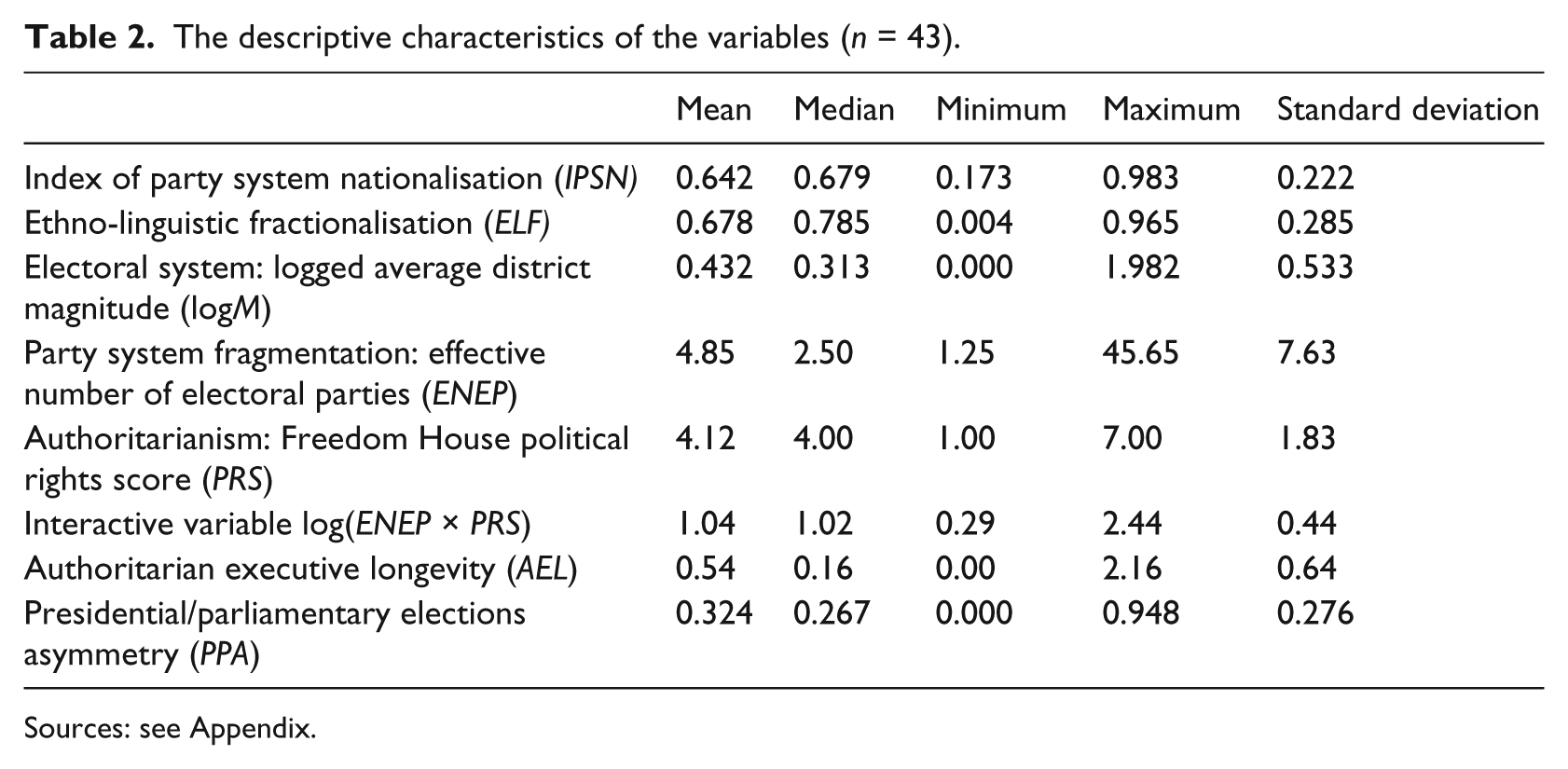
Sources: see Appendix.
The method and findings
Table 3 reports the main results of statistical analysis (multiple linear regression). A brief discussion of the statistical properties of the reported models is in order. Since some – albeit very modest – levels of heteroscedasticity in the models have been detected, I report only robust standard errors for all estimations. In both models reported in the table, the difference between the robust and non-robust estimations of error terms is negligible. It can be noted that the skewness of the distribution of standardised residuals in Models 1 and 2 is 0.28 and 0.49, respectively, which means that the distributions are very close to perfect normality. Given the presence of several explanatory variables that are either interactive or account for multiple factors, multicollinearity was my major concern. As apparent from the table, the difference between Models 1 and 2 stems from the fact that one of them includes the ENP and PRS variables as such, while the other replaces them with the interactive term, which is done specifically with the aim of decreasing multicollinearity. Upon this adjustment, the conventional tests did not detect any violations of the assumptions of multiple regression analysis. The mean and maximum Variance Inflation Factors (VIFs) for all variables in Models 1 are 1.59 and 2.03, respectively. In Model 2, the mean and maximum VIFs are 1.43 and 2.01, respectively. This is very far from the threshold value of 10 recommended by the majority of statisticians (Kennedy, 1992). My analysis of the condition indices obtained from eigenvalues also did not reveal any significant problems related to multicollinearity. Given the explanatory power of the models, with R-squared values of 0.87 in Model 1 and 0.92 in Model 2, this opens the way to a rather confident substantive interpretation of the coefficients.
Factors of party system nationalisation in Africa (n = 43).
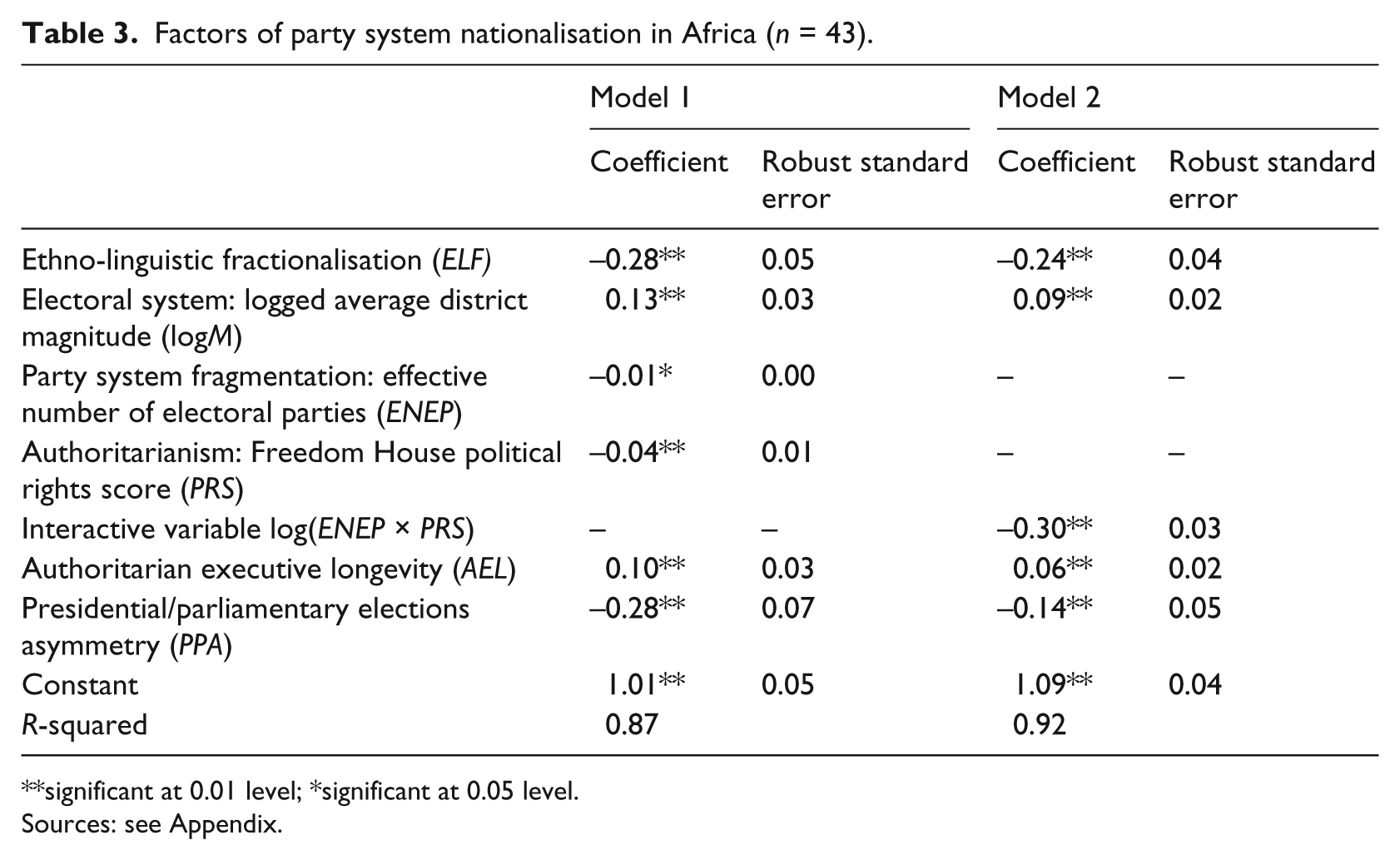
significant at 0.01 level; *significant at 0.05 level.
Sources: see Appendix.
As follows Table 3, all coefficients in both models are highly statistically significant. They have the theoretically predicted signs. When interpreting the coefficients, I was guided primarily by the crucial task of establishing the relative importance of ethno-linguistic fractionalisation vis-à-vis other explanatory variables. In order to solve this task, I started with the usual procedure of analysing the predicted values of the IPSN under the variable impact of the explanatory factors. If the values of all independent variables are set at their means, as reported in Table 2, then the value of the IPSN predicted in Model 1 is 0.642. If ethno-linguistic fractionalisation were to increase by one standard deviation, then party system nationalisation would decline to 0.562, that is, by 12.44 per cent. This is, indeed, the strongest impact of any individual variable registered in Model 1. However, other explanatory variables are not very inferior in their explanatory power. Performing the same procedure on other factors that are negatively associated with party system nationalisation, we obtain the predicted values of 0.564 (12.12 per cent decrease) with presidential/parliamentary election asymmetry; 0.569 (11.33 per cent decrease) with political rights scores; and 0.584 (9.02 per cent decrease) with the effective number of electoral parties.
The variables that are positively associated with party system nationalisation are comparably strong. If logged average district magnitude were to increase by one standard deviation from its mean value, which in substantive terms corresponds to a shift from a most likely majoritarian system with the average district magnitude of about 1.4 to a most likely proportional system with the average district magnitude of about 9, then party system nationalisation would rise to 0.713, that is, by 11.04 per cent. With the authoritarian executive stability variable, the same procedure yields 0.705 (9.89 per cent increase). Model 2 differs from Model 1 in that upon the introduction of the log(ENEP × PRS) interactive term, it emerges as the strongest variable in the model. If the value of the interactive term were to increase by one standard deviation, then party system nationalisation would decrease by more than 20 per cent. At the same time, the impact of ethno-linguistic fractionalisation remains about the same as in the previous model, while the explanatory power of other variables declines, even though all of them retain high levels of statistical significance. My analysis of standardised coefficients, not reported here, produced a very similar picture of the relative explanatory strengths of the independent variables.
Thus, while being quite important in itself, ethno-linguistic fractionalisation is by far not the factor that exhausts the causes of party system nationalisation in Sub-Saharan Africa. Other factors play comparably important roles. The substantive implications of this conclusion will be presented below. At this moment, it is important to address one issue that might be important for the assessment of the overall validity of the reported models. It is conventional to explicate the causal logic beyond the theoretically expected effects of one of the major explanatory variables, logged average district magnitude, on the assumption that electoral rules operate in a democratic context. In the literature on the impact of electoral systems upon party system fragmentation, it has been argued that the applicability of such theories to overtly authoritarian contexts should be limited. Indeed, in a recent study of Africa’s party systems, Mylonas and Roussias (2008) demonstrate that in authoritarian conditions, electoral systems with large district magnitude may sustain very concentrated party systems, which is quite consistent with my own observations.
Of course, there is no apparent reason to assume that electoral systems will affect two substantively different party system properties, fragmentation and nationalisation, in the same way. Quite the reverse, as argued in the previous section of this article, I expect district magnitude to exert its impact upon party system nationalisation irrespective of political regime. In order to validate this expectation empirically, I performed an additional test on a different sample obtained by removing all countries with the political rights scores of one or two, that is, full-fledged democracies. This reduces the overall size of the sample to 32. The resulting models, not reported here, display little difference from the models discussed above. In fact, the overall explanatory power slightly increases, yielding the R-squared value of 0.89 for the model that is structurally analogous to Model 1, and 0.94 for the model that is structurally analogous to Model 2. Among the individual variables, only the effective number of electoral parties significantly declines in explanatory power, even though it is significant at the 0.1 level when entered into the regression independently, and remains essential for increasing the strength of the model upon the introduction of the log(ENEP × PRS) interactive term. More importantly for this analysis, the exclusion of full-fledged democracies does not affect the performance of the log(M) variable, as attested by the fact that while the standardised coefficients for this variable in the Models 1 and 2 reported above are 0.319 and 0.225, respectively, in the structurally analogous models obtained on the reduced sample they are 0.302 and 0.245, respectively. Therefore, as far as party system nationalisation is concerned, electoral system effects are exerted irrespective of political regime.
Conclusion
The most general conclusion that can be drawn from the analysis presented above is that it finds very little evidence of Africa’s exceptionalism, as far as party system nationalisation is concerned. While the overall level of party system nationalisation in Sub-Saharan Africa is relatively low, it is quite similar to the levels observed in other developing regions of the Eastern hemisphere, Asia and the Pacific and Eastern Europe and the former Soviet Union. The analysis does not support the idea of a paramountly important role played by ethno-linguistic fractionalisation in shaping the party systems of Africa. While the impact of this factor in Africa is quite visible, as it is in all other regions of the world, a comprehensive explanatory model of party system nationalisation in Africa can be obtained by entering several other factors.
Firstly, party system nationalisation in Africa is strongly conditioned by electoral system effects. Greater district magnitudes lead to more homogeneous territorial patterns of party support. Secondly, there is a negative association between party system nationalisation and the number of parties in the system. Thirdly, the characteristics of the political regime are essential for our understanding of party system nationalisation in Africa. The observed effects of these characteristics are not straightforward. On the one hand, lower levels of democracy are associated with lower levels of party system nationalisation. On the other hand, however, highly consolidated, long-lasting authoritarian regimes can also contribute to party system nationalisation. Presidentialism reduces party system nationalisation if the structures of party competition in presidential and legislative elections are asymmetrical, but not otherwise. Thus, the overall level of party system nationalisation in Africa is defined by a number of comparably important factors, with ethno-linguistic fractionalisation being ‘the first among equals’ at best.
Footnotes
Appendix
Funding
This research received no specific grant from any funding agency in the public, commercial or not-for-profit sectors.