




Abstract
In the last decade, negative attitudes towards the United States have increased throughout the world. Though the United States and East Asian countries have relatively had harmonious relationships, anti-Americanism is still prevalent for various reasons. In spite of China’s increasing economic interdependence with the United States, the country is succeeding to its long history of anti-Americanism. Although Japan and South Korea have been considered pro-United States allies since the Korean War (1950–1953), the countries’ younger generations have often expressed critical opinions of the United States. What is the cause of this anti-American sentiment in the East Asian countries? The purpose of this study is to examine the determinants of anti-American sentiment in East Asian countries using a cross-national survey. The results of the empirical analyses support previous approaches and promote four theoretical concepts: (1) the people’s knowledge and curiosity about the United States is the most influential factor of anti-American sentiment for East Asian college students (the cognitive-orientation); (2) individual’s attitudes towards American culture and society influence anti-American sentiment in East Asian countries (the cultural-cleavage); (3) anti-American sentiment in East Asian countries is mostly affected by people’s general ideas about the roles of the United States in the world and United States’ foreign policies (the anti-hegemony); and (4) the people’s general perception on the relationship between their own countries and the United States is another determinant of anti-American sentiment in East Asian countries (the equal-relationship). In contrast, it explains that gender and the financial condition of East Asian college students are not significant determinants of anti-American sentiment.
Introduction
The overarching question is how do others view the United States of America? What is the foreign publics’ opinion of the American people and its institutions? Do they agree or disagree with our politics and policies? Do they like or dislike American ideals and culture? In the early years of the 21st century, popular opposition towards the United States seems to be on the rise in many parts of the world, such as East Asia.
Anti-American sentiment in East Asia is particularly evident in China, Japan, and South Korea. China is still unfavorable towards the United States despite their increasing economic interdependency, and Japan and South Korea’s younger generations have started expressing their dislike despite having been long-time allies since the Korean War (1950–1953) (Hathaway, 2003; Kim, 2014; Moon, 2007). This study explains what caused this recent wave of anti-Americanism.
This study investigates the character and sources of foreign attitudes towards the United States using empirical investigations that tap into the East Asian perceptions. Its primary goal is to shed empirical light on the phenomenon that is anti-Americanism in East Asian college students of China, Japan, and South Korea. To accomplish this, surveys in these three countries were conducted from 2013 to 2014.
Anti-Americanism in East Asia
In the last decades, negative attitudes towards the United States have increased around the world. This is even the case even in East Asia. In spite of increasing economic interdependency with the United States, China is still maintaining its history of anti-Americanism. Although Japan and South Korea have been considered strong allies of the United States and very pro-American countries since the Korean War, the younger generation unlike the older, often criticize the United States.
In China, there has been a history of anti-American sentiment with a general disrespect for foreigners since the early 19th century. The Boxer Rebellion (1899–1901) was a violent anti-foreign, anti-Christian, and anti-Western movement that took place in China. It was motivated by nationalist sentiments and opposition to foreign imperialism and Christianity (Cohen, 1997). As a Western imperial force, the United States was considered an enemy of China.
After the Communist revolution in 1948 Mao Zedong launched an anti-American campaign that intensified as China and the United States fought the Korean War. Michael Sheng (1994) argues that Mao never intended to have friendly relations with the United States. Mao condemned the United States as a paper tiger, an occupier of Taiwan, the enemy of the people of the world, and a monopoly of capitalist groups. However, since the Chinese economic reforms of the 1980s, hostility has gradually diminished with the increase of large-scale trade, investments, and cultural exchanges.
Nevertheless, the conventional wisdom in the United States is that anti-Americanism is once again on the rise in China, particularly among Chinese youth, as China begins to foster nationalism and replace Marxism-Leninism as the basis of its legitimacy (Johnston and Stockmann, 2007). For example, the Taiwan Strait crisis caused China to blame the United States for any issues that rose in the bilateral relationship between China and Taiwan. The Chinese believed American support of Taiwan was an effort to weaken their country (Ma, 2002). Relations were especially strained by the North Atlantic Treaty Organization bombing of the Chinese embassy in Belgrade in May 1999. Though it was an accident and an intelligence error, the Chinese claimed the bombing to have been deliberate. Because the mass media is censored and controlled by the government, the Chinese government is capable of manipulating the new sources and creating anti-American sentiment among the Chinese people anytime.
In Japan, the United States’ military presence in Okinawa remains a contentious issue. Objections to the presence of American military personnel are often reported as anti-Americanism as seen in the 1995 Okinawan rape incident. While protests have usually risen because of such specific incidents in Japan, they are often reflective of deeper historical resentments. According to Robert Hathaway (2003), the growth of anti-American sentiment in Japan is not simply a response to American policies and actions, but a greater, deeper reflection of domestic trends and developments within Japan. In Japan, pacifism on the political left and nationalism on the political right have contributed to anti-Americanism in the post–World War II era despite that Japan has been a longtime ally of the United States.
In South Korea, anti-Americanism also represents the collective venting of accumulated grievances in many instances that have been hidden for decades although the majority of Koreans support the American alliance (Moon, 2006). This negative sentiment has been motivated by the rejection of authoritarianism and a resurgent nationalism in the 1980s. This nationalistic anti-Americanism continued into the 2000s fueled by a number of incidents such as the International Monetary Fund economic crisis, the Yangju highway incident when two Korean middle school students were run over by a United States Army vehicle, the Apolo Ohno Olympic controversy, and the 2008 protest in South Korea against United States beef (Kim, 2003). Anti-American sentiment in South Korea reached especially high levels during the time although a majority of South Koreans were still reported as having a favorable view of the United States in 2009 (Pew Research Center, 2010).
Previous research on Anti-Americanism in the world
Anti-Americanism has been described by many different scholars in many different ways depending on location and context. For instance, Peter Katzenstein and Robert Keohane (2007) define anti-Americanism as a psychological tendency to hold negative views of the United States and of its society in general. In this sense, they explain anti-Americanism is an attitude that is largely determined by the political situation in the country or region. Therefore, it can portray the actions and policies of the United States in either a positive or negative light. Alvin Rubinstein and Donald Smith (1984) define anti-Americanism as anything from policy disagreements between governments (issue-oriented) and deliberately generated outbursts for domestic political use by the government (instrumental) to antagonism rooted in belief systems such as Marxism and Islamic fundamentalism (ideological) as well as a variant that becomes a central form of legitimation after a revolution (Rubinstein and Smith, 1984).
On the other hand, Stephen Haseler believes true anti-Americanism is the opposition to the cultural and political values of the United States (Haseler, 1985). This narrower viewpoint is also used by Kenneth Minogue who describes anti-Americanism as “a form of xenophobia” (Shin, 1996). This split in thought is summarized by Katzenstein and Keohane (2007) as they try to determine whether anti-Americanism is based on what the United States is or what it does. They explain that both are valid, albeit different forms of anti-Americanism. Using the definitions of Alvin Rubinstein and Donald Smith (1984), the issue-oriented form would be that anti-Americanism is based on what the United States does, while the ideological form would be anti-Americanism that is based on what the United States is. Gi-Wook Shin (1996) makes a connection with this idea using French anti-Americanism as an example; anti-Americanism in France is a mixture of cultural and ideological criticism. In France, cultural anti-Americanism is a highly defensive response to threats (perceived or real) to national and cultural identity. In a sense, he is saying that many French believe American culture is threatening to the French culture, and therefore, in an act to preserve their own cultural identity, they reject all American influence. Ideologically, French anti-Americanism is expressed as anti-capitalism. He also argues that the German Green Party is a similar expression of anti-Americanism (Shin, 1996).
In Central America, Shin (1996) explains that anti-Americanism takes the form of rejecting the political and economic dominance of the United States. Katzenstein and Keohane (2007) describe this type of nationalism as sovereign-nationalist which is when a country perceives American power to be a threat to its sovereignty and welfare. Sovereign-nationalist has the mentality that [they] are rich because we are poor; we are poor because they are rich. These countries which include not only Latin America, but also parts of Asia, the Middle East, and Africa are reacting to current actions of the United States and their own histories. The countries that exhibit sovereign-nationalist anti-Americanism have usually had a long struggle for their independence and sovereignty. Hence, like France’s cultural anti-Americanism, their negative attitudes towards the United States are largely defensive when United States’ actions are perceived as detrimental to nationalism, sovereignty, or the exercise of state power.
Although it is not the most common form of anti-Americanism, Islamic fundamentalism is the most radical and persistent form of ideological anti-Americanism. Shin (1996) argues that it goes beyond the defensive attitudes mentioned above because it is religiously grounded and legitimized. Katzenstein and Keohane (2007) describe this attitude as “radical anti-Americanism” which consists not only of Islamic fundamentalism, but Marxism, and “argues for the weakening, destruction, or transformation of the political and economic institutions of the United States.” This type of anti-Americanism is not merely defensive, but it can also be offensive. A branch of this radical and ideological anti-Americanism is called Occidentalism and represents a wider clash of cultures as it is not only the United States that is targeted, but Western culture in general. The United States is regarded by these cases of anti-Americanism as the most evil leader of the Western countries. It is important to note, however, that radical anti-Americanism is not necessarily always violent, but it tends to be the most violent of the forms of anti-Americanism.
Two theories of Anti-Americanism
The measurement of a concept presupposes definition of said concept. The term anti-Americanism, or the anti-American sentiment, refers to opposition or hostility to the people, culture, society, policies, economics, and/or superpower role of the United States. Contemporary negative stereotypes of Americans suggest that they are aggressive, arrogant, ignorant, overweight, poorly dressed, materialistic, obsessed with financial gains, too moralistic, and generally obnoxious (Melton, 2005). Brendan O’Connor (2004) suggests that Anti-Americanism cannot be isolated as a consistent phenomenon because the term originated as a rough composite of stereotypes, prejudices, and criticisms towards Americans and the United States; however, it is now evolving into a more politically-based criticism. Marie-France Toinet also says use of the term “is only fully justified if it implies systematic opposition – a sort of allergic reaction – to America as a whole” (O’Connor, 2004). Discussions on anti-Americanism have, in most cases, lacked a precise definition of what this sentiment entails. As a result, the term is broadly used in a negatively impressionistic manner by those foreign to the United States (O’Connor, 2004).
Historically, the main anti-American debate in the literature can be effectively narrowed down to a contestation between two major frameworks. The first one views anti-Americanism as part of a coherent belief system incorporating opposition to liberal democracy and capitalism, if not also to modernity at large. Thus, it largely disagrees with American politics and government. The alternative approach, however, emphasizes complexity and ambiguity of popular attitudes toward the United States and its sensitivity to messages received through the channels of political communication (Chiozza, 2009).
After reviewing various attempts to define “anti-Americanism” and its empirical referents, Chiozza (2009) elaborates that there are two antithetical views definitions. First, “anti-Americanism is a cultural syndrome” in which opposition to America encompasses all that America does and stands for and second, “anti-Americanism is a feature of the belief system” that is predominant in a society. He argues that these two views portray divergent conceptions of the beliefs and attitudes that are usually subsumed under the same category of anti-Americanism.
These two master narratives are premised on different normative perspectives and stem from different scientific traditions about international affairs. As is always the case with divergent interpretations of social phenomena, each narrative commands a degree of empirical plausibility and its own assortment of intellectual supports. If we seek to extend our understanding of the attitudes towards the United States beyond such prima facie empirical plausibility, such narratives should be subject to intensive empirical investigation. Therefore, in this study, we explore how such negative attitudes towards the United States were structured based on the beliefs of college students from China, Japan, and South Korea.
Variables, hypotheses, and data
This study elaborates on the empirical profile of the individuals who are more likely to express anti-American opinions. Using regression modeling, we evaluate several propositions about the demographic and attitudinal characteristics of the individuals expressing anti-American views. As already mentioned the samples for the survey come from three East Asian countries, China, Japan, and South Korea, from 2013 to 2014.
What kinds of respondents were more likely to formulate negative attitudes towards the United States? This study first considers a series of demographic indicators, which then acts as a standard measurement in this public opinion analysis. The goal is to identify some basic characteristics of the respondents and to then compare whether or not there were any differences across the three East Asian countries. We particularly took into account the demographic characteristics of gender and financial condition. Each demographic indicator likely captures alternative motives that animate popular opposition to the United States. For examples, a male student’s opinions and thoughts may differ from that of a female’s simply because of their gender. This is likewise for financial condition as well. Thus, what irritates or upsets a rich male or female will most likely differ from what bothers a poor male or female.
This study then assumes that each respondent’s profile reflects his/her fundamental experience of socialization and mediation of opinions and thoughts about the United States as well as his/her overall attitude on things such as United States foreign policy, free market economics, and the modern life. Therefore, we consider four causal hypotheses: (1) the cognitive-orientation hypothesis; (2) the cultural-cleavage hypothesis; (3) the anti-hegemony hypothesis; and (4) the equal-relationship hypothesis. These hypotheses can be engaged in a confrontation of the empirical record to go beyond the assertion of who says what of the United States and then evaluate some of the reasons why such opinions are held.
The cognitive-orientation hypothesis assumes that those who have closer contacts and better information about the United States are less likely to hold negative views of the country. This perspective undermines the argument advanced by Joseph Nye (2004), who claims that social interactions with the United States foster socialization into the values and goals of the United States. For that reason, Nye advocates cultural exchange programs as a way to promote and sustain a positive image of the United States. In his perspective, information about the United States would shatter the walls of ignorance and prejudice and give the United States’ soft power a chance to exert its influence. This study employs a measure to test whether the cognitive-orientation hypothesis is reflected in the respondents’ responses. Therefore, in order to measure respondents’ knowledge and curiosity about the United States, this study selects nine different indicators from the survey, including respondents’ level of English ability. Those who are more proficient in the English language tend to be interested in American news and culture and arguably more likely to watch international news channels, like the BBC or CNN, and follow various American cultures and trends.
The second hypothesis, the cultural-cleavage hypothesis, states popular anti-Americanism stems from a reaction to the challenges that the individualistic and egalitarian ethos of the United States presents in opposition to the more traditional systems of authority in some societies. In challenging Samuel Huntington’s thesis in The Clash of Civilizations and the Remaking of World Order (1999), for example, Pippa Norris and Ronald Inglehart (2004) show that the cultural cleavage existing between the Western and the Islamic societies pertains to social beliefs about gender equality and sexual liberalization and not to the appreciation of or disdain for democratic values and ideals. In this study, four indicators are used to identify the respondents who embrace a cultural conflict. The first indicator recognizes the respondents who agree with the statement “American society has serious problems because of drug abuse and gun crimes.” The second indicator identifies respondents who declared, “American culture is too individualistic and decadent.” The third indicator then distinguishes respondents who believe that “There are big differences between their own cultures and the American culture.” Lastly, the fourth indicator identifies respondents who agreed that “Their society is negatively affected by American cultures, such as fashion, music, movies, sports, etc.”
The third conjecture – the anti-hegemony hypothesis – basically summarizes the respondents who said they felt concerned about the global consequences of United States hegemony in the world. Scholars, such as Josef Joffe (2001) point out that “Mr. Big” is never liked. Thus, critics stress that lack of subtlety or restraint in the exercise of power by the United States negatively portrays the country to others. Since the end of the Cold War, the United States has been the most powerful state in the world system, making its political hegemony a focal point for opposition. This hegemony is not necessarily a condition for anti-Americanism, but it may be conducive (Katzenstein and Keohane, 2007). Thus, in the survey, two indicators are used to distinguish the respondents who embraced the worldviews implicit in the anti-hegemony hypothesis. The first indicator identifies the respondents who agreed “The United States is the only world superpower and will continue to be in the 21st century.” The second indicator identifies the respondents who agreed that “The United States’ foreign policy is not only hegemonic, but also coercive.”
The final conjecture – the equal-relationship hypothesis – claims that the origin of popular anti-Americanism can be found in a psychological mechanism that induces individuals to transfer dissatisfaction with the state of affairs in their countries onto the United States. Simply put, those who are unhappy with their own countries will project their anger on the United States to blame for personal inadequacies. Therefore, people who are satisfied with their own country are less compelled to blame the United States in all its manifestations and actions. Two indicators are used to identify the respondents who embrace an equal-relationship mentality. The first indicator identifies all the respondents who agreed with the statement “The United States is currently a foe of my nation and will be in the future.” The second indicator identifies the respondents who agreed with the statement “My nation does not have an equal relationship with the United States today.”
Therefore, this study proposes six research hypotheses.
Hypothesis 1: As the knowledge about the United States increases, anti-American sentiment will decrease (β1 >0).
Hypothesis 2: As the positive perception towards American cultures increases, anti-American sentiment will decrease (β2 >0).
Hypothesis 3: As the satisfaction with the roles of the United States in the world increases, anti-American sentiment will decrease (β3 >0).
Hypothesis 4: As the satisfaction with the relationship between their own country and the United States increases, anti-American sentiment will decrease (β4 >0).
Hypothesis 5: The better financial condition of college students leads to the lower level of anti-American sentiment (β5 >0).
Hypothesis 6: Males have a higher level of anti-American sentiment than females (β6 >0).
Using survey data, this study applies individual-level analyses to explore causes of anti-Americanism in Chinese, Japanese, and South Korean college students. The surveys were conducted in seven different universities in these three countries from May 2013 to May 2014. In total, the study collected responses from 1030 students (371 Chinese, 323 Japanese, and 336 South Korean students). The surveys comprised five sections and contain a total of fifty-three questions. The survey questions in the first section are designed to measure respondents’ views on the relationship between their own countries and the United States, which includes four questions regarding the relationship between these three East Asian countries and the United States. The second section, with five questions, is about the roles of China in the 21st century. These questions measure respondents’ ideas about the role of China in world politics. The third section consists of seven questions about the roles and foreign policies of the United States. The following section, containing eleven questions, focuses on respondents’ attitudes towards American culture and society. These questions ask respondents to locate themselves on a scale of 0 (strongly disagree) to 5 (strongly agree). The final section of the survey, with twenty-five questions, measures each respondent’s background including his/her financial condition, gender, English ability, etc. The survey instrument, translated into English, appears in the Appendix.
Analysis
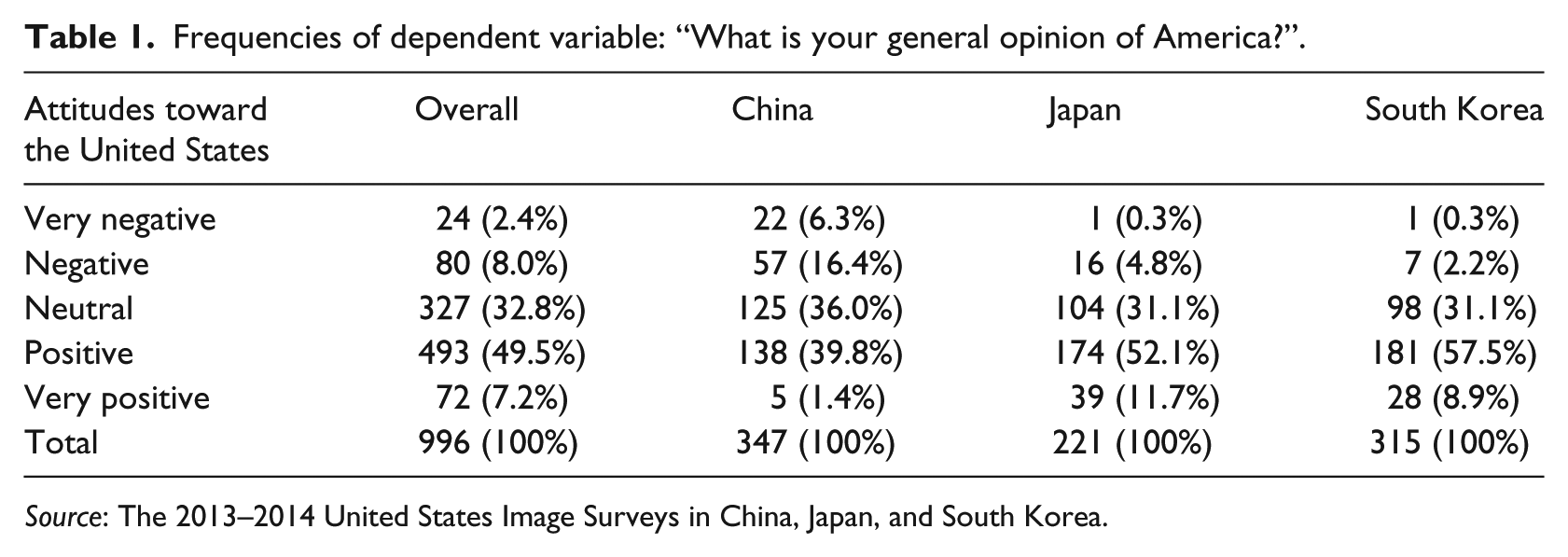
The dependent variable of this study is the presence or absence of anti-American sentiment. Table 1 shows frequencies of the dependent variable. One question of the survey is designed to measure the dependent variable: “What is your general opinion of America?” Respondents are asked to choose from “very negative,” “negative,” “neutral,” “positive,” or “very positive.” According to the survey, only 10.4 percent of the respondents feel very negatively or negatively towards the United States while 49.5 percent feel positively and 7.2 percent very positively. This leaves 31.7 percent who expressed that they felt neutral towards the United States. Among these three East Asian countries, China is more negative towards the United States than Japan and South Korea. For example, 22.7 percent of Chinese college students feel negative towards the United States whereas only 5.1 percent of Japanese college students and 2.5 percent of South Korean college students have negative feelings toward the United States.
Frequencies of dependent variable: “What is your general opinion of America?”.
Source: The 2013–2014 United States Image Surveys in China, Japan, and South Korea.
According to the survey data from 2013–2014, the college students of the three East Asian nations show relatively high level of positive preference towards the United States. Indeed, in Japan and South Korea, less than 20 percent of students have negative attitudes towards the United States. Nevertheless, such negative attitudes can be explosive, and massive anti-American demonstrations can happen quite abruptly as seen in the 1995 Okinawan rape incident (Japan) and in the 2002 Yangju highway incident and 2008 protest against United States’ beef (South Korea). It means that more than 30 percent of college students who surveyed “neutral” are susceptible to adopting a negative attitude toward the United States in the future. Therefore, it is relevant to study causes of anti-American sentiments in the East Asian nations although the recent survey shows high levels of positive perception towards the United States.
The survey data allows correlation and regression analyses on the dependent variable, anti-American sentiment, at the individual level. Here, the ordinary least squares (OLS) regression model seems the most appropriate statistical technique because the measurement types of variable are at least ordinal. Therefore, in order to explore the causal relations between explanatory variables and anti-American sentiment of East Asian college students, this study constructs OLS regression analysis.
Table 2 shows descriptive statistics of the dependent variable and six independent variables.
Descriptive statistics of variables.

Source: The 2013–2014 United States Image Surveys in China, Japan, and South Korea.
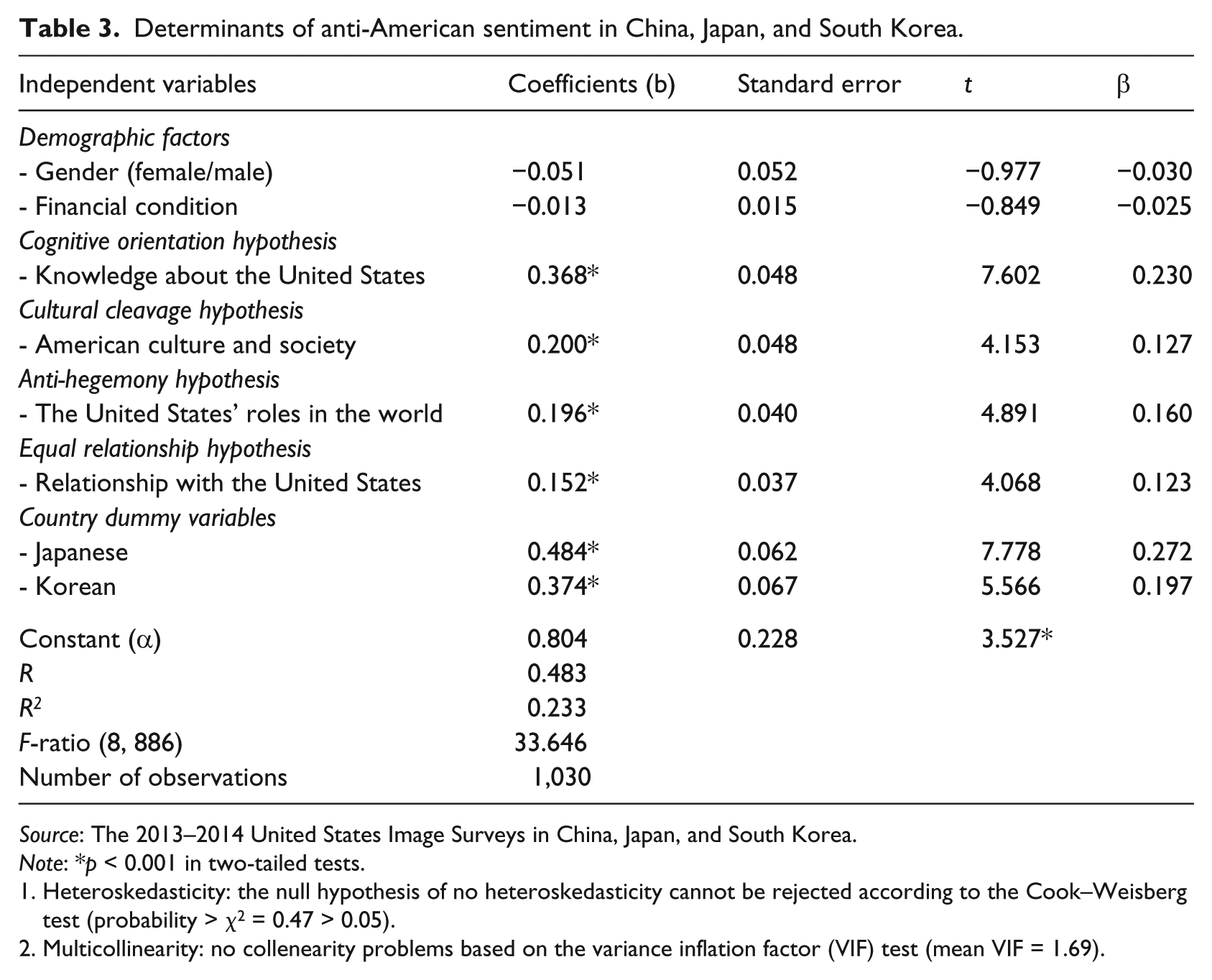
Table 3 summarizes the results of the multivariate regression analysis. The overall relationship between the eight independent variables, including country dummy variables and the dependent variable of anti-American sentiment, are reported as R = 0.483. Study results show that more than 23 percent of the variance in anti-American sentiment of East Asian college students (R2 = 0.233) can be explained using these independent variables. The coefficients of the independent variables, including cognitive orientation, cultural cleavage, anti-hegemony, equal relationship, and country dummy, are positive and statistically significant. In contrast, the coefficients of both demographic factors (gender and financial condition variables) show that the relationship between these two independent variables and the dependent variable are not statistically significant.
Determinants of anti-American sentiment in China, Japan, and South Korea.
Source: The 2013–2014 United States Image Surveys in China, Japan, and South Korea.
Note: *p < 0.001 in two-tailed tests.
Heteroskedasticity: the null hypothesis of no heteroskedasticity cannot be rejected according to the Cook–Weisberg test (probability > χ2 = 0.47 > 0.05).
Multicollinearity: no collenearity problems based on the variance inflation factor (VIF) test (mean VIF = 1.69).
The cognitive-orientation hypothesis (knowledge about the United States)
People’s knowledge about the United States is a statistically significant variable to explain the anti-American sentiment of East Asian college students. According to the standardized coefficients (β = 0.230) of the independent variable, the cognitive orientation variable is the most influential factor to cause anti-American sentiment in the East Asian countries. Therefore, anti-American sentiment in these college students differs based on their knowledge about and understanding of the United States. Furthermore, for the survey Question 26, “English ability is very important to success in your country,” about 59.8 percent of respondents replied “agree” or “strongly agree” whereas only 19.3 percent said “strongly disagree” or “disagree.” Indeed, about 60.7 percent of college students in the East Asian countries study English regularly. As a result, this study supports that the more likely a student is to spend studying English, the less likely he or she will exhibit anti-American sentiment.
The cultural-cleavage hypothesis (perception towards United States’ cultures)
This study assumes that East Asian college students’ perception towards American culture and society is one of the main determinants of anti-American sentiment. The results of the analysis show there is a statistically significant relationship between the two variables. Although over 75.3 percent of respondents said there is a big difference between their own cultures and American culture, only 13.75 percent of them responded that their societies are negatively affected by American culture. According to the standardized coefficients (β = 0.127) of the independent variable, the cultural- cleavage variable is the second most influential factor to cause anti-American sentiment in East Asian countries. Therefore, according to the results of the empirical analysis, anti-American sentiment in East Asian countries mostly depends on the general perceptions of American culture and society in these countries.
The anti-hegemony hypothesis (roles of the United States in the world)
Many scholars argue that anti-Americanism in the world takes the form of rejecting the political and economic dominance of the United States (Cha, 2004; Gweon, 2004; Katzenstein and Keohane, 2007 Shin, 1996; Shin and Chang, 2006). The findings of this study further support this argument. Results show that the general ideas about the roles of the United States in the world and its foreign policies are another major determinant of anti-American sentiment in the surveyed college students. Therefore, the equation of recent anti-Americanism in East Asia to “anti-Bushism” by Cumings (2005) is relevant. In contrast, the multilateralism approach by the Barack Obama administration to deal with regional issues of East Asian countries might be a positive factor reducing anti-American sentiment in the East Asian countries.
The equal-relationship hypothesis (relationship with the United States)
Does the international relationship between East Asian Countries and the United States cause college students’ anti-American sentiment? Cumings (2005) argues that American ignorance about Asian history and culture and the unbalanced relationship between the countries is the primary cause of anti-Americanism in Asia. Woo-Cumings (2005) also expresses American unilateralism, subordinated relationship, and national identity could cause anti-Americanism in East Asia. According to the results of the empirical analysis, the current study argues that unbalanced relationship between countries is another main reason of anti-American sentiment in East Asia. According to the standardized coefficients (β = 0.123) of the independent variables, the variable of the relationship between East Asian countries and the United States is one of the most influential factors to explain anti-American sentiment. Therefore, in order to mollify the anti-American sentiment in East Asian countries, a more equal relationship between the two countries might be suggested.
Demographic factors (gender and financial condition)
Both demographic variables, gender and financial condition, are not statistically significant variables to explain anti-American sentiment in East Asian college students. Therefore, anti-American sentiments in these countries’ college students are not different by their gender and financial condition. This suggests that though these three East Asian countries are historically patriarchal, their gender gaps are decreasing and gender roles are becoming more equal. In addition, Chinese college students show anti-American sentiments more than Japanese and South Korean students. However, the difference between Japanese and South Korean students is insignificant.
Although the main purpose of these empirical analyses is to find the most influential factor of anti-American sentiment for East Asian college students among four conjectures – the cognitive-orientation, cultural-cleavage, anti-hegemony, and equal-relationship hypotheses, it should, however, be noted some hypotheses may overlap while others are non-exclusive. For instance, the cognitive-orientation and cultural-cleavage hypotheses may conflict. Students who have closer contacts with and are well educated about the United States may be more likely to recognize the cultural cleavages between two countries. In addition, both the anti-hegemony and equal relationship hypotheses may seem to be mutually non-exclusive. Indeed, students who support the United States’ hegemony throughout the world may be more likely to be satisfied with the relationship between their own country and the United States. Therefore, in order to test intercorrelations among the independent variables of this study, the variance inflation factor (VIF) test of multicollinearity is applied. According to the VIF test (mean VIF = 1.69), there are no collenearity problems among independent variables. In addition, if both independent variables of the anti-hegemony and equal- relationship hypotheses are highly intercorrelated, the results of the regression analyses suggest large standardized regression coefficients with opposite signs. However, all independent variables’ coefficients have the same positive sign. For the cognitive-orientation and cultural-cleavage hypotheses, the same results are found. Additionally, according to the Cook–Weisberg test (probability > χ2 = 0.88 > 0.05), the null hypothesis of no heteroskedasticity cannot be rejected.
Conclusion and implications
The purpose of this study is to examine the determinants of anti-American sentiment in East Asian countries. The results of the empirical analyses support previous approaches. In other words, the preceding analyses promote the four following theoretical concepts: (1) the people’s knowledge and curiosity about the United States is the most influential factor of anti-American sentiment for East Asian college students (the cognitive orientation); (2) individual’s overall attitude towards American culture and society also influence anti-American sentiment in East Asian countries (the cultural cleavage); (3) anti-American sentiment in East Asian countries is mostly affected by people’s general ideas about the roles of the United States in the world and United States’ foreign policies (the anti-hegemony); and (4) the people’s general perception on the relationship between their own countries and the United States is another determinant of anti-American sentiment in East Asian countries (the equal relationship). In contrast, it explains gender and financial condition of East Asian college students are not significant determinants of anti-American sentiment.
This study also inspires future research in three related areas. The first implication of the findings is about data collection. The survey data with 1,030 samples is a decent sample size to test the research hypotheses, but a larger sample size would probably more accurately reflect the country’s overall opinion. There are about 16 million college students in the three East Asian countries: about 11 million in China, 2.8 million in Japan, and 2.2 million in South Korea as of 2013. The second implication is related to the purpose of this study. This study mainly focuses on East Asian college students because its main goal is to explain the causes of anti-American sentiment among younger generations in the nations. However, recent changes of East Asian’s attitude towards the United States are common phenomena regardless of one’s age. Therefore, future research should be expanded to a wider range of East Asian peoples, regardless of age. The last implication regards generalization of research. In the last few decades, negative attitudes towards the United States have been increasing all around the world. Therefore, cross-national comparative researches with more countries in different regions will be needed to generalize competing theories in the explanation of anti-Americanism.
Footnotes
Appendix. The Questionnaire of the 2013–2014 United States Image Surveys in China,Japan,and South Korea
Acknowledgements
The authors have many people to thank for their valuable support with the cross-national survey research: Miho Fujuwara, Noriko Odagiri, Yoshiko Kawamura, Yasuko Ito, Sookhyun Kim, Daesong Hyun, Kyoungmook Kim, Yongmin Kim, Jing Li, Hang Lee, Minhee Choi, Maria Gahan, Kelly Cyr, Marissa Mitchell, Ilhwan Kim, Sangmook Lee, Giwoong Jung, Dongyoung Kim, Namchul Bu, Ungjin Kim, and Chunghee Lee. Many thanks to Younjoung Shim for her support as well as to Christine Kim and Edward Kim for their careful editing. We would also like to convey our gratitude to the editors and anonymous reviewers of the IASR.
Funding
The author(s) disclosed receipt of the following financial support for the research, authorship, and/or publication of this article: Young Choul Kim gratefully acknowledges financial support of the Austin S. Igleheart Family Endowment and the Global Scholar Awards by the Global Enterprise in Indiana from the University of Evansville.