



Abstract
This article investigates the interactions of socioeconomic characteristics and electoral outcomes at the constituency level to demonstrate the change in the Thai party system since 2001. Probing the effects of the agricultural population and income inequality on electoral outcomes in the proportional representation (PR) tier, this article finds that the Thai Rak Thai Party (TRT) and the Democrat Party (DP) attracted voters with opposite social standings. While voters residing in the provinces with substantial agrarian populations tended to vote more for the TRT than the DP, constituencies with highly unequal income distribution were more likely to be DP supporters. The findings provide evidence against alternative explanations, including regionalism and support for a charismatic leader, for the TRT’s consecutive victories. Due to the convergence between social divisions and party support, the Thai party system has become stable and strong enough to resist short-term interventions, implying that the future electoral outcomes will likely be similar.
Introduction
Division and polarized politics have defined Thailand in the past decade. The demise of the revered King Bhumibol Adulyadej in October 2016 added another layer of uncertainty to Thailand’s future. With two military coups and the latest constitution passed in 2016 that limits people’s rights and participation in politics and the power of elected governments (e.g. McCargo, 2015; Nelson, 2015), the efforts of blocking a popular politician from getting back to politics will be tested in the next round of elections currently scheduled in 2019. Given that Thaksin Shinawatra and his parties had won four consecutive elections since 2001, amid political turmoil and military takeovers, one important question that has been widely asked is why these interventions did not succeed in dismantling the support base of Thaksin and his Thai Rak Thai Party (Thais Love Thais, or TRT) and the successor parties. 1
Thai experts and observers have offered various explanations. One explanation is support for a charismatic leader, which argues that Thaksin, a talented businessman and politician, used policy benefits and provocative rhetoric to attract rural voters and the urban poor (Pasuk and Baker, 2005). Although the overwhelming support waned after Thaksin was removed from politics in 2006, the support did not disappear entirely even after Thaksin went into exile. This persistent support indicates that Thaksin and his parties had loyal followers whose voting intentions would not be swayed by the absence of a charismatic leader. This sustaining support for the TRT then is explained to derive from class struggle and confrontation between the masses and the royalist–military alliance backed by the middle class in Bangkok (Ungpakorn, 2009; Pye and Schaffar, 2008). Within this argument, some have argued that different interests shaped by unequal political and economic power of Thai regimes had been activated by electoral politics and became the underlying factor of class conflict (Hewison, 2013, 2014; Pasuk and Baker, 2016). Others have taken a historical and anthropologist view to track the roots of northern and northeastern (Isan) identities and explained how the identities were revived and intensified through electoral participation and the anti-establishment movement (Ferrara, 2015; Streckfuss, 2012). Such identity was reflected in the electoral arena to demonstrate the sense of regionalism that helped the TRT garner votes in the north and northeast regions.
In this article we focus on how interests defined by economic conditions as well as regional identity explains the TRT’s consecutive victories. Most studies have explained the causes of conflicts but few attempted to get a thorough picture showing that voting and interests and identity are indeed tied together. By investigating electoral data, this study finds that the TRT’s support mostly came from the beneficiaries of its social policies, farmers in particular. While this social group continued to vote for the party and was less supportive of the Democrat Party (DP), the 2006 military coup and the confrontation between the yellow- and red-shirt movements activated another societal division. Although income inequality has long been a problem in the country, it asserted importance in the electoral arena only after 2006. While the class divisions overlapped with regional differences, economic divides were present within regions. The political conflict in Thailand, therefore, is not only about farmers against the middle class and elites in Bangkok, but also the rural rich resisting the challenge from the less fortunate people around them.
The findings provide additional explanations for the TRT’s successive wins. The support for the TRT/Thaksin was sustained by the agrarian population, which implies that Thaksin and his parties had become the champion of this social group. In other words, the support for the TRT was not just support for Thaksin per se, but for the interests that the TRT and Thaksin represented. Meanwhile, it is clear that the north and northeast regions have become the stronghold of the TRT, while the DP maintained an iron grip on the southern region. However, the findings suggest that regional differences should be understood through the pattern of class voting by farmers. That is, the north and northeast regions became a TRT stronghold because these two regions contained large agrarian populations. However, even in the north and northeast, social divisions defined by income distribution affected the TRT’s vote shares as well. The south, by contrast, was a staunch supporter of the DP and was less responsive to class and social divisions. Thus, regional identity can explain party support in the south but less so in the north and northeast.
The findings indicate that the Thai party system is relatively “frozen” compared to the pre-2001 period. The party system now reflects the cleavage structure of Thai society, and the pattern of inter-party competition has lasted for four elections and might last even longer. This explains why the 2007 political reforms failed to restore a decentralized multi-party system that the military so wanted. Given that the party system now reflects the bipolar cleavage of Thai society, the outcome of the next election will likely be determined by such societal divisions.
This article is structured as follows. The next section briefly discusses the change in the Thai party system in conjunction with political conflicts, which gradually activated the effects of social divisions on electoral competitions. The subsequent section then presents the empirical evidence indicating that supporters of the TRT and the DP have different social traits and that the correlation between social class and party support has only intensified with each election cycle. The last section discusses the findings against other alternative explanations for the TRT’s consecutive wins since 2001 and the implications for the next round of elections before the conclusion of this article.
Explaining the change in the Thai party system
Thailand has gone through dramatic changes since 2001, when the TRT came into power. After the 1997 political reform with its success of drafting the so-called “people’s constitution” and the initial performance of the TRT government praised as achieving the goals of the reform, Thailand’s prospect for democracy seemed promising (McCargo, 2002: 112). Yet the first year of the TRT’s reign already raised some doubts about the country’s future. The party’s leader, Prime Minister Thaksin Shinawatra, became more and more controversial: Thaksin was increasingly intolerant of criticisms and tried to curb freedom of speech (Kengkij and Hewison, 2009: 459–464). Thaksin, however, was beloved by the population in agriculture at the provincial level and the urban poor who benefitted from his party’s social policies—a universal health care scheme and village fund scheme (Brown and Hewison, 2005: 359; Pasuk and Baker, 2009: 80–82). His provocative but charismatically populist rhetoric also attracted loyal followers (Pasuk and Baker, 2008).
Despite criticisms and controversies surrounding Thaksin, the TRT won overwhelmingly in the 2005 election, holding approximately 75% of the House seats. No party in Thailand had ever made such an achievement and the decades-old fragmented party system was now dominated by an invincible party. This development might be considered conducive to the stability of government and representative democracy, which is a contrast to the unstable multi-party system in the pre-2001 era. Back then, the electoral fortunes of major parties could change dramatically from one election to another due to party switching (Hicken, 2009: 37–38). The multi-party system also led to fragile coalition governments plagued by internal fights among party factions and allied parties over cabinet portfolios (Chambers, 2005). In such an environment, the government could hardly accomplish anything. To have a stable government indeed provided a favorable condition for Thaksin to consolidate his power.
However, antagonism toward Thaksin gradually simmered, especially after the TRT gained 377 of 500 seats in the 2005 House of Representatives election. Such a landslide victory of Thaksin and his party led to many concerns about the development of the party system in Thailand, particularly the development that may produce a dominant party system which has long occurred in other Asian democracies such as Singapore and Malaysia—rather than a two-party system as in the UK or the USA—as the 1997 constitution drafters expected. Anti-government (Thaksin in particular) reactions then emerged, starting from various concerns raised by journalists, academicians, and activists about its high popularity due to the implementation of various “populist policies” (prachaniyom), its intervention in the mass media and independent organizations, and various “conflict of interest” issues. The latter provoked a public movement when Thaksin sold his family’s share of the Shin Corporation to the Singaporean government investment arm Temasek without paying tax in January 2006 (McCargo, 2008: 340). Accusing Thaksin of being corrupt and abusing power, demonstrations organized by the anti-Thaksin forces ensued asking Thaksin to resign. Protesters donned yellow shirts, the color representing the monarchy, to express their allegiance to the established institutions and political order led by the king (Ungpakorn, 2009; Pye and Schaffar, 2008). In response to the crisis, Thaksin dissolved the parliament and called a snap election in April but the opposition parties, including the DP, boycotted the election. The TRT won the snap election handily yet demonstrations continued until the military took over the government to end the political gridlock when Thaksin was attending the United Nations general assembly in New York in September. Supporters of Thaksin then quickly organized the United Front for Democracy against Dictatorship (UDD) and demanded electoral democracy be restored. Claiming to represent the masses, UDD supporters wore red shirts to highlight their identity. 2 Since 2006, different colored camps have taken turns staging demonstrations whenever the other side’s preferred party has been in power.
This ongoing political contest between the “yellow-shirts” and the “red-shirts” that followed the 2006 coup has had a massive impact on Thai society. This conflict has been described by many as the deep societal division that cuts across many types of loyalties and socioeconomic backgrounds (Hewison, 2015; McCargo, 2008). The yellow-shirt movement has often been portrayed as primarily driven by the establishment of well-off urban people with royalist sentiments (Naruemon Thabchumpon and McCargo, 2011). Many of its supporters came from the Bangkok middle classes and from the DP’s strong electoral base in the south (Pye and Schaffar, 2008). Key aspects of the yellow-shirt movement’s rhetoric were its anticorruption, protection of the monarchy, and a growing opposition to electoral politics (Hewison, 2015). In contrast, the red-shirt movement has been delineated as the political movement of awakening rural people, especially in the densely populated north and northeastern parts of the country, with the consciousness of inequality (Naruemon Thabchumpon and McCargo, 2011).
The colored-shirt confrontation had twice invited the military to step in to end the political turmoil in 2006 and 2014. Political reforms were also carried out to cure the political ills, claimed the conservative forces. The conservative forces regarded politicians and parties as the source of poor governance. They also believed that parties gained power by buying the votes of the unsophisticated, rural poor. The relationship between the TRT and its supporters was essentially “business as usual.” Political reforms, therefore, were a necessary means to solve political problems by incentivizing parties to act like their counterparts in advanced democracies (Nelson, 2009; Tamada, 2008).
The relationship between the TRT and its supporters, however, might be more than what the conservative forces thought it was. Although the TRT’s consecutive wins can be interpreted as support for Thaksin since he was a capable leader who could deliver policies, it is unclear why voters continued voting for his parties after he went into exile and was not steering the executive branch personally with his adept skills. The 2006 military coup certainly had the intention to remove Thaksin from the political scene to interrupt the overwhelming support of his party. The strong support did wane in the 2007 election but the TRT’s successor party, the People’s Power Party (PPP), still won the election. The electoral outcomes indicate that there were loyal supporters whose voting intention was not swayed by the absence of a charismatic leader. This is because the military coup and the colored shirt movements gave “support for Thaksin” new meanings: demand for inclusive democracy and a rejection of the established political elites. In other words, Thaksin and his parties represent the interests of certain segments of society, and these groups keep supporting the party no matter what name it has.
Scholars also argued that the resurrected social divisions have found expression in the party system and that this convergence set the stage for the ongoing political conflict (Hewison, 2013, 2014). As the TRT and the DP represent the interests of different social groups, partisan support had been steadily developed in the past decade, with its strongest presence in the 2011 election (Hicken, 2013). The TRT, on the one hand, benefiting from its social policies, established a party–voter linkage anchored by interest representation, which helped the party cultivate loyal followers. The TRT supporters were said to consist of grassroots activists who demanded political equality and full representative democracy and rural residences and the urban poor who appreciated the TRT’s social policies (Forsyth, 2010; Naruemon Thabchumpon and McCargo, 2011; Taylor, 2011). The DP supporters, on the other hand, comprised the middle class who wanted a clean government and the loyalists who accused Thaksin of being disrespectful to the king (Kengkij and Hewison, 2009). Regional identity also played a key role, with the northern and northeastern voters opting for the TRT and the south staunch supporters of the DP, due to the peculiar historical, linguistic, and cultural traits of these regions (Askew, 2008; Pasuk and Baker, 2013). Unequal wealth distribution was recently highlighted to explain Thailand’s political crisis, with the wealth resisting electoral democracy due to the fear of re-distribution (Baker, 2016; Pasuk and Baker, 2016). In the section that follows, these factors are all included in the analysis to scrutinize the sources of party support across time and space in Thailand.
The sources of electoral cleavages
To examine the determinants of party support, this article relies on electoral data to investigate the association between voting pattern and socioeconomic characteristics of constituencies, assuming that voters who live in the same geographic area tend to vote similarly as a response to the conditions in the macro-environment. 3 The electoral data cover four elections since 2001. The electoral systems used in the four elections have two tiers. The first tier elects individual candidates, and the single-member district vote system (SMD) was used in 2001, 2005, and 2011 and a block vote in 2007. 4 The second tier selects parties using a proportional representation (PR) voting system across the four elections.
This article conducts analyses only on the PR-tier voting data to exclude electoral system effects on voting behavior. It is assumed that, in the PR tier, voters tend to cast sincere votes that reveal their true preferences but might vote for a less preferred party in the constituency-tier elections due to the incentives provided by the electoral system there. 5 Moreover, since the constituency tier used different electoral systems across the four elections, change in electoral systems might also lead voters to alter their vote choice for strategic reasons. The fact that there were usually several viable parties competing in the constituency tier but the PR-tier competition was often a two-horse race between the TRT and DP 6 demonstrates that voters usually split their tickets to elect candidates who had a good chance of winning the election with their constituency vote but cast the PR vote for their favorite parties. Thus, if voters cast ballots for parties that represent their interests and such interests are pertinent to voters’ social standings, it should be evident in the PR tier.
The explanatory variables are proxies of social characteristics coming from two sources. The first source is the percentage of the population employed in the agricultural sector in a province. As discussed earlier, the main beneficiary of the TRT policies is rural voters whose primary occupation is usually farming. Thus, we expect to see that a province with a substantial agrarian population would be more likely to vote for the TRT than the DP. The second indicator is the Gini coefficient, a measure of income inequality. We expect to see that constituencies with large income inequality should have fewer votes for the TRT than for the DP. This is because constituencies with high inequality are usually cities or towns that are the center of wealth and power of a locality. Although rich and poor voters live side by side in such locations, the city dwellers and the middle class are more likely to support the claims advocated by the DP and the yellow movement. Bangkok certainly demonstrates such a relationship. Accordingly, the first indicator is a proxy for class and the rural–urban divides, and the second for the poor–rich divisions. Note that data of agricultural population are only available at the province level and data of income inequality are available at the constituency level. These data were collected from the annual reports and the website of the National Statistical Office of Thailand (2002, 2006, 2008, 2011). Electoral data were then collected from the election reports published by the Office of the Election Commission of Thailand (2001, 2005, 2007, 2011). Finally, we also include regions as explanatory variables to understand whether regionalism plays a role. We expect to see that north and northeastern regions tend to vote for the TRT while the south is the stronghold of the DP.
Since the dependent variable, the TRT’s and DP’s vote shares are measured at the constituency levels and agrarian population is measured at the province level, we apply a mixed-effects model in the analysis. The mixed-effects model has a random intercept effect but a fixed coefficient effect because a province covers many districts with different economic conditions that might be independent of the conditions at the higher level. For instance, the percentage of the population employed in the agricultural sector in Bangkok is close to zero, but constituencies are highly variable in terms of income distribution. Random coefficient effects introduce the effects at the higher level, so the independent effects of the coefficients might be masked by the effects above. To investigate the independent effect of variables at the constituency level, fixed effects serve the purpose better than random effects. The model is specified as follows.
Model specification
Level-1 Model

Level-2 Model

Mixed-Effects Model

Note that the dependent variable is vote share, which is bound between 0 and 1. Yet the assumption of the model is that the dependent variable should be continuous and thus we use logit transformation to meet the criterion. Moreover, some of the explanatory variables are closely related. As shown in Figure 1, the percentages of agricultural population are high in provinces located in the north and northeastern regions and these two regions happen to be the stronghold of the TRT. Thus, agricultural population and regionalism might take over each other’s independent effect. On the other hand, the southern region has a large percentage of agricultural population as well, yet it is the DP’s stronghold, which also blurs the expected effect of agrarian population. Thus, we try different specifications in the analyses below to tease out the two factors’ independent impacts on party vote share.
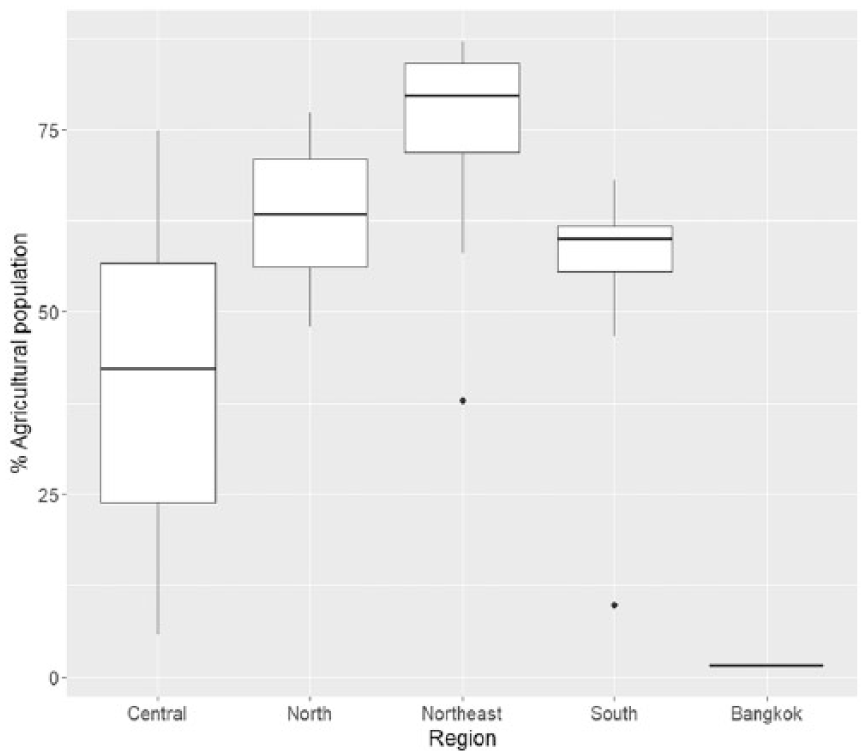
Distribution of agricultural population across regions in 2001.
Results and discussion
Table 1 shows the results of the 2001 election. In this election, agricultural population was not a determinant of vote shares for the TRT and the party actually garnered more votes from constituencies with high income inequality; mostly cities and towns. This result is reasonable; only after the TRT came into power and implemented social policies did the agricultural population begin to vote for the party. The TRT was a new entrant in the 2001 election but it swept votes across a large number of constituencies thanks to the alliance Thaksin succeeded in building ahead of the election as well as clever political marketing (Case, 2001; Somchai, 2008). On the one hand, the TRT employed some old-style political methods, co-opting provincial politicians, developing local campaigning networks, and splashing money about (Hewison, 2010: 122). On the other hand, Thaksin and TRT utilized a new style of electoral campaign, advertising the mildly nationalist motto “new thinking, new ways, for all Thais” (Hewison, 2004: 511). Together with the policies offering social welfare, income support, and ideas about how the poor might get ahead, this nationalist rhetoric was admired not only by the poor and rural voters but also by many business people, intellectuals, and leaders of civil society groups. The latter had abandoned the DP by attacking its economic policies, and the TRT had made these groups of people believe that the TRT’s policies were the right way to assist all those suffering from the 1997 economic crisis (Hewison, 2010: 122). In addition, the TRT’s success in garnering city votes was partly due to its introduction of new candidates with high profiles—good educational background, successful experiences in their past careers, and being well-known in other segments of business or civil society—into the election (Stithorn Thananithichot, 2012: 94).
Determinants of party’s vote share in 2001.

Note: Significance level * p <0.05; ** p <0.01; *** p <0.001; Bangkok was excluded from the analysis due to missing values for income inequality.
To the contrary, the DP’s votes were concentrated in the southern region. Although it seems that agricultural population has a negative impact on the DP’s vote share, when we add other regions in the model, the effect of agrarian population is taken over by the northeastern region, indicating the DP’s weakness in the region. The weakness of the DP in the northeast region was not a new phenomenon. It has existed since the late 1970s as a result of the development of Thai politics in the provinces that have been dominated by politicians who were local businessmen and influential persons, or so called “Chao Pho” (“godfathers”) (Backman, 2004; Ockey, 2004; Pasuk and Baker, 1997). The victory in the election of political parties before 2001 thus relied much on the patronage system of the local administration embodied in the figure of the sub-district headman (Kamnan), the village headmen, businessmen, and local influential persons in drawing public support and raising funds (Siripan, 2006, 2012; Sombat, 2001). The key factor that made the Chart Thai Party (CTP) and the New Aspiration Party (NAP) win in the 1995 and 1996 elections, for example, was the ability of these parties to magnetize influential groups of politicians to join and support their party leaders (i.e., Banhan Sinlapa-acha of the CTP and Chavalit Yongchaiyudh of the NAP). During this period, while the DP was successful in establishing a strong political network in the south, it was only able to recruit a few influential persons to represent the party in the northeast. Overall, the 2001 election was similar to the previous elections in which a party’s success mainly depended on how capable a party leader could be in establishing a large pre-election alliance (Chambers, 2005). Although the 2001 election was the first election to have a PR tier, voters might just cast ballots for the parties of the candidates they voted for in the constituency tier. Thaksin was a well-known politician, which might also boost his party’s votes in the PR tier.
The 2005 election was the heyday of the TRT thanks to the successful implementation of social policies and the surge in popularity of Thaksin. In this election, the TRT swept seats across Thailand, except the southern region, the staunch supporter of the DP. In this election, the effect of the agricultural population becomes significant for the TRT and this effect is closely associated with regions, with the northern and northeastern regions giving more votes to the TRT than other regions when other things were equal. The effect of agricultural population disappears when regions are taken into account, indicating that regions and agricultural population are highly collinear. Indeed, it is quite clear that regionalism is the most influential factor for the DP, as its candidates survived only in the south and almost disappeared in the north and northeast (the DP won only five of the 40 seats in the north and five of the 138 seats in the northeast). However, for the TRT, because of its implementation of several pro-poor policies, especially those that had a direct impact on the lives of the people in the agricultural sector such as debt relief, village and community investment funds, a people’s bank, and the promotion of entrepreneurial initiatives during the first term of the Thaksin government, the landslide victory of the TRT in the 2005 election was not simply the outcome of its success in establishing itself as a representative party of the people in the north and the northeast but of the poor and agrarians who are the majority of the entire population in these two regions. Meanwhile, income inequality begins to show a positive effect on the DP’s vote share (Model 2 and Model 3 at 0.1 significance level), reflecting the simmering dissatisfaction with the TRT among city dwellers (Table 2).
Determinants of party’s vote share in 2005.

Note: Significance level: * p <0.05; ** p <0.01; *** p <0.001.
The 2006 military coup and the ensuing 2007 political reforms attempted to change the political landscape dominated by the TRT. Thaksin went into exile and the TRT was disbanded and re-organized under the new name of the PPP. The military persuaded factions in the TRT to establish their own parties and competed against the PPP in the 2007 election. Rumors also have it that the military threatened those who might vote for the PPP with serious consequences (Nelson, 2013). Despite these efforts, the PPP/TRT still won the 2007 election though with a smaller margin compared to the 2005 election. As Table 3 shows, income inequality has a negative impact on the PPP/TRT vote share, reflecting the atmosphere of anti-corruption and disapproving abuse of power, reasons that justified the 2006 coup, which was widely supported in Bangkok. 7 Note that in the 2001 election, voters in constituencies with high income inequality actually tended to support the TRT; a trend that was reversed in the 2007 election. Thus, the political turmoil sharpened the rich–poor divisions and the divisions were mirrored in the 2007 election.
Determinants of party’s vote share in 2007.

Note: Significance level: * p <0.05; ** p <0.01; *** p <0.001.
Despite winning the 2007 election, the PPP was disbanded by a court order in 2008 and the DP formed a new government without an electoral mandate. The new incarnation of the TRT, the Pheu Thai Party (PT, For Thais) then won the 2011 election. As Table 4 indicates, income inequality has the opposite effect on the PT/TRT and DP vote shares, a result of political polarization in Thai society. Agricultural population then continues to have an overlapping effect along with region.
Determinants of party’s vote share in 2011.

Note: Significance level: * p <0.05; ** p <0.01; *** p <0.001.
To make the above statistical results easy to comprehend, Figure 2 compares the vote shares of the TRT and the DP at the district level and agrarian population at the province level. It is clear that these two parties’ vote shares are closely related to the distribution of the agrarian populations across the country. The north and the northeast regions have the largest agrarian populations, and they are also the stronghold of the TRT. The central region and Bangkok have the smallest agrarian populations, and they reward the TRT with fewer votes. The political conflict in Thailand is said to be along rural–urban and rich–poor divides. From the data analyzed here, it is more accurate to describe the conflict as being between the agrarian population and the non-agrarian population. This result is not surprising, because a plurality of the Thai population is still engaged in farming and fishing (40.8% in 2010). 8 The fact that the TRT garnered most votes in the northern and northeastern regions and the south the stronghold of the DP seems to indicate that vote choice is associated with regional identity. Yet before the TRT came into power, the north and northeast tended to elect different parties. Moreover, the support for Thaksin and the TRT seemed to be stronger in the northeast than in the north, Thaksin’s region of origin. Thus, regional identity cannot account for why the TRT/Thaksin was appealing to the northeastern voters. There must be some factor that united voters in the north and northeast in support of the party. The TRT was the first party to gain solid support from the vast population in the hinterland with social policies. The social policies united voters in the northeast, a region that contained the majority of the agricultural population. Thus, the distribution of the agrarian population also highlights regional differences. These differences might be seen as regionalism but they are actually a class vote. The south, despite having substantial agrarian and fishery populations, is a staunch supporter of the DP.

Comparing the TRT’s and DP’s vote shares with the percentage of agrarian population across Thailand.
The overwhelming support for the TRT in the north and northeast, however, masks the rich–poor conflict in the two regions. As shown in Figure 3, the predicted vote share of the TRT decreases as income inequality increases, while the predicted vote share of the DP increases when holding agricultural population constant. This contrasting effect of income inequality is consistent across regions. The initial vote share of the TRT is high in the north and northeast due to the large agrarian populations in these two regions. The vote share, however, gradually dwindles when a district moves from having low income inequality to high income inequality. A close inspection shows that province capitals (muang) have higher income inequality on average than other districts in these two regions. It indicates that the rural–urban and rich–poor divides exist not only across regions but within regions as well. The military coup and the colored shirt confrontation activated the ongoing yet dormant problem of income inequality, and this factor became a determinant of vote shares for the two parties, even in the TRT’s stronghold. By contrast, the south is less sensitive to class and economic conditions, and voters there support the DP unconditionally. Without the south, the support base of the DP is limited to some districts in Bangkok and its surrounding provinces, where economic conditions are disproportionately better than in other provinces. In other words, while we might see different voting patterns across regions, the south is the only region in which regional identity dominates to determine vote choice. Voters in the south tend to cast ballots based on who they are, not what they want.

Predicted vote share by income inequality in the 2007 and 2011 elections.
These findings also provide evidence against the alternative explanation for the TRT’s successive wins—support for a charismatic leader. The overwhelming support that a charismatic leader enjoys is certainly persistent in many immature democracies. However, a charismatic leader tends to attract voters from all walks of life, as seen with Thaksin in the 2005 election. This overwhelming support waned after Thaksin was removed from politics in 2006, but the support for his parties did not disappear entirely even after Thaksin went into exile. The support for the TRT/Thaksin, as the analysis indicates, was sustained by the agrarian population, which implies that Thaksin and his parties had become the champion of this social group. Even though voters did vote for Thaksin, the support was much more stable compared to the support for other Thai parties being organized around their party leaders. This stability, therefore, is more likely to be sustained by the interests the TRT and Thaksin represent.
The findings suggest that we can, to some extent, predict a constituency’s voting pattern by looking at its socioeconomic traits. Due to the convergence between social divisions and party support, the Thai party system had become stable and strong enough to resist short-term interventions. As Figure 4 shows, before the 2001 election, the leading parties’ electoral fortunes could change dramatically from one election to another. Yet, since 2001 the TRT and DP basically occupied the electoral arena. This is because the social characteristics of supporters for both parties hardly changed from one election to another even after measures were taken to break up the TRT. This is why the 2007 political reforms failed to restore a multi-party system since the system now reflects the bipolar cleavage of Thai society. Based on these results, it is likely that the pro-Thaksin forces will survive another political reform and win the next election even with the new constitution attempting to preserve the old political structure of the country.

National vote shares of major parties across election years.
Conclusion
This article investigated the relationship between social characteristics and party support to explain the change in the Thai party system. Arguing that social divisions and party support have converged to uphold the party system, making it less susceptible to short-term interventions, this article shows that electoral outcomes are indeed tied to the social characteristics of constituencies. Groups of different social standings, the sense of regionalism, and the support for a charismatic leader have been argued as reasons explaining the TRT’s consecutive victories since 2001. This article probes those factors and offers some alternative explanations.
Investigating the relationship between electoral outcomes in the PR tier and the socioeconomic characteristics of constituencies, it was found that constituencies in provinces with substantial agricultural populations tended to vote more for the TRT than the DP. This group of voters had benefitted from the TRT’s social policies since 2001 and had become the party’s loyal followers. The 2006 military coup and the “colored shirt” conflicts, then, activated another social division defined by income distribution. Constituencies with relatively high income inequality tended to vote more for the DP than the TRT due to the fear of re-distribution. The change of the Thai party system, therefore, is the result of the convergence between social divisions and party support that stabilizes inter-party competition. Unlike the fluid multi-party system in the pre-2001 era, the Thai party system has gradually evolved to a two-party system in conjunction with political polarization in the country.
Showing evidence against regionalism, the voting pattern among the population in the agricultural sector explains why the northern and northeastern regions of Thailand have become a TRT stronghold. Although the electoral outcomes there seem to indicate regionalism as the driving force for such strong support, it is actually a class vote. The south has long been viewed as the bulwark of the DP due to the sense of regionalism and the analysis here further supports this argument. This analysis suggests that the Thai party system has become stable because of the convergence between social divisions and party support. This convergence is triggered by a charismatic leader but its sustainability does not rely on this factor alone. Voters have found parties to express their interests and vote choice can be predicted based on voters’ social standings. Such convergence between interests and party support has proved to be strong enough to resist short-term interventions and it might last for quite some time. The findings of this study, therefore, imply that any measure to reshape the political landscape might fail again if this convergence of social divisions and party support is unaccounted for as the determinant of future electoral outcomes.
