



Abstract
In this paper, we argue natural disasters have a positive association with the likelihood of internal or domestic trafficking. Trafficking is a function of individual vulnerability and subsequent criminal agency. Economic scarcity and lack of government protection are conditions of vulnerability that are exploited by criminal agents and networks in recruiting and transporting victims. The advent of natural disasters exacerbates these conditions and provides an opportunity for criminals. We argue that internal trafficking is more likely in the wake of disasters as routes to transnational trafficking may be inaccessible. Employing generalized estimation equations on a unique cross-section, time-series dataset of 158 countries, between 2001 and 2011, we find a consistent positive link between natural disasters and the likelihood of internal trafficking. The internal trafficking angle is under-studied, and our findings point at the need for further exploration of the topic.
Introduction
In 2015, a series of earthquakes in central Nepal left about 9000 people dead and millions injured or homeless (Stout 2015). Following the earthquake, international agencies like the United Nations Children’s Fund and World Vision reported a dramatic rise in the number of rescued children from traffickers at border checkpoints. In one town, 70 children were rescued from traffickers in the 5-month post-earthquake period, compared to 30 children the previous year (Jones, 2015). This reality, although deeply concerning, is not surprising; criminal networks are known be opportunistic and expedient (Akee et al., 2009; Bales, 2007; Salt and Stein, 1997). We view natural disaster as a disruptive catalyst that creates an ideal environment for human trafficking. In addition to the death toll and property damage, disasters “heighten the risk [among the vulnerable survivors], and create the right environment, for traffickers to exploit the vulnerabilities of the affected population” (International Organization for Migration, 2015). This link between natural disaster and human trafficking has been suspected in the past (Danailova-Trainor and Laczko, 2010; United Nations General Assembly, 2012) but to the extent of our knowledge, is yet to be studied empirically. In slight deviation from typical works on human trafficking, we estimate the likelihood of internal or domestic trafficking based on the severity of natural disaster. In our view, mechanisms of inequality and scarcity that drive transnational trafficking are the same for internal trafficking, but the latter is more susceptible to the effects of natural disaster.
Trafficking, or modern-day slavery, is the exploitation of men, women, and children for sex (i.e. prostitution) and/or labor. Today, trafficking is an illicit but a lucrative global business, with an annual profit of around US$150 billion (International Labor Organization, 2016). Transnational trafficking accounts for the third-largest illicit global market (UN Office on Drugs and Crime, 2014). Human trafficking has always been defined as a global migration and economic problem, but little academic attention has been spared for internal trafficking. The current trafficking-based and migration scholarship highlights the global aspect of trafficking flows (Amahazion, 2015; Cho, 2014; Danailova-Trainor and Belser, 2006; Peksen et al., 2017), from the trafficking of Nepali women to Indian brothels (Hennink and Simkhada, 2004), to cross-border smuggling of Eastern European workers to Western European countries (Choi, 2010; Salt 2000). Through this exploratory paper, we seek to draw some much-needed attention to internal trafficking, and how it is affected by natural disaster.
In exploring the possible link between natural disaster and human trafficking, we first unpack the political dynamics of both phenomena. The aftermath of natural disaster often brings political consequences for the country’s government (Olson, 2000; Olson and Drury, 1997). Political scientists and international relations scholars have also studied the conflict-creating potential of natural disasters (Brancati, 2007; Nel and Righarts, 2008; Slettebak, 2012). Consequently, immediate government actions following disaster don’t necessarily pay attention to the needs of their populations; instead, they prioritize their own political survival and economic security (Cohen and Werker, 2008; Wood and Wright, 2016).
Then, we explore the relevant scholarship on human trafficking. Natural disaster has the ability to expose, or worsen existing vulnerabilities within communities. After a devastating series of earthquake or floods, the survivors are left with acute scarcity and competition for limited resources (Brancati, 2007), especially in the absence of adequate government protection (Cho, 2015b; Danailova-Trainor and Laczko, 2010). Trafficking flows can be initiated and facilitated by established criminal networks (Bales, 2007; Akee et al., 2014), or it can be the result of an opportunistic development under the right conditions. In an interesting study, Smith and Smith (2011) report the presence of UN peacekeeping troops in conflict-affected countries like Kosovo and Sierra Leone that have established local trafficking flows.
The post-disaster environment, through heightened vulnerability of survivors and possibly a distracted government, creates an ideal moment for trafficking. In the rest of the paper, we argue that trafficking, in the aftermath of disasters, is likely to manifest within countries. Natural disasters create larger pools of vulnerable people. This increase in supply can make internal trafficking more attractive as transportation costs would be cheaper, especially if cross-border trafficking routes are obstructed or destroyed by natural disasters. Disaster-driven scarcity can lead to individuals becoming impromptu internal traffickers. In sum, there are fewer costs associated with internal trafficking after natural disasters. From the government standpoint, addressing post-disaster recovery and managing long-term rehabilitation can be overwhelming (Olson, 2000; Olson and Gawronski, 2003; Wood and Wright, 2016). It is important to note that government’s measures against trafficking and response to disasters are unlikely to overlap. In between the elevated individual vulnerability to trafficking and lack of adequate government protection, natural disaster resembles a perfect storm.
The rest of the paper is divided into five sections. We start by unpacking literature on natural disaster and its political nature. Scholarship on natural disaster is quite extensive, but we narrow our theoretical focus on its potential overlap with trafficking literature. Next, we explore the diverse theoretical offerings on trafficking literature and forge a coherent path forward, and outline our hypothesis. In the research design section, we outline our empirical framework and describe the pertinent variables; here, we also discuss the application of generalized estimating equation (GEE) models and possible empirical concerns related to our data. We follow this section with a discussion of our empirical findings. We conclude the paper with a brief discussion of implications of our research.
Political cost of natural disaster
We start with natural disaster, an area of inquiry that is relatively well represented in the social science scholarship. We share the assertion of Cohen and Werker (2008: 795) that “[n]atural disasters occur in a political space.” When a country is struck by a calamity, its level of economic development can be the difference (Kahn 2005; Persson and Povitkina 2017; Strömberg 2007). More importantly, how the government responds to natural calamity is inherently a political decision: “…disasters are fundamentally political occasions because their impacts must be not only managed, but also explained” (Olson, 2000: 272). The impact of disasters varies among countries as well as among populations within the affected countries. Disasters impact poor countries disproportionately (Naik et al., 2007), and the poor suffer the worst consequences in a country (Olson and Drury, 1997). It is reasonable to consider if post-disaster vulnerability is uniform within a country. Populations might be more vulnerable in some areas (maybe rural regions) compared to other parts of the country. The use of country-level data is far from ideal in this analysis.
How do governments respond in the aftermath of disasters? Natural disasters test the government’s ability to provide necessary basic needs as well as long-term rehabilitation to the affected populations. When it comes to natural disasters, developing economies tend to be reactive at the expense of long-term planning and disaster preparedness (Cohen and Werker, 2008). Following their respective earthquakes, Haitian and Nepali governments struggled to disburse incoming foreign aid effectively, even though the earthquakes were long anticipated. Amartya Sen (1999) asserted that democratic governments are more likely to shield their populations from crises like famine; this is presumably because governments try to avoid being “punished” for their failure to provide relief to their populations (Boix, 2001). Because disaster preparedness is considered public goods, democratic governments with a high capacity for welfare protection are expected to fare better with fewer affected populations (Persson and Povitkina, 2017). However, when it comes to disaster prevention, developing countries don’t have an economic incentive to prepare proactively (Cohen and Werker 2008). In their formal estimation, developing countries are more likely to gain from post-disaster foreign aid than proactive disaster preparedness. To be fair, poor countries often lack the necessary political incentive (Olson and Gawronski, 2010) as well as the appropriate infrastructure.
On the other hand, a post-disaster environment can lead to a repressive turn from the government. Disasters can generate political space for rebellions to organize and act against the government (Olson and Drury, 1997: 23), leading governments into retaliatory and repressive tactics. For instance, Wood and Wright (2016) present evidence that government repression increases in the post-disaster environment.
[Disasters] can reduce the states’ ability to suppress rebellion and, concurrently, increase the capacity of groups to fight, providing them with new sources of funding and new opportunities to attract, support, and recruit members (Brancati, 2007: 720–721).
Therefore, the country applies repression to wrest back political control, and nip the possibility of rebellion in its bud. Influx of humanitarian aid is argued to contribute to the reducing disaster severity in democracies (Wood and Wright, 2016: 1461). Furthermore, some scholars have identified the weaponization of disaster aid: following the devastation of the 2004 Indian Ocean Tsunami, the Sri Lankan government blocked incoming relief aid to areas controlled by Liberation Tigers of Tamil Eelam to apply pressure on the rebel group to capitulate (Enia, 2008: 20).
The pernicious political effect of disasters has also been determined by the likelihood of occurrence of armed conflict in the country. The onset of armed conflict is more likely in countries with conflict-prone attributes such as high levels of inequality, political instability, and a high ratio of youth population (Nel and Righarts, 2008: 168). Brancati (2007) provides a more nuanced take on the disaster-conflict linkage. Focusing on the impact of earthquakes solely, she argues that intrastate conflicts are exacerbated indirectly, due to the disaster-led scarcities and competition for resources (Brancati, 2007: 717). Employing a similar line of argument, Berrebi and Ostwald (2011) argue disaster-led deaths lead to a higher incidence of terrorism episodes and fatalities. This disaster-conflict argument, however, is not a universal consideration. Slettebak (2012) asserts an empirical challenge to the disaster-conflict link. Slettebak provides evidence that climate-affected natural disasters actually lead to a lower risk of civil war. Although the author acknowledges the harmful effects of natural disasters, she critiques empirical inferences of prior scholars studying the link. For instance, Slettebak finds Brancati’s (2007) choice of dependent variable (conflict incidence instead of onset) erroneous; Slettebak also highlights the lack of empirical consideration for interactive effects of large population upon the onset of armed conflict.
The pernicious effects of disasters in a country is not limited to the occurrence of armed conflict. Post-disaster scarcity is likely to make vulnerable communities more susceptible to exploitation and trafficking. It is also likely that populations from rural areas of the country are more susceptible, as government relief may take longer to reach them. It is reasonable to expect governments to emphasize rescue and rehabilitation actions over anti-trafficking activities (the government’s anti-trafficking duty is likely to function independently from the government’s disaster response unit). These are relevant points to consider in forging a theoretical link between disaster and trafficking. At this point, we acknowledge the myriad weaknesses evident in our proposal. Although the causal link between disaster severity and probability of internal trafficking may be hard to establish, we find the inquiry into the theoretical and empirical association a relevant and worthwhile pursuit.
Internal dimensions of trafficking
In its definition, the UN Palermo Protocol emphasizes the criminal agency of traffickers.
‘Trafficking in persons’ shall mean the recruitment, transportation, transfer, harbor[u]ring or receipt of persons, by means of the threat or use of force or other forms of coercion, of abduction, of fraud, of deception, of the abuse of power or of a position of vulnerability or of the giving or receiving of payments or benefits to achieve the consent of a person having control over another person, for the purpose of exploitation.
1
Scholars have similarly tried to delineate human trafficking through precise definitions and systematic frameworks. Choi (2010), for instance, considers the process of trafficking to consist of five stages: recruitment or abduction, removal, transportation, establishment of control, and maintenance of debts over the victims. Alternatively, Danailova-Trainor and Laczko (2010: 41) define trafficking with the help of three core elements: action (consisting of recruitment, transportation, transfer); means (comprising threat, deception, and use of force); and purpose of trafficking. Given the illicit and hidden nature of trafficking, precision of these definitions and models can always be debated.
In lieu of a simpler understanding of human trafficking, we find it to be a function of individual vulnerability and criminal agency. As one can deduce from the earlier section, natural disaster exacerbates the former and provides opportunity for the latter. In other words, post-disaster scarcities leave people vulnerable (Brancati, 2007), which allows criminals to exploit this vulnerability (IOM, 2015). In the trafficking scholarship, categorization of traffickers is between organized criminals and opportunists. The link between human trafficking and organized crime is well established, especially in the transnational exploitation of labor and prostitution (Danailova-Trainor and Laczko, 2010; Salt, 2000; Salt and Stein, 1997). Scholars believe trafficking operations can vary in organization and number (Aronowitz, 2001; Salt, 2000), but their operations are generally known for their expediency (Bales, 2007). Known cases range from Indian networks smuggling Nepali women to Middle Eastern countries in the immediate aftermath of the 2015 earthquake (Burke, 2015), to gangs abducting and selling unaccompanied children during the European migration crisis 2 (Rankin, 2016). Deception and exploitation of victims for trafficking, however, can exist independent of the organized crime. Individuals (including family friends and close relatives) have been documented to deceive, transport, and sell victims into forced labor, indentured servitude, or prostitution (Bales, 2004; Hennink and Simkhada, 2004). In post-disaster internal trafficking, we expect this individual-based, opportunistic form of trafficking to thrive.
In the trafficking scholarship, categorization of “victims” remains a theoretical challenge. In labor-related trafficking (and to an extent, prostitution), scholars have tried to distinguish voluntary, economic migrants from “true” victims (Aronowitz, 2001; Bettio and Nandi, 2010; Rao and Presenti, 2012; Salt, 2000). Especially in transnational trafficking, individuals smuggle themselves across international borders in search of employment opportunities 3 (Aronowitz, 2001). Irrespective of agency of victims, economic assumptions dominate the trafficking scholarship, articulating trafficking as “south-to-north” migration. Put simply, transnational trafficking is a migratory process defined by economic “push-and-pull” factors (Salt and Stein, 1997). “Push” factors include poverty, inequality, and population pressure, as well as governance factors such as state welfare, democratic institutions, and the rule of law (Akee et al., 2010; Bales, 2007; Cho, 2015b; Richards, 2004). Vulnerable populations are also tugged by “pull” factors, such as demand for cheap labor, presence of migrant networks, and a semblance of legal protection available at destination countries (Bettio and Nandi, 2010; Choi, 2013, 2015b; Cho et al., 2014; Farrell et al., 2014; Mahmoud and Trebesch, 2010).
In the extant scholarship, the relation between development and trafficking is expected to be negative, but this picture is far from straightforward. Middle-income countries have been observed to be the top source countries of trafficking (Danailova-Trainor and Laczko, 2010). Although the poorest individuals are likely to be victims of trafficking (Bettio and Nandi, 2010), mechanisms of trafficking and migration are more likely to exist in countries with relatively high economic development. Similarly, vulnerability of populations is likely to be high in countries with inadequate welfare disbursement and low government protection (Danailova-Trainor and Laczko, 2010). Hence, countries with low investment in social welfare are more vulnerable to trafficking (Danailova-Trainor and Laczko, 2010) as they lack the necessary institutions to aid their citizens (Strömberg, 2007; Toya and Skidmore, 2007) or the incentive to prepare for disasters 4 (Cohen and Werker, 2008). A state’s institutional strength, therefore, should be positively associated with its capacity to tackle post-disaster trafficking. Democratic states are expected to fare better, and Persson and Povitkina (2017) provide evidence that this is true in countries with high institutional capacity; however, people suffer more in democracies with low quality of institutions. Economic development and governance remains pertinent in trafficking scholarship, but further analysis is needed to draw a more concrete conclusion, especially at a sub-state level.
In the absence of a clear picture on the role of democracy, institutions and welfare in relation to trafficking, there can be a suspicion of interactive relations in addressing trafficking. It may be true in some cases that, in an affluent country such as Canada, strong institutions and generous welfare-based protection can help individuals survive disasters and curtail the likelihood of trafficking. However, even though governments address trafficking and disaster concurrently, they do so through separate institutions. In some cases, disasters can distract government from post-disaster trafficking, or even from addressing the disaster itself (Olson and Drury, 1997; Wood and Wright, 2016). Realistically, governments fail to observe this interaction in the advent of disaster, or choose to ignore it. Therefore, we believe the theoretical suspicion of such interactive influence is likely to be unfounded. 5
Trafficking is a fact of life, and countries appear helpless in eliminating it, especially in the face of economic liberalization and labor demands (Peksen et al., 2017). The academic interest in trafficking is valid, but scholarship on internal trafficking is scarce (Frank, 2013). Internal trafficking exists in many guises: from domestic servitude and sexual exploitation of young girls in Thailand, to exploitation of labor in gold mines in Brazil, to debt bondage and domestic servitude in India (Bales, 2004). In the post-earthquake Haiti, orphaned children became victims of internal trafficking. Local practice such as the restavek simply allowed affluent families to “take in” the children and enslave them 6 (Padgett and Ghosh, 2010). Countries like Haiti also conspicuously lack appropriate laws and institutional protection for orphaned and unaccompanied children in the wake of disasters (UN General Assembly, 2012). Natural disasters intensify the “push” factors for source countries, but this is not always accompanied with an increase in demand in destination states. In the event of large natural disasters, developed societies are wary of unchecked migration into their territory and may actually increase scrutiny at the border. Consequently, internal trafficking is likely to become an attractive opportunity in the midst of post-disaster chaos.
Akee et al. (2010) come closest to our conceptual inquiry. They study the effect of onset of armed conflict as an external event in estimating the likelihood of a country being a source of trafficking flow. 7 Their findings were mixed: “[i]nternal conflicts reduce the likelihood of trafficking while external conflicts exacerbate the problem” (Akee et al., 2010: 10). Although they propose that internal conflict could have destroyed the transportation networks necessary for trafficking, a more likely explanation is that the relative security, necessary for the trafficking market, was missing. Neighboring countries are likely to secure their borders to prevent a conflict spillover. If the international migration routes and necessary networks are restricted, it’s likely the flow of trafficking would turn inwards. Internal trafficking is likely to be an easier operation to conduct in the wake of natural disasters. Post-disaster chaos can lead to opportunism that is instrumental in internal human trafficking (Bales, 2007; Hennink and Simkhada, 2004).
Although the gravity of human trafficking is apparent, the global response has evidently been inadequate. In the global context, the necessary minimum role countries can play in the fight against human trafficking is measured in three areas: protection, prevention, and prosecution (collectively known as the “3Ps”). The 3Ps represent a consolidated global framework in approaching trafficking as a global problem. The most relevant “P” for our work is state prosecution of trafficking 8 (Frank, 2013). Prosecution can be divided into two mechanisms—national legislation criminalizing trafficking, and enforcement of these laws. State criminalization of trafficking is perhaps the most popular measure of state response to trafficking. Both Lloyd et al. (2012) and Kelley and Simmons (2015) provide evidence that criminalization is influenced by political pressure created by international indicators. Prosecution has been a problematic measure in the human trafficking arena for some time.
First, a contemporary criticism of criminalization is that it does not necessarily equate to application. National criminalization has not seen adequate implementation in the form of societal enforcement (Frank, 2013; UN Office on Drugs and Crime, 2009). The number of countries criminalizing the human trafficking has risen steadily in the past few decades (Frank, 2013; Kelley and Simmons, 2015). However, enforcement of these laws remains a challenge, especially in poor states. Even in rich Western countries, anti-human-trafficking laws are somewhat new. Application of these laws is often sporadic as prosecutors, police and the courts struggle to learn how to apply them and recognize victims (Farrell and Pfeffer 2014). Human trafficking enforcement becomes even more difficult when law enforcement is part of the criminal ring that perpetuates it (see US State Department’s Trafficking in Persons (TIP) Report 2016 for reports, by country, on law enforcement complicity in human trafficking around the world).
Second, in addition to the uneven application or understanding of anti-human-trafficking laws, these laws entail a large investment in victims’ services and rehabilitation that many states are unable to meet. Even rich Western countries, with hundreds of nonprofits advocating for increased spending on anti-human-trafficking programs, do not invest heavily in these areas. For example, the entire annual budget of the US State Department’s anti-human-trafficking office is around US$20 million, which is less than the war on drug’s daily budget (Skinner 2011). If rich countries do not prioritize anti-human-trafficking spending, it is not a stretch to believe that countries with even fewer resources would de-prioritize enforcement expenditures in this area, particularly in tough economic times or after disasters.
Although the trafficking scholarship is afflicted by imprecise data and a theoretical proclivity toward transnational trafficking, we have tried to make a case for internal forms of trafficking. Individuals are generally vulnerable to trafficking in the event of economic insecurity, exploitation and a relative lack of government security—factors that are acutely magnified in the aftermath of natural disasters. Consequently, the risk of internal trafficking is likely to increase as the severity of disaster rises.
Hypothesis: Severity of natural disaster is positively associated with the likelihood of internal human trafficking.
Research design and data
As we are interested in estimating the impact of natural disasters on the likelihood of internal trafficking, we estimate the following model

We study the impact of natural disasters’ impact on trafficking in 158 countries from 2001 to 2011. Our unit of analysis is country-year. 9 For our estimation, we employ four dependent variables, which capture the presence of four types of internal trafficking in country-year—forced prostitution, forced labor, child prostitution, and child labor. As we discussed in the previous section, trafficking exists in a variety of forms. In using several dependent variables, we increase our odds of yielding interesting and nuanced inferences. The outcome variables are coded “1” for the country witnessing internal trafficking in a given year, and “0” otherwise. 10 We obtained these variables from Richard Frank’s (2013) Human Trafficking Indicators (HTI) dataset. 11 The HTI dataset is compiled from the US State Department’s annual TIP report that gauges a country’s attempt (and their relative success or failure) in combating trafficking.
We obtained affected population, our explanatory variable, from the Emergency Events Database (EM-DAT) of the Center for Research on the Epidemiology of Disasters (Guha-Sapir et al., 2014). To be classified as a natural disaster in EM-DAT, the disaster must fulfill these criteria: “ten or more persons reported killed, one[-]hundred or more persons reported injured; (2) the declaration of a state of emergency; or (3) a call for international assistance” (Wood and Wright, 2016: 1456). We employ EM-DAT’s affected population, 12 defined as “people requiring immediate assistance during a period of emergency, i.e. requiring basic survival needs such as food, water, shelter, sanitation, and immediate medical assistance” (Center for Research on the Epidemiology of Disasters, 2012). We use the natural log of affected population to address its positive skewness. Disaster-related deaths and frequency of disasters have been used elsewhere as measures of disaster impact. From our perspective, we find the severity of natural disasters, rather than their occurrence or death toll, to be an appropriate measure of the impact of natural disaster. 13 The higher the disaster-affected population, the greater the severity and urgency—likely resulting into a higher probability of internal trafficking.
We have relied on past and recent trafficking-based scholarship to identify pertinent control variables for our analysis (Cho, 2015a; Frank, 2013; Kahn, 2005; Kelley and Simmons, 2015). We also introduce two variables to gauge government action against trafficking: trafficking legislation and trafficking enforcement. The former captures the country’s legislation criminalizing trafficking, and the latter measures the country’s criminal prosecution of trafficking legislation. 14 Both of these are three-category ordered variables. For trafficking legislation, a country is coded as “2” “if comprehensive laws prohibiting all forms of trafficking have been passed and come into force” (Frank, 2013: 11). The score of “1” refers to “laws prohibiting one or more types of human trafficking … but it does not have a comprehensive law prohibiting all forms of trafficking” (Frank, 2013: 11). In the case of trafficking enforcement, a score of 2 denotes “a country fully investigates and prosecutes cases of human trafficking” (Frank, 2013: 11). The score of ”1” means that the country’s investigation or prosecution of trafficking-related crimes is not comprehensive. Adoption of trafficking legislation and subsequent trafficking enforcement should be expected to curb the likelihood of domestic trafficking. It is interesting to note that trafficking criminalization and enforcement aren’t parallel to each other. The number of states adopting criminalization of trafficking has been on a steady rise, but the rate of enforcement has evidently stalled (Frank, 2013). Past scholarship suggests criminalization of trafficking has been popular, but it might be an empty promise, likely influenced by international political pressure (Lloyd et al., 2012; Kelley and Simmons, 2015). On the other hand, the impact of enforcement has not been adequately studied. A cursory glimpse into the data set reveals that enforcement level is not constant for countries over time. 15
Democratic and stable regimes are generally expected to lower the likelihood of trafficking (Peksen et al., 2017). However, this relationship is far from straightforward. Democratic states are more often susceptible to international pressure and promises of foreign aid (Kelley and Simmons, 2015; Wood and Wright, 2016). On the other hand, “democracies tend to have more open borders, which lower the risk of detection for traffickers” (Cho et al., 2013: 71). People are often more vulnerable in democracy with low-quality institutions (Persson and Povitkina, 2017). As we are working with four separate outcome variables, the effect of democracy on internal trafficking will hopefully provide interesting insights. We obtained variables on democracy and corruption from the Varieties of Democracy dataset. 16 Derived from Varieties of Democracy’s Electoral Democracy Index, democracy captures the country’s level of electoral democracy, measured from “0” (low) to “1” (high) (Coppedge et al., 2018: 38). Like democracy, corruption can be a relevant control variable in the likelihood of internal human trafficking, expected to exhibit an overall positive association with the outcome variables. Here, the corruption variable captures a regime’s political corruption, measured from “0” to “1” (Coppedge et al., 2018: 224). Rule of law captures “perceptions of the extent to which agents have confidence in and abide by the rules of society” (Kaufmann et al., 2010: 4). It is standardized in units of standard normal distribution (i.e. between −2.5 and 2.5), with higher scores representing relative stability of the country. Here, the expectation is that a stronger rule of law increases the risk of traffickers getting taught, and consequently reduces the likelihood of trafficking (Cho et al., 2014).
Economic indicators are common in disaster- and trafficking-related analysis. States with higher incomes are likely to be better protected against disasters but higher economic development does not translate into absence of trafficking. Economic liberalization leads to opportunities of labor exploitation (Peksen et al., 2017) and affluent countries serve as destinations of transnational trafficking (Cho, 2014, 2015a, 2015b). However, we expect richer countries to fare better in addressing internal trafficking, that is, yield an overall negative relationship. As gross domestic product (GDP) per capita (logged)—our economic control—increases, the likelihood of internal trafficking should decrease. We further include the unemployment rate and logged infant mortality rate (IMR) to supplement the economic analysis. Unemployment rate is a measure of the country’s share of the labor force without work and is seeking employment (World Bank, 2017). The likelihood of internal trafficking should increase dramatically in the case of high employment. The IMR measures the number of infants dying before reaching one year of age, per 1000 live births (World Bank, 2017). As a variable, it has been employed elsewhere as a proxy for country’s social protection and income inequality (Nel and Righarts, 2008). High value of IMR points toward the country’s inability to shield its population from its susceptibility to trafficking (Danailova-Trainor and Laczko, 2010). We also include controls for country population (logged) in our analysis.
Finally, we include a duration variable to address the issues of path dependence—“countries that have a history of trafficking issues are more likely to experience trafficking flows” (Peksen et al., 2017: 678)—and temporal dependence. In our duration variables, we model the number of years since the last incidence of internal trafficking for each outcome variable to capture the temporal trend of the data, as recommended by Beck et al. (1998). These variables capture the number of years since the last case of internal trafficking took place in a country. We lag all our explanatory variables one year to reduce the simultaneity bias.
At this point, we want to acknowledge that country-aggregated data lead to certain empirical challenges. First, TIP data on our dependent variables are self-reported by countries and might be biased. Second, the fact that disaster and trafficking data are aggregated per year leaves a question mark over their potential causal link: for instance, if a country experienced an increase in trafficking likelihood at the start of the year but witnessed natural disaster toward the end of the year, this can lead to misleading inferences. We employ lagged predictor variables to address this, but lack of disaggregated, precise data remains a challenge in human trafficking scholarship (IOM, 2015). Despite the methodological challenges, we believe our exploratory work is relevant in the overall scope of trafficking scholarship.
Spatial and temporal concerns are relevant when working with cross-section-time-series data (Beck and Katz, 1995, 2001). Appropriate estimation begins with the nature of available data and associated restrictions. Our panel data is unbalanced, that is, we are missing values for years across some countries, preventing us from the correct employment of panel-corrected SEs, as recommended by Beck and Katz (1995). On the other hand, binary variable makes it difficult to adequately capture variation within panels over time. Our dependent variables are not time-invariant. The binary variables register a high presence of internal trafficking (i.e. score of “1”)—prostitution (55 percent), forced labor (45 percent), child prostitution (48 percent), and child labor (39 percent).
Although the use of lagged dependent variable is used to address autocorrelation (Beck and Katz, 1995), it can also underestimate the coefficients of primary predictor variables and bias the inferences 17 (Achen, 2000). Therefore, we have refrained from including a lagged variant of dependent variable in our models. As our time span is relatively short (2001–2011), we use the GEE with the “logit link” function. GEEs are considered appropriate for temporally limited data, especially for models with categorical outcome variables (Zorn, 2001). Using fixed effects is a popular mode of interpreting hierarchical data, but the inclusion of fixed effects in models with a binary dependent variable can bias the results (Beck, Katz and Tucker, 2001). GEE models allow us to estimate the population-averaged effects and address intra-unit correlation.
Empirical findings and discussion
We started our analysis with the baseline assumption that internal trafficking exists in countries; then, we tested if disaster severity, on average, increases the likelihood of internal trafficking. 18 As we can see in Table 2, our hypothesis finds some empirical traction, and the results paint an interesting picture. All our outcome variables are positively associated with the post-disaster affected population, but this effect is more pronounced in the cases of prostitution-based internal trafficking. In our post-disaster scenario, sexual exploitation is more likely in comparison to labor-based trafficking. In the aftermath of disasters, scarcity and competition for limited resources becomes the new reality, especially in poor countries with weak institutions (Brancati, 2007; Nel and Righarts, 2008; Noy, 2009). Survivors of natural calamities, especially children, are tremendously vulnerable to trafficking, often at the hands of their own guardians. Most countries lack an adequate mechanism to protect vulnerable children in the aftermath of disasters (UN General Assembly, 2012). The inadequacy against prostitution is further captured by the weak effect of both legislation and enforcement in Table 1 models. Inferences from Table 1 point to a need for a deeper investigation into internal trafficking, especially in the context of prostitution.
Summary statistics.
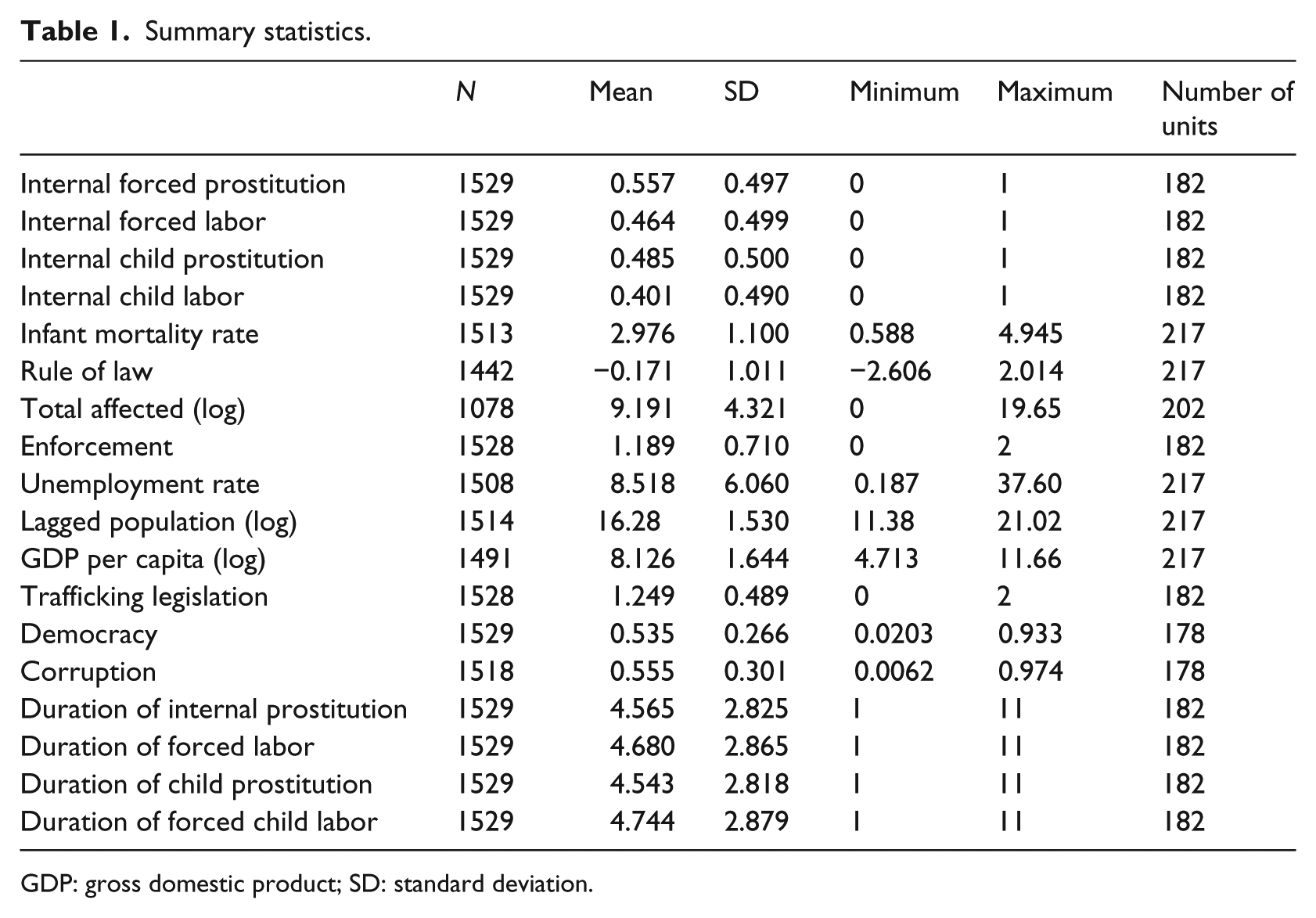
GDP: gross domestic product; SD: standard deviation.
Although the overall vulnerability to trafficking rises after disasters, the likelihood of labor-based trafficking is relatively low across the models. Natural disaster exacerbates the existing economic desperation, but it is unlikely to create an unexpected demand for labor. Economic liberalization has been observed to increase the likelihood of human trafficking for labor in both transnational and national contexts (Peksen et al, 2017). On the other hand, our analysis shows weak evidence of likelihood of labor-based trafficking following natural disasters. 19 Transnational and local demand for labor is constant but this demand appears to be independent from the immediate effects of natural disasters. After disasters, the supply for labor is likely to rise (Barry, 2015), but not the access to necessary trafficking networks and markets.
Although interesting, our initial interpretation of Table 2 is far from comprehensive. For a more substantive understanding, we predicted the probabilities of internal trafficking, as shown in Figure 1. From initial observation, the positive association between the likelihood of prostitution-based internal trafficking and severity of disasters is evident. Here, the X axis shows the logged values of affected population, and the Y axis represents the probability of different forms of internal trafficking. In the upper left-hand corner, the Y axis is the likelihood of forced prostitution (i.e. score of “1”) in countries with internal trafficking, provided they scored “0” in the past year. All else being equal, the probability of one-unit increase in forced prostitution (i.e. shift from “0” to “1”), one year to the next, is over 60 percent when the affected population is at zero. The likelihood of countries witnessing forced prostitution increases to over 70 percent when affected population is approximately 10 on the logged scale (i.e. approximately 10,000 affected people). At the maximum value of the predictor variable, the likelihood of affected population increases to approximately 80 percent. This marks a shift of almost 20 percent for forced prostitution from its minimum to maximum value. Alternatively, 1 SD from the mean value of affected population results in a five-percent rise in the likelihood of forced prostitution. In other words, the likelihood of countries witnessing domestic trafficking in the form of forced prostitution rises substantially in relation to affected population.
GEE estimates of likelihood of internal trafficking.
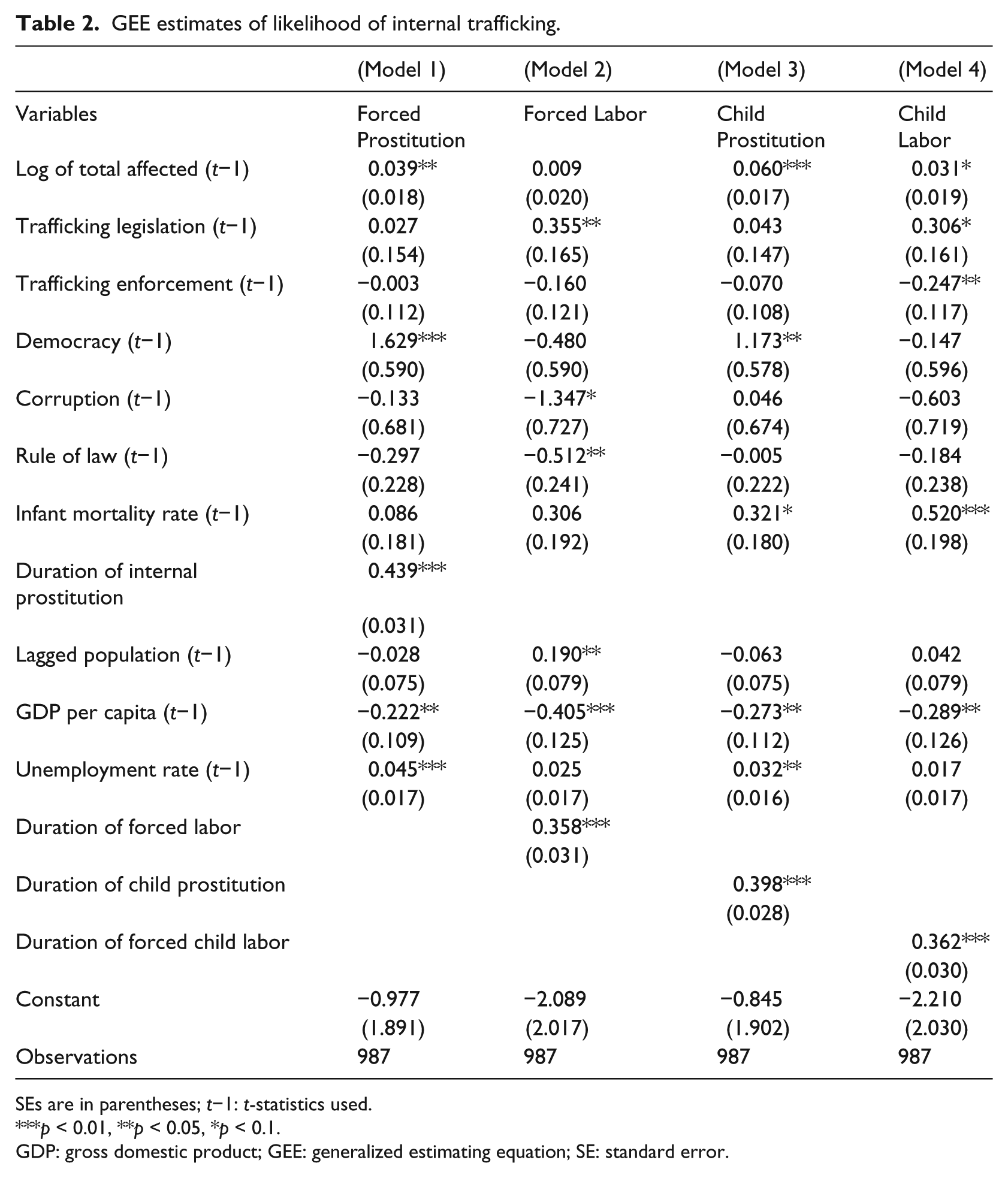
SEs are in parentheses; t−1: t-statistics used.
p < 0.01, **p < 0.05, *p < 0.1.
GDP: gross domestic product; GEE: generalized estimating equation; SE: standard error.
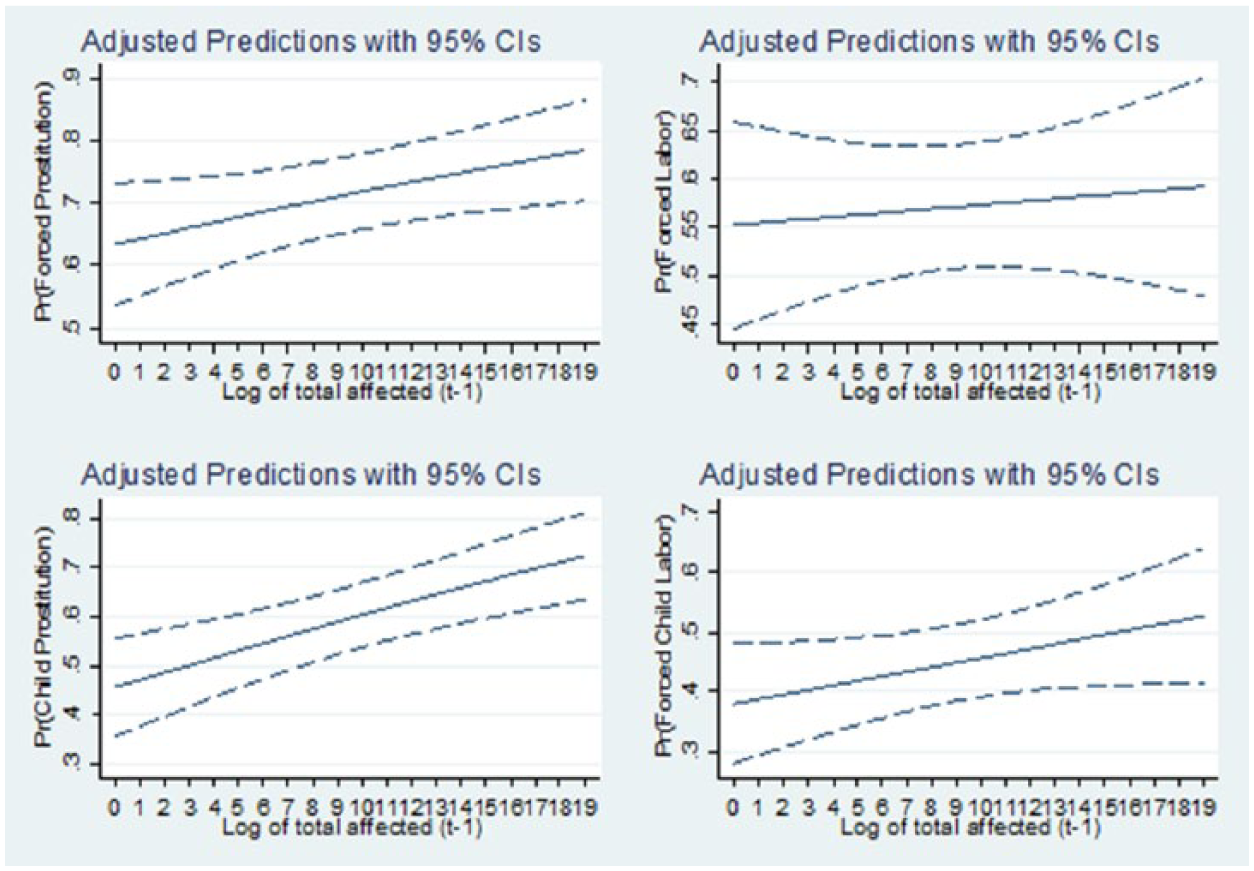
Marginal effects of natural disaster on internal human trafficking.
This distinct upward trajectory of our outcome variable is similarly noticeable in the case of child prostitution. When the affected population is at zero, the likelihood of internal child prostitution is around 45 percent. With the X-axis value at 10 (or, 22,000 deaths), the probability of this form of internal trafficking rises to 60 percent, capturing a 15 percent increase. The overall rise (an overall shift of 25 percent) here is more slightly pronounced in comparison to the case of forced prostitution (rise of 20 percent). Based on our observation, it appears that children are far more susceptible in post-disaster environment, confirming the existing fears (UN General Assembly, 2012).
In comparison to the prostitution-based internal trafficking, the impact on the labor-based trafficking appears relatively weak, especially in the prediction of the likelihood of forced labor. The overall shift in the likelihood of the outcome variable is less than five percent. Two SDs of total affected registers minimal effect on forced labor. The existence of internal forced labor, therefore, is largely independent of the effects of the disaster-affected population. On the other hand, the rise in the likelihood of forced child labor is more pronounced; the overall shift here is slightly more than 10 percent. Although inferior to the prostitution-related dependent variables, overall observations further underline the vulnerability of children in the aftermath of disasters.
Among the control variables, the effects of legislation and enforcement on the outcome variables are in opposite directions, as we suspected. Although enforcement appears to deter the likelihood of internal trafficking, anti-trafficking legislation seems to facilitate internal trafficking. As we discussed earlier, countries that criminalize trafficking behavior are often found to have ulterior motives, often more interested in political benefits and political image (Kelley and Simmons, 2015; Lloyd et al., 2012). A commitment to enforcement of trafficking laws can lead to unwanted economic ramifications; a clampdown on trafficking and related migration can result in negative consequences for the economy (Aronowitz, 2001). Therefore, criminalization and enforcement of trafficking laws remain diametrically opposed, confirming the observations of Frank (2013).
The impact of rule of law is consistently negative across all models. A stable regime serves as a dissuasion from criminal activities, including internal trafficking. Results for democracy and corruption are mixed. Democracy appears to deter the likelihood of labor-related trafficking but facilitate prostitution-based trafficking. This insinuates a complex relation between types of trafficking and democratic regimes. It has been estimated that countries with prostitution laws are positively associated with trafficking (Cho et al., 2014; Jakobsson and Kotsadam, 2013). In other words, an overall liberal ideology of the country can attract prostitution-based trafficking. On the other hand, respect for human rights can deter the likelihood of trafficking for labor (Peksen et al., 2017). This is further evidence of the difference between labor-based and prostitution-based trafficking.
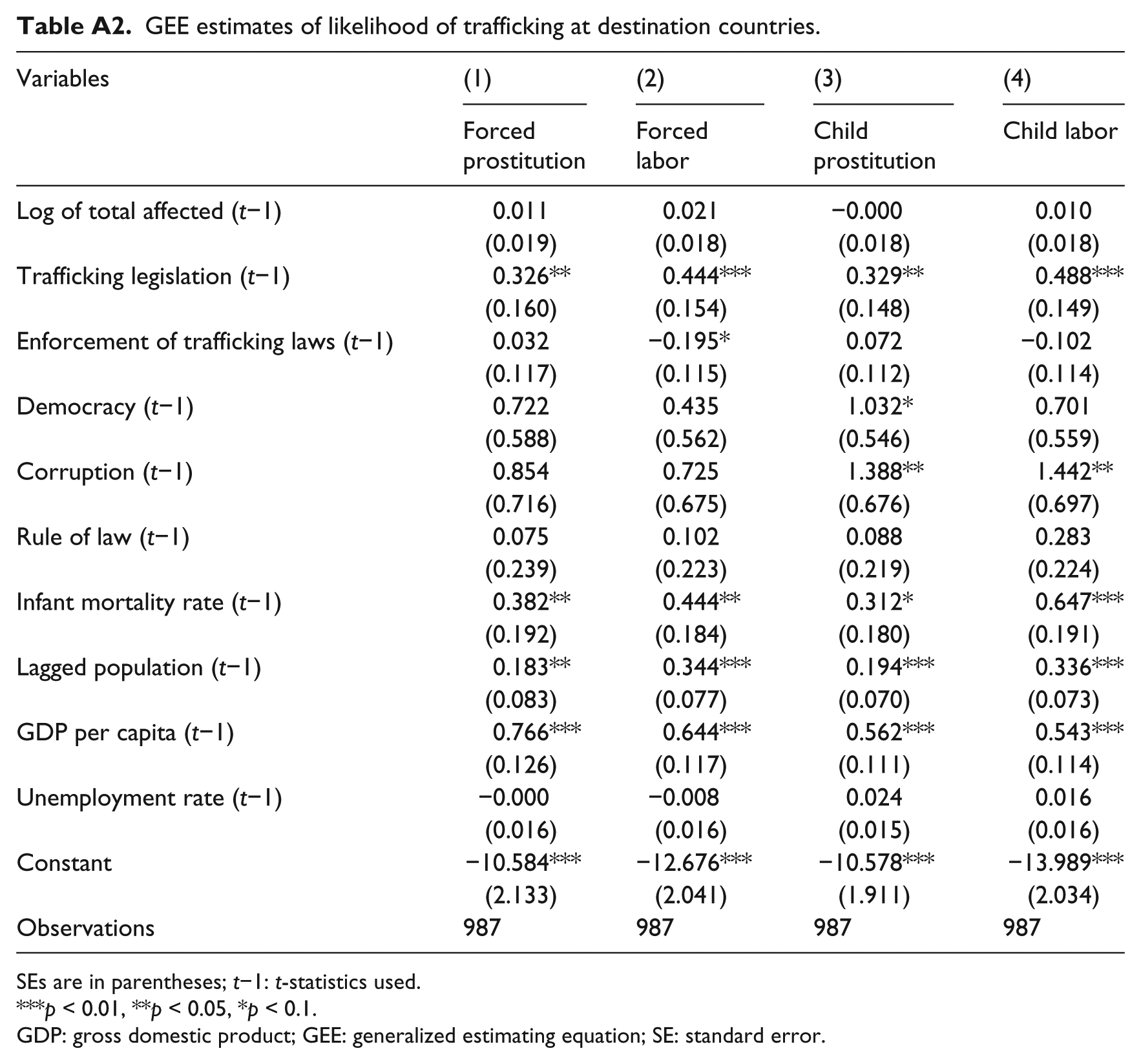
The inconsistent effect of corruption is more difficult to interpret. It is argued that there is a symbiotic relation between corruption and trafficking (Richards, 2004). Interestingly, the corruption-trafficking relation is similarly inconsistent in the GEE model for source countries but consistently positive in the case of destination countries (see Appendix). This expected trend in the case of destination countries implies a complex relation between corruption and trafficking. Considering the potential for omitted variable bias, and the overall paucity of data, a re-estimation with disaggregated data might provide a more nuanced picture here. On the one hand, our economic predictors—GDP per capita and unemployment rate—are consistent with our expectation. The income level shares a consistently negative association with the outcome variables. On the other hand, the level of unemployment is especially rough on prostitution-based internal trafficking, which is consistent with our primary findings. Overall, our results provide some interesting and nuanced inferences on internal trafficking in relation to the effects of natural disaster.
Tentative conclusions
Human trafficking manifests itself in a variety of forms. We estimated the effects of disaster on internal trafficking based on forced prostitution, forced labor, forced child prostitution and forced child labor. Prostitution-based exploitation appears more likely in the aftermath of disasters. Realistically, this points toward an acute vulnerability faced by women and children. The positive association between labor-based trafficking and disaster severity is not as dramatic, however. We attribute this effect to a relative paucity of trafficking networks and necessary markets in comparison to transnational trafficking. From a theoretical standpoint, we infer that disaster effects contribute directly to the vulnerability of individuals and therefore also to the government response. This “perfect storm” relationship, however, needs further exploration.
Internal trafficking, as we have shown, is a legitimate concern, most notably in the case of countries with low institutional capacity and welfare programs (Danailova-Trainor and Laczko, 2010). The impact of a hurricane in Puerto Rico is going to be far severe and long-lasting compared to a similar disaster in the continental USA. We need more precise measurements of institutional capacity and state-based welfare programs. Although we have anchored our focus on internal trafficking, it is linked to transnational trafficking dynamics (Peksen et al, 2017). In the future, empirical models estimating the linkage within and between countries should yield substantive inferences. Our work also points to a further inquiry on enforcement of trafficking laws. There is little assessment on what works in the global fight against trafficking. What leads to effective enforcement of trafficking laws? A nuanced understanding of enforcement is not only relevant, but extremely significant.
Armed with this knowledge, countries can adjust disaster preparedness plans to account for this specific trafficking threat. Based on our results, in addition to rescue and relief work, governments would be wise to pay attention to domestic trafficking, providing necessary protection to vulnerable survivors, especially women and children. Our findings also show that authorities might be better off paying close attention to prostitution-based exploitation and networks. If internal trafficking is more prevalent during the post-disaster time frames, the state can work with disaster relief agencies to watch for unusual movement of people internally, and not monitor the borders as much. Finally, in terms of child protection, states need to plan for the potential of large numbers of children being left without parents or guardians. Programs need to be implemented to provide children a safe place to live, with proper supervision by other adults.
Our work is not a conclusive statement on trafficking or natural disaster. Instead, we view our exploratory work as a point of departure in the investigation of trafficking and natural disaster. In establishing the connection between internal trafficking and disaster effects, we hope to draw attention to domestic trafficking. Although the global emphasis on trafficking is pertinent, empirical and theoretical investigation into internal trafficking is well merited.
Supplemental Material
TPS_Supplementary_Files – Supplemental material for The perfect storm: The impact of disaster severity on internal human trafficking
Supplemental material, TPS_Supplementary_Files for The perfect storm: The impact of disaster severity on internal human trafficking by Anuj Gurung and Amanda D Clark in International Area Studies Review
Footnotes
Appendix
GEE estimates of likelihood of trafficking at destination countries.
| Variables | (1) | (2) | (3) | (4) |
|---|---|---|---|---|
| Forced prostitution | Forced labor | Child prostitution | Child labor | |
| Log of total affected (t−1) | 0.011 | 0.021 | −0.000 | 0.010 |
| (0.019) | (0.018) | (0.018) | (0.018) | |
| Trafficking legislation (t−1) | 0.326** | 0.444*** | 0.329** | 0.488*** |
| (0.160) | (0.154) | (0.148) | (0.149) | |
| Enforcement of trafficking laws (t−1) | 0.032 | −0.195* | 0.072 | −0.102 |
| (0.117) | (0.115) | (0.112) | (0.114) | |
| Democracy (t−1) | 0.722 | 0.435 | 1.032* | 0.701 |
| (0.588) | (0.562) | (0.546) | (0.559) | |
| Corruption (t−1) | 0.854 | 0.725 | 1.388** | 1.442** |
| (0.716) | (0.675) | (0.676) | (0.697) | |
| Rule of law (t−1) | 0.075 | 0.102 | 0.088 | 0.283 |
| (0.239) | (0.223) | (0.219) | (0.224) | |
| Infant mortality rate (t−1) | 0.382** | 0.444** | 0.312* | 0.647*** |
| (0.192) | (0.184) | (0.180) | (0.191) | |
| Lagged population (t−1) | 0.183** | 0.344*** | 0.194*** | 0.336*** |
| (0.083) | (0.077) | (0.070) | (0.073) | |
| GDP per capita (t−1) | 0.766*** | 0.644*** | 0.562*** | 0.543*** |
| (0.126) | (0.117) | (0.111) | (0.114) | |
| Unemployment rate (t−1) | −0.000 | −0.008 | 0.024 | 0.016 |
| (0.016) | (0.016) | (0.015) | (0.016) | |
| Constant | −10.584*** | −12.676*** | −10.578*** | −13.989*** |
| (2.133) | (2.041) | (1.911) | (2.034) | |
| Observations | 987 | 987 | 987 | 987 |
SEs are in parentheses; t−1: t-statistics used.
p < 0.01, **p < 0.05, *p < 0.1.
GDP: gross domestic product; GEE: generalized estimating equation; SE: standard error.
Conflict of interest
The authors declare that there is no conflict of interest.
Funding
This research received no specific grant from any funding agency in the public, commercial, or not-for-profit sectors.
Notes

References
Supplementary Material
Please find the following supplemental material available below.
For Open Access articles published under a Creative Commons License, all supplemental material carries the same license as the article it is associated with.
For non-Open Access articles published, all supplemental material carries a non-exclusive license, and permission requests for re-use of supplemental material or any part of supplemental material shall be sent directly to the copyright owner as specified in the copyright notice associated with the article.
