



Abstract
This article identifies, through a retrospective study of literature, the transitional dynamics of traditional crafts of South and South East Asia. It aims to explain the various factors that necessitate commercialization of crafts, the most important element in transitional dynamics. The review of literature functions at two levels: on the one hand, it reiterates the relationship between commercialization and transition of crafts, whereas, on the other hand, it reveals the changes which accrue to the crafts of the region. A significant number of researchers have documented the reasons behind commercialization and subsequent modification of crafts, which take place either through tourism or through the expansion of export markets. Some countries go into commercial production mode for the betterment of the extremely poor craft-making communities, whereas others try to revive decaying traditions. In such instances of commercialization, it is important to understand the extent of the producer–customer interface that acts as a catalyst in the commoditization and modification of crafts. In regions where tourism flourishes, producers often commercialize their crafts spontaneously, whereas in regions where direct tourists as customers are not adequate in number, organizations, particularly non-governmental organizations (NGOs), play a vital role in the process of sponsored commercialization by linking producers with customers.
Introduction
Traditional craft practices have neither remained static nor confined to a particular region or a community, but have gone way beyond the conventional modes of production. Crafts that were majorly traded within the community as utilitarian or everyday objects (Sarma, 2008; Swanson & Timothy, 2012; Yang, 2008) are gradually being commercialized to suit other needs. Changing socio-economic conditions have also forced artisans to sell items of everyday requirement, thus taking the craft from the rural to the urban market space (Handique, 2010) by intersecting traditional manufacturing practices with techniques of mass production. It may seem to be antithetic to the original value of the crafts, but there is no denying the fact that the system has become far more complex due to the presence of artisans, craftsmen, intermediaries and consumers. Cutting across the barriers of internal audience 1 (Graburn, 1976), it has now reached the global market, thereby broadening its scope of commercial pursuit. To better explain this transition, one could take the example of Indonesia, a South East Asian country that has carved out its space as one of the largest exporters of crafts in the world (Chotiratanapinun, 2009). Today, it is common to find craft objects across world markets having ‘Made in Indonesia’ tags (Shen, 2011). At the same time, it is also not unusual to come across a global manufacturer producing and tagging a local Indonesian souvenir (Asplet & Cooper, 2000).
The rise in mass tourism is another factor that contributes to the global outreach of traditional crafts, thus creating a market for the external audience (Graburn, 1976). 2 Tourism in a region leads to the emergence of souvenir industry, which thrives mostly on local crafts. To make a craft suitable for touristic commercialization (McKercher, 2008), it is necessary to incorporate new designs, colours, materials and appearances in the original product (Berma, 1996; Cant, 2012; Cohen, 1988, 1993; Markwick, 2001; Reynolds, 2011; Stephen, 1991). Such new features are introduced in order to keep the traditional crafts in sync with the requirements of modern life (Huhtamaa, 2006). Handicrafts that were generally used as utilitarian items in the past, thus, become luxury goods (Wiboonpongse, Sriboonchitta, & Chaovanapoonphol, 2007) and items of aesthetic and economic value (Yang, 2008). Likewise, tourists and art connoisseurs have now become the new patrons of these crafts displacing the local community members.
It is important to understand the commercial dynamics that forms an integral part of the transformative journey of crafts. While most crafts spontaneously react to changing needs of customers, certain crafts, according to Cohen (1989a), get adapted under the aegis of dedicated organizations and undergo sponsored commercialization. Artisans commoditize crafts on their own or sometimes reinvent and reconstruct a traditional craft under the guidance of various agencies. Change is unavoidable (Berma, 1996) and grows perceptibly though slowly over time (Cohen, 1983). In this age of mass consumption, commoditization due to commercialization is existent in many forms.
Need for the Study
Differentiation in crafts ‘involves a deliberate action on part of artisans to produce crafts for sale’ (Berma, 1996) and is the most important factor for commercialization (Hoyos, n.d.). Constant innovation and reinvention take place as artisans become aware of the fact that traditional crafts produced for a utility-seeking rural society have lesser or no value in the urban market (Shen, 2011). In other words, the nature of the market is a decisive factor for change and innovation of crafts (Berma, 1996). Markets may comprise direct or indirect tourists, 3 and both give rise to ‘transitional arts’ (Cohen, 1984). In these markets, transition may happen spontaneously or through the intervention of intermediaries. Cohen (1989a, 2000) evaluated this interface between the customer (especially the tourist) and the producer in his study of Thai crafts, where he propounded the term ‘spontaneous commercialization’ and ‘sponsored commercialization’. In spontaneous commercialization, artisans intuitively start modifying and producing items that may attract the tourists’ frequenting their place, whereas in sponsored commercialization, artisans far away from the tourists and other external customers are guided by intermediaries to manufacture products for distant markets.
It is generally observed that tourists often visit the principal craft markets in central locations and capitals, but not all the craft villages. Hence, all craft villages of a region do not often get the opportunity to witness the interface between the producer and the direct customer (especially tourists). The role of intermediaries thus becomes vital in this process of commercialization. The craftsmen’s artistic instinct may drive them to modify their craft leading to spontaneous transformation, but its trade might be possible only through intermediaries. The same set of intermediaries may also work as change agents who are involved in the modification of the craft. Earlier studies have overlooked the extent of this particular producer–customer interface and the distinct role played by intermediaries in regulating the sponsored commercialization process of crafts.
The South and South East Asian region offers ample scope to study these relationships as it occupies an important space in the world craft map owing to its diverse cultural heritage and a booming market governed by travel, tourism, trade and commerce.
Objective
The broad objective of this article is to examine the process of commercialization of traditional crafts of South and South East Asian countries and study the extent of producer–customer interface keeping in view the role of intermediaries. The study also aims to point out and understand the transitional dynamics.
Methodology
The study is primarily based on secondary sources. The basic methodology includes a retrospective study of various research works on the commercialization of traditional crafts of South and South East Asia. The narratives and viewpoints of different researchers are structured within a comparative framework, keeping in mind the angles of trade and tourism, role of intermediaries and the extent of producer–customer interface. Established concepts such as commoditization and sponsored as well as spontaneous commercialization are critically examined with respect to the economic circumstances prevailing in the two regions. Furthermore, based on the comparative viewpoints, an attempt has been made to provide a holistic picture of the process of commercialization [1. Spontaneous: a) Complementary and b) Substitutive commercialization & 2. Sponsored: a) Encroaching & b) Rehabilitative commercialization] developed by Cohen (1989a).
Understanding Commercialization of Traditional Crafts
In a traditional set-up, craft items are produced in relatively small numbers essentially meant for an audience comprising the producer and members of his/her community (Cohen, 1983; Graburn, 1976). This internal market is rather limited. In order to expand their market base, artisans start exploring outside the internal domain. In doing so, they start producing crafts that might suit the tastes of external communities. Also contact with the modern and external world like tourist audiences, give rise to many new folk arts (Cohen, 1983). Outsiders or external audience thus become the catalyst for innovation and diversification of crafts (Cohen, 1993). This is termed as spontaneous commercialization, which happens in situations where direct contact with the external audience (i.e., the tourist) leads to modification of crafts (Cohen, 1989a).
Several studies (Cohen, 1993; Graburn, 1976; Popelka & Littrell, 1991) have taken into account such direct effect of tourism on traditional and cultural landscapes. The influence of mass tourism is reflected when objects of fine arts are produced in miniaturized or gigantic forms (McKercher, 2008). Tourism may also lead to simplification of the art to cater to new demands (Ballengee-Morris, 2002; Revilla & Dodd, 2003). Graburn (1976) said that arts of the Fourth World 4 can be produced for the aesthetic satisfaction of the dominant world in the form of ‘tourist art’ or ‘airport art’. Many indigenous crafts have transformed from ‘traditional and religious arts’ to ‘functional art and fine art’ (Graburn, 1976) and ‘secular arts’ (Parezo, 1981), especially for this external community. Novel or hybrid crafts 5 become the most sought-after souvenirs (Graburn, 2008). Contemporary crafts may be studied from the perspective of commercial pursuit of craftsmen. When a craft is introduced to the commercial dynamics of the tourism system, it transforms the object and gives new meanings to the artisan as well as the consumer community. Craftsmen start distinguishing their products as commercial, traditional or rustic and fine pieces (Cant, 2012). Accordingly, designs, motifs, colour combinations and use of raw materials also differ.
Many a crafts get commoditized under the guidance of external agencies. Crafts that do not directly relate to the producer’s culture become popular under the influence of outside agents. This is termed as sponsored commercialization (Markwick, 2001; Sarma, 2008). Cohen (1989a, p. 162) identifies sponsored commercialization as a process ‘induced by an external agency, for purely commercial or for humanitarian reasons’. In some cases, novelty is also introduced by these external agencies, which is known as sponsored innovative commercialization (Markwick, 2001; Sarma, 2008). In many developing countries, once the government and sponsoring agencies have established the economic prospects of crafts, they attempt to redevelop the crafting practices and provide market access to the artisans. In certain cases, international organizations such as UNESCO play a major role in sponsoring the re-production of cultural objects of the local people (Graburn, 1984). This has helped in keeping the local traditions alive. Thus, the process of commercialization of handicrafts in developing countries mainly involves the production of objects such as trinkets, furnishings, gifts and housewares by skilled artisans for the local and foreign markets, often regulated by intermediaries (Subramanian & Cavusgil, 1990). Income generation and trade thus become key to the commercialization process.
The above discussion primarily reflects two distinctive types of commercialization. The first with a direct producer (artisan) and customer (tourist) interface where artisans respond to customer needs, thereby initiating the spontaneous commercialization of crafts. In the second form, that is, sponsored commercialization, artisans operate via intermediaries and act as per their design specifications and guidelines (Cohen, 1989a; Reynolds, 2011). Spontaneous commercialization is thus a natural process, whereas sponsored commercialization involves intervention by intermediaries.
In regions where tourists are not abundant and there is a lack of proximity between the producer and the customer, it may be difficult to establish a direct interface between the two, thereby hindering the process of spontaneous commercialization. It is observed that most often only a handful of artisans come into direct contact with outsiders. The majority of the community, who is also engaged in spontaneous innovation, gains access to customers only through ‘participation in networks and institutions’ (Stephen, 1991). In such cases, intermediaries such as retailers and wholesalers, who constitute a considerable portion of the market (Cant, 2012), play an important role in negotiating with the external customers (Moreno & Littrell, 2001). The extent of interface, an important aspect of the commercialization process, was often overlooked in earlier studies but has been discussed in detail in the present article.
It has become necessary for artisans to adapt to modern features in order to make handicrafts up to date and ready for sale. Artisans experiment with their products to make them suitable for the market (Ballengee-Morris, 2002). Commercialized arts, thus, belong to ‘transitional’ dynamics (Cohen, 1983), capable of continuous evolution and transformation (Tung, 2012). In the present study, the term ‘commercialization’ of crafts has been viewed largely from the perspective of change and modification to the craft.
The Commercial Dynamics of Traditional Crafts of South and South East Asia
In this section, an attempt has been made to explore the traditional craft practices of the countries of South and South East Asia, from the perspective of commercialization. The Western world has always been attracted to this region for its richness of history, culture and heritage. Geographically, the region encompasses South East Asian countries (Thailand, Cambodia, Vietnam, Laos, Brunei, Malaysia, Singapore, Indonesia, the Philippines, Myanmar and Timor-Leste) and South Asian countries (India, Bangladesh, Pakistan, Nepal, Sri Lanka and Maldives).
Traditional craft practices, a significant heritage of the region, constitute an important part of the economy. Commercialization of this heritage has taken various forms. For instance, the strategic location of Thailand on the borders of East Asia and South East Asia provides it with an advantageous position, which facilitated intermingling of various cultures such as Indian, Sri Lankan, Khmer and Chinese. Thai crafts, thus, are influenced by all these varied cultural fabrics (Chotiratanapinun, 2009).
The first ever classification of commercialization of Thai handicrafts was done by Cohen (2000). The categories initially identified by Cohen (1983) represented the commercialization of the textiles of Meo and Yao tribes. Due to the resettlement of the tribes during the political upheaval of the 1960s and 1970s, commercialization of tribal crafts was mostly sponsored in the refugee camps. The Thai Hill Crafts Foundation played an important role in this process as an external agent. According to Cohen, it was a collaborative effort of artisans and intermediaries which led to a strict standardization of the craft. However, there were some agencies under which artisans could innovate freely, though within standardized guidelines. At the same time, a different form of commercialization was taking place in the highland villages that were accessible by the tourists. This commercialization was more of a self-generated nature. Cohen (1989b) mentions ‘Pa Ndau 6 ’ or the traditional Hmong squares which showed both spontaneous and sponsored responses to external demand under the aegis of NGOs and missionaries and also as a result of direct tourist demand. The squares witnessed spontaneous changes when conventional designs were being transformed into innovative forms. This happened as a result of the tribe trying to adapt to different ecological settings while moving from one place to another. Moreover, the fact that the squares were still in demand among the internal community provided a congenial environment for the spontaneous changes to have occurred (Cohen, 1989a). At the same time, sponsorships provided by various NGOs led to the production of coin bags, tablecloths and bedspreads in these ‘batiked’ squares 7 . Major innovations took place along with the introduction of a wide range of colours suiting Western tastes and new raw materials, which eventually led to ‘standardization’ and ‘routinization’ of the products. In this case, the artisans had no direct communication with the market (Cohen, 1993).
Sometimes, even without a hereditary practice of crafting, craft production becomes an essential part of the everyday life of some communities (Roux, 2006). When provided with an opportunity, communities tend to get inspired by nature, culture and other resources to create a new range of products. This was the case with the Thai pottery of Dan Kwien village. The community here continued to produce simple utilitarian earthen wares like mortars (Krok), rice steaming vessels (Mo Hun Khao) and marinated fish containers (Hái), but the introduction of industrial products led to the proliferation of a variety of new miniaturized pottery products and wares, especially meant for tourists and export markets (Cohen, 2000). A variety of traditional jars and vessels were modified to adapt to new functional or decorative uses and were ornamented by novel designs and colour combinations in order to suit the taste of external customers. It showed spontaneous transition when artisans transformed their items from functional wares to decorative products based on Western art objects. Cohen observed that these transitions, which involved the fusion of size, shape, colour, function and form, took place in an effort to capture the market, especially the external export-oriented one. With the rise in tourist activities, earthen jewellery with new designs and artistic style gave rise to a novel line of products in Dan Kwien village (Cohen, 1993). The direct customers for Dan Kwien products were principally the domestic and international tourists who influenced the changes in the craft and, thus, led to the spontaneous expansion of the market (Cohen, 1984). Similarly, in Ban Thawai, carvers 8 responded to the demands of the external market, especially the export market, by producing novel objects based on Asian and Western models (Cohen, 2000). It can be deduced that the producers reached the external customer base through middlemen while spontaneously innovating and modifying the existing products, thereby restricting the role of intermediaries to being only the sales agents of the craft.
Chartniyom (2013) refers to commercialization of traditional basket-making in Thailand where artisans responded to the demand of foreign customers, who wanted to replace bamboo with plastic strips. Here, a direct producer–customer interface resulted in spontaneous commercialization. In some other circumstances, as mentioned by Chartniyom (2013), traditional craftsmen spontaneously reacted to the substitute product market but the items reached the foreign audience only through middlemen. For instance, the artisans 9 had spontaneously initiated the process of making customer-oriented items like plates instead of the traditional bronze water jars (Chartniyom, 2013) but they approached this market through Chinese intermediaries. In some cases, middlemen brought the design specifications requested by customers and encouraged the craftsmen to adopt those designs (Chartniyom, 2013). This is a perfect example of how a middleman can facilitate sponsored commercialization. The above cases clearly show two distinct forms of commercialization. The first where the intermediary acts only as a sales agent linking the producer with the customer, commercialization is initialized by the producers, whereas in the second form, the intermediary was fully involved in the modification as well as sales, thus acting as both a change and a sales agent. The craft sector in Thailand flourished with similar such efforts, as contemporary designs were used to revitalize and elevate local crafts to a whole new level (Chotiratanapinun, 2009).
In Indonesia, tourism has always been one of the main catalysts for the commoditization of many of its craft forms (Gustami, Wardani, & Setiawan, 2014). The artisans here create craft pieces that reflect a beautiful amalgamation of local and Western designs. Their creations 10 are directly influenced by Western buyers who visit the island in large numbers. International design magazines like ELLE Décor, Vogue Living and Belle have also influenced the craftsmen of Indonesia (Chotiratanapinun, 2009). A kind of spontaneous innovation (Markwick, 2001) can be seen when items like chopsticks, wine containers and Japanese noodles bowls, completely alien to the Balinese culture but decorated with the traditional batik pattern, are produced in the remotest workshops of the island 11 , which in all probability are not accessible to the tourists (Chotiratanapinun, 2009). It could be surmised that, in such cases, intermediaries fill in as sales agents. In another instance, traditional utensils made of coconut shell are redesigned and transformed into decorative bowls, cups and spoons through ‘coconization 12 ’ (Nugraha, 2010). The process is conducted with the help of external agencies who provide service to the local as well as external customers.
Indonesian textiles have almost ceased to be utilitarian in nature and are now found mostly in individual homes and galleries as objects of art (Howard, 2006). It is also not uncommon to see the spontaneous introduction of batik on wood in central Java, converting it into an object essentially used for decoration (Nugraha, 2010). Batik embroidery can be seen in many products such as bags, handkerchiefs, tablecloths and neckties. Batik motifs underwent a change during the nineteenth century when they were influenced by Western cultural elements brought in by the Dutch and Indo-European people (Matsumoto, 2004). In the city of Jambi in Sumatra, batik primarily originated as a rural craft which was later produced to meet the demands of the royal courts (Goslings, 1929/1930, as cited in Hitchcock & Kerlogue, 2000). Turkish, Syrian and Indian influences could be seen on Jambi’s traditional batik motifs, which was a spontaneous response of the artisans to the new cultural elements (Goslings, 1929/1930, as cited in Hitchcock & Kerlogue, 2000; Steelyana, 2012). Scholars have noted inscriptions from Middle Eastern countries in the batik design and clothing of Jambi and other regions of Indonesia (Kerlogue, 1997, p. 184). Barbara Leigh (1982) also highlighted the likely influence on designs due to Indonesia’s trade connection with Turkey. Calligraphy motifs in Batik cloth of Jambi is one such influence (Barbara Leigh, 1982, as cited in Kerlogue, 1997, p. 185). Steinmann (1947) also writes that Indian batik cloths were imported to Java which could have influenced the designs in Jambi’s batiked cloth (as cited in Hann 2005, p. 17). Indonesian artisans readily started adapting Indian motifs on local productions (Davidson, 2012). In recent years, tourist inflow to Indonesia has largely influenced the nature of batik (Kerlogue, 1997, p. 22). Jambi batik printed cloths were popular among the elites who used to buy these for ceremonial purposes. The introduction of block print enhanced their commercialization as the prints started to appear in uniforms of schoolchildren and government employees (Goslings, 1929/1930, as cited in Hitchcock & Kerlogue, 2000). This practice was presumably sponsored by government agencies. Nowadays, wax-resist and dyed lukisan batik prints of Kraton in Yogyakarta can be found as wall paintings (Tolentino, 2012). Commercial batik masks are also produced by the artisans as souvenir items, especially for sale in tourist outlets (Tolentino, 2012). These masks are different from the traditional ‘topeng’ masks, as the latter contain hand-painted batik designs. These products have undergone spontaneous commercialization through the direct producer–customer interface.
Commercialization of traditional crafts in Indonesia has reached such an extent that fine embroidery, once reserved for elite dresses, has started appearing in contemporary fashion items like home apparels, shirts, T-shirts, women’s tops, blouses or tunics and undergarments (Trade Research and Development Agency, 2008). Kebaya, a traditional long-sleeved blouse worn over skirts that was originally made of brocade or silk, have now been replaced with cotton fabrics in an attempt to cater to the need of the masses (Trade Research and Development Agency, 2008). Songket, a kind of woven fabric, underwent further embellishments after the artisans of Palembang spontaneously added glittering floral embroidery onto it. Such additions have brought more economic value to Songket (Trade Research and Development Agency, 2008). Professional designers are also utilizing the talent of traditional Javanese artisans residing in distant villages to create embroidery on contemporary collections (Kolesnikov-Jessop, 2013; Prathivi, 2013). Thus, they are becoming the change agents by providing additional markets to the artisans.
Indonesia is also a huge exporter of customized earthenware products. Craftsmen follow pictures provided by buyers and mostly produce customized items ordered by them (Raharjo, 2013). Functional earthen products satisfy the internal customers but to meet the demand of the burgeoning export market, which is reached through retailers, items are made more decorative and aesthetically pleasant. Wayang, a folk puppet play from Java and Bali, also saw massive transformation in recent years. Along with changes in the traditional storyline, the artisans have also brought visible changes to their flat wooden puppets or the Wayang figures. Some artisans have spontaneously created Wayang figures like ogres and demons in bright colours, which are in total contrast to the traditional figures (Rath, n.d.). Such spontaneous transformations are inclined towards the modern-day audience. The Toraj weavers of Sadan sell their traditional fabrics in the form of Western functional items such as napkins, tablecloths and miniature replicas of ceremonial fabrics through community-based marketing practices (LaDuke, 1981). Dayak weavers also practice the same for selling their crafts to the tourists visiting their villages (LaDuke, 1981). It can be deduced that modifications are introduced by the weavers themselves upon realizing the commercial opportunities of diversified crafts. With respect to the bamboo craft of Buniasih and Paniis, Triharini (2015) observes that most of the craftsmen work for middlemen who sell the crafts outside the artisans’ place. Here, it can be inferred that middlemen become the sales agent, linking the producer with the customer. However, artisan communities who find independent buyers (such as tourists) bypass the intermediaries (Wherry, 2006) and thus fall under the domain of spontaneous commercialization.
In East Timor, the cradle of tradition swings in the hands of the womenfolk. A revered piece of hand-woven costume ‘Tais’, originally produced in two main styles ‘Mane’ and ‘Feto’ for the male and female, respectively, has undergone massive changes (Alola Foundation and Oxfam, n.d.). ‘Selendang’, a type of long and slender Tais, is a recent addition that is nowadays produced as a memento to be worn around the neck (Alola Foundation and Oxfam, n.d.). The presence of international military personnel on Timorese soil provided the much needed income-generating opportunity for the talented weavers. In this case, commercialization, and hence transition, seems to have occurred due to the artisans’ proximity to international audience, a spontaneous process similar to that of Thai crafts. Selendangs were thus manufactured as customized products, made according to the colour and design request of the direct customers. Tais are also adapted and produced from Indonesian threads as tablecloths, bedspreads, bags, hats and even mobile phone cases in places like Dili in Timor (Alola Foundation and Oxfam, n.d.). A still newer trend is that of making customized fabric for select foreign customers with their name or a word woven into the design (Alola Foundation and Oxfam, n.d.).
Indigenous crafts from Cambodia have also seen transformation due to their commercialization, mostly for the indirect tourist market. Commercialization under the aegis of Creative Industries Support Programme, a partnership between UN agencies and local organizations, in the districts of Prasat Balangk, Prasat Sambor and Sandan has facilitated the production of unique handicraft items made of bamboo and rattan (Indigenous Crafts of Cambodia, 2011). Functional products that integrate culture, tradition and design are created to attract local as well as international customers. Such sponsored commercialization efforts are also seen in the textile and pottery products, with traditional clothing and utilitarian vessels being converted into decorative masterpieces by infusing in-demand designs for the modern customers (Indigenous Crafts of Cambodia, 2011). In Phnom Penh, the Cambodian Craft Cooperation leads artisans to produce export-oriented products such as silk scarves, ceramics and wicker wares (International Trade Centre, 2010). This highlights the role played by such agencies as change and sales agents.
In Malaysia, people in rural areas produce handicrafts for personal use. However, the government’s policy of dedicated commercialization of handicrafts and increasing demand from local and external customers have influenced commercial handicraft production (Fabeil, Marzuki, & Langgat, 2012). The traditional women-oriented art of plaiting, which was once a leisure activity used for making household items such as mats, is now utilized for commercial production of colourful decorative pieces like pillow and cushion covers with harmonious colour arrangement and suitable motifs (Ismail & Nawawi, 2013). It can be derived that the government of Malaysia partly bears the responsibility of sponsoring the commercialization process through its policies. The artisans are provided with access to markets that has helped them in transforming a household activity into spontaneous creations, thereby facilitating commercialization of indigenous craft.
The Thai women in Mai Chau district of Vietnam have a regular practice of manufacturing artistic waist bands and funeral clothes. In response to the direct demand from tourists, some of these women have started producing a wide range of new woven products like brightly coloured cotton scarves (Burkett, 2001). This is, in fact, another example of spontaneous commercialization arising out of direct customer interface.
Traditional, carved wooden figures such as ‘Kinnahu’ and ‘Bul-ul’ found in the Philippines, which was previously required for rituals in the community, is nowadays meant only for trade (Tolentino, 2012). Tolentino confers these changes to the direct influence of Western culture. However, the export of these items is routed through intermediaries. In the growing craft trade market, the artisans from the Philippines depend on marketing channels and intermediaries to ensure that their commercialized products are in demand (Chibnik, Colloredo-Mansfeld, Lee, Milgram, Rovine & Weil, 2004). Here again, the role of intermediaries in the spontaneous commercialization process is more of sales agents only. At times, however, it is useful to understand the market through the eyes of these intermediaries who further assist the artisans in product development and diversification as per customer demand, thereby also acting as change agents.
Traditional crafts have also undergone similar forms of commercialization in South Asia. Malik (2011) presents the example of ‘Phulkari’ embroidery of the Hazara region in Pakistan that was rediscovered with the efforts of NGOs. The craft was decaying since artisans had stopped producing phulkari designs on head covers and shawls. However, an NGO revived it from extinction by introducing its commercial production on contemporary dresses like ‘kurtis’ and other items (Malik, 2011). Herein, the intermediary (i.e., the NGO) provided market access to the talented artisans by diversifying its use. Similarly, ‘Jamdani’ and ‘Kantha’ textiles of Bangladesh also underwent revival in form and design owing to the efforts of Bangladesh Rural Advancement Committee (BRAC). 13 In an effort to enhance its commercial value, BRAC placed orders for Kantha with the rural womenfolk (Chen, 1984). While women artisans experimented with new imprints and designs on Kantha (Chen, 1984), leading to its spontaneous transformation, BRAC also initiated a process of diversification of Kantha products. According to Chakravarty (n.d.), the famed ‘Chikan’ embroidery of Lucknow in India underwent changes in designs and use of raw materials due to a shift in its clientele from royal patrons to commoners. The transition of this craft was slow but spontaneous, initiated by the artisans in search of a wider market among commoners. In the latter part of the nineteenth century, Kashmiri artisans ‘responded to information about design preferences in Europe by producing shawls in accordance with them’ (Maskiell, 2002, p. 55). The blankets and shawls are presumed to have reached European markets through exports led by bulk buyers of the craft. Likewise, the artisans of Dhalapathar, a remote village in the state of Odisha in India, realized the importance of diversification of weaves like ‘Kusumi Kasta’ for door screens, now famously known as ‘Dhalapathar Parda’. This spontaneous commercialization also happened in response to the demand of such products in the contemporary market (Nayak, Patra, & Thilagavathi, 2011).
Tourism has a direct influence on commoditization of crafts in India, somewhat similar to that of South East Asia. The town of Pipli in Odisha has always been vibrant with tourist activities, where one of the main attractions is the beautiful appliqué work produced by the local artisans. A direct interface between tourists and the artisans have led to the transformation of this otherwise utilitarian art form into commercial art (Mohapatra, 2005). ‘Pasapali’ or the dice mat has given way to wall hangings and cushion covers. Artisans create new designs spontaneously in order to monopolize a specific item and gain more profit in the market (Mohapatra, 2005). Direct contact with tourists has also led to the emergence of diversified products (Mohapatra, 2008). The much revered traditional mask-making craft of Majuli 14 is also undergoing changes due to direct tourist–artisan interface. The satradhikar 15 of Natun Samuguri Satra 16 in Majuli believes that masks should be made as per the size of a regular tourist bag (Bhattacharyya, 2010). This is another example of self-generated change. Hauser (2002) believes that commercialization of the scroll paintings of West Bengal in India—from oral tradition to paintings and folk art 17 —is a result of the self-generated or spontaneous work of the folk artists.
According to Mishra (n.d.), the commercialization of Madhubani paintings created opportunities for artists of Mithila to earn money. They started re-creating the floor paintings onto papers provided by government and private agencies and later onto other items like greeting cards and dress materials. These agencies acted as change agents for the artists of Mithila. In the midst of this sponsored process, there also has been a spontaneous transformation when, as a response to direct customer requirements, painters of Mithila started depicting stories of day-to-day life instead of traditional and mythological stories (Mishra, n.d.). Government agencies started to pick up the works of women painters in lieu of monetary benefits (LaDuke, 1981). A similar situation can be observed in the case of hand block-printed clothing of Rajasthan, which reached the international market from a rural clothing landscape with the help of intermediaries (Ronald, 2012). The practice of altering traditional designs and motifs and ‘cutting, stitching, tailoring and transforming flat textiles into fashionable garment’ came into prominence under the guidance of exporters and professionally trained designers (Ronald, 2012). During the 1960s and 1970s, direct tourists who flocked to the state as a result of the flourishing tourism market also constituted a major chunk of the customers for this traditional cotton clothing (Ronald, 2012). It seems that, at times, the spontaneous and sponsored processes move simultaneously but still remain distinct due to the role played by the intermediaries.
In the case of Bandhej craft of Rajasthan, artisans modified traditional bird and animal motifs to geometric patterns, keeping in mind the demand of modern customers. Artisans have learnt to change according to demand through the ‘trial-and-error method’, showing yet another example of spontaneity (Jain & Tiwari, 2012). At the same time, they are dependent on middlemen or traders in reaching out to customers. In Kutch, 18 product diversification has taken place under NGOs like Kutch Mahila Vikas Sangathan. Customer-oriented products like bags and pillows are manufactured, but traditional embroidery designs and patterns are still ingrained in these modern products. Womenfolk associated with such dedicated organizations are generating a stable income, besides preserving tradition. Likewise, pottery and terracotta crafts of Dhubri District in Assam are commercialized in government- and private-sponsored fairs and exhibitions through middlemen (Rural Tourism Project, n.d.). This becomes a partly sponsored process of commercialization, as government mediation in this case provides the much needed channel for the artisans to reach external customers.
There are many other crafts in South and South East Asia, which are going through similar phases and processes of commercialization, apart from those that have been discussed here. Further study and in-depth cross-examination is required to understand all the inherent aspects of these processes. The critical analysis, conducted through the review of some aspects of commercialization of traditional crafts in this article, has helped in drawing certain conclusions.
Conclusion
The detailed discussion made in this article reveals many intertwined factors contributing to the process of commercialization. While crafts of countries like Indonesia were influenced by trade and commerce with other neighbouring countries of the region, political situations fuelled the commercialization of the crafts in nations such as Timor. Also, in strategically located countries like Thailand, where there were adequate number of tourists, crafts underwent modification due to direct communication between the tourists and the artisans. On the other hand, craft-producing regions without direct access to customers often took recourse to intermediaries. Artisans of some countries adopted community-based marketing practices, while others took the assistance of international organizations and NGOs to resurrect their traditional wealth. In many instances, governments took direct responsibility of commercialization of crafts as well. A very significant aspect of commercialization is the extent of interface between the producer and the customer, which decides the presence of intermediaries and their specific roles as change and/or sales agents.
Terms like spontaneous and sponsored commercialization came into focus as a result of the research conducted by Cohen, which helped in drawing an accurate picture of the transition of crafts in the face of tourism and highlighted the efforts made by various organizations to help artisans sell their crafts. His study highlighted the importance of the tourist’s face-to-face communication with the artisan community. According to his theory, direct customers in the form of tourists inspire the modification of crafts. Artisans then initiate production according to direct demand patterns, leading to spontaneous commercialization. However, a critical observation of studies related to craft modification and commercialization drew attention to many instances where artisans did not modify their crafts even when they were in direct contact with tourists. Artisans are often guided by their instincts and skills, and sometimes the information available through mediums like magazines provide them with new concepts to work on. Direct transaction may not always be a possibility in many remote regions of the world in spite of a thriving craft culture and heritage. In the absence of a direct touristic market and demand for modified crafts in a mostly utilitarian product-seeking market, artisans try to reach external markets through middlemen who act as sales agents. The involvement of middlemen who happen to work only as sales agents in spontaneous commercialization of crafts has often been overlooked.
Spontaneous Commercialization
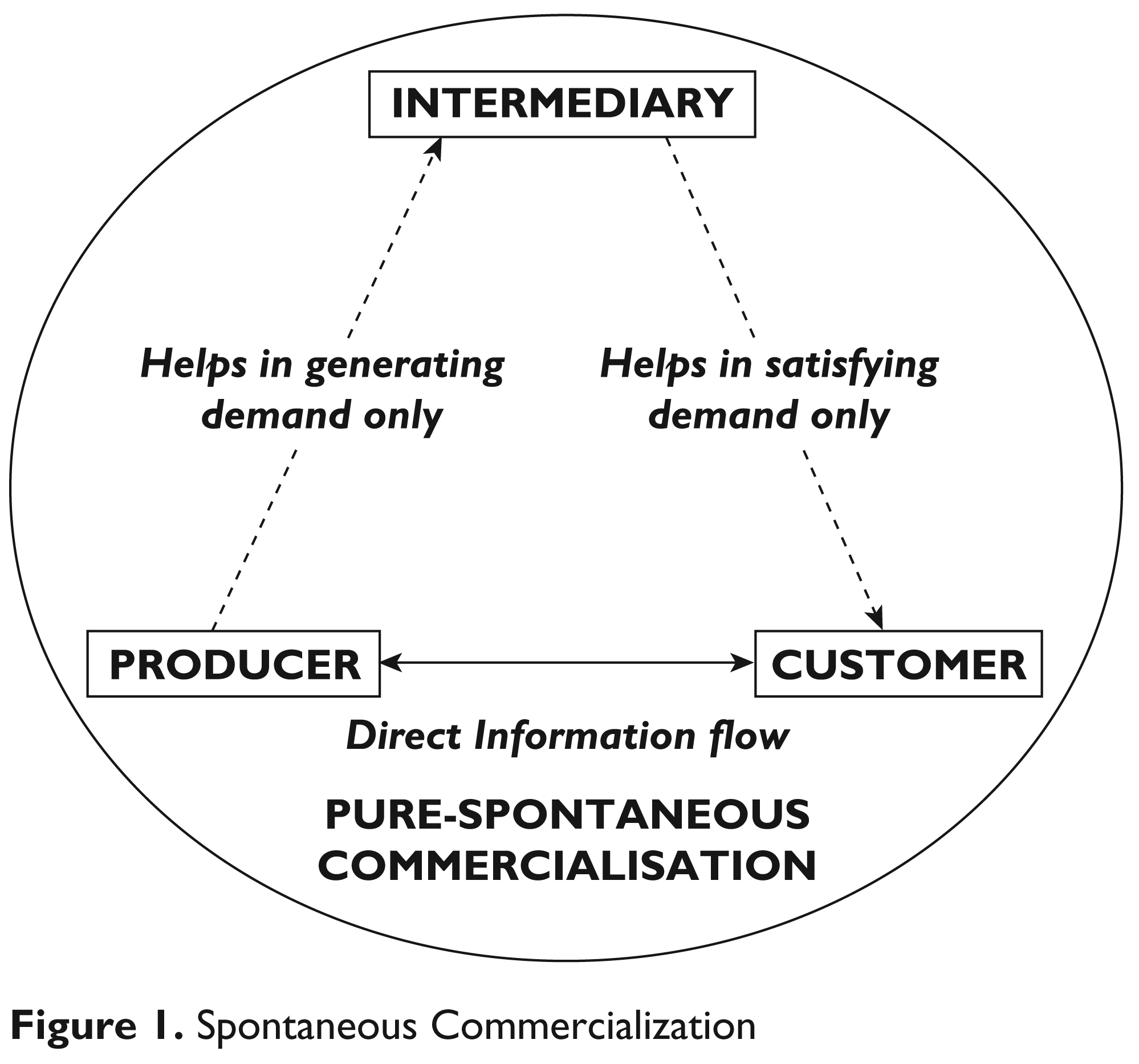
In the light of these observations, Figure 1 has been conceptualized. It can be seen that where direct flow of information and transaction possibilities exist between producers and customers, intermediaries do not have any role to play. This part of the process is, therefore, termed as pure-spontaneous commercialization where craftsmen guide themselves in the modification of crafts through the direct information obtained from the customer. But when the customer is far away and cannot be reached directly, the producer takes help of the intermediary who works only as a sales agent. Here, the intermediary does not dictate the new styles or designs to be introduced in the craft. This is a case where producers are not in proximity to market areas, mostly touristic ones. The intermediary helps in generating demand for the craft items in the external market and also in channelling it to the customers. The entire process, with a distinct role of the intermediary only as a sales agent, is termed as spontaneous commercialization. The contribution of the current model is that it takes into consideration the limited role of the intermediary in the process of spontaneous commercialization. It identifies that change is spontaneous as it is initiated by the producers, although the items are sold through intermediaries.
Sponsored Commercialization

The present discourse also critically analyzes the role of intermediaries in the sponsored commercialization process. According to Cohen’s theory, intermediaries initiate the modification in crafts by controlling the size, shape, form, design and colour of the craft items to be produced by the artisans. NGOs, government agencies as well as individual designers and agents often direct the countryside artisans to produce functional but decorative items for the external customer, thereby facilitating the revival of many craft forms. Jamdani, Kantha and Madhubani paintings are examples of such revived crafts. The examples bring into focus the role of intermediaries, who act as both change and sales agents and introduce standardization of crafts for the export market. Figure 2 explains sponsored commercialization where the intermediary gathers information related to customer demand and subsequently dictates standard specifications to the producers. This intermediary again acts as a sales agent and helps producers in the marketing of their products. The above process could be termed as a pure-sponsored commercialization. In certain cases, intermediaries like government bodies and NGOs provide their services to artisans by arranging initial market access, thus acting only as change agents. However, often there are situations where spontaneous and sponsored commercialization overlap. Such a situation arises when the artisan invokes creativity and leads to novelty in crafts. This may take place even while the artisan is reaching the market through indirect machineries or is following the instructions of the intermediaries. Circumstances such as inaccessibility to the market draw the producer to the intermediary. Here, the intermediary acts as a sales agent rather than a change agent.
The article reflects upon the different processes of commercialization of crafts. It utilizes the base theory of commercialization of crafts propounded by Cohen and further develops it to accommodate situations where intermediaries play limited and distinct roles. It contributes to the understanding of the producer and customer interface in varied situations, distinctively identifying the role of intermediaries as change and sales agents. Also, the extensive review of literature has given a glimpse into the importance of the varied processes of commercialization. Some crafts get a breather due to the direct influence of tourists 19 , whereas others need the involvement of intermediaries to revitalize a diminishing craft tradition. Nevertheless, it is the artisans, their proximity to the market, the market type and the role played by the intermediaries that ultimately decide the emergence of the different categories of commercialization. Traditional crafts, however, always have a tendency to change in a vibrant marketplace.