




Abstract
Work–family experiences, such as work–family conflict and work–family enrichment, not only spill over from one role domain to another but also cross over from one role occupant (e.g., a partner in a dual-career couple or a supervisor in a work setting) to the other member in a dyad (e.g., the other partner in a dual-career couple or a subordinate in a work setting). Review of the literature suggests that studies using crossover models in work–family experiences, especially in work–family enrichment, are limited. Rarely studies have explored the processes through which the crossover takes place. Moreover, not many studies have considered supervisor–subordinate dyads as units of analysis in work–family literature. With this backdrop, the present article aims to put forth a few propositions to examine the crossover of work–family experiences from a supervisor to his/her subordinates. It posits that a supervisor’s work– family experiences may influence the perception of family supportive work-environment and the perceived control over work schedule, which in turn may influence his/her subordinate’s work–family experiences and the latter’s subsequent performance. This article also explores the moderating roles of empathy and leader–member exchange (LMX) quality in the crossover of work–family experiences from supervisors to subordinates. A conceptual framework is proposed for further empirical validation. Research and applied implications of the conceptual model are also discussed.
Keywords
Introduction
Two major role domains, that is, work and family, are of great significance to individuals. Traditionally, these domains were considered separate with the assumption that the man was the breadwinner and the woman was the homemaker. Contemporary demographic, technological and market changes across the globe have minimized the distinction between work and family role domains. Consequently, today, work and family are considered as interdependent role domains having significant impact on each other. Subsequently, examining the relationship between work and family roles has become an important subject matter among researchers and practitioners.
A recent report published by the American Sociological Review suggests that 7 out of 10 American workers struggle to balance their work and family lives (Fondas, 2014). In China, a survey conducted by the Community Business revealed that 72 per cent of Chinese employees cited work–life balance as a critical factor affecting job performance and productivity (Yik, 2013). Work–life balance has become an important concern in India as well. A survey conducted in 2014 by Kelly Services Inc., which featured in a report in The Hindu Business Line (2014), highlighted that around 74 per cent of employees were attracted when employers considered employee’s work–life balance as important. Nair (2013) reported that information technology (IT) employees experience more work–life balance issues since they encounter tremendous work pressures due to heavy work demand, which leads to conflict between work and family domains. These reports emphasize the significance of work–life balance for individuals as well as corporates around the world.
Researchers have adopted various perspectives and have applied various frameworks, models and approaches to study the link between these two integral spheres of life—work and family. Among these, the conflict framework (Greenhaus & Beutell, 1985) has occupied a respectable space in the literature of work–family interaction. The underlying assumption of conflict framework is that work and family are two different role domains. They have different set of demands and responsibilities. Investment of more time and energy in one role will make it difficult to perform efficiently in the other, leading to work–family conflict (WFC; Greenhaus & Beutell, 1985).
Studies on WFC have extensively used spillover and crossover models which suggest that demands or strains from one role domain are carried over to the other role domain and transfer between closely related individuals (Westman, 2001). Spillover is a within-person transmission of strain across one domain of life to another, whereas crossover involves transmission across individuals, where the demands and their consequent strain cross over between closely related persons (e.g., from one partner to the other in a dyad; Westman, 2001). There are quite a few studies which examine the spillover and crossover effects of WFC among dual-career couples (Hammer, Allen, & Grigsby, 1997; Hassan, Dollard, & Winefield, 2010; Rodríguez-Muñoz, Sanz-Vergel, Demerouti, & Bakker, 2014; Rotondo & Kincaid, 2008; Westman & Etzion, 2005; Zhang, Foley, & Yang, 2013).
Role expansion framework has been used to explain positive spillover of work–family experiences within role domains (Marks, 1977; Sieber, 1974). According to role expansion hypothesis, individuals gain resources (e.g., positive mood, skills) and opportunities from the multiple roles (such as work and family) they are engaged in and these, in turn, are used in both the life domains to improve functioning and promote growth leading to work–family enrichment (WFE; Edwards & Rothbard, 2000). Based on this hypothesis, several studies have been conducted to examine the positive spillover of work–family experiences (Baral & Bhargava, 2010; Carlson, Ferguson, Kacmar, Grzywacz, & Whitten, 2011a; Greenhaus & Powell, 2006; McNall, Masuda, & Nicklin, 2009; Rotondo & Kincaid, 2008; Siu, Lu, Brough, Lu, Bakker, Kalliath, & Shi, 2010). Positive spillover model has been predominantly used in studies to examine the impact of WFE on individuals’ job satisfaction, life satisfaction, etc. (Demerouti, Bakker, & Schaufeli, 2005; Ilies, Wilson, & Wagner, 2009; Masuda, McNall, Allen, & Nicklin, 2012).
Yet, transmission of work–family experiences from one individual to the other in a close relationship has received scant research attention (Bakker & Demerouti, 2013; Bakker, Westman, & van Emmerik, 2009) except a few which examine the crossover of strain in principal–teacher dyads (Westman & Etzion, 1999), WFC between team members (van Emmerik & Peeters, 2009), burnout and work engagement between working couples (Bakker, Demerouti, & Schaufeli, 2005), job demands within team members (Westman, Bakker, Roziner, & Sonnentag, 2011). Studies have rarely examined the crossover of WFE between closely related persons (e.g., from one partner to another partner in a family context and from supervisors to subordinates in a work context), one exception being Carlson et al. (2011a).
The supervisor is the closest representative of the work organization and the authority most involved in an employee’s daily work life and has maximum scope to influence the subordinate’s attitude and experience (Major & Morganson, 2011). Given this, Carlson et al. (2011a) examined the crossover of WFE in supervisor–subordinate dyads and emphasized that crossover of work–family experience, especially WFE, requires more attention from researchers and more progress can be made by examining the underlying processes of crossover in detail. Examination of crossover of work–family experience between supervisors and team members or subordinates also needs more attention from researchers, given the rise of jobs involving team work (van Emmerik & Peeters, 2009).
Moreover, studies using crossover models in both WFE and WFC have mostly been conducted in the Western context. Given the changing socio-demographic context, work–life balance studies are demanded across cultures including that of India. Indians, being part of a collectivist culture, give high priority to fulfil their family and social responsibilities (Hofstede, 2001; Rathi & Barath, 2013). Indians usually feel content by spending quality time with their family members, neighbours, friends and relatives, while at the same time they face several demands from both family and job (Rathi & Barath, 2013). Compared to Western culture, in India, the distinction of work and family boundaries is less with more scope for overlap and interference from one to the other (Hassan, Dollard, & Winefield, 2010).
The relationship between supervisors and their subordinates is unique in Indian culture. India differs considerably from the USA and the UK on the dimensions of power distance and individualism/collectivism (Hofstede, 1997; Krishnan, 2011). Varma, Srinivas and Stroh (2005), when comparing India and Western countries, found that the supervisor–subordinate relationship and the way subordinates perceived their supervisors are noteworthy. Indian organizations maintain a hierarchical structure between the supervisor and their subordinates (Krishnan, 2011). At the same time, the correlation between supervisor and subordinate’s ratings on leader–member exchange (LMX) in Indian sample is found to be much higher than supervisor and subordinate’s ratings on LMX in the US sample (Varma et al., 2005). Superior in a collectivist culture acts as a father or mother who takes care of not only work-related issues but also personal issues (Varma et al., 2005). These findings suggest the close relationships between subordinates and their supervisors in Indian work context which needs further exploration.
Most of the theories of work and family linkages (i.e., spillover, segmentation and compensation), primarily focused on the individual as the unit of analysis (e.g., within-individual relationships), as opposed to the couples as units of analyses (e.g., crossover effects of work and family from one spouse/partner to the other) (Hammer et al., 1997). Studying the supervisor–subordinate dyads in a work setting as the unit of analysis allows the examination of crossover effects of work–family experiences of supervisor affecting the work–family experiences of the subordinate which has received relatively little research attention (Carlson et al., 2011a; Westman, 2001). Also, although studies have focused mostly on the crossover of stress, strain, burnout and engagement, the mechanisms through which the crossover happens have not been explored fully (Westman, 2006).
In the light of the above discussion, the first objective of the current study is to review the literature to ascertain the extent to which crossover of work–family experiences (both WFC and WFE) takes place between supervisor–subordinate dyads. The second objective is to explore the extent to which it affects the WFC, WFE, job satisfaction and job performance of the subordinates. The third objective is to delineate the mechanism or process through which the crossover happens.
Literature Review and Propositions
Work–Family Conflict and Work–Family Enrichment
WFC has been conceptualized as bi-directional in nature, where work roles may interfere with family roles (work-to-family conflict) and vice versa (family-to-work conflict) (Frone, Russell, & Cooper, 1992). Conflicts are higher when it is from work to family compared to when it is from family to work (Erdamar & Demirel, 2014). WFC affects individuals’ health, personal lives (Erdamar & Demirel, 2014), marital satisfaction (Carroll, Hill, Yorgason, Larson, & Sandberg, 2013), performance (Mete, Ünal, & Bilen, 2014) and even the partner’s psychological health and experiences (Bakker, Demerouti, & Dollard, 2008; Shimazu, Kubota, Bakker, Demerouti, Shimada, & Kawakami, 2013) and team performance (van Emmerik & Peeters, 2009).
WFE occurs when resources generated in one life domain promote enhanced quality of life in another life domain (Carlson, Kacmar, Zivnuska, Ferguson, & Whitten, 2011b; Greenhaus & Powell, 2006). WFE is also considered to be bi-directional (work-to-family enrichment and family-to-work enrichment) in nature. Experiences created by paid employment can benefit an individual’s family life; likewise, family experiences can benefit an individual’s work life. Regardless of the direction, WFE contributes to positive emotions or affective states of the individuals (Carlson et al., 2011b; Greenhaus & Powell, 2006). WFE affects several positive job outcomes (Baral & Bhargava, 2010; Russo & Buonocore, 2012), teams and their job satisfaction (Hunter, Perry, Carlson, & Smith, 2010).
Theoretical Foundations
The theoretical foundation behind work–family experiences and their spillover and crossover is based prominently on two theories, namely, role theory and broaden and build theory.
Role Theory
Role theory was proposed by Kahn, Wolfe, Quinn, Snoek and Rosenthal (1964). It assumes that work and family role demands conflict with each other resulting in WFC and strain. WFC is a kind of inter-role conflict which results when the role demands of one sphere (work or family) are incompatible with the role demands of another sphere (work or family) (Greenhaus & Beutell, 1985).
Broaden and Build Theory
Broaden and build theory was developed by Fredrickson (1998) to explain the developmental value of positive emotions which has found place in organizational literature in recent years (Bakker et al., 2008). It essentially argues that positive emotions broaden the way individuals think about and act upon a concept referred to as ‘thought–action repertoire’ (Carlson et al., 2011b). Positive emotions broaden the thoughts and actions towards others and encourage an individual to show outward orientation wherein they respond more readily and favourably to others (Fredrickson & Branigan, 2005).
This theory has been applied to understand the crossover of WFE from one partner to the other in a dyad. For example, greater the supervisor’s WFE, greater is the positive emotions which act as the fuel to enhance WFE of the supervisor and, in turn, augment the subordinate’s WFE and performance (Carlson et al., 2011a).
Crossover of Work–Family Enrichment and Work–Family Conflict
Majority of the research studies focused on the spillover model and described how an individual’s experience at work domain brought an effect at the family domain for the same individual (Eby, Casper, Lockwood, Bordeaux, & Brinley, 2005). Crossover is the interpersonal process where one’s psychological stress affects the level of strain of another partner (Westman, 2001). Crossover is an interpersonal dyadic transmission process that operates when one person’s experience affects the experience of another person in the same social environment (Bolger, DeLongis, Kessler, & Wethington, 1989). Experiences that cross over from one individual to the other are job induced stress and strain (Jones, 1993; Westman & Etzion, 1995), negative experiences and emotions (Bakker & Schaufeli, 2000), job demands and emotional exhaustion (Westman et al., 2011), job engagement (Bakker et al., 2005) and positive attitudes, positive experiences at the workplace (Bakker, van Emmerik, & Euwema, 2006). Hammer et al. (1997) suggest that WFC not only spills over from one domain (work) to another (family), but also crosses over from one partner to the other in a dyad. However, crossover of positive experiences has received scant attention in research, although there is some evidence that positive events for one individual will impact the other individual in a dyad (Carlson et al., 2011a; Hammer, Cullen, Neal, Sinclair, & Shafiro, 2005). Negative strain usually causes negative impact on the well-being of the partner/colleague and positive feeling causes positive impact on the partner/colleague (Westman, 2001). Based on this understanding, Carlson et al. (2011a) studied the crossover of WFE in 161 supervisor–subordinate dyads and called for more research on examining the crossover of both positive and negative work–family experiences and the processes underlying such crossover. Moreover, a close scrutiny of the literature suggests that most of the studies are limited to the cross- over of strain and stress between spouses (Bakker et al., 2009), leaving scope to examine the crossover of work–family experiences among dyads. The present study aims to address this need by laying down a framework to study the crossover effects of both positive and negative work and family experiences among supervisor–subordinate dyads.
Any stress and strain experienced by one partner in a dyad, who share close relationships, may create empathetic concern in the other, thereby increasing the level of stress and strain in the other partner in a dyad (Westman & Etzion, 2002). In the family setting, husband and wife share a close relationship and similarly in the work setting, supervisor and subordinates share close proximity and regular interactions. There is enough evidence of crossover of both positive and negative events/experiences such as engagement and burnout from one partner to the other in a family setting (e.g., Bakker et al., 2005). Hammer et al. (1997) and Westman and Etzion (2002) found significant direct crossover of WFC from husbands to wives in family settings. Carlson et al. (2011a) found significant crossover effect of supervisor’s WFE on the subordinate’s WFE.
Hence, we expect that there will be a significant positive relationship between both WFC and WFE of any dyad. In a supervisor–subordinate dyad, the level of WFC of the supervisor because of the role demands placed on him/her may hinder the time and support a supervisor may offer to his/her subordinates and which may augment the pressure on the latter resulting in higher WFC for the subordinates. Similarly, supervisor’s perception of WFE may enhance the subordinate’s perception of WFE because of the enhanced sense of attention, involvement and support. Hence the following propositions:
Effect of Supervisor’s Work–Family Experiences on the Subordinate’s Job Satisfaction and Performance
Supervisor’s level of WFC may result in lesser time spent with the subordinates creating anxiety, stress and less control over work schedules by the subordinates which are detrimental to subordinate’s performance and job satisfaction. Similarly, when the supervisor experiences positive emotions, his/her thoughts and actions towards his/her subordinates will also be positive. As a result, the subordinates may reciprocate the same in their work-related attitudes, activities and higher work performance, creativity and better decision-making (Carlson et al., 2011a; Fredrickson, 2001). Higher the job satisfaction, higher is the organizational commitment and, hence, there is a significant increase in the performance of the subordinates (Lund, 2003). When supervisors experience higher levels of WFE, their subordinates will strive to achieve more and display better performance or output. Hence the following propositions:
Underlying Mechanisms through which Crossover Takes Place
Role of Family Supportive Organizational Perception
Family supportive organizational perception (FSOP) is defined as the extent to which employees perceive that their work organization is family supportive (Allen, 2001). An individual can balance his/her work and family lives, when there is greater demonstration of FSOP (Wayne, Casper, Matthews, & Allen, 2013). Supervisors play critical roles in work–family programmes and policies, personal issues, emergency situations and in which they are implemented and utilized (Hammer, Kossek, Zimmerman, & Daniels, 2007). Broaden and build theory suggests that the supervisor’s thought–action repertoire as a result of enrichment may lead to much different behaviour that are helpful to employees and which ultimately get manifested in greater FSOP (Carlson et al., 2011a; Fredrickson, 2001). Every individual is happy to find an empathetic ear in those who experience similar stress or strain. These people are more capable of relating to the feelings of others as supervisor and subordinates. There is always a greater positive emotion, when the supervisor experiences positive work environment. This subsequently will give the subordinates a perception of supportive environment increasing their level of WFE. Similarly, higher the WFC for supervisors, lesser is their interaction with the subordinates, which bolster higher stress/pressure for the latter and difficulty in balancing their work and family. When the interaction is less, it is not easy for the subordinates to share/tackle their family-related issues with the supervisor and hence less is the FSOP for the subordinates, which may enhance their level of WFC (Hsu, Chen, Wang, & Lin, 2010). When subordinates are given family support in an organization, they tend to perform better in their work-related activities. They tend to tackle with personal and family problems easily which results in reduced level of WFC and increased level of WFE (Carlson et al., 2011a; Hammer et al., 2007; Kossek, Pichler, Bodner, & Hammer, 2012). This leads to the following propositions:
Role of Perception of Control over Work Schedule
Schedule control is defined as the employees’ sense of latitude or control regarding the timing of their work, the number of hours they work and the location where they work, which affects their commuting time and total time away from home (Kelly, Moen, & Tranby, 2011). It deals with the amount at which employees carry out their daily routine during their working hours. Schedule flexibility is an individual’s subjective assessment that his or her work schedule provides the needed flexibility to handle family responsibilities, regardless of the type of schedule (Grigsby & Hammer, 1994). Broaden and build theory suggests that positive emotions broaden the supervisor’s thoughts about how the work is accomplished and facilitate actions that support a wide variety of subordinate’s workplace behaviour (Carlson et al., 2011a; Fredrickson, 2001). High levels of support from the supervisors helps the subordinates to report high levels of control over their work and family issues, expanding the perception of higher control over work schedules (Carlson et al., 2011a; Thomas & Ganster, 1995).
Flexible working arrangements have helped employees reduce their work pressure and WFC. Several flexible practices like flexi-time, part-time work, working from home and job sharing play vital roles in enhancing the lives of the employees both in terms of performance and other commitments. Flexi-time helps in concentrating more on family responsibilities and also reduces stress at both work and home (Ala-Mursula, Vahtera, Linna, Pentti, & Kivimäki, 2005; Shockley & Allen, 2007).
Although flexible work practices are formal work- place practices offered by the organizations, the actual implementation mostly depends on the supervisors through informal family supportive culture perceptions held by the employees (Thompson, Beauvais, & Lyness, 1999; Thompson & Prottas, 2005). If the management provides support and flexibility, supervisors will experience more WFE (Baral & Bhargava, 2010; Carlson, Kacmar, Wayne, & Grzywacz, 2006) and will engage constructively with their subordinates. This act of theirs will help in creating a supportive environment in which the supervisors will be able to replicate their own experience for their subordinates. This will enhance their perception of schedule control which, in turn, will create a positive influence on the subordinate’s WFE (Carlson et al., 2011a). Studies have found that higher the control over the working hours by an employee, lesser is the perceived WFC. Similarly, lower the perception of schedule control by the subordinates, higher is the WFC for the subordinates (Beutell, 2010; Kelly, Moen, & Tranby, 2011). It is expected that supervisor’s level of WFC will lower the perception of subordinate’s control over his schedules which, in turn, will affect his/her level of WFC. Hence, it is proposed that:
Role of Empathy
Empathy is defined as the dispositional propensity to ‘experience perspectives and feelings more congruent with another’s situation than with one’s own’ (Decety & Lamm, 2006, p. 1147; see also O’Brien, Konrath, Grühn, & Hagen, 2012). Empathy has both emotional (empathic concern) and non-emotional components (perspective taking) (Bakker, Westman, & Schaufeli, 2007; Davis, 1983). Empathic concern refers to an individual’s tendency to experience feelings of warmth, compassion and concern for others (Bakker et al., 2007; Davis, 1983). It is a personality trait and depends on the level of emotions of each of the individuals. Individuals imagine how they would feel in the position of another and thus come to experience and share other’s feelings (Bakker et al., 2007). Bakker and Demerouti (2009) found empathy to significantly influence the crossover of work engagement between partners in such a way that when men were high on perspective taking, the work engagement from women to men was strongest. Similarly, it is expected that empathic concern will moderate the crossover of WFC and WFE between the supervisor and the subordinates. Hence the following propositions:
Perspective taking is ‘the spontaneous tendency of a person to adopt the psychological perspective of other people—to entertain other’s point of view (Davis, 1983, p. 119). This component is a non-emotional or cognitive type of empathy and involves the ability to understand the thoughts of others. It is the ability that allows individuals to anticipate the behaviour and reaction of others, thus facilitating smoother and more rewarding interpersonal relationships (Bakker et al., 2007; Davis, 1983). Balance in the intake of each other’s viewpoint helps in bringing work satisfaction. Perspective taking helps in higher socialization, too. Perspective taking has been prominently studied in the context of marital relationship such as between husbands and wives. Bakker, Shimazu, Demerouti, Shimada and Kawakami (2011) found that crossover of work engagement from husbands to wives was found to be stronger when husbands scored high on perspective taking. The same can be extrapolated to work–family experiences in a supervisor–subordinate dyad as well and the following can be proposed:
Role of Quality of Leader–Member Exchange
LMX enunciates the development of a working relationship between the supervisor and his/her subordinate (Graen & Uhl-Bien, 1995; Scandura & Pellegrini, 2008; Varma et al., 2005). It helps the leader and the members/followers to build good rapport, perform freely and share each other’s ideas and viewpoints. Managers are expected to develop a different relationship with their subordinates and the quality of these relationships is theorized to affect theirs as well as their subordinates’ performance and success (Chen & Tjosvold, 2007; Varma et al., 2005).
Not all the members in a team get equal attention from their managers, since managers have only limited energy and time, which they utilize to develop close relationships with a few subordinates, for whom they use their personal and positional resources to help them perform. As a consequence, leaders have both in-group and out-group relationships with their employees. In-group, high quality exchange relationships are characterized by high levels of information communication, mutual support, informal influence and trust, whereas out-group, low quality ones have formal supervision, little support and mistrust (Chen & Tjosvold, 2007; Graen & Uhl-Bien, 1995). Managers or supervisors do experience WFC and WFE. So, when there is a sharing of viewpoints or a constructive conversation between the supervisor and the subordinate, there are higher chances of crossover of emotions and experiences.
Graen and his colleagues (1995) trained supervisors in the LMX model through the development of active listening skills, setting mutual expectations and exchanging resources which certainly have implications for coping with work–family issues (Major & Morganson, 2011). LMX based models suggest that high quality relationships between managers and employees can promote constructive and more positive experiences in both of their work and family life (Major & Morganson, 2011). It helps the supervisor and his/her subordinates to perform in a friendly way, provides family-friendly atmosphere and helps the leaders to understand their members’ work- and family-related issues (Major & Morganson, 2011) reducing the level of WFC for subordinates. Hence, is expected that quality of exchange relationship will influence work– family experiences, leading to the following propositions:
The Conceptual Model
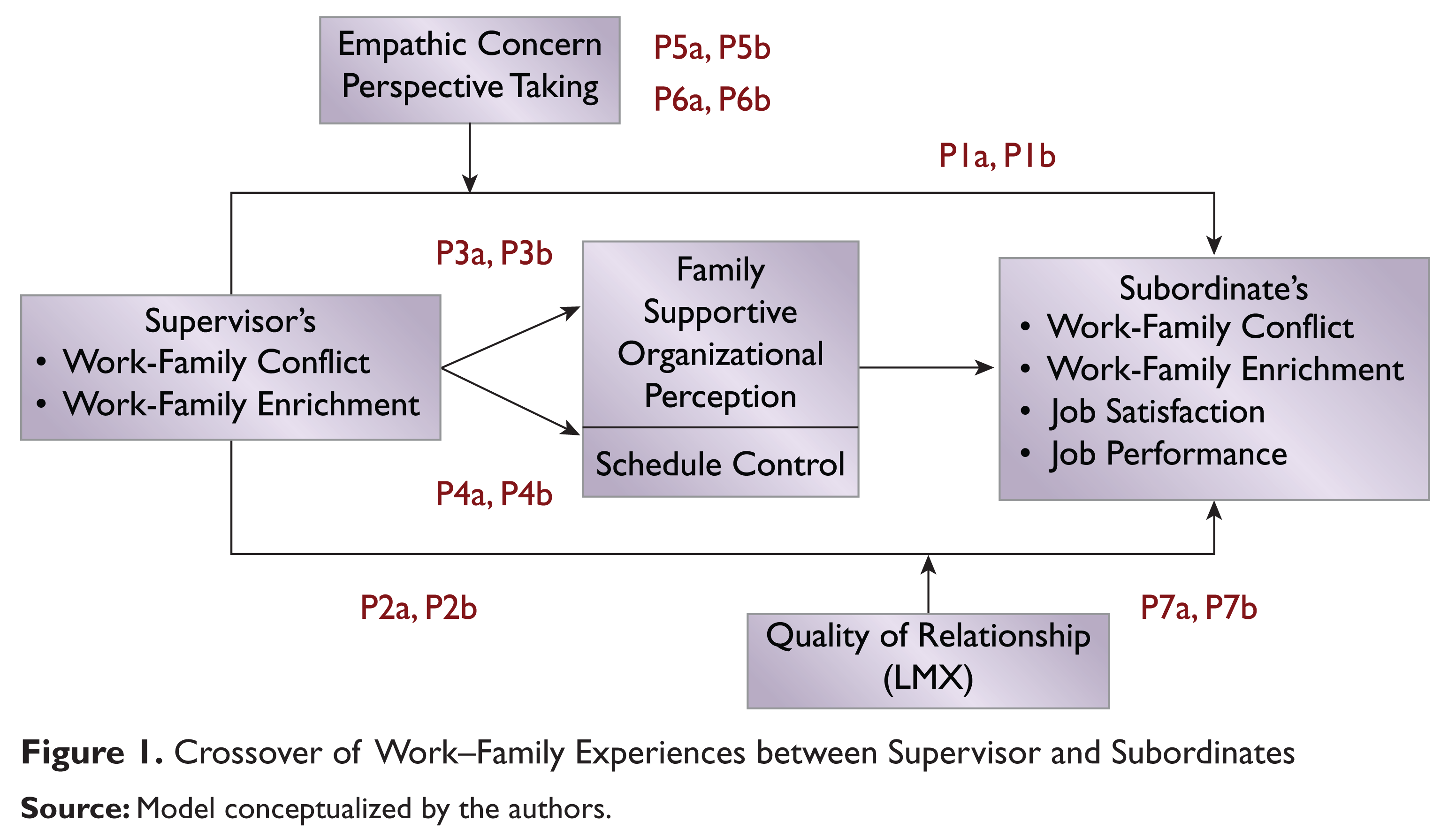
Based on the discussion made in this article and the stated objectives, a conceptual model (as shown in Figure 1) is proposed to delineate the crossover of work–family experiences between the supervisor and his/her subordinates.
Conclusion and Implications
This article has taken a broad look at the crossover literature and especially at the crossover of work–family experiences. It offers a conceptualization (provided in Figure 1) and a few research propositions based on the available literature. A key outcome from the review of literature is the assessment of the role of supervisors in influencing both the positive and negative work–family experiences of the subordinates/partners. The review of literature also underpins the importance of supervisors in improving FSOP, perception of schedule control, showing empathy and enhancing the quality of leader–member exchange with their subordinates to bolster the latter’s WFE, job satisfaction and performance and reduce WFC. This article contributes to the literature by exploring several mechanisms through which crossover of work–family experiences may take place. FSOP and perception of schedule control are found to be the mechanisms through which crossover of WFE and WFC takes place from the supervisors to the subordinates. Some of the processes which could influence the strength of the relationships between the supervisor’s WFE and WFC, and those of subordinates, are found to be empathic concern, perspective taking and quality of relationship or LMX. Exploring these processes through empirical studies in future will help in bringing new insights into the situations, which might influence the crossover of WFC and WFE from supervisors to subordinates.
In a nutshell, the model presented in this article can be used to propagate empirical research to augment the work–family literature. Examining the crossover of work–family experiences will contribute to the theory by broadening crossover research to include transmission of positive and negative events, especially in the workplace context by emphasizing the supervisor–subordinate dyads. Crossover research is an especially promising avenue of enquiry since it includes data from and about the significant other in a dyad. These propositions, if tested, will expand our understanding on the mechanisms through which the crossover of experiences takes place in a supervisor–subordinate dyad.
Both WFC and WFE play significant roles in critical organizational behaviours such as performance and job satisfaction, demonstrating the need for the organizations to consider the role of the supervisors in shaping the subordinates’ work–family experiences. Understanding the mechanism of crossover could contribute to the design of preventive interventions to counter or augment the effects of WFC and WFE.
However, the model proposed here has to be empirically tested to arrive at concrete conclusions about the crossover of WFC and WFE in supervisor–subordinate dyads and the significant processes through which the same takes place. Empirical tests on this model may provide cultural insights pertaining to supervisor–subordinate relationships in the Indian context. Such tests will also give some directions to the professionals in India to understand how their work–family experiences may influence a subordinate’s WFC and WFE and resulting outcomes.