



Abstract
Work-life balance research suffers from a lack of consistency in defining the scope of non-work (life outside work). Considering the evolving life preferences of modern workforce, work-life balance researchers should have a broader view of life which expands beyond work-family, and includes other non-work domains of life. This study is an attempt to establish that for today’s employees, work-life balance means balancing work not only with family life; but also with other non-work domains. Several non-work domains were identified from previous literature and a survey was conducted to identify the different non-work aspects important for respondents to have work-life balance. Based on results from 214 Indians working in various Indian cities and abroad, it was established that in the context of work-life balance, non-work includes not just family, but a combination of life domains, which varies from person-to-person. Although family remained the topmost priority, other non-work aspects were also chosen by varying proportions of respondents. Non-work preferences and related experiences of employees varied based on gender, marital status and child-care responsibilities. Satisfaction with organization’s work-life balance facilities differed when employees chose family, from when they chose other non-work domains. Findings indicate that various non-work preferences of employees should be considered during work-life balance research, and while designing work-life balance practices. This would help to address the non-work demands of different types of employees, and hence give more acceptance to such initiatives.
Introduction
The discussions on work-life balance have different perspectives, often changing according to the context of the study. The changing composition of work and non-work spheres of life has been highlighted in several studies, leading to different conceptualizations and definitions of work-life balance. There is a dearth of consistency in defining work-life balance in organizational behaviour literature. This variety has enriched the field of work-life interface studies by giving several perspectives for approaching the work-life problems of employees and provided vast knowledge that can be applied to several industrial and organizational situations.
It is important to understand the notion of work and life outside work while studying work-life balance/interface. According to (Guest, 2002), the term ‘work-life balance’ is a convenient way of referring to work and the rest of life. Elaborating on the ‘rest of life’ is a complicated and confusing task. Past literature suggests that work-life balance could be interpreted from various perspectives. Work-life balance means finding a balance between one’s work and the life outside work, and fashioning ways to deliver at both work and non-work commitments, and feel satisfied and comfortable about it (Igbinomwanhia, Iyayi, & Iyayi, 2012).
Balancing the demands posed by work and non-work spheres of life poses a challenging task in itself. So, for the Industrial-Organizational Psychology and Organizational Behaviour (IO-OB) researchers who take an interest in studying the work-life balance problems of individuals, the challenge is two-fold—(a) defining the ‘work’ and ‘life’ (non-work) part (especially the non-work part); and (b) deciding upon which perspective/approach to adopt, that is, work-life balance, conflict or enrichment.
Literature is overflowing with work-life studies oriented towards family domain; which deals with problems of working parents, spouses with dual income and working women (Aryee, Srinivas, & Tan, 2005; Ensher, Murphy, & Sullivan, 2002; Greenhaus, Collins, & Shaw, 2003; Hilbrecht, Shaw, Johnson, & Andrey, 2008; Matthews, Del Priore, Acitelli, & Barnes-Farrell, 2006; Unger, Niessen, Sonnentagz, & Neff, 2014; White, Hill, McGovern, Mills, & Smeaton, 2003). This trend can be attributed to the conventional emphasis on family responsibilities instead of broader ‘life’ concerns (Chang et al., 2010). This approach may leave out the problems of singles, men with care-giving responsibilities and cultures with different value-systems (Crooker, Smith, & Flitz, 1999). The narrow perception of life which equates non-work to just family and care responsibilities fails to take into account the rich varieties of life (Eikhof, Warhurst, & Haunschild, 2007). Life, at least for some people, may mean more than just managing between work and family. The government as well as employers often fail to provide anything beyond the generic, ‘family-friendly’ work-life balance policies which target women workforce; often leaving out other demographics, such as single people, men with caregiving responsibilities and the like. This causes the left-out employees become unappreciative towards the organization’s work-life policies, as it may not be helpful to them.
But at the same time, there have also been studies where the ‘work’ and ‘personal life’ dimensions were used instead of just ‘work’ and ‘family’ experiences to study work-life balance (Banu & Duraipandian, 2014; Dash, Anand, & Gangadharan, 2012; Singh, 2014). But we cannot ignore the fact that such studies are very few compared to ‘work-family’ research.
Problem Statement
There is a need to have an understanding of the various non-work aspects of life which are important to the workforce, before researching about their work-life balance. It is not enough to limit the queries to one’s work-family issues alone. The best approach to understand the work-life balance issues of individuals would be to first know the various non-work aspects of personal life that they consider as important for a balanced work-life equation. To assume that all work–non-work issues belong to the work-family category is a non-comprehensive approach to the problem, which could leave out other non-work aspects. Such a narrow perspective leads employers to design mainly family-oriented policies and solutions, which may not be enough to cater to all the non-work demands of the modern workforce who may have other interests in life, such as friends, hobbies, leisure, community and volunteering.
The Study
The main intention of this study is to understand the various non-work aspects of life that are important to the modern Indian workforce (particularly managers and IT professionals) in the context of their work-life balance. It is also an attempt to gain empirical evidence for the argument that although family may be the top non-work concern for employees, the ‘life’ part in ‘work-life’ balance can also mean other things for some people. To get a better understanding about people having non-work concerns other than family, some auxiliary objectives were formulated as follows: (a) to find out if the Satisfaction with the Organization’s Work-Life Balance facilities (SOWLB) differs based on people’s non-work domain preferences; (b) whether the availability of various sources of domestic support has any effect on their lives and (c) to explore whether people with different non-work domain preferences face difficulties in managing the demands of their personal life along with their work.
Method
Overview
In this study, the researcher has made an attempt to gather some insights on the various aspects of non-work (personal life) perceived as important by employees, when they think about work-life balance. The findings discussed here are part of a larger study conducted in the area of work-life balance, in which this study is only one of its many objectives. Only the results pertaining to the objectives of this article are being discussed here. The following paragraphs discuss only the sample, procedure, measures, analysis and findings that pertain to the problem discussed in this article. All the other information collected from the survey has been omitted, as it does not come under the scope of this study.
Sample
Data were randomly collected from employees working in various managerial and non-managerial positions in several companies in some Indian cities. Data were also collected from IT professionals working at different IT companies. The online link to the survey was circulated to about 400 people out of which 138 responded (response rate 34.5%), and hardcopies of the survey questionnaire was circulated from which 76 responses were received. Out of the received responses, 114 were managerial employees (~53%), 85 were IT professionals (~40%) and 15 (~7%) respondents had other occupations.
Procedure
During a survey, the respondents were asked their opinion about the various non-work aspects of life, which matter to them for their work-life balance. The survey was circulated in two ways—online and direct circulations. The online link was circulated via individual e-mails and personal messages through social media. For direct circulation, several organizations were visited, and willing employees were handed out copies of the questionnaire and collected from them after filling up.
Measures
There was an item in the questionnaire which asked—‘When you think of the term Work-Life Balance, what are the different aspects of life that you consider as important to be balanced along with work?’ A list of seven non-work domains was given to choose from. Each of these seven domains represents a non-work aspect that has been previously considered in work-life/work-family balance/conflict research. They are—(a) Family & family responsibilities (Carlson, Grzywacz & Zivnuska, 2009; Carlson, Kacmar, Wayne, & Grzywacz, 2006; Carlson, Kacmar, Zivnuska, & Ferguson, 2015; Gurvis & Patterson, 2005; Keeney et al., 2013; Wickham & Parker, 2007) (b) Friends (Gurvis & Patterson, 2005; Keeney et al., 2013; Wickham & Parker, 2007), (c) Hobbies (Padma & Reddy, 2013), (d) Personal care (Padma & Reddy, 2013), (e) Leisure activities (Gurvis & Patterson, 2005; Keeney et al., 2013; Warren, 2004), (f) Volunteering work (Wickham & Parker, 2007) and (g) Community activities (Crooker, Smith, & Filiz, 1999; Gurvis & Patterson, 2005; Keeney et al., 2013; Voydanoff, 2001; Wickham & Parker, 2007). Respondents were asked to select suitable options from the list. For some items on the list, illustrative (but not exhaustive) examples were given in brackets, for a better understanding of what each domain stands for. Hobbies include activities, such as reading, music and travelling. Personal care includes aspects, such as health, fitness and beauty. Leisure activities included watching TV, going to party/pub, movies, visiting relatives, attending social or family functions, going for vacation etc. Volunteering work includes involvement of a person with NGOs and other charitable organizations, and community activities means the various affiliations and involvement that an individual may have with any spiritual, religious, social, political, professional clubs or associations. There was also an option for the respondents to write other non-work preferences (if any), which does not fall under the given categories. Besides this, some other questions were asked to gather details regarding the secondary objectives of this study, as discussed in previous sections. Questions included (a) SOWLB—one item (assessed on a five-point scale from strongly disagree to strongly agree); (b) sources of domestic support available to employees for managing the demands of work and non-work (a list of various sources of domestic support was given to choose from; for example, stay-at-home spouse, parents, paid domestic help, day care/playschool facilities, etc.)—one item and (c) questions to find out about the difficulties to manage the demands of personal life along with work—two items (assessed on a five-point scale from strongly disagree to strongly agree) from the work-family conflict scale by Matthews, Kath and Barnes-Farrell (2010), which were suitably adapted.
Results
Data Analysis
Data were processed using IBM SPSS Statistics 21. Descriptive statistics and frequency analysis were used for understanding the demographic profile and respondents’ preference of the non-work aspects of life that they considered important for work-life balance. Cochran’s Q-test was used to find out whether or not there is a difference between the proportions of respondents choosing/not choosing the different non-work domains listed out to them. Chi-square test for independence was conducted to evaluate whether there is any association of factors, such as gender, marital status and occupation of respondents with them choosing a particular non-work domain. Independent sample t-test was used to find out whether there was any difference in the experiences of employees based on their choice of a particular non-work domain.
Demographic Profile of Respondents
There were respondents from the following major cities of India—Kochi (38.8%), Bangalore (17.3%), Mumbai (5.1%), Chennai (5.1%), Thiruvananthapuram (5.1%), Delhi/Noida (2.3%), Pune (1.9%) and Hyderabad (1.9%). There were around 8.4 per cent of respondents who belonged to other places across the states of Kerala, Tamil Nadu, Maharashtra and Karnataka. Around 11.2 per cent of respondents lived outside India, mostly IT professionals who were currently living abroad for onsite assignments. All the respondents were of Indian nationality. About 2.8 per cent of respondents did not specify their location. Out of the respondents, 69.2 per cent were male and 30.8 per cent were female. Almost 72 per cent were married and 27.6 per cent were single. There was only one respondent (~0.4%) who was divorced. The average age of the respondents was 31.5 yrs.
Non-work Domain Preferences
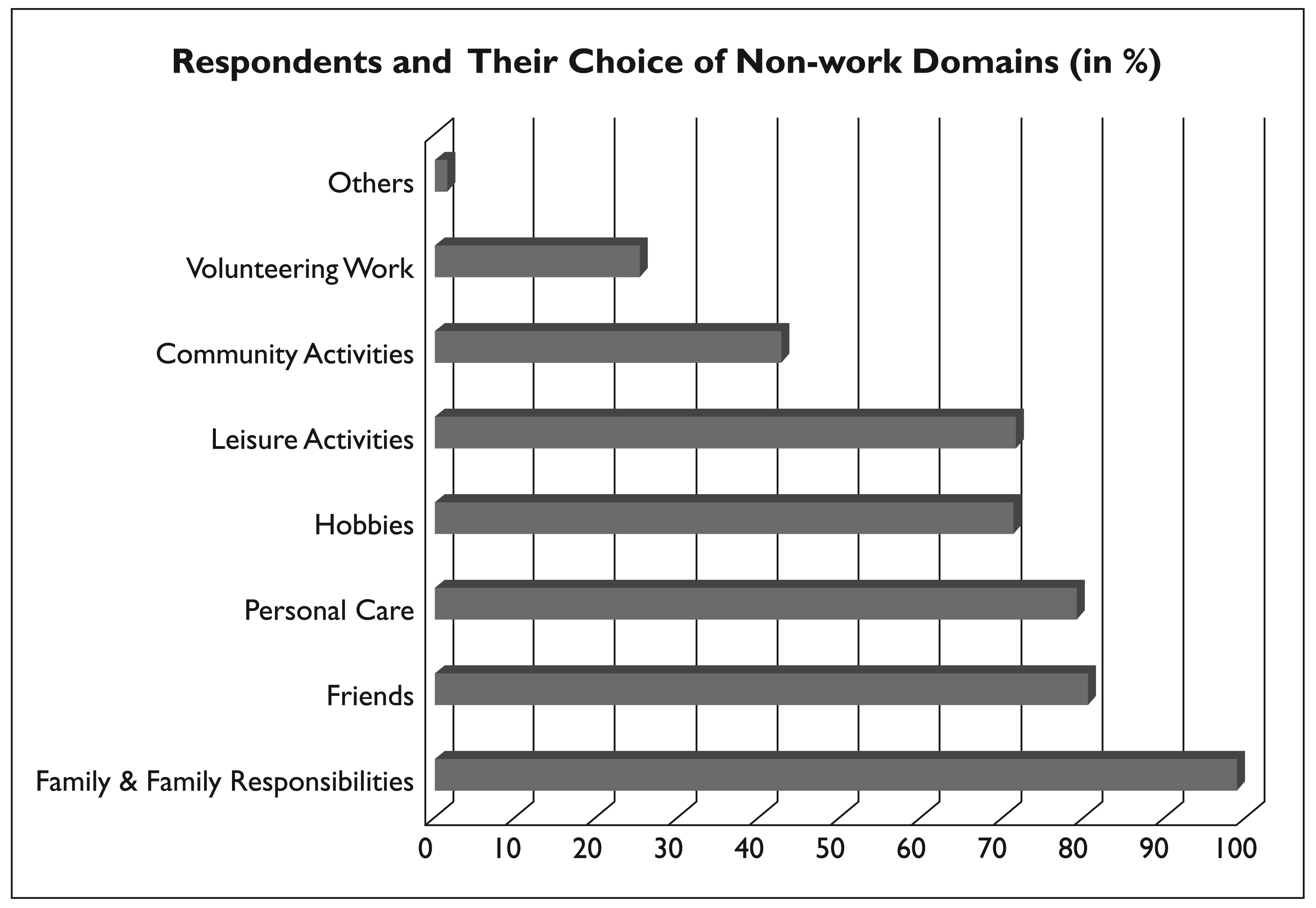
Out of the total respondents, 99.1 per cent chose family and family responsibilities. The next most chosen aspect of life was friends (80.8%), closely followed by personal care (79.4%). This was followed by leisure activities (~72%) and hobbies (71.5%). About 43 per cent of respondents stated that community activities were one of the non-work aspects that they would consider while dealing with work-life balance. It was noted that the least chosen non-work aspect of them all was volunteering work (25.7%). It should be noted that as the respondents were asked to list all the non-work preferences applicable to them, they could choose more than one non-work domain as important. Therefore, the events of choosing each non-work domain are independent of each other. Figure 1 shows the statistics.
The non-work domain preferences based on different classification of respondents is given below:
Age
The average age for the group of people who had marked their preferences in each category was: Family and family responsibilities (31.5 yrs), Friends (31.4 yrs), Hobbies (30.9 yrs), Personal care (31.8 yrs), Leisure activities (32.2 yrs), Volunteering work (32 yrs) and Community activities (32.2 yrs).
Gender
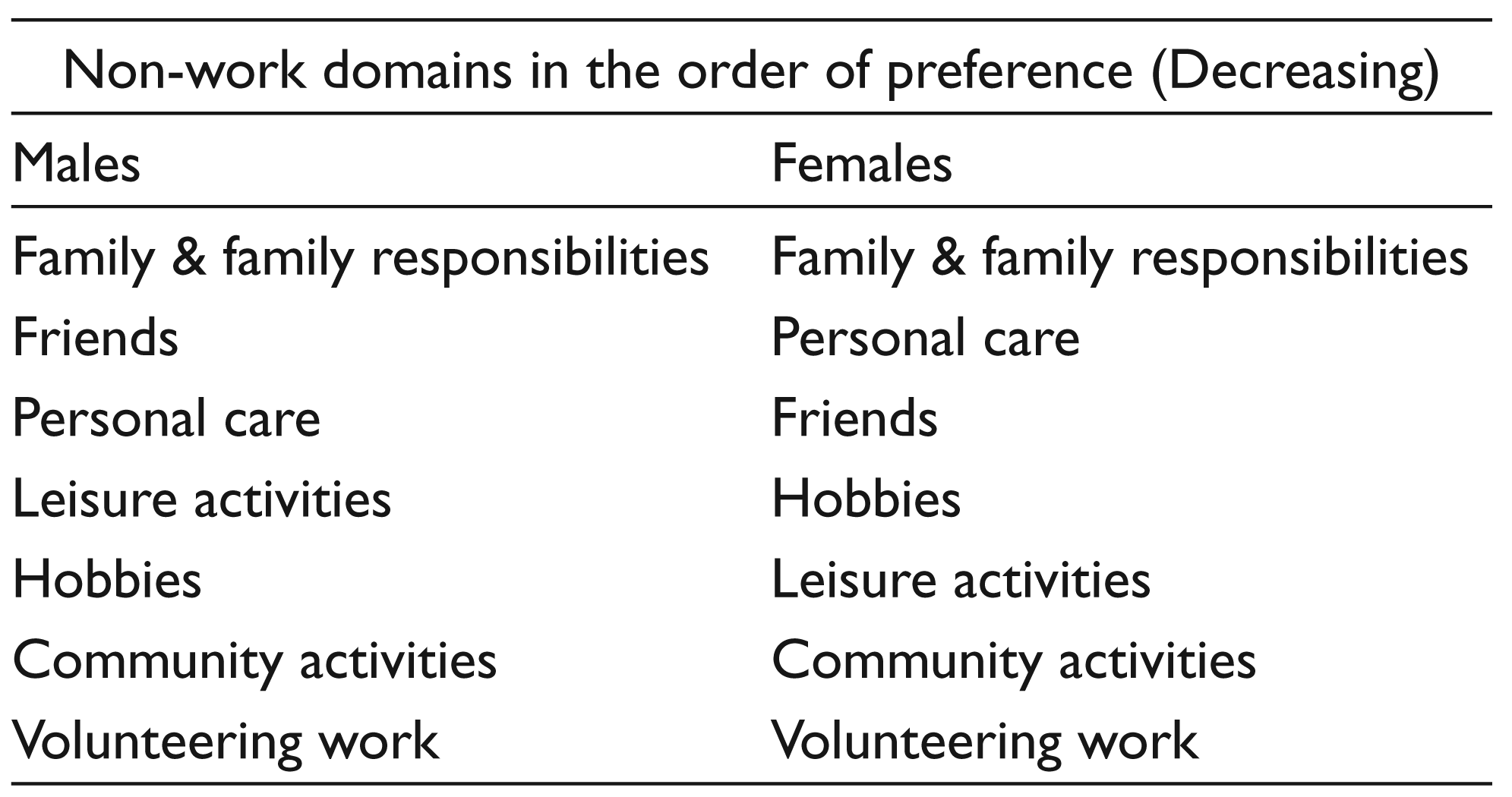
Among males, the share of respondents choosing the seven non-work domains were Family and family responsibilities (99.3%), Friends (85.8%), Hobbies (75%), Personal care (~77%), Leisure activities (76.4%), Community activities (43.9%) and Volunteering work (27.7%). Among females, the trend was seen as follows: Family and Family responsibilities (98.5%), Friends (69.7%), Hobbies (63.6%), Personal care (84.8%), Leisure activities (62.1%), Community activities (40.9%) and Volunteering work (21.2%).
Marital Status
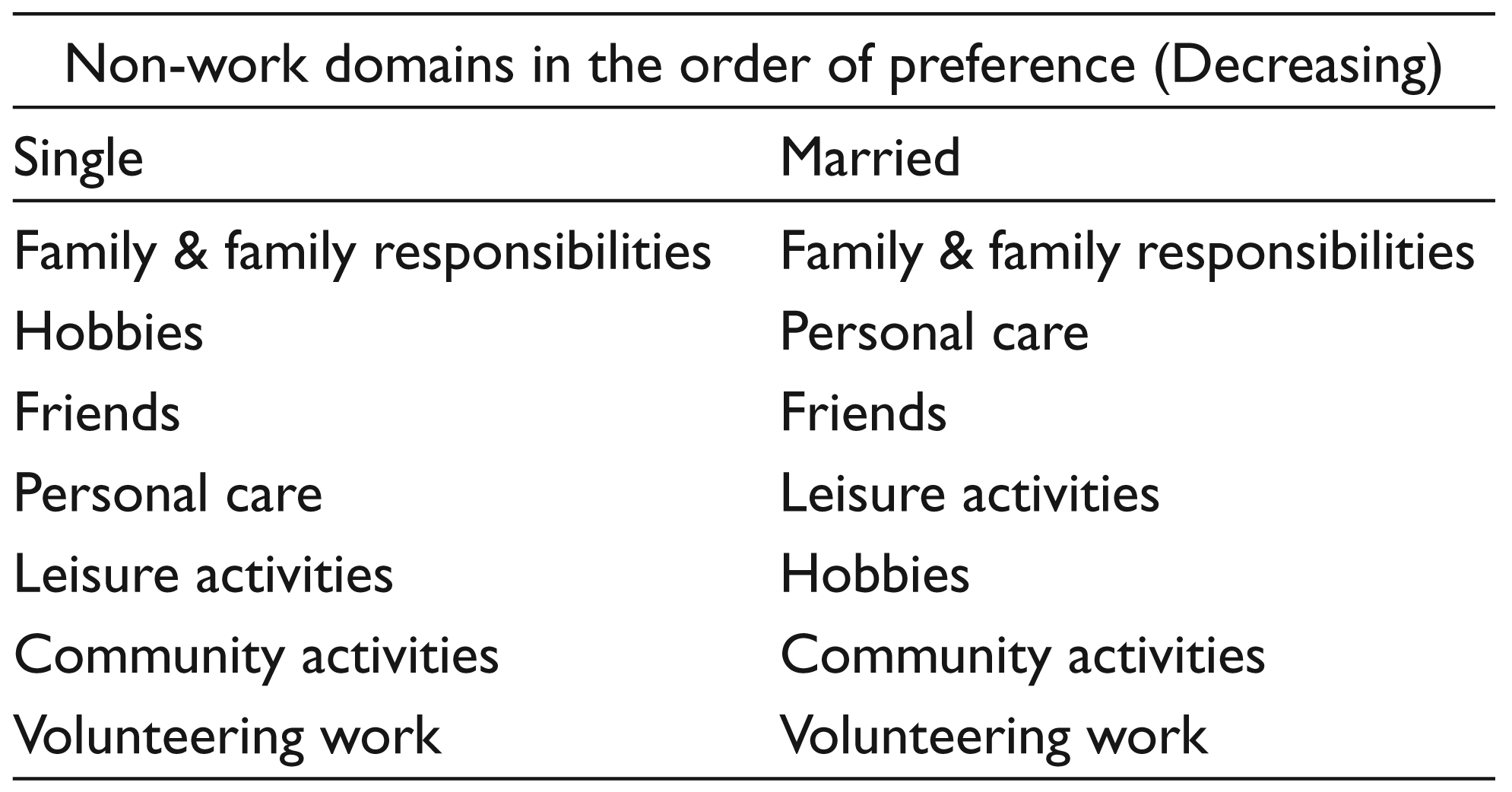
Family and related responsibilities was chosen by 100 per cent married respondents and 96.6 per cent of single respondents. Personal care appeared in 81.2 per cent of married people’s list, while 74.6 per cent of single people chose it as one of their non-work preferences. Friends featured among 79.2 per cent of married respondents, while 84.7 per cent of singles voted it as an important non-work domain of their life. Leisure is important to 72.1 per cent of married respondents and 71.2 per cent of single respondents, while 65.6 per cent of married people gave importance to hobbies, almost 86.4 per cent of single respondents gave importance to hobbies. Community activities were preferred by 43.5 per cent and 40.7 per cent of married and single people, respectively. The least preferred non-work activity was volunteering work, with only 24.7 per cent and 28.8 per cent of married and single people choosing it respectively.
Occupation
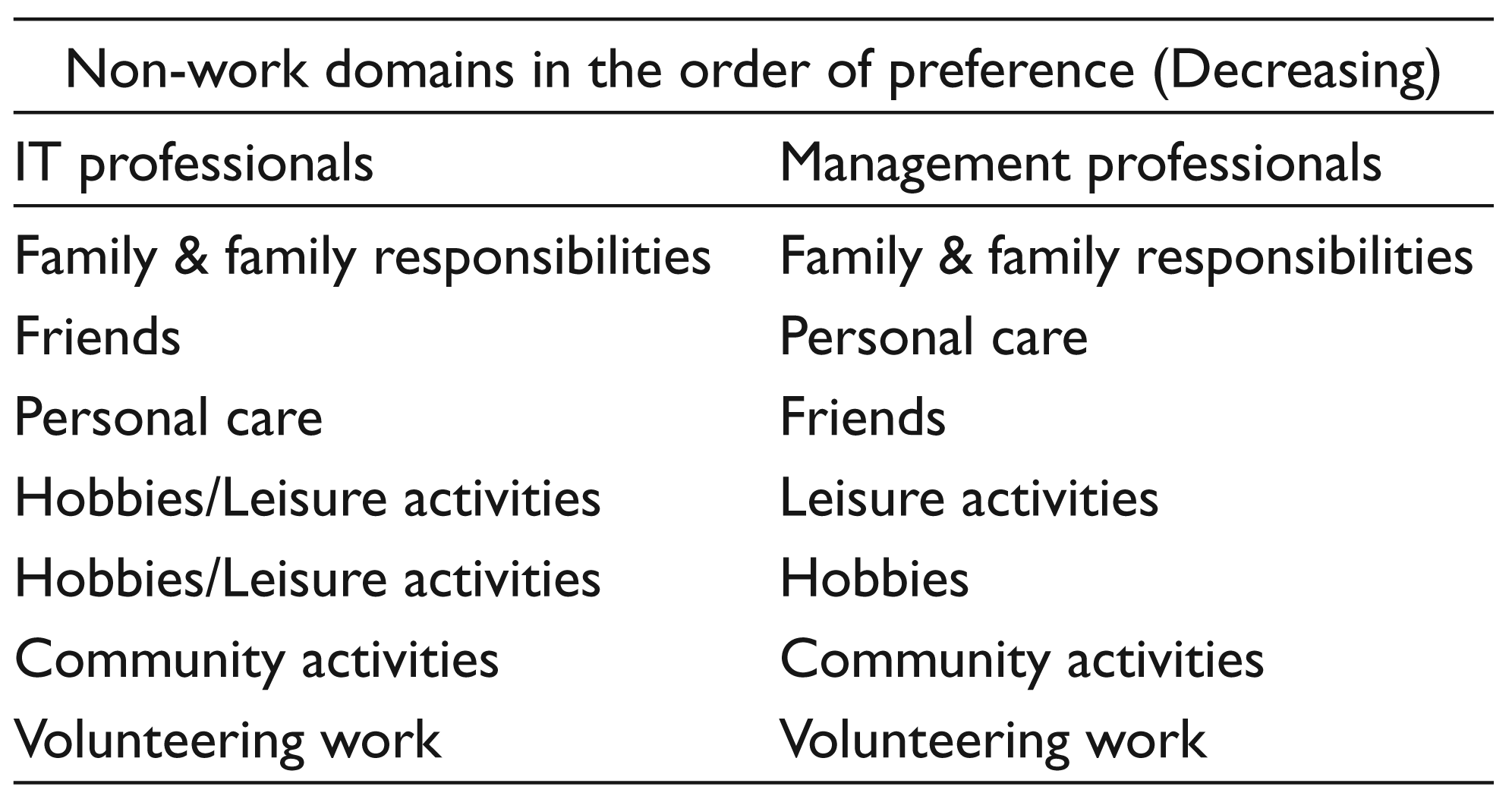
Among IT professionals, 100 per cent chose family and family responsibilities. There were around 84.7 per cent who had included friends, 71.8 per cent who had included hobbies, 76.5 per cent who had chosen personal care, about 71.8 per cent who had chosen leisure, 48.2 per cent who had listed community activities and 29.4 per cent who had selected volunteering work in their list of non-work domains important for work-life balance. In the case of managerial employees, the share of respondents selecting various non-work aspects important for work-life balance was as follows: Family and Family responsibilities (98.2%), Friends (78.9%), Hobbies (71.1%), Personal care (80.7%), Leisure activities (72.8%), Community activities (36.8%) and Volunteering work (24.6%). The trend for people who belonged to other occupations was as follows: Family and Family responsibilities (100%), Friends (73.3%), Hobbies (73.3%), Personal care (86.7%), Leisure activities (66.7%), Community activities (60%) and Volunteering work (13.3%).
There were respondents who had mentioned some other aspects of life that they consider important. They were as follows: quality sleep time, car and bike riding, peace of mind and satisfaction. Out of these, quality sleep time may be broadly included under personal care concerns, as getting enough sleep is related to one’s health. Car or bike riding can be classified as a hobby. But one option that stands out is the need for peace of mind and satisfaction. Although it can be remotely considered under the personal care umbrella, it differs in the sense that it is a much broader concept than maintaining one’s physique or health. Achieving satisfaction and peace pertain to the self-actualization needs of humans; according to the need hierarchy theory by Abraham Maslow. It is a desire for self-fulfilment, to become everything that one is capable of becoming (Maslow, 1943). Satisfaction with one need (even partial) leads to a person’s desire to migrate to the next level of need hierarchy (physiological/safety/love/esteem/self-actualization), which is unique to each individual.
Based on results of the Cochran’s Q-test, it was found that there was a statistically significant (p = 0.000) difference between the proportions of respondents choosing each non-work aspect of life listed to them. The test was run separately for males, females, single, married and for occupations (managerial, IT professionals and others) and found to be significant in each case (p = 0.000). It means that the respondents were able to view each non-work aspect as distinct domains. All the seven non-work domains are not equally preferred. Thus, it proves that irrespective of the gender, marital status and occupation, all these non-work domains are viewed as separate life domains and are important for people in varying proportions.
Pearson’s Chi-square test for independence was conducted to see whether choosing a particular non-work aspect was dependent on the respondent’s gender, marital status or occupation. It was revealed that
Gender and preferring friends as one of the important non-work aspects for work-life balance, was associated, χ2 (1) = 7.652; p = 0.006 (p < 0.05). Marital status and preferring hobbies as one of the important non-work aspects for work-life balance, was associated, χ2(1) = 9.079; p = 0.003 (p < 0.05). Marital status and preferring family and related responsibilities as one of the important non-work aspects for work-life balance, was associated, χ2(1) = 5.270; p = 0.022 (p < 0.05)
Employee Experiences based on Non-work Domain Preferences
It is evident from the above findings that family is the most important non-work concern for all individuals across gender, marital status and occupation. However, in order to gain some more insight on the other non-work domains that were also chosen by respondents, it was enquired whether the opinion of respondents who chose a particular non-work domain differed on things like (a) SOWLB and (b) difficulty in managing the demands of personal life along with work. For this, independent sample t-tests were conducted. The findings are as follows
Family and family responsibilities: SOWLB was significantly higher for the respondents who chose family as an important non-work aspect of their life (M = 3.68, SD = 1.193), compared to the SOWLB of those who did not (M = 2.00, SD = 1.414); (t = 1.980, df = 212, p < 0.05). It was generally noted that SOWLB was lower (although not statistically significant) for the respondents who said friends, hobbies, personal care, leisure, volunteering and community activities were important, and SOWLB was comparatively higher for those for whom these non-work domains were not important. Friends: Respondents with children for whom friends were important, reported lower levels of SOWLB (M = 3.56, SD = 1.268) than respondents with children for whom friends were not important (M = 4.13, SD = 0.947); (t= –2.363, df = 49.587, p < 0.05). Personal care: Among females, those who chose personal care had greater tenure than those who did not choose personal care as a preferred non-work domain (t = −2.950, df = 61.117, p = 0.005). Among respondents with children, SOWLB was significantly lower for those who thought personal care was important (M = 3.59, SD = 1.281), compared to those for whom it was not (M = 4.16, SD = 0.765) (t = −2.566, df = 43.405, p < 0.05). In the case of females with children, those who preferred personal care felt significantly more emotionally drained due to work, and hence had difficulty to contribute in personal life (M = 3.47, SD = 1.106), than those females with children for whom personal care was unimportant (M = 2.17, SD = 1.169) (t = −2.606, df = 34, p < 0.005). Leisure: For males, the tenure of those who were interested in leisure was significantly higher than those who were not (t = −2.852, df = 90.484, p = 0.005). When asked whether they missed out personal activities due to work, unmarried males for whom leisure was important, felt so more strongly (M = 3.94, SD = 0.873) than the unmarried males for whom leisure was not important (M = 3.14, SD = 1.231) (t = −2.568, df = 47, p < 0.05). It was found that among IT professionals, people who chose leisure as an important non-work activity had higher tenure than those who did not choose leisure (t = −2.265, df = 75, p < 0.05). Volunteering work: The tenure of the females who considered volunteering work as an important non-work activity was significantly higher than the females for whom volunteering was not important (t = 2.106, df = 64, p < 0.05). Community activities: For females, the tenure of those who were interested in community activities was significantly higher than those who were not (t = −2.722, df = 64, p < 0.05). Males who were interested in community activities complained of having to miss activities in their personal life due to work to a greater extent (M = 3.62, SD = 1.221) than those males who did not prefer community activities (M = 3.19, SD = 1.273) (t = −2.040, df = 146, p < 0.05).
Next, the role of domestic support in these situations was explored. Since SOWLB was found to be higher for people who chose family but lower for those who chose other non-work domains, independent sample t-tests were conducted to investigate whether having some kind of domestic support to manage their non-work life would result in any significant changes in the experiences of these people. The various sources of domestic support that emerged as important were as follows: support from a stay-at-home spouse (SSP); support from parents (SPRT); support from friends (SFRN); support from paid domestic help, for example, maids (SPDH); and support from day care/playschools (SDAY).
Support from stay-at-home spouse (SSP): Respondents with children for whom friends were important, had significantly higher SOWLB (M = 4.12, SD = 1.054) when they had SSP than those who did not have SSP (M = 3.42, SD = 1.286) (t = −2.074, df = 80, p < 0.05). For married respondents for whom hobbies were important, it was found that SOWLB was significantly higher for those who had SSP (M = 4.29, SD = 0.726) than those who did not have SSP (M = 3.51, SD = 1.266) (t = −3.293, df = 27.805, p < 0.005). For married respondents for whom personal care was important, SOWLB was significantly higher if they had SSP (M = 4.26, SD = 0.864) than those who did not have SSP (M = 3.46, SD = 1.264) (t = −3.647, df = 46.002, p < 0.005). It was also found that married respondents for whom personal care was important, SSP helped them feel less emotionally drained from work to contribute in their personal life (M = 2.43, SD = 1.273) compared to those who did not have SSP (M = 3.02, SD = 1.280) (t = 1.980, df = 122, p = 0.05). For respondents with children for whom personal care was important, SOWLB was significantly higher for those who had SSP (M = 4.21, SD = 0.918) than those who did not have SSP (M = 3.41, SD = 1.318) (t = −3.022, df = 41.081, p < 0.005). For respondents with children for whom hobbies was important, SOWLB was significantly higher for those with SSP (M = 4.11, SD = 0.782) than those who did not have SSP (M = 3.43, SD = 1.352) (t = −2.116, df = 17.493, p < 0.05). For respondents with children for whom volunteering was important, SOWLB was significantly higher for those with SSP (M = 4.80, SD = 0.447) than those who did not have SSP (M = 3.32, SD = 1.359) (t = −4.209, df = 20.883, p < 0.005). For respondents with children for whom community activities were important, SOWLB was significantly higher for those with SSP (M = 4.71, SD = 0.488) than those who did not have SSP (M = 3.52, SD = 1.366) (t = −4.251, df = 25.528, p < 0.005).
Support from parents (SPRT): Among unmarried respondents for whom leisure was important, those who had SPRT missed personal activities to a lesser extent due to work (M = 3.63, SD = 0.761), than those who did not have SPRT (M = 4.17, SD = 0.761) (t = 2.289, df = 41, p < 0.05). Also, for the same group, those who had SPRT felt less emotionally drained from work to contribute in their personal life (M = 2.89, SD = 1.286) when compared to those who did not have SPRT (M = 3.63, SD = 1.056) (t = 2.046, df = 41, p < 0.05). For unmarried respondents for whom community activities are important, those who had SPRT missed personal activities to a lesser extent due to work (M = 3.55, SD = 0.934) than those who did not have SPRT (M = 4.21, SD = 0.579) (t = 2.201, df = 23, p < 0.05). Also, for the same group, those who had SPRT felt less emotionally drained from work to contribute in their personal life (M = 2.45, SD = 1.440) when compared to those who did not have SPRT (M = 3.57, SD = 1.016) (t = 2.275, df = 23, p < 0.05).
Support from friends (SFRN): Among respondents with children who considered friends as important in their life, those who received SFRN experienced significantly greater SOWLB (M = 4.17, SD = 0.985) compared to those who did not have SFRN (M = 3.39, SD = 1.292) (t = 2.358, df = 80, p < 0.05). Among unmarried respondents for whom community activities were important, SOWLB was significantly higher for those who had SFRN (M = 4.00, SD = 0.500) compared to those who did not (M = 3.19, SD = 1.276) (t = −2.257, df = 21.325, p < 0.05). Also among unmarried respondents for whom community activities are important, those who had SFRN missed personal activities to a lesser extent due to work (M = 3.33, SD = 1.000) than those who did not have SFRN (M = 4.25, SD = 0.447) (t = 2.607, df = 9.835, p < 0.05).
Support from paid domestic help (SPDH): It was found that among respondents with children who thought volunteering work was an important aspect of non-work, SOWLB was significantly higher for those who had SPDH (M = 4.80, SD = 0.447), compared to those who did not have SPDH (M = 3.32, SD = 1.359) (t = −4.209, df = 20.883, p < 0.005).
Support from day care or playschools (SDAY): Among respondents with children who were interested in hobbies, the SOWLB was higher for those who had SDAY (M = 4.13, SD = 0.354) than those who did not have SDAY (M = 3.44, SD = 1.369) (t = −3.033, df = 43.978, p < 0.005). Among respondents with children who were interested in personal care, SOWLB was significantly higher for those who had SDAY (M = 4.00, SD = 0.577) than those who did not have SDAY (M = 3.51, SD = 1.357) (t = −2.164, df = 40.360, p < 0.05).
This shows that having some sort of domestic support like a stay-at-home spouse, parents, friends, paid domestic help, day care, etc. may be helping employees to handle the demands from their personal life better, thus creating a perception that the organizational work-life balance facilities being offered to them are enough to satisfy their work-life demands. The lower SOWLB levels in the absence of such help may be because the organizational facilities may not be catering to their non-work demands well.
Discussion
Not just family, but there are many other non-work aspects of life which are important for individuals when it comes to discussions about work-life balance.
Family is the most widely agreed and chosen non-work aspect/domain of life, to be considered in one’s work-life balance equation. This trend was the same across genders, marital status and occupation. It was empirically proved that marital status may influence a person’s orientation towards family and its responsibilities.
While family stays on the top of the list for both genders, the next items on the list vary. It was statistically proved that the variance in proportions across the non-work domains is significant for both males and females. Personal care is more important than friends for females, while it is the opposite for males. Table 1 shows the order of preference for both genders.
In the case of marital status, there is a significant difference between the proportions of married and single people choosing their non-work activities. Table 2 shows the trend.
Volunteering work was the least preferred, and Community activities were the second least-preferred non-work aspect of life important for work-life balance, irrespective of gender, marital status and occupation.
Since there is a statistically significant difference among the proportions of respondents choosing the various non-work domains in the case of IT professionals as well as managerial employees, it can be concluded that all these non-work domains of life should be included in the work-life balance discussions of employees belonging to these occupations. Table 3 shows the order of preference of non-work domains based on occupations.
It was found that in certain cases, tenure was associated with an employee’s choice of personal care and leisure activities. Females who chose personal care, females who chose community activities, females who chose volunteer work, males who chose leisure and IT professionals who chose leisure had comparatively higher tenure than their counterparts who did not prefer these activities. Probably with passing time, these employees start concentrating on more relaxing non-work interests in life either to de-stress, or because they realize its importance in life. It may also be because they move to higher levels of need hierarchy (Maslow, 1943) with tenure, hence leading to these choices.
Another observation was the way in which gender, marital status and having children had some influence on meeting the demands from work and personal life. Females with children felt more emotionally drained to concentrate on personal life if they had a preference for personal care. Similarly, unmarried males choosing leisure, and males interested in community activities felt that they had to miss personal activities due to work. This may be because of their inability able to devote enough time and energy towards their non-work interests, as they have to give priority to work.
It was empirically proven that employees who had family preferences were significantly more satisfied with the work-life balance facilities than those for whom family was not an important non-work aspect of life. It was also noted that the employees who had listed other non-family domains such as friends, hobbies, personal care, leisure, volunteering work and community activities as important to them, had comparatively lower levels of satisfaction (although non-significant) with the work-life balance facilities of their organization (SOWLB), when compared to those employees who did not choose them. In particular, SOWLB was found to be significantly lower for employees with children for whom friends or personal care was important. All this may be because the work-life balance facilities that are being offered to employees are more useful for handling family responsibilities, and less useful to deal with other non-work interests of life that they may have.
Non-work Domains of Life—Preferences Based on Gender
Domains of Life—Preferences based on Marital Status
Non-work Domains of Life—Preferences Based on Occupation
So what may help in improving the work-life experiences of such employees? From the analysis, it was clear that when employees receive help from non-work/domestic sources, such as their spouse, parents, friends and paid domestic help, there is significant improvement in the levels of satisfaction with currently available organizational work-life balance facilities. Married employees and employees with children for whom friends, personal care, hobbies, volunteer work and community activities mattered, were more satisfied with organization’s work-life balance facilities when they had a stay-at-home spouse to help them with their personal life. Satisfaction levels were higher for employees with children preferring volunteering, when they had a paid domestic help. Married employees interested in hobbies and personal care, and employees with children interested in personal care who made use of day care facilities seemed to be more satisfied with organization’s work-life balance facilities. Unmarried employees interested in community activities had higher SOWLB when they had support from friends. Such kind of support also helps them to feel less drained out and time-crunched due to work, and hence giving them more opportunity to pursue their personal life activities. For unmarried people who thought leisure or personal care was important in life, support from parents helped them to feel less emotionally drained, and reduced the extent of missing personal activities due to work. Having a stay-at home spouse made employees who chose personal care feel less emotionally drained from work. Also, unmarried employees who chose community activities tend to miss personal activities to a lesser extent when they had support from friends. The way in which each source of support influences employee experiences differs based on their non-work domain preferences, marital status and having children.
Practical Implications
We saw that SOWLB was higher for employees who gave importance to family, but lower when other non-work domains were considered. We also saw that satisfaction levels of organizational facilities were higher when there was support from non-organizational sources, such as spouse, parents, friends, paid help and day care. This may mean that work-life balance facilities offered by organizations concentrate mainly on work-family issues and that other non-work domains are not given much importance. So employees with non-work interests other than family may be resorting to non-organizational sources for support to handle these demands from personal life. This suggests that in future, employers must design their work-life balance practices after considering all the non-work domains of life. Anticipating and addressing only the family responsibilities is not enough. More organizations should provide recreational and fitness facilities at work. Providing concierge services could help employees to have their out-of-office hours free of family-related chores (e.g., paying bills), and they could use this extra time to pursue their non-work interests. The option to take sabbaticals for reasons other than medical or educational should be explored. Researchers and organizational consultants should adopt an all-encompassing approach to measure work-life balance. The questions they ask should not be based only on family experiences and related responsibilities, but it should also include other aspects of their personal life (e.g., friends, leisure, hobbies, personal care, volunteering and community involvement). For this, while constructing work-life balance measures, researchers can use a broader term such as ‘personal life’ to depict the ‘life’ part, to refer all non-work domains (including family).
Limitations
This study is not without its limitations. Only eight major cities and a few small cities of India were covered. Cities, such as Bengaluru, Thiruvananthapuram, Chennai, Hyderabad and Kochi, were included in the survey, which are not only major IT hubs but also home to offices of several multinational companies in India. Although these cities are represented in the data and results, majority of respondents were from Kochi and Bangalore. Further research in this area should concentrate on a better representation of other cities. Since the main objective of the study was to establish that all the non-work aspects of life were important for work-life balance studies, the focus was not on ensuring an equal representation of gender and marital status. Hence, the representation of single persons and women is not at par with married individuals and men, respectively. The aim of the study is to show that across genders, marital status and occupations, there are other non-work aspects beyond family that are important for individuals. Hence, it is recommended that this thought should be borne by the readers while comprehending the results.
Conclusion
This study was able to show that although family is the most important and universally accepted aspect of non-work, there are many other aspects of non-work, which are also important to individuals when it comes to work-life balance. It cannot be ignored that along with family, the other non-work domains like friends, hobbies, personal care, leisure, community activities and volunteering work were chosen by individuals in varying proportions. Therefore, we can conclude that not only family, but all non-work domains of life deserve a fair share in work-life balance discussions. Hence, instead of using the narrow term ‘family’, researchers should make use of a broader and more inclusive reference such as ‘personal life’ to address the non-work part of work-life balance research. The variety in non-work preferences was found to be true across genders, marital status, childcare responsibilities and occupations. Therefore, organizations should address different non-work domains and consider the interests of all types of employees while designing work-life balance practices. For instance, maternity/child care leave may not be important to unmarried employees. A married employee may be interested to play tennis or pursue amateur photography after work, but struggling to find some time as he/she needs that time for buying groceries, or to pay bills, or to book train tickets. Employees having non-work preferences other than family were found to be more emotionally drained and missed personal activities because of work in some cases. Their SOWLB was also generally lower, except for the cases when they had some source of domestic support. If organizations are able to address the less-explored non-work domains discussed in this study, not only would they be addressing a gap in their work-life balance practices but also helping in reducing the negative effects of work on employees’ personal lives. When enquiring about an employee’s work-life balance, if the researcher asks the question ‘Do your work responsibilities prevent you from spending time with your family?’ they may not always get the entire picture. The employee may spend all the time off-work with family, but still experience conflict if he does not get enough time for his hobbies, or to go out with friends, or at the gym, or even to the NGO that he is associated with. It must be understood that human interests are as unique and varied as humans themselves. Therefore, work-life balance is not only about balancing family life with work but also about addressing other non-work interests in life, if any. Everyone defines life based on their own experiences and interests. Therefore, except for those studies which are specifically about ‘work-family’ issues, work-life balance researchers should use broader terms like ‘non-work’ or ‘personal life’ to include all the various non-work preferences.
Footnotes
Acknowledgements
The author thanks her research supervisor, Dr Mathew J. Manimala for his encouragement, insightful comments and valuable suggestions during all the stages of development of this article. Also, the author thanks all the anonymous reviewers whose comments helped to improve this article.