




Abstract
With the growing concern about excessive Internet use and accompanying adverse psychosocial outcomes, unveiling the underlying mechanisms related to problematic Internet use has become an important topic to study. The present study examines the relationship between dispositional mindfulness and psychosocial well-being through problematic Internet use. An attempt has also been made to investigate whether negative affect and self-control are useful in explaining the relationship between dispositional mindfulness and problematic Internet use or not. The data was derived from a questionnaire survey of 246 postgraduate management students from a leading business school (approximately 48% females) and structural equation modelling technique was used for data analysis. The results suggest that higher mindfulness is associated with lower problematic Internet use, and the relationship is partially mediated by negative affect and self-control. Problematic Internet use partially mediate the relationship between mindfulness and depression/loneliness (indicators of psychosocial well-being). The study outcomes may prove helpful in empirical understanding of previously unidentified mediating mechanisms through which mindfulness may impact problematic Internet use, which further influences psychosocial well-being. Limitations and future directions, as well as potential implications, are also discussed.
Introduction
In the last two decades, Internet has become an important medium of communication. Several studies are undertaken to understand and analyse the outcomes of increasing use of Internet (e.g., Caplan, 2006; Seabra et al., 2017). At one end, Internet use is related to positive consequences such as the facilitation of continuing education, easier communication with others and formation of new relationships (Parks & Roberts, 1998) without requiring the social skills demanded in face-to-face interactions. On the other end, several studies have attempted to address the potentially harmful effects of Internet use, such as diminished sense of cognitive and behavioural control (e.g., Davis, 2001) and addictive properties of the Internet (e.g., Young, 1999). Internet addicted individuals, even when not using the Internet, are occupied with the thoughts of online activities or going back online. Internet addiction has been a focal point of many studies, which variously call it problematic Internet use (Caplan, 2002), pathological Internet use (Davis, 2001), and generalized problematic Internet use (Caplan, 2010). More commonly, it is referred to as problematic Internet use (PIU).
Several countries have identified Internet addiction as a significant threat to the psychosocial well-being of people and attempted to reduce excessive Internet use by educating people. Taking an alternative and stringent approach, some countries, including China and South Korea, have enforced ‘shutdown’ regulations to reduce excessive Internet use. However, such a policy with outside measures to curb Internet use has had insignificant outcomes in reducing addictive Internet use (Choi, Cho, Lee, Kim, & Park, 2018), indicating that policymakers should use different strategies to reduce or prevent Internet addiction and improve psychosocial well-being of the people.
A consistent and growing body of research suggests that problematic Internet use (PIU) is a common problem (e.g., Young, 2017), with prevalence rates between one per cent to 18.7 per cent among nationally representative samples across several countries, with an average prevalence rate of 7.5 per cent (Pontes, Kuss, & Griffiths, 2015). A recent study among Indian teens in a city found the PIU prevalence rate of 16.7 per cent (Vadher et al., 2019). Internet addiction gradually increases if not addressed (Widyanto & Griffiths, 2006). The existing studies related to Internet addiction in organizational contexts and interpersonal domain suggest that the main focus has been on the consequences related to PIU, such as cyberloafing (Yan & Yang, 2014), decreased face-to-face communication (Kraut et al., 1998) and anxiety (Caplan, 2006). Besides, many studies have focused on the contributory factors for PIU. Previous research provides evidence that various social and psychological mechanisms such as dysfunctional coping, less supportive social context, unmet psychological needs, lack of awareness and poor self-regulation (Ataşalar & Michou, 2019; Caplan, 2002) may contribute towards the development of PIU. In contrast, identifying the variables that may serve as a protective shield against PIU has received little attention.
One encouraging focus of study in a related field is in the mindfulness area. Mindfulness is ‘the awareness that emerges through paying attention on purpose, in the present moment, and nonjudgmentally’ (Kabat-Zinn, 2003). Mindfulness promotes awareness of events happening around without being judgmental, to notice each moment as unique and to make deliberative decisions without being influenced by reactive thoughts (Baer, Smith, & Allen, 2004; Bishop et al., 2004). Although mindfulness can be cultivated through meditation and different mindfulness-based interventions, it is also conceptualized as a trait-like or dispositional characteristic, with some individuals being more mindful than others (Brown, Ryan, & Creswell, 2007).
The essential features of PIU, such as low self-regulation coupled with compulsive and ruminating thoughts of online activities, are negatively related to mindfulness (Arslan, 2017; Calvete, Gámez-Guadix, & Cortazar, 2017; Gámez-Guadix & Calvete, 2016; Yu, Kim, & Hay, 2013). PIU, considered as the manifestation of a lack of cognitive control (Brand, Young, & Laier, 2014), is expected to be accompanied by less self-conscious process of attention and awareness of stimulus, the key components of mindfulness (Kabat-Zinn, 2003).
There is some preliminary evidence of a negative relationship between mindfulness and PIU (Arslan, 2017; Calvete et al., 2017; Gámez-Guadix & Calvete, 2016) and this study is intended to provide more comprehensive evidence for their findings. For example, Arslan (2017) measured mindfulness using a 4-item subscale of compassion scale from Pommier (2011), which has been critiqued by several researchers (e.g., Neff & Germer, 2013) for entailing a narrower scope of mindfulness oriented towards being attentive to negative thoughts and others’ sufferings only than mindfulness in general, which refers to paying attention to any experience – positive, negative or neutral. Since the two mindfulness conceptualizations are not precisely the same, the compassion scale may not be able to measure the essential mindfulness traits.
Similarly, Gámez-Guadix & Calvete (2016) used mindful attention awareness scale (MAAS; Brown & Ryan, 2003). Although MAAS has been widely used in research, it was conceived as unidimensional and exclusively focused on measuring the attention/awareness component of mindfulness. MAAS does not measure non-judgmental attitudinal components of mindfulness, which are emphasized as essential mindfulness components by various mindfulness scholars (Baer, 2003; Kabat-Zinn, 2003). Further, mindfulness scholars have critiqued MAAS for measuring mindfulness in negatively worded items (Grossman, 2011) and, as a result, its ability to accurately report the level of mindfulness may be limited (Smallwood, McSpadden, & Schooler, 2007). The present study uses a validated scale designed to measure multiple components of trait mindfulness using which a composite mindfulness score is calculated.
While research has focused primarily on the direct effect of mindfulness on PIU, the role of mediating variables through which mindfulness influences PIU remain mostly unexplored. Several mindfulness scholars (e.g., Luberto, Cotton, McLeish, Mingione, & O’Bryan, 2014) have emphasized the need for identifying the process through which mindfulness influences the outcomes as this may help practitioners to gain a better insight into the predicted relationship. Also, taking into consideration the key theoretical model proposed by Brand et al. (2014), different mechanisms might mediate the relationship between distal causes and PIU. In addition to mindfulness, findings in Internet addiction literature reveal that two other constructs that might influence PIU are negative affect and self-control.
Use of self-control as a mediating variable is supported by social cognitive learning theory (Bandura, 1997) and self-control theory (Gottfredson & Hirschi, 1990). Negative affect as a mediator is supported by reward-deficiency hypothesis (Blum et al., 1996) and self-determination theory (Deci & Ryan, 2000). While negative affect is one of the most firmly established correlates of mindfulness (Brown & Ryan, 2003; Schutte & Malouff, 2011), studies have demonstrated that negative affect is associated with several addictive behaviours such as smartphone addiction (Jeong, Kim, Yum, & Hwang, 2016) and substance use (Chassin, Pillow, Curran, Molina, & Barrera, 1993). Weinstein and Lejoyeux (2010) found that excessive use of Internet may serve as an (inadequate) stress coping strategy from negative emotions. Whereas higher mindfulness is associated with self-regulation (Shapiro & Schwartz, 2000), PIU is cited as the problem of regulating one’s online behaviour (LaRose et al., 2003; Li, Dang, Zhang, Zhang, & Guo, 2014; Montag, Jurkiewicz, & Reuter, 2010). Thus, plausibly, negative affect and self-control mediate the relationship between mindfulness and PIU.
Furthermore, there is an overwhelming consensus among researchers, psychologists, clinicians, and public media concerning the adverse impacts that excessive Internet use has on the psychosocial well-being of people (Oraison, Nash-Dolby, Wilson, & Malhotra, 2020; van den Eijnden, Meerkerk, Vermulst, Spijkerman, & Engels, 2008). Concurrently, studies on mindfulness have shown that mindfulness is positively associated with various types of well-being (Brown & Ryan, 2003; Baer et al., 2008), including psychosocial well-being as measured by depression and anxiety (Bränström, Duncan, & Moskowitz, 2011). The fact that studies have demonstrated a positive relationship between mindfulness and psychosocial well-being and a negative relationship between mindfulness and PIU as well as between PIU and psychosocial well-being gives rise to the speculation that PIU may mediate the relationship between mindfulness and psychosocial well-being. Understanding this mediating mechanism is essential to advance our knowledge related to Internet addiction (Grant et al., 2014), which may help us develop effective intervention strategies to improve the psychosocial well-being of the people. Thus, we deemed it essential to examine the mediating role of PIU between mindfulness and psychosocial well-being relationship.
The present study aims to examine the factors and intrapsychic mechanisms that may mitigate PIU, which may in turn influence psychosocial well-being positively. We first set out to replicate findings of previous studies regarding the connections between mindfulness and PIU. As stated before, with this we expect to provide support to the relationship between mindfulness and PIU. Second, we assess the mediating role of two constructs negative affect and self-control between mindfulness and PIU. In our knowledge, there is no past study that has examined these two variables as mediating mechanisms through which mindfulness influences PIU. Third, we examine the mediating role of PIU between mindfulness and psychosocial well-being. Thus, the study outcomes may provide a robust understanding of direct and indirect mechanisms that show how mindfulness influences PIU and, in turn, the psychological processes through which individuals’ psychosocial well-being can be positively impacted.
The remainder of this work is organized as follows. The next section is devoted to the development of the conceptual model through a review of appropriate literature. Section three describes the materials and methods used. Section four presents the results, followed by a discussion in Section five. Section six highlights the limitations and the provides future directions. Finally, practical implications and conclusions are given in Section seven.
Conceptualization and Hypotheses Development
Personality theories highlight the importance of personality and psychological variables as protective factors in several compulsive and addictive behaviours (Hirschman, 1992). Adopting this perspective, Takao, Takahashi, and Kitamura (2009) examined problematic mobile phone use from the lens of personality trait extraversion. Kuss, Van Rooij, Shorter, Griffiths, and van de Mheen (2013) found that personality variables extraversion and conscientiousness may have a negative influence on addictive Internet gaming behaviour. In the present work, we look at the possible role of more dispositional variables, namely mindfulness, negative affect and self-control on the PIU, which further influences psychosocial well-being. The following subsections explain the conceptual framework and the rationale behind it.
Mindfulness and PIU
PIU is using the Internet for dysfunctional purposes rather than functional ones (Caplan, 2010). Multiple scholars from the Internet addiction domain have developed the criteria to identify PIU. Some criteria include (a) preoccupation with the Internet (thinking about the previous online session or contemplating the next), (b) continued Internet use despite intention to cut down the use, (c) not being able to use the Internet causes irritable behaviour, (d) using the Internet to escape from negative feelings and (e) Internet use results in conflict with others or self (Beard, 2005; Meerkerk, van den Eijnden, Franken, & Garretsen, 2009).
There are several reasons to expect mindfulness to be negatively associated with PIU. First, attention and awareness, which are central to the mindfulness construct, have been highlighted as the cornerstone in psychological and behavioural functioning related to controlling one’s behaviour (e.g., Fernandez, Wood, Stein, & Rossi, 2010). The process of attention helps in acting in a non-compulsive manner (Deci & Ryan, 1980) whereas the ability to act with awareness relates to continually scanning and monitoring the inner and outer environment (Brown & Ryan, 2003), processing the sensory information received. These mechanisms enable greater insight into behavioural processes through acknowledging and attending to one’s cognitions and emotions and enhance preparedness to make thoughtful decisions. Thus, mindful individuals tend to behave constructively in a responsible manner, even in the presence of unpleasant experiences (Hayes & Strosahl, 1999). In contrast, people who exhibit PIU display a loss of cognitive control (Brand et al., 2014), accompanied by non-productive use of the Internet (Caplan, 2010) and low self-directedness (Montag et al., 2010). Second, mindfulness promotes emotion regulation (Teper, Segal, & Inzlicht, 2013) that may reflect the acceptance of emotional experiences, clarity of one’s feelings and ability to engage in a goal-directed behaviour (Gratz & Roemer, 2004). Thus, it is plausible to expect that individuals who may regulate their emotions and possess clarity of feelings are less likely to indulge in PIU, which is considered as the manifestation of insufficient self-regulation (Davis, 2001). Further, scholars have reasoned that mindfulness reduces the automaticity of thought processes (Hülsheger, Alberts, Feinholdt, & Lang, 2013) through moment-to-moment experience, and allows individuals to respond in a controlled manner by dismantling the patterns of thoughts, behaviours and actions (Brown & Ryan, 2003), thus weakening the perpetuation of any compulsive (Ostafin & Marlatt, 2008) or impulsive behaviour (Park & Dhandra, 2017) whereas impulsive Internet users are more vulnerable to addictive Internet use (Meerkerk, van den Eijnden, Franken, & Garretsen, 2010). Third, key aspects of mindfulness such as awareness (of self), assisted with non-judgmental and nonreactive behaviour, help a mindful individual to develop a strong interpersonal relationship and friendship quality (Pratscher, Rose, Markovitz, & Bettencourt, 2018), which is associated with more satisfaction with life and a supportive social context. Having a satisfied life fulfils the psychological need for relatedness, reduces negative emotional states and is often related to less engagement in online activities and reduced preference for online social interactions (Shen, Liu, & Wang, 2013). Thus, it is plausible to expect that mindful individuals are less likely to use the Internet for dysfunctional and non-productive purposes.
H1: Mindfulness is negatively associated with PIU.
The Mediating role of Negative Affect between Mindfulness and PIU
Negative affect is a state of subjective distress and unpleasant mood states, including nervousness, anxiety and fear (Watson, Clark, & Tellegen, 1988). The present-focus aspect of mindfulness enhances concentration through greater access to consciousness, assisting mindful individuals to act rather than react even during the presence of unpleasant thoughts and affective experiences. This results in ‘healthy engagement’ with the negative affect (Chambers, Gullone, & Allen, 2009) in which mindful individuals find it easier to break the habitual ruminative cycle by simply observing and labelling the negative experiences and mood, instead of getting absorbed in it.
The recent research on ever-expanding mindfulness literature attempts to trace the presence of thoughts related to mindfulness in other traditions through the cross-religious lens. With this focus, mindfulness scholars (e.g., Nirban, 2018) argue that the concept of mindfulness resonates with the idea of sthithaprajña (stable intellect) from the Bhagavadgita, the ancient scriptural text of Hinduism. Stable intellect has a significant role in the functioning of a balanced and controlled mind. Similar to the mindfulness orientation, an individual with stable intellect lives every passing moment judiciously and rationally, without any influence of negative affect in such a way that ‘all sensations pass without disturbing the mind’ (Nirban, 2018). On the other hand, mind wandering (‘a shift in attention’; Smallwood & Schooler, 2013), which is denoted as the absence of mindfulness, has been linked to various negative consequences such as lower happiness and worsening of mood (Welz, Reinhard, Alpers, & Kuehner, 2018) that manifest as negative affective states. Thus, we expect a negative relationship between mindfulness and negative affect.
There is considerable evidence from clinical and non-clinical studies supporting a positive association between negative affect and addiction vulnerability (Sinha, 2008), and between negative affect and several addictive behaviours, including smartphone addiction (Jeong et al., 2016) and substance use (Chassin et al., 1993). In contrast, individuals with low negative affect are found to be less associated with inclinations towards an addictive behaviour (Schlauch, Gwynn-Shapiro, Stasiewicz, Molnar, & Lang, 2013). Moore, Clyburn, and Underwood (1976) showed that negative affect leads to ‘a desire to conserve one’s resources’. A person in a negative mood may avoid the cognitively demanding process of thinking and rationally examining the long-term consequences of the choices made. An individual under negative affect seeks an instant reliever to get over the negative affective state (Moore et al., 1976), biasing the response selection process away from the alternative and more effective options of dealing with the negative affect (Kassel et al., 2007). Such a description is consistent with the reward-deficiency hypothesis (Blum, Cull, Braverman, & Comings, 1996), suggesting that those who are under the negative affect and achieve less satisfaction from natural rewards turn towards various addictions to satisfy the need for rewards (Blum et al., 1996). Because Internet use provides immediate gratification, overwhelmed by the ‘irrational self’ (Hobfoll, Halbesleben, Neveu, & Westman, 2018), excessive Internet use may become a preferred mood-regulation strategy to get relief from adverse subjective internal experiences.
Further, negative affect influences the preference for social situations adversely (Whelan & Zelenski, 2011). Individuals under negative affect use avoidance mechanisms (Fishbach & Labroo, 2007) through online interaction as it reduces their anxiety about self-presentation in interpersonal situations (Caplan, 2006). Because anxiety is lower when interacting online than in real life, the tendency to prefer online interactive platforms over face-to-face interaction, which is cited as a factor responsible for the unhealthy and excessive use of the Internet (Young, 1999), appears to be a socially effective and less threatening way to communicate.
At the same time, people with relatively low negative affect experience greater satisfaction with social relationship (need for relatedness) in comparison to people with high negative affect (Tong et al., 2009). Individuals who are more satisfied with relatedness need are less likely to develop Internet addiction (Li et al., 2016). Such a view is supported by self-determination theory (Deci & Ryan, 2000) which posits that when people find their social contexts inadequate in satisfying the basic psychological needs, they are motivated to pursue activities that compensate for the fulfilment of their psychological needs.
In sum, because mindfulness is negatively associated with negative affect (Brown & Ryan, 2003; Schutte & Malouff, 2011), and negative affect is positively related to PIU, we propose that in the presence of mindfulness, negative affect will reduce, which will subsequently reduce PIU.
H2: Negative affect will mediate the relationship between mindfulness and PIU.
The Mediating Role of Self-Control between Mindfulness and PIU
As early as 1890, psychologists had identified attentional processes as critical ingredients of self-control (James, Burkhardt, Bowers, & Skrupskelis, 1890). Later, Mischel and Ebbesen (1970) found evidence of possible links between attention and self-control in the context of the delay-of-gratification paradigm. Attention inhibits distraction from intrusive thoughts and acts as an enabler to resolve mental conflicts in favour of goal-directed processing, thus promoting self-regulation (Bishop et al., 2004). An essential component of self-regulation is monitoring (Forgas, Baumeister, & Tice, 2011), which refers to deliberately paying attention to the behaviour or cognition one wishes to control or alter. Ability to deliberate inhibits actions that either intensify or maintain the maladaptive response (Davis, 2001), which is expected to promote self-control.This explanation is supported by the social cognitive learning theory ((Bandura, 1997), which suggests that self-regulatory mechanism influences the level of self-control. Scholars have asserted that mindfulness is related to higher levels of self-concept clarity (explicit knowledge of self-beliefs) and lower levels of ambivalence (Dummel, 2018). Clearly defined self-knowledge in a temporally stable manner is expected to internalize one’s values and reduce intrapsychic conflicts that may promote higher self-control.
In the seminal work on self-control, Mischel, Ebbesen, and Raskoff (1972) conducted a simple marshmallow experiment with pre-school children in which they were offered a small snack to eat right away or wait for 15 minutes and get a bigger snack. They followed the participants for almost five decades, tracking how the ability to exercise self-control was correlated with various life outcomes. Results exhibit that children who exercised more self-control were more successful in almost every measured outcome such as coping with stress, the likelihood of substance addiction and led a healthy lifestyle at different stages in their life.
We rely, further, upon self-control theory (Gottfredson & Hirschi, 1990), which suggests that absence or low self-control leads to various problem behaviours. Individuals with low self-control are guided primarily by short-term goals and immediate gratification (Gottfredson & Hirschi, 1990). In contrast, high self-control is associated with more effective planning for the future (Hofmann, Friese, & Strack, 2009), long-term consideration of the behaviours and actions rather than acting impulsively with a focus on short-term temptations (Baumeister & Heatherton, 1996). Typically, self-control manifests in our ability for impulse control and to break bad habits (Strömbäck, Lind, Skagerlund, Västfjäll, & Tinghög, 2017), which are essential factors in staying away from many addictive behaviours, including the Internet addiction. In a related study, researchers found self-control to be a negative predictor of smartphone addiction (Jeong et al., 2016) and addictive Internet use (Li et al., 2014). Considering the positive associations between mindfulness and high self-control (Shapiro & Schwartz, 2000), as well as the negative relationship between high self-control and PIU (Montag et al., 2010), we expect self-control plays a mediating role between mindfulness and PIU relationship.
H3: Self-control will mediate the relationship between mindfulness and PIU.
Mindfulness, PIU, Depression, and Loneliness
Mindfulness does not aim to suppress the experiences and affective feelings, rather it intends to change how present-moment experiences are interpreted. Mindful awareness helps in observing the thoughts and feelings as mental events, rather than as the absolute reality about the self (Economides, Martman, Bell, & Sanderson, 2018), keeping these feelings away from critical judgment (Brown et al., 2007). Ṭhānissaro and DeGraff (2016) remind us that ‘not everything that arises in the mind is trustworthy’. Results from previous studies suggest that higher mindfulness is associated with lower levels of maladaptive emotion regulation, including worrying tendency and rumination (Feldman, Greeson, & Senville, 2006). In contrast, individuals with low mindfulness are more likely to be vulnerable to feelings of personal inadequacies and excessive cognitive elaborations about the future (Hayes & Feldman, 2004; Segal, Teasdale, & Williams, 2004). Research has shown that mindfulness positively affects brain areas responsible for emotion regulation and stress impulse reaction (Hölzel et al., 2011) through which mindfulness helps individuals to suspend depressive ruminating tendencies. These mechanisms are expected to help a mindful individual gain a sense of composure, well-being and reduced feelings of depression and loneliness (Feldman et al., 2010).
Individuals with PIU find it difficult to stop or cut down their Internet use despite a desire or intention to do so (Meerkerk et al., 2009). Spending extended time on the Internet reduces the time available for real-life interactions with others (van den Eijnden et al., 2008). Such people may develop a fragile online network of connections at the expense of real-world relationships (Zhang et al., 2018), experiencing loneliness as a by-product (Underwood et al., 2004). Studies have shown that the online network of relationships is often shallow and illusory (e.g., Hills & Argyle, 2003), which may not satisfy the need for relatedness and other emotional requirements. Such a view is supported by several researchers (e.g., Kraut et al., 2002), who contend that excessive Internet use increases loneliness and depression. On the contrary, individuals with balanced and healthy Internet use, which is obtained through harmonious integration of offline and online worlds (Suler, 1999), experience better interpersonal relationships and less loneliness and depressive tendencies (Lin, Su, & Potenza, 2018).
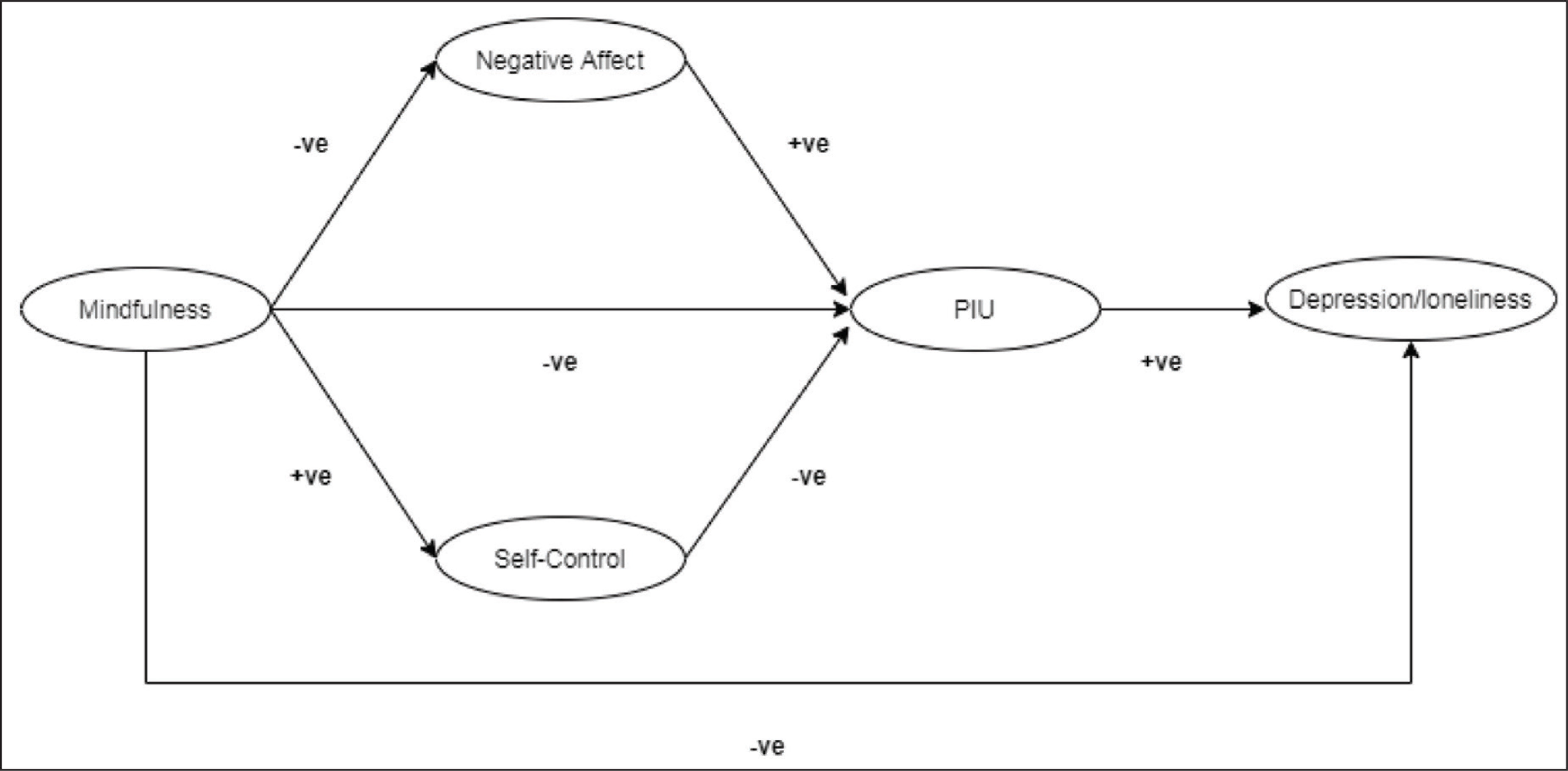
Based on the preceding rationale and existing literature suggesting a negative relationship between dispositional mindfulness and PIU (e.g., Arslan, 2017; Gámez-Guadix & Calvete, 2016), and that PIU correlates positively with depression and loneliness (e.g., Kraut et al., 2002), we expect that in the presence of mindfulness, level of PIU will lower, which subsequently will reduce feelings of depression and loneliness.
H4: PIU mediates the relationship between mindfulness and depression/loneliness.
Materials and methods
Participants
We approached a convenience sample of 390 postgraduate students from an AACSB-accredited business school for the survey. We received 255 completed surveys, yielding a 65 per cent response rate. Nine responses came with incomplete information and were not included. So, the final analysis was performed on the remaining 246 respondents (approximately 48% females) aged 20–34 years (Mage = 25.06 years, S.D.age = 2.8 years). The minimum required number of respondents for performing linear regression using four predictors was found to be 169 (effect size = 0.15, α = 0.01, power = 0.95, predictors = 4) using GPower 3.1.9.4 (Faul, Erdfelder, Lang, & Buchner, 2007). An effect size of 0.15 in social and personality psychology is considered modest (Richard, Bond, & Stokes-Zoota, 2003).
All respondents had 24-hour access to the Internet. The respondents were informed about the objective of the study and the voluntary nature of their participation. They were assured that their responses would be used in an aggregated manner and that their responses would remain anonymous. No incentive or remuneration was offered to the respondents.
Measures
Trait mindfulness
Trait mindfulness was measured using the 10-item version of Cognitive and Affective Mindfulness Scale–Revised (CAMS–R; Feldman, Hayes, Kumar, Greeson, & Laurenceau, 2006). We did not use the 12-item scale of CAMS–R following the suggestion of Feldman et al. (2006), who recommend the 10-item version to the researchers investigating the association between mindfulness and constructs such as worry, anxiety and depression. CAMS–R measures four components of mindfulness, namely attention, awareness, present-focus, and acceptance. These four components of mindfulness have been emphasized as the core themes of mindfulness in several definitions (e.g., Bishop et al., 2004). Participants responded to the 10 items on a 4-point scale from 1 (rarely/not at all) to 4 (almost always), using which the overall mindfulness score was computed. The 10-item CAMS–R version showed adequate reliability in the present study (α = .72).
Negative affect
Negative affect was assessed using Positive and Negative Affect Schedule (PANAS; Watson, Clark, & Tellegen, 1988). PANAS consists of 20 adjectives reflecting the characteristics of positive (10 items, e.g., ‘excited’, ‘inspired’) and negative (10 items, e.g., ‘distressed’, ‘upset’) affect. Participants reported how do they generally feel, on a 5-point scale ranging from 1 (very slightly or not at all) to 5 (always or extremely high) and higher scores mean higher affect.
Self-Control
Self-control was measured using six items from the self-control rating scale (Kendall & Wilcox, 1979) (e.g., ‘I can deliberately calm down when excited’, ‘I can wait in line patiently’). Respondents expressed their (dis)agreement using a 5-point Likert scale (1 = strongly disagree, 5 = strongly agree), in which higher scores indicate higher self-control.
Problematic Internet Use
PIU was measured using the 15-item Generalized Problematic Internet Use Scale (GPIUS2; Caplan, 2010) (e.g., ‘Online social interaction is more comfortable for me than face-to-face interaction’.) Participants were asked to rate the extent to which they (dis)agreed with each of the items on a scale ranging from 1 (‘definitely disagree’) to 6 (‘definitely agree’), in which higher scores mean higher PIU.
Psychosocial Well-being
Psychosocial well-being was measured using the loneliness/depression dimension subscale from Online Cognition Scale (OCS; Davis, Flett, & Besser, 2002). Notably, depression and loneliness have been identified as the indicators of psychosocial well-being by several researchers in previous studies (e.g., Caplan, 2002; Davis et al., 2002; van den Eijnden et al., 2008). Respondents expressed their (dis)agreement to the six items’ subscale (e.g., ‘Few people love me other than those I know online’) on a scale ranging from 1 (‘definitely disagree’) to 5 (‘definitely agree’), in which higher scores mean higher loneliness/depression, which means lower psychosocial well-being
Results
Preliminary analyses
Preliminary data analysis (using SPSS v.24) was conducted to obtain correlations and descriptive statistics (Table 1) of the variables in the study. Mindfulness was found to be negatively associated with composite PIU score (r = -.430, p < .001), negative affect (r = -.254, p < .001), self-control (r = .527, p < .001) and the terminal variable depression/loneliness (r = -.315, p < .001). The proposed mediators between mindfulness and PIU, namely negative affect (r = .418, p < .001) and self-control (r = -.472, p < .001), exhibited a significant correlation with the composite PIU score. Age was not significantly correlated with mindfulness, self-control, PIU, and psychosocial well-being, therefore we did not control for age in the subsequent analyses.
Descriptive Statistics, Reliabilities and Correlation Matrix (n = 246)

** p-value < .01 (2-tailed). α = reliability estimates (Cronbach’s α). PIU – Problematic Internet Use, NA – Negative Affect, SCS – Self Control Score, Dep/lon – Depression/loneliness.
Testing the Measurement Model
To examine the fit of our proposed model containing mediation hypotheses, we applied structural equation modelling (SEM) using AMOS v.18. SEM offers the advantage of testing a model that is theory-driven rather than data-driven.
First, a measurement model was tested to assess the extent to which each of the latent variables was reliably represented by its indicators. To evaluate the overall fit of the model to the data, Hu & Bentler (1999) recommend several indices and their acceptable limit: comparative fit index (CFI) of .90 or above and root mean square of approximation (RMSEA) value less than .60 indicate a good fit. The Tucker–Lewis index (TLI) of .90 or above and 2/df value between 1 and 3 imply good fit (Arbuckle & Wothke, 1999). In the present study, the measurement model exhibited good model fit: CFI = .923, TLI = .916, RMSEA = .041, and 2/df = 1.38. We dropped one item from the depression/loneliness scale owing to poor factor loading (.28). In the accepted model, all factor loadings for the indicators on their respective latent variables were significant (p < .05).
Testing the Structural Model
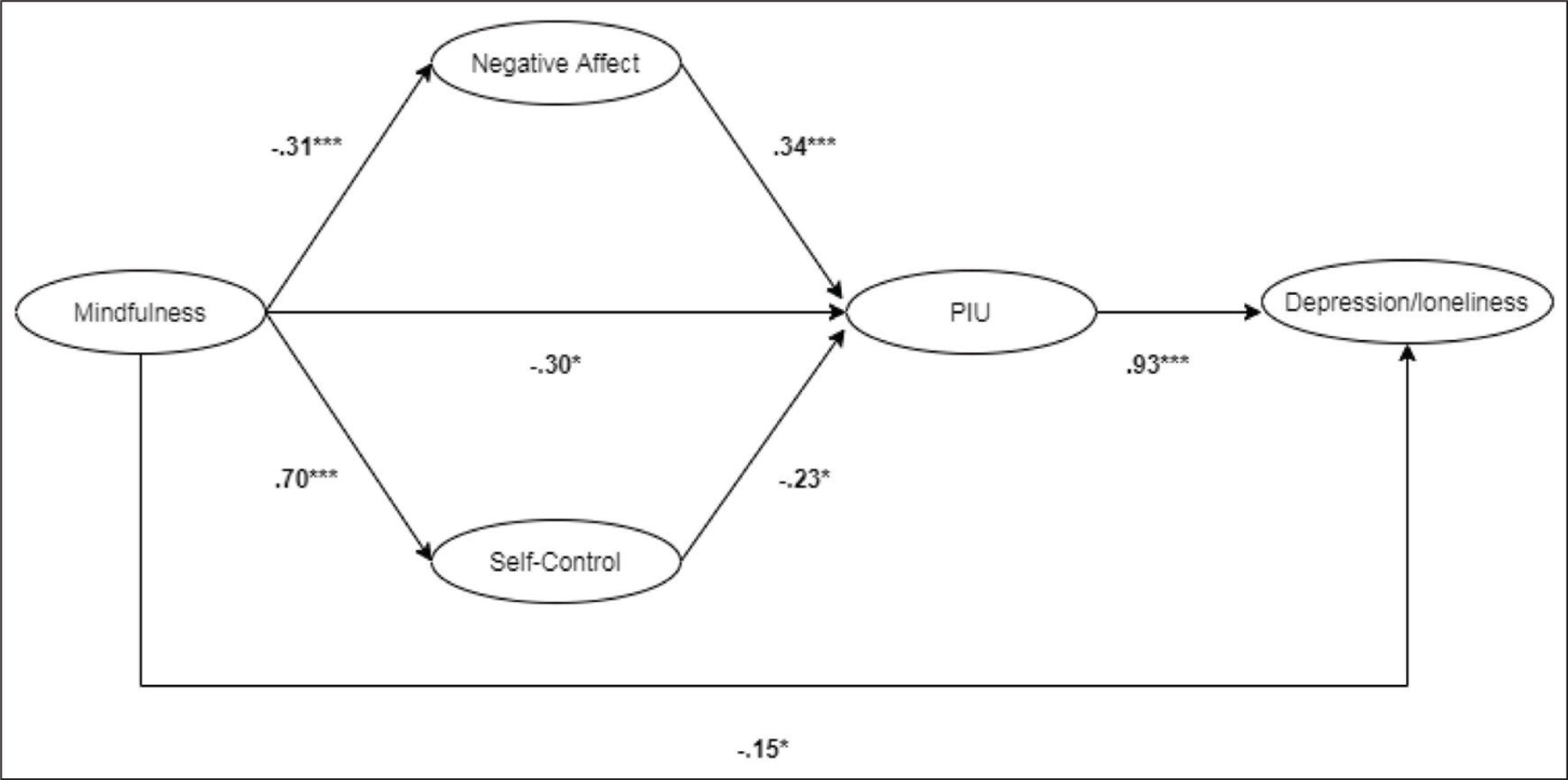
After accepting the measurement model in Stage 1, the estimation and assessment of the proposed structural model was completed in Stage 2. An initial test showed a good model fit: 2 (553) = 773.10, CFI = .925, TLI = .919, RMSEA = .040, and 2/df = 1.398. All individual paths were significant (p-value <.05; Figure 2 and Table 2). Standardized regression coefficients showed that mindfulness was a negative predictor of PIU (β = -.30, p = 0.01), negative predictor of negative affect (β = -.31, p < 0.001) and positive predictor of self-control (β = .69, p < 0.001). PIU was predicted by both the proposed mediators between mindfulness and PIU, namely negative affect (β = .33, p < 0.001) and self-control (β = -.22, p < 0.001).
p-Values for the Mediation Test
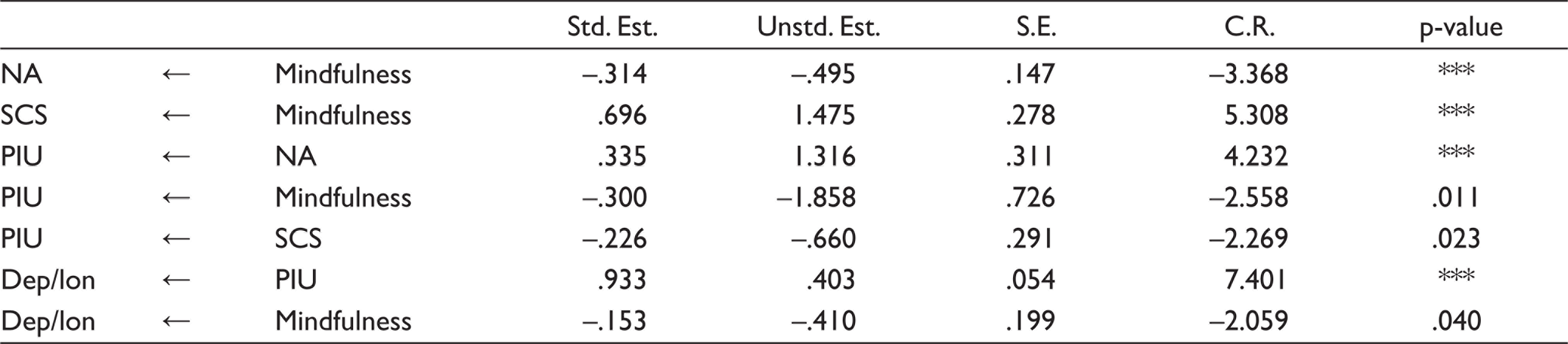
(*** p <.001)
Results exhibit that individuals with higher mindfulness are expected to experience lower negative affect, and in turn, lower PIU. Besides, as mindfulness was the positive predictor of self-control, which predicted PIU negatively, this established the mediating role of self-control through which mindfulness exerts its benefits on PIU. Finally, mindfulness predicted depression/loneliness (β = -.15, p = 0.04) and PIU predicted depression/loneliness (indictors of psychosocial well-being) (β = .93, p < 0.001). Because mindfulness is a negative predictor of PIU, people with higher mindfulness are less likely to indulge in PIU, and they experience lower depression/loneliness. In other words, lower PIU acts as an indirect mechanism through which mindful people experience higher psychosocial well-being.
The direct effect of mindfulness on PIU was -.300, and the indirect effect was -.263. The total effect of mindfulness on depression/loneliness was -.463.
Discussion
Our goal was to investigate the relationships between mindfulness, mediators (negative affect and self-control), PIU and the resultant psychosocial well-being. Understanding the role of specific predictors may explain why an increase in mindfulness may alleviate PIU directly and through the two mediating mechanisms, thereby reducing adverse psychosocial outcomes.
The present study contributes to the literature in several ways. First, mindfulness is negatively associated with PIU, supporting the first hypothesis, thus replicating the findings of prior studies (e.g., Arslan, 2017). Mindfulness promotes acting with awareness and allows for more adaptive responses, which works as an enabler in identifying more choices to choose the actions through deliberative thinking and restricts habitual reactions to certain triggers such as conflicting internal situations and impulsivity (Bishop et al., 2004). Such mindful individuals tend to recognize and connect with their intrinsic needs, do not react in maladaptive ways and maintain a healthy personal and societal interaction, having more satisfaction in life. Besides, mindfulness is related to the use of emotions in productive purposes (Wright & Schutte, 2014). Thus, mindful individuals are self-disciplined and more capable of handling their impulses (Papies, Barsalou, & Custers, 2012), subsequently reducing the automaticity in behaviour. Overall, these factors provide the theoretical underpinning of the negative relationship between mindfulness and PIU.
Beyond the direct process, our study examined the indirect processes in understanding the role of mindfulness in PIU. To our knowledge, no previous study has delved deeper into understanding the role of these mediating variables through which mindfulness influences PIU. Our study outcomes establish previously unexplored partial mediation effect of negative affect between mindfulness and PIU, supporting the second hypothesis. Consistent with the prior work, we found that individuals under negative affect get themselves immersed into excessive use of the Internet (Wan & Chiou, 2006). Although, the results indicate that using excessive Internet is not an effective way to cope with negative affective experiences. The phenomenon is explained by Hayes and Strosahl (1999): when adverse cognitions and emotions are acknowledged and engaged, and not suppressed, the process of a meaningful dialogue and adjustments with the individuals’ unmet needs is initiated. Mindfulness promotes active engagement with thoughts and emotions, that helps in focusing on the possible antecedents of negative feeling, without getting immersed in the negative experiences. Because negative affect is related to addictive behaviour, individuals with lower tendency to experience negative affect are less expected to indulge in PIU. Through these mechanisms, a mindful individual is expected to experience less negative affect and subsequently lower PIU.
The second process that gets established through our findings is the partial mediation role of self-control between mindfulness and PIU, supporting the third hypothesis. Self-awareness and attention components of mindfulness promote self-control mechanism that guides behaviours towards set goals. Further, self-control facilitates the regulation of thoughts and improves concentration (Tangney, Baumeister, & Boone, 2004), thus overriding the undesirable impulses to use the Internet. Not surprisingly, individuals with higher self-control find it easy to monitor and adjust their behaviour (LaRose, Lin, & Eastin, 2003) away from dysfunctional purposes, which may reduce PIU.
The present study found that PIU mediated the relationship between mindfulness and psychosocial well-being, supporting the fourth hypothesis. We did not find any previous study that examined the mediating effect of PIU on the mindfulness and psychosocial well-being relationship. The inherent benefits of mindfulness, such as the focus on the present moment, awareness, openness to information assimilation and the ability to think more clearly, help in self-regulation and better assessment of behaviours. Particularly, the role of mindful awareness is critical in breaking habitual behaviour patterns whereas automatic or implicit internal processes are considered as predictors of several addictive behaviours (Ostafin & Marlatt, 2008). Human beings may have a need for altered consciousness, to experience reality from different viewpoints, pursued through different activities, including the use of cyberspace (Suler, 1999). When the need fulfilment related to alternative consciousness of self and others through Internet becomes excessive, Internet use assumes a dysfunctional and addictive shape. As mindfulness enables present-centred consciousness, mindful people are able to contain the fanciful ideas related to online world and are less prone to addictive Internet behaviour. Healthy Internet use, which emphasizes on creating a synergy between online activities and offline life (Suler, 2000), is associated with greater life satisfaction and less depression and loneliness (Lin et al., 2018). In contrast, with addictive Internet use, individuals may experience less face-to-face relationships and reduced social interactions and connectedness (Beard, 2005). Such individuals may associate themselves with more loneliness and depression, thus psychosocial well-being is reduced. Thus, the study outcomes show that higher mindfulness may act as a practical means to reduce PIU and increase psychosocial well-being.
Limitations and Future Directions
Several limitations of the present study must be considered. The first limitation is the reliance on postgraduate students from a premier business school, who may be more mindful than the general population. Future research may consider a more generic community sample. Although the instruments used in the study have exhibited excellent psychometric support and the study outcomes were consistent with the hypothesized predictions, the findings should be studied with the usual cautions related to self-reported cross-sectional data. Future studies may use mindfulness-based interventions to obtain additional insight into the influence of mindfulness on the dependent variable. As both dispositional mindfulness and problematic Internet use are broad constructs, future studies may examine other indirect mechanisms regarding this relationship.
Practical Implications and Conclusion
Notwithstanding these limitations, the present study advances our knowledge on the relationship between mindfulness and PIU directly and indirectly through mediators. The respondents of the study were future managers. Thus, the study outcomes have multifaceted implications for individuals and society as well as for the organizations. Individuals with a high tendency to indulge in PIU face multiple adverse psychosocial outcomes such as depression and loneliness. Within the organizational context, PIU is found to be associated with higher levels of cyberloafing (Yan & Yang, 2014). Serious cyberloafing causes not only loss of productive human hours but also may compromise information security network (Hadlington & Parsons, 2017). Several studies have established that mindfulness is a trainable quality and can be enhanced through various physical and app-based mindfulness interventions (Chittaro & Vianello, 2016; Brown & Ryan, 2003). To this effect, the policymakers should take note that any PIU prevention program in the larger society or at the organizational level may incorporate mindfulness interventions. Policymakers may also ask the admins/owners of various websites, where people spend excessive time (e.g., social media websites), to enable pop-up messages after a specific time limit. The use of pop-up messages, which have better visual saliency than static screen messages (Stark, 1990), is based upon empirical evidence for their effectiveness in enhancing people’s awareness and attention level (Monaghan, 2008) and which may act as brief mindfulness inducement exercise (Mak, Chan, Cheung, Lin, & Ngai, 2015). Appropriately designed pop-up messages temporarily disrupt the surfing sessions and are expected to facilitate the mindful awareness related to the time spent online and may make people more attentive towards suitable behavioural modifications.
The present study aimed to broaden the empirical perspectives related to the role of dispositional variables on PIU. The findings of the study provide substantive evidence that mindful individuals are less likely to indulge in problematic Internet use and more likely to experience higher psychosocial well-being.
Footnotes
Declaration of Conflicting Interests
The author(s) declared no potential conflicts of interest with respect to the research, authorship and/or publication of this article.
Funding
The author(s) received no financial support for the research, authorship, and/or publication of this article.