



Abstract
Obstacles and threats are common occurrences for entrepreneurs in their journey of starting and surviving a venture. These challenges often induce a fear of failure in entrepreneurs, sometimes affecting their mental well-being. Although coping literature lists several explicit mechanisms to mitigate the adverse impact of entrepreneurial fear of failure, empirical evidence suggesting the role of some intrinsic typical entrepreneurial characteristics such as overconfidence and optimism is missing from the extant knowledge bank. Our study joins those missing links by studying the role of entrepreneurs’ confidence elements—overconfidence and optimism in entrepreneurial fear of failure. We adopted stress appraisal theory and experience sampling methodology to explore the hypothesized relations. We triangulate our results with semi-structured interviews with entrepreneurs. Our findings reveal the positive side of entrepreneurs’ confidence in dealing with stress and fear of failure. Therefore, we contribute to the entrepreneurial well-being literature and provide a reason for practicing entrepreneurs to build on their confidence.
Keywords
Introduction
Entrepreneurship and obstacles often go hand in hand. Entrepreneurs face hindrances while running or even before starting a new venture. The apprehension of facing such obstacles generates a cognitive and emotional response in entrepreneurs named entrepreneurial fear of failure (Cacciotti & Hayton, 2015). While experiencing entre- preneurial fear of failure influences subsequent action (or inaction) in new ventures (Kollmann et al., 2017), it can take a toll on entrepreneurs’ well-being too (Foo, 2011). The literature stream that takes a dispositional approach (by considering fear of failure as a stable personal trait) studies entrepreneurs’ characteristics to understand entrepreneurial fear of failure (Rauch & Frese, 2007). On the other hand, literature considering the state approach (by considering fear of failure as a changeable cognitive state) emphasizes exploring coping mechanisms to study entrepreneurial fear of failure. Entrepreneurial coping literature mentions several methods to deal with the fear of failure (Engel et al., 2021; Sode & Chenji, 2019). While the techniques such as loving-kindness meditation (Engel et al., 2021) facilitate coping with entrepreneurial fear of failure, the personal traits of entrepreneurs influence the effectiveness of those. One such stereotypical characteristic of entrepreneurs is their confidence, manifested in overconfidence and optimism. Although literature hinted a link between entrepreneurs’ confidence and the intensity of fear of failure (Morgan & Sisak, 2016), empirical evidence of the same is still missing. This missing knowledge can convey a confusing signal to entrepreneurs and researchers regarding the role of entrepreneurs’ confidence in fear of failure and well-being. As there are mixed opinions about the impact of entrepreneurs’ confidence in various entrepreneurship processes (Kraft et al., 2022), it is urgent to address this knowledge gap and with carefully designed empirical studies. Thus, we argue favouring the need to explore personal characteristics considered typical of entrepreneurs, such as entrepreneurs’ confidence to understand its influence on entrepreneurial fear of failure. Our study examines the correlation between entrepreneurs’ confidence elements (optimism and overconfidence) and entrepreneurial fear of failure. We adopt the stress appraisal theory lens to explore how optimism and overconfidence influence entrepreneurial fear of failure. We tested our hypothesized relations on a sample of 470 student responses. Other similar studies in entrepreneurship have used student samples (e.g., Duong, 2022) using an experience sampling methodology (ESM) as this method helped us to assess the participants’ instantaneous confidence, stress and fear. The findings reveal that optimism negatively correlates to entrepreneurial fear of failure through reduced stress. Similarly, overconfidence is negatively associated with stress, which in turn reduces fear of failure. Additionally, we triangulate our inferences by taking semi-structured interviews with 10 entrepreneurs. The qualitative analysis of the interview data corroborates our quantitative findings. Our findings contribute to the entrepreneurial well-being literature by exploring antecedents to managing stress and entrepreneurial fear of failure. Practicing entrepreneurs can benefit from the results by building on their confidence.
The rest of the paper is structured as follows. We provide a theoretical background related to the topic and derive our hypotheses in the next section. The following section discusses the methodology used and the reason for selecting it. The next section lists and discusses the results. We then discuss the theoretical and practical contributions of the study before presenting the concluding thoughts.
Theory and Hypotheses
Entrepreneurs’ Confidence
Entrepreneurs characteristically exhibit higher confidence levels than managers who are not entrepreneurs (Forbes, 2005). The higher confidence in their abilities or the expected favourable outcomes drives entrepreneurs to start their businesses (Carter et al., 2003) amidst uncertainties and risks. However, the literature asserts entrepreneurial confidence as a double-edged sword. While having confidence has positive correlations with several encouraging outcomes such as more innovation (Hirshleifer et al., 2012), better opportunity identification (Koellinger et al., 2007) and higher entrepreneurial resilience (Seligman & Schulman, 1986); exhibiting more than an optimal level of confidence has its downsizes with less survival rate (Camerer & Lovallo, 1999), poor decision-making (Hayward & Hambrick, 1997) and escalation of commitment (Nouri, 2020; Whyte et al., 1997). Trevelyan (2008) attributed such contrasting evidence to the two constituting constructs of entrepreneurial confidence—optimism and overconfidence. Optimism is defined as expecting positive outcomes in general (Scheier et al., 2001), and overconfidence is estimating one’s ability more than the actual ability (Moore & Kim, 2003). Optimism can aid in entrepreneurial success (Crane & Crane, 2007) by facilitating more risk tolerance (Harris & Middleton, 1994) and resilience in entrepreneurs (Brissette et al., 2002). However, optimism may easily cross the line to become overconfidence in entrepreneurs (Dubra, 2004) when they attribute consecutive favourable outcomes to their extra ordinary capabilities (Gudmundsson & Lechner, 2013). Overconfidence is found to be a common characteristic among entrepreneurs (Koellinger et al., 2007), often leading to errors in judgment (Russo & Schoemaker, 1992). Since both elements of entrepreneurial confidence are commonly observed in most entrepreneurs, it becomes vital to understand their impact on other key entrepreneurship out-comes. Literature majorly focused on the effects of entrepreneurs’ confidence on venture-level outcomes such as survival or failure rate, innovation and so on. We explore the role of entrepreneurs’ confidence in individual-level outcomes such as entrepreneurs’ well-being. Understanding the impact of two commonly observed characteristics in entrepreneurs on their well-being will help them build the necessary intelligence to deal with them.
Entrepreneurial Fear of Failure
Fear of failing in the face of uncertainties and challenges is a significant and recurring reality of the entrepreneurial process (Cacciotti et al., 2016; Mitchell & Shepherd, 2010). Although the intensity of and response to entrepreneurial fear of failure varies from individual to individual, its impact across multiple levels of a new venture is unavoidable. The seminal work of Cacciotti et al. (2016) provides empirical evidence supporting the mixed implications of entrepreneurial fear of failure on entrepreneurs at an individual level and on their venture at the firm level. Some entrepreneurs may feel motivated to perform better to combat the feeling of fear by working harder (Carver, 2006). However, the majority of literature emphasizes the adverse impact of entrepreneurial fear of failure on entrepreneurial performance leading to poorer venture outcomes. Fear of failure often impairs entrepreneurs’ ability to identify and pursue opportunities. To avoid the feeling of fear, entrepreneurs may even choose to be inactive and shy away from risk-involving actions (Kollmann et al., 2017). However, increasing literature associating the detrimental impact of entrepreneurial fear of failure on entrepreneurial well-being (Cacciotti et al., 2016) rings an alarm to study and explore ways to cope with it (Uy et al., 2017). We respond to the need to explore more coping mechanisms to deal with the adverse impact of entrepreneurs’ fear of failure. We do so by drawing on stress appraisal theory and considering fear of failure as a cognitive mechanism.
Stress Appraisal Theory
Stress appraisal theory (Lazarus, 1982) posits that individuals differ in their response and behaviour to any external stressor depending on their appraisal of it. Appraisal of each situation varies among individuals. What looks stressful to one individual might not have any impact on the other individual. Lazarus and Folkman (1984) explain the appraisals in cognition. People perceive things in three different ways. It will either be irrelevant to them, positive or joyful or stressful. The stress one perceives, in turn, can be due to some loss that had occurred in the past or the possibility of harm or loss. It can also be due to taxing or hard work that might lead to a positive outcome, termed ‘Challenge’. So, how a person thinks will determine how much stress he perceives. And this will, in turn, induce different coping mechanisms (Mitchell et al., 2019) to deal with stressors.
While stress is universal, entrepreneurs face a lot more stress because of the nature of their work. There is psychological stress on entrepreneurs to remain confident and calm even in adversity. Showing weakness is seen as taboo. Also, entrepreneurs are mostly lonely because they often need to supervise and manage things single-handedly. They are so immersed in shaping the business that they forget their social circle (Hannafey, 2003). Moreover, they must keep themselves updated with the required skills, deal with responsibilities and uncertainties, be competitive in the market and meet family expectations and needs. This makes stress a significant variable in the entrepreneurship context (White & Gupta, 2020).
Confidence and Stress
Studies suggest that stress negatively affects entrepreneurs’ well-being, which hampers venture performance (Lerman et al., 2021). However, some studies also suggest that entre- preneurs value the venture more than their well-being, and their stress does not hinder venture growth and performance to a greater extent (Wach et al., 2021). Also, stressors are all not always negative. In some cases, stressors enhance the well-being of entrepreneurs. Though this is counter-intuitive, this is seen in cases where the entrepreneur perceives the situation as an opportunity for growth (Lepine et al., 2005). Thus, stress depends on how an individual perceives a given situation.
Overconfident people feel better at doing things than others. They overestimate their performance and believe that they are more accurate than others (Pompian, 2012). They think the tasks to be easier. So, their initial perception of risk and stress will be lesser than others (Salamouris, 2013). Similarly, over-optimistic people tend to believe that the outcome will be positive in the end, irrespective of the current situation. Their perception of stress will also be lesser than those who are not optimistic (Zíka & Koblovsky, 2016). While some studies explored the influence of over- confidence and optimism on life satisfaction (Cummins & Nistico, 2002). But literature does not say much about the effect of entrepreneurs’ overconfidence and optimism on stress. Overconfidence and optimistic bias make entrepreneurs perceive risks with lesser intensity and help aid the venture start-up process (Salamouris, 2013).
Drawing on the above reasoning that entrepreneurs who are overconfident and over-optimistic will perceive the situations to be less stressful than people who are not, we hypothesize as below:
Confidence, Stress and Fear of Failure
As mentioned earlier, we consider entrepreneurial fear of failure as a cognitive and behavioural response to the threats and uncertainties entrepreneurs face throughout their journey. Drawing on stress appraisal theory, the intensity and impact of entrepreneurial fear of failure depend on how these are appraised by the entrepreneurs (Jenkins et al., 2014). Entrepreneurs can either evaluate an obstacle as a threat or a challenge. The evaluation process, in turn, determines the coping method entrepreneurs adopt (Lebel, 2017). The coping mechanism involves self-regulating the intensity of negative affect associated with the fear of failure (Gross, 2015). External coping methods, such as self-compassion (Engel et al., 2021) and mindfulness (Sode & Chenji, 2019), help regulate the negative effect generated in response to obstacles. However, the effectiveness of such external methods is shaped by the intrinsic nature stereotypical to entrepreneurs.
Therefore, we are interested to understand how entre- preneurs’ confidence impacts the regulation of negative affect and stress associated with fear of failure. Studies dealing with external coping mechanisms acknowledged the mediating role of reduced anxiety and stress levels, which in turn help manage the fear of failure better (Hjeltnes et al., 2015). As discussed in the earlier section, entrepreneurs’ confidence elements—optimism and overconfidence—also help mitigate the negative impact of stressors by perceiving environmental cues as less threatful but more challenging. Since entre- preneurs’ confidence acts as a stress buffer in the roller-coaster journey of entrepreneurship, we argue that these typical characteristics of overconfidence and optimism in entrepreneurs also aid in mitigating the severity of felt intensity of negative affect associated with entrepreneurial fear of failure. Thus:
Methodology
Sample and Data Collection
An ESM is adopted to collect data for the study due to the nature of the research question. The experience sampling method or the diary method allows one to collect data directly from the participants about how they feel at that instant. It evaluates happiness, stress, pain, fear and other emotions ‘at the moment’, prompting subjects several times, yielding a time series rather than a single data point. This method minimises recall bias, as participants fill in the responses immediately during the event or at the end of each day (Atz, 2013).
The survey was conducted on the student population. Many previous entrepreneurship studies used student samples to study entrepreneurial intent or fear of failure (Duong, 2022). The participants were individually approached and explained the purpose of the study. After getting their consent, a form was sent to them every day at 8 pm. And the participants were given a reminder to fill out the form. And their response was checked at the end of the day to ensure their participation. Sixty students agreed to participate in the study. They were asked to fill out the survey form for 10 consecutive days. But 13 students did not complete the questionnaire daily despite regular reminders. The response rate is 78.33%. This resulted in 470 responses, which is above the golden range of responses for ESM (the standard range is 56–168) (Atz, 2013). Stress, tiredness, confidence and optimism were measured. And as participants were expected to complete the survey every day, the questionnaire was kept as short as possible. Separate surveys were conducted to measure fear of failure and other demographic details.
Measures
Stress: Stress is measured as a one-item scale. The measured stress is the perceived stress of an individual at the end of the day. Tiredness and how they felt about their day were also measured as control variables for stress (Atz, 2013).
Overconfidence and optimism: Overconfidence and optimism were measured using a one-item scale. Self-reported confidence is widely considered during data collection (Brinkman et al., 2015; Tomić et al., 2007). Often many studies estimate confidence in something specific. So, the questions were slightly modified to suit the purpose here. Optimism was usually measured using a set of items. But that does not give insight into optimism at that instant. Also, for the ESM method, questions were supposed to be kept short and precise not to tire out the participant. So, optimism was also measured with one item scale (Kemper et al., 2011). The variables were measured on a Likert scale of 1–7.
Fear of failure: A survey measured the fear of failure when the participants thought about starting their businesses. Fear of failure was measured as a mean score of six subscales. Each subscale, in turn, was measured by a set of items (Cacciotti et al., 2020).
Control variables: Demographic variables and other controls were measured to control for other factors and influences. Age, gender, employment status (in the case of part-time students), whether they are presently at home or the workplace, whether they are married or not, whether they have children or not and how they perceive their financial condition, was measured.
Triangulation
Based on convenience sampling, 10 entrepreneurs were chosen. Semi-structured interviews were conducted to understand the stressors in their life and how they cope with them. They were also asked how confident and optimistic they feel about their business. The interviews were conducted in English and Tamil languages. And the audio was translated and transcribed into text for analysis.
This mixed-method study uses quantitative and qualitative data to understand the question under consideration.
Results
Experience Sampling Method
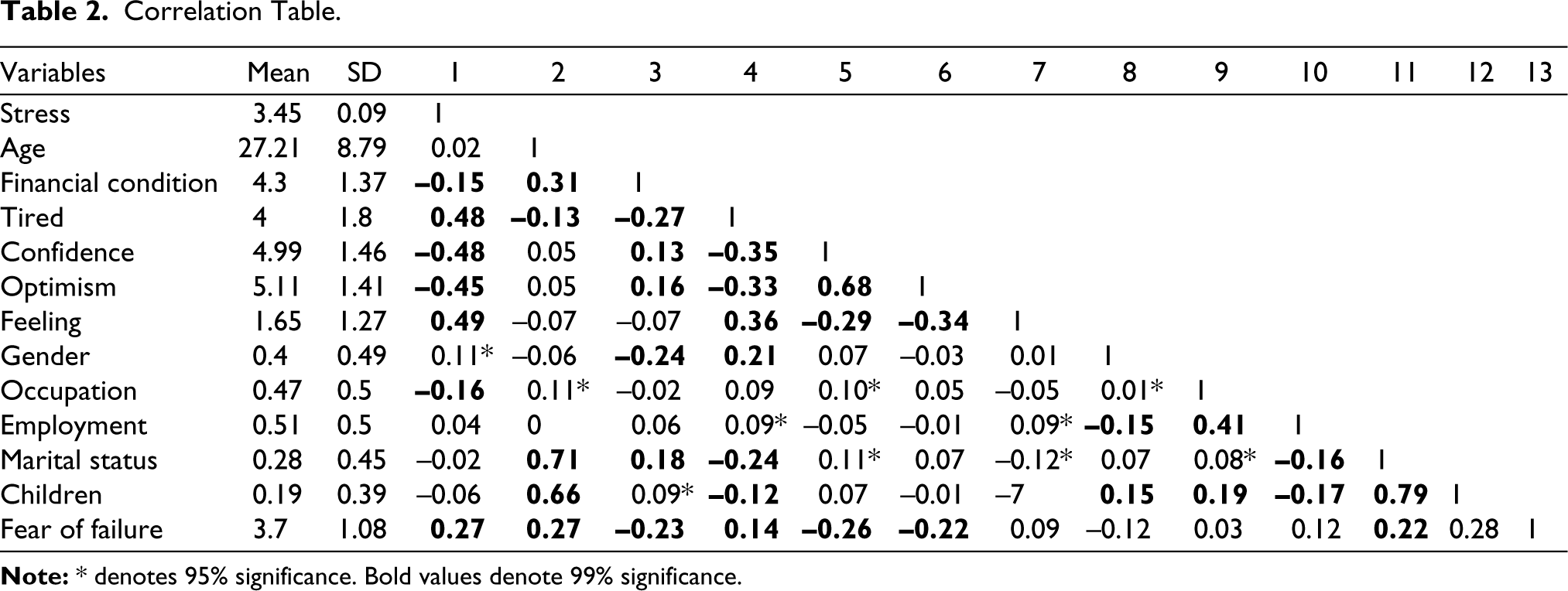
Table 1 defines all the relevant variables. Table 2 shows the descriptive statistics and correlations of all variables for the sample (n = 470). The sample is distributed among all ages of people, who are students pursuing various degrees. The average age of the sample population is 27. And the sample consists of males (n = 28) and females (n = 19) with roughly equal gender ratios. Fifty-one per cent of the sample work from the office not from home. Forty-six per cent are employed and studying part-time. And the rest, 54%, are students pursuing either master’s or doctoral programmes. Twenty-seven per cent of the sample population are married, and 19% have children.
Variable Definitions.
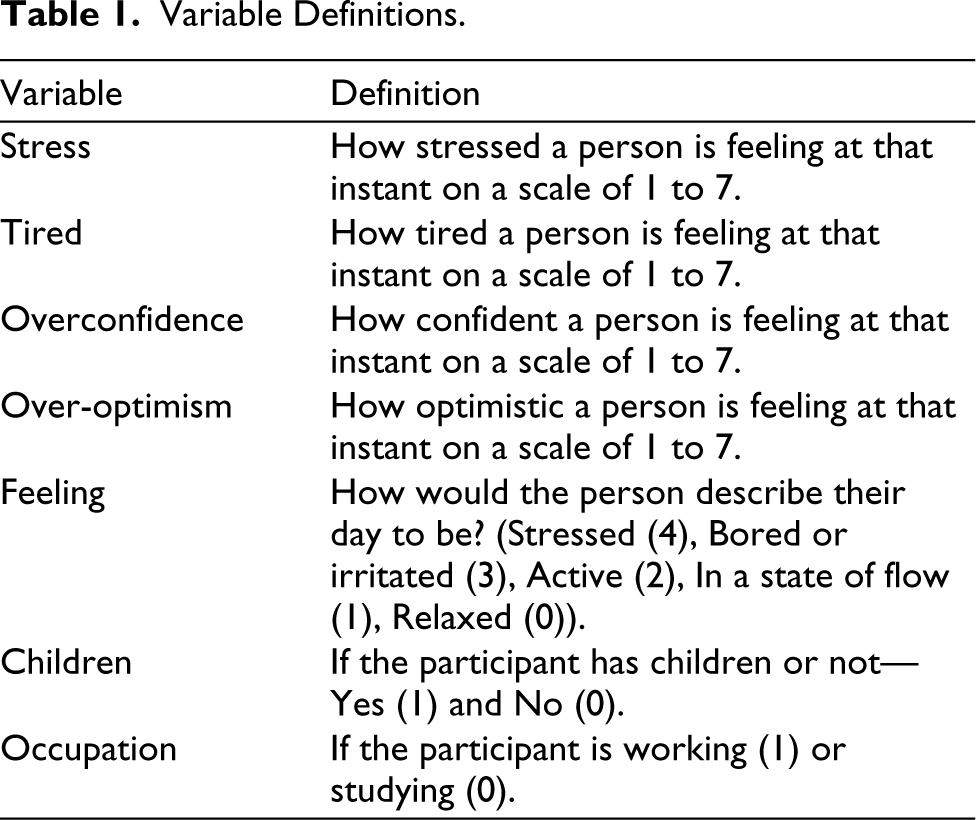
Table 2 shows the descriptive statistics and correlation values of all variables. From the correlation table, we can see that stress is negatively correlated with both confidence and optimism. The correlations are significant at 99%. So, the relationships between stress and confidence and stress and optimism are negative and significant.
Correlation Table.
According to the proposed hypotheses, the following regression model was first conducted:

The fitted regression model is,

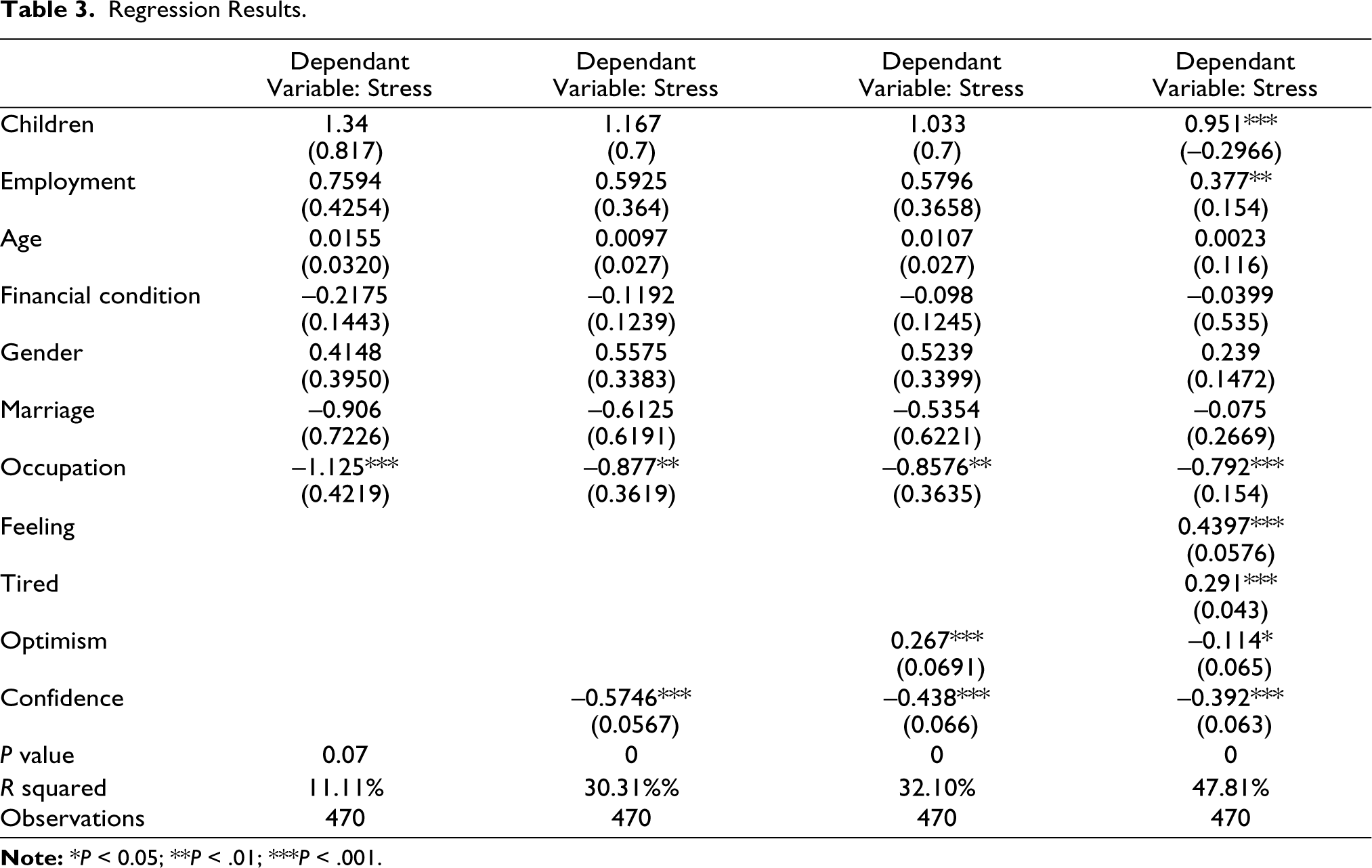
Simple linear regression was used to test if overconfidence and optimism significantly affected the dependent variable, that is, stress. The regression results are listed in Table 3.
Regression Results.
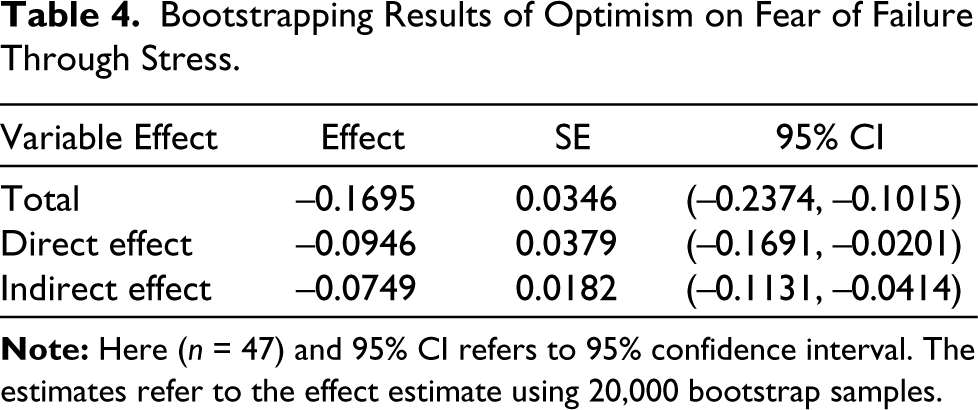
Bootstrapping Results of Optimism on Fear of Failure Through Stress.
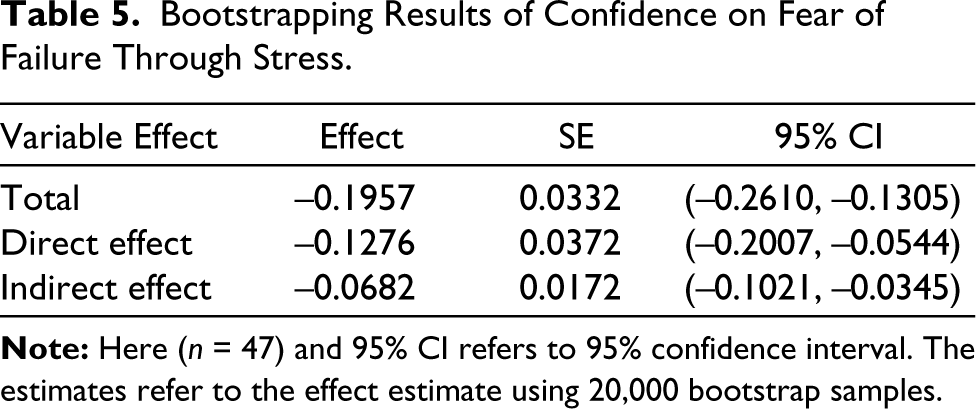
Bootstrapping Results of Confidence on Fear of Failure Through Stress.
The overall regression was statistically significant (R2 = 47.81%, F(11, 458) = 38.14, P = 0.0000). From this model, we can observe that the presence of children significantly affects stress. Moreover, how a person feels at that moment also significantly affects stress.
A student who is also employed experiences significantly less stress than a person who is not employed. A person working from the office is experiencing significantly more stress than someone working from home. How tired a person feels at the end of the day has a significant positive effect on stress. Per the proposed hypotheses, confidence and optimism have a significant negative relationship with stress. When the confidence of individual increases, stress significantly decreases. When the optimism of an individual increases, stress significantly reduces.
Post hoc analysis
Given the time series structure of the data, we additionally explored the above regression model using a dependent variable lagged indicator as a control for the analyses. Although the literature suggests that the control variables captured on the same day have more predictive power than lagged relationships in daily studies (Gabriel et al., 2019), dependent variable lag is used to understand how good the explanatory variables are in the presence of the previous day’s predicted value. In our case, we find that the lag of stress is significant on our dependent variable with a beta value of 0.26 (p-value <.001). Additionally, confidence is significant as before (β = –0.28, p-value <.001), and the significance of optimism decreases (β = –0.08, p-value >.05).
Stress as mediator
The study aimed to analyse the relationship between optimism and fear of failure, where stress is considered a mediator variable. And to examine the relationship between confidence and fear of failure, where stress is considered a mediator variable.
To test hypotheses 2a and 2b, the study applied the procedure suggested by Hayes (2013). Following this approach, model 4 in process macro was applied using SPSS software. The model was run with 20,000 bootstrapped samples. The independent variable under consideration is optimism in the first mediation model. The dependent variable is fear of failure. Stress is the mediating variable. Our results confirm that optimism reduces stress (where beta = –0.6105). The overall model was statistically significant (R2 = 19.87%, F = 116.07, P = 0.0000). Thus, we can infer when optimism increases stress decreases, providing additional support for H1b. The total effect of optimism on fear of failure is negative (where β = –0.1695). Here, the direct effect is significant (direct β = –0.0946). And the indirect effect of optimism on fear of failure is mediated by stress with indirect β = –0.0749. Thus, the indirect effect of stress between optimism and fear of failure is statistically significant. Stress decreases when optimism increases, and it further reduces fear of failure. (Boot SE = 0.0182, LLCI = –0.1131, ULCI = –0.0414) H2b is supported. In the result, we observe that the signs of indirect and direct effects are the same. Therefore, the mediation effect is complementary.
In the next mediation model, the independent variable under consideration is confidence. The dependent variable is fear of failure. Stress is the mediating variable. Our results confirm that confidence reduces stress (where beta = –0.6331). The overall model was statistically significant (R2 = 19.87%, F = 25.2804, P = 0.0000). Thus, we infer that when confidence increases, stress decreases, providing additional support for H1b. The total effect of optimism on fear of failure is negative (where β = –0.1953). Here, the direct effect is significant (direct β = –0.1276). And the indirect effect of optimism on fear of failure is mediated by stress with indirect β = –0.0682. Thus, the indirect effect of stress between confidence and fear of failure is statistically significant. Stress is decreased when confidence increases, which further reduces the fear of failure. (Boot SE = 0.0172, LLCI = –0.1021, ULCI = –0.0345.) H2a is supported.
Analysis of Excerpts from the Interview
Semi-structured interviews of entrepreneurs were conducted to understand the different stresses they face and how they cope with them daily. The interview also aimed to understand how confidence and optimism affect stress. Open-ended questions were asked so that they could answer the questions from their experience. A thorough conversation was tailored to maintain proper communication and flow during the interview, and a few follow-up questions were kept handy. The interviews were conducted through zoom calls, regular phone calls or direct meetings. The inter- viewees were explained the purpose of the study as to understand the daily ups and downs in entrepreneurs’ life. Detail about the confidence elements, stress and fear of failure was not mentioned explicitly to avoid any intentional bias in answering. The respondents’ consent was received orally at the beginning of the interviews. Interviews were conducted in English and Tamil. The audio was recorded. Tamil audio was translated and transcribed, and English audio was transcribed to text for coding and analysis.
After conducting the interviews and transcribing them, the initial phase in data processing was open coding. It comprises a method for recognizing and classifying important words or groupings of terms in the data. Memos were kept for such terms. Memos were frequently written to record the researcher’s thought process throughout the study. Memo writing is important for developing themes (Charmaz, 2012; Corbin & Strauss, 1990). The overarching themes derived from the interviews are discussed below.
When the future seems uncertain, confidence is less and stress is more
When an entrepreneur thinks that the future can never be predicted, they do not feel confident about doing the right thing. They always feel a need to be alert, so everything seems to be stressful.
A Jewellery business owner says:
Everything is stress, There’s nothing specific. Everything is interlinked. Not just because of one thing, I feel stress. But that also happens at times. I always feel like every day is a learning process. One can never be sure about what will happen in the future. We can never be very confident about what will happen. New things keep happening every day.
Passion and confidence reduce stress
Passionate entrepreneurs are confident to innovate and adapt to the changing market needs. When one puts heart and mind into a business, they work continuously to improvise the product to keep up with the trend. They enjoy the process as a whole and do not feel stressed. Their interest in the venture fuels their motivation to do more making them more confident.
The founder of a terracotta jewellery creation says:
I’m not really stressed out with my business because I really like what I’m doing. I enjoy making terracotta jewellery. But in certain situations, I do get stressed out. But then, I take a nap and I always think about why I started my business. It will make me all excited and happy. And it’s gonna go a long way because women can never be without jewellery. Unless women’s love for jewellery fades, I’m sure that this will go a long way.
The founder of a handmade soap venture says:
I have no stress. I started it as a passion. I wanted to do it for my daughter. In fact, I need this to get me out of stress. I sometimes make soaps because that is something which I like doing. So, I’d rather say it does not cause stress, it has freed me from being stressful.
Confidence and optimism about the product enable coping with stress
When entrepreneurs are confident about the product and the market research, they feel confident and optimistic about the future. It enables them to handle stress better. Business owner of a Pan India Savouries company says: ‘Banana is a plantation crop from India and has the potential to rule the world. We don’t have this anywhere. We have to explore and update. When you have a good forecast, you have good growth. You won’t be outdated in the market.’
Discussion
Stress is ubiquitous among entrepreneurs as they work in ambiguous situations and under pressure (Rauch et al., 2018). This affects their mental well-being negatively (White & Gupta, 2020). Fear of failure and doing something wrong are also frequent in entrepreneurs (Cacciotti et al., 2016). This is because their decisions are vital for the proper functioning of their venture, and a lot is at stake. Stress and fear of failure often occur together (Atkinson & Litwin, 1960). Therefore, the current study adds to the extant literature (Arshi et al., 2021; Engel et al., 2021; Morgan & Sisak, 2016) by explaining how stress and fear of failure can be mitigated in the entrepreneurial context. This study shows that overconfidence and optimism have a negative relationship with stress. Our findings suggest that overconfident individuals can handle a situation better than others. So, the situation does not seem as stressful to them as they consider themselves more competent. So, their stress level is less. Consequently, their fear of failure is also less. Similarly, over-optimistic people feel that positive outcomes are more likely. They are not very stressed about adverse outcomes or possibilities. This will lead to less perception of stress. Consequently, their fear of failure is also less.
Theoretical Contributions
We contribute to the theoretical conversation that individual differences interact with cognition (Trevelyan, 2008) and influence entrepreneurs’ actions and venture performance (Boyd & Vozikis, 1994). Our study contributes to the entrepreneurship literature by providing complementary evidence for the positive role of overconfidence and optimism (Dushnitsky, 2010; Koellinger et al., 2007). We also establish the association between entrepreneurs’ confidence and their well-being. Entrepreneurs’ confidence is often considered as bias and detrimental to venture performance (Invernizzi et al., 2017). Our study re-emphasizes the need to study the natural characteristics of entrepreneurs—optimism and overconfidence in a positive light (Trevelyan, 2008).
We further contribute to the entrepreneurs’ well-being literature by providing empirical support for reducing the negative impact of fear of failure and stress. We contribute to the conversation that discusses coping mechanisms for mitigating entrepreneurial fear of failure (Engel et al., 2021; Sode & Chenji, 2019). Our study provided empirical evidence suggesting the need to consider personal differences (entrepreneurs’ confidence levels) while exploring external coping mechanisms as they may facilitate or hinder the efficiency of different coping techniques. Therefore, we open future research avenues by suggesting probable boundary conditions of entrepreneurial fear of failure coping mechanisms available in the literature.
Practical implications
Entrepreneurial well-being has an important consequence for business because entrepreneurs value their personal wellness (Sherman et al., 2016). But entrepreneurs work in a stressful environment, and stress builds up silently over time and might lead to potentially toxic consequences (Buttner, 1992). Continuous minor effects due to stress can build up to substantial impacts later. The knowledge that perception of stress is subjective and is influenced by cognition will make entrepreneurs more self-aware and cognitively intelligent, thus leading to entrepreneurial success (Allen et al., 2021). Entrepreneurs, in general, are overconfident and optimistic (Keh et al., 2002). Knowing that these innate traits have an appreciable effect on stress will help them use it to their advantage. Overconfidence and optimism are so far known to stimulate entrepreneurial action (Koellinger et al., 2007). From this study, it is also clear that it reduces stress perception and enhances mental wellness. So, entrepreneurs can try to be more cognitively aware, especially when facing difficult tasks or decisions. And when they are more self-aware, they can appraise the situation to be a challenge than a threat. This will have a positive effect on their well-being and venture performance subsequently.
Investors can further benefit from the findings by looking for an optimum level of confidence in entrepreneurs before investing rather than getting straightaway deterred by it.
Conclusion
The paper aimed to get better insights into the relationship between entrepreneurs’ confidence and fear of failure through qualitative and quantitative data. We infer that overconfidence and optimism negatively influence stress. When stress is low, mental well-being is enhanced through a positive perception of fear of failure.
One main limitation of the study is that the quantitative data were not gathered from entrepreneurial samples. The study was done with a student population similar to some prior entrepreneurship studies (Duong, 2022). Though the results agree with the proposed hypothesis, better insights could be gathered from further analysis of entrepreneurs. Furthermore, despite taking measures to avoid common method bias (verified successfully with Harman’s one-factor test with total variance extracted by one factor as 28.84 percent), we acknowledge that the study is susceptible to such a bias due to the use of single-item measures. And in the qualitative analysis, interviewing more entrepreneurs from different industries will give an in-depth understanding of how their confidence level helps them cope with stress.
Entrepreneurs’ confidence has both positive and negative effects. But most of the research focuses on negative aspects. Future studies can also focus on the positive consequences of entrepreneurs’ confidence to get a comprehensive picture. How entrepreneurs’ confidence varies with time and situations, and how it affects mental perceptions at an instance will probably give a better understanding of how it influences stress and well-being in the long run.
Footnotes
Declaration of Conflicting Interests
The authors declared no potential conflicts of interest with respect to the research, authorship and/or publication of this article.
Funding
The authors received no financial support for the research, authorship and/or publication of this article.