



Abstract
This article examines the expansion of agribusiness and the evolution of land grabbing in Brazil and Mozambique. The modernization of Brazil’s agricultural sector, which began in the 1960s, successfully expanded into the cerrado region in the 1980s under the state-led PRODECER project. Modernization and state-led programmes such as PRODECER gave new rise to different forms and practices of land grabbing, creating spaces for investment by foreigners. Over the last three decades the production of soybeans in the cerrado has come under substantial foreign control and in recent years, sugarcane production and foreign investment in the ethanol industry has grown markedly in the region; the social and environmental effects of this have been devastating. In this article we will also examine the recent interest of Brazilian agribusinesses in investing in Mozambican land and in particular, the ProSAVANA programme modelled on PRODECER. We argue that while Brazil is subject to land grabbing by foreign capital, it has also become a promoter of land grabbing in Mozambique.
Introduction
In light of the global food and energy crises culminating in 2007–2008, the magnitude of large-scale investments in foreign land made by transnational agro-energy corporations has witnessed a remarkable increase. It is estimated that, between October 2008 and September 2009, over 56 million hectares of land was transferred globally, two-thirds of it in Sub-Saharan Africa (Deininger et al. 2011). Data compiled in the World Bank’s 2011 report, Rising Global Interest in Farmland, reveals that ‘potential availability’ of global ‘uncultivated land’, is concentrated in Sub-Saharan Africa and Latin America and the Caribbean (Deininger et al. 2011: xxxiv). It is in this context that both Brazil and Mozambique are perceived by prospective investors as being ‘land abundant’ countries with considerable capacity to increase agricultural output through further expansion of agricultural frontiers.
However, the rising cost of acquiring land in Brazil and in Latin America in general, has meant that corporate entities, including Brazilian agribusinesses, are tending to favour investing in Sub-Saharan Africa, in countries like Mozambique, where fertile land is extremely undervalued and vast tracts can be acquired under long-term lease agreements (Mello 2011; Oakland Institute 2011). The government of Mozambique has been one of many developing country governments complicit in promoting land grabbing practices, welcoming large-scale foreign investments in national agricultural land and heralding concessions as a viable means to generate state revenue, reduce poverty and provide jobs and national food and energy security (Notícias 2012, Borras et al. 2011). Between 2004 and 2009, the country granted more than one million hectares in concessions to foreign investors (Oakland Institute 2011).
In Brazil, now the world’s sixth largest economy and second largest agricultural producer (Inman 2012, Barbosa 2011), land grabbing is not a new phenomenon. Land grabs, including land theft (grilagem), have been intrinsic to an ongoing historical process resulting in the creation of a highly concentrated system of land ownership (Sauer and Leite 2012). Today, Brazil has one of the most unequal land structures in the world, with just 1.5 per cent of rural land owners effectively occupying 52.6 per cent of all agricultural lands (DATALUTA 2012). Rooted in a colonial past marked by Portuguese land occupation and dominion, the agrarian question in Brazil has long been a contentious issue.
With the modernization of agriculture beginning in the 1960s, the agrarian question was given new breadth. Contemporary forms of foreign land alienation have emerged, with transnational agribusinesses and international capital playing a central role. Soybeans and sugarcane have become primary commodities in the process of modernizing agriculture and expanding the agricultural frontier. State-led colonization projects, such as PRODECER (Program of Brazilian and Japanese Cooperation for the Agricultural Development of the Brazilian Cerrado), 1 have further promoted land concentration and foreign land ownership in Brazil (Inocêncio 2010).
The government of Brazil, cognizant of the impact of acute land-grabbing on peasant populations, small rural producers and national sovereignty, has attempted to implement regulations to impede the unbridled usurpation of national land by foreign companies (Bancada do PT 2012; Oliveira 2010). Yet, it has become an avid promoter of land grabbing practices abroad, with Mozambique today being ‘the epicenter of Brazilian investments in Africa’ (Batista 2012). Brazil is in the process of exporting its model of agrarian capitalism to Mozambique, with financial backing from Japan, through ProSAVANA (Programme for the Development of Agriculture in the Tropical Savannahs in Mozambique). A sister project to PRODECER, ProSAVANA seeks to modernize agriculture in the country by transplanting Brazilian agribusinesses and agricultural expertise to the savannahs of Mozambique.
While ProSAVANA explicitly seeks to replicate the experience of PRODECER in Brazil’s cerrado biome, virtually all socio-environmental impacts resulting from PRODECER have remained conspicuously absent from the ProSAVANA narrative. Thus, questions are being raised as to whether the ‘Brazilian model’ in Mozambique’s Nacala Corridor will lead to poverty alleviation, food security, jobs and sustainable development, as the leaderships of both countries claim (Rangel 2011), especially given that such promises of capitalist agriculture in Brazil remain largely unfulfilled (Oliveira 2001).
The role of Brazil in global land-grabbing is that of both recipient and promoter, first in Latin America and now in Africa. The focus of this article will be on this process of land grabbing by foreign companies in Brazil and by Brazilian agribusiness in Mozambique.
Land Grabbing in a Historical and Contemporary Brazilian Context
The process of land grabbing and the ‘high level of concentration that characterizes the current structure of land’ in Brazil ‘acquired its [present] form in the 1960s through the implementation of the Green Revolution and the modernization of large estates for agriculture and livestock production’ (Sauer and Leite 2012: 875). Over the last two decades, foreign ‘land grabs’ in Brazil have increased markedly. In 1992, approximately 2.6 million hectares of rural land were in the hands of foreign corporations or individuals (Oliveira 2010); in 2008, almost 5.6 million hectares were owned by foreigners (Hackbart 2008). In this context, land grabbing can be seen as a new geo-political dimension of the age-old agrarian question in Brazil (Fernandes 2011). More than half of the foreign capital invested in land in Brazil comes from just seven countries: Portugal, Japan, Italy, Lebanon, Spain, Germany and the Netherlands (Sauer and Leite 2012).
Between November 2007 and May 2010, foreigners acquired 1,152 estates, amounting to half a million hectares, ‘the equivalent of 22 soccer fields of land in Brazil every hour’ (Odilla 2010). Two-thirds of the land owned by foreigners is concentrated in the cerrado, particularly in the states of Mato Grosso, Goiás, São Paulo, Minas Gerais, Mato Grosso do Sul and Bahia, the primary ‘land grabbing corridor’ in Brazil. Foreign land ownership is also prevalent in the southern states of Paraná and Rio Grande do Sul, as well as in the Amazon region, in Pará and Amazonas states, with each respective pair of states comprising 10 per cent and 12 per cent of the total land owned by foreigners (Fernandes 2011).
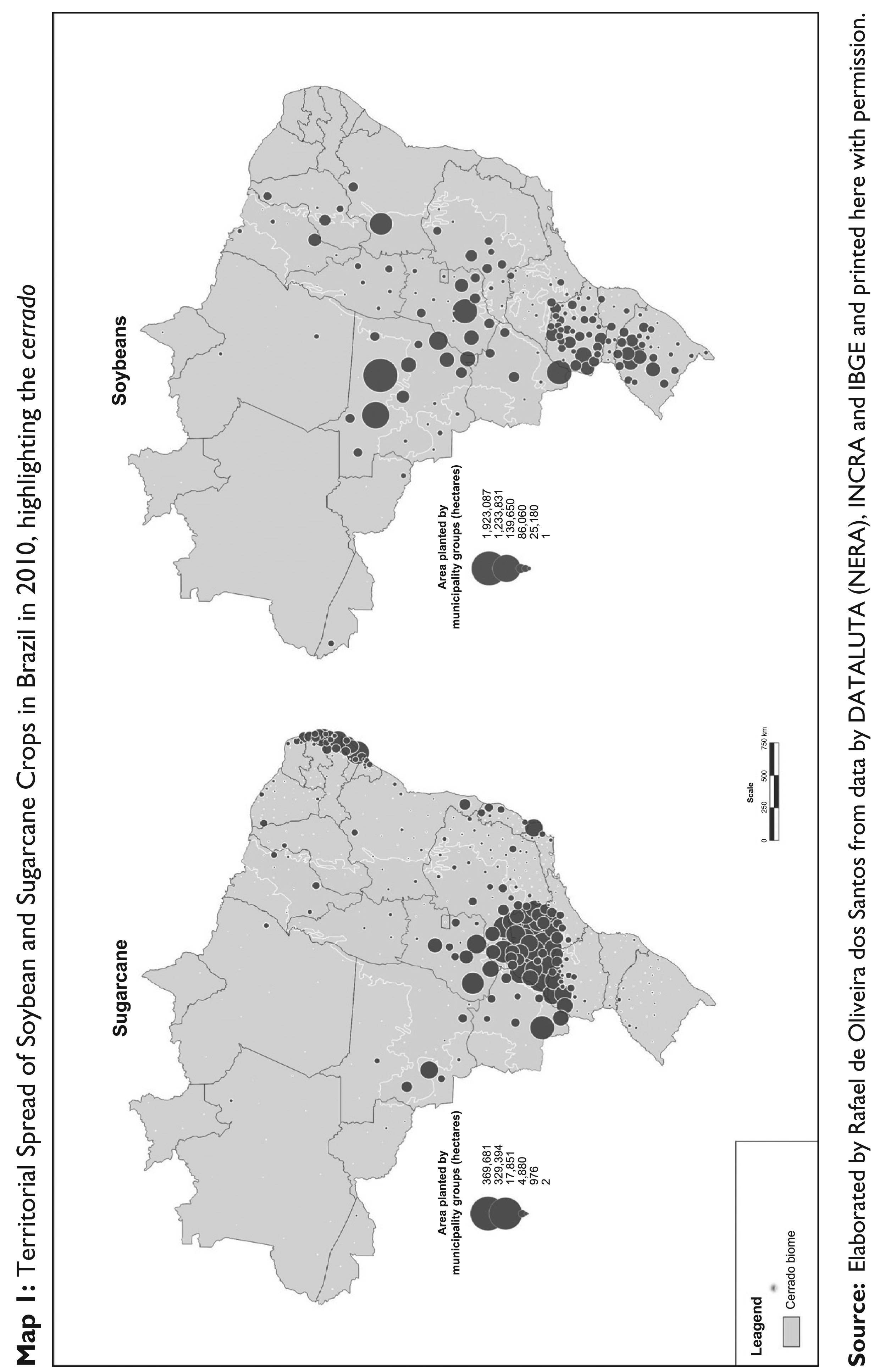
Foreign interest in the cerrado has grown together with the implementation of state-led projects of colonization and agro-industrial expansion, like PRODECER (Inocêncio 2010). Financed largely by the Japanese government and private banks, PRODECER was implemented in the 1980s and resulted in extensive industrial production of soybeans. The cerrado is now one of the most productive agricultural areas in Brazil (Map 1). Through PRODECER, substantial land transfers have been made to 717 experienced large-scale producers, whose operations have been heavily subsidized by the Brazilian government (Inocêncio 2010). Soybean has thus become Brazil’s ‘wonder crop’ in the cerrado (Bradford and Rocha 2002: 187), processed in local agro-industries and exported to the international market (Sauer and Leite 2012: 882).
Inevitably, the expansion of soybean monoculture in the cerrado has created space for the involvement of transnational agro-industrial giants, such as ADM, Bunge, Cargill, Dreyfus, Monsanto, Syngenta and Dupont. These foreign corporations, among many others, have reaped considerable benefits from Brazil’s soybean boon, gaining control over national agricultural land and processing facilities through an intricate and ongoing process of corporate mergers and acquisitions. In the span of just a decade, between 1995 and 2005, the share of international capital in Brazil’s agro-industrial grain sector increased dramatically, jumping from 16 per cent to 57 per cent (Sauer and Leite 2012).
More recently, the agro-fuel boom has sparked even more interest in Brazil’s agricultural soils, provoking an influx of investments in the country’s sugarcane-ethanol industries. There has been a flurry of mergers and acquisitions among national and international firms in the energy, agriculture, biotechnology and chemical sectors, such that foreign entities today control about 22 per cent of Brazilian sugarcane and ethanol companies (Geiver and Jessen 2010). While sugarcane cultivation has traditionally been concentrated mainly in São Paulo–in 2011–2012, the state accounted for 54.5 per cent of the country’s harvest and 51.1 per cent of its total ethanol production (CONAB 2012)—as well as the country’s Northeast region, the lucrative agro-fuel cash crop is now expanding into the agricultural frontier regions of Amazonia and the cerrado (Map 1).
As a result of the purchase of land by foreigners in Brazil, land prices have increased significantly across the country; in 2010, the price of land witnessed its most significant increase in decades (Chiara 2011). According to one news report, land purchases by foreigners contributed to a 14 per cent increase in the average national land price between 2008 and 2010, with the price per hectare rising from US$ 2,500 to US$ 2,900 (Chiara 2011). Another source (Sauer and Leite 2012) has cited an alternate figure for ‘the average price per hectare of crop lands’ in particular, based on a larger temporal period assessed. Thus, between June 1994 and June 2010, prices for agricultural land witnessed an increase of more than 430 per cent, from US$ 590.45 to US$ 3,721.79. 2
Land grabbing in Brazil was facilitated in the 1990s by drastic changes made to land regulation pertaining to foreigners. In 1995, Brazil’s National Congress approved an amendment to the Constitution, eliminating Article 171 which had previously made a distinction between national and foreign companies based on the degree of participation of foreign capital. The amendment effectively removed barriers to the amount of land foreign corporations were able to purchase in Brazil, by allowing national companies controlled by international capital to continue operating as Brazilian entities, regardless of their respective degree of foreign ownership and capital (Oliveira 2010). Three years later, in 1998, another major alteration was made, by way of an Informed Opinion (GQ181) issued by the Office of Solicitor General (AGU) at the direct request of President Cardoso, which saw the federal government relinquishing ‘any form of effective control on land purchase by foreign companies in Brazil’ (Pretto 2009: 7).
Such radical legislative changes have meant that, between 1998 and 2010, foreign entities have been able to acquire virtually unlimited tracts of land in Brazil, by operating under the protection of legislation which regulates national companies, free of onerous restrictions and effective state monitoring. According to Rolf Hackbart, former president of INCRA, the federal agency responsible for land reform, ‘the unbridled occupation of land nationwide by foreigners’ has been ‘legally masqueraded’ and justified under the false pretext that lands acquired are ‘for Brazilian companies’ (Hackbart 2008: n/p, our translation). The AGU has now recognized ‘the Brazilian State has lost effective control over the acquisition and renting of these lands’ by foreigners (Vaz 2010; n/p, our translation). Both INCRA and the AGU hold that it is necessary to consider ‘legal alternatives to restrict foreign capital from accessing land … as a strategic mechanism in defense of national sovereignty’ (Hackbart 2008: n/p, our translation). This was the position adopted by President Lula until the end of his mandate in 2010.
In 2007, in the face of looming global food and energy crises, and in response to considerable concern raised by INCRA and AGU, as well as major social movements, the Lula administration began to reassess the need to reestablish limits to land appropriation by foreigners. In 2008, the AGU issued a new Informed Opinion (LA-01), which was approved by the government and published in August 2010. The new legislation restricts the acquisition of rural estates by companies in which 50 per cent or more of the shareholdings are controlled by foreigners and limits the amount of land that can be owned by foreigners in any given municipality to no more than one-fourth of the total municipal area. According to the legislation, national companies with a majority of foreign capital cannot acquire rural land holdings of more than 50 fiscal units (five thousand hectares). The current legislation also grants INCRA authority to regulate foreign acquisitions (AGU 2010).
Given the significant level of foreign capital involved in Brazilian agro-industrial sectors, and the vested interest of transnational corporations and trading companies in expanding operations in Brazil, this move by the Lula administration has inevitably been met by corporate opposition that supports a repeal of the new regulations (Pessôa 2011). There has also been much opposition to the legislation coming from within some political parties, most notably the Social Democratic Party (PSD). In early 2012, Federal Deputy Marcos Montes of the PSD submitted a report to the Agricultural Committee of the Chamber of Deputies recommending that foreign capital once again be given free rein to carry out land grabs in Brazil by acting through national companies, claiming that foreign investments enable Brazil to feed the world and create jobs and income (Montes 2012). In July 2012, the report was approved by the Agricultural Committee of the Chamber of Deputies and is now being considered for legislation, although the ruling Workers’ Party (PT), has vowed to block revision of the text, for prejudicing national sovereignty and risking food security and national biodiversity (Bancada do PT 2012).
Brazilian Land Grabbing in Latin America
Depite its opposition to foreign land grabbing at home, the Lula administration strongly supported the aquisition of lands in Latin America, as previous administrations have done since the 1960s. Paraguay is a prime example of this. Of its 31 million hectares of arable land, 25 per cent is in the hands of foreigners, with Brazilians controlling approximately 4.8 million hectares, almost 15 per cent of the total area (Glauser 2009). With the introduction of Green Revolution monocultures in the 1960s and the displacement of millions of peasants (Altieri and Bravo 2009; Welch 2006), many migrated to Paraguay where they purchased or otherwise acquired land; known as brasiguaios, they settled on small properties, generally along the border areas. Brazilian businessmen also settled in various regions of the country, acquiring land from both Paraguayan and brasiguaio peasants, mainly for soybean production (Galeano 2010). Today, soybean production in Paraguay occupies more than 29 per cent of agricultural land (Altieri and Bravo 2009) and has contributed to an increase in poverty, by forcing displaced rural workers to settle in urban areas where they face unemployment and marginalization (Carmo 2012).
The occupation of land by Brazilians and other foreigners in Paraguay has resulted in the generation of land conflicts (Galeano 2010). While agribusiness entrepreneurs were initially called upon by the Paraguayan government to expand the areas of soybean production, the presence of foreigners in the country has stimulated the domestic struggle for agrarian reform. Landless peasants and indigenous people in Paraguay have mobilized and are now fighting against land grabbing practices for the recovery of their territories. As land conflicts between foreigners and the Paraguayan peasantry and landless have escalated, the government has faced pressure to address the increasingly volatile situation. In 2011, the state initiated an investigation into the veracity of land title documents held by foreigners in the country, with the Minister of the Interior, Carlos Filizzola, warning that those who have acquired land by illegal means may have their land titles revoked (Carmo 2012).
Historically, five countries, Paraguay, Bolivia, Argentina, Brazil and Uruguay—which together have been pejoratively called the ‘Soybean Republic’—have been the primary targets of land grabs in the Americas. The current political sentiment around curtailing the practice of land grabs in Latin America, along with rising land prices, has led to a reassessment by foreign investors of other regions of the globe that may be more amenable to large-scale land acquisitions in the purported interests of poverty alleviation, food and energy security and sustainable agricultural development. It is within this context that Brazilian agribusinesses have now set their sights on acquiring fertile growing lands in Africa.
Brazil-Africa Relations
Historical ties between Brazil and Africa date back to the sixteenth century, initiated against the backdrop of Portuguese colonization and the consolidation of a global market for African slaves. Following official abolition of slavery in Brazil in 1888, patterns of racial discrimination that had been systemic under slavery persisted, remaining deeply entrenched in the consciousness of Brazil’s class society. Pervasive inequalities continued to be encountered by former slaves while the Brazilian economic, political and class structure virtually ensured the marginalization of Afro-Brazilians, particularly those attached to their cultural roots and identity, by systematically excluding them from employment and educational opportunities. The pervasive nature of such racially motivated sentiment led to a protracted period of ‘silence’ in the history of Brazil-Africa relations, characterized by a ‘deliberate distancing’ of Brazil from its own intrinsic afro-identity and all Brazilians from the African heritage of a large segment of the population (Saraiva 1994: 264).
It was not until the 1950s that Brazil made the first steps towards a re-approximation with Africa, formally consolidating a new relationship in the early 1960s (Penha 2011). As a former Portuguese colony and home to one of the largest Afro-descendant populations in the Diaspora, Brazil has long emphasized its historical, cultural and linguistic ties to Lusophone Africa, in particular to Mozambique and Angola. It has sought to accentuate similarities so as to garner geo-political and economic influence (Penha 2011), while also projecting a model of successful ‘tropical industrialization’ (Selcher 1984: 61).
In the 2000s, the embryonic ties between Brazil and Mozambique acquired a new dimension, with Mozambique rapidly becoming the ‘hotspot’ for Brazilian investments in Africa. The importance of a strong and growing bilateral partnership between the two countries, and the benefits hoped to be achieved through such partnership, have been affirmed and enthusiastically re-asserted by the governments of both countries. In 2010, then President Lula, whose administration (2002–2010) is largely credited for the close relations that now characterize the two countries (Saraiva 2012), confirmed the strong commitment of Brazil to the food sovereignty of Mozambique: ‘[t]he greatest demonstration of the sovereignty of a country’, he maintained, ‘is its capacity to produce all the food necessary for its people … and in this Brazil has accumulated experience … to share with Mozambique’ (Monteiro 2010, our translation). More recently, in 2012, Aires Bonifácio Baptista Ali, then Mozambican Prime Minister reassured Brazilian corporations, that their presence in Mozambique is ‘extremely important’ and that those interested in investing in land in the country can rest assured that they will receive ‘a fertile ground’ on which to operate (Exman 2012, our translation).
The Advancement of Brazilian Agribusiness in Mozambique
Mozambique possesses 36 million hectares of arable land (Republic of Mozambique 2009), of which 5.7 million hectares are estimated to be currently under cultivation (Batistella and Bolfe 2010). In stark contrast to Brazil, where just 1.5 per cent of farms occupy 52.6 per cent of agricultural land (DATALUTA 2012) only 3 per cent of land cultivated in Mozambique is occupied by agribusiness (Borras et al. 2011). Of the total population of Mozambique (21.4 million), 14.3 million live in rural areas and agricultural production is almost solely derived from the labour of small farmers cultivating plots of land averaging 1.3 hectares (Batistella and Bolfe 2010). Approximately 80 per cent of the Mozambican population is involved in the agricultural sector, with the majority of the produce either used for subsistence, or marketed at the regional, provincial and national levels. Cotton, sugar, tobacco and cashew nuts are the primary export crops, which together earned US$ 264 million in 2009. Even the production of cash crops is predominately done by small farmers, often through private-public contracts, or out-grower schemes, as is the case for three of the aforementioned export commodities; only cashew nuts receive broader support through state structures and financial assistance (Oakland Institute 2011).
Presently, given the record-high prices of land in Brazil, the ‘uncultivated’ and so-called ‘available’ lands being offered up with zeal by the Mozambican government represent lucrative havens for Brazilian agribusinesses seeking to expand production. Contrary to the privatized land market system in Brazil, all land in Mozambique pertains to the state and in accordance with the 1997 Land Law (Lei de Terras 19/97), it cannot be purchased or sold. Individuals, communities and corporations gain access to land through the acquisition of Land Use and Benefit Titles, known as DUATs (Direitos de Uso e Aproveito de Terra), which are typically granted for terms of up to 50 years, with the potential for subsequent renewal for an equal period. 3
Agribusiness thus does not need to make upfront investments to purchase land in Mozambique; instead, it may pay an annual tax of about US$ 1.00 per hectare on all land held under DUAT. Compared to the cost of land in Brazil, land in Mozambique is being offered at giveaway prices (Oakland Institute 2011). Commenting on the tremendous allure for Brazilian investors, Carlos Ernesto Augustin, president of the Mato Grosso Cotton Producers Association, was quoted in the Brazilian newspaper, Folha de São Paulo, as saying ‘Mozambique is the Mato Grosso in the middle of Africa, with free land without environmental impediments and cheaper freight to China’ (Mello 2011, our translation).
Until recently, Brazilian corporations active in Mozambique have comprised mainly of a handful of construction, engineering, energy and minerals giants (that is, Vale, Odebrecht, Camargo Corrêa, Andrade Gutierrez and Eletrobras). Brazil’s National Bank of Social and Economic Development (BNDES) has thrown its support behind the operations of such sizeable corporate entities in the form of generous financing which allows companies to import Brazilian goods and services used in the development of their major infrastructural works. These include the construction of the Nacala Airport by Odebretch, a hydro-electric dam being developed by Andrade Gutierrez in the southern province of Maputo and another proposed to be built by Camargo Corrêa in the province of Tete. Vale’s coal operations in the Moatize Valley also figure into the future financing plans of the BNDES, the idea being ‘that part of the royalties paid to the Mozambican government by Vale from the extraction of coal would be put in an account and act as a guarantee for loans made for projects’, such as those related to ProSAVANA (Góes 2012).
Since 2009, there has been a sharp rise in the number of Brazilian corporations and government organizations linked to the agro-industrial and agro-energy sectors, particularly, SLC Agrícola, Petrobras Biocombustíveis, BMG, and EMBRAPA, either carrying out and expanding operations in the country, or otherwise publically expressing their intent on investing in Mozambique’s ‘fertile ground’ in the near future. Arlindo Moura, President-Director of the Brazilian agricultural giant SLC Agrícola, for example, has recently revealed to the Brazilian newspaper Valor Econômico the intention of his company to have operations up and running and be industrially producing soybeans in Mozambique before 2015. The corporation is currently one of the largest land owners in Brazil with a total area of 250,000 hectares planted with soy, corn, cotton or sugarcane crops in the 2011/2012 harvest year (Batista 2012). Likewise, Miguel Rosetto, Director of Petrobras Biocombustíveis, which is already growing sugarcane in Mozambique, has expressed the company’s intention to produce ethanol in the country in the very near future.
Furthermore, the Brazilian millionaire family, Pentagna Guimarães, owners of the Bank of Minas Gerais (BMG), have also recently disclosed to Valor Econômico their involvement in developing a project to produce soybeans in Mozambique, with production bound for the markets of South Africa, Asia and the Middle East. Industrial soybean farming in Mozambique is but part of the family’s stated goal of generating profit from activities in sectors other than finance, such as agriculture and energy. Through numerous holdings pertaining to BMG in the agricultural and energy sectors, the family are currently effective owners of 120,000 hectares of land in Brazil which are utilized for the production of coffee, soy, corn, beans, as well as cattle-ranching (Souza 2012).
ProSAVANA and the Triangular Accord
The dramatic rise of agribusiness related projects correlates with two landmark events which took place in 2009: the inauguration of a National Strategy for Biofuels (Resolução no. 22/2009) 4 on 17 May, and the signing of ProSAVANA, the Triangular Accord for the Development of Agriculture in the Tropical Savannahs in Mozambique, by Japanese, Brazilian and Mozambican officials on 17 September. Several recent studies have focused their analyses on the ongoing acquisition of land by foreign companies for the purpose of biofuel production in Mozambique and have provided much evidence of the subsequent impacts (Borras et al. 2011; Nhantumbo and Salomão 2010). The present article will focus on one of the direct project outcomes resulting from the signing of ProSAVANA, which seeks to modernize Mozambican agriculture by transplanting Brazilian agribusinesses and agricultural expertise.
PROSAVANA is broadly based on PRODECER. In the case of ProSAVANA, the idea is that through cooperative partnership among the three signatory countries and their respective institutions, the knowledge acquired in the development of the cerrado can be put to use in Mozambique and ‘will contribute to the betterment of agricultural productivity’ in the country (Mocumbe 2009: 4, our translation). While the ProSAVANA programme has been spearheaded by the Brazilian Agricultural Research Corporation (EMBRAPA)—whose research associated with PRODECER had led to the development of new technologies for soils and climates generally considered to be unsuitable for industrial agriculture—several other partners are involved in the project’s design and implementation, including the Brazilian Cooperation Agency (ABC), the Japan International Cooperation Agency (JICA), the Japan International Research Centre for Agricultural Sciences (JIRCAS), along with the Ministry of Agriculture in Mozambique (MINAG) and the Mozambique Institute for Agrarian Research (IIAM).
The ProSAVANA programme has been quietly underway since the signing. Land surveys and soil analyses have been carried out by EMBRAPA, which has also been working to strengthen Mozambique’s institutional capacity and enhance expertise in the area of agricultural science and development through training programmes and the transfer of technology (AIM 2011; Mozambique News Agency 2012). Presently, the project is making a final push towards implementation, which will involve major land concessions made to Brazilian corporations in Mozambique’s Nacala Corridor, a fertile, productive and economically important region in the northern part of the country. The Nacala Corridor comprises the province of Nampula and large parts of Niassa, Cabo Delgado and the central province of Zambezia (Batistella and Bolfe 2010). Identified as having enormous potential for agricultural expansion due to abundant rainfall and a significant amount of undeveloped land suitable for rainfed cultivation, 19 districts in the provinces of Nampula, Niassa and Zambezia have been selected for implementation of ProSAVANA projects (Justiça Ambiental et al. 2013).
Ten of the 19 districts are located in the Nampula province. According to a publication by EMBRAPA, about 4.6 million hectares of land in Nampula are appropriate for agriculture, of which 30 per cent, or just 1.45 million hectares, are currently being exploited (Batistella and Bolfe 2010). Aside from the suitability of land in Nampula, the province and surrounding region also offer a solid infrastructural framework—consisting of the Nacala airport, the Nampula-Cuamba highway, the Nacala-Mecanhelas railway and the Port of Nacala with well-established shipping routes to Europe and Asia—which further favours agricultural expansion and development along the Corridor (O País 2012).
However, it appears that there are still a few outstanding issues needing to be resolved before inevitable concessions can be made and the project can go ahead as planned. On a visit to Mozambique in April 2012, Brazilian delegate for the project, federal deputy Luiz Nishimori, specifically highlighted some of the main impediments to the current ability of ProSAVANA to produce rapidly the desired results (Notícias 2012). According to Nishimori, work still needs to be done to further the development of agricultural technology in the region; workers’ salaries and a stronger and more effective system of agrarian extension (that is, better defined limits for acquisition areas) need to be agreed; and, ultimately, there also remains the question of community consultations (Notícias 2012). The question of community consultations is one requiring particularly sensitive consideration for Brazil, especially given the negative publicity that the country has received due to protests arising from the resettlement process conducted by the Brazilian mining corporation Vale after it was awarded a contract for coal extraction in the Moatize Valley of the Tete province in 2007 (Hanlon 2012). 5
The Mozambique-Vale land deal involved the transfer of 23,780 hectares to the Brazilian mining corporation and resulted in the resettlement of 1313 families (approximately 5,000 people) between November 2009 and April 2010, whose traditional lands in the Moatize Valley were expropriated as part of the deal. Since resettlement, families in both new sites have faced numerous difficulties on the land arbitrarily assigned to them by the company. The problems faced by resettled families and their legitimate complaints regarding lands allocated have been well-documented in a report by Mosca and Selemane (2011). The report reveals that a full two years after the initial resettlement, Vale had largely failed to address the problems facing the resettled families and that promises which had been made to communities in the initial consultation process also remained significantly unmet (Mosca and Selemane 2011).
Given the growing knowledge surrounding the impacts of foreign land acquisitions and speculations made in the Mozambican press (Borras et al. 2011; Justiça Ambiental and UNAC 2011; Mabunda 2011), the proposed transfer of agricultural land in Mozambique to Brazilian agribusinesses inevitably raised profound alarm among rural producers living in the Nacala Corridor. In October 2012, the country’s National Peasants’ Union (UNAC 2012) issued a public statement regarding ProSAVANA, in which it formally denounced the project:
We, peasant farmers, condemn the way in which the ProSavana programme was drafted and the way it is intended to be implemented in Mozambique, which has been characterised by reduced transparency and the exclusion of civil society organisations throughout the process.
The UNAC also ‘condemn[ed] the arrival of masses of Brazilian farmers seeking to establish agribusinesses that will transform Mozambican peasant farmers into their employees and rural labourers’ (UNAC 2012). According to the movement, the ProSAVANA programme ‘does not take into consideration the demands, dreams and basic concerns of peasants, particularly those within the Nacala Corridor’ (UNAC 2012) and poses a serious threat to both the livelihoods of peasant families in the region and the environment. In response to the mounting disapproval, or otherwise outright opposition now manifesting itself among the country’s national peasant union and the general public, both the former governor of Nampula, Felismino Tocoli and the country’s former Prime Minister, Aires Ali, have attempted to placate the populace and dissipate the growing apprehension and discontent.
For his part, Tocoli sought to reassure the rural population that they remain secure on their land and that ProSAVANA is a programme designed for their benefit. The then governor was paraphrased in the Mozambican newspaper Notícias as saying ‘no one will be removed from their land without a community consultation being conducted’, which the enterprise is required to carry out as part of the concessions. The same source also paraphrased the governor to have claimed that the ProSAVANA project will first and foremost ‘valorize and help local producers, in the sense that’ they will be able to ‘produce more on the same lands that they currently work’, while also bringing new agricultural technologies which will benefit small farmers (Notícias 2011, our translation). In turn, Aires attempted to dissociate ProSAVANA from the notion of neo-colonialism stating that the project does not intend to ‘transfer Brazil to Mozambique’, but it will see the transfer of relevant Brazilian technologies and spur agricultural development in the region through effective and balanced partnership (Notícias 2012, our translation).
The project has been skillfully wrapped up in the language of ‘greenwash’ by Brazilian and Mozambican leadership and sold to Mozambicans and the international community under the guise of ‘sustainable agricultural development’. Indeed, according to its signatories, the official objective of the project ‘is to create new models of sustainable agricultural development in the savannah region of Mozambique’ (Mocumbe 2009: 4, our translation). Aside from the ubiquitous claim of the project to sustainability, other key claims of the project include, to ‘create employment, achieve food security and reduce poverty along the Nacala Corridor and in adjacent areas’ (Notícias 2012, our translation).
Given that ProSAVANA explicitly seeks to ‘replicate’ the experience of agricultural development in the Brazilian cerrado, it is imperative to ask: were any of these key claims of sustainability, job creation, food security and poverty alleviation actually realized by expanding monocultures of soy and facilitating the handover of massive tracts of land to agribusiness entities in the cerrado over the last three decades? The conflicting reality faced by the region and its people has been overshadowed by the steady stream of propaganda regarding the so-called ‘success’ of the cerrado.
PRODECER and the Impacts of Agribusiness Expansion in the Brazilian Cerrado
Next to the Amazon Rainforest, the cerrado is Brazil’s second largest biome and covers over 200 million hectares, approximately 25 per cent of the national territory (IBAMA 2009). Its ecology and original inhabitants have been radically compromised over the last three decades, as agribusiness and monoculture, particularly soybeans and sugarcane, have usurped vast tracts of the region’s land. In 2010, monocultures of soybeans and sugarcane occupied 21.4 million hectares in the ten states that comprise the cerrado, covering approximately 14.2 and 7.2 million hectares, respectively (IBGE 2010a). The negative impacts resulting from such substantial change in land use have not gone undocumented. Data from numerous sources show that expansion of the agricultural frontier has resulted in extensive deforestation (IBAMA 2009); displacement of rural producers and indigenous communities (Inocêncio 2010); soil compaction and erosion (Klink and Machado 2005); and contamination of regional water resources due to heavy use of chemical pesticides and fertilizers (Thenório 2006). Brazil is the world’s leading consumer of agro-toxins and Mato Grosso, the leading soybean-producing state, is the country’s largest pesticide market, consuming close to 150 million litres of agro-toxins per year (Revista Nova Ambiente 2012). In general, the national soybean crop alone accounts for 25 per cent of the nation’s total pesticide application (WWF 2012).
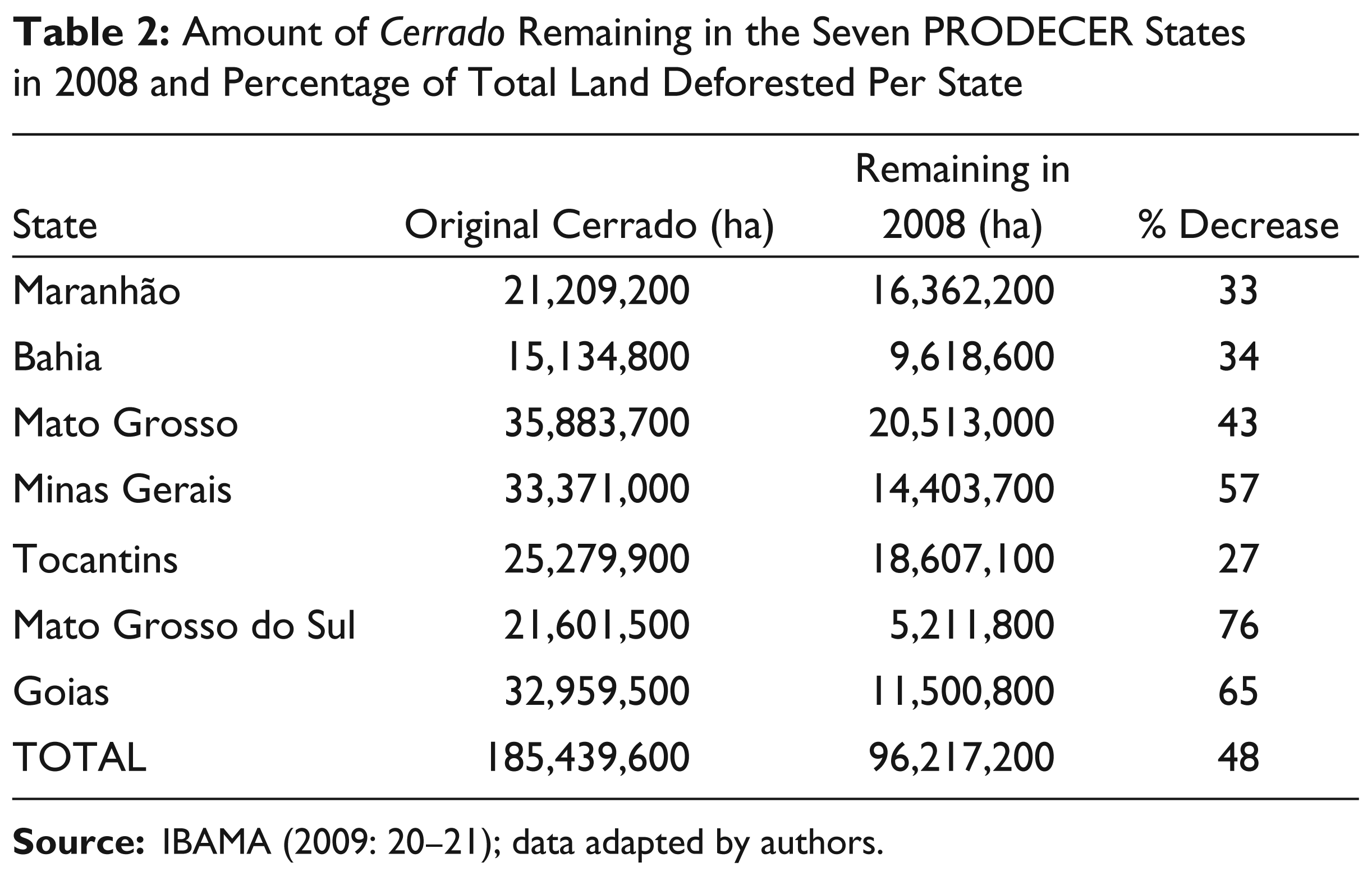
Despite ongoing and extensive deforestation of the cerrado since the 1970s, the region has received significantly less attention and study than the Amazon rainforest (PNUB 2009). A study conducted by the Brazilian Institute of Environment and Renewable Natural Resources (IBAMA) published in 2009, brought renewed attention to the cerrado biome, revealing that approximately 48 per cent of the entire region has already been deforested (IBAMA 2009). Much of the deforested area—roughly equal to the size of Venezuela—is now occupied by pasturelands and monocultures of cash crops (PNUB 2009). Only 2.2 per cent of the remaining forest in the cerrado is under legal protection (Klink and Machado 2005).
With the introduction of PRODECER, the government enacted strong pro-colonization policies and subsidy programmes which extended opportunities to a relatively small number of experienced large-scale producers who were selected for involvement in the project. Support was offered by Japan in the form of immense capital infusions which financed agricultural research conducted by EMBRAPA and made cutting-edge agricultural technologies (seeds, fertilizers, pesticides and machinery) available for the operations of producers identified under the purview of the project (Inocêncio 2010).
PRODECER effectively began to be implemented in 1980 and evolved in three distinct phases. Beginning in the western part of the state of Minas Gerais (Prodecer I), the project expanded in 1987 to incorporate areas of Goiás, Mato Grosso, Mato Grosso do Sul and Bahia (Prodecer II). From 1995 onward, it further expanded to include parts of the northern states of Maranhão and Tocantins (Prodecer III). Over the course of almost 30 years, the direct socio-economic benefits of the PRODECER programme were effectively offered to just 717 producers who acquired a combined total of 345,000 hectares of land spread across seven States (Table 1). This expansion and development came at an overall investment borne by the Brazilian and Japanese governments and private banks, totalling nearly US$ 563 million.
As Table 1 demonstrates, between 1980 and 1995, PRODECER I and II saw the transfer of 265,000 hectares of land to 637 farmers/corporations. According to CAMPO (Company for Agricultural Promotion), which was created in 1978 to provide technical and financial support to the project, during the first two phases of PRODECER beneficiaries were awarded lots averaging between 350 and 410 hectares. Since 1995, however, the average lot size allocated has more than doubled. PRODECER III involved the acquisition of 80,000 hectares of land by 80 producers, with each beneficiary gaining entitlement to a lot averaging 1000 hectares (Inocêncio 2010).
PRODECER Projects by State, Area Occupied, and Producers and Investments Involved

As the Brazilian geographer Inocêncio (2010: 94, our translation) describes, the reality of PRODECER and the adoption of a ‘large farm model’ in the cerrado:
…[it] served expansionist interests…It was the ‘model’ of expulsion of rural workers and small producers…which did not have sufficient capital to adapt to the [imposed] model of the modernization of agriculture [and who were subsequently] forced to migrate to the cities, swelling the ranks of the underemployed or unemployed, resulting in serious socio-economic problems.
Furthermore, studies maintain that virtually irrespective of where such a model is implemented—in Brazil’s cerrado or Mozambique’s Nampula—the fact remains the same: mechanized production of soybeans and sugarcane, or any other agricultural commodity, does not create an abundance of direct employment opportunities and often cannot provide sufficient work for all the people who have been displaced by the imposed monocultures. Family farming in tropical regions generates 35 jobs per one hundred hectares. In contrast, oil palm and sugarcane plantations generate only 10 jobs, eucalyptus production two and soybeans only a half of a job per one hundred hectares (Holt-Giménez 2007). In Brazil, for every new worker employed by soybean production, eleven agricultural workers are displaced (Altieri and Bravo 2009).
Amount of Cerrado Remaining in the Seven PRODECER States in 2008 and Percentage of Total Land Deforested Per State
Many of the rural producers who have not been displaced or forced to leave their lands to look for work in the cities, have been incorporated into the framework of agrarian capitalism by becoming contract farmers and producing soybeans on their small plots of land for multinational agro-industrial giants. Thus, a dramatic transformation in the role of the peasantry has taken place. Producers which previously harvested food-crops for personal, regional and national consumption have become ‘producers of commodities’ for agribusiness and export markets (Inocêncio 2010: 48).
As a result of peasant-agribusiness ‘partnerships’ promoted by EMBRAPA and the Brazilian government, the peasantry has been and continues to be, vertically integrated into the capitalist agricultural production chain, ensuring the continuation of the peasantry as suppliers of the raw materials used by industry, while largely denying them the ability to add-value to the fruits of their labour. As peasant autonomy is being undermined, relations of dependency are being built and strengthened (Fernandes et al. 2010). In a country where 70 per cent of all the food consumed is produced by small farmers planting on only 30 per cent of all the agricultural land (INESC 2008), the expropriation of peasant land by agribusiness and the promotion of contracts which incentivize rural producers to switch from food to cash crops are, ultimately, to the detriment of national food security.
Contrary to widespread claims made by the government and EMBRAPA, family farming and agro-ecological agriculture in Brazil receive relatively little viable financial and policy support; the lion’s share of resources allocated for agriculture go substantially to support agribusiness and large landholders. For example, in 2008/2009, smallholders received approximately the equivalent of US$ 6.35 billion through programmes like PRONAF (the National Program to Strengthen Family Agriculture). In comparison, agribusiness and large landholders received roughly US$ 31.9 billion in funding and credit for the same time period (Anton 2011). As Vincente Almeida, President of the National Union of Agricultural Research, Development and Workers (SINPAF), has pointed out, despite EMBRAPA’s official mission statement to create viable ‘research solutions, development and innovation for the sustainability of agriculture’ for the ‘benefit of Brazilian society’ in 2011, only 4 per cent of EMBRAPA’s resources and research was focused on the family farming sector and agro-ecological developments (Silveira 2012: n/p, our translation).
Since the turn of the century significant deforestation of the cerrado has only continued to occur as agribusiness expands further onto previously undeveloped areas. Currently, the destruction of forests is happening at an exceptionally rapid rate: between 2002 and 2008, the region’s vegetation was reduced by 7.5 per cent, or 8,507,400 hectares (IBAMA 2009). In the specified time period, the cerrado in Mato Grosso state was reduced by 1,759,800 hectares. After Mato Grosso, the most substantial areas deforested were in Maranhão and Tocantins states (Prodecer III), amounting to 1,482,500 and 1,219,800 hectares, respectively. Deforestation in the cerrado as a result of agribusiness expansion has also had a direct impact on rural producers whose livelihoods and subsistence are dependent on the region’s biodiversity (Mendonça 2009, Inocêncio 2010). If the current rate of deforestation continues, it is estimated that the cerrado will disappear completely by 2030 (Mendonça 2009). According to EMBRAPA (2004) more than 50 million hectares are available in the cerrado for further expansion of productive soybean monoculture.
By prioritizing predominately large-scale and commercial producers in a process which has auctioned off vast tracts of lands, PRODECER has played a significant role in creating a highly concentrated land ownership structure in the region (Inocêncio 2010). Not surprisingly, the concentration of land ownership, now exhibited in the states where PRODECER colonization projects have been implemented is further correlated with the concentration of land owned by foreigners in Brazil: 59.5 per cent of the area occupied by foreigners in the country corresponds to these same seven PRODECER states, amounting to some 2,588,324 hectares (Sauer and Leite 2012). Looking beyond the profit and loss statement of PRODECER, the overall outcomes fall short of the optimistic proclamations of the neoliberal economic ideology. It might well be asked if ProSAVANA in Mozambique will fare any better.
Conclusion
While attempting to curtail the acquisition of agricultural land by foreigners at home, in the name of protecting ‘national sovereignty’ and ‘food security’, the Brazilian government is simultaneously promoting land grabbing through the proxy of agribusiness in Mozambique as a means to achieve food security and, thus, national sovereignty. Through ProSAVANA, Brazil is attempting to export to Mozambique a model of agro-industrial development that has failed profoundly in terms of providing food security and sustainable development in Brazil. Over 65 million Brazilians currently face food insecurity, roughly one-third of the entire population (IBGE 2010b); the country has millions of landless, many of whom participate in movements in a nation-wide struggle for access to land to grow food and gain a livelihood (DATALUTA 2012). Experience shows that the benefits of the Brazilian model of agrarian capitalism for peasants have been relatively few, while the impacts on the rich biodiversity and forests of the country have been devastating.
Bringing into account the well-documented socio-environmental impacts of PRODECER, agro-industrial expansion and soybean monocultures in the cerrado biome, the potential implications associated with ProSAVANA become more apparent. A greater understanding of the reality of the ‘Brazilian experience’ allows for a better critical assessment of the ProSAVANA narrative. The lessons learned by Brazil through its contradictory and asymmetric process of rural territorial development and agricultural expansion over the course of four decades offers insight for Mozambique as it works toward its goal of agricultural expansion and intensification. While Brazil may offer some paths for Mozambique to follow as it seeks to develop its agricultural capacity and alleviate the pervasive problems of poverty and hunger, it also illuminates paths that are best forsaken.
Footnotes
Acknowledgements
The authors would like to thank Lana Robinson for her helpful comments and suggestions for this article.