




Abstract
The article argues that the US agricultural subsidies are sustained by a coalition of forces larger than is normally asserted by mainstream analysis. Using the concept of agro-industrial complex, the article sustains that subsidies are a state policy intended to keep farms functional. The subsidies push farmers into a technological treadmill, an economic dynamic by which farmers must keep investing in expensive inputs and expanding scale. All this investment and expansion makes farmers highly indebted and places downward pressure on the price of commodities, creating a tendency that, if it were not for the subsidies, would probably lead to bankruptcy. A generalized farm bankruptcy would be a grave setback for many interests: input suppliers, commodity merchants, food suppliers, landowners, banks and the state itself, among others. Thus, agricultural subsidies should be seen through a broader political economy perspective, not one that traces subsidies only to the connections between farm interest groups and key members of Congress.
Introduction
The agricultural subsidies of developed countries are a major issue in theory and practice. In practice, the impacts of subsidies in terms of artificial competitiveness, as well as their collateral effects, are well documented. In theory, in the field of political science, their roots and maintenance have obtained some consensus, at least in the mainstream. This consensus, however, is not sufficient to grasp the deep political forces that sustain agricultural subsidies in developed countries, in spite of all domestic and international challenges.
The traditional question is: how is it possible for a small political force, in terms of votes and economic weight, such as the agricultural commodity producers to capture state institutions in a country as complex as the United States? How can such a small fraction of the workforce and of the Gross National Product (GNP) be able to protect agricultural subsidies from domestic and international criticism?
This article aims to discuss those questions through a framework of analysis centred on the concept of agro-industrial complex (AIC). This concept considers the inherent network of relations that tie on-farm production to many off-farm industrial and financial segments of the economy. In this light, farmers are considered as one actor among others in the political force in favour of agricultural subsidies. As such, the political source of power that sustains the highly controversial subsidies is broader and stronger than the mere lobby of farm interest groups. Because subsidies are, as I intend to show, in the interest of input suppliers, food processors, traders, banks, land-owners and the state itself, among others, they have much deeper roots.
In the section that follows, the traditional explanation for the maintenance of the subsidies’ policy is briefly presented. Although useful, the traditional explanation tells only one part of the story. The AIC concept is presented in the third section as a way to grasp a more complete understanding of the problem. The fourth section shows some of the ways in which subsidies are in the interest of off-farm sectors and argues that farms are weaker actors in AICs. The fifth section posits that the agricultural subsidies have a structural function in the AICs, rather than being primarily a privilege for farmers. The sixth section argues that farmers are being subsumed in the US AICs. The discussion is concluded by reinforcing that, if farm interest groups are the efficient cause for the maintenance of the subsidies’ policies (in the sense of triggering them), they are probable not a sufficient cause.
Electoral Connections, Legislative Processes and the Maintenance of Subsidies
Luther Tweeten (2002: 1), like many others, asks the critical question: ‘[h]ow are the relatively few farmers who receive most of the benefit from farm programmes (0.2 per cent of the nation’s population in 1999) able to extract billions of dollars annually from taxpayers and voters?’ The traditional explanation lies in a set of factors, summarized next (Browne 1988, 1995; Davis 2003; Moyer and Josling 1990; Sheingate 2001; Veiga 1994).
The first one is that farm interest groups are able to organize collective action and, as attentive actors, pressure politicians to protect their businesses by adopting measures whose burden falls upon the taxpayers as a whole. The taxpayers, however, do not unite to protest against that burden. A second factor is that farm groups can be important to politicians’ electoral ambitions, which makes politicians more vulnerable to farm groups. Farm groups are able to gather very significant amounts of money and votes, compared to their rival groups (e.g., environmentalists, small farmers, budget observers), which provide them access to key legislators.
The third factor is institutional. Because major farm legislation is mainly formulated in the Agricultural Committees of the House and Senate, the politicians influenced by farm groups have leverage in constructing bills that shelter their clients’ interests. Having veto power in the process, they cannot only block the dismantling of the protective structure of subsidies, but also negotiate with conflicting and rival interests and accommodate most of them—urban and rural, big business and rural communities, chemical suppliers and environmentalists, etc., on an omnibus legislation. It does not mean that the deal is symmetrical, nor that every interest group is satisfied, but it is a deal that legislators can defend when facing most of their electoral constituencies. Furthermore, the deal is renegotiated every new Farm Bill cycle (five to seven years), which makes it a dynamic win–win possibility for a majority of legislators.
Nonetheless, this compelling explanation misses one fundamental aspect of the picture: the position of farms in the agro-industrial production system. As mainstream political scientists do not consider the broader structure of the agro-industrial system, they do not take into account what many other fields of knowledge (Geography, Sociology, Economics, Management, etc.) have recognized: when agricultural commodity production is highly capital intensive, farm groups are in a weaker power position in relation to other sectors of production. This means that, although they are the central and vital part of agro-industrial production webs, they are not the drivers. Rather, they are subsumed, or are minor partners, at best. This is the result of a historical change in the production relations in agriculture, as briefly argued later.
The Agro-industrial Complex in the United States
Since the 1930s, one aspect of the status quo has been sustained without fail that the farmers have been paid by the state when they overproduced. Agricultural programmes have suffered changes, their prerequisites have been reformed, but the cash has continued to flow to selected agricultural commodities when market prices have been insufficient to make a profit. Why?
At the beginning, subsidies programmes were designed to protect farmers from bankruptcy, due to the fatal economic combination of high production, rising investment costs, insufficient demand and low prices—the ‘curse of American abundance’, in Cochrane’s (2003) words. Prices and sales were not enough to make a profit, despite the reduction of unitary costs. The government, thus, decided to intervene and protect farmers of ‘basic commodities’—basic because they were the most common on farms—at a time when the rural population, and especially agricultural workers, was larger and becoming impoverished (Conkin 2009).
Although the programmes helped, true salvation came from the demand surge brought about by World War II—at least for a time. In 1940, it was already clear that, after the war, that fatal economic combination would show up again. In a memorandum from 30 January 1940, Secretary of Agriculture Henry Wallace affirmed to the President that the wartime expansion of production, mainly of wheat and cotton, on account of the war effort itself, would hardly be absorbed by international markets for two main reasons: first, the lack of revenue abroad, due to the impoverishment caused by war; and second, the closing of international markets, mainly those in Europe. Thus, based on historical experience, Wallace (1940: n/p) alerted President Roosevelt:
a multitude of economic headaches—not the least of which will be the agricultural troubles in cotton and wheat—are certain to descend upon us after war, if economic experience and reasoning and certain obvious situations and implications are any guide at all. The problem of meeting the peace will eventually be even greater than the present problem of adjusting ourselves to a European war.
In this prospective negative scenario, Wallace added,
[u]nless industry is expanded to such an extent that it can absorb large sections of the present rural population, it will be necessary to continue direct subsidies to farmers or to subsidize the disposal of agricultural surpluses, particularly of cotton and wheat…thus, the need for agricultural programs and subsidies is likely to continue indefinitely, particularly with reference to the important export commodities. The best thing for the country would be to recognize this fact now, and to provide for these programs, and their financing, in some way than the temporary expedients of which resort has been had in the past.
By that time, it was a national economic issue, with country-wide political and electoral consequences. From that period on, however, there was a major change in the structure of agricultural production. While its importance relative to GDP declined sharply, as well as the workforce dedicated to it, it became intertwined with other productive sectors. In other words, while the agricultural sector declined in overall economic and employment importance, it became more relevant to other business sectors.
It is usually admitted that farms were almost self-sufficient productive units until the twentieth century. Almost everything necessary to production, such as seeds, fertilizers and tools, was made on the farm. That model has been progressively extinguished for the major commodities in the Unites States, since the first decades of the past century. In order to become more productive, farms became more reliant on industrialized inputs, specialized services, as well as on processors and distributors for their products (Cochrane 1993; Coleman et al. 2004; Conkin 2009; Fitzgerald 2003; Gardner 2006; Hurt 1994; Kenney et al. 1991; Soth 1968). 1
Thus, since the mid-twentieth century, it is not possible to think about the production of a major commodity without advanced inputs, techniques and services, heavy financing, industrial processing and large-scale distribution. Moreover, all these transactions around farm production occur in institutional environments composed of regulations, laws, programmes and public agencies. In this sense, all the actors involved in advanced farm production are part of so-called AIC (Belik 1992; Delgado 1985, 2012; Graziano da Silva and Kageyama 1996; Müller 1989). Those complexes differ from the rural ones, which were complexes confined to the countryside, whereby every farm was a highly autonomous production unit in relation to industrial society (Goodman et al. 1990). The transition from one complex to another is a unique phenomenon, very recent in the human history, bringing with it enormous economic, ecological, social and political consequences, and that is a point that the mainstream political science does not scrutinize sufficiently.
The assessment of the growing interdependence among agriculture and other sectors—suppliers, processors, transporters, distributors—began to be undertaken more systematically in the 1950s, in two main fronts: the United States, by Harvard’s Goldberg and Davis, and in France, by Montpellier’s Malassis and Morvan (Belik 1992; Graziano da Silva 1994; Mendonça 2013; Zylbersztajn 2000). Since those studies, the analysis of agro-industrial systems grew and diversified greatly, but a central element has remained: advanced agricultural production brings with it interdependent relations with industrial, technological, commercial, financial, distribution and service sectors—and those relations need coordination, in order to be efficient or minimally viable. The need for some kind of coordination is common in capitalist systems (Hollingsworth et al. 1994), and it is not different in agro-industrial systems. Recognizing those interdependent relations, the AIC concept treats coordination as a fundamental political issue. From our perspective, subsidies are a powerful form of coordination, because of the structure of incentives it creates.
Since the 1970s, Brazilian authors like Alberto PassosGuimarães, José Graziano da Silva, Ângela, Kageyama, Walter Belik, Guilherme da Costa Delgado e Geraldo Müller made important contributions to the analysis of advanced agro-industrial systems through the concept of AIC, and deployed it to examine the rapid modernization of Brazilian agriculture.
The concept, which could be said to be grounded in critical political economy, is different from the agribusiness and filières notions, because it attributes to politics an explanatory function (Delgado 2012). That is, besides analyzing the formation and performance of agro-industrial activity, it deals with its political sources and the implications of historically constituted economic arrangements.
The concept is basically built on three pillars: (a) economic and technical interdependency between agriculture, industry, services, finance, distribution and science and technology; (b) the institutional environment in which those relations occur; and (c) the conscientious need for coordination between its main actors, including the state. All three pillars are understood in the context of the capitalist production. As such, the concept is useful for the understanding of the US agricultural subsidies from lenses different from those of political pluralism, given that this later disregards capitalism as a relevant variable.
The first two pillars are more common in the literature. The third needs more attention. Mainstream political science usually treats the state as an arena in which societal actors rally for power and control of state leverages. The AIC perspective, however, sees the state as both an arena and an actor. An important actor wherever the state is strong, as in the case of the US agriculture.
The AIC concept attributes much significance to governmental regulation, both in its institutional aspect and in the political relations in which it is grounded. For instance, according to Graziano da Silva (1994: 227, own translation), the dismantling of the rural complexes by the introduction of agro-industries would oblige
[i]ncreased participation of the state to formulate specific policies for regulating each AIC. This intervention responds to a double objective: first, to establish another system of regulation in which the state will define the main parameters for the return on capital employed in different segments; and second, to act as arbiter of contradictions internalized by those complexes, for example, fixing the limits of oligopolistic competition, the establishment of quotas, especially for imports, etc.
Among the reasons for state intervention is the state’s own interest in making the productive model work in a determined direction (Carnoy 1988; Lindblom 1979; Offe and Ronge 1994). According to our studies, the formation of AIC usually occurs with the regulative and financial support of, if not inducement by, the state. Goodman et al. (1990: 144–45, own translation) affirm that:
[i]nitially, the main objective of government’s financial intervention in agriculture was to promote appropriation
2
by providing credit. Since World War I and the depression interwar years, however, priority had to be given to the increasingly comprehensive regulation of agricultural markets. When the full impact of appropriation on productivity was felt in the post-World War II period, overproduction capacity had become a structural phenomenon in advanced capitalist countries. The maintenance of agricultural production, and hence the reproduction of appropriationist capitals, is then attributed to a complex set of measures, including price guarantee, deficiency payments, government purchases, farm insurance, boards of trade, subsidized schemes for setting aside production, and import/export fees, and subsidies. The state, in short, is in charge of the task of reconciling the conflicting effects of continued productivity growth, associated with industrial appropriation, on production and productive capacity, rural incomes and rural social structures.
The Brazilian case is a clear example of the articulation between firms, farmers and the state, in which the latter exercised the role of inducing the modification of Brazil’s agricultural pattern (Delgado 1985, 2012; Müller 1989; Moraes et al. 2008). Belik (1992: 37, own translation) stresses that, from the 1960s:
industrial capital, most of it transnational, as part of its growth strategy and taking advantage of the Federal Government’s policies, seeks integration with agriculture and even with the capital goods and agricultural inputs industry …. Thereafter, the industry-agriculture articulation could no longer be explained by any mechanism other than the direction imposed and stimulated by the State at the mercy of pressure by special interests groups, with the greatest influence in the state apparatus.
That is, the state used its power resources to affect the direction of private investments, though that direction could be negotiated or influenced in some extent by those same investors. The interest in directing and fostering private investment is a special feature of the capitalist state. As Offe and Ronge (1984) and Lindblom (1979) explained, it is not the private investors that primarily seek access to the state; it is the state that wants to bring private investors inside. That happens because capitalist states depend on private investments for the most basic things: taxes, employments, products and services. In capitalist states, it is the private sector’s function to supply the largest part of investments and, as the investments are private—that is, as they cannot be commanded by the state—the state must create the best conditions to keep the investments flowing.
Of course, it is not a smooth relation, as Miliband (1982) alerts, but in the end the capitalist state will work mainly to foster the prosperity of private investors, given precisely its structural dependency on the latter. The more the investments grow, the stronger the state becomes and vice versa. In this sense, once agricultural production is absorbed by the industrial system, it is placed in the political dynamic of capitalism. The state becomes responsible, as Graziano da Silva (1994) argued, to be the referee among the many actors that interact in the AICs. In this process, the ‘agro’ becomes a vital part of the complex because it constitutes the buyer of input suppliers, the source of raw material for food and fibre processors and breeders, the borrower of credit from banks and the renter of land.
Farm’s investment capacity is, then, a crucial variable to the performance of other businesses. Let us take the example given by Levins (2001: 8), regarding input suppliers:
[c]onsider the cost of something farmers need other than land: a tractor, for example. In the theory of free markets, the cost of buying a tractor is closely tied to the cost of making a tractor. Simple enough. Now, instead of thinking about tractors, think about Deere and Company, the world’s leading manufacturer of farm equipment. What does a share of Deere and Company stock cost? Even though Deere makes tractors, this is not a question about tractors. It is about owning a share of Deere and Company’s profits. A share of Deere and Company stock can sell for a high price when the farm economy is doing well. When the farming economy is struggling, the same Deere stock will sell for less.
Thus, if subsidy programmes allow continuous sales of new and technologically advanced equipment, they may affect the market value of those companies in the end. And, as the new equipment is usually bought with borrowed money, credit suppliers are linked too.
The dependence on credit makes the farmers vulnerable to the demands of banks to some extent. Perelman (1977: 89) identified in the 1970s that ‘[i]f the farmer does not intend to farm in conformity with the ‘best commercial practices’, the bank will not extend credit—a form of agricultural reclining’. This means that financing was more available to the farmers that decided to grow certain crops, using certain methods and inputs. According to Price (1983: 18), ‘[t]he more farmers borrow, of course, the more independence they give to creditors. Some banks in the Midwest, for example, have forced farmers to continue chemical rather than organic approach to farming even when the farmer himself prefers the later’. Besides banks, subsidies programmes also create biases towards some crops and methods, which tend to disincentivise alternative and organic farming (GAO 1990). Thus, the programmes tend to direct farmers to traditional farming, reaffirming farms’ relations with input suppliers and banks.
This converges with Delgado’s (1985, 2012) analysis of the role of banks in AICs. Accordingly, ‘banks, alone or in connection with the state, define in advance a set of financial parameters that should work in a crop year as a base for rural production’ (Delgado 2012: 27, own translation). These parameters end up influencing the farmers’ investment decisions and, by extension, affect the sales of input suppliers and the purchases of the processors of agricultural products.
But why would banks have an interest in directing production on farms? A first reason is to make farms less self-sufficient, that is, to break the rural complexes that isolated them as autonomous productive units and to turn them into buyers of inputs. As Perelman (1977: 90) argued,
[b]ankers also know that their business would not fare well in a nation of self-sufficient farmers or even self-sufficient communities. They have no reason to encourage farming practices which could do away with the need for borrowing. On the contrary, the more farmers adopt capital intensive techniques, the brisker the demand for the commodity banks sell—namely, money. Banks also realize that they are dependent on the success of business in general. A general business failure means a general banking failure. Again, capital intensive techniques are in the bank’s best interest.
Thus, every new season US farmers capture loans in the private market, or from state sponsors such as USDA’s Farm Service Agency (FSA), considering the “‘lender of last resort”, to provide direct loans to producers that cannot obtain credit elsewhere’ (Klose et al. 2008). The importance of this fact cannot be underestimated in AICs, because ‘the necessity of working capital tends to grow as agriculture gets more modernized or capitalist’ (Delgado 2012: 24, own translation). In the United States, concludes Cochrane (1993: 205), one of the most famous researchers of the development of the US agriculture, this historical process has turned ‘the modern farm unit [into] a highly capital-intensive unit that must have ready access to production credit of all kinds and that must make use of large amounts of that credit, if it is to operate successfully’.
The Centre, but not the Driver
The effort to link agriculture and industry had profound consequences for the development of the United States, as is well known. As Fitzgerald (2003) shows, the aim was to make ‘every farm a factory’. To do so, agriculture needed to be adapted to the tempo of industrial production (Goodman et al. 1990; Mowery and Rosenberg 2002). The result is a configuration whereby industrial and service sectors rely on agricultural production for an important part of their business, but without making agricultural producers the most powerful actors in the complex.
Farms are the customers of input suppliers, and it is in the latter’s interest that the former always have means to buy more and more products. Farms are also the source of raw material for food and feed processors and of inputs to animal breeders. It is the latter’s interest to have abundant, uniform and cheap raw materials and inputs. Farms are in the middle of those sectors, and they face oligopolies and oligopsonies on the input and buyer sides, respectively. This is a historical problem for farmers (Bonnen and Schweikhardt 1998; Heffernan 1998; Lauck 1996; USDJ 2012). Such market structures leave farmers in a weaker position, because of the market power of both sectors. The input sector may charge higher prices and the processor sector may pay lower prices due to diminishing competition. Farmers are squeezed in the process (Murphy 2002, 2006).
In addition, agricultural commodity production in the United States is dominated by a dynamic by what Cochrane (1993, 2003) has called the ‘technological treadmill’. Stated very briefly, it means that agricultural producers must always invest in new technology to raise productivity and lower unitary costs in order to out-compete other farmers. To do so, they race against each other to adopt newest generation inputs and machinery, which are historically more expensive than those of a generation before. This race has two main consequences: it raises the need for financing, making producers more dependent on credit; and it creates another race, a race for land, because the new technology is prone to expand production and also because a larger operation may increase the possibility of paying the loans. These two consequences bring into the AIC analysis two important actors: banks and land owners.
A large amount of the loans that keep agricultural investments flowing—making farms a stable buyer of inputs and a stable producer of raw materials—comes from private banks. Because agricultural production is a risky enterprise, due to the uncertainties of world markets and the weather, subsidies have the very important function of making loans repayments more secure. After all, if the market crashes, or if bad weather shows up, banks will have a strong safe-house, known as the US Treasury. Something similar happens to the land market. Subsidies are a governmental insurance for the landlords, because they know that even if farmers do not make enough money through the market, they will have some amount secured by the US budget. In this sense, subsidies provide both a floor and an insurance for banks and landowners (Goodwin et al. 2011; Mendonça 2013; Nickerson et al. 2012).
The treadmill dynamic has still another effect: it stimulates over-production. This could be good for the final consumer, if it translates into lower prices. It is certainly good for input suppliers, because it proves their inputs work and keeps their clients satisfied. It is good for landowners, because there it heats up the land market. It is good for banks, because the search for land, technology and scale will require loans. It is great for processors and breeders too, because it makes their raw materials cheaper. However, this may not be good for many farmers, because the price may drop so low that they will be unable to make a profit, and because of the elevated production costs. The subsidies, however, deal with this problem. Public money will pay the bills needed for another round of investments.
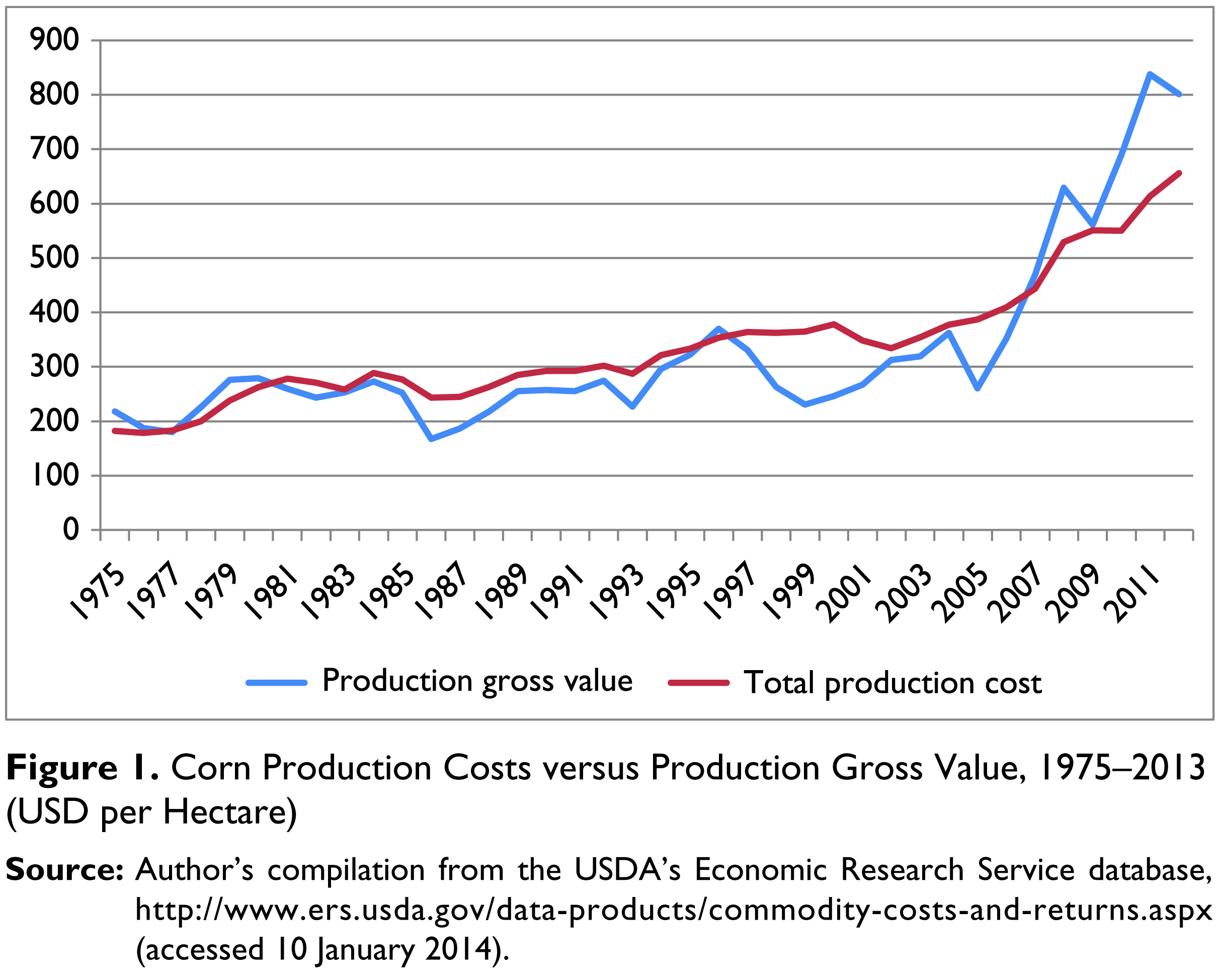
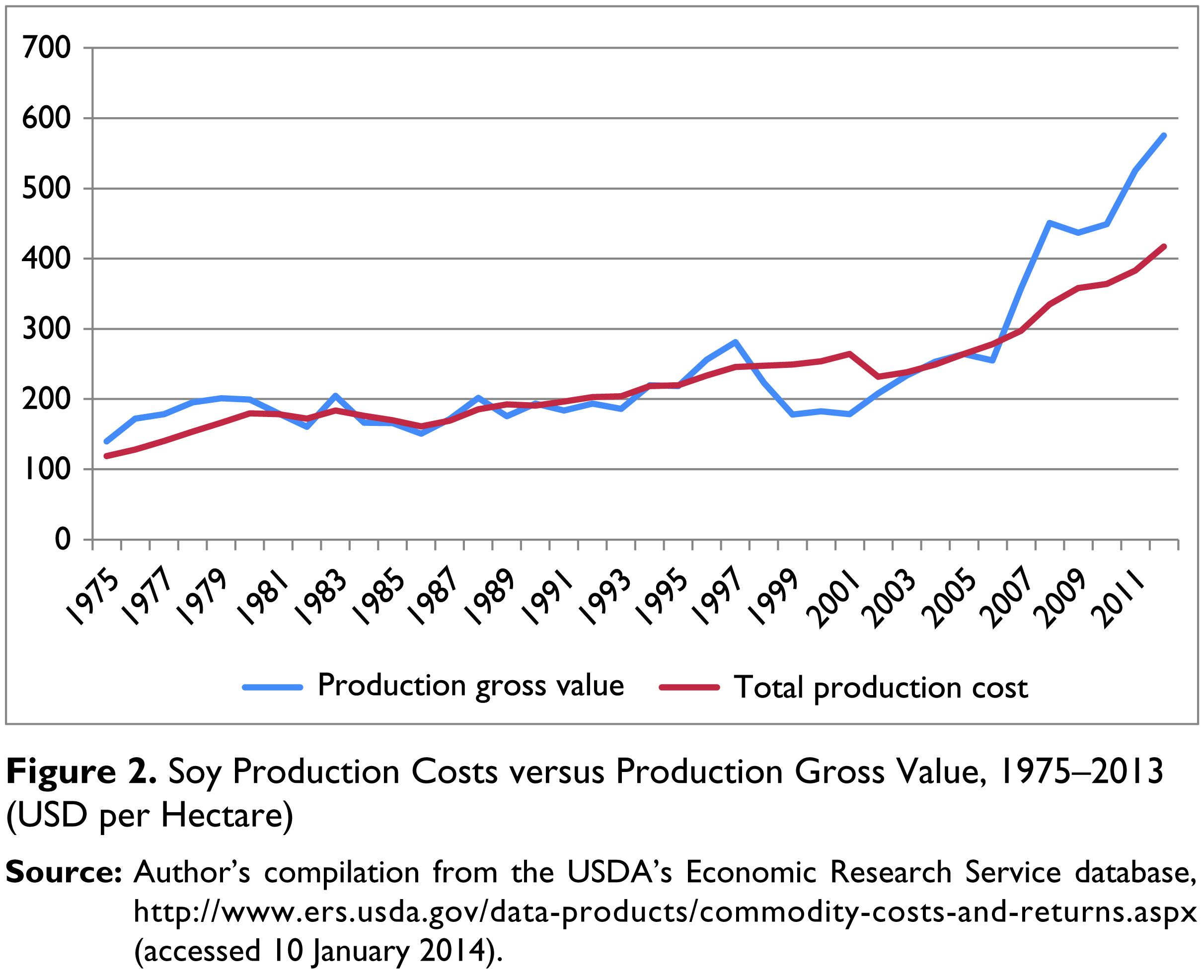
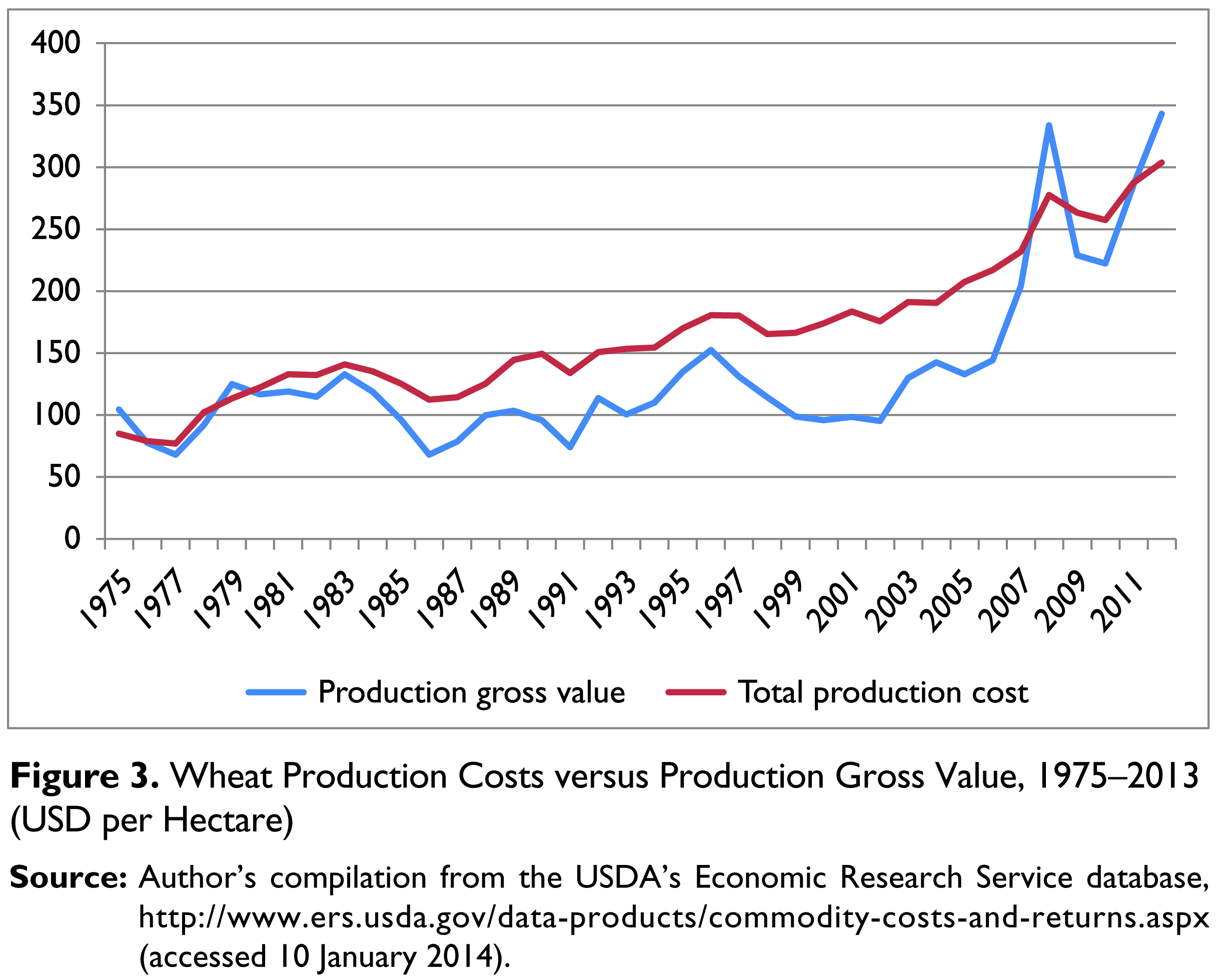
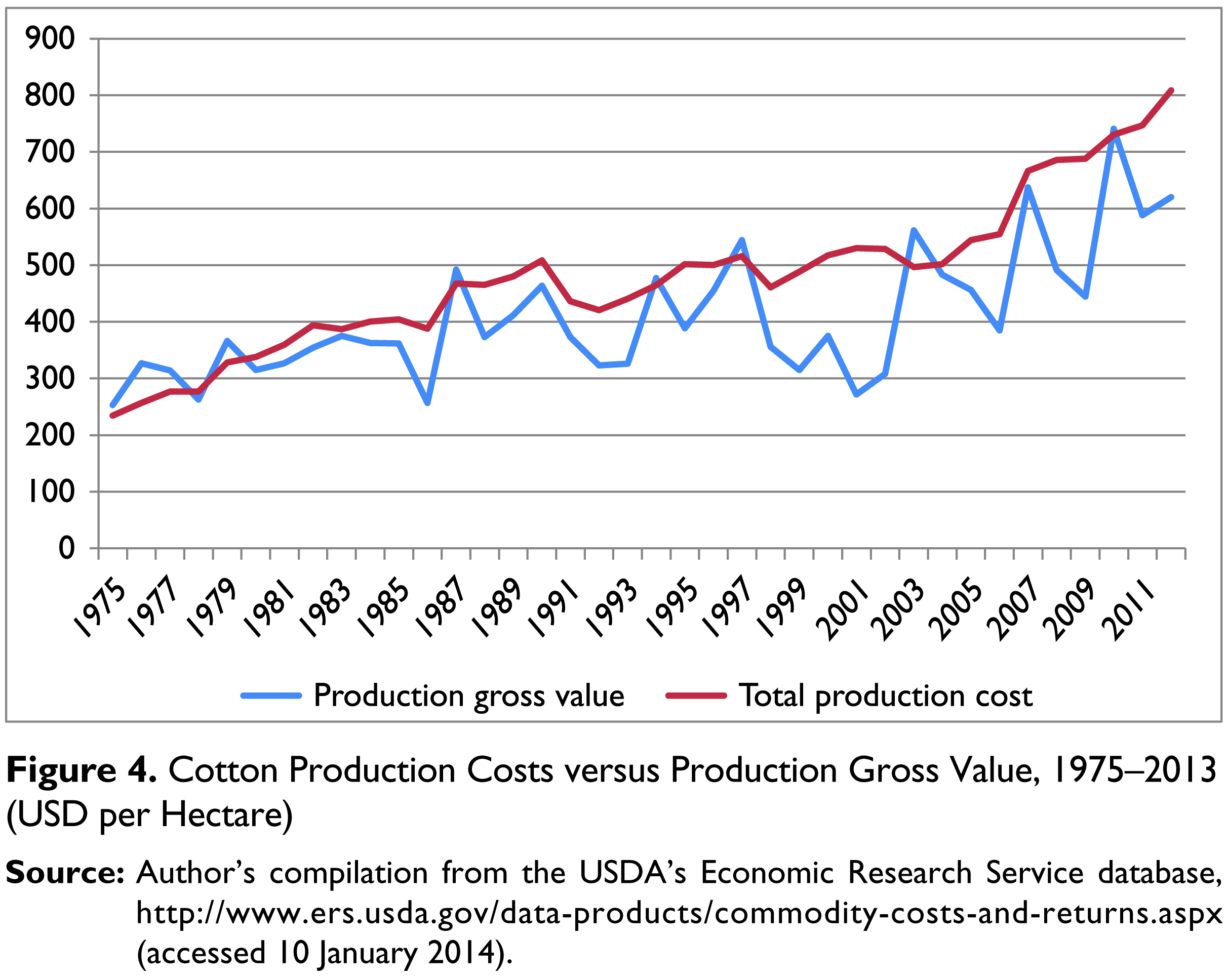
The figures show production cost and returns for some major commodities. As can be seen, costs are usually higher than returns. In a normal private business, this would mean that investors would choose to invest their money elsewhere. But they do not in this case, at least not in the speed it would be expected, because public money fills the gaps.
In this context, it is possible to question whether subsidies are evidence of political power or weakness. While normally considered a sign of disproportionate power, it is reasonable to think of subsidies the other way around: as a resource used in favour of the other sectors of AICs, including the state, to keep farms tied to the treadmill dynamic and keep them investing, even though that dynamic puts them frequently in the red.

This argument fits very well the interest of the banks, which are admittedly strong political actors with close relations with politicians and bureaucrats. The US state, through subsidies, contributes to lowering the banks’ risks in supplying essential credit to the farm economy. In the words of Klose et al. (2008: 1, emphasis added),
[t]raditional government commodity programs have also been instrumental in credit decisions. The loan rate program effectively creates a minimum price upon which a producer (and therefore his lender) can rely. In commodity markets where prices are uncertain, knowing the worst case scenario on the price received component of a farmer’s ability to repay an operating note alleviates some aspect of the credit risk. Similarly, the historical target price programs and the recent counter-cyclical payment program offer a source of added revenue to the farmer when prices fall, again reducing at least a portion of the lender’s risk in financing crop production. In 1996, fixed direct payments were added to the policy tools providing support to production agriculture. Direct payments, being certain well in advance, provide potential collateral for operating loans, thus reducing lender risk. While crop insurance is not often considered in the context of farm bill provisions, the subsidized premiums for crop insurance have helped create a tool that might otherwise not be available to agriculture. Agricultural lenders have used crop insurance to further reduce loan default risk by requiring for some borrowers to purchase at least a minimal level of crop insurance.
In this sense, shouldn’t financial actors also press for subsidies? A GAO (1990) report found evidence that banks incentivize the participation of producers in subsidy programmes. This should not be taken as surprise. As stressed by Jeff Gehart (apud SDOOC 2012: 2052), chairman of Independent Community Bankers of America, while defending increases in subsidies at a House’s hearing,
[a] strong farm program also supports lenders in their decisions to extend loans to the farm community with some assurance that the loans will be repaid. A strong farm program helps to support our local communities—rural and non-rural. From Newman Grove to Omaha and similarly from small towns to larger cities across America, our success depends upon a strong agricultural industry.
This is evidence that subsidies are part of a larger political economy than the mainstream of political science usually supposes. Matthew H. Williams, from the American Bankers Association, gives an idea of the magnitude of banks’ interests (apud SDOOC 2012: 2060–63): in 2011, the farm lending portfolio of the US banks amounted to approximately USD 130 billion, 13.8 per cent higher than in 2007, when the portfolio was around USD 114 billion. In 2011, that amount was bigger than Hungary’s GDP (USD 124.6 billion), the 58th country in the World Bank’s GDP ranking, and also comparable to the GDP of the last fifty countries on that list, taken together (USD 134.2 billion). One of every three dollars lent by a farm bank goes to agriculture. In 2011, the United States had 2,185 farm banks employing around 87,000 workers. 3
The credit issue is deeply entangled with real estate (Goodwin et al. 2011; Mendonça 2013; Nickerson et al. 2012). 4 After all, land is the main loan guarantee in the rural areas of the United States since the early twentieth century. When land gains value, it enables greater access to funding; when it depreciates, it can not only reduce the borrowing capacity of the producer, but also depreciate the assets of the banks that have accepted them as collateral.
In 2010, the total value of Farm Real Estate, which consists of the land and its facilities, was USD 1.85 trillion, accounting for 85 per cent of agricultural assets in the United States. Besides the high gross value, the high percentage indicates the relevance of land value in the operations of the AIC. Nickerson et al. (2012) point out that, as land is the biggest asset for most agricultural businesses in the United States, and is the largest single investment in a typical farmer portfolio, changes in the values of rural properties affect the financial well-being of agricultural producers, as well as retired farmers who rent their land. In fact, the issue may be more complex; to take another example, from 1964 to 2007, approximately 35 per cent of agricultural land was not operated on average by their owners and about 60 per cent of agricultural land receiving subsidies in 2000 was not farmed by their owners (Barnard et al. 2001).
The Structural Function of Subsidies
What if traditional commodity farms stopped investing almost altogether? One indication is what happened previously in times of deep agricultural crises, such as that of the 1980s.
Land prices experienced a strong upward tendency since World War II, but faced a fierce decline in the 1980s (Barnett 2000). Between 1969 and 1978, a period of great agricultural expansion, partly due to government stimuli, in a world market scenario of high demand, the price of land rose by 73 per cent. Agricultural exports soared from USD 7 billion in 1970 to around USD 44 billion in 1981 (Cochrane 1993). However, this trend reversed dramatically in the beginning of 1980, due to the fall of the external demand for food, the hike in energy costs and the high interest rates of anti-inflationary policy. This last one not only made credit more expensive, but also elevated the value of the US dollar, diminishing the competitiveness of US exports. In the case of wheat, there was also the US embargo imposed on the Soviet Union in 1980 (Conkin 2009; Friedmann 1993; Gardner 2006). If agricultural exports amounted to USD 44 billion in 1981, in 1986 they totalled half of that in real terms. The main products sold abroad, wheat, soy and corn, experienced a drop in their value of 51, 52 and 64 per cent, respectively, in that period. To make the situation even worse, there was a severe drought between 1980 and 1983. In 1983, the USDA registered the lowest value for agricultural national revenue since 1910: just USD 12.2 billion.
This conjuncture contributed to the outbreak of a rural crisis, marked by the bankruptcy of many farms and banks throughout the whole decade: between 1981 and 1987, 623 banks broke! 5 Of these, around one-third consisted of farm banks (Glenna 2003). The Farm Credit System suffered the worst loss of a financial institution in the United States until then: USD 2.7 billion (Barnett 2000). Bank bankruptcy is one of the worst things that can happen in a capitalist economy. Since farms were not able to repay their loans, many banks closed their doors, taking with them the money and savings of firms and people that could have nothing to do with a farm. Such a situation may spread social and political instability, and it is in the interest of the state to control it.
In 1981–87, agricultural assets were downgraded by 30 per cent nationwide, reducing dramatically not only farmers’ wealth, but also their capacity to access credit. The relation among land value and the banking system is of utmost importance. According to Levins (2001: 15, emphasis added),
[i]f a bank lends someone $1 million to buy land that is worth at least that much, no special problems arise. But if the value of that land falls to, say, $500,000, the bank has a big problem. The bank’s assets, which include the value of land held as collateral against mortgages, are no longer as large as the loans outstanding. If enough such loans are outstanding, the bank can be forced by banking regulations to close its doors. The farm crisis of the mid-1980s presents a good example. As farm product prices slid ever downward, so did land values. As that happened, banks became insolvent and began closing in rural areas. This, for the general public, was far more frightening than farmers being forced off the land. We always seem to have fewer farmers. But bank closings bring back Depression fears, and nobody wants that. Any program that meant dramatically lower land values would have to address the potential banking problem. And lest we think that would somehow be easy, here is a sobering statistic: the total value of U.S. farmland routinely exceeds $500 billion.
The argument made by Levins (2001) highlights the possibility of a massive banking failure, and this is one of the main problems a capitalist state may face. The 2008 financial crisis showed what efforts a capitalist state must make to save the banking system. From the theoretical perspective adopted here, banks are private investors of public interest and, thus, actors with privileged access to the state apparatus. In Offe’s words (1995: 225),
[p]olicies that confer status to stakeholders ascribe them certain semi-public or public functions and regulate the type and the radius of its activities that are, under the conditions of advanced capitalist social and economic structures, much more important factors affecting the ongoing change in the system of interest representation than the factors related to the change in ideological direction [will] or structure of socio-economic opportunities. The representation of interest, for a number of reasons to be explored, tends to become primarily a matter of ‘political scheme’, and therefore, in part, a dependent variable, and not an independent one, in public policy decisions.
In other words, although it is possible to attribute public resource transfers for the purpose of saving private businesses to the action of interest groups, or to the personal networks among business and state leaders, it is not possible to discard the state interest derived from the structural relations among the state and the capitalist economy (Block 1980; Lindblom 1979; Offe and Ronge 1994).
A large part of the solution to the 1980s crisis came from the US Treasury. Besides the lowering of the interest rate and the recovery of demand, the Food Security Act of 1985 had a crucial role. Three years after the law, more than USD 50 billion were paid to farms, which represented 31 per cent of their net revenue in the period (Barnett 2000; Cochrane 1993; Veiga 1994). From the middle of 1980s onwards, the upward trend in the price of land resumed. Of course, the price of land may be affected by many factors—economic, logistical, ecological, social, etc. Nonetheless, as the USDA’s economists (Nickerson et al. 2012: 18) among others, concluded,
[g]overnment agricultural program payments may increase income from agricultural production. When they do so in a consistent way, the value of farmland is likely to increase due to expectations of a future income stream from government payments or reduced volatility in farm revenues.
6
Metaphorically, land ownership can be considered a company’s stock. Having one hectare of land would be similar to owning some stocks of a company, and that company would be the agricultural economy (Levins 2001). The profit that the owner of hectares/stocks will gain, or the loss sustained, depends on the prosperity of the agricultural economy. Hence the interest of the landowners in the continuation of subsidies that keep the land producing, the operator solvent and, if possible, profitable. The more profitable the farmers, the more the landowners can extract income for themselves. After all, as Cochrane (1993) affirms after examining the trajectory of agricultural development in the United States, there is ‘a hard lesson of history’: it is a fallacy to try to elevate or maintain the income of farmers through programmes linked to the volume of production or prices levels above market equilibrium. This is because, in his own words (Cochrane 1993: 434),
[t]he income gains to farmers resulting from such governmental activities will be used by the larger, more efficient, more aggressive farmers to expand their operations through the purchase and acquisition of the productive assets of their smaller, less efficient neighbors. In this cannibalistic process, the price of land is bid upward, the cost structures of all farms firms are raised, and the income assistance provided by the government is wiped out. Income gains to farmers from governmental programs of price and income support have, in the long run, been bid into increased land values and have increased the wealth position of landowners. In the main, the landowners who have benefited from government programs of price and income support have been the larger, aggressive, innovative farmers in each farming community who have used the income assistance from government to acquire additional land. In the process, these farmers have bid up the price of all farmland, including their original land, and have made themselves wealthy landowners.
A significant portion of the lands that are benefited by the subsidies are not hewn by their owners. This needs to be considered in the political economy of agricultural subsidies. The landowner, in many cases, is not the producer, and this means that that owner has even greater interest in the tenant’s solvency and land valuation. The USDA’s economists assert that some renting contracts can affect land value by the way they direct the behaviour of the farmer when it comes to ‘production decisions, adoption of conservation practices and technologies that can improve land productivity’ (Nickerson et al. 2012: 29). This means that landowners have a direct interest in the subsidies that lubricate the AIC and they can use their influence to direct production in their lands. Finally, it is interesting to mention the heterogeneous profile of beneficiaries of agricultural subsidies, as reported by Goodwin et al. (2011: 1):
[w]hat do former basketball star Scottie Pippen, publisher Larry Flynt, and stockbroker Charles Schwab all have in common? The surprising answer is that all are recipients of farm program subsidies. Other notable payment recipients include nine U.S. Members of Congress; David Rockefeller, former chairman of Chase Manhattan and grandson of oil tycoon John D. Rockefeller, who received 99 times more in subsidies than the median farmer; Ted Turner, the 25th wealthiest man in America, who received 38 times more subsidies than the median farmer; and the late Kenneth Lay, the ousted Enron CEO and multi-millionaire. Several Fortune-500 companies have also received substantial farm program payments, including John Hancock Mutual Insurance ($2.5 million in 2002), the Chevron corporation, and the Caterpillar corporation.
Recently, the prestigious Environment Working Group reported that about USD 11.3 million was paid to fifty billionaires, from 1995 to 2012 (Nixon 2013). Among the recipients were Paul G. Allen, cofounder of Microsoft, Charles Schwab Soros, George Kaiser, from oil company Kaiser-Frances Oil Company, among others. Overall, more than 40 billionaires are owners of farms whose production may be covered by subsidies from the Farm Bill.
Hence, a general farm investment reduction, not only diminishes the taxes generated by the AICs, but it also the investments of input suppliers. It will make processors and breeders import their raw material, thus deteriorating the trade balance. Or even worse: processors and breeders may change their operations to other countries in order to have access to sources more stable and cheaper. The price of land will fall, lowering the value of assets and diminishing its function as collateral guarantee. Unemployment—not only, or even mainly, in farms—may rise, together with the expected negative political, social and economic consequences.
Is it possible to imagine what will happen if there were no farm lobby for subsidies? What if the farm groups that represent far less than one per cent of GDP and 0.2 per cent of the total population quit trying to influence legislators? Would the subsidies fade away? Seen through the lenses of the AIC, that would not be the bet. Why? Because subsidies are the oil that keeps a large engine running, and the engine parts are composed of many powerful big enterprises whose investment capacity and political power are enormous: machine and vehicle companies, chemical and pharmaceutical firms, biotech industries, food and feed processors, large breeders, grain traders, landowners, banks and financial services, among others, including state managers themselves.
In other words, the historical formation of the AICs in the United States created a structure in which subsidies are one vital element. 7 And, although they are paid to farms, they are in a large part channelled to other sectors of the AICs.
Subsumption or the Proletarization of Farmers?
The structure of production for main commodities directs many farmers to adopt practices that will only reinforce that structure (Glenna 2003). Subsidies are lubes that keep that engine running. As Levins (2001: 6) argues, ‘the core problem of agricultural income is not low profits in the system. The problem is that farmers cannot claim these profits’. In other words, the market structure makes commodity farms operate typically above the costs of production, and the risks of the operations fall mostly upon them and the state. Levin’s examples clarify the point, justifying a longer quote (2001: 19, emphasis added):
In particular, many of the major commodity crops such as corn, wheat, and cotton, have virtually no retail demand. Instead, they are sold as inputs to industrial processes that yield livestock, sweeteners, bread, and clothing. With this in mind, consider the case of a bountiful harvest in a particular year. This certainly puts processors, that is, those who buy farm products, in an enviable position. There is more product being offered for sale than is necessary during a normal year. The resulting lower prices paid for farm products mean higher profits in the processing sector. At the same time, less money is available in the farm sector to pay costs, so there is turmoil in the input supply sector. The public views this as a tragic problem for farmers, and not the bad luck of landlords or other input suppliers, so money is doled out to farmers so they can pay their bills. In this way, the input supply sector is able to continue to operate at full capacity and no land goes idle, no seed unplanted. The opposite case is one of a short crop, perhaps due to widespread drought or disease problems. Then bidding wars among processors, and dramatically higher farm product prices, could result and depress profits among the processors. The input suppliers, on the other hand, are delighted with such developments. They immediately set themselves to raising land rents and charging higher ‘tech fees’ on the hottest new seed varieties springing from biotech labs. This price adjustment takes a full season of crop production, so a brief period of this year’s high farm prices and last year’s lower costs creates the illusion that all is well for farmers. Soon, however, farmers are once again complaining of costs that are too high.
Interestingly, despite the economic weakness of farmers and the trend of vertical integration of production chains, corporations did not adopt widespread direct control of farms via acquisition. That is, even having enormous economic power, they decided not to absorb formally that link of the chain into their productive structure.
8
Why? Glenna (2003: 18) offers an answer:
[t]he Federal government, railroads, banks, and agribusinesses collaborated at the beginning of the twentieth century to construct this industrial agriculture system. Agribusinesses chose this approach over the direct involvement in on-farm production because: farmland cannot be depreciated; the farm labor process is too expansive to be easily controlled; natural events like bad weather and pests are hard to control; and production cannot be shortened because of natural plant and livestock growth and reproduction cycles. However, the system has still come to resemble F.W. Taylor’s scientific principles for factory management.
Seen through these lenses, farms are independent units that, in fact, serve non-farm interests. Some authors, such as Le Heron (1993), find farms to be, to a large extent, subsumed. That is, they may be formally independent, but the structure places them in an exploited position and leaves them with little autonomy. Subsumption occurs when external organizations are able to extract surplus value from workers, or farmers, who nevertheless produce using much of their own productive resources. The subsumed, in other words, are subordinated to stronger organizations and, while retaining a scarce independence, lose much of the surplus produced to the ones that dominate them (Le Heron 1993). In the case of farmers, Lawerence (Le Heron 1993: 52) points out that
[t]his arises, for instance, when so-called independent farmers, reliant on external credit and other inputs, are incapable of altering the ‘rules’ of accumulation, and must conform to the needs of agribusiness…[F]ormal subsumption of agriculture by finance and industrial capital is premised upon the continual adoption by farmers of new technology.
For Cochrane (2003), this situation has changed so much the practice of farming that he substituted the word ‘farm’ for the critical term ‘food production unit’, because farms are no longer what common sense would lead to believe. To be subsumed means, thus, being in a weaker position in the economic structure, one in which revenue is extracted from the weak by the stronger. Placed in that position, it is still possible to argue that the food producing units—subsidized farms, or 0.2 per cent of the US population (Tweeten 2002)—can be the efficient cause condition for the cyclic renewal of the subsidy programmes in the United States, but they may not be a sufficient cause. Although essential to AICs, farmers do not command the AICs, because they are subject to the power of other market sectors. They are not the chief builders of the consensus that coordinates the AICs. In Murphy’s synthesis (2002: 40),
[m]ost agricultural policy is enacted in the name of farmers, and farmers are the object of most of the criticism that is made of developed countries farm policies. However, farmers are really the weakest link in the chain. They are price-takers, dependent on highly concentrated industries for their inputs and for the sale of their products. Farmers in Mexico and the Philippines who depend on maize for their livelihoods compete, not with farmers in the United States, but with the companies that export grain to their countries—companies, incidentally, that are the prime beneficiaries of U.S. farm policy.
Delgado (2012), using less strong wording, argues that farmers are minor partners of the AICs, because they remain their own bosses and get their share, even though they do not have much influence over the main direction of the whole enterprise. An enterprise, it must be said, of which the state is a major partner.
If farmers are subsumed or a minor partners, which actors drive the AICs? The AIC concept argues that the actors in the complexes are conscious of the need of coordination, and that the coordination that emerges may be the result of negotiations and arrangements between those actors, including the state. Depending on the historical period, one sector may have the upper hand: in some accounts, the processing industries in the 1980s and 1990s, retailers from the 1990s to the 2000s, and from the 2000s until today, the financial services. This is not, however, a discussion worth delving into for our argument here. The point here is not to identify the driver of the many AICs, but to show that farmers are not in the lead.
Another perspective about the position of farms in the AICs is that which considers them as proletarians. Put differently, would it be possible to compare this condition with the workers who sell their labour power? It is known that most of the farms that receive subsidies from the United States are large and wealthy. Yet, does the notion of ‘proletarianisation’ helps us to understand their position in this system? Can the continued protection of the state, through subsidies (among other means), which prevents these proletarians from starving, rebelling, or stop working—or, prevents proletarianized farms from going bankrupt, organizing against the consensus which governs the AICs, or stopping production—be likened to the relationship between capitalist and proletariat? Consider Lewontin’s (2000: 97) analysis:
[a]s the farmer loses any power to choose the actual nature and tempo of the production process in which he or she is engaged, while at the same time losing any ability to sell the product in an open market, the farmer becomes a mere operative in a determined chain whose product is alienated from the producer. That is, the farmer becomes proletarianized. It is of little import that the farmer retains legal title to the land and buildings and so on, in some literal sense, if the owner of some of the means of production. There is no alternative economic use for these means. The essence of proletarianization is the loss of control over one’s labor process and the alienation of the product of that labor.
The controversial and outspoken Secretary of Agriculture of the United States in the 1970s, Earl Butz, stated that ‘[t]he farmer’s function will be to assemble packages of technology which have been produced by others on a custom basis’ (quoted in Perelman 1977: 90). Don Paarlberg’s (Perelman 1977: 91) analysis—who was the USDA’s chief agricultural economist and one of the most prominent in the twentieth century in the United States—converges, albeit not entirely, with Lewontin, because for him, it makes a difference to own the means of production, even though it may not translate into higher economic gains:
the farmer who feeds and cares for the broilers, formerly a farmer in the tradition of family farming, making his own decisions and risking his own capital, becomes essentially a hired laborer or a pieceworker piece of worker. This ‘hired labor’ differs from the industrial worker in two important ways: firstly, the farmer owns very expensive means of production; and secondly, he earns less money.
Glenna (2003) also sees farmers as employees, and emphasizes two points: the role of the state as the payer of wages and the USDA as a manager, given the effect of farm programmes in stimulating production and standardization. This conclusion derives from the analysis of the agricultural crisis of the 1980s and the policy measures required, with respect to the positions of segments upstream and downstream of agricultural production. For example, John Reed, vice president of Archer Daniels Midland, one of the Top Five grain merchant and processing companies in the world, affirmed to the congressional Joint Economic Commission that a stable supply of raw materials is necessary for his business, while acknowledging that the continuous increase in production would harm farmers that, without profit, would leave the market. As a solution, he proposed the following (Glenna 2003: 23):
[w]e’re not arguing that the economic needs or the small farmer should be ignored, but I think we would argue that perhaps it’s time to separate the welfare component, if you will, of the price support system from the loan itself and provide the welfare component through some form of direct payment to the people for whom it is deemed necessary to provide support, either in the form of target prices or in the form of some other kind of direct payment program. Let the loan be at levels which will keep us competitive in the export market and meet the income needs of the small farmers in another way.
In Glenna’s (2003) analysis, subsidies in the form of direct payments, unrelated to production decisions (‘decoupled’, in international parlance) would be the same as the state remunerating producers directly to keep them active. This would ensure more predictability to processors and merchants, as well as for customers, suppliers of inputs and for the agricultural export performance of the United States. This would be the minimum wage.
Although the idea of proletarianization has good heuristic potential, it seems that the subsumption notion is more accurate. After all, even though farms are indebted and must comply with the strict production requirements of their contractors, the US farmers are not in the same condition as the people who have only their labour power to sell. Unlike them, farmers also make investments in terms of capital, and this is a crucial role in the logic of US AICs. A role so crucial that the state pays for it.
Conclusion
Are the subsidy programmes the result of the political power of farm interest groups? The argument made here has argued that, even though the farm groups may be an active force in the process, the subsidy programmes may be supported by a stronger and broader force in the US political economy. The subsidy programmes maintain traditional commodity farmers investing and tied to the ‘technological treadmill’, which is in the interest of input suppliers, processors, merchants, landowners, banks and the state.
Would cutting the subsidies mean the end of the traditional agricultural commodity production? Probably not. The type of land and infrastructure developed over the decades is best for the commodities already being farmed there. There would be, however, some adjustment to the new levels of costs and returns. 9
Why is that adjustment not made? One privilege great powers have is to postpone domestic adjustments by transferring costs abroad. That is the case of United States in agriculture in the post war period. To alleviate the ‘curse of American abundance’ (Cochrane 2003), the US state developed programmes and strategies to export its agricultural surplus through trade or aid operations. As chief architect of the rules of the international trade system, the United States created legal space for agricultural subsidies in international law, while forbidding industrial subsidies under the same law. Domestically, the huge budget deficit is rolled over time and again, thanks to its apparently infinite capacity of borrowing and printing dollars.
If the adjustment costs can be postponed, the consensus that keeps non-farm interests of AICs prospering can be maintained, even though this consensus heavily contributes to the historical trend of elimination of farm units. Farmers may press for subsidies, but it seems they are not acting only—or mainly—in their own best interest.
Although this perspective is not embraced by the mainstream of political science, this economic strategy has long been recognized. Montesquieu (1914: 412) in the eighteenth century, for example, stated that
[…] not only a commerce which brings in nothing shall be useful, but even a losing trade shall be beneficial. I have heard it affirmed in Holland that the whale fishery in general does not answer the expense; but it must be observed that the persons employed in building the ships, as also those who furnish the rigging and provisions, are jointly concerned in the fishery. Should they happen to lose in the voyage, they have had a profit in fitting out the vessel.
Bringing an agro-industrial perspective into the centre of the analysis may improve our understanding of the political forces that sustain agricultural subsidies in developed countries.