



Abstract
The transformations of the coffee sector have posed major challenges to rural farmers who have lost an important source of income. However, the way in which such shocks are experienced by families hinges on the gender relations governing families’ production and sale of coffee. In this article, it is argued that in Meru, Tanzania, which once had a strong coffee economy, the production of coffee depended on the subjugation of women by men. The collapse of coffee has created new opportunities for women. They do not mourn its demise, as one might expect from a merely financial perspective. At the same time, women’s new opportunities for income earning and business are also contested by men. The changes in this part of Tanzania in response to recent transformations can only be understood through the gender dynamics, and the contests, they fuel.
We are doing a drive through villages in Arumeru, and stop to talk to a group of elders and local leaders. I get out of the car and three little girls, all aged about three, come to say hello to me. They have been studying at their teacher’s house, ‘learning to read!’ they tell me:
(one of the girls, staring at the car) ‘Do you drive that?!’
OH: Yes! Of course. When you’re older, you can also drive a car if you want.
‘No! Me, I’m going to be a pikipiki driver, with a bodaboda business’.
OH: Wow! (turning to one of the other little girls) What about you? Will you drive a car, or a piki?
‘No. I will have my own bajaji and my own business, driving to Tengeru market to sell vegetables and bananas. I’ve already helped my uncle to drive his bajaji so I know what I’m doing!’
(Pikipiki: motorbike; bodaboda: motorbike taxi; bajaji: a three-wheeled motorbike taxi used for carrying goods)
—(Extract from Olivia Howland’s field notes, 18 October 2017)
Introduction
What happens to rural societies when the economic basis of their existence is suddenly transformed for the worse? When crops on which they had relied for income and livelihoods suddenly become worthless, or smitten by diseases whose treatment is just too expensive to bear? And, most particularly, how are the impacts of these misfortunes mediated by gender relations within the societies they afflict, and how do they themselves alter gender relations?
One of the most well-known instances of declining fortunes of rural producers is the collapse of farm gate coffee prices which reflects a mixture of oversupply and marketing structures. It has been particularly exasperating for development activists and campaigners who have seen a collapse in coffee farmers’ incomes, and this juxtaposed to the rise of consumer prices in rich countries. All of them create the uncomfortable contradiction of rich companies in the value chain profiting from northern drinking habits while southern farmers go hungry. Ponte (2002b, p. 1099) neatly captured the contradictions observing that:
the global coffee chain has gone through a ‘latte revolution’, where consumers can choose from (and pay dearly for) hundreds of combinations of coffee variety, origin, brewing and grinding methods, flavoring, packaging, social ‘content’, and ambience. At the same time, international prices for the raw product … are the lowest in decades. Coffee industries in developing countries are in disarray. Coffee farmers are losing a source of livelihood.
We do not dispute the enormous challenges, and injustice, that this transformation of the coffee industry has entailed. But we need properly to understand the complexity of the dynamics results. In particular, before we can assume that the effects of these changes are necessarily negative for all rural families, and all members of them, we have to understand better how such dynamics play out in different contexts. Specifically, we contend that changes in the external economic, political, and social environments are fought over and contested within households. Gender relations will determine what a coffee revolution looks like on the ground. If we are to understand well the impacts of the changing coffee economy, then we have to understand how they intersect with intra-household dynamics. Exploring these changes allows us to make contributions to debates about the different dimensions of poverty and prosperity and the importance of considering how these are contested within families (Brockington et al., 2019; Orr et al., 2014; Ossome, 2014).
In this article, we address this need for a better understanding of the gendered impacts of decline. We use a unique longitudinal data set that allowed us to revisit families surveyed in 1996 after a 20-year interval. We show that for women in Meru, in north-eastern Tanzania, the demise of coffee is not mourned as much as one might expect. This is partly because the gendered division of labor that produced the coffee was oppressive for women. It is also because new livelihood opportunities are emerging from the nearby expanding city of Arusha, which are more liberating in terms of opportunities for women. Accordingly, many women in Meru welcome the demise of coffee, and the pests and diseases which have contributed to it.
Yet, we also show that moves away from coffee to other livelihood strategies are still strongly gendered. Men contest the loss of power they experience with the declining coffee economy as much as women celebrate it. Women still feel oppressed despite these changes, and this article will examine these changes in the context of post-coffee Meru society. The types of crops and businesses controlled by men and women have changed, but this has resulted in new struggles for women, and not always, as they hoped, greater financial or social freedoms. Welcome progress in some areas has come with regression in others.
We proceed as follows. First, we discuss some of the literature on gendered divisions of labor and contests over social and economic change particularly as it pertains to East Africa. We then focus on the changes that have afflicted Meru, showing how coffee once sustained growing prosperity for much of the twentieth century but which has since declined. We argue that studies that explicitly explore the gendered impact of these changes are few. Next, we describe our methods, in which we are fortunate to draw on two different intimate accounts of Meru rural society—the late Rolf Larsson’s detailed doctoral thesis and its data written in the mid-1990s (2001), and the formative years of transition for Christine Noe from secondary school in Meru to the University of Dar es Salaam (where she later developed her research career). To develop our argument, we next explore gender ideologies in Meru and consider how they are changed by the decline of the coffee sector and rise of new economic opportunities. We conclude by considering the implications of these findings for work on measuring progress using economic indicators.
Women, Agriculture, and Coffee
Women’s rights and freedom matter for rural livelihoods. Over 60 per cent of women are employed in agriculture in the Americas and Africa (Raney et al., 2011). Women are at the forefront of rural livelihoods in African contexts, caring for livestock and tending crops (Guèye, 2000; Kristjanson et al., 2017; Wangui, 2008). Estimates of women’s share in agricultural labor on the continent vary between 24 per cent (Niger) and 56 per cent (Uganda), with a general average close to 50 per cent (Palacios-Lopez et al., 2017; Raney et al., 2011). Yet, women’s work in agriculture continues to be neglected. Women are recognized to have less access to farming inputs, technologies, and, importantly, decision-making power (Kristjanson et al., 2017). This is in addition to the fact that structural shifts in global and local economies continue to alter rural women’s strategies for survival. Carolyn Sachs (2018, p. 3) argued in a recent study that:
rural women continue to work harder, suffer greater material deprivation (sometimes oppressed and exploited) and have less access to income-earning opportunities but they have continued to create and shape rural lives.
This global issue is important in Tanzania, where most people, and most women, are employed in agriculture. Here 70 per cent of economically active women work in agriculture (Mbilinyi, 2016). Agriculture remains the mainstay of most Tanzanians. Just under 70 per cent of the population live in rural areas, and most are smallholders. Consumption poverty (captured by poverty lines) is disproportionately concentrated, as above 80 per cent of the poor live in rural areas (United Republic of Tanzania, 2019). This gives the impression that rural areas are concentrations of stasis and inactivity, and government policies (SAGCOT, Kilimi Kwanza) seek to transform apparently rural communities dominated by ‘subsistence’ agriculture (World Bank, 2015). But this impression is misleading. Poverty-line data exclude peasant investment in assets and so conceal new forms of rural prosperity (Brockington, 2019; Brockington et al., 2019). New cash crops in the form of sesame, sunflowers, and irrigated crops provide new sources of income (Corbera et al., 2017; Östberg et al., 2018; Woodhouse et al., 2017). Rural areas in Tanzania are sites of dynamism and change.
Yet, this economic change is not necessarily socially progressive for women. Women’s status is still marginal and precarious, particularly in more patriarchal contexts (Madaha, 2014). In some instances, women in Tanzania, who in recent years have gained rights to land and access to assets due to local change in cultures and norms, report an improvement in their general position in society as well as empowerment and political strength (Goldman et al., 2016). But this is not driven by national-level pushes or policy initiatives. Rather, as Ossome (2014) showed, social practices and the customary laws which accompany them are arenas of contestation. Tanzanian societies can appear to resist social change as men and women are continually contesting opportunities and change. Rural women’s rights and needs in some societies are not on the sort of upward trajectory which measures such as the Sustainable Development Goals (SDGs) like to envision. Instead, the situation may be better characterized by flux rather than by progressive change.
For this reason, it is particularly important to understand how women fare when sweeping changes brought about through shifts in value chains (or land grabbing) occur. Ossome (2014, p. 172) has argued that, ‘[u]nderstanding the customary systems that mediate women’s relationship with the state, capital, and community is critical for shaping the nature of interventions by feminist activists’. Ossome recognized that much of this custom is derived from patriarchal societies’ encounters with patriarchal capitalism and colonialism, and that its pedigree is poor in that respect. But she also insisted that this ‘should not blind us to the democratic and transformative possibilities inherent in the contestations taking place in these arenas’ (ibid.).
The dynamics between cash crops and food crops provide useful insights to understand gender dynamics in rural African societies, and the contestation and formation of custom and tradition (Ranger, 1993). There is evidence that women’s share of agricultural labor increases with female education and land ownership, enhancing the possibilities of contestation (Palacios-Lopez et al., 2017). In particular, the cash-crop/food-crop dynamics can often cross traditionally female realms of food provisioning and realms that men seek to control by providing cash incomes. Orr et al. (2014) studied the case of Zambia where groundnuts are largely regarded as a women’s crop and cotton as a men’s crop. They suggested that women’s rights to control the income from certain crops do not matter as much as women’s share of the workload. As such, men may neglect women’s crops as long as theirs are fetching good prices, but take on decisions for marketing and spending of the sales in different ways (including neglecting some household cash needs). Women have greater control over food crops but only as long as these crops do not gain greater commercial value than other crops that a household produces. Or to put this differently, what counts as a food or cash crop, or woman’s or man’s crop, can vary considerably. The shift of produce from ‘subsistence’ to ‘commercial’ will be the very substance of gender disputes in many rural households.
Brockington observed similar processes in rather different circumstances in pastoral societies in northern Tanzania (Brockington, 2001). In that region, men in families who had suffered eviction from a game reserve and lost livestock sought to use women’s income (from sales of milk or medicines) to provide for needs they had once paid for. Women resisted these moves.
In some contexts, control over crops is not just about financial issues but it is closely intertwined with the construction of gender identities that hinge on determining who undertakes what labor, how that labor is performed, and at whose behest (Mbataru, 2007; Razavi, 2016). When women challenge the ownership of income from high-value crops such as coffee, they also challenge male identity, which, in most patriarchal societies, is strongly linked to household property ownership and control over family affairs (Orr et al., 2014).
Coffee makes a particular interesting lens to explore the gender dynamics of agriculture and agricultural change. The sector is fascinating and important because farmers’ incomes have declined, but at the same time demand has continued to grow. Yet, it is noteworthy that, amid all the attention paid to coffee economies, a remarkably small proportion of the literature or research explores the gendered dynamics of coffee production and the gendered consequences of its decline.
Coffee was once the mainstay of Meru agriculture. It grew from the early decades of the twentieth century supporting a vibrant economy and much progressive change (Spear, 1997). Coffee sustained strong cooperative societies that focused on marketing of local agricultural crops while also supporting the provision of subsidized farm inputs. More importantly, cooperative societies organized farmer’s coffee incomes to facilitate long-term investments in educational infrastructure such as secondary schools. Meru Social Development and Education Trust was established in the 1980s, and over three secondary schools were built through contributions made from coffee farmers. School fees were subsidized for Meru children.
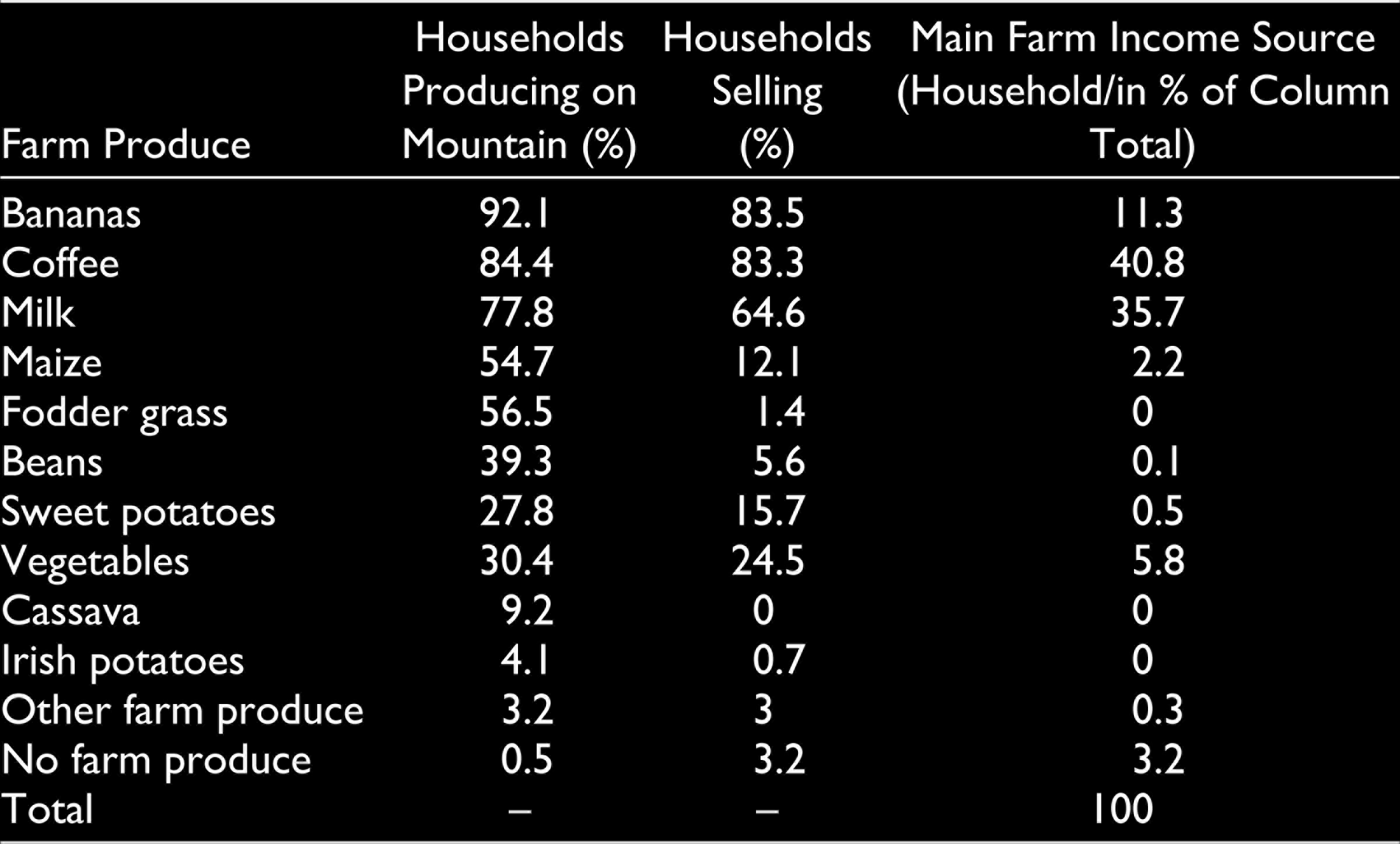
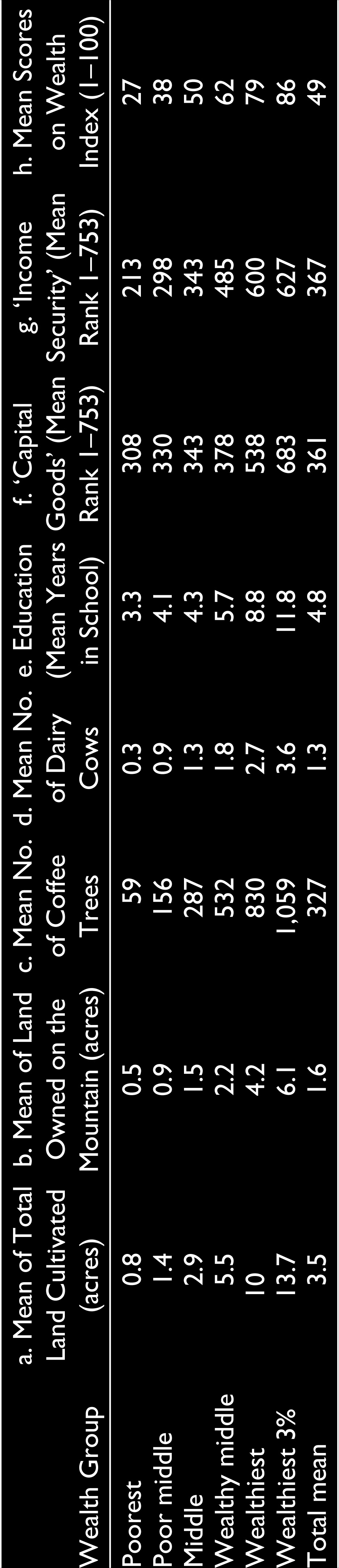
The importance of coffee is clearly visible in Rolf Larsson’s extensive survey of over 750 households, which was conducted in the mid-1990s. Larson showed that the vast majority of families depended on selling bananas, coffee, and milk (Table 1). Every single household he spoke to had cattle and many of them sold milk; all had smallstock which were kept in the lowlands (Table 2). There was considerable inequality within Meru society, as the amount of land actually farmed varied (Table 3). But the main point to note is that, despite the inequalities of amount of land worked and goods sold, there was remarkable uniformity in the nature of the local economy—coffee was preeminent.
The Rural Coffee Economy in 1996
Livestock Ownership in 1996

Differences in Wealth and Farming Activity in 1996
Since the 1990s, there has been a dramatic and considerable decline in production and coffee trade in Tanzaniaas and it faced a series of compounding challenges. Coffee cooperatives that had provided important support for quality coffee production and marketing, and helped to subsidize inputs, began to fail (Hillbom, 2012). This reflected price fluctuations. Maghimbi (2010) reported that low coffee prices in the global market caused cooperatives in mainland Tanzania to accumulate huge bank debts. Without cooperative support, poor quality control common to individual or small-scale producers, much of the coffee produced is suitable only for the local or regional market, where prices are lower and demand is less vigorous (Ponte, 2002a, p. 25). Furthermore, the withdrawal of government subsidies had a significant impact on living standards for farmers (Ponte, 2002a, p. 22) and their ability to continue to grow coffee commercially. This largely wiped out the benefits of higher prices in coffee in the mid-1990s (Larsson, 2001, pp. 220–221). In 2001, these cooperatives had lost their traditional role in protecting coffee farmers (Maghimbi, 2010). Pests and diseases invaded coffee as farmers could not afford direct purchase for pesticides.
In Meru, two afflictions were particularly important. Leaf rust (emelea, in Kiswahili), or Hemileia vastatrix, is a type of fungus which originated in East African coffee plantations, but spread globally. It causes greatly reduced yields and poor quality beans. Unfortunately, the only way either to prevent or cure leaf rust is the application of expensive fungicides, or the removal of plants. The other leaf rust, borer beetles (known locally in Meru as sambembe), are prolific pests, and many Meru farmers are affected by either, or both, of these afflictions. Due to emelea, sambembe, and the dramatic drop in coffee prices, many Meru men were forced to give up cultivation of coffee as their main source of income (Dancer, 2015, p. 30). The treatment for emelea and sambembe is more expensive than the price achieved at market, 1 and coffee became financially unviable for many Meru families, especially when government subsidies ceased.
The impact of lower prices, combined with higher prices for inputs to deal with pests and diseases, has been complicated in Tanzania. Maghimbi noted that price declines have seen production fall in the Kilimanjaro area, but increase in the south of the country (Maghimbi, 2007). This he attributed (in a paper which barely mentioned gender) in improving economic opportunities in other sectors. In Meru, as public intervention in coffee markets had decreased, and many of the coffee cooperative societies and board had either closed or were significantly reduced in power and size by mid-1990s, diseases caused a decrease in production and stock generally. Prices became more volatile due to deregulation. As Ponte reported, before deregulation, prices would fluctuate by 15 per cent a month. Post-deregulation brought price fluctuations of 43 per cent from 1998 to 2000 (Ponte, 2002a, p. 20). Such variability in prices led to loss of confidence for farmers and unreliability of the market, leading many farmers increasingly to give up coffee in favor of vegetables, with a stronger local market and more reliable prices.
The results of this decline are clearly visible in the farms that the Meru cultivates when we conducted our surveys in 2017 (see the section ‘Methods’). Coffee is grown only by a minority of families. New crops such as potatoes and trees have become more important (Table 4). In some villages, only half of the families own cattle and smallstock are infrequent (Table 5). In terms of occupations of adults in our survey who were not educated, only 50 per cent of them said that they were only farmers and 42 per cent said that they were not farmers at all but engaged in various sorts of business (n = 367).
Proportion of Families Growing Different Crops, 1996–2017

Livestock Ownership in 2017

The contours of this story are well known, but it is remarkable how rarely gender relations feature in its telling. Indeed, we have been able to find only isolated papers that examine this explicitly. 2 Bacon’s work on coffee cooperatives in Nicaragua has shown that these became vehicles for (contested and uneven) female empowerment in different contexts (Bacon, 2010). This became visible in the leadership of some cooperatives.
Closer to our own study, Patrick Mbataru offered a long-term perspective on the gendered consequences of the collapse of coffee among the Kikuyu people in Nyeri, Kenya (Mbataru, 2007). He described how, before the coffee economy, women had traded grain and other goods for income which they controlled, and how men’s coffee income had curtailed that activity. With the collapse of coffee, these female trading networks and opportunities have been revived. Women have found new sources of income, and there is some evidence that control over milk supplies is contested by men as a replacement for coffee income. But Kikuyu women see this as their money. Since they provide the cattle feed, Mbataru claimed that men who won the battle for the money could lose the war for the cow. As he observed, ‘[t]he control of the milk production therefore becomes one of the most contested areas of family production, which leads to frequent domestic conflicts’ (Mbataru, 2007, p. 112).
Indeed, men appear to do rather little and suffer ‘psychological torment’ as a result. They have lost the ‘symbolic authority’ of being the provider, and ‘their power was severely dented on the home front’ (Mbataru, 2007, p. 110). While women earn money and organize women groups, men do little and, according to one informant, suffer an ‘inherent incapability to organise anything collectively’ (ibid.).
Hillbom’s work stands in stark contrast to Mbataru’s, and our own. She has researched agricultural change in Meru since the mid-90s, although has not focussed so much on the gendered relations of agricultural production (Hillbom, 2011; Hillbom, 2014). She takes a completely different view as to the gendered consequences of the new cash crops to the work we present here. Hillbom’s (2012, pp. 676–677) observations are worth quoting in full.
Few men adopt individual strategies which combine petty trading of food cash crops with farming. They may still be part of a household strategy where the husband stays at home farming, while his wife goes to the market to sell the household produce as well as engage in petty trading. This division of labour within the household makes the husband concentrate on the local community, while the wife has more connections to the world outside the village. It also strengthens the economic position of women within households, as they are in control of a large part, or even all, of the household’s cash income. Some husbands even confess to having no insight into the incomes brought in by their wives, and relying completely on their budgeting for the family’s economic strategies.
The explanation for female dominance in trading with food crops lies in the local historical division of labour and incomes. Traditionally, women were responsible for feeding the family, especially the children. As farming food crops was primarily for subsistence purposes, this was the responsibility of the wife, while the husband controlled the cash crop, such as coffee. The negligible surplus production, particularly of bananas and milk, could be sold by the wife and generated some minor income from trading. Women of today have maintained their position as the petty traders in the family. What has changed drastically is the context. Farm intensification, with the introduction of new high-value food crops such as vegetables, and increasing urban demand, including demand for traditional staple crops such as maize and bananas, has significantly expanded both supply and demand for the trading sector controlled by women.
These statements differ substantially from our own view and we will return to them in the discussion of this article. Suffice to say here that it may not be appropriate to see food cash crops as simply the domain of women. Rather, different sources of family income are contested.
If we anticipate contest, then we can expect the change of coffee economy to have a significant consequence on gender relations. In Meru, much like Nyeri, men traditionally controlled both the cultivation of and the finances associated with coffee (Dancer, 2015). Women would be expected to do much of the labor. They would weed, pick, wash, dry, and clean the beans. Noe has described this in detail (Brockington and Noe, forthcoming). When sold, men would retain the money from coffee without having to inform wives of how that money was being used. Women tended to exert more control over income from milk and bananas. It is precisely the dynamics of this division of labor, controls, and crops which we have to explore to understand what the coffee crisis has done to rural societies.
Methods
Our study in Meru is part of a larger project which is exploring social and economic dynamics over the last 20–30 years in more than 30 sites in Tanzania (Brockington et al., 2018, 2019). We do so by revisiting families visited by researchers in the 1990s, preferably with the original researcher who carried out the first study. 3 In this instance, we have been revisiting the field sites and interviewees of the late Rolf Larsson. He was tragically killed while travelling back to Meru to conduct his own re-study. Fortunately, we have been granted access to his data and, more fortunately, one of the authors, Christine Noe was herself raised and brought up in Meru and was, in fact, in senior school at the time that Larsson was conducting his research in the villages that bordered hers.
Larsson’s extensive research looked at agricultural practices in Meru, and his research was conducted at a household, or domestic unit level, as well as at the village level. He interviewed an astonishing 753 families drawn from six villages along an altitudinal gradient. The value of his comprehensive work cannot be overstated—we are able, using his data, to go back and trace families from his original sample, to understand what has happened to them in the past 20 years. Furthermore, his ethnographic detail at a village level has meant that we can understand changes in ideologies and social concepts, vital to a longitudinal study like ours.
We have chosen three of these villages at the top, middle, and bottom of the gradient for the revisits. In addition to revisiting the families (we were able to meet 75 per cent of them), we also undertook focus group discussions (of around 15 women and men conducted separately), participant observations, and key informant interviews, during October 2016, and later a follow-up visit in March 2017 and June 2018.
We also draw considerably on Noe’s intimate knowledge of the region and its dynamics. Noe grew up tending coffee on her family’s farm and at home like many other Meru girls. Her childhood (and young adulthood) in Meru was indelibly inscribed by the long hours of labor undertaken tending coffee bushes and washing coffee beans in cold Meru mountain streams before dawn.
Our methods reflect the two purposes which enervate our research. On the one hand, we feel that, empirically, it is important to document the stories that we tell in this article. They are missing in the literature and their relative absence is troubling. And, ideologically, we feel it is important for women’s voices to be heard and that ‘it is women’s experiences and the way women themselves frame their claims that should form the starting point for research’ (Dancer, 2015, p. 19).
Nevertheless, it has been a struggle. Our presence in the villages was very much controlled and facilitated by the male elders and village leaders. It was from them we gained permission to conduct our research and fieldwork, and so they assisted with the visiting of individual householders, and any group meetings we required. They explicitly told us that there was no point in having a women’s focus group, as women had nothing interesting to tell us and did not understand the workings of local Meru society: only they, the men, could provide us with reliable information especially because this was about coffee, which is known to be a men’s crop (regardless of where it draws labor from).
Gender Ideologies in Meru Society
The rural economy of Meru therefore has been transformed by the collapse of coffee. What effect has this had on gender relations within households? The Meru people are well-known as being a patriarchal society. This means that men strongly influence women’s access to resources, finances, and their social and business interactions (Meinzen-Dick et al., 2011). The change in livelihoods is likely to have a significant impact on the status and day-to-day difficulties faced by women in Meru because of the ideals to which women are subject.
Meru men have a number of expectations about themselves that they had to fulfill as men, and in order to be men. First, men control family wealth. Family wealth has in the past and at present (to some extent) been dependent on land. The control of land gives men the power to determine land use, how family labor is used on that land, and the distribution of income generated from it. As such, men are expected to keep the behavior of their wives and children in check and to make sure that everyone behaves in a way considered right and proper for Meru families. This would include that women are disciplined to work mostly on family farms, take care of zero grazed livestock, and keep up the homes as opposed to doing ‘loose’ jobs such as business and casual labor.
Men must earn more than women, but they are not expected to have to collate many different projects to earn this money. It is normal for a Meru man to have one or two major projects, and his wife to take care of many smaller roles with less perceived significance. Men are the primary decision-makers: any important decisions will be made by the man. Smaller and less important decisions can be made by the woman, but the final say is always with the man.
Men must never help the wife in the kitchen. Men who help their wives in the kitchen, or who get involved in any ‘women-only’ tasks, will be a laughing stock. Mothers will shoo their male children out of the kitchen, in case he gets a ‘reputation’. Men who help their wives with ‘women-only’ tasks will be shamed by their peers and socially outcast. Women’s behavior must always be regulated by their fathers or husbands. They are, as one man described to us, the chairman, and the wife is considered the deputy chairperson. A woman who is unlike this is known to be ‘sitting on’ her husband.
There are also strong expectations with respect to women’s social behavior which affect her economic opportunities. Haram (2001) explained that two different types of women are identified in Meru social narratives: the clean woman and the dirty woman. The clean woman is the woman who stays at home and does not go out much. She works very hard on her domestic or farming duties and wears unfashionable or traditional clothing. She is obedient and does not talk to men. The dirty woman is the woman who travels outside of her home village. She might work in town, and it could be rumored that she is a prostitute. As soon as a Meru woman travels, or is out of sight of a Meru man, she is thought to be out of control.
These normative ways in which Meru understands and conceptualizes gender ideology are important for understanding gender in relation to the decline in the coffee economy. As Haram (2001, p. 48) has observed, ‘… men have experienced a dramatic reduction in income due mainly to the fall of coffee prices in both the local and the world markets. Thus, changing social and economic conditions have generated new strategies in the household economy …’
As we have seen many of these new strategies are off-farm incomes, including small businesses, trading, and non-agricultural strategies. As income generation moves increasingly to off-farm incomes, women are involved in income generation activities that often involve being out of their homes for periods of time: it is then that women need to be even more controlled. They are out of sight of their men, crossing geographical (and therefore also moral) boundaries. Their economic independence makes them a threat, and it is at these times that gender ideology is most powerful. It reinforces social stratifications in order that social norms can be maintained in times of economic change or social upheaval.
How Have Gender Norms Changed Because of emelea and sambembe?
It is because of our tears, the tears of women, that coffee got this disease, emelea. Many crop researchers have come to Meru to try and find a cure for emelea, but they cannot, because this is not caused by sickness, it is caused by women’s tears.
—Women’s focus group discussion, Meru (19 October 2016) 4
With the collapse of coffee, household economies revolve around different goods and activities. At present, bananas are the most widely cultivated crop. Even if a family has no farm, they will have a banana tree in their compound. Bananas were traditionally a woman’s crop. This means that a woman is able to make money from it without having to reveal to her husband exactly how that money is spent, although women explained that they mostly invest this money in the education of their children, and this is known by their husbands. She is still required to give a proportion of this to her husband, which she will not deny, as the consequence may involve limited freedom for activities such as attendance to the market.
But without coffee, men were left with no primary source of income. They would have to ask their wives for money from the sale of bananas. To rely on their wives for money would be considered shameful. Women could not deny their husbands money even though they knew it was mostly used for drinking alcohol. Doing so would cause conflicts, which extend as far as being denied permission go to the market to sell more bananas. If they disobeyed and went to market, we were told, ‘she might as well stay there!’ They would be beaten if they returned home after such behavior. We continually heard ‘Meru men must be real men!’, and allowing his wife to support him financially is not what a ‘real Meru man’ would concede.
So to have a source of income for which they do not have to account to their wives, Meru men have begun to claim a species of banana for themselves. This species, mshare, is a highly commercial breed of banana, fetching higher prices than other types compared with kisasa/uganda and ndizing’ombe. The former is closely related to Matoke, of Ugandan origin, a species of bananas that is mainly used for family food, while the latter—as its name suggests—was in the past food for cows and raw material for local brew (mbege). Since mshare fetches higher prices, men seek to make it a man’s crop.
Women described the situation with bananas as ‘trying to turn bananas into Tanzanite’. They see men imagining that women get lots of money when they sell bananas at the market, likening bananas to Tanzanite (a high value extremely rare gem that is found nearby). Hence, they are forced, by male expectations, to finance many household activities, such as education, health, food, and asset acquisition. This gives women mixed feelings about these developments. They are happy that there is some income coming their way, but concerned that men have left everything to them (including provision of money for their alcohol). They complained that if they sell their species of banana, their husbands demand money from them. They will take this money and ‘convert it into piss’, because they are spending their wives’ hard-earned cash on alcohol.
The women lamented all the wasted opportunities that could have been created with this money, which they saw as especially painful since bananas now are not exclusively a woman’s crop. These views were the same across all three women’s focus groups, and women said that these changes in gendered control of certain crops have led to increased power struggles between men and women.
It is still primarily the woman’s job to sell the bananas in the market. A man can only do so if he is bringing so many bananas to market that he must (and can afford to) carry them in a pickup. If the bananas are only enough to carry on the head, then these must be sold (and carried) by a woman. Men cannot carry bananas on their heads, only in a pickup or on a motorcycle. The division of labor here is determined by the amount of income likely to be achieved by the quantity of bananas. More money means it is a man’s job.
Furthermore, milk, we were told (formerly exclusively for women), has become divided: the milk produced in the evening is for the women. 5 This is used at home for making evening and morning tea. The milk produced in the morning is only for the men, and it is sold. Women do not have control of this source of income.
Men only used to go to the farm to check on their coffee plots. This has changed after the loss of coffee for most families. Men, as we have discussed, control high-value commercial crops, and so men are increasingly going to banana farms. As other crops gain commercial value (as it is with maize, potatoes, and carrots), men have taken responsibility for marketing.
One positive aspect of this change, say women, is that ‘you cannot eat coffee’, but at least you can eat potatoes and carrots. They say diets have improved, and despite these crops being controlled by their husbands, the women see this aspect as a positive change. This contributes to their belief that ‘God brought coffee disease’, because of their tears.
Since the coffee market became unviable, women have diversified away from farming. They do not like being ‘unpaid labourers on the husband’s plots’, 6 and so many have gone into business. SACCOs (savings and cooperative groups), and microfinance loans, have in recent years facilitated women’s business opportunities, but in all of our focus groups, women reported that men do not like them doing business. Indeed, men told us that women often misuse money from loans. Women said that they have greater ability to make an income for themselves these days, and much more time for business, as they no longer have to work on the coffee farms. This is seen by men as women trying to take over from them as the head of the family, with control of finances, which might explain why men see women as misusing money. However, it is clear that men acknowledge women at present have greater power, which comes with ownership of assets: ‘they have a place in decision making because they own their own capital’. 7
Discussion: Contesting Change in Meru
The coffee farmers of Meru are popularly known as one of the Tanzania’s early success stories. These were, in the words of one observer, ‘the Freemen of Meru’ (Nelson, 1967). They fought violent imperial oppression and extensive land alienation to launch the celebrated Meru Land Case against the British rulers which foreshadowed and hastened the independence struggle. They formed cooperative unions that were wealthy and coordinated enough to buy back farms settlers sold and pay for educational trusts that subsidized the education of thousands of their children (Neumann, 1998; Spear, 1997).
Perhaps ‘freemen’, however, is the apposite term. For the untold story that underpinned this success was female labor—in particular, hard female labor. As Noe described, preparing coffee required washing beans early in the morning in cold mountain streams before school, picking every berry from the bushes, and retrieving and piling the beans appropriately before sale—and all of them were to produce the revenues that men alone controlled (Brockington and Noe, forthcoming).
This explains the bitter voices that we encountered in our fieldwork. Many female informants were pleased that there is no coffee any more, as the work was very hard, labor intensive, and unpleasant, and they had no way of knowing how the money was spent from all their hard work. One woman commented, ‘I hope bananas too acquire diseases’. Some women have also come to hate the banana business, as they feel that men have taken it from them.
It may seem strange that women could be so opposed to a source of revenue which had driven so much ‘progress’ for their community as a whole. But communities are differentiated. We have to be attentive to the misfortunes that this success generated and who experienced them. Indeed, some women celebrate the demise of coffee because of the financial freedom that new economic activities at present make possible: ‘… better these vegetables than coffee. Let coffee get lost. Men would sell the coffee we toiled over, eat, spend the money with other women … he would not even bring home a piece of kanga. 8 It is better now that we have somewhere to grow vegetables’. 9
But we cannot see the demise of coffee as ushering in a new era of relative female freedom. Rather, it brings in a new period of contest over the ownership and control of revenue streams and the proper domains of male and female activity. These disputes are a constant part of everyday life (Box 1)). The gendered contests over commercial crops are central aspects of daily life and filter people’s interpretation of change.
Box 1. Contestation of Gender Roles in Meru
‘Women have become kings!’—Meru man
Husband: Men do cook!
Wife: Well, we’ve been married for more than 40 years and I don’t even know if you can make tea!!
Husband: I can make a cooking fire.
Wife: I have never seen that happen! Men make fire only when they have to prepare men’s food. This comes rarely when there is goat slaughtered. And this happens because men don’t allow women to eat certain parts (and best parts) of goat meat.
Husband: Well, there is no much work in the kitchen these days anyway. You no longer fetch firewood, you just switch the gas cooker on and off.
Wife: Indeed, thanks to the change. Yet, it is really interesting how you maintain the same tradition of not going to the kitchen even when there is no traditional kitchen anymore.
The wife turns to us and continues:
My husband can go hungry just because I am not home to get him food (not to cook) from the kitchen to the table. I could place his favourite tea on the stove, get busy with other things and forget to turn to it. He will shout to tell that the tea is boiling over! It doesn’t cross his mind that he could help with his own tea!
—Meru husband and wife, 19 October 2016
Women see some progressive change amid these economic shifts. This includes women having their voices heard, accessing loans, starting businesses, and no longer working on the coffee plots: these are all seen as considerable steps forward. On the other hand, some women feel that life is worse than 20 years ago, because men have taken over what were once small businesses for women. However, most of them agree that despite all the struggles in the control of family income after the cessation of coffee cultivation, at present they are more empowered. They have more opportunity to be heard and to take control of the family.
Older women believe that the younger generation of women is even more independent and are able to ‘speak’ without the traditional consequence of violence. Younger couples are more likely to work together on tasks. However, for many women, the strict gender roles and control of finances remain. The cessation of coffee has not made as dramatic a change to women’s equity as men might believe as in their saying, ‘women have become kings’.
Our point here is not that these new income earning possibilities for which Meru women are fighting provide security. As Ossome observed, growing female participation in informal labor markets can simply entail more vulnerability and exclusion (Ossome, 2015). But in the context of partriarchal Meru societies, and small formal sectors that exclude most people anyway, they provide resources for which women want to fight.
In this light, it is instructive to return to Hillbom’s account of gender relations, because it is so different from our own. What could explain it? First, we must recognize that the sorts of gender relations she described can and do exist. Hillbom reported her findings from the field. The issue is which portrayal is most representative of wider experience. Here it is instructive to compare the different conceptual frameworks we have used. First, Hillbom’s description of agricultural labor (‘the husband stays at home farming’) obscures the importance of female labor on male farms. Women do more work than that suggests and we can only appreciate the strength of their feelings by understanding that labor and its difficulties. This echoes Mbataru’s findings in Nyeri (Mbataru, 2007). Women wanted to control milk revenues because they fed the cows.
Second, and most importantly, we disagree with Hillbom’s suggestion that if food crops were ‘traditionally’ subsistence and under female control that, when they acquire more commercial value, they will remain under female control. The literature that we have considered above (Orr et al., 2014) suggests otherwise. Andersson-Djurfeldt (2018, p. 83) has also recently published a similar assessment of this literature which draws the same conclusion: ‘numerous studies, both contemporary and historical, concern the male dominance over cash crop production and sales and the growing male control over women’s crops as they become commercialized’.
When women’s crops become commercially valuable, men seek to control them. This is unsurprising if, following Ossome (2014), we should expect this sort of change in control over commercial crops because we need to see the gendered domains of control over land, labor, and their products as contested. Male and female realms are not given by tradition, rather these traditions are forged and re-made through myriad interactions every single day.
These contests are an essential part of life and well-being and, therefore, measures of well-being which omit gender differences will be flawed by that oversight. In other work which this project has generated, we have shown that poverty-line data are flawed because they ignore smallholders’ investment in rural assets (Brockington, 2019). A substantial dimension of rural prosperity is therefore omitted. But equally looking at assets alone risks missing dynamics within families that contest the benefits from the revenue streams which assets provide (Brockington et al., 2019). If we are to understand changes in well-being and the contests over them, then, most especially in more patriarchal societies, we have to see how they are gendered.
Attention to this aspect of rural life in Tanzania, and other parts of sub-Saharan Africa, could become yet more important. If other aspects of the push toward the SDGs are to succeed, then we should expect more such gender-based conflict and contest to arise over the changes that occur (Mbilinyi, 2016). It is possible that new revenue streams from new crops, new labor practices and requirements, new jobs and businesses may present opportunities that men and women agree to share amicably within families. But we think this is unlikely. Contest will be the norm. Hence it is so important to look for it.
Conclusion
Sadly, it seems that these three outspoken and determined little girls in the extract at the beginning of the article will face a number of challenges to their dreams. Female bajaji or pikipiki drivers simply do not exist in Meru society at the moment. If they did, their peers, parents, and fellow Meru would see them as ‘loose’ women, with poor morals. They would be unlikely to marry, as their husbands would be shamed for not adequately ‘controlling’ them or for allowing themselves to be dominated by their wives. Meru women are not allowed to be in a more senior role than their husbands and they are not facilitated to earn more money than men. It would be highly unusual if these girls did manage to achieve their dream jobs as bodaboda drivers or bajaji drivers.
As women find new, entrepreneurial ways of making money, men seek ways to take them over. At present, high-value bananas, once a women-only crop, are controlled by men. Chicken businesses, also originally only seen fit for women, are taken over by men, as men lose their coffee business and search for more commercial ventures. This strongly patriarchal society expects men to take over from women and assumes that men will control any significantly commercial, income-generating activities. Men used to control finances from the coffee business, but at present that coffee has become unproductive due to a slump in the market, pests, and diseases, men have sought to control other commercial ventures. The transference of control by men from coffee to bananas, to chickens, to high-value vegetable growing is a seemingly ‘natural’ order which women struggle to avert.
Men see women as usurping their control of finances. They believe that women have achieved greater freedoms and financial control during the past 20 years. Women see this very differently; they feel that whatever small progress they make is rapidly followed by men taking over this control. They are happy to be rid of the hard physical labor coffee crops require from them, but are angry that many small businesses, formerly the preserve of women only, have been usurped by their husbands, allowing women even less financial autonomy.
In an era of the SDGs, we are accustomed to talking about progress toward those goals and setting targets and indicators of welcome change. Yet, the case of change in the context of Meru coffee suggests that this may well not be the best way of conceiving of these dynamics. The targets and these indicators matter. But the linear thinking in terms of progress does not allow for regress. From the perspective of the women in Meru, any movements toward development goals have to be viewed through a lens of contested gender dynamics that could reverse hard won gains.
Footnotes
Declaration of Conflicting Interests
The authors declared no potential conflicts of interest with respect to the research, authorship and/or publication of this article.
Funding
This work was funded by the DFID-ESRC Growth Research Program, jointly funded by the UK Department for International Development (DFID) and ESRC, grant number ES/L012413/2. The findings and conclusions contained in the chapter are those of the authors and do not necessarily reflect positions or policies of the UK Government, DFID or ESRC.