



Abstract
Neoliberal policies have put farmers in a greater situation of vulnerability. Tribal farmers are among the most neglected in policymaking as well as in the larger capitalist framework of development. Watershed development might play a transformative role in reducing the burden of tribal farmers in Odisha. However, it is yet to gain traction in policymaking circles. Increasing the level of production and productivity are two major dimensions of watershed development, along with the conservation of land and water resources. This study is an attempt to examine the impact of watershed development on the shift toward productivity and income-enhancing cropping patterns. We have collected data among 160 farmers from four watershed development areas of Koraput and Mayurbhanj districts of Odisha, where the tribal population is a significant portion of the overall demographic composition, using a multistage sampling technique. Descriptive statistics and paired t-test have been used in the study as statistical tools.
Introduction
The neoliberal policy formulated by the Indian government for the development of the agricultural sector is stimulated by financial interest. A small group of capitalists owning a disproportionately higher share of the means of production exercise significant influence in the policymaking processes of all sectors, including agriculture. The presence of a very high share of small and marginal farmers characterizes Indian agriculture. Most Indian farmers fall under the small and marginal categories, operating on less than two hectares of land. Farmers are among the most vulnerable sections of the agricultural value system, and its structural power asymmetry affects small and marginal farmers the most (Kumar, 2022). In addition, most of the policies formulated by the state aid and abet the exploitation of the small peasantry by their ‘capitalist’ counterparts. Policies such as the occupation of land by capitalists are nothing but the displacement of farmers, particularly small and marginal farmers (Jha & Yeros, 2019). The broader policy structure leads to lower yield realization by the small and marginal farmers relative to the rich groups (Amin, 2012), further deepening the quantum of existing socioeconomic inequality. Hence, the capitalist development of the agricultural sector has also caused a rise in inequality of income, wealth, and standard of living among the different groups.
In India, per-capita food availability and consumption have declined over the last 30 years (Jha et al., 2021). The current food crisis cannot be separated from the country’s economic development pattern, which has pushed most of the population toward food insecurity. A sizeable section of the food insecure population in India consists of the actual food producers, including the tribal farmers. The neoliberal thinkers attempt to depict the country’s financial gains as a whole, circumventing the analysis of the distributional aspects of the gains. This trajectory of analysis has pushed the issues of the vulnerable sections of the population to the margins of the policy discourse.
Tribals tend to depend highly on natural resources for their existence and livelihood, including agriculture and a host of other activities. Degradation of the natural resources of their habitats has the potential to exacerbate their vulnerability. The tribal population of Odisha consists of mainly small and marginal farmers; they produce primarily for their consumption and with maximum use of family labor. The chances of crop failure and economic distress tend to be very high in the case of these small and marginal farmers due to the presence of debilitating structural factors. The crisis further manifests itself in the suicides of tribal farmers. Measures to increase productivity and the scale of production can address food insecurity and improve the livelihood conditions of the tribal population to a significant degree.
The scarcity of water and the lack of irrigation facilities make irrigation almost impossible or unpredictable in tribal areas of Odisha. It continues to be one of the major hurdles in the agricultural development of the tribal areas. The geographical condition of hilly land makes tribal farmers more prone to water scarcity. The development of irrigation facilities has the potential to enhance production to a certain extent. In this context, a watershed development program is considered an effective instrument for managing natural resources. Productivity improvement, income enhancement, greater marketable surplus, and overall economic upgradation could reduce the vulnerability of marginalized tribal farmers.
The water resources, especially in arid and semi-arid regions, are subject to significant variability and uncertainty, leading to constraints in food production (Sharda & Ojasvi, 2005). The non-availability of adequate water resources diminishes the capacity of small farmers to earn their livelihoods and makes them more vulnerable to drought and natural disasters (Chandrakanth et al., 2004). To improve groundwater levels and sustain agricultural productivity, effective management and utilization of rainwater are essential. The land is another vital natural resource for the rural agro-based economy suffering soil erosion in watershed areas. Thus, the development of such an area is needed to conserve water and land. Watershed development has the potential to conserve and improve the quality of natural resources and enhance the welfare of the inhabitants of the area. The increased employment opportunities and the overall increase in income and consumption levels have been evident and reflect the potential of watershed development to enhance rural livelihoods (Tripathy, 2013). Moreover, storm runoff water gives rise to problems such as land degradation and water scarcity (Hellmana et al., 2018). Thus, higher investment in land, water, and supportive forestry are necessary for the sustainable development of watersheds (Das, 2008).
Improvement in agricultural productivity is hindered by the unfavorable natural environment. Water harvesting through watershed development is crucial for reviving agricultural growth and productivity in semi-arid and rain-fed areas (Wani et al., 2006; Vaidyanathan, 2006). As a result of the eradication of soil erosion and water reservation through watershed development, the cropping intensity of watershed areas has been found to be higher than others (Nasurudeen & Mahesh, 2006). Watershed development not only increases cropping intensity but also helps transform traditional crops into commercial crops (Pathak et al., 2012). This happens due to an increase in net sown area, gross cropped area, and area under irrigation (Varat, 2013). The gross output of all crops was significantly higher and the inputs used were significantly lower in watershed areas than in non-watershed areas (Palsaniya et al., 2012; Mondal et al., 2013). The availability of water resources benefits farmers in the form of better production returns, improvement in the concentration of organic nitrogen, and increased land productivity (Pellerin et al., 2004; Xu et al., 2018). As a result, the area’s economic condition improves due to diversified cropping patterns and the cultivation of labor-intensive vegetable crops (Tripathy, 2013).
Despite this evidence, the claimed benefits of watershed management may not apply to all cases in the same way. For example, there has only been limited improvement in the economic status and situation of landless and marginal farmers’ (Sangameswaran, 2006). Furthermore, the impact of watershed development remains negligible for poor people in fragile ecosystems (Tripathy, 2013). An illustration of this is the case of tribal people who mostly reside in fragile ecosystems and face constraints in obtaining full benefits from interventions like watershed management. However, the literature rarely addresses the impact of watershed development on the tribal communities including the impact of such an intervention on the cropping pattern of the tribal groups. Thus, there is a need for empirical investigation into the impact of watershed development on tribal areas.
The present study attempts to answer the following questions: (a) does watershed development play a considerable role in water management? (b) Does watershed development impact cropping patterns and agricultural productivity? (c) Does the watershed development program have any impact on the income of inhabitants?
Historical and Conceptual Background
The watershed management programs began in 1880 upon the proposal of the Famine Commission and were expanded in 1928 by the Royal Commission on Agriculture. These two commissions set the basis for systematic study within a hydrological framework. After Independence, the focus on watershed programs was sharpened with the launch of government-supported programs and the establishment of the Soil Conservation Research, Demonstration and Training Centres at eight locations during the mid-1950s. Schemes, such as Integrated Watershed Development Program (IWDP), Desert Development Program (DDP), and Drought Prone Area Development Program (DPAP) under the watershed development program were launched by the Ministry of Rural Development of the Government of India (GoI). In 2008, IWDP, DDP, and DPAP were merged under the Integrated Watershed Management Program to bring a compressive approach to sustainable development. Odisha’s government also launched many schemes for watershed development in the state.
The Common Guidelines for Watershed Development Projects of 2008 establish the facilitation of equity and gender sensitivity processes as guiding principles for the Project Implementing Agencies (PIAs). The guidelines direct the PIAs to address the issues of the enhancement of livelihood opportunities for the poor and the enhancement of the decision-making power of women. They also direct the PIAs to spread awareness about opportunities, create income-generating assets, and upgrade the technical skills of the inhabitants. In this light, watershed development is regarded as a necessary but not sufficient condition for sustainable rural livelihoods.
Community participation also has a greater role in the implementation of programs. The decisions about planning, budgeting, implementation, and management of the projects must involve the primary stakeholders. All these actions lead to inclusive, equitable development of inhabitants in that watershed areas. The development of policy arrangements increases farmers’ literacy and encourages them to participate in cooperatives (Babalola & Olayemi, 2014), improving equity through women’s empowerment in the area (Sangameswaran, 2006). However, the efficacy of the participatory approach was found to be not up to the level elaborated in the objectives of local adoptive capacity (Singh C., 2017). The participatory approach failed in monitoring activity, management of common property resources and improving equity (Mondal et al., 2020). A study found that the watershed community was not functioning well after the withdrawal of the project (Sen, 2016), thus revealing the limitation of the participatory approach.
Watershed development helps to avert the negative externalities which are created through the impact of drought by creating conditions for groundwater recharge (Ali et al., 2012; Chandrakanth et al., 2004). The awareness of its benefits also encourages environmental protection and habitat improvement (Uchidaa et al., 2018). Therefore, it can be considered a suitable strategy for achieving a sustainable approach to agriculture, especially in dry belts where it ensures short-run and long-run drought-proofing in dry belts (Deshpande & Rajasekaran, 1997). This helps to increase the extent of land under irrigation by ensuring the availability of sufficient water. (Kulshrestha et al., 2014). Improvement in water tables and farmers’ awareness of technologies like drip irrigation can result in declining cost of production and improvement in productivity (Narayanamoorthy, 2017). Sufficient availability of water and fodder in the watershed area leads to an increase in the cattle population and other livestock (Kulshrestha Anil et al., 2015). As a result, the household’s net income increases due to increased farm and non-farm incomes due to watershed development (U, 2014). However, a study found that the impact tends to be short-term and persists mainly during the period of the continuation of the project (Hope, 2007).
Watershed development is the process of conserving, regenerating, and prudently utilizing all natural resources (such as land, water plants, and animals) and humans within a watershed area. The development of the watershed aims to achieve the optimal balance between nature, on the one hand, and humans and animals, on the other. Watershed development is recognized as a potential approach to agricultural growth and rehabilitation of fragile and degraded land. Watershed development entails not just environmental regeneration but also the management of the needs of people so that their requirements fit the available resources, such as land, water, and vegetation, within that particular watershed.
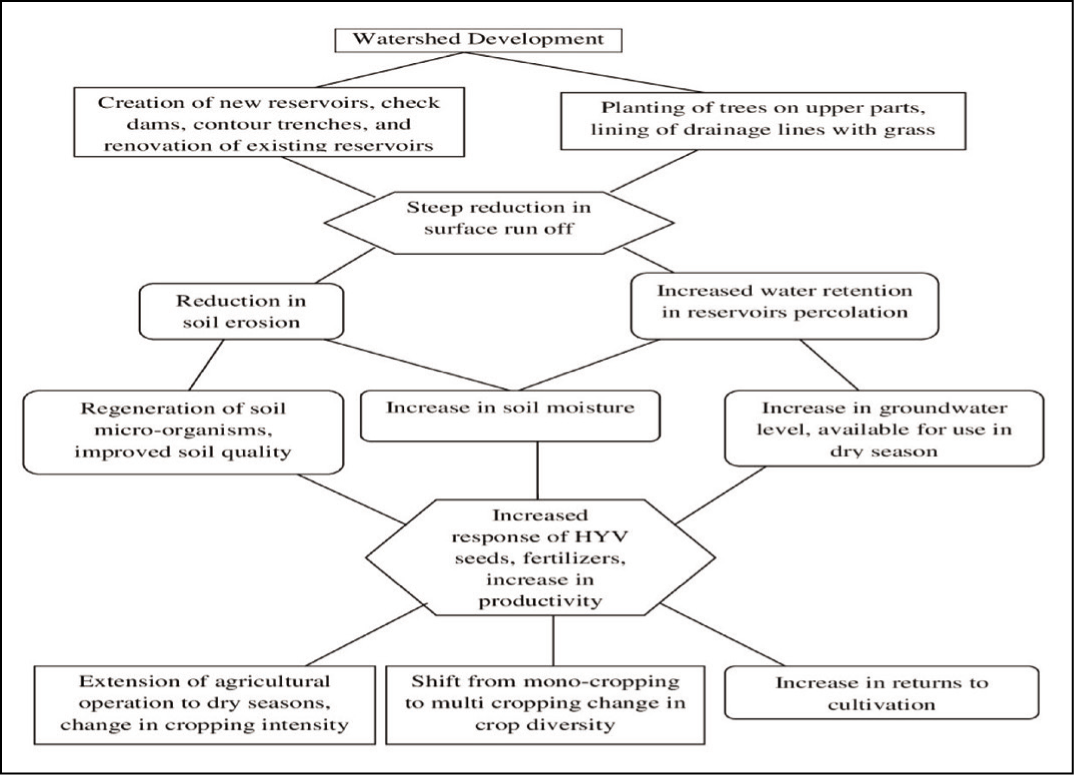
Figure 1 provides a graphical representation of the pathways through which watershed development affects agricultural practices. In the first stage, the construction of a new water storage structure on the lower land and the plantation of trees and grass on the drainage basin reduces the surface runoff. It also reduces soil erosion and increases water percolation and retention in the area (Nasurudeen & Mahesh, 2006). The reduction in soil erosion improves soil quality, and micro-organisms in the land regenerate productivity (Pellerin et al., 2004). Water retention and percolation increase groundwater levels, increasing water availability potential in the dry season for agricultural and domestic purposes. Enhanced soil quality and improved land productivity induce farmers to respond positively to high-yield variety (HYV) seeds, fertilizers, and pesticides, resulting in improved productivity (Palsaniya et al., 2012; Mondal et al., 2013). As a result of the availability of water and higher productivity, the intensity of cropping increases, and farmers shift from mono-cropping to multicropping patterns, especially in favor of vegetable cultivation and other high-return crops. In all, there is intensification in agricultural activity with increasing costs and higher returns.
Pathways Through Which Watershed Development Impacts Agriculture.
Materials and Methods
To assess the impact of watershed development, it is necessary to measure the indicators in two different scenarios: without intervention and after intervention. In order to assess the information about those indicators, such as land and water management, which cause a shift in the cropping patterns, the study has been conducted in two tribal districts of Odisha. The study is based on primary data. A multistage purposive sampling technique has been used to select the study areas. In the first stage, Mayurbhanj and Koraput districts were selected randomly from 23 watershed-implemented districts in Odisha. Two blocks, namely Udala and Nandapur, from the respective districts were selected in the second stage. Two watershed development areas from each block selected in the second stage were then chosen in the third stage. The study was carried out on sites where watershed projects had been recently completed. This was done because such sites could provide reliable information for the comparison of chosen indicators in two periods: before the watershed was started and after it was completed. A five-year reference period has been taken for comparison; all the studied watershed development projects were started in 2013 and completed in 2018. Data for the study was collected in the year 2019. A sample of 40 farmers was randomly selected from each watershed development area. Therefore, the study comprises 160 farmers as a sample unit for the analysis. Descriptive statistics, such as percentage, frequency, standard deviation, and average have been used in the study to analyze the impact of watershed development on water and land management, changes in the cropping pattern, and farm productivity. The study uses the paired t-test to evaluate the difference between pre-watershed and post-watershed development scenarios.
Study Areas
The study chose sites in two watershed development projects from the Udala block of the Mayurbhanja district. These projects have treated 616 acres and 274.33 acres of land, respectively. Udala block is situated in a hilly area. The block was faced with land degradation, heavy soil erosion, and water scarcity during the dry seasons before the commencement of the watershed development project. Many drainage treatments and area treatment structures have since been constructed to solve these problems. Area treatment strategies include the construction of farm bunds, dug wells, and earthen guard walls; drainage treatment strategies include the construction of earth bunds, safe disposal structures, stone pitching at vulnerable points, and nala cross bunds. These strategies have partly solved the problems of water scarcity, soil erosion, and land degradation. Improved agricultural practices and the use of an improved variety of seeds have raised land productivity and farmers’ income. More farm bunds in the agricultural land of farmers have restricted the speedy flow of water and helped in conserving water in the farmlands. Women’s empowerment in the area has received a conspicuous fillip from the creation of income-generating work opportunities and the formation of self-help groups (SHGs).
The other district selected for the study, Koraput, has a high concentration of tribal population. There exists a high incidence of poverty alongside tremendous ecological wealth in the district. Two watershed development project areas were selected from the Nandapur block of the district. They have treated a total of 788.25 acres and 508.05 acres of land, respectively. The construction of different water conservation structures became crucial for restoring unutilized water. Area treatment strategies, such as dug wells, farm bunds, contour bunds, and earthen guard walls, and drainage treatment strategies, such as stone pitching at vulnerable points and earthen bunds fortified with vegetation, have been deployed in these watershed development areas. These strategies have partly solved the problem of water scarcity and soil erosion. The increase in employment opportunities induced by the watershed development programs has contributed to a considerable reduction in the extent of migration from these areas.
Variables Used in the Study
The variables used in the study are provided and defined below.
Water harvesting refers to collecting rainstorms from catchment for the use of humans, animals, and agricultural purposes. The construction of water harvesting structures reduces soil erosion and restores water for peak demand during the summer season. Water is an essential input for agricultural activities. The improved availability of water stimulates agricultural activities and positively affects agricultural production.
The positioning or layout of land use is known as the land use pattern. The land use pattern is determined by climate, soil, water availability, and technical and socioeconomic factors. Watershed development has the core feature of changing the land use pattern by restoring soil and water.
The crop production decision is influenced by the farmer’s physical, social, and economic considerations. A cropping pattern refers to the amount of land under cultivation of various crops at different points in time. The cropping pattern is largely dictated by the weather conditions, average rainfall, temperature, type of soil used for agriculture, and awareness about different crop production. Watershed development affects soil quality and farmers’ awareness about diversified crop production, changing the cropping pattern.
Generally, agricultural productivity is seen as a quantitative measurement of the ratio of inputs to crop production. But in this study, productivity is measured in terms of crop yield accruing from one acre of land. Moreover, agricultural productivity exhibits temporal and spatial variations for many reasons. Watershed development replenishes water in that area and reduces soil erosion, generating improved soil nutrients. This has an impact on the productivity of land and related resources.
Income is the value or amounts an individual receives for his or her labor or product. Income is a core parameter for defining a person’s development and living standard. A farmer earns income by selling his or her produce. The greater the production, the higher the income the farmer will accrue. Thus, the development of farmers is highly associated with their income. The farm income presented in the study reflects the farmer’s net income. Net income has been arrived at by deducting the cost of production from the total income from the farming activity.
Results and Discussion
It was found that 88% of the residents possessed below poverty line (BPL) cards, which enabled cardholders to access various services and goods provided by the government. The study did not capture any significant change in the extent of poverty prevailing in the study areas before and after the launch of watershed development programs. In fact, the study observed that the intensity of poverty measured in terms of household consumption expenditure had declined to some extent after the program’s incorporation. The high prevalence of illiteracy might be a contributing factor inhibiting poverty reduction and inclusive growth, as more than 31% of the respondents were illiterate, revealing the grim picture of the educational backwardness of the study areas. Land distribution among the habitants was highly skewed. Most of the farmers in the study areas were small and marginal in size. The land is the most crucial resource in an agricultural economy, particularly in a rural tribal economy. The land utilization patterns indicate the degree of resource utilization in the area. The impact of watershed development in terms of changes in the land-use patterns can be discerned from Table 1.
Land Use Pattern (Acres).

The availability of water facilities and improved land quality has reduced the uncultivable land area and increased the area under cultivation in the study areas. The extent of owned land under agriculture before the commencement of the watershed development program was 302 acres. It shot up to 363 acres after the watershed development. The area of leased land in agriculture increased from 3 to 52 acres. 1 The study observed a 37% increase in land under agriculture. This increase was made possible by the conversion of uncultivable land into cultivable land and increased cultivation of leased-in land by landless farmers.
Land and water are two critical natural resources for a rural agricultural economy. Water conservation leads to efficient utilization of water. The unutilized rainwater in an area could be utilized through water harvesting structures. The run-off rainwater feeding the river can be conserved through different water harvesting structures. The study found the construction of different water harvesting structures in the area during the process of program implantation. The study found that different water harvesting structures were constructed to implement the programs. Water harvesting structures like check dams, 2 wells, farm bunds, and farm ponds were constructed in significant numbers. Watershed development had a significant effect on water conservation in those areas. The groundwater level in the areas increased after the implementation of the watershed development program. Respondents reported that the groundwater level of their areas had risen by three to four feet. The increased water level of the open wells helped residents in their farming and family activities.
At this point is important to point out that since water has been a scarce resource, people are taught how to use it judiciously by making a water budget, which results in the efficient use of water and the conversion of water resources. Half of the farmers had adopted water budgeting for cultivation after watershed development in the study areas. Farmers prepare a budget for water to pursue farming activities with a limited supply of water. Government agencies spread awareness about the importance of water in agricultural production and the possibility of producing different crops with differential availability of water resources. It encouraged farmers to adopt water budgeting.
The watershed development program aimed to conserve natural resources, develop technical knowledge, and spread awareness among inhabitants of the study areas. The watershed development agency made people aware of the benefits of growing new commercially profitable crops. The change in the cropping pattern is illustrated in Table 2.
Change in Cropping Pattern (Acres).

Table 2 delineates a change in cropping pattern in favor of economically profitable crops in the study areas. Paddy was cultivated on 226 acres of land in the Kharif season before watershed development. This figure jumped to 290 acres after watershed development. Similarly, paddy was cultivated on 18 acres of land in the Rabi season, and there used to be no cultivation of paddy during the summer season before the development of the watershed. The development of the watershed led to a substantial change in land use patterns. Paddy was cultivated on 51 acres in the Rabi season and on two acres in the summer season after the development of the watershed. Despite an increase in the area of land cultivation for paddy, land used for millets declined from 44 acres to 41.4 acres in Kharif, because of an increase in land use for cash crops and vegetables. 3 Land used for pulses in Kharif was 8.6 acres before watershed development, which increased marginally to 8.8 acres after watershed development. Pulses were not cultivated in Rabi and summer seasons before watershed development. The intervention by the watershed development program resulted in the cultivation of pulses on two acres of land in the Rabi season.
Watershed development led to an increase in land used for groundnut cultivation in all seasons. A significant change in the land used for vegetable production was observed. The area under vegetable cultivation in the Kharif season was 16 acres, which increased to 42.6 acres after watershed development. Likewise, vegetables were cultivated on 13 acres in the Rabi season, which increased to 54.9 acres. Vegetables were not produced in the summer season. The development of the watershed caused the area under cultivation of vegetables to rise from zero to 37 acres of land in the summer season. The increase in vegetable cultivation had an augmenting impact on farmers’ income. Corn, ginger, and pipla did not fare in the list of cultivated crops before the watershed development. Their cultivation became possible only after the watershed development. Cash crops such as corn, turmeric, ginger, and pipla are high-yield crops. Their cultivation helped farmers realize higher levels of income. Availability of irrigation facilities was a crucial factor behind the observed shift in cropping pattern. Before watershed development, water scarcity forced farmers to rely primarily on the cultivation of millet and cereals. The water availability for irrigation made possible by the watershed development allowed them to shift to better alternatives. Awareness programs run by the farmers’ clubs and program implementation agencies to spread awareness about the higher market prices of cash crops and other associated benefits induced farmers to shift from traditional crops to diverse cash crops.
Farming practices greatly depend on the status of irrigation facilities. Access to adequate irrigation facilities enables farmers to practice multicropping. Multicropping practices create more employment opportunities and augment farmers’ incomes. Table 3 shows that most farmers (75%) followed a single cropping pattern in their agricultural lands before watershed development. Double cropping was practiced by only 30 farmers (19%) out of 160 farmers. None of the respondents practiced multicropping, and 10 respondents were not engaged in agriculture before watershed development. The development of watersheds gave rise to remarkable changes in cropping patterns. The share of farmers practicing single cropping dropped from 75% to 35%. The number of farmers practicing double cropping rose by 100%. The most noteworthy change in the cropping pattern was witnessed in the case of multiple cropping. The share of farmers practicing multicropping went from zero to around 30%. The cropping patterns of the study areas underwent massive changes in the aftermath of the development of watersheds. An analysis of cropping intensity provides a more nuanced picture of the changes in cropping patterns in the study areas.
Types of Farming Practised by the Farmers.

Productivity of Different Crops (In Quintal Per Acre).

Cropping intensity 4 increased from 110 to 140 after watershed development in the study areas. This amounts to a 27% increase in cropping intensity. The transformation from mono-cropping to multicropping by a few progressive farmers was largely responsible for driving up the cropping intensity in the areas of study.
The major crops produced in the study areas were paddy, millets, and vegetables. The per acre yield of these crops can be considered a measure of productivity of the land. 5 Table 4 depicts the changes in productivity brought about by the development of watersheds.
As shown by Table 4, the productivity of all three types of major crops cultivated in the study areas saw a massive surge after the development of watersheds. The productivity of paddy increased by 68% and 74% in the Kharif and Rabi seasons, respectively. Similarly, the productivity of millets and vegetables in the Kharif season shot up by more than 100 percent. The gains in productivity should be treated with some caveat. The changes in productivity show considerable variation across different farm sizes. As most of the cultivation is done in the Kharif season, we have compared the productivity of different crops in the Kharif season during the pre-watershed development phase and post-watershed development phase according to the size class of the farmers. Table 5 shows the changes in the productivity of major crops according to the size class of the farmers.
Impact of Watershed Development on Productivity of Different Crops in the Kharif Season.

Farmers of all size classes realized gains in productivity after the development of watersheds. However, the marginal farmers cornered the highest productivity gains. The gains in the extent of productivity exhibited an inverse relationship with the size class of farmers. The significance of the productivity difference has been tested using the paired t-test. Table 6 lists the results of the paired t-test.
Paired Samples Test of the Productivity of Paddy in the Kharif Season in Post-watershed and Pre-watershed Development Periods.

Table 6 indicates that the mean difference in the productivity of paddy between the post-watershed and pre-watershed development period was 4.70 quintals. The mean difference between the productivity of the two time periods is significant as the t-value is 20.92 with a p-value of .000. This indicates that there has been a significant increase in productivity after watershed development.
Farmers were not only engaged in farming activities but also in a host of other activities. They eked out incomes from various sources. Table 7 presents their inflation-adjusted 6 incomes before the watershed development programs’ onset and after the programs’ completion for comparison. The annual average consumer price index (CPI), with the base year 2012, has been used to arrive at the inflation-adjusted values of the incomes.
Average Income of Farmer Per Annum (In ₹).

The average annual income from agricultural activities catapulted from 9,062 to 19,612 rupees per annum. A shift toward cash crops, such as turmeric, ginger, sugarcane, corn, and pipla and increased land productivity boosted agricultural income. The average per-annum income from allied activities also increased from 2,058 to 3,517 rupees after watershed development. The average income from other activities increased from 4,456 to 10,550 rupees per annum. The 137% increase in the average income from other activities was made possible by the creation of employment opportunities in non-agricultural and allied activities and the generation of employment by the project itself. The average income of respondents in the area increased by 116% due to watershed development. Labor-intensive productive activities of the watershed development projects were instrumental in generating additional employment opportunities. The income difference has been tested using paired t-test method. The results of the paired t-test on income difference are listed in Table 8.
Paired Samples Test of Income Difference Between Post- and Pre-watershed Development Periods.

The paired t-test for income difference shows that the mean difference in income between the two periods was 18,102 rupees. The difference in income is also significant as the t-value is 13.192 (at significance level of 1%). The study found a substantial increase in the income of individuals inhabiting the watershed development areas.
Conclusion
The study found evidence supporting the positive impact of watershed development on the livelihoods of the inhabitants and environment of the study areas. The decrease in the extent of soil erosion and increased availability of water resources converted uncultivable land into cultivable ones. The availability of better irrigation facilities made farmers less vulnerable to the vagaries of nature. It allowed farmers to practice more intensive farming on their lands. Farmers shifted from traditional crops to diverse cash crops. The nature of agriculture as a means of producing goods solely for self-consumption changed into means of producing a marketable surplus, raising farmers’ income. Development of the watershed projects had a more favorable impact on the marginal and small farmers than on the farmers of the larger size classes. Intensification in agricultural and allied activities and the labor-intensive processes of the watershed development projects boosted employment generation in the study areas. The development of watershed projects contributed to the overall economic development of the residents of the study areas.
The positive impacts of watershed development can be further strengthened by addressing the limitations of the earlier strategies of participative watershed development. They can be through the promotion of democratic governance in collaboration with local user groups, panchayat institutions, and civil society organizations. Farmer Producer Organizations (FPOs) should be formed to ensure forward linkages and augment the marketing capabilities of local user groups. All these actors can be engaged in the implementation and planning of the program. Further, from a long-term perspective, the government should make proper budgetary allocations and regularly monitor implementation. All these measures can ensure that the benefits of watershed management projects are sustained over a longer period.
Footnotes
Declaration of Conflicting Interests
The authors declared no potential conflicts of interest with respect to the research, authorship, and/or publication of this article.
Funding
The authors received no financial support for the research, authorship, and/or publication of this article.