



Abstract
Since 2004, the 130 winegrowers of the Saumur–Champigny appellation d’origine controlee have been committed to biodiversity. In a sector sometimes resistant to change, and indeed for the first time in France, winegrowers have chosen more ecological weed control methods and concentrated on creating and maintaining plant hedges within zones écologiques reservoirs (ecological conservation areas)(ZER) (Jarno, 2011). The growers’ Syndicate, backed by a powerful regional cooperative, rallied all its members and urged them to commit to the process. Collective awareness has driven the majority of winegrowers to ‘go organic’ and with the ultimate benefit of being awarded an organic label. But going organic is costly in terms of time, labour and finances and inevitably increases production costs. However, despite the less favourable cost equation, their business model is nonetheless effective, and most producers manage to sell their entire product. The aim of this case study is to show how some wine producers, in the quest for quality, have ‘looked outside the box’ for new information (for example: sustainable agriculture, biodiversity, biodynamics), assimilated that information and applied it to their own operation and production for improved commercial results.
Introduction to the AOC
Situated on the left bank of the Loire, between Angers and Tours, Saumur is a historic city dominated by one of the most famous castles in France. The castle, like many of the great Châteaux of the Loire Valley, is built with the same tuffeau limestone that underlies the great vineyards of the region. Tuffeau is easy to carve, making it the stone of choice for medieval castles and cathedrals. White Saumur (like the sparkling wines) is primarily Chenin Blanc, and in some cases, is only this varietal. Red Saumur is mainly made from Cabernet Franc. Saumur–Champigny, a separate appellation makes rich red wines from one of the most famous terroirs for Cabernet Franc in the world. The chalk here is quite deep and the hillsides are such that the vines see wonderful exposition. Cabernet Franc may be blended with Cabernet Sauvignon or Pineaud’Aunis, a grape unique to the Loire Valley. 2 One of the most famous terroirs in Saumur–Champigny is in Varrains, a village just south-east of Saumur. The name Champigny comes from the Roman ‘Campus Ignis’ (or field of fire). Campus Ignis indicates a microclimate ideal for making good wine. The wine in question is produced in an area where nine communes are dotted around the village of Champigny: Saumur, Montsoreau, Parnay, Turquant, Souzay, Dampierre-sur-Loire, Varrains, Chacé and Saint-Cyr-en-Bourg.
When they arrived in the twelfth century, the monks at Fontevraud Abbey 3 started developing viticulture throughout the Saumur region. When Henri Plantagenêt, Count of Anjou, came to the English Throne in 1154, a strong demand from the English nobility resulted in a winemaking boom. Throughout the Middle Ages, despite the Hundred Years War, under the influence of the Dukes of Anjou, and specifically the renowned King René (1434–1480), the winemaking sector saw considerable expansion. In the seventeenth century, Richelieu charged Abbé Breton, officiating priest in Fontevraud, with the mission of planting the region with Cabernet vines. He obtained Cabernet Franc plants from Guyenne which he planted around the Abbey. This golden age continued until the French Revolution when the wars in the Vendée region caused devastation of the vineyards.
In 1886, an extraordinary individual came to live in the region: Antoine Cristal. He was an ambassador for Champigny and a fierce opponent of chaptalization and ‘anything chemical’. He was also an ecologist of his time and slowly but surely discovered the nature of refinement and defined standards of quality for Saumur–Champigny. The prestige created by ‘Father Cristal’ and many other winegrowers in the region brought about a gradual expansion in wine production which, from a few dozen hectares at the start, now covers almost the entire surface area of the appellation. Today, 1550 ha owned by 130 producers are shared by 9 communes and produce an average of 80,000 hectolitres.
When he died in 1931, ‘Father Cristal’ had spread the reputation of Champigny far outside the area. His always authentic wine led his friend George Clémenceau to remark: ‘A country producing this wine is a great country, since there is no great country without history and civilization’. Saumur–Champigny is one of the best red wine appellations in Anjou and the Loire. It is similar to the tuffeau 4 in the caves on top of which it is grown. Tender when young, it ages gently to gain the softness of its place of origin and acquires a purple colour and an elegant and rounded flavour, with subtle elements of violet giving way to tones of raspberry and black currant. The caves cut into the tuffeau keep the wine at a constant temperature (12°C).
Recent history in Saumur–Champigny has seen both highs and lows. There have been euphoric times interspersed with difficult ones. The visit from the Pope in April 1996 and that of President Chirac 5 were both important events. In the early 1980s, Saumur–Champigny wine was much sought after for the tables of Paris, the ‘cheap and cheerful drop’ which can be enjoyed straight away. At that time and to satisfy demand, wine production increased considerably. For winegrowers, it was a time when it was raining wine (Laurent Daheuiller). The big distributors were buying in quantity, meaning less stock, and winegrowers were generally happy. The 1990s saw the arrival of new problems: 1990 was still an exceptional year, 1991 far less so and 1992 was disastrous; over-abundant produce harvested in the rain, rotten grapes, lack of colour, negligible tannins and flavourless fruit. 6 Prices would plummet for some time to come.
Interview with Laurent Daheuiller, Saumur–Champigny Winegrower
We had arranged an interview by e-mail two weeks previously with Laurent Daheuiller, explaining that we were investigating innovation and in particular dynamic capacities. Our exact words were: ‘…we are researching knowledge-sharing in organizations…’ He responded that he would be happy to speak to us and a meeting was arranged. Upon our arrival in the Varinelles domaine, we were met by Laurent Daheuiller, tired after his return from China the night before. He told us briefly about his business trip, his discoveries, potential sales in China, etc. He was enthusiastic and the interview lasted over an hour, during which he did not avoid a single question, even the more indiscreet ones: ‘How much do you earn? Are price premiums in China really that high?’ He proved to be a passionate man, and he was occasionally interrupted by his son (sixth generation!) or employees requesting his approval, needing information or just letting him know a certain operation was underway or a particular vehicle would not be ready for another few days.
We found a cordial, spontaneous working atmosphere brimming with enthusiasm for the business! ‘Today,’ he explained, ‘We are in a very good position: wholesalers come to tastings from November onwards in order to pre-empt the good wines and quickly grab the best ones. The quality of Saumur–Champigny wines has improved in leaps and bounds in just a few years.’
The biodiversity journey then began in the early 2000s with Thierry Germain (another winegrower synonymous with the appellation), the first to discuss it with his colleagues at a meeting. From there, the Syndicate immediately took over. Relationships among the winegrowers were very good; many of them were taking over from their parents; several of them had been at school together and also knew each other socially. At the time, F. Filliatreau, Syndicate President, was a genuine and well-respected man in the terroir due to his extensive knowledge. He was able to promote good decision-making which allowed the Syndicate to surround itself with the right people. He then appointed a specialist from the Bordeaux ENITA (Maarten Van Helden) and encouraged the recruitment of a young woman to manage the project 7 who has proven very dynamic in assisting with the implementation of the procedure. Next, students arrived for the initial study phase and the hedge-planting period. The Chamber of Agriculture also played an advisory role in determining the best places for the hedges to be planted. Next, the funding: both regional and European grants soon arrived. Laurent Daheuiller adds that ‘the biodiversity concept came at the right time; wine-making was “quality-oriented and sales were good”’. Soon afterward, the powerful Saint-Cyr-en-Bourg Cooperative joined the project, encouraging its members to sign up to the movement. This is how all the members of the winegrowers’ Syndicate came to be associated with the newly implemented Biodiversity Charter.
Laurent Daheuiller explains, ‘Since our launch into biodiversity, it has been a pleasure to stroll around the vineyards: everything has changed. We have hedges, there are no parasites and there are grassy areas in the vineyards.’
In order to provide the vine with a dynamic environment, the soils are cultivated between the rows and under the base of the vine. We also promote natural grass and biodiversity through the planting of hedges (repopulation of insects). Indeed, walking in the vineyards of Saumur–Champigny exposes one to all kinds of encounters, from deer to sparrows, passing birds of prey, lizards, spiders and other crawling insects: there’s life among the vines, which are in turn producing ever improving wines. 8 The effects of these decisions, he explains, are felt quite rapidly; the brand image of Saumur–Champigny continues to rise, the vineyards have become places to visit and tourist numbers are on the increase. Lastly, insecticides are no longer used (economy and quality improvement). Many winegrowers are now committed to this way of wine-making and are starting the process of obtaining an Organic Label. Today, more than 15 producers have taken this option and their number is set to increase considerably in the next two to three years.
From Ground Cover Between the Vines to Collective Results
For Saumur–Champigny producers, compulsory reduction of production is a reality, dropping from 68 hectolitres per hectare 10 years ago to 57 last year (in 1982 it was a steady 77 hectoliters). Some of the best winegrowers never produce more than 50. At the request of the winegrowers’ Syndicate, INAO 9 officers carry out ‘overloading’ checks in the vineyards. If there are too many grapes on the vines, they inform the producer.
‘The producer then has to remove some of the green grapes; otherwise s/he risks another check at harvest time to determine whether the minimum quota is being complied with.’
If not, s/he runs the risk of compulsory distillation. The ‘group’ has also encouraged ‘enherbement’ (growing grass between the vines): grass competes with the vines and absorbs humidity, reducing the risk of rotting. It also promotes ‘l’ebourgeonnage’: the process of pruning opposite buds on the vine. This operation ensures that from the very start of spring the potential number of grapes is reduced. ‘…even if we had another year like 1992, we would do much better…’
Today, Saumur–Champigny is the first red wine appellation in the Loire to be sold by supermarket chains, 10 around seven out of ten bottles are sold in supermarkets and hypermarkets (Laurent Daheuiller). Saumur–Champigny has a very positive sales record (+5 per cent in 2011) in a market where sales of Anjou red wines are decreasing in favour of sparkling wines and rosés.
Questions
Who are the stakeholders of the Saumur–Champigny appellation? You may group them into primary and secondary stakeholders.
Identify the prior knowledge and past history (cultural elements, perceived characteristics of wine, etc.) present in Saumur–Champigny before the arrival of biodiversity.
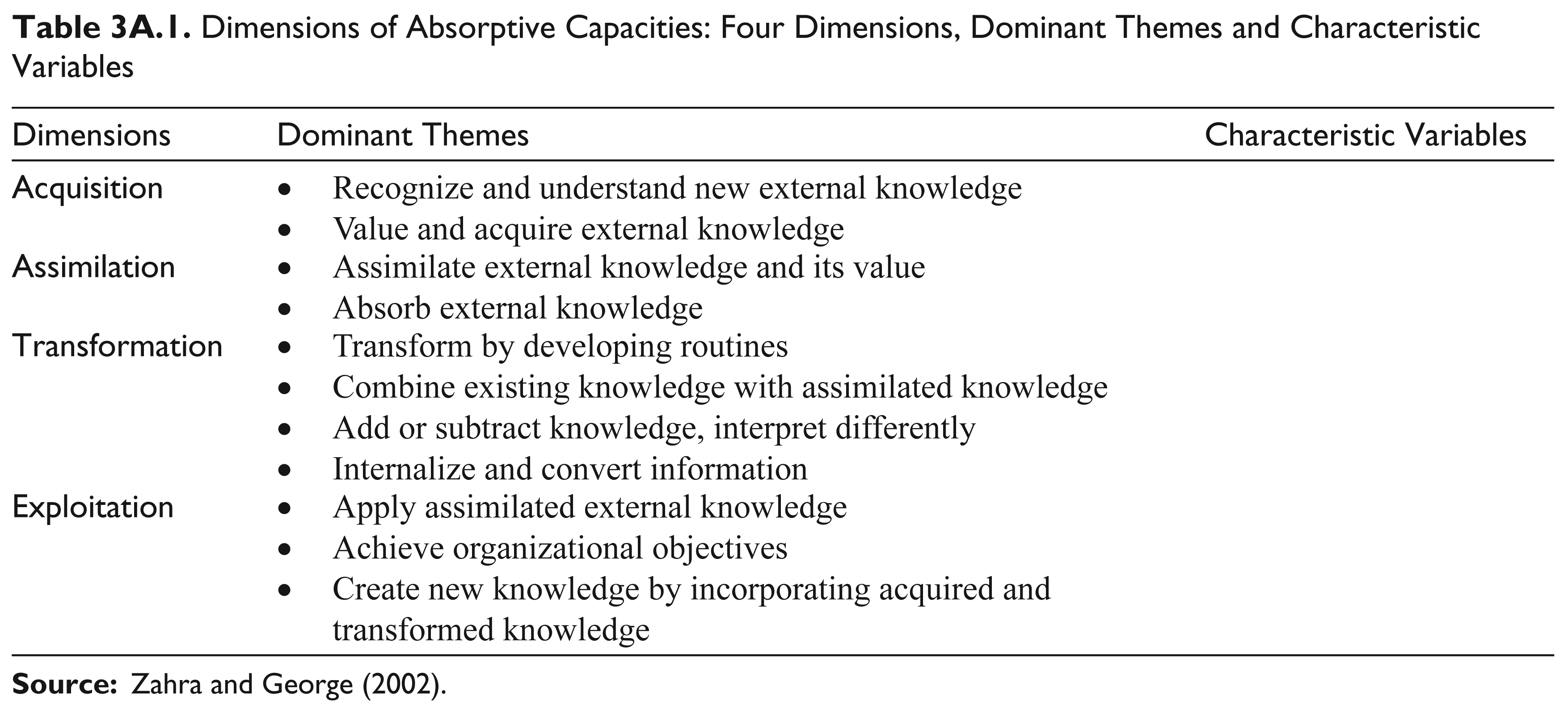
Identify the typical variables (Appendix 3, Col. 3) which constitute the different absorptive capacity dimensions proposed by Zahra and George (2002).
In terms of the process exploitation phase, what are the effects of the process for the winegrower? Can one extrapolate these results to the Syndicate members?
Complete Todorova and Durisin’s model (2007) (Appendix 4).
Can one say that a collective strategy has been implemented?
Footnotes
Some Information about Laurent Daheuiller and His Domaine
The Domaine des Varinelles, with its lovely bucolic name reminiscent of lavender fields, is an old property run by the Daheuiller family. The Vineyard currently covers 42 ha planted with Cabernet Franc, Chardonnay and Chenin vines over several hamlets known as ‘les Petits Clos, les Bonneveaux, le Clos Marconnet and les Poyeux’. The vines are very old, on average 35–60 years, with some plants dating from 1900.
The soil is calcareous clay. Grass is planted between the vine rows and the aim is to grow sustainably. This delicate work is carried out by a young, environmentally aware team. Nearby, at the house, the temperature-controlled cellar stores the vats in thermo-regulated autopigeantes (automated crushing) stainless steel tanks where the entire harvest will arrive once it has left the sorting table. Maceration takes between 15 and 30 days.
Awarded numerous prestigious distinctions: ‘Saumur–Champigny 2010’–Silver Medal at the 2011 Independent Winemaker’s Competition and listed in the 2012 Dussert-Gerber Guide. ‘Saumur–Champigny Vieilles Vignes 2009’–Silver Medal at the 2011 General Competition in Paris, Silver Medal at the 2011 Independent Winemaker’s Competition and awarded a star in the 2012 Hachette Guide. ‘Saumur–Champigny Larivale 2008’–Gold Medal at the 2010 Independent Winemaker’s Competition. ‘Crémant de Loire Rosé’–Silver Medal at the 2011 National Sparkling Wine Contest. ‘Saumur Blanc 2009 L’Ingénue’–listed in the 2012 Dussert-Gerber Guide. And ‘Saumur–Champigny Laurientale 2010’–awarded a star in the 2012 Hachette Guide, etc., to mention but the most recent.
Thierry Germain,Winegrower and Founder of the Biodiversity Concept in Saumur–Champigny
Originally trained in Bordeaux, Thierry brings his sensibility to the noble Cabernet Franc grape to what is arguably some of the most suitable terroir for it in the world, the Saumur–Champigny appellation in the central Loire valley. The special combination of clay, limestone, flint and alluvial soils helps to produce wines with power and elegance at the same time. When cropped at low levels, these vines produce Cabernet Franc with wonderful purity, length and precision which can age for decades. 11
Thierry Germain, a Varrains producer, is the man who persuaded the Saumur–Champigny winegrowers’ Syndicate to sign the now famous biodiversity charter. An advocate of biodynamics, motivated by his reading of The Metamorphosis of Plants by Johann Wolfgang von Goethe, Thierry Germain views and treats his vines as living beings and equals.
Amongst the vines, the Bordelais, planted in Varrains in 1991, is thriving.
‘This will be a difficult year, especially for the whites’, he says, inspecting his grapes.
In 2010, Thierry Germain was voted ‘Winegrower of the Year’ by the very exacting Revue des Vins de France, a title granted for the first time to a producer of Loire wines.
In discussion with Thierry Germain one sunny Wednesday in December 2011, he confessed that his inspiration had come from Roussillon, specifically the Rousselot domaine. Rousillon remains for him a prime example of biodiversity, so great is the improvement of its landscape and wines.
Different Absorptive Capacity Dimensions According to Zahra and George ( 2002 )
Dimensions of Absorptive Capacities: Four Dimensions, Dominant Themes and Characteristic Variables
| Dimensions | Dominant Themes | Characteristic Variables |
| Acquisition |
Recognize and understand new external knowledge Value and acquire external knowledge |
|
| Assimilation |
Assimilate external knowledge and its value Absorb external knowledge |
|
| Transformation |
Transform by developing routines Combine existing knowledge with assimilated knowledge Add or subtract knowledge, interpret differently Internalize and convert information |
|
| Exploitation |
Apply assimilated external knowledge Achieve organizational objectives Create new knowledge by incorporating acquired and transformed knowledge |
Todorova and Durisin’s Absorption Capacity Model ( 2007 )
Todorova and Durisin (2007) suggest a model for the absorptive capacity of knowledge:
At the input stage, the organization seeks to recognize the
value of past knowledge, its own experience and the experience of
others. The absorptive capacity process takes Zahra and
George’s categories (Appendix 3) and
determines power relationships, regimes of appropriability, social
integration mechanisms and activation triggers. At the output stage, the authors concentrate on the
competitive advantages generated by the previous
process.
Acknowledgements
The authors would like to thank the participants of the International Conference on Management Cases, 2012, held on 29–30 November at the Birla Institute of Management Technology, Greater Noida, India, for their constructive comments on previous versions of this case.