




Abstract
In an effort towards business survival, an executive team considers progressive options for the future of their organization. The external business environment continues to change with fierce competition, a battle for talent, budget pressures and changing customer demands. What does it take for a large multinational Fortune 500 ‘logistics’ organization based in the USA to modify the culture and become an acclaimed learning organization? A decision to conduct employee ‘culture’ surveys in combination with other efforts was implemented. The authors share the experience of an organization’s odyssey to a learning organization through a change of culture.
Introduction
The purpose of this case study is to explore and understand the multiple ways in which organizations learn and utilize the knowledge of its own culture to foster organizational change through organizational learning. This case study will explore perceptions of leaders and employees through surveys. Three identical surveys of employees at various levels of responsibility conducted over a period of 2 years form the underpinnings of a review and assessment to inquire whether the change of culture in the company was achieved and evidence of a learning organization as a consequence can be ascertained. The methods of changing organizational culture, leadership styles, different survey designs and the process of creating a learning organization are at the focal point of our discussion.
The Case
ABL Logistics (in short ABL—name changed to hide identity) is a Fortune 500 ‘logistics’ company based in the United States Midwest region. Despite its large portfolio, ABL has been very successful for several years with a small number of lucrative products. The executives believed that the demand for selected profitable product would continue to grow. The original company was established in the 1900s as a small business and expanded in the 1980s after strategic mergers. The early years of 2000 saw the original company ABL being engaged in a handful of additional mergers and spin-offs. At its peak, the company employed more than 25,000 people. Then, around 2010, a separation occurred, which led to the formation of two large logistics companies, instead of one behemoth. ABL is one of these entities that was left with a smaller portfolio and more than 10,000 employees that work globally in the USA, Canada and Puerto Rico.
The 2013 net revenue of ABL of over US$17 billion was less than the previous year. Likewise, the net revenues of the years 2012 and 2011 were lower than projections.
The former headquarters of the company was located in the Midwest with over 36 manufacturing facilities. Five more facilities were located in Canada. Several distribution centres leased space to ABL, for storing a score of product categories in the USA. The ABL’s customer base includes grocery store chains, supermarkets, drug stores and retail food outlets. Some competitors introduced natural products for health-conscious segments. However, ABL lacked the resources to execute globally and was, therefore, unable to enter this marketspace. Some leaders had concerns over the employees who ‘survived’ the company’s previous mergers and spin-offs and did not want to lose any top talent. Led by a third-party vendor, the new company’s leadership initiated a series of culture assessment surveys for 10,000 salaried employees. Three surveys were completed in 24 months.
The executive team hoped that the culture surveys would move the company towards a revised performance-based and customer-centric organization that would help ensure ABL maintain its dominant position in the ‘logistics’ industry. It would also give the paternalistic top leaders direct feedback and insight into the frame of mind of current employees at all levels of the organizational hierarchy. Is this effort, steered by the executive team, alone and independently enough, for the changing the culture, which would lead to the development of a learning organization? Which steps would you as a consultant, guide the top leadership team, to take next?
Survey Design
The logical design of the survey was intended to elicit employees’ perceptions on how company ABL can move to a new company culture, one that would include the following employee-derived attributes:
Simple and efficient structure and processes. Metrics that can measure performance driven outcomes. Drive towards employee ownership with differentiated rewards based on performance outcomes. Engaged employees and increased communications.
Three identical surveys were administered over time: (i) in spring 2013, (ii) in fall 2013 and (iii) in spring 2014. The survey design contained 12 items with two open-ended comment questions. The 12 items gave employees the option to respond on a five-point Likert scale permitting a respondent to select ‘agree…tend to agree…neutral/question mark’, or ‘tend to disagree’ and ‘disagree’. The results of the survey are determined by ‘favourability’, that considers the sum of the ‘agrees’ and ‘tend to agrees’ responses. There were also three benchmark groups the consulting company made available for ABL to compare against. These included: (i) fast-moving companies in the USA, (ii) transnational companies in the USA and (iii) innovative companies in the USA. For purposes of this case, study employees shall mean respondents.
The following 12 items assessed aspects of the current organizational culture:
I have a clear understanding of the goals and objectives of ABL. I understand how my work impacts ABL’s results. I have the equipment/tools/resources, I need to do my job effectively. ABL does an excellent job of keeping employees informed about matters affecting us. Leadership acts in a way that is consistent with ABL’s values. I trust the decisions made by our leaders. My manager gives me a regular feedback on my performance. I believe that I have an opportunity for personal development and growth at ABL. My manager recognizes and appreciates good work. ABL continually works to ensure our processes are as simple as possible. I am empowered to make the decisions needed to do my job well. I would recommend a family member or friend to come work at ABL.
Survey 1: Spring 2013
The survey was administered electronically to all salaried employees. The overall participation rate was 82 per cent. According to the consultants that were commissioned to administer the survey, the response rate was above the 75th percentile as compared to other companies that took the same survey.
There were following two open-ended comment questions:
Which topics related to our company would you, or your team, like to understand better? In the new ABL, we want to create a more customer- and consumer-centric focus. What can we do more of to drive ABL to this new customer and consumer culture?
Survey 1: ABL results compared to the benchmark companies rated in the following ways:
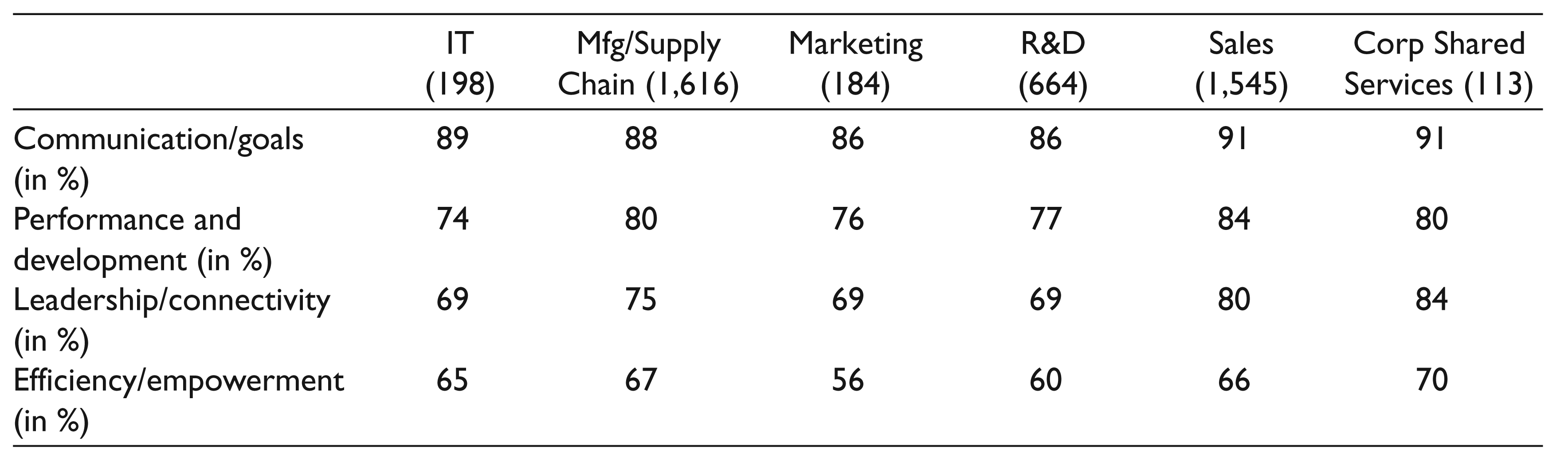
Questions 1 and 4 covering communication and goals were significantly more favourable than the benchmark companies. Questions 5 and 6 covering leadership and connection to the company were significantly less favourable than the benchmark companies. Questions 3, 10 and 11 covering efficiency and empowerment were significantly less favourable than benchmark companies.
Noticeable was that the question: ‘I have a clear understanding of the goals and objectives of Company ABL’ scored the highest in the benchmark. The question ‘Company ABL continually works to ensure our processes are as simple as possible’ scored the lowest in the benchmark.
Tables 1–3 show a sample of the survey results for the various larger constructs that the individual items represented.
Business Units and Corporate

Job Function
Job Levels

Assessing the overall qualitative comments showed favourable regard for leadership but a desire to see more authenticity. Employees also felt the organization was extremely bureaucratic, which hampered their ability to act decisively for the good of the company. Feedback on the survey results and brainstorming sessions on how to move forward to the desired state were conducted post-administration of survey 1.
Survey 2: Fall 2013
The second survey was again issued electronically to all salaried employees. The overall participation rate was 79 per cent. According to the third-party consultants that company ABL hired to administer this survey, the response rate was above the average of 75th percentile as compared to other survey clients.
One more open-ended question was added to the second survey. There were the following three open-ended comment questions:
At ABL, we want to create a customer- and consumer-focused and performance-driven company, where each employee is excited to come to work every day. What can we do more of, less of, or continue to do to drive the changed company ABL’s new culture? Since the last survey, we have focused on process simplification. Please describe the impact of process simplification efforts on your day-to-day work and/or add any further process simplification suggestions. How do you receive information about issues impacting our company (e.g., my manager, company email, town halls and intranet)?
Survey 2: company results compared to the benchmark companies in terms of the larger constructs were as follows:
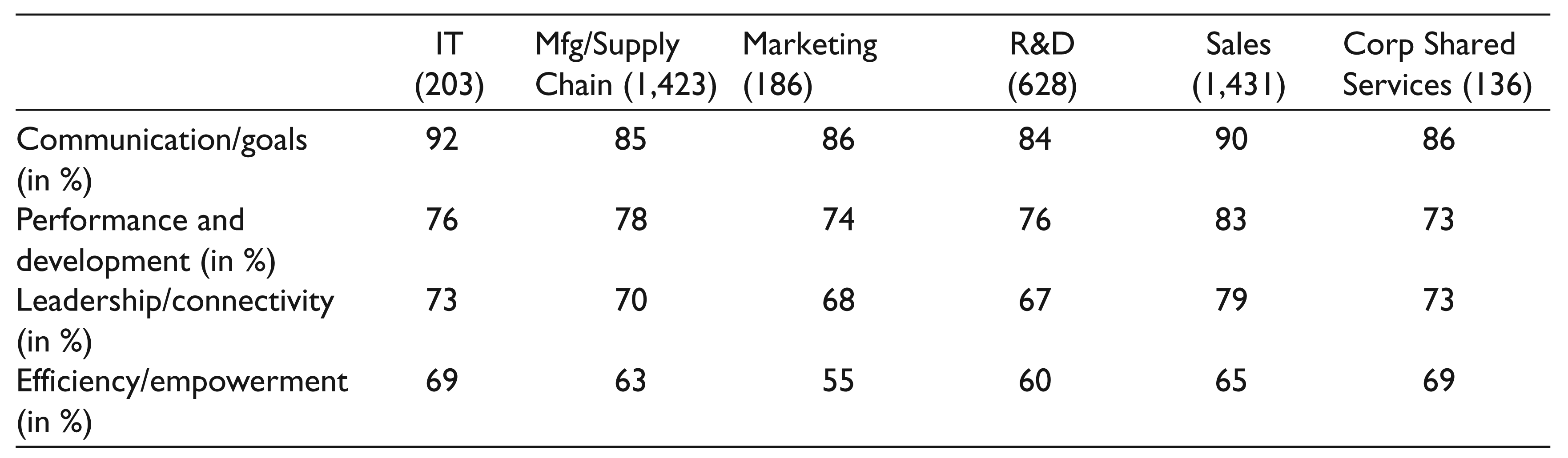
Questions 1 and 4 covering communication and goals were significantly more favourable than the benchmark companies. Questions 7, 9 and 8 covering performance and development were significantly more favourable than the benchmark companies. Questions 5 and 12 covering leadership and connectivity were significantly less favourable than benchmark companies.
Noticeable that the question ‘ABL continually works to ensure our processes are as simple as possible’ scored the lowest in the benchmark.
Tables 4, 5 and 6 show the survey results for the larger construct represented by the individual items.
The qualitative responses from the three open-ended questions reflected a desire from employees to have better leadership, communication and efficiency. Employees felt the processes needed to be further simplified. There was a desire to receive communications that were not solely department-specific, but were company-wide, to learn directly from the executive team about other areas of the organization instead of obliquely through ABL’s ‘grapevine’. The leadership concern was that directives are aligned and allowed ample time to be completed with high quality. Feedback on the survey results and brainstorming sessions on how to move forward to the desired states were conducted post-administration of survey 2.
Business Units and Corporate

Job Function
Job Levels

Survey 3: Spring 2014
The third survey was issued electronically to all salaried employees. The overall response rate was 74 per cent.
These were the three open-ended comment questions:
At the ABL, we want to create a customer- and consumer-focused and performance-driven company, where each employee is excited to come to work every day. What can we do more of, less of, or continue to do to drive the new culture of ABL? Please describe the impact of process simplification efforts on your day-to-day work and provide additional simplification suggestions. Please describe behaviours, we need to do more/do less to demonstrate a culture of simplicity. It is important that leadership acts consistently with our values. How do you see leadership living our values day-to-day? What can leadership do more of, and how could they role model our value across the organization?
Survey 3: Results for ABL compared to the benchmark companies for the larger constructs:
Questions 8 and 9 relating to performance and development issues were significantly more favourable than the benchmark companies. Question 4 relating to leadership was significantly less favourable than benchmark companies. Question 3 relating to empowerment issues (e.g., my manager gives me feedback) was significantly less than the benchmark companies. Questions 1 and 3 relating to efficiency and empowerment issues (e.g., I am empowered to make decisions) were significantly less favourable than benchmark companies.
Noticeable was that the question ‘ABL continually works to ensure our processes are as simple as possible’ scored lowest in the benchmark.
Tables 7, 8 and 9 show a sample of the survey results for the various larger constructs.
Age/Generation Group

Job Function

Job Levels

Qualitative responses from survey 3 showed discontent with the required speed to get work done with the current complex work processes. There was tremendous discontent with the degree of bureaucracy within the organization, with little genuine support perceived by the employees from leadership to alter the level of efficiency between departments. Many employees believed that leadership had too narrow a focus on the ‘now’ and no vision for the future and its concomitant long-range plans. Mixed comments on leadership were noted, where many applauded the leaders, who appeared to be their local/close management, with concerns for the executive leadership team to pay more attention to lower level employees.
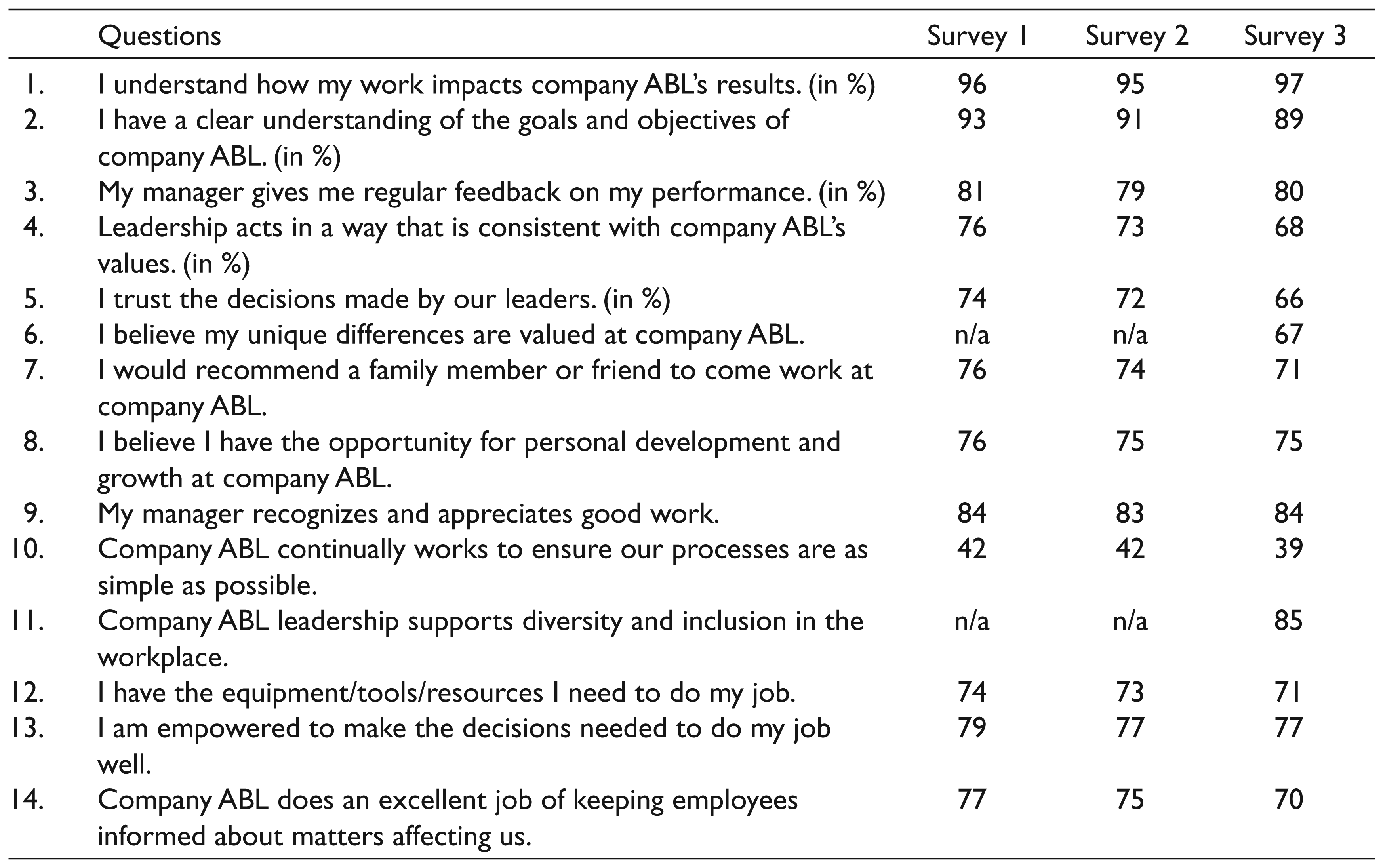
The compiled view of the three surveys (Table 10) shows a 1 per cent increase in scores for Question 1 only, that is, ‘I understand how my work impacts company ABL’s results.’ Statements 4, 5 and 14 moved in a negative direction with percentage decline. A t-test revealed that these changes were statistically significant. If the organization intended to gain knowledge of the culture, drive the change and derive valuable learning, the somewhat convoluted results fail to provide important take a way. The only benefit from the surveys appeared to be a further exploration into the perceptions of the employees. However, the question remains whether the surveys were precisely constructed to glean the information ABL had intended to obtain. In other words, was the survey developed by an external vendor valid and reliable?
The evaluated results of each survey was discussed with top leaders. Next, results were presented to the level below senior leaders, with a mandate to request their business units to host town hall meetings and discuss the survey results. Between the time it took for business units to get detailed results, in the interim, mass communication was planned from the CEO giving a macro view of the survey (e.g., with an emphasis on company results). Some managers argued arduously that action plans be developed and led by each human resources (HRs) leader for businesses that the HR leader supported. This debate resulted in inconsistent lower level roll out of the survey results.
A selected number of major business unit leaders decided to utilize their top talent with a mandate for them to attend cohort-style leadership classes. They believed this objective to form a team would overcome the deficiencies in those major areas found from the survey to drive the needed improvement. One team was formed to craft a new vision statement for the organization, and a statement was unveiled at an all-employee meeting accompanied by a t-shirt giveaway at the reception. Other business group leaders assigned sub-teams to conduct focus groups. They were tasked with exploring the potential development opportunities for the business. The focus groups comprised of a smaller set of employees specific to the business unit or department and the individuals’ feedback were reported.
Comparison of Overall Company Results of All three Surveys—Number Indicate Percentage Favourable
Next, a list and summary of opportunities were provided to each business unit’s senior leader. The leader was expected to develop an action plan that would address the opportunities and create an avenue to brainstorm on what actions could most effectively beget positive change. Only the vision launch ideas were communicated companywide in 2014. A corporate update to the performance management process was added to flesh out the how, as in ‘How were employees demonstrating the company values in their daily work’, which included simplicity, shared winning and trust building.
Hiring and promotions were on the decline as a measure to maintain cost. The 2014 business revenues were down slightly but not significantly, when compared to the previous year’s revenues, which were flat. This was not an encouraging trend for a large publicly traded company that in many ways had served as a regional and national economic bellwether firm.
Theoretical Considerations
The executives felt strongly that the organization had to learn and grow at an accelerated pace consistently. According to Yang, Watkins & Marsick (2004), the co-mingled involvement of people and culture are necessary constituents to create the learning organization. Learning may occur at various levels; individual, team and organizational (Watkins & Marsick, 1999; Yang, Watkins & Marsick, 2004). Watkins and Marsick define ‘learning organization’ as ‘an organization that has an enhanced capacity to learn, adapt and change. It is an organization in which learning processes are analyzed, monitored, developed, managed and aligned with improvement and innovation goals’ (Gephart, Marsick, Van Buren & Spiro, 1996). Yang et al. (2004) write that there are multiple dimensions of a learning organization that can be measured, which can impact organizational results.
With no substantial improved business, the executives continued to search for answers to ensure the organizational survival. A search within its own culture was seen as the primary avenue for change. Considering the implications of this companywide change, is it true that they have always needed to adjust by embracing innovation, speed, interpreting customer sentiment and spending habits, in order to be and remain a viable logistics business? What is different now? The added challenge in a hyper aware and diverse culture has been to equip and foster a myriad of people, maintain top talent amidst issues, business challenges and financial forces that compel an organization to learn and coordinate rapidly in this information age for success of the organizations (Garvin, 1993; Schein, 2004; Senge, 2006). The complexity of change, learning and diverse employee populations at multiple sites in addition to the changing business environment causes a quandary in how to move forward. This dichotomy of the former business process, cultural dimensions of the organization and the need to change in the quest for ever changing customer preferences and performance measures leads to the ubiquitous and commonplace need to continually learn. How can you operationalize culture change that leads to learning to impact an organization’s performance (Bhatnager, 2006; Yang, Watkins & Marsick, 2004; Zhou, Hu & Shi, 2015) for the better?
The interaction between culture and organizational learning remains a complex relationship. Learning organizations have gained much attention in the academic arena (Watkins & Golembiewski, 1995; Yang et al., 2004) but must also be seen as contextually intertwined with the organization’s culture (Schein, 1996; Yang et al. 2004). Culture is a dynamic construct that is not easy to understand in many organizations, due to its various levels of artefacts, beliefs, values and underlying assumptions (Schein, 2004).
Empirically, much more can be understood about the learning organization by assessing the organizational culture. The challenge and dilemma are sifting through a variety of models, styles and approaches to select and implement (Burke, 1994, 2014; Kegan et al., 2016; Kotter, 1995; Pasmore, 2015), when dealing with change, culture and learning.
Discussion and Debate
In conclusion, within 6 months the organization announced its intention to merge again with another US ‘logistics’ company. The merger was successfully initiated; company ABL headquarters moved, and culture surveys ceased.
This case impresses upon this researcher the daunting task of cultural change in organizations. It also emphasizes the difference between organization learning and an organization’s purposeful momentum into becoming the learning organization. The organization learned about employee perceptions from the survey responses; yet, it is unclear as to what was distilled further from this knowledge to learn to become the learning organization? How was the knowledge shared and exploited to drive improved survey results? What new approaches to process or leadership change were implemented? The series of surveys showed evidence of learning about the organization culture, perceptions, strengths and weaknesses, but was that enough? The organization gained perspective of what employees desired to change, improve and obtained detailed insight into other concerns. Did the information and ideas engender a learning organization? What particular organization, function, business unit or salary level culture implications arose? Were the teams connected enough to drive heightened team learning with empowerment? How was the bureaucracy handled? Furthermore, was there a significant change in the survey results between surveys? What could that mean?
Debate further, what are the implications for organizations and how they handle these ever-evolving characteristics of corporate survival? How could this organization exhibit speed to change that drove improved results and performance? What could have been done differently to make the most impact? There is likely no magical formula, yet much to ponder.
Strategically, how can we plan and nurture interventions that foster an environment for learning, reflection and exchange of ideas at multiple levels (Garvin, 1993; Gronhaug & Stone, 2012; Schein, 1996). Is targeted specific learning as opposed to wide, broad based learning best? Alternately, knowing what could be the obstacles to learning and the impact of culture in creating such barriers at various levels of organization should provide a great insight into next steps or the required actions to move forward (Moilanen, 2001).
This case has shown that the connection of the organization’s desire to learn about its culture and environments is only a first step. The desire and capacity to learn along with a process of organization learning that is integrated system-wide in the current context are not easy. Additional steps, plans, interventions or processes may be required using the knowledge obtained from the survey of employee perceptions. Hence, the practitioner must be aware that organization interventions to drive change and in turn enable organizational learning are complex, multilevel and time consuming. Leaders, management consultants, organization development (OD) and HR practitioners have a tremendous opportunity in the workplace today to plan, execute and manage change initiatives in organizations that drive the much-needed learning organization and culture change. Hopefully, our future work will encourage the importance of collaborations with leaders to see the cultural transformation, we all desperately need to enable a learning organization to survive in business today.