




Abstract
The case is structured around the Volkswagen (VW) fiasco wherein large number of cars sold by the company was found to violate the emission norms of EPA significantly. The case traces the origin and history of the firm. Then the case narrates accidental observation of the violation of the emission-norms and response of the firm to the situation. The case contrasts the responses of other firms in the industry who were affected by similar, albeit much smaller level, violation of emission-norms. The case explores the possible courses of punitive actions and the overall impact on each of the stakeholders. The case leaves the reader to explore the responsibilities of each stakeholder and the need to balance the expectations and impacts from the course of action that need to be followed.
Keywords
Introduction
On 18 September 2015, the Environmental Protection Agency (EPA) of USA issued a notice on the German automobile giant Volkswagen (VW) Group for violation of the Clean Air Act and ordered recall of nearly half-a-million vehicles.
The EPA was convinced beyond reasonable doubt that the car maker had deliberately manipulated the device monitoring the release of obnoxious nitrogen oxide (NOx) gases and managed to show the vehicles within the tolerable limits, whereas the actual quantum of release was far in excess of the limits. The EPA asked VW to give a plan for the recall of vehicles by 26 April 2016. This was a shocker for the shareholders and investors of VW worldwide; the share prices plummeted in all leading stock exchanges. It was a big question mark on the corporate governance practices and brand equity of VW; it would have serious repercussions on the sales of VW cars in the coming years and the overall financial viability of the company. Did VW indulge in fraud practices consciously or was it an unintentional incident at one location at one point of time?
Volkswagen, its Global Footprint
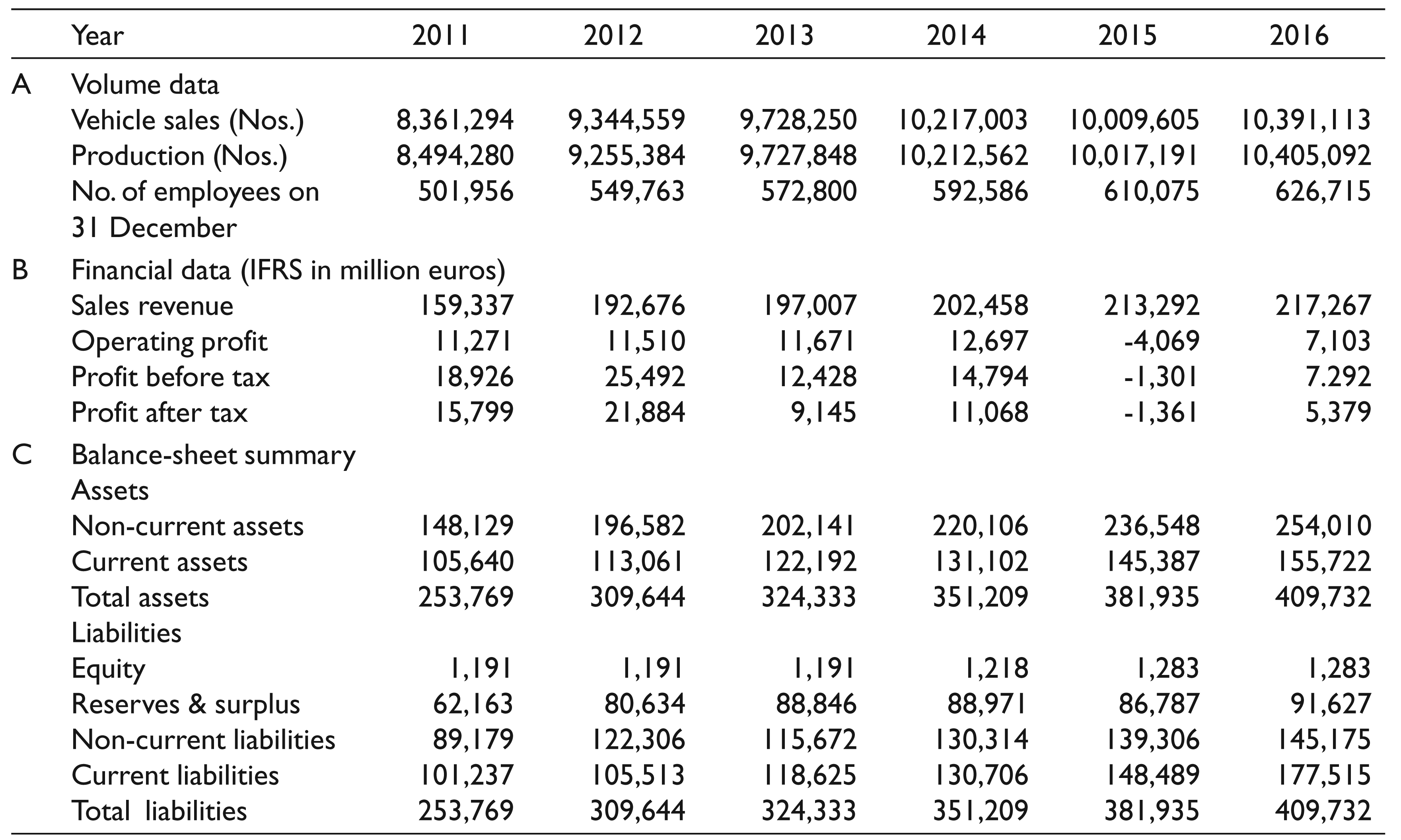
Volkswagen Aktiengesellschaft (AG) was established in 1937 in Wolfsburg, Lower Saxony, Germany to make cars for the common people. Over the years, with trials and tribulations and with precision manufacturing and engineering skills, it has emerged as the second largest seller of automobile in the world by 2012 (Hirsch, 2012). A holding company, VW Group has been created in 1975 to take care of the global operations. By the close of the twentieth century, VW had made its footprint across the world. Apart from Germany, it had manufacturing facilities in Mexico, USA, Slovakia, China, India, Indonesia, Russia, Malaysia, Brazil, Argentina, Portugal, Spain, Poland, Czech Republic, Bosnia, Herzegovina, as well as South Africa. To look after the global operations, VW founded VW Group, a large international corporation handling multiple car and truck brands, such as Audi, SEAT, Lamborghini, Bentley, Bugatti, Scania and Skoda. The VW Group also had its headquarters at Wolfsburg, Germany. By 2008, it had become the third largest automaker in the world (Ganz, 2008); in 2010, it had sold 6.29 million vehicles and held global market share of 11.4 per cent. In 2011, Forbes magazine included VW among the top 25 companies of the world in the Forbes Global 2000. In 2012, VW became the second-largest automobile manufacturer across the world (Forbes, 2013). As on 2014, it had plans to assemble engines in India to increase the indigenization to 90 per cent (Auto Today, 2014); it had plans to set up facility in Indonesia and Algeria in a big way. It aimed to become the world’s largest automaker by 2018 (Autocar, 2016). Exhibit 2 presents the VW’s performance data in brief.
Accusation on Volkswagen
The accusation was that a specially designed software (called ‘defect-device’ or ‘defeat-device’ or ‘cheat-software’) was used that switched the engine to a low-emissions mode during tests. This software turned off the controls when the vehicle was on the road, allowing it to spew out the harmful gases freely. The accusations were contained in ‘Notice of Violations (NOV)’ issued by US-EPA on 15 Sep 2015 and 2 Nov 2015 (US-EPA, 2015a, 2015b).
But how did the ‘defeat device’ know when the vehicle was on test or when it was on road? The computer software installed inside the vehicle could sense test scenarios by monitoring speed, engine operation, air pressure and even the position of the steering wheel. When the vehicle is operated on controlled conditions—which typically involved putting it on a stationary test rig—the ‘defeat device’ would put the vehicle onto a safe-mode of operation: The engine would run below normal power and performance, thereby restricting the emissions within the permissible limits. Once the device recognized/sensed that the vehicle is on the road, it would switch over to a free-mode of operation thereby removing all controls on performance and emissions (Hotten, 2015). All these were possible because EPA allowed vehicle manufactures to do the testing under certified conditions in the manufacturer’s premises. The EPA relied on the recordings of the test conditions and test results submitted by the manufacturers. It resorted to actual testing of vehicles only selectively and rarely (US-EPA, 2016).
Impact on Volkswagen
The problem came to be known when University of West Virginia accidentally found that the cars it tested emitted NOx gases to the extent of 40 times the permissible limits. The EPA, in its Notice of Violation (NOV), has identified the models of VW cars, between the years 2009 and 2015, that have been afflicted by this problem as: Jetta, Beetle, Audi A3, Golf and Passat.
The EPA has estimated that 485,000 cars are affected in the USA, which needed to be recalled. In fact, the NOV has asked the firm to give its plans for recall of the vehicles (Atiyeh, 2016). In other countries such as UK, Italy, France, South Korea, Canada, Germany, etc., politicians, legislators, regulators and environmental groups have initiated investigations on the dealings of VW. In South Korea, Thomas Kuehl, the VW chief in South Korea was being summoned by its Parliament (Agence France-Presse, 2015). Preliminary estimates place the number of cars afflicted by this syndrome at 2.4 million in Germany, 1.2 million in UK, aggregating to about 8.5 million cars in Europe (Hotten, 2015). The global total is estimated at 11 million cars. The time and costs involved in the recall and refurbishing of the vehicles would be colossal and perhaps fatal to the very existence of the firm. Each country, where complaints are lodged with the regulatory agencies, would be dispensing each of the complaints in its own way with fines and penalties; the aggregate impact of these on the firm would be significantly high. Exhibit 3 shows the press release of EPA.
Response of Volkswagen
Michael Hom, Chairperson of VW, USA, said he came to know about the problem when University of West Virginia announced the results of tests in its laboratories (Agence France-Presse, 2015). The VW Group’s CEO, Martin Winterkorn, resigned his position. Heinz Jacob Neusser, Head of Brand Development, was suspended; Ulrich Hackenberg, Head of R&D at Audi, and Wolfgang Hatz, Head of Porsche R&D, were suspended immediately (DNA, 2015). By April 2016, share prices of VW had crashed by 40 per cent. Christian Klingler, board member and head of sales and marketing, had put in his papers. In Germany, the new chief of VW, Mathias Mueller, stated that four senior employees have been suspended but felt the top management was not aware of any fraud (Hamann, 2015).
In early 2015, triggered by the disclosures on VW, Ministry of Transport, Government of Japan, instructed each of the Japanese car-makers to give self-declaration on its compliance to environmental protection norms. Mitsubishi Motors declared that it had used a method of measuring fuel efficiency that was not approved by the Ministry of Transport resulting into overstatement of the fuel efficiency of its cars. Mitsubishi promised to rectify the mistake immediately. Suzuki Motors Co stated that it had employed an un-approved method of measuring fuel efficiency with similar results. The company promised immediate rectification of this error and had voluntarily imposed punitive measures on all senior executives and directors of the company (Bloomberg, 2016) (Exhibit 4).
Remedial Measures
The EPA’s NOV hinted about recalling the afflicted cars and repairing them to normalcy. This would be a colossal measure in terms of costs and time, besides being detrimental to the survival of the firm that was the second-largest automaker in the world. Centre for American Progress, a think tank made an alternate suggestion as a remedial measure to the situation (Putre, 2016). This envisaged
US$18 billion in fines to be paid to EPA Retrofitting public diesel fleets with cleaner technology Making an appropriate contribution to a fund for a project to reduce vehicle pollution in the environment.
Settlement
The District Court at San Francisco, in the last week of June 2016, ordered a settlement for 475,000 numbers of 2-litre cars sold in 44 states of USA, Washington DC and Puerto Rico in the last 7 years (Times of India, 2016). As per the court orders, VW would have to spend
US$10 billion to either buyback or repair the 475,000 vehicles, US$5,000 to US$10,000 as compensation to the owners depending on the age of their vehicle, US$2.7 billion to governments as governmental mitigation charges, and US$2 billion for research on zero-emission vehicles.
The total pay-out on the above accounts comes to US$15.3 billion. Settlement for 3-litre vehicles numbering about 80,000 was still being worked out. This was just the beginning; the company was still facing litigation for billions more in fines and penalties besides possible criminal charges.
Based on the papers submitted in the court proceedings, expert felt that repair of the affected cars to bring back to US-EPA compliance was not technically feasible; they have to be only replaced. The court had also specified that if VW offered to repair the cars, it can be done only after the process of repair is approved by EPA and the California Air Resources Board.
The court order has also specified that on buy-back, the owner must be assured of the clean trade value of the cars that prevailed before 18 September 2015, when the scandal became public. According to Kelly Blue Book, the average value of a VW diesel car was US$13,196 in August 2015 and US$10,674 in May 2016 recording a drop of 19 per cent.
The settlement was with respect to 475,000 vehicles sold in the USA. Globally 11 million vehicles have been affected. The group sale of vehicles in 2014 was 10.2 million vehicles, which was marginally less than the 11 million vehicles affected in the scam. In 2014, the group turnover was 202 billion euros and the profit after tax was 11 billion euros. Contrast these figures with cost of settlement ordered by the San Francisco court. The magnitude of the overall damages the group would have to face was likely to be much greater than what has been ordered by the district court of San Francisco.
On-board Diagnostics (OBD) 1
Over the decades of 1970s and 1980s, the auto manufacturers have been introducing electronically controlled systems to monitor and diagnose the engine functions, performance and problems. This concept had its origins in 1966 when the State of California started requiring emission control systems to combat its smog problem in the Los Angeles basin. In 1968, the Federal Government extended these controls nation-wide. The passing of the Clean Air Act in 1970 and the establishment of EPA thereafter triggered the need for systems to monitor, maintain and control emission norms of vehicles for extended periods of time. This prompted manufacturers to design and make systems that monitored engine performance, emission as well as diagnose the overall performance of the vehicle for extended periods of time.
In 1988, Society of Automobile Engineers (SAE) set the standards of diagnostic signals and parameters; the EPA adopted most of these and paved the way for on-board diagnostic programmes. The OBD-II is an expanded set of standards and practices developed by SAE and adopted by the EPA and California Air Resources Board (CARB) for implementation from 1 January 1996.
When every vehicle on the road had an OBD since 1996, how come the error on the VW vehicles was not detected by EPA or any of the emission-monitoring agencies? The answer lies in the fact that every automobile manufacturer made or sourced the OBD from its own sources on its own responsibility. The EPA or other agencies did not verify the manufacturing process of the OBD nor certify the OBD of its capability and performance before it is fitted on to the vehicle; neither of the EPA had implemented any process to monitor the emission performance of the vehicles while in operation. The agencies trusted the automobile manufacturers for their integrity. This trust had left gaps for occurrences such as the VW fiasco.
One of the methods of plugging this loop-hole is to bring the making and marketing of OBD within closer scrutiny of EPA or similar other agencies: restrict (licence) the number of manufacturers of OBD; certify every OBD before being shipped to the automobile manufacturers; and replace each OBD on its pre-decided expiry date. This may call for fresh legislation; perhaps that is the price of the VW fiasco.
Enigma
Mathias Mueller, the new chief of VW, made a statement that the top management was not aware of any fraud (Hamann, 2015). This statement appeared to lack conviction. Being the second-largest car-maker in the world, well known for its precision engineering and quality standards, would it ever be possible for anybody to fit a VW car with a spurious part before it is sold anywhere in the world? When 11 million cars were sold over a 6-year horizon, with an identical flaw, it could hardly be the case of delinquency on the part of a single mis-guided operator or an assembly unit in isolation. There is high probability of a collusion which cannot happen in an organized firm like VW without the official sanction from the highest quarters.
Should not the organization be purged of the toxic elements responsible for the disaster? Would it be fair to let go of the key executives of VW who were actively involved in the massive fraud on the society at large through just loss of their jobs or positions? The organization of VW needs to be cleaned and pruned simultaneous with the rectification of the afflicted vehicles.
Punitive sanctions like asking VW to rectify each of the 11 million vehicles at once and also pay compensation to its customers and the state would cripple an astonishing organization verging on total annihilation. Would that be fair to an astonishing organization and its stakeholders who were instrumental in creating a whole range of innovations in the history of automotive industry? Would it not be desirable to segregate the organization and the toxic elements that caused the havoc in dealing with the punitive actions?
The EPA and other pollution control agencies across the world owe an answer to the nations and societies that each of them represent for their inherent incompetence, naivety, inefficiency in keeping pace with the technological change. How come they could not detect an on-going disaster for 6 years at a stretch? Do they have a workable solution to prevent such occurrences in the future?
The End Game
In January 2017, VW agreed to plead guilty of the allegations and submitted a ‘Statement of Facts’, which was based on an investigation that VW had commissioned through a US law-firm Jones Day. This report unravelled the modus operandi followed by the engineers in developing the defeat software that enabled the vehicles to get through the emission tests. The report established that the engine department found it difficult to fulfil the expectations of customers and comply with the EPA standards simultaneously. Their solution was to develop software that recognized the standard testing conditions and directed the performance of the engine in a compliant manner. The report also established that the situation was known to the executive management and its decision was only to conceal it (Leggett, 2017). On 21 April 2017, a US federal judge decreed (Rogers, 2017) VW ‘to pay a $2.8 billion criminal fine for rigging diesel-powered vehicles to cheat on government emission-tests’. Thus, there came an end to an unprecedented and unpleasant chapter in the history of automobile manufacturing.
Exhibit 1: Genesis of Volkswagen
In the 1930s, the cars that German firms produced were not affordable to the common man. Deutsche Arbeits Front (German Workers Front) started a firm in 1936 with the object of making cars for the common man. ‘Volkswagen’ literally meant ‘People’s Car’; this was the origin of Volkswagen AG (Manfred, Ulrike & Schlinkert, 2008). The firm’s objective attracted attention of government headed by Adolf Hitler who was searching for a car capable of transporting two adults and three children at 100 kmph, to be put on road at 990 Reichsmark (approximately US$396 during 1930s). This was roughly the price of a motorcycle at that time. In the absence of private sponsors, state decided to fund the project. Ferdinand Porsche, a well-designer of high-end cars, volunteered to design the affordable car.
Before the car could be put on road, war broke out and the priorities got altered. The firm had to make vehicles for the armed forces. Some prominent models that VW facility made during that time were Kublewagen (Bucket Car) and Schwimmwagen (Amphibious car). After the war, the facility came under the British Army administration. As per the Potsdam Agreement 2 all facilities used by the German armed forces were to be destroyed. Major Ivan Hirst, the British Army officer in charge, thought of exploring the facility to make light transport vehicles for the British Army, which was woefully inadequate. This resulted in VW’s first post-war order for 20,000 cars from the British Army (Massey, 2012).
In 1946, VW’s facility was producing 1000 cars a month; given the constraints and the state of the physical facilities, this was considered commendable. In the subsequent years, British Army tried to sell the facility to automakers from USA, UK, Australia, and so on. Many of them visited the site and explored the prospects; none of them felt it was economically feasible (Nelson, 1967; The Guardian, 2000).
In 1948, Heinrich Nordhoff, who had managed production of civilian and military automobiles in the USA, mainly at Opel from 1930s onwards, was brought in to head VW in place of Major Ivan Hirst. The company was restructured as a trust controlled by West German Government and the state government of Lower Saxony. Nordhoff led the company for the next two decades till his death in 1968 (Pre67VW, 2016). These two decades marked a period of steady growth and revival for VW; in fact, VW emerged as a critical element in the economic reconstruction of West Germany (Tooze, 2006). Nordhoff era was characterized by limited models; in terms of passenger cars, VW was known for its single model, Beetle. By 1973, production of Beetles had crossed 16 million vehicles, far ahead of Ford Model T, the previous record-holder (Exhibit 1).
Volkswagen Group—Data on Financial Performance.
2.
3.
Exhibit 3: Press Release of EPA
The full press release from the EPA is reproduced here:
Today, EPA is issuing a notice of violation (NOV) of the Clean Air Act (CAA) to Volkswagen AG, Audi AG, and Volkswagen Group of America, Inc. (collectively referred to as Volkswagen). The NOV alleges that four-cylinder Volkswagen and Audi diesel cars from model years 2009–2015 include software that circumvents EPA emissions standards for certain air pollutants. California is separately issuing an In-Use Compliance letter to Volkswagen, and EPA and the California Air Resources Board (CARB) have both initiated investigations based on Volkswagen’s alleged actions.
‘Using a defeat device in cars to evade clean air standards is illegal and a threat to public health,’ said Cynthia Giles, Assistant Administrator for the Office of Enforcement and Compliance Assurance. ‘Working closely with the California Air Resources Board, EPA is committed to making sure that all automakers play by the same rules. EPA will continue to investigate these very serious matters.’
‘Working with US EPA we are taking this important step to protect public health thanks to the dogged investigations by our laboratory scientists and staff,’ said Air Resources Board Executive Officer Richard Corey. ‘Our goal now is to ensure that the affected cars are brought into compliance, to dig more deeply into the extent and implications of Volkswagen’s efforts to cheat on clean air rules, and to take appropriate further action.’
As described in the NOV, a sophisticated software algorithm on certain Volkswagen vehicles detects when the car is undergoing official emissions testing, and turns full emissions controls on only during the test. The effectiveness of these vehicles’ pollution emissions control devices is greatly reduced during all normal driving situations. This results in cars that meet emissions standards in the laboratory or testing station, but during normal operation, emit nitrogen oxides, or NOx, at up to 40 times the standard. The software produced by Volkswagen is a ‘defeat device’, as defined by the Clean Air Act.
The Clean Air Act requires vehicle manufacturers to certify to EPA that their products will meet applicable federal emission standards to control air pollution, and every vehicle sold in the U.S. must be covered by an EPA-issued certificate of conformity. Motor vehicles equipped with defeat devices, which reduce the effectiveness of the emission control system during normal driving conditions, cannot be certified. By making and selling vehicles with defeat devices that allowed for higher levels of air emissions than were certified to EPA, Volkswagen violated two important provisions of the Clean Air Act.
EPA and CARB uncovered the defeat device software after independent analysis by researchers at West Virginia University, working with the International Council on Clean Transportation, a non-governmental organization, raised questions about emissions levels, and the agencies began further investigations into the issue. In September, after EPA and CARB demanded an explanation for the identified emission problems, Volkswagen admitted that the cars contained defeat devices.
NOx pollution contributes to nitrogen dioxide, ground-level ozone, and fine particulate matter. Exposure to these pollutants has been linked with a range of serious health effects, including increased asthma attacks and other respiratory illnesses that can be serious enough to send people to the hospital. Exposure to ozone and particulate matter have also been associated with premature death due to respiratory-related or cardiovascular-related effects. Children, the elderly, and people with pre-existing respiratory disease are particularly at risk for health effects of these pollutants. VW may be liable for civil penalties and injunctive relief for the violations alleged in the NOV. The allegations cover roughly 482,000 diesel passenger cars sold in the United States since 2008.
Affected diesel models include:
Jetta (Model Years 2009–2015)
Beetle (Model Years 2009–2015)
Audi A3 (Model Years 2009–2015)
Golf (Model Years 2009–2015)
Passat (Model Years 2014–2015)
It is incumbent upon Volkswagen to initiate the process that will fix the cars’ emissions systems. Car owners should know that although these vehicles have emissions exceeding standards, these violations do not present a safety hazard and the cars remain legal to drive and resell. Owners of cars of these models and years do not need to take any action at this time.
More information on EPA’s NOV: www3.epa.gov/otaq/cert/violations.htm
More information on CARB’s In-Use Compliance Letter:
Exhibit 4: Responses of Other Automakers to Environment Protection Norms
In early 2015, Mitsubishi Motors disclosed that it has been using an unapproved method of testing fuel-consumption since 1991 on many models of cars and consequently the mileage-rating of four models of mini-cars were overstated by about 15 per cent. This prompted Japan’s Ministry of Transport to order every Japanese automobile manufacturer to self-report their fuel-economy testing methods. Suzuki Motors responded to this directive of the Ministry of Transport that it too has been using unapproved methods of testing fuel economy. The 86-year-old Osamu Suzuki, Chairman & CEO of Suzuki Motor Company, announced that to prevent the recurrence of improper testing, Suzuki would promote a whistle-blowing system and consolidate testing facilities. Further, to atone for the improper testing and the consequences thereof, Suzuki Motor planned that
Osamu Suzuki will relinquish the position of CEO; a new CEO will be selected shortly. Osamu Suzuki, who would remain the Chairman, would voluntarily accept a 40 per cent cut in his compensation for 6 months after July 2016. Executive Vice President, Osamu Honda, 66, will resign immediately after the Board Meeting of 29 June 2016. Toshihiro Suzuki, 57, son of Osamu Suzuki, President of the company would accept a 30 per cent cut in his compensation for 6 months after July 2016.
All directors would accept a full waiver of their bonuses for 2015. Senior managing officers and managing officers would accept 50 per cent waiver of their bonuses for 2015. Other executives will accept 25 per cent reduction in their compensations for 6 months after July 2016. (Bloomberg, 2016)
[Compiled by the authors based on Bloomberg, 2016]