




Abstract
The approach towards teaching and learning has drastically changed with the advent of technology. Classrooms are no longer what they used to be. The traditional spaces fitted with blackboards and controlled by overbearing/strict teachers have given way to the new-age ‘smart’ classrooms. The post-millennial generation, which is highly exposed to gadgets like smartphones, has a short attention span and seeks quick learning at the click of a button. They want the freedom to decide what and how they want to learn; this wish is fulfilled by technology that has democratized Indian education system. The integration of technology and education was seen as a thrust area for business development in the early 2000s. In 2007, two IIT alumni and serial entrepreneurs, Beas Dev Ralhan and Raveendranath Kamath, started Next Education with the aim of changing the face of education in India by melding it with technology. In a short span of 10 years, it reached over more than 10,000 schools across the country transforming lives of more than 1,000,000 students with its flagship products such as TeachNext, LearnNext, MathsLab, Next ERP and aims at becoming the leader in technology-based education solution provider. The journey has been quite challenging with stiff competition from EdTech market leaders and resistance from various stakeholders. The questions Ralhan and Kamath were facing: How to enter into an industry which was at the nascent stage? How to create its market space and how to sustain it? How to beat the challenges in establishing a foothold in technology-driven education industry?
Introduction to Indian Education Industry
It is a fact that an education system built on the foundation of quality and equity is primal to sustainable success in the developing knowledge economy. Education is no doubt a potent tool for grooming inhabitants of the knowledge society. In India, one of the fastest growing economies, education will enable amalgamation of globalization with localization and will enable younger demographics segment to become global citizens, with their roots deeply embedded in Indian traditions and culture (MoHRD, 2016). With hope in their eyes and an eagerness to learn, the youth of this great nation anticipates another paradigm shift of education that cultivates knowledge with analytical skills, logical reasoning and the capacity to envision past the given that aims for changing lives by ingraining twenty-first century abilities and stimulating deep-rooted learning. This country’s educational framework ought to be so adjusted and executed so the advantages of this system reach the very last one particularly the most denied segments of the society (MoHRD, 2014–2015).
India has an important place in the global education industry. The country has more than 1.4 million schools with over 227 million students enrolled and more than 36,000 higher education institutions (IBEF, 2017). It has one of the biggest highest education frameworks on the planet. However, there is still a considerable measure of potential to facilitate improvement in the education framework. It has become the second largest market for e-learning after the USA where it is expected to touch USD 40 billion by the end of 2017 (IBEF, 2017). Indian education sector is ready to see the real development in the years to come as it will have world’s largest tertiary-age populace and second biggest graduate pool pipeline globally by the end of 2020 (IBEF, 2017). The education market is worth about USD 100 billion and will climb to USD 116.4 billion by the end of March 2017 (IBEF 2017). Currently, higher education contributes 59.7 per cent of the market size, school education 38.1 per cent, pre-school segment 1.6 per cent, and technology and multimedia merely 0.6 per cent (IBEF, 2017). According to data released by Department of Industrial Policy and Promotion (DIPP), total amount of foreign direct investment (FDI) inflow into the education sector in India stood at USD 1256 million from April 2000 to March 2016 (IBEF, 2017).
Over the last 20 years, the educational situation has seen real changes and new ideas have developed, for example, the rights-based way to deal with basic elementary education, student entitlement, a change in paradigm from literacy and basic education to secondary, higher, technical and professional education, the undertaking to stretch universalization to secondary education, and remould the higher education system. Recent improvements incorporate another catalyst to skill development via vocational training which is relevant in the context of development of new technologies in a quickly extending economy in a globalized environment. Need for innovative means of education financing, addressing challenges of globalization and liberalization, acknowledgement of multidisciplinary and interdisciplinary nature of learning and knowledge, productive utilization of public resources and encouraging ways of upgradation of private investment and funding are also being addressed.
Use of ICT in Education
India could envision the usage of information and communication technology (ICT) in education. In the year 1984–1985, Computer Literacy and Studies in Schools (CLASS) was introduced as a pilot project. The reach of ICT is enhanced manifold because in 2010, thousands of computers were installed in upper primary and secondary/higher secondary schools under various programmes of central and state governments (MoHRD, 2016). Gone are the days when only textbooks were used for imparting education, all boundaries and barriers for learning have been removed due to access to internet. ICT has slowly been ingrained into learning process of the education system instead of just being a school subject.
ICT as an Aid to the Teachers in the Classroom
In the past few years, there has been gradual increase in efforts via private channels for creation of video material. These initiatives are based on the textbooks in the curriculum of various school boards, or the National Council of Educational Research and Training (NCERT) suggested textbooks. Most of these increased initiatives are being utilized at urban level where teachers are using it as an aid to their classroom teaching. In this model, instead of a computer, student or the teacher uses only a video projection or equivalent of textbook material, suitably prepared and adapted, with animation features to make it attractive for young children in the classroom. The invincible role of ICT in school education had been highlighted in the national curriculum framework (NCF) 2005. Till 2015, 85,127 ICT-enabled schools—‘smart schools’—were established in India under Rashtriya Madhyamik Shiksha Abhiyan (MoHRD, 2016).
Trends in EdTech Industry
The year 2014–2015 witnessed a huge number of EdTech start-ups founded in India. Substantial funding of more than the USD 100 million was infused in the sector (Bansal, 2016) (Exhibit I). Some recent trends show an increasing focus on the technology-driven education system is going to be the next big thing and will eventually gain a strong foothold (IBEF, 2017):
Byju’s, an education technology start-up, had raised USD 75 million from the US-based firm Sequoia Capital and Belgium-based investment firm Sofina. This funding would be used for improving content delivery, expand product pipeline, new markets launch and building talent pool. Intel Corporation partnered with Extramarks Education, a digital learning solutions provider to get access to the USD 40 billion private school sector in India and thereby provided optimized learning solutions and extended computing technologies throughout the country. EdCast, a technology education start-up based in Silicon Valley plans to invest up to USD 50 million in education-based technology and network with around 500 educational institutions to build digital content and curriculum for them in India. Tata Trusts, part of the Tata Group, has entered into a strategic partnership with web-based free learning portal, Khan Academy, and seeks to use the same technology for providing free education to anyone and anywhere in India. NIIT (training and skills development firm) has partnered with US-based edX to offer online courses from leading international universities including MIT and Berkeley to about 500,000 people over the next 3 years.
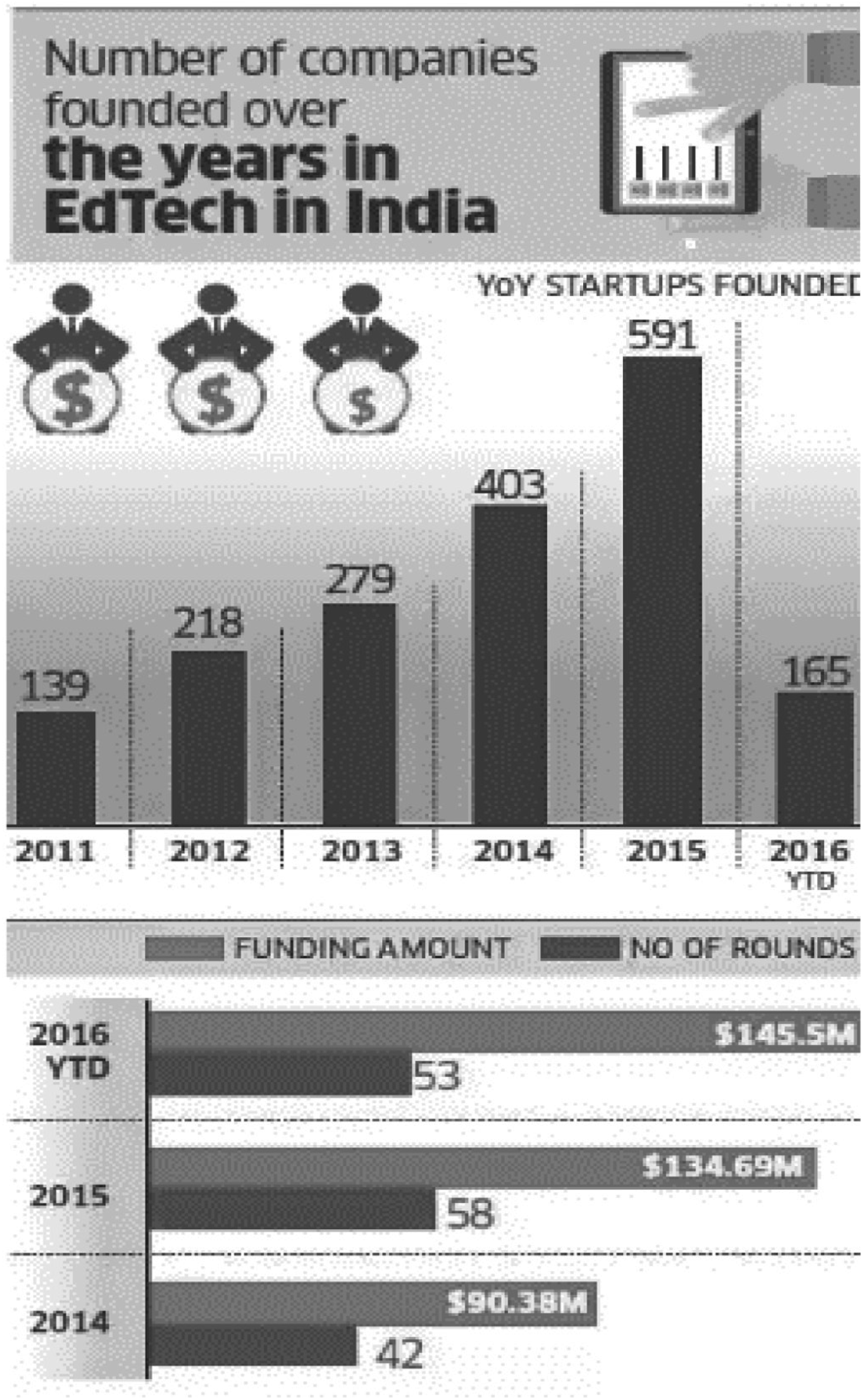
Moreover, the Government of India aims to increase digital literacy from the current 15 per cent level to at least 50 per cent over a period of 3 years (IBEF, 2017).
Identifying the Market Opportunity
Before 2005, technology-mediated education was not given enough importance in schools. Computer science was one of the many subjects in the curriculum, and its application was often neglected. However, with the National Curriculum Framework detailing the importance of ICT intervention in K-12 sector, schools and educators came together to fulfil the mission to ‘devise, catalyze, support, and sustain ICT and ICT enabled activities and processes to improve access, quality and efficiency in the school system’ (Department of School Education & Literacy, 2017).
The aim of introducing the youth to ICT-mediated ways of learning was to enable their participation in the ‘establishment, sustenance and growth of a knowledge society leading to all-round socio-economic development of the nation and global competitiveness’ (Department of School Education & Literacy, 2017). Established in 2007, Next Education aligned its vision to enter this market and has grown as a big player. It felt that this field has a lot of potential to grow, but denuded of the presence of big players, and thus, it decided to exploit the opportunity.
From Party-Gaming to EdTech Company
‘Next Education was started with the thought that technology will change the face of education in the future,’ says Beas Dev Ralhan, Founder, and CEO, Next Education (Vardhan, 2014).
It was the year 2007 when two IIT alumni ventured to be a market changer in the field of technology-driven education. Ralhan and Kamath, serial entrepreneurs who worked together in a venture ‘Party-Gaming’ in Europe, were passionate for a tech-based educational start-up in India. Reminiscing the landscape of technology in education when the duo started, Ralhan points out, ‘Education was the least impacted by technology at that point, which led us to this idea’ (Vardhan, 2014). Next Education evolved as the result of this venture to revolutionize K-12 (kindergarten to class 12) school education in India. Though 2007 witnessed the emergence of many players in the field of digital education, Next Education was determined to bring forth a disruptive change in the education sector. Ralhan and Kamath realized that the existing players did not gave importance to the quality of the digital content and so they decided to focus on this aspect and built up Next Education as a K-12 based education solutions provider driven by the latest technology.
Next Education Philosophy
‘The Indian education system should soon give up on its obsession with textbooks and come out from the old-fashioned way of teaching students for an outcome-based education. Indian schools should be able to rethink and redesign their curriculum for the holistic development of students. They should, however, refrain from blindly copying these methods and develop a system that is best suited for the Indian education scenario,’ says Ralhan (2016). Phenomena-based learning (PBL) provides a holistic overview to the student which helps in a 360-degree understanding and also helps in answering the inquisitiveness of students. Finland, the country with the most successful education and school system in the world, perched at the top of international league tables for literacy and numeracy, has been practicing PBL for long. Adopting this philosophy, Next Education founder wanted to facilitate the education process and to be a complete education solution provider.
The existing vendors were selling computers and projectors as technology solutions. Next Education launched itself on the strength of content. Instead of just dumping videos in a server, all its videos were catalogued as per class, subject, chapter and modules. Besides focusing on content, they also focused on ease of use. Most of the functions of its digital classroom solution, TeachNext could be performed using a remote within just a few clicks. A teacher’s presence was thus not limited to the front of the classroom; the backbenchers got their attention too. The remote lets a teacher move around comfortably and operate TeachNext from any corner of the classroom.
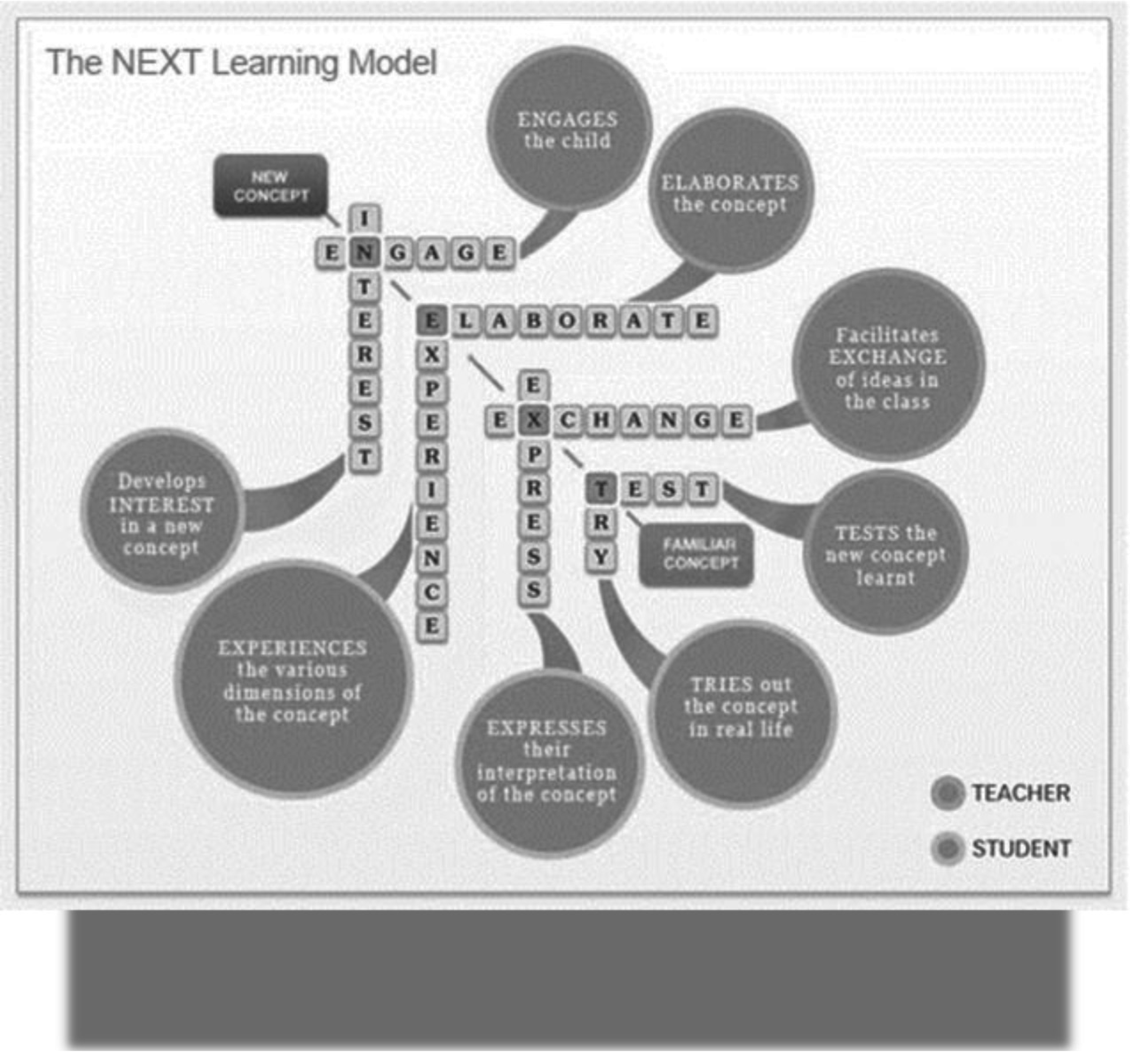
All their products have been designed based on the ‘NEXT’ learning model (Exhibit II), a proprietary model designed by their team of eminent educators for the twenty-first century learners. The ‘NEXT’ learning architecture is an experiential education model designed as a blend of extensive research within the Indian market segment and contemporary international learning design principles (Next Education, 2017). These products are designed to cater to both the key stakeholders in the classroom—the teacher and the student. The teacher becomes a facilitator for the student’s journey in exploring each new concept. During the journey, the student is encouraged to collaborate with other students and together build new cognitive models of the concept being taught. Next Education, a K-12 focused technology-based education solutions firm, has created innovative solutions that make teaching—easy, engaging and effective. Its leading products such as TeachNext, LearnNext, MathsLab, ScienceLab and EnglishLab are used in over 10,000+ schools across country transforming the lives of more than 10 million students. Next Education products are mapped to cover CBSE, ICSE and 29 state boards in seven major Indian languages.
From One to Many
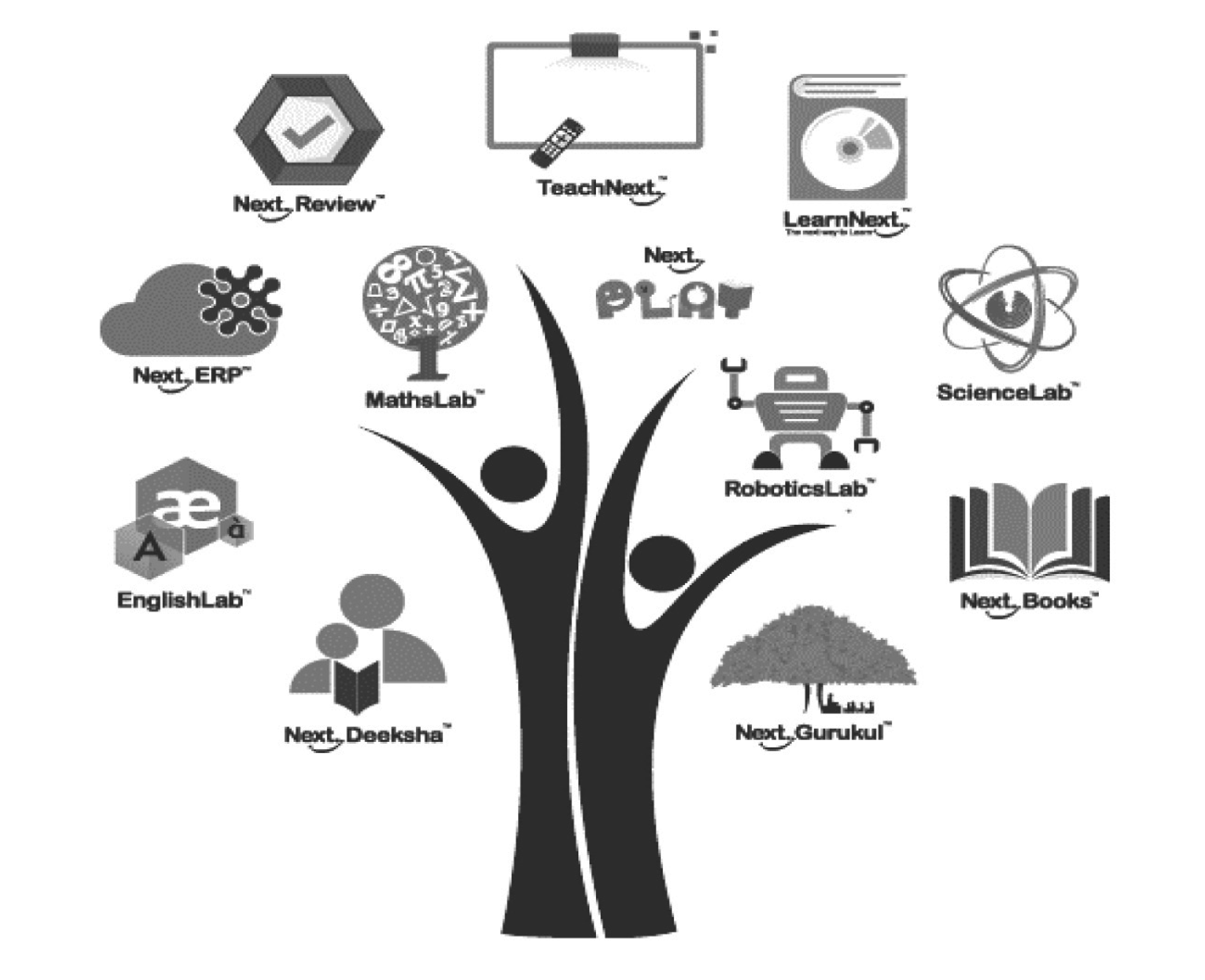
The first product launched by the company LearnNext was targeted at home learning because the duo thought schools might be slow to adopt the technology. ‘The product became an instant hit. Even today we have approximately 65% renewal rate,’ reveals Kamath (Vardhan, 2014). Later, Next came up with TeachNext, a complete digital classroom solution. The content of TeachNext was developed by dedicated in-house team and modules were designed keeping in mind both teachers and students (refer Exhibit III for full product portfolio).
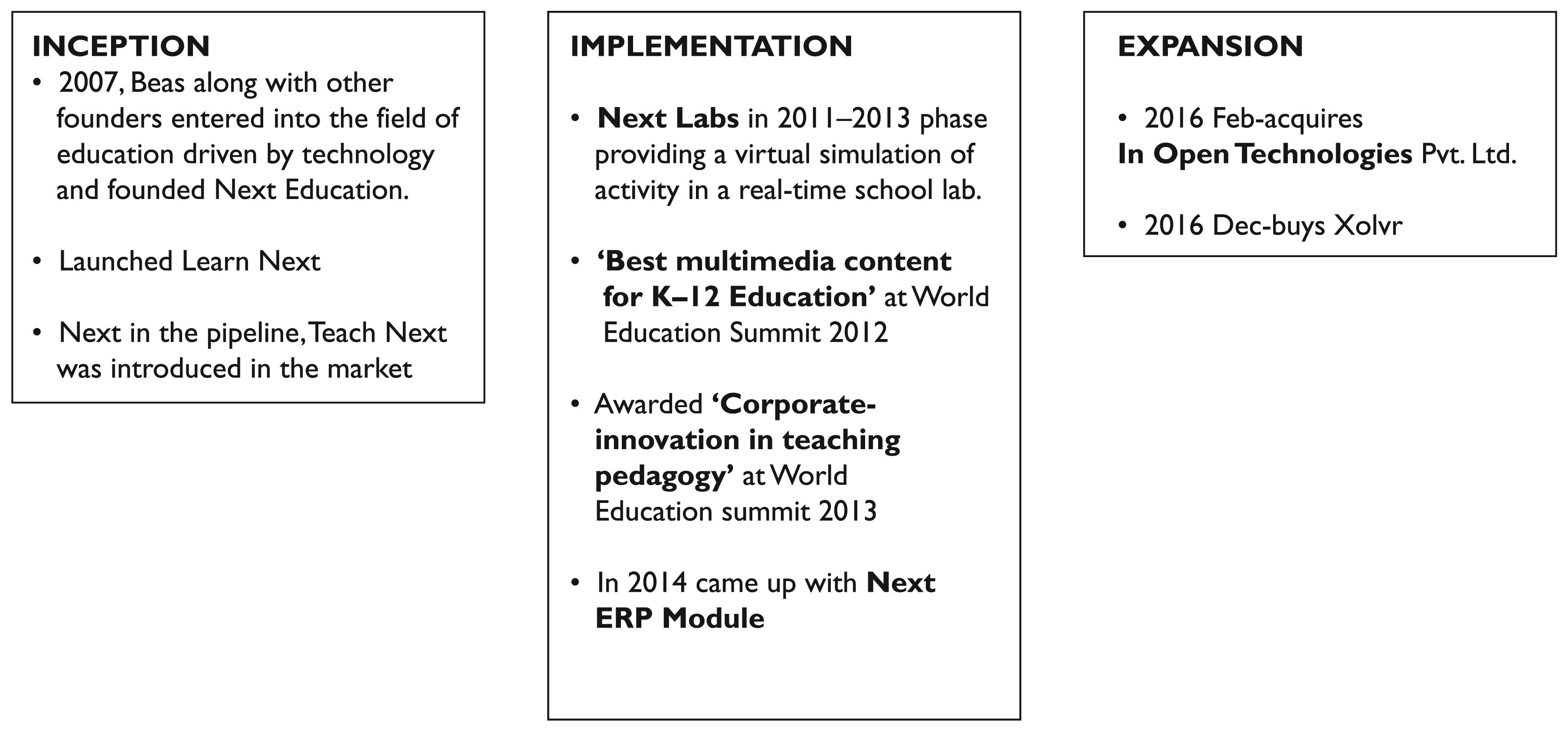
From there, Next moved on to hands-on learning solutions with virtual lab segment which is known as Next Labs in 2011–2013 phase providing a virtual simulation of activity in a real-time school lab. To expand its portfolio, it came up with Next ERP Module in 2014 for providing a complete solution for running a school administration. In addition to that, NextCurriculum, a complete curriculum solution for a more holistic, rounded, grounded education, was also launched. Next also believes in capacity building of teachers. So, an initiative called NextDeeksha—a teacher capacity building programme for teachers and principals—was initiated in 2016 (refer growth timeline presented in Exhibit IV).
Technology: Way of Life
Adoption of the latest technological innovations and pedagogies helped Next to maintain its relevancy in the technology-driven world. Next has devised its very own home-grown business tracking and customer relationship management software, Mobile Customer Relations Management (M-CRM). All order processing was carried out through this. M-CRM ensured timely information and communication across multiple stakeholders. Because it was developed in-house, the processes complemented the technology well. These processes were not dependent on any third-party software, and hence, work and processes were never disrupted. The tech team was always quick to address any bug or issue disrupting the school’s work. Moreover, CRM facilitated automatic agreement generation that helped in speeding up the entire post-sales process and enabled to serve customers better. They have been able to reduce turnaround time from 7 to 4 days. The entire book delivery was automated from processes to vendors. All processes were fast and transparent. In fact, it was the first one to launch distributor portals. They could track the usage of products by students and teachers also. This definitely helped teachers and principals to understand the involvement of students and teachers, respectively. These reports lent valuable insights too. Depending on the usage of products, the executives understand whether they would be able to go and sell more in the market or develop complementary features and products.
Next Education has got a brilliant team of 300–400 engineers for developing the Internal M-CRM system through which the processes were smoothened out. Next had a 5-year contract period in which they provided customer services that included upgradations due to changes in the curriculum. ‘This provides sustainability to the business and creates long-term relationships with the customers,’ says its operations manager. As the density per district has increased, Next was working on optimal margins and utilization of workforce. As a result, decision-making was faster as per the dynamics of the environment—enabling implementing change faster than the competitors.
Innovation Culture that Helped in Excelling
Ravi Kumar, Assistant Vice President, Next Education (UP and Uttaranchal), says, ‘Multiple factors keep the sales team motivated that include timely incentives.’ During his time in the organization, he has progressed from a management trainee to AVP Sales, and his growth has happened alongside that of the company. Ravi recollects his conversations with the founder, ‘Whatever we deliver that product will be a quality product, no compromise on that. All content will be in-house R&D and will not be outsourced.’ At Next sales, the attrition rate was low, owing to incentives such as earning, stability, reach—growth, incentive plan, year plan roll out (dinner, trip, certificate of recognition, appreciation). Salesforce greatly motivated to challenge on face to compare with the competitors regarding content; to instil this spirit in DNA is a challenge too.
Pallavi, PR specialist, Next Education, says,
There is a lot to learn as the head honchos of the company are genuine and down-to-earth. Being creative is appreciated here. Flexible working schedules and the options of work-from-home make the workplace environment comfortable. Employees who work in the field are provided with M-CRM so they can easily track their work and select schools in their area. There are open-door policy and women safety policy in place. There are also a lot of employee engagement activities—birthdays, farewells, festival celebrations, cultural events and team outings to motivate employees.
Her discussions reminiscent founder’s words that say, ‘If we want to grow in life, we have to be flexible and hardworking.’
According to Vinod Raj, Creative Director,
I have been associated with the founders since Party-Gaming days. They floated Next Education, and I joined them after a month or so. It took me around 3–4 months to figure out how to go about it. There was no style guide, no clear instructions. I figured it out all eventually. Since then, we have strategized a lot. I have learnt and innovated simultaneously. The CEO has never come up to me and asked to make a claymation or a motion capture studio. These are the innovations of my team and me. The CEO trusts our work and gives us full creative freedom. I had got an offer from Disney, but I never wanted to go abroad. But there was no limit to my ambition and passion. I wanted to work in a world-class 3D studio. Now, Next Education has a 3D studio. It has been like I pursue my dream, passion, and ambition and draw a salary too. The management is absolutely dedicated to investing in innovation and creativity, and they never let anything come in between.
Taking it Forward
With the aim of becoming a complete education solution provider, Next Education has acquired three firms in the year 2016. It had acquired the robotics lab program RoboLAB from ThinkLABS soon after it has acquired Gurugram-based education technology start-up Xolvr (Bansal, 2016) in late 2016 which is an online one-to-one learning platform for high school students and would be integrated with its self-learning platform LearnNext. It also acquired InOpen Technologies, an IIT Bombay incubated start-up for its K-12 computer science product Computer Masti.
After almost a decade in the industry, Next Education is no more an education start-up but a major player in this segment. It has partnered with 10,000+ schools, established 60,000+ digital classrooms and helped almost 10,000,000+ students. The industry has validated its credentials. It has been awarded more than 20 awards since its inception. In the year 2016, it was awarded ‘Innovation in Pre-school Pedagogy Award’ at World Education Summit, New Delhi.
It aimed to be a complete education solution provider and transform the way education is provided in the country. It has already functioned at an optimum productivity level and planned to expand further in other tier-II and tier-III cities in India. It believed that technology in education was the game changer and it worked towards using the best of the technology to make learning an engaging affair. To that end, it aimed to advance in technologies like augmented reality (AR) and virtual reality (VR). The opportunities in this segment were enormous, and Next Education was all set to capitalize them.