




Abstract
This case explores the potential of Appreciative inquiry (AI) as a process for leadership development. As a relational approach, AI is poised to develop new leadership by encouraging upcoming generations to collectively envision novel and inspiring futures and engage in participatory action. Moreover, generative capacity and collaborative strength are identified as primary developmental variables in AI, the interconnection of which facilitates a concert of leadership and engenders change through collective imagination. To that end, this case draws from data derived from a case study of AI in a military setting to support this claim. Additionally, a basic programme model for AI-based leadership development and implications for future research and practice are presented for consideration.
Keywords
Introduction
Reviews of leadership development research have distinguished the field into two streams of focus: leader and leadership (Day, 2001). The first approach is characterized by cultivating intrapersonal skills, while the second emphasizes a social context. Although the latter takes a more relational approach, its focus on developing leadership relationships as the chief outcome depicts a primarily individual approach. Given recent literature re-conceptualizing leadership as embedded within the relational dynamics of organizational life from which social order develops (Uhl-Bien, 2006), what is the implication of this perspective in a developmental context? What strategy could effectively capture leadership development as a socially constructed phenomenon?
This case proposes that Appreciative inquiry (AI; Cooperrider & Srivastva, 1987) can serve not only as a model for participatory research or organizational change but also as a context in which organizations can cultivate and expand collective leadership capacity (Van Velsor, McCauley, & Ruderman, 2010). Essentially, the AI process can give rise to new leadership and empower them to redefine the social order of the system. Following a literature review on both relational leadership and AI, a case study depicting the evolution of AI into a leadership development programme within the US Military is described. To that end, preliminary results from qualitative surveys are used to identify several propositions, highlight an experimental framework, and conclude with implications for future research and practice.
Theoretical Overview
Relational leadership is an emerging perspective on leadership as a social construction (Uhl-Bien, 2006). The underlying assumption is that organization occurs through interaction and sense-making (Bradbury & Lichtenstein, 2000), providing a relational context from which leadership is derived. Consequently, the emergence of social order is perceived as constitutive of this process rather than through traditional hierarchical power. Uhl-Bien (2006) outlines two separate orientations of leadership that illustrate its relational nature: entity and relational. First, the entity perspective is portrayed as outcome-based in which ‘leadership relationships are produced by social interactions’ between two entities (Uhl-Bien, 2006, p. 669). Predominantly characterized by traditional assumptions of leader-follower relationships, this focus comprises much of the contemporary literature on leadership development in the social context (Day, Fleenor, Atwater, Sturm, & McKee, 2014).
The latter approach is depicted as a ‘process of structuring’ in which leadership is the result of everyday interaction for the purpose of organizing (Uhl-Bien, 2006, p. 670). Central to this theme is that leadership is found in the context of organizing rather than the management of that which is already organized. By using these two perspectives as a framework, a lens can be extrapolated for recognizing AI as a potential process for leadership development. In fact, while this case contends that most, if not all, contemporary leadership development using a relational lens does so from the entity perspective, it is not to say that AI as a context does not also fall into this category. More to the point, the theoretical and methodological framework of AI allows for a dual context from which both entity and relational perspectives of leadership can be advanced.
As a methodology, AI advocates deliberate change in organizational life through collective inquiry and self-organized action towards a shared vision of the future. Using its 4-D method, AI seeks to Discover what works well, Dream of ideal futures, Design new initiatives and Deliver change through execution. Core to this model is the idea that social reality is malleable and therefore open to endless alteration (Cooperrider & Srivastva, 1987). The implication is that theory can and does influence social reality (Gergen, 1994), thereby freeing the scholar-practitioner to instigate change through prospective inquiry. The conceptual basis for these claims and relative to AI’s influence on leadership development are the principles of social constructionism and generative capacity.
The theory of social constructionism states that reality is emergent and consequently not reducible to a discoverable set of objective facts (Gergen, 1994). Given the human potential for infinite variability and ways in which to make meaning of the world and respond, the potential for future realities is arguably infinite (Cooperrider & Srivastva, 1987; Gergen, 1978). If extrapolated to the organizational realm, reality then becomes socially negotiated by its members through a convergence of perspectives and responses (Bushe & Marshak, 2009). It defines organizational life as an ongoing construction and therefore open to revision by everyday human activity.
If reality is merely a social construct and constantly under revision, then it stands to reason that the most effective changes are those influenced by generative ideas (Bushe, 2007). Thus, generative capacity, the power to change social systems by challenging the status quo and proposing novel ideas for action (Gergen, 1978) plays a central role in the purposeful act of organizing. To that end, generativity is cited as a core aspect of AI by empowering individuals to envision new organizational futures and innovative possibilities (Bushe, 2007, 2013; Cooperrider, Zandee, Godwin, Avital, & Boland, 2013).
Using these two perspectives, a promising link can be inferred between AI and its potential for leadership development. If leadership is characterized by the very act of organizing and invariably a product of daily interaction (Uhl-Bien, 2006), then AI is poised to facilitate the generation of new leadership through its collaborative process. It infuses a social constructionist mindset within the organization, empowering members to recognize and appreciate themselves as agents of change and cultivating their capacity for generating new and inspiring futures. The following section presents a case study of AI application in the US Military and initial results that establish its potential for leadership development in a social context.
The Case: Appreciative Inquiry in the Utah National Guard
The Utah National Guard (UTNG) comprises both Army and Air contingents. Although officially organized on 24 March 1894, its existence dates back to 1847 as the Utah Territorial Militias. The UTNG has participated in every major US combat operation since the Spanish American War, deploying many units and personnel who served and fought with distinction. At the heart of these assignments is a strong Non-Commissioned Officer (NCO) Corps.
The application of AI in the UTNG developed as an offshoot from several strategic discussions about the future of the US Army NCO Corps. The challenge facing the NCO Corps, and central to these discussions, was the need for greater adaptability and initiative at lower levels of the Corps for an increasingly complex and volatile world. These conversations fuelled local dialogue within the UTNG for accelerating its own NCO professional development. Although several ideas were suggested, there was concern they may not be what the UTNG needed. More voices were needed. What started as a small discussion among several mid-level NCOs evolved into the first annual Leadership Summit in 2015 utilizing AI methodology to engage and empower NCOs as stakeholders in developing the UTNG.
Initial Summit Methodology
Summit planning adopted various aspects from the US Navy’s 2001 AI Summit (Powley, Fry, Barrett, & Bright, 2004). The UTNG similarly titled their approach a Leadership Summit as it aligned with the desire to induce NCOs to see themselves as agents of change in cultivating greater leadership opportunities. In keeping with these aims, the Summit’s primary objectives were to
design initiatives that will galvanize action and empower ownership of solutions; instil a stakeholder mentality towards the UTNG and develop interdepartmental partnership.
The Leadership Summit mostly followed the typical AI Summit and 4-D methodology (Cooperrider, Whitney, & Stavros, 2008; Ludema, Whitney, Mohr, & Griffen, 2003); however, two departures occurred. First, the traditional 4-D method was translated into a five-phase approach using more military-oriented language. During pre-Summit rehearsals, it was noted that some of AI’s progressive language may be incongruent with military culture, potentially causing participants to be unreceptive. Therefore, the 4-D method was converted as follows: Continuity Search (Discover); Visualizing UTNG 2025 (Dream); Ambitious Outcomes, Action Initiatives and Designing UTNG 2025 (Design) and Achieving UTNG 2025 (Delivery).
Second, rather than merge the visions from each group into a comprehensive statement, each group presented a distinct vision. Given that each vision represented a metaphorical expression of the group’s combined individual values and perception of the ideal organization (Barrett & Cooperrider, 1990; Srivastva & Barrett, 1988), there was concern that further assimilation into a larger, generalized statement would make it less powerful and unable to mobilize action. More to the point, such a vague ideal would not represent individual contributions to the collective ideal and thus lose the power of that diversity. Instead, facilitators used the diversity to lead a discussion to pinpoint the common themes (ambitious outcomes) resonating throughout the visions.
Using this methodology, two separate Summits were planned and executed over the course of a year. The Summit first started with the Army Guard side of the UTNG, and then a year later, the Air Guard side was welcomed into the process.
Army Guard Summit
The first Summit was conducted over 3 days at Camp Williams, Utah. The participant roster included approximately 41 NCOs ranging from sergeant to Master Sergeant and representing 11 major commands and directorates. The facilitator group consisted of both mid- and senior-level NCOs. Each participant was expected to arrive having read The Army Vision (US Department of the Army, 2015), which served as the conversational groundwork for the Summit’s objective. Over the course of 3 days, the participants engaged in the five-phase version of the 4-D method, resulting in the creation of four ambitious outcomes that were derived from the groups visions, as well as eight initiatives to drive the outcomes. The Summit concluded with a presentation of the outcomes and initiatives to the Senior Enlisted Leader and a panel of senior NCOs for feedback and support.
Over the course of the following year, there was a mixed bag of success as some groups worked to progress their initiative, while others hit roadblocks or failed to take any action. In order to track the different groups’ progress and provide a level of accountability, a Steering Committee was formed from the facilitator group that also included a few more motivated soldiers from the participants. As initiatives from the Army Summit started to grow, discussion at the senior staff level progressed to include the Air Guard.
Air Guard Summit
Conducted at the Wright Air National Guard Base in Utah 9 months after the first event, the Air Guard Leadership Summit was facilitated by the Steering Committee plus two new airmen who joined in the planning. Due to having less personnel in the Air Guard, only 12 NCOs could attend. In addition, although the format mirrored the previous Army Summit, only one day was available for the Air Guard Summit. Despite these limitations, the Air Summit culminated positively with an additional four ambitious outcomes and five initiatives.
Yet the success of these two events are not limited to just the creation of the new initiatives. There was raw excitement from the participants about the opportunity to create change. The discussions were lively as many NCOs engaged with each other about ideas for the future. Some arrived visibly apprehensive about the Summit’s purpose, but that hesitation eroded through dialogue about the possibility for change. At the end, there was an atmosphere of energized ambition for taking action and making a difference. Some of the most common remarks throughout the Summit were about feeling empowered as leaders to create change in the UTNG.
Even a cursory read-through of comments from the post-Summit surveys indicated an infusion of leadership. Many statements mentioned feeling empowered and taking ownership in conjunction with collaboration and developing new ideas for change. It therefore seemed apparent from these statements and observations that the generative potential and social impact of these events were the most prominent variables connoting leadership. Needed now was an understanding of the interplay between the social dynamics and generative capacity present in the AI change process and the potential leadership outcomes it engenders. To accomplish this, a deeper examination of the surveys’ rich accounts ensued to discern the underlying phenomena of these two variables and, when linked together, what aspects of leadership development they can reveal.
Research Methodology
Data collection stemmed from responses to post-Summit surveys for both events. A party external to the Steering Committee disseminated and collected all responses. Committee members conducted an initial read-through of the responses to identify any ideas or themes that stood out, connected with their prior observations or sparked creativity that could further develop the Summit. Insights were then discussed in subsequent committee meetings, resulting in the above-mentioned focal points.
Only two of the five survey questions were used for this thematic analysis due to their inquiry into what the participants valued from the Summit, whereas the other three dealt with processes for managing the initiatives. The two questions were: ‘What was the most valuable part of this event for you?’ and ‘What could we do better/change to improve this conference in the future?’ Responses to both questions were coded and interpreted together as they explored similar themes of value.
Comments were coded based on interpretation of the meaning behind specific words and groupings of words. Similar themes were clustered together using the two prominent variables, and relationships were identified based on mutual occurrence throughout the comments. This analysis resulted in several propositions concerning the interplay of relational dynamics and generative capacity in AI and their potential for producing leadership as both an outcome and process for contributing to the ongoing structuring of the organization.
Results
Fourteen of the 41 Army attendees and 4 of the 12 Air attendees completed the survey, for a combined total of 36 responses to the two questions used for this study. As mentioned earlier, the two prominent themes, social relations and generative outcomes, became the lens for interpreting and coding the data, as well as umbrella concepts for grouping the sub-themes. As shown in Figure 1, the resulting themes were: Networking, Sharing Ideas, Collaboration, Common Concerns, Opportunity and Inclusion, Perspective, Generative Ideas, Future Focused and Taking Action. By organizing them together according to their related meanings, a more vivid description emerges.

Generative Capacity
The narrative that resonated most throughout the responses was the prospect of novel change. Many participants voiced excitement about creating new vistas for action based on their collective ideas. Consistent with these sentiments, four key sub-themes were identified. First, participants emphasized the generation of new ideas in connection with the desire to create change. Numerous comments revealed great energy for the opportunity to develop fresh approaches to organizing. Second, participants placed a noticeably high value on encountering different perspectives. Many conveyed appreciation for the chance to work with others outside their work circle. More specifically, they described it as an opportunity to exchange ideas and listen to others’ concerns in a receptive setting.
The possibility of new futures comprised the third theme. Participants used enthusiastic language in describing the process as an opportunity to make a difference and mould a better future. The fourth and final theme was a pronounced inclination towards action. These statements denoted making plans, implementing ideas and actualizing outcomes.
As illustrated earlier, generative capacity, defined as the power to challenge the status quo and create ‘new alternatives for social action’ (Gergen, 1978, p. 1346), strongly resonates throughout these four themes. A unique development in the Leadership Summit punctuated the significance of this notion. Approximately four months into this process, the NCOs briefed their initiatives to the Adjutant General of the UTNG. This opportunity yielded insight into the strategic planning process as the NCOs received feedback and their initiatives were adopted as UTNG strategic priorities. This allowed NCOs to see the power of their ideas in shaping the organization and instilling a sense of ownership (Powley et al., 2004). Furthermore, it indicates that the capacity for revitalizing and changing the organization through generative ideas demonstrates a unique aspect of leadership. Thus, the leader can be considered analogous with an organizational theorist in terms of influencing change by envisioning and communicating new possibilities.
Extrapolating this concept to the realm of development requires a unique approach. In answer, AI can cultivate leadership by recognizing that every individual has the potential to influence organizational reality through sharing vision and developing supporting outcomes and initiatives. Leaders are empowered through AI to hone their generative capacity to see past status quo and offer new choices for action. However, generative capacity grows exponentially in the collective process where ideas are shared, tested and combined to produce change. This warrants further exploration of AI’s social context to understand leadership development in terms of collaborative strength.
Collaborative Strength
The second major focal point concerned the Summit’s underlying social dynamics. Participants identified it as an opportunity to build relationships in conjunction with exchanging ideas and finding common ground. Five core sub-themes sustained this collaborative strength. The most significant comments emphasizing social value cited the Summit as a chance to reach across organizational boundaries and collaborate. Participants valued the group setting in which they could discuss mutual issues and work towards common solutions. Moreover, they enjoyed working across different contexts which afforded greater connection and coordination.
The next two focal points expand on the first. Members cited networking as a valuable part of the Summit. They expressed excitement about working across diverse teams to meet new peers, develop relationships, and gain new perspectives. In the same vein, members shared ideas through cooperative dialogue. To that end, they talked about bouncing ideas off each other, seeking others’ input and remaining open to differing values.
Another focal point was a recognition of common concerns that linked individual members within a collective visualization of the future. Many comments invoked feelings of solidarity based on shared values and working towards common solutions. The fifth and final theme, opportunity and inclusion, reinforced collaboration as the central focus. Members conveyed strong sentiments about participating in new changes and having their voices heard. These statements indicated a sense of pride for the opportunity to exercise this new leadership. Moreover, there was a keen desire to share that leadership with others.
AI thus builds collaborative strength by inviting new members to interact, find common ground and share ideas. It creates a cooperative process in which multiple conceptions of the organization are negotiated (Uhl-Bien, 2006) by a concert of leaders working together. Yet as these leaders interact, share ideas and negotiate new values, ideas and proposals for new ways of organizing surface. Hence, the strength of generative capacity cannot be divorced from the collaborative context.
Discussion and Implications
This depiction of collaboration and generativity as interconnecting and underlying concepts of AI in developing leadership exemplifies the relational perspective. In essence, by viewing leadership as a social process in which members exchange ideas and advance new ways of organizing, it recognizes that organization occurs within interdependent relationships (Uhl-Bien, 2006). By viewing AI as a relational approach to leadership development, a more intricate understanding of organizational phenomena comes into view.
Organization as a Concert of Leadership
AI expands the notion of leadership as a collective endeavour by inviting members to instigate change through group dialogue and participatory action. This implies a cooperative process in which members are receptive to, and appreciate the diversity of, others’ ideas. In this regard, the value of perspective becomes a strong aspect of leadership as a collective process.
This notion is supported by the strong relationship between perspective and the variables of collaboration among participants’ responses. In approximately 79 per cent of these instances, participants conveyed excitement about exchanging ideas and hearing others’ views on changing the organization. As a collaborative effort, AI facilitates new perspective and the appreciation thereof. From a leadership standpoint, such appreciation represents a concert of leaders respecting, and performing from, varying strengths, the combination of which generates new organization.
Organization through Collective Imagination
Equally significant for AI as a basis for leadership development is the conceptualization of generative ideas as a product of cooperation. In this context, the application of perspective implies a negotiation of values between participants. As members come into relation with one another, they do so with pre-existing values and interests that inform a conception of ideal organization (Uhl-Bien, 2006). Through this collaborative context, however, members negotiate these underlying values to find common ground from which to construct new social order. As members relate and discuss, they collectively perceive new organizational prospects.
While this could be construed as simple brainstorming process, there is a deeper meaning. Such relational dialogue amplifies the potential for generative ideas, inferring the importance of collective imagination (Appadurai, 2013) in the process of organizing. In this context, there is shared responsibility for envisioning, constructing and leading an organization. As a result, AI enables new leadership through its visioning process whereby members not only see each other anew (Srivastva & Barrett, 1988) but also their ideas and together develop new forms of organizing.
In summary, by reconceptualizing leadership development in the context of AI, a depiction of leadership as a collective capacity emerges. From this relational perspective, leadership is thus viewed as a concert of leaders engaged in cooperative negotiation, from which a collective imagination engenders new organization. Additionally, this approach offers several different implications for practice and research.
Implications for Practice and Research
The UTNG Leadership Summit as a model for leadership development through AI is presented here as an experiential, long-term broadening programme for developing leadership capacity in mid- to senior-level members of an organization. This programme is designed to facilitate a cohort of individuals in the design and implementation of projects for organizational growth. As represented in Figure 2, this Summit encompasses a two-year rotation. The Leadership Summit employs both an entity and relational perspective (Uhl-Bien, 2006). In the first case, individual development occurs through relationship building as a means of resource exchange (Day, 2001) and cognitive transformation. In the second, the Summit acknowledges the transient nature of organization that necessitates a relentless generation of new leadership (Hart, Conklin, & Allen, 2008).
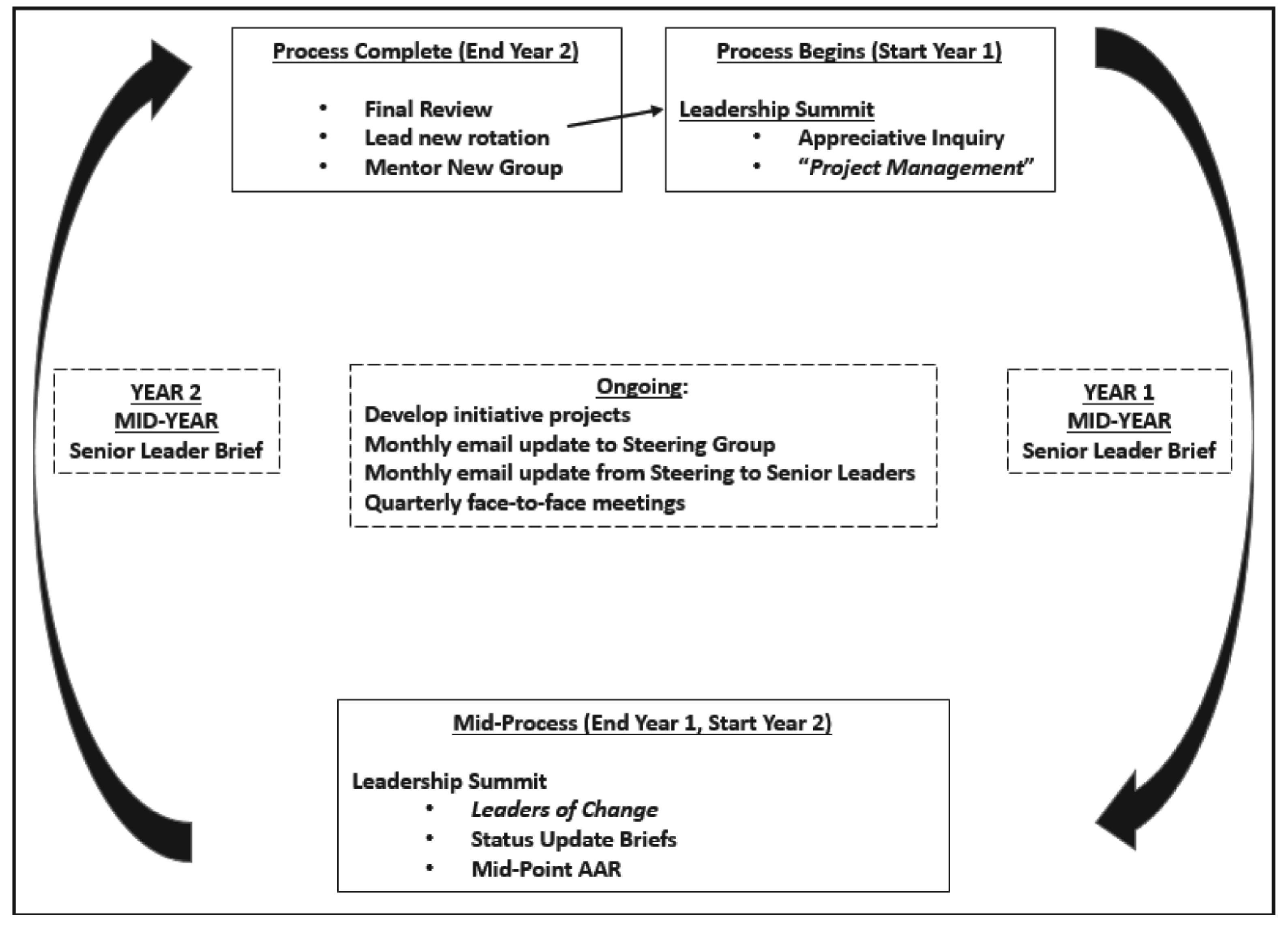
As this model demonstrates, a leadership cohort collaboratively envisions new ideas for organizational growth and, over a two-year process, engages in participatory action to achieve these goals. Throughout this process, these leadership groups are encouraged to provide monthly updates, conduct quarterly face-to-face meetings and collectively revisit their vision halfway through in order to sustain motivation. At the time of this writing, the first UTNG Leadership Summit cohort is still undergoing the pilot phase of the programme. Various aspects of the programme’s structure and outcomes are being evaluated and re-written. Further analysis will ensue after its culmination in late 2018 to better understand how AI can contribute to leadership development.
Application of AI as a leadership development programme offers several unique implications for general AI practice. First, while this study presents a model for leadership development in a military context, a framework of this kind could be easily translated for use in the private sector. Second, as a leadership development strategy, it demonstrates a way of implementing AI successively in one organization. Application of AI with different cohorts every few years would allow for organizational change to occur without a concern for saturation in terms of excessive initiatives or overuse. Finally, there is also potential for iterative organizational development by focusing on initiatives along themes evolved from previous Summits.
Lastly, this study seeks to extend other research on AI in terms of its development potential (Hart et al., 2008; Verleysen, Lambrechts, & Van Acker, 2015). However, while those studies focused on individual development, this study borrows from Relational Leadership Theory territory (Uhl-Bien, 2006) to explain the implications of leadership as a social construction in the context of leadership development. This study argues that AI offers a unique social context in which leadership is produced as members come into relation with each other for the purpose of envisioning and actioning new organizational futures.
However, while this study explored the interplay of generative capacity and collaborative strength as the variables from which leadership is produced, it does not provide conclusive evidence about the specific moments in which these variables are most present. Needed now is further investigation into the exact moments when collaboration and generativity interconnect and give rise to leadership. Going one step further, in what ways can these processes be amplified to increase its collaborative strength and generative capacity?
Conclusion
This case study proposes AI as a collaborative context in which leadership is viewed as a relational output. By using AI as a context for development, this study focuses on the processes by which leadership is developed through relationships and from which social order evolves (Uhl-Bien, 2006). To that end, it advances the notion that AI provides an experiential format for developing leadership potential underpinned by generative capacity and collaborative strength. As these two variables interconnect, leadership implies a cooperative process in which a concert of leaders performs together to envision and co-construct new organizational futures through a collective imagination.
Finally, as a potential model for leadership development, AI recognizes the imperative for recurrent leadership development in view of the transient nature of change. As the organization evolves, so do its challenges, necessitating continuous development of new communities of leadership over that of single ‘heroic’ leaders in advancing the organization (Cooperrider, Barrett, & Srivastva, 1995). AI is poised to facilitate the collective development of these new leadership communities through its process of cooperative visioning and participatory action.
Declaration of Conflicting Interests
The authors declared no potential conflicts of interest with respect to the research, authorship and/or publication of this case.
Funding
The authors received no financial support for the research, authorship and/or publication of this case.