



Abstract
Although the extant research in entrepreneurial innovation shows how organizational challenges could enact such innovations, the relationship between organizational challenges and organizational innovation under the small and medium enterprise (SME) context requires attention. Especially considering that SMEs face supply chain challenges, we need to know whether such challenges consistently enact supply chain innovations. Moreover, although those innovations can address the immediate SME challenges, extant research does not capture the life cycle of the innovations efficiently. To find an answer to this theoretical quest, we conduct participatory case research at Saha Textile, India. The founder of Saha Textile started his journey as a small garment shop owner in a Bazar. Within two decades, Saha Textile became one of the most prominent vertically integrated organizations in the Indian textile sector. Our reflexive process study reveals that the organization faced multiple survival threats throughout its journey. The uniqueness of the organizational crisis enacted sensemaking in the organization. The organization looked at unusual and unconventional resources within its access and creatively converted those into valuable resources to address the challenges. If successful with the creative attempts in addressing the pressing challenges—the organization further strengthened those resources into core competence. Over time, the organizational learning in converting crisis to core competencies through creative utilization of resources became rational heuristics and acted as a (higher-order) dynamic capability. Our inductive theorization makes a significant academic contribution as it proposes a generalizable dynamic capability process model of converting crisis into innovation and capitalizing such innovations as a core competence. Our research points out the possibility of standardizing and leveraging innovations-as-crisis-responses as core competence towards a sustainable competitive advantage for practice.
Keywords
Introduction
Researchers often argued about the underlying factors essential for entrepreneurial innovation (Toms et al., 2020). There were two essential features associated with the notion of this type of innovation. First, the major thrust to implement the unique ideas was dependent upon the entrepreneur’s existence. The pertinent question had arisen how the prospective entrepreneurs came into reality. One school of thought claimed that entrepreneurship required a very sophisticated skill set acquired from higher education, proper knowledge and solid technical underpinning (Chell, 2013). Second, another issue was the critical resources needed by the entrepreneur to follow the path of innovation. It was often said that a lot of economic capital was essential. Some scholars pointed out that lack of resources hindered the process of innovation (Autio et al., 2014). It suggested that the innovation would be possible only when there were no constraints or boundaries. A third view suggests that resource constraints enact entrepreneurial innovation through effectuation (Cornelissen & Clarke, 2010). This inconclusiveness in research outcomes inspires us to look at the entrepreneurial process. How could an entrepreneur enact innovation in response to entrepreneurial challenges?
In this study, we evaluated and attempted to extend the understanding of crisis as a source of entrepreneurial innovation (Acar et al., 2019) in the context of small and medium enterprises (SMEs). Due to its limited availability of resources, SMEs had faced various supply chain challenges (Hong & Jeong, 2006). However, this lack of resources imposed binding constraints on the SMEs to search and implement innovative ideas to sustain in the long run (Kim & Kim, 2018). We had shown that strong situations would bring entrepreneurship from an otherwise ordinary person (Alvarez & Barney, 2007). With the help of an entrepreneurial attitude (Sarasvathy et al., 2003), a traditional trader could transform a small garment shop into an organized textile retail chain. We further surfaced how such innovations, nurtured over time, acted as core competence (Prahlad, 2008) for the organization. Studying some of the key innovations that were transformed into core competence, we identified the enactment and evaluation of a dynamic capability (Makadok, 2001; Teece, 2018; Vogel & Guttel, 2013) of converting crisis into core competence. We found that the dynamic capability helped the organization defy resource constraints under survival crises by identifying and converting unconventional resources into organizational elements in addressing such survival challenges. Over time, the organization extended that dynamic capability in strengthening such new organizational features into core competence. The resource constraints forced the entrepreneur to think effectually (Sarasvathy et al., 2003) and convert those critical resources into innovative implementations (Acar et al., 2019) in a competent manner, resulting in the sustainable competitive advantage. In sum, we contributed to the extant understanding by proposing a new dynamic capability model of converting crisis into organizational competence.
Theoretical Motivation
Entrepreneur and Entrepreneurial Innovations
The broader theme underlying this study considered the various factors, leading to the organizational outcome, resulting from entrepreneurial activities (Ferreira et al., 2017; Ray & Ramachandran, 1995). It dealt with the different possible choices identified by the entrepreneur, considering the associated environmental aspects and applying the best-perceived option in the organizational set-up to obtain an optimal result (Henrekson, 2014). Many a time, numerous challenges were imposed upon an organization, and positive entrepreneurial thinking would be required to turn those challenges into opportunities (Gartner, 1990; Schumpeter, 2000).
Traditional literature argued that innovation would be possible only by eliminating the obstacles in its path. In this context, resource constraints were considered as one of the major hindrances. However, Acar et al. (2019) observed that an optimum level of constraints would bring better performance in terms of creativity and innovation.
Supply Chain and Innovation
Supply chain could be considered a dynamic construct, involving a flow of information, product and money in different stages (Chopra & Kalra, 2019). It involved different stakeholders directly or indirectly in fulfilling the requirement of the customer. It covered various parties, for example, transporters, warehouses, etc., with different competencies, beyond the traditional manufacturer-supplier-retailer-customer quad. Each party adds unique value at different stages of the supply chain.
Supply chain innovation had dealt with the improvements in the existing products, services or processes to obtain the competitive differential advantage (Flint, 2007). With the innovative approaches chosen by the managers, an organization could create more value than its competitors for its different stakeholders—internal and external. The competitors will find a resource, which is valuable, rare, imperfectly inimitable and does not have strategically equivalent substitutes, difficult to emulate, thus providing a competitive advantage for the organization (Arlbjørn et al., 2011). It could be considered essential in obtaining a sustainable competitive advantage.
Research Context
Indian Textile Industry and Key Challenges
The textile Industry, one of the oldest industries in the Indian economy, dates back to several centuries. It continues to attract both domestic and global players with vast growth potential. This industry is highly varied, with hand-spun and handwoven textile sectors at one end, while the capital-intensive sophisticated mills on the other end of the spectrum. The traditional decentralized power looms/hosiery and the knitting sector forms the most significant component in the textile sector in India. However, the progress of the Indian textile industry has suffered due to various challenges (Prakash et al., 2020). On the supply side, the cost of raw materials has increased due to lack of production, dependence on foreign imports and higher taxes. The production efficiency is low due to a lack of infrastructure and an unorganized weaver community. On the demand side, the low cost of factory-made imported garments hampers the prospect of domestic industry.
Textile Heritage of the Bengal Region
Bengal had a rich heritage in textile manufacturing for many centuries. Bengal had a 25% share of the global textile trade in the early 18th century (Maddison, 1995). Traditionally, rich culture and ethnic issues were predominantly present in the different textile offerings produced in this region. Bengal was famous for its Muslin saris (Abdullah, 2015) that originated in Dhaka. Sari is a single piece of unstitched fabric, worn by the women, draping over the whole body (Google, 2021). Noakhali was famous for producing Jamdani Saris throughout the ages. Nadia, Murshidabad and Bishnupur were famous for the production of Tant—silk saris. Bengal had improvised to blend hand-stitching in handloom products to create world-famous Kantha-Stitch, Baluchori Saris (Chakrabortty et al., 2013).
The Journey of Saha Textile
Mr Sukanti Lal Saha (Saha), the owner and master weaver of ‘Saha Textile’, started his entrepreneurial journey from a humble background at Barasat, district headquarters of North 24 Parganas, outskirts of Kolkata (erstwhile Calcutta), the capital city of the state of West Bengal, India, in 1986. Within two decades, ‘Saha Textile’ had become one of the largest retail stores of textile in Bengal with organized and innovative efforts employed by Saha. At a backdrop of Bengal’s economy, which was mainly dominated by a large unorganized retail sector, it became one of the largest organized retail shops generating employment, offering various product lines and innovative customer benefits. Saha took the benefit of available cheap skilled manpower in the weaving community and converted them as an organized unit through integrating the processes from material procurement to final production. It had created a unique value chain that utilized the efficacy of manpower and made distinctive signs of progress. Saha had identified the change of customer’s demand with time. As he was aware of the limitation to compete with the factory-made standardized products, he focused on value-based innovative offerings for the customers. Saha had blended the cultural heritage of Bengal in his offerings. He offered 12 different brands and re-created various products, having a rich cultural and ethnic heritage. It helped him establish the ‘Saha Textile’ as a domestic brand in the Indian retail textile sector.
Research Methods
Data Sources
We collected data through three sources (Reinecke & Ansari, 2014)—participant observations, conversations and interviews, and documents. We conducted participant observations through fieldwork (Pettigrew, 1990) for an extended period of 3 years (July 2018–April 2021). During this time, we spent, on average, 5 h every week (total of about 700 h), primarily on the weekend, conducting participatory studies in various ‘Saha Textile’ locations—retail shops, warehouses, studios where live shows were conducted, company guest houses and manufacturing units. We took extensive field notes, sometimes taking photographs. Often, we accompanied the management team members in offsite works, such as vendor meetings and meetings with the weavers. The participatory observations helped us develop ‘rich’ (Weick, 2007) insights into ‘Saha Textile’s day-to-day operations’. We also had the opportunity to participate in several ‘Saha Textile’ events, like the annual meet and trade shows.
In the field, during the participant observations, we also engaged in numerous conversations with ‘Saha Textile’ members and external stakeholders. We understood customers’ preferences and their reasons for opting for ‘Saha Textile’ over other organizations in similar businesses through such conversations. We also conducted eight open-ended semi-structured interviews (Bradbury & Lichtenstein, 2000) of the founder. In addition, we conducted 13 interviews with other members and stakeholders of the organization. The average interview duration was approximately 2 hours. Interviews and conversations most of the time were audio-recorded with permission from the interviewees. At other times, we took detailed notes during the interviews.
Archival documents were the third type of data source we considered. We received conditional access to the media archives of ‘Saha Textile’. We also collected additional documents from public sources. For organizing the data, we used NVivo software. NVivo platform helped all the co-authors from different locations to access the data and participate in the analysis.
Data Analysis
We adopted the process study approach (Langley, 1999; Langley et al., 2013). Using inductive theory building (Eisenhardt & Graebner, 2007; Strauss & Corbin, 1998) from process research, we theorized the data and offered a process model. Following the Gioia methodology (Gioia et al., 2012), we conducted the data analysis through five steps. First, we organized the data chronologically and wrote in-depth and comprehensive narratives (Smith, 2014) on the organizational journey. Second, from the narratives, we identified the crisis events for the organization. In the third step, we looked deeper into the events and identified the enactment–actions–outcomes for each event. We separated the identified events through ‘temporal brackets’ (Peng, 2003). In the fourth stage, we started coding the data related to each other through ‘asking questions’ and ‘constant comparison’. We developed a data structure (refer to Table 1) based on the subsequent higher-order coding (Gioia et al., 2012). In the fifth and final stage, we established the interlinks among the data structure elements to arrive at our theoretical process model.
Data Coding

During the fieldwork and subsequent analysis, the second author and the fourth author conducted the fieldwork. Originally based in Kazakhstan, the third researcher made a trip to India in April 2019 to review the audit trail. The first author stayed completely detached from the field. The arrangement helped us to attain the etic–emic (Horsburgh, 2003) balance. All four authors coded the data independently. We then compared our coding outcomes and arrived at a consensus through intended debate and discussions. We often returned to the field to seek clarity or further insights into the collected data. Data collection and data analysis went simultaneously and in cycles until the emergent theoretical model explained the data (Van De Ven, 1992). We exited (Horsburgh, 2003) the field when we attained data saturation.
Findings
In this section, the core innovations of ‘Saha Textile’ Are described. We observed a common trend within the process of all these innovations. A survival challenge acted as a factor of enactment in this process. It enabled the entrepreneur to go through and analyse the various resources—regular or unconventional—under his disposal. In this process, he formulated an innovative solution and implemented it.
Innovation 1: Struggle for Existence
Saha, in his teens, was forced to migrate to India from his ancestral village in Bangladesh (erstwhile East Pakistan) during the Bangladesh Liberation War, leading to political turmoil and partition of Pakistan in 1971. He took shelter in the house of his stepbrothers, who were already settled then in India. Stricken by the tremendous poverty, he started to work as a helper in the garment shop of his stepbrothers. ‘I used to open and close the shutters of the store; additionally, I cleaned the accumulated dust on the surface of the cloths’. Saha reminisced. He was not fond of his initial job, but he attributed this as the capital of experience in his journey.
Enactment
Saha was fired from the job by his stepbrothers after a misunderstanding over some issue. He never thought of being dejected by his relative. It was a challenging moment for him to survive. As he was not formally educated enough, he could not apply for traditional jobs. ‘Due to our poor family condition and responsibilities, I had to stop my studies after matriculation’, said Saha.
Process and Implementation
When he ventured through different plans for the future, the experience gathered while working in the shop of his stepbrothers prompted him to start his textile store. He managed to accumulate initial capital from his savings and the support of the family. His beginning was very humble. Saha began his retail store ‘Saha Textile’, with a floor area of 175 sq. ft only, with two employees in 1986 at Barasat, district headquarters of North 24 Parganas, outskirts of Kolkata (erstwhile Calcutta), the capital city of the state of West Bengal, India. In his early days of business, he acted as a traditional retailer in the supply chain structure. He purchased the products at wholesale price from the Intermediaries at Burrabazar, a famous trading market for Saris and other textile products in Kolkata. He sold them in his store at Barasat.
Innovation 2: Mitigation of Supply Chain Risk
The initial years went well for Saha and fetched him a solid ground for expansion. He started to offer more variants of the product. Apart from procuring from the Burrabazar market, he began to import products from different parts of West Bengal. He also scouted other parts of the country himself and tried to measure the feasibility of offering products in his store. Due to the demand of the South Indian fabric in the local market, he started importing from there as well.
Enactment
A cursed morning in October 2000 changed the course of the business, which Saha initially thought of. He gathered a vast stock just before the festive season. Due to an electrical short circuit, a massive fire broke out and gutted almost everything piled in the store premises. He was entirely at a loss. He had to pay the trade credits offered to him by the upstream agents in the supply chain. Though the fire had devastated much of the business, it failed to impact the business ethics maintained by Saha. He did not want to declare himself bankrupt; instead, he cleared all the debts by selling his assets and using the accumulated incomes to date. He had the option to re-start and run the business in the usual way. However, he recalibrated his business strategy by thinking something different and tried to implement it. ‘Though I faced a bad phase, it taught me to think differently, deal differently and encouraged me actively to take risk within the risk itself’, he mentioned.
Process and Implementation
Analysing the root causes of the financial burden due to damage by the fire, Saha found that he had to bear more due to procurement from the intermediaries. If he procured directly from the weaver or producer, the quantum of loss would be much less. He redesigned the supply chain structure partially for his retail operation. As a pilot project, he hired some weavers in the adjacent district of Nadia and Murshidabad. He sketched and provided them the necessary designs. The weavers were paid based on their work. Customers appreciated these handwoven products, and demand for the same increased gradually within a year as compared to the procured items from the Burrabazar market. Sensing the situation critically, he started investing more into his production line.
Saha realized the importance of the self-production line from a different perspective. It allowed him to innovate the production line. Though he was well aware that machines could increase productivity, he exploited the power of humans to achieve creativity, an essential component in Sari production. He took advantage of the availability of skilled labour in rural Bengal. He hired the entire workforce of several villages and engaged them in different stages of production. A particular village resembled a factory in the traditional production line. This ‘humanized’ production line gave him agility to improve the quality of Sari production and create a large employment base, while contributing to the social development of the marginal sectors. The value creation in this supply chain was based on trust between both party—the marginal weavers and Saha himself. This unique supply chain could only be possible with the deep understanding of modern technology and management and empathetic grassroots realities with social commitments, which exuded from Saha’s mind.
By integrating the entire supply chain from production to retail, Saha managed to eliminate the double marginalization problem (Chopra & Kalra, 2019). As there were no intermediaries, he was able to set a lower price margin. ‘Utpadan Aamader, Aamrai Pari!’ (We produce ourselves, so only we can!)’, he proudly proclaims his lower pricing strategy. As the targeted consumers were very price sensitive, the lower pricing led to a high demand and, consequently, higher market penetration. The enormous demand offered him the opportunity to benefit from the ‘Economy of Scale’ in the production system.
The integrated supply chain also mitigated the inventory risk faced by Saha soon after the fire incident. He was struggling for capital and the product in hand to continue the regular operation of the store. The decentralized warehousing and different product stages were more robust to deal with any unforeseen situation more efficiently. Moreover, as the information regarding customer demand had spread within the same organization, better production management could be feasible by reducing the bullwhip effect (Cachon et al., 2007).
Innovation 3: Negotiating Contingent Situation
Enactment
‘Saha Textile’ incidentally bounced back by the able leadership of Saha. By 2002, he transformed the once burnt store into a multi-storeyed superstore, increased the number of employees to over 50 employees and expanded the business through an innovative self-production line. However, the crisis did not spare him for a moment. The store of ‘Saha Textile’ was on the major roadside, considered a prime location at Barasat.The construction of a new flyover (Annexures: Exhibit 1) in front of the store turned the site into virtual debris and hindered the line of sight of the prospective buyers. The footfall in the store decreased and Saha sensed the long-term impact of this contingent situation on his business.
Process and Implementation
The indomitable spirit of Saha had forced him to deal with the situation, and he started to think beyond the traditional brick-n-mortar store. He convinced a local television channel and organized a paid promotional show on the offerings of ‘Saha Textile’ in 2005 (Annexures: Exhibit 2). The programme was well accepted by the viewers. They ordered through telephone calls at a time when telemarketing was in a very nascent stage. This direct marketing channel helped Saha reach all over West Bengal beyond the concentrated traditional customer base. Later, with the advent of time and availability of technology, this television show was augmented with Online Store, Facebook Lives, YouTube Channel and other social media platforms to reach the younger generations.
Though Saha reached many customers through the television programme, many did not prefer remote purchasing through telephone. They liked to visit the store and purchase after due evaluation of the product. As the store was located at a distance of 40 km from the heart of the main city of Kolkata, Saha arranged free pickup and drop facilities for potential prospective buyers. He later constructed a ‘guest house’ for the outstation buyers and provided complimentary lodging facilities (Annexures: Exhibit 3). These two innovative ideas increased the footfall for the customers for wedding and festival purchases. He induced traditional Bengali sentiments into his business by arranging cultural events associated with weddings and festivity, even at customer sites.
Innovation 4: Steering Through Competition
Enactment
As the business grew, Saha looked upon the feasibility of opening a store at Gariahat, the heartland of the retail garment shops within Kolkata. It was difficult for him to penetrate a market already dominated by established retail shops. It was difficult for his new shop to make a name in that area. Surprisingly, Saha was very reluctant to expend in the usual advertisement methodology. He took the opportunity to sponsor ‘Kavi Sammelan’ (literary fests by the poets) and felicitated the veteran poets. This event gave mileage towards making his presence felt among the educated classes in Kolkata.
Process and Implementation
Saha knew that he had to use an unconventional shopping experience to attract people to his store. He utilized the lack of information associated with the Sari purchases among the customers. He deputed the weavers as salespersons in the store, who described the process of Sari making and its uniqueness to the prospective buyers (Annexures: Exhibit 4). This innovative idea was unheard of in the retail segment of Kolkata and became famous overnight. The perceived utility of the customers was enhanced, and their willingness to purchase increased manifold.
Saha understood the sentiment and aspiration of the customer well. The self-production line allowed him to use unique fabric and material with a new style of stitching. The design was developed in-house to maintain exclusivity within the product itself. He produced a diverse range of products available at a common store, where different floors catered to different categories and price ranges. Moreover, he intelligently escalated the aspiration of buyers and encouraged them to opt for products from the floor of their dreams.
Innovation 5: Revival of Cultural Ethos
Enactment
Saha was deeply rooted in the culture of the traditional rural Bengal. Often, he was in dilemma thinking whether he had forgot his cultural lineage to establish his business supremacy. He always dreamt of reviving the cultural ethos imbibed within himself and diffused within his offerings. He offered a vast product line, consisting of various fabrics, including cotton, silk, desi (made in India), handloom, rayon cotton, linen, jacquard, ghicha, etc., designed into ready-made garments, saris and others. Along with these usual products, he re-created few expensive products of ancient India like Muslin, Banarasi (named after the holy city of Varanasi) of the Mughal period, or even Tanchoi (a very fine weave and lightweight variety of sari that use an extra weft thread to create delicate patterns. The technique was invented by weavers of Surat but now dominated by weavers of Varanasi) saris of the Sultanate period. These brands unfolded his deep research on diverse areas like costly clothing, woven with golden or silver threads, vegetable die colours and handwoven sari (thread made of gold or silver).
Process and Implementation
Saha had extended the idea of hiring the entire village with a ‘humanized’ production line beyond the geographical boundary of West Bengal. Different variants of Banarasi sari were produced in the villages of Uttar Pradesh and supplied to ‘Saha Textile’. As a result, he offered those non-localized products within affordable price ranges. Apart from these products, he imported the production techniques of various brands and produced them locally. The historical tie between the Bengal—West Bengal in India and East Bengal, that is, Bangladesh—was well beyond the political boundaries. The emotions shared by the people from both sides of the border were the same. Saha exploited this connection by localizing the production of Zamdani sari of the Noakhali district of Bangladesh. He also organized various cultural programmes to celebrate the cultural lineage of Bengal and promote his business (Annexures: Exhibit 5).
‘Saha Textile’ offered 12 different products to its customers, which were unique in characteristics. With deep knowledge in production technology, Saha introduced product line customization to yield the benefit of economy of scope. He tried to group different standard processes used for the variety of the same range of products and postponed customization at a later production stage. It caused a lot of savings in production by synchronizing volume with variety, which resulted in affordable prices to the customers.
Combining Innovations into Core Competence
Considering the aforementioned innovative processes, it was not an exaggeration to state that Saha’s journey resembled a roller coaster ride in different situations. We had identified a striking pattern among the incidents, which forced him to take the path of innovation in the manner that he did. He was threatened by the various challenges, which questioned his survival—externally or internally, in the business environment. This pressure urged him to create something unique. Coming from a humble background without having many resources in hand, he never thought of planning beyond his capacity. Instead, he looked for the available resources and tried to make the best use of them. His risk-taking approach was pragmatic in the sense that he could lose a maximum of what was available to him only. His familiarity at the grassroots level made him understand the ground reality of the business process and sense (Weick et al., 2005) the possible outcomes for taking different paths. He afforded to lose the maximum at his disposal, while gaining large in his plan’s success. We observed the successful implementation of the unique and innovative ideas, which made Saha ride across adverse situations in his entrepreneurial journey.
We had identified another aspect of Saha’s career. He did not proactively plan for innovation; instead, situations compelled him to think to take the out-of-the-box path. As the problems faced by him were unique, the innovative strategies undertaken by him were also inimitable. For example, his innovative method to introduce a direct marketing channel, using television, was unheard of in SMEs at that time. He also acted as the anchor in TV shows. It gave him a first-mover advantage because he directly connected to the customers to identify their requirements and understandings that helped him in redesigning his offerings. The customers were also allowed to share their views on-screen (Annexures: Exhibit 6). This live feedback and review significantly increased the acceptability of ‘Saha Textile’. He transferred the television-based channel into social media to keep pace with the changing times. His creative methods of solving a contingent situation using the scarce resource available created the core competency in operation. These unique interrelated innovations provided ‘Saha Textile’ the competitive advantage to steer through the dynamic business environment.
Theorizing the Emergent Process Model
In this study, we developed a process model describing how an SME would achieve Dynamic Capability and become successful in converting Survival Crisis into Core Competence. With the help of Figure 1, the process model of dynamic capability has been elaborated.
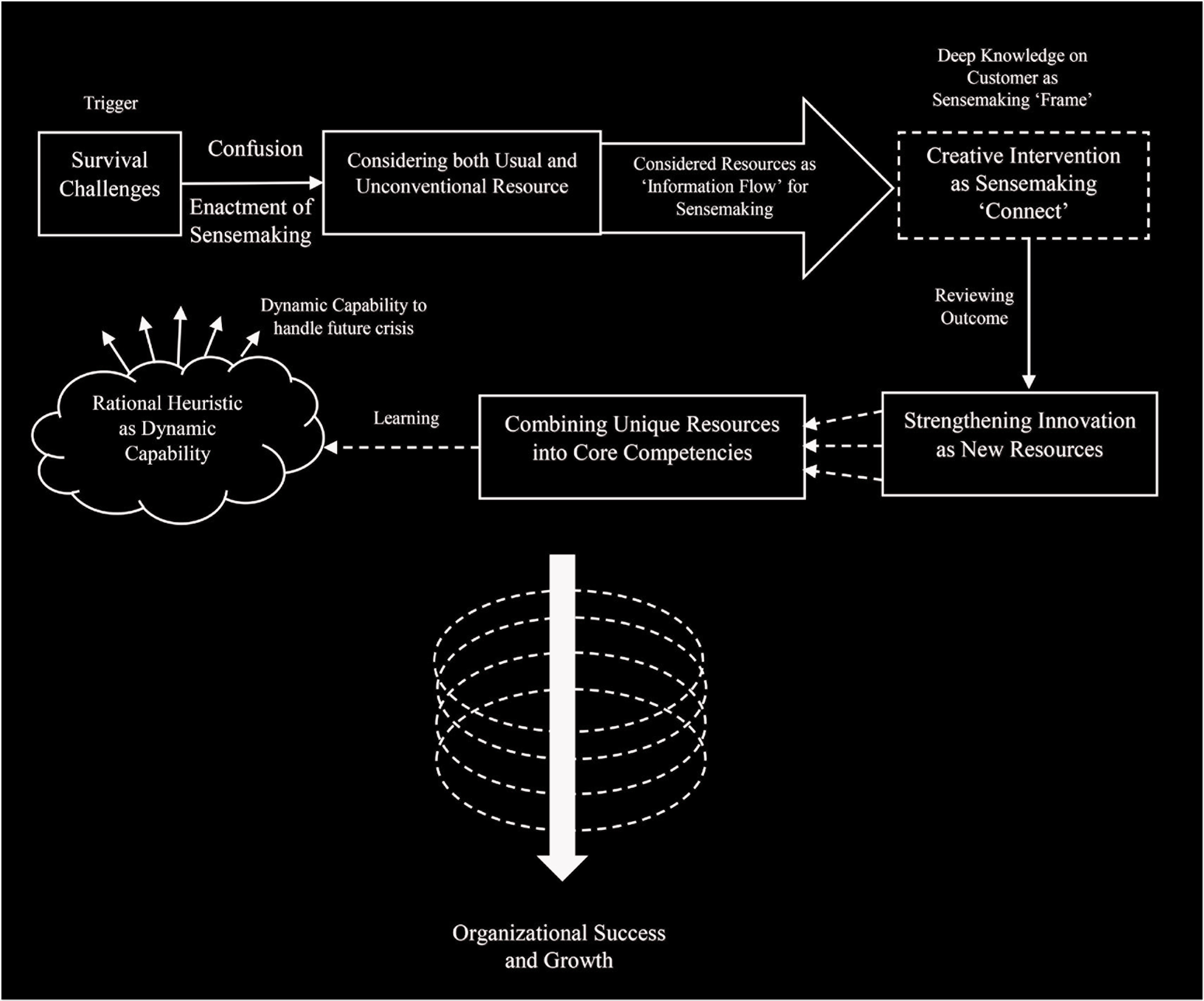
The problem of resource constraints faced by an SME could limit its prospect for structured innovation. However, the possibility of enactment of innovation in SMEs had emerged under the survival crisis. The regular resources available might not be able to solve the situation. The entrepreneurial intervention found a way out to the unique problem enacted sensemaking (Weick et al., 2005). The deep understanding of audience behaviour acted as the sensemaking frames, and unusual resources acted as sensemaking elements (Weick, 1988) that passed through the frames. The cognitive process continued till the entrepreneur found a ‘connect’ (Maitlis, 2005) between a frame and the specific element passed through it. The ‘connect’ guided the entrepreneur to develop an approach or intervention strategy to counter the crisis. The entrepreneur then strengthened those unique resources. As the resources were not readily available to the competitors, the organization could leverage those resources to create core competencies. Combining such resources, and their repeated use over time, produced consistent results, could result in a competitive advantage for the organization. Repetition of such processes could become an organizational heuristic (Bingham & Eisenhardt, 2001) and hence become a dynamic capability.
Discussion
Contributions and Implications
SME Innovation as Sensemaking
This work contributes to SME supply chain innovation literature (Khalil et al., 2019) by proposing a new model of converting survival crisis to core competence. We show how a unique survival crisis that comes as a shock to the organization enacts a sensemaking process (Bettiol et al., 2012; Valaei, 2017). With available resources—both conventional and unconventional as possible resources to counter the challenge passed through the sensemaking frame with deep customer knowledge as a sensemaking element—the management finds a ‘connect’ through sensemaking cycles. That ‘connect’ enacts a creative process of organizational innovation. Therefore, our first contribution is to detect some new elements, most prominently—the unconventional resources—as constituents of sensemaking in addressing the crisis. It also shows the importance of knowing customers beyond the ‘need–want–demand’ frame in creating superior and often unexpected customer value.
SME Innovation and Core Competence
Our second contribution is to show how SME innovations in addressing crisis can contribute beyond addressing the immediate crisis (Kerr, 2006). Innovations that can create superior and unexpected customer value could be strengthened and standardized. Several such innovations, when combined, can develop core competence as such competencies become hard to copy by the competition (Bhamra et al., 2011; Ng & Kee, 2018). We have interviewed several customers of ‘Saha Textile’ who availed ‘Saha Textile’s accommodation services. Many of them, to shop for significant events like weddings, followed ‘Saha Textile’s TV shows and YouTube shows for months, noted down the code numbers of items they liked, took the online consulting help to finalize the list and negotiate the price, and visited ‘Saha Textile’s facilities for 2–3 days for the actual shopping. That said, it was a unique offer from the organization and helped them reduce the overall cost of shopping.
A Process Model of Leveraging Survival Crisis Towards Building Innovation as Core Competence: Theorization from the Journey of a Textile Firm
SME Converting Core Competence into Dynamic Capability
Finally, our research shows how the organization’s ability to turn crisis challenges into sources for core competencies through innovative approaches eventually becomes part of organizational practices and, therefore, a dynamic capability (Borch & Madsen, 2007). Under the dynamic capability influence, the organization no longer shies away from challenges but hunts for challenges to develop opportunities for innovation (Grimaldi et al., 2013). To sum up, our longitudinal case study of ‘Saha Textile’ links SME crisis, organizational innovation, core competence and dynamic capabilities through our process model.
Limitation
Our theorization is limited by some unique characteristics of ‘Saha Textile’ and its contexts. First, ‘Saha Textile’ was a spin-off from a family business. The family was in the business of textile for two generations. This context made Saha get involved and develop an understanding of the sector from an incredibly early age. Such deep embedding sharpened his sensemaking abilities. Our proposed theory needs further strengthening by including ‘sensemaking abilities’ as a constituent of the process model (Dyer Jr & Wilkins, 1991).
Similarly, being a ‘son of the soil’, Saha always received support and patronage from the local communities. His business faced many crises, but he always received sympathy, empathy and compassion from the locals. Something that also contributed to the early success of the organization. Future research needs to consider this attribute and focus more on community support in SMEs’ responses to the survival crises.
Conclusion
We started with the theoretical question of developing further insights into organizational challenges as the source of organizational innovation. Through a longitudinal case study on ‘Saha Textile’ and an inductive theory-building approach, we developed a process model on how SMEs could turn survival crises into innovation opportunities through sensemaking towards developing core competencies.
Our work connects SME innovation to sensemaking, core competence and dynamic capabilities. Future research should strengthen our model in trying the model into other case contexts and check the statistical significance of the constituents of the model through theory-testing quantitative research. Environmental shock like Coronavirus Disease 2019 (COVID-19) puts survival pressure on SMEs across the globe (Fitriasari, 2020; Kalemli-Ozcan et al., 2020). Our work might provide valuable insights and guidelines to the policymakers, SME development and support agencies in supporting SMEs to building innovative resources and capabilities in navigating the crisis.
Footnotes
Acknowledgements
The authors acknowledge and thank Mr Sukanti Lal Saha, Founder-Head of ‘Saha Textile’ and all the members of ‘Saha Textile’ who interacted with us and supported us throughout the research period. We also thank Narxoz University especially the Silk Road Case Center for providing the necessary infrastructure and technical support for this project.
Declaration of Conflicting Interests
The authors declared no potential conflicts of interest with respect to the research, authorship and/or publication of this article.
Funding
The authors received no financial support for the research, authorship and/or publication of this article.