




Abstract
In India, agriculture is labour intensive. The agricultural tasks such as sowing, weeding, spraying pesticides and harvesting are done manually. As it provides only seasonal employment, most rural labour force migrates to urban areas to earn a more sustainable income. This intrastate and interstate migration of the labour force creates a massive shortage in rural areas. This migration pushes the labour cost, leading to an increased price of agricultural produce. It is a significant concern for semi-medium and medium farmers with a limited budget for a small scale of operation. Non-availability of labourers pushed farmers to seek and adopt semi-mechanization in agricultural activities. The available farm machinery in the market is costly and primarily caters to the need of big farmers. Higher cost prevents semi-medium and medium farmers from using such machinery. They need farm machinery customized as per their need at an affordable price. Considering the problems faced by the horticultural farmers, ‘Kakade Agro Equipment’ designed farm machinery that could meet the requirements of the local farmers. The present case attempts to understand how small and medium enterprises operating at the local level are solving the problems of semi-medium and medium-scale horticultural farmers using technological innovation in a financially sustainable way.
Keywords
Introduction
In India, the majority of the rural population continues to be dependent on agriculture for their livelihood. The agriculture-dependent population includes land-owner farmers, tenant farmers, landless farmers and farm labourers. In India, still, agriculture is labour intensive. Labourers do various agricultural works, such as sowing, weeding, spraying pesticides and harvesting. However, it fails to provide sustainable income throughout the year. Hence, most rural labour force migrates to urban areas searching for employment. This intrastate and interstate migration of the labour force creates labour shortages in the rural area. Because of this, the labour cost increases, leading to increased production costs in agriculture. It is a significant concern for medium and semi-medium farmers as they have a small scale of operation. This phenomenon pushed farmers to seek and adopt semi-mechanization in agricultural activities. The available farm machinery in the market is costly and primarily caterers for the need of big farmers. Due to the high price of the farm machinery, small, semi-medium and medium farmers cannot afford such machinery. They need farm machinery customized as per their need at an affordable price. The small firms engaged in agricultural technology need to create value through entrepreneurship. The study attempts to understand how technological innovation enables small-scale enterprises to address local problems in a financially sustainable way.
Theoretical Motivation
The entrepreneurial value creation theory explains that value creation comprises the stage of venture formulation and venture monetization (Mishra & Zachary, 2014). The venture formulation process encompasses entrepreneurial intention, opportunity, resources and effectuation of entrepreneurial competency. The venture monetization process comprises investment, dynamic complementary capabilities, professionalization and business model design of the venture. It also includes the realization of the entrepreneurial model.
Farm Mechanization in Horticultural Sector
After modernization and industrialization in India, more work opportunities are created in the service sector and industries of urban places (Rao, 1972; Sarkar, 2020; Sen, 1967). With the expansion of industrial and service sectors, the surplus labour force engaged in the agricultural sector shifted to these sectors (Sen, 1967). This trend has created a labour shortage for agricultural work. The workforce engaged in agriculture was 82.00% in 1950–1951, 59.90% in 1999–2000 and 48.80% in 2011–2012 (NSSO, 2013; Tripathi & Prasad, 2009). Though the availability of a workforce has declined in the agriculture sector, the need for a workforce still exists. Hence, the deficit of the workforce needs to be addressed through mechanization. Labour shortage in rural areas leads to the mechanization of agriculture (Pingali, 2004; Rao, 1972). Mechanization is most profitable and contributes to growth where land is abundant, labour is scarce relative to land, and labour is moving rapidly off the land (Bachman, 1952). Eliminating the laborious operations of human work farm mechanization can facilitate an increasing output of higher value products and improve the way of life (Sarkar, 2020). Recently, there has been a sustained increase in the use of agricultural farm machinery in India. The Economic Survey of 2018 revealed that adaptation to farm mechanziation among Indian farmers had been faster in recent years (Ministry of Finance, GoI, 2018 matched with expand and without comma after finance). India also experienced a significant shift towards mechanical and motor power away from human and draught animal power in farming (Gulati & Juneja, 2020). In 1951, 97.40% of farm power was coming from human and draught animals, but in 2014, their contribution was reduced to 12.00%, whereas mechanical, electrical and motor had increased from 2.60% in 1951 to 88.00% in 2014 (Gulati & Juneja, 2020; Singh et al., 2014).
India is a leading producer of fruits and vegetables in the world. The total area under horticulture in India is 25,870 thousand hectares, and the total production is 314,671 thousand metric tonnes. Horticulture production in India has increased from 146 million tonnes in 2001–2002 to 314 million tonnes in 2018–2019 (DoACFW, 2018). For the same period, food grain production extended from 213 million tonnes to 285 million tonnes, indicating the fast growth of the horticulture sector in India. The increased demand for different fruits, vegetables and flowers provides a larger domestic market for the horticulture business in India. Horticulture is a labour-intensive farming practice. But the reduced manpower in the agricultural sector has increased the demand for farm machinery in horticulture. Horticulture farmers require machinery for various activities, such as seeding, transplanting, weeding and spraying. They require farm size-specific machinery at a low cost. The available machinery in the market is expensive and suitable for large-scale farm operations. However, there is also demand for agricultural technology for medium and small-scale farm operations, which needs to be addressed. Such kinds of needs can be addressed by social entrepreneurs who work on community problems. This study was designed to understand the entrepreneurial value creation process of the small enterprise using technological innovation.
The Journey of Kakade Agro Equipment (KAE)
To address horticulture farmers’ problems, Kakade and his brother started ‘Kakade Agro Equipment’. Incorporated in 2015, KAE is one of the pioneer business entities registered under micro, small, and medium enterprises betrothed in manufacturing, supplying and wholesaling an inclusive variety of products comprising agricultural sprayers and agricultural equipment. Their array is made up and designed with superiority and precision and is widely acclaimed and commended due to its durability, elevated functionality and effectiveness. They designed and manufactured the essential products that farmers needed but in an innovative manner using various engineering techniques, such as gear shifting and hydraulic, to name a few, which reduce human labour. With the motor system’s farm cultivator, ploughing and chop cutter, they started and made machineries, such as automatic seed drill and sugar cane plough with gear shifting of various sizes. Due to less demand for these products, they started focusing more on long-term products that could help them generate enough profits. The categorization mentioned above presents a wide range of products, including agricultural mist blower, pomegranate sprayer, blower sprayer, grape blast and grape sprayers.
Data Sources
The data were collected from both primary and secondary sources. Primary data were collected through a semi-structured interview schedule and in-depth interviews. The semi-structured interview was used to collect data related to the year of establishment, number of employees, enterprise turnover, enterprise products, the enterprise’s scale of operation, marketing plan, customer retention policy and the socio-economic impact created by the enterprise. All major stakeholders such as employees, customers and founder members were interviewed. Data related to the enterprise’s context, the entrepreneur’s journey, challenges and problems and resource planning were collected through in-depth interviews of the founder members. Secondary data were collected from the company’s annual report. For data triangulation, a field visit to the site was also done (Table 1).
Data Structure
Data Analysis
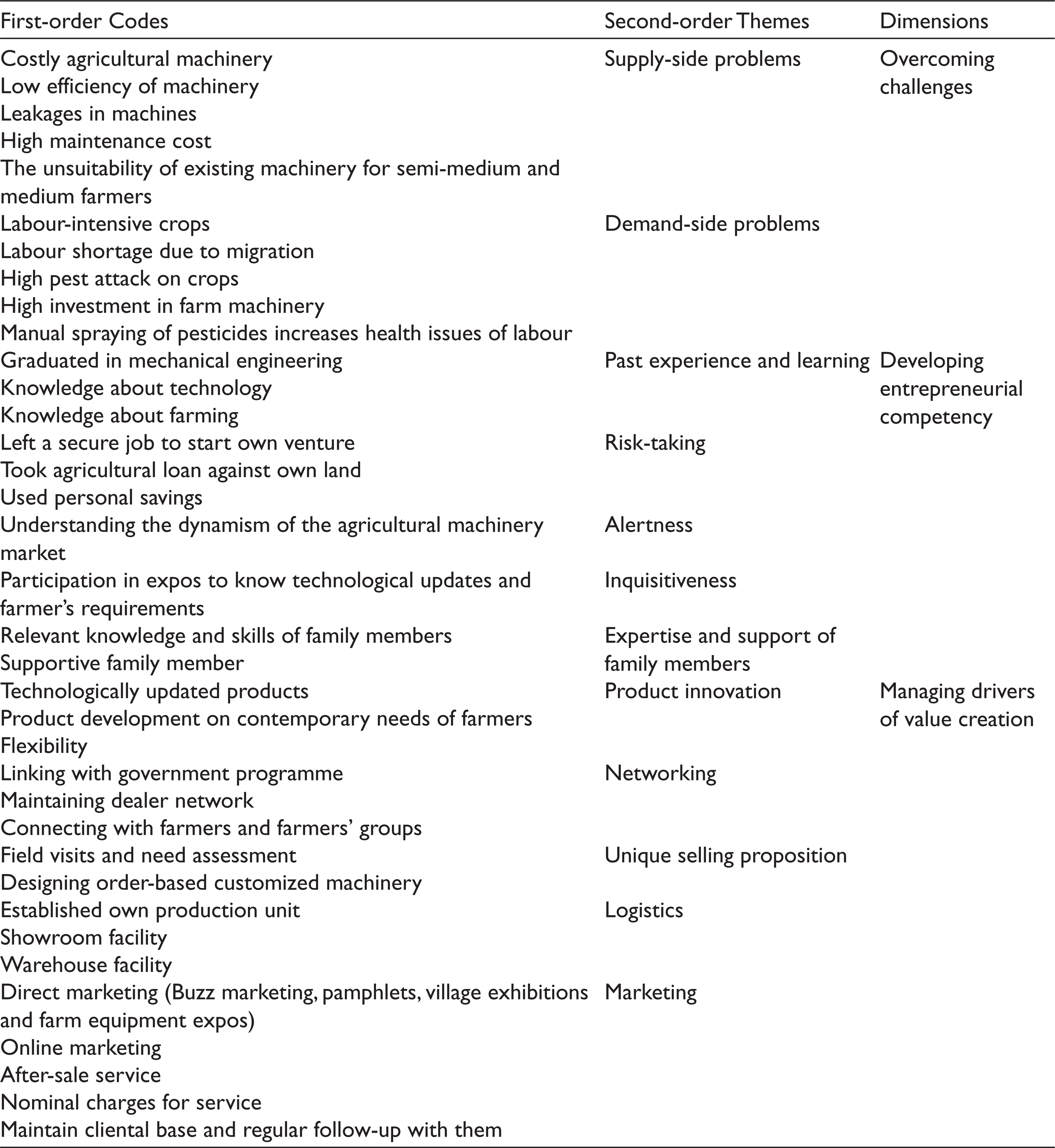
We did an inductive study using the Gioia (2021) methodology. The data were analysed in five steps. First, we organized the data chronologically and wrote in-depth, comprehensive narratives on the organizational journey. Second, we identified different phases of the organization’s value creation process from the narratives. Third, we understood in-depth activities carried out in each phase and how the activities and strategies add value to the process. Fourth, we coded the data related to each other through constant comparison. Lastly, we established the interlinks among the data structure elements. The authors visited the field but independently coded the data, compared the coding outcomes and reached a consensus through deliberate debate and discussions. Further, the authors often revisited the field for more insights and to seek clarity in the collected data.
Findings
The study’s findings are discussed under three major headings: overcoming challenges, developing entrepreneurial competency and managing drivers of value creation. Gradual expansion of customer base to other districts and then to neighbouring states was used as evidence of value creation.
Overcoming Challenges
Kakade observed an increasing trend of labour migration from rural to urban areas leading to a labour shortage in the rural areas. In the agriculture sector, this resulted in an increased labour cost and reduced profit for farmers. This was a big problem for farmers, mainly medium and semi-medium farmers. Their family labour was insufficient, and hiring labour from outside was costly. As their scale of operation was not very big, the production cost increased because of high labour costs. So, there was a demand for agri-equipment by medium and semi-medium farmers.
The existing farm equipment was primarily suitable for large farmers in terms of price, area of operation and purpose of use. Semi-medium and medium farmers required affordable agri-equipment specifically designed to cater for their needs.
Developing Entrepreneurial Competency
Being a horticulture farmer, he was sensitive enough to understand that there was a scope for an entrepreneurial intervention. He assessed the situation using his farm experience and engineering knowledge, which led him to start a for-profit venture. The venture was conceived to manufacture low-cost, customized, multipurpose agri-equipment suitable for semi-medium and medium farmers.
Organizing, mapping and managing existing resources are crucial for an entrepreneur to succeed. Kakade and his brother, an engineer by training, started working to materialize the dream. The journey was not that easy as it came at the cost of his well-paid secured job. The decision to quit a secured government job for an uncertain path of enterprise establishment made him a laughingstock among people; some even called him a fool. However, his family always supported him in driving ahead to achieve his dream. In addition to the stereotypical thought of society, another major constraint between him and his goal was finance. He took an agricultural loan of ₹ 1.0 million rupees from ICICI bank against his farmland. Once he started earning a profit, he reinvested that money for business expansion. Currently, the enterprise employs 11 employees, out of which four members are from the family, and seven are from outside. Out of eleven, two are engineers (bachelor’s degree in engineering), four are in manufacturing (degree in ITI diploma), three are helpers, one person looks after marketing, and one person looks after finance, three are in manufacturing and three in marketing. The employees include three members of his family. Three helpers are daily wage employees, and the rest are salaried employees.
To meet the workforce, need initially, Kakade utilized his family members’ skills, experience, and expertise, including himself, and then hired people from outside. For establishing his manufacturing unit, he used his roadside village land. He had sound knowledge and experience in farming and the difficulties associated with horticulture farming. As an engineer, he had sound knowledge regarding agri-equipment and various engineering technology. As a farm practitioner, he had a good network with the other farmers, which provided him with a customer base. He also has good knowledge of the agri-equipment market. He could combine the opportunity with the available resources to form the enterprise.
Managing Drivers of Value Creation
Product Innovation
KAE designed and manufactured all essential products that farmers needed innovatively using various engineering techniques such as gear shifting and hydraulic. The products manufactured by KAE are durable and efficient and ensure consistency in rendering high performance. They design and manufacture a variety of agri-equipment, such as mini cultivator 22–30 hp, cultivator 40–60 hp, mist blower (pomegranate and grapes sprayer), sugarcane stubble shaver, sugarcane rotten manager, hydraulically reversible plough and single bottom reversible plough. They continue to manufacture seed drills, ploughs and mist blowers named ‘Toofan’ as there is high demand for this product. ‘Toofan’ is a tractor-mounted sprayer used to spray plantation crops in orchard crops, such as sugarcane, orange, pomegranate, grapes and sweet lime. The spray volume can be controlled as per the requirement. The sprayer consists of a high-pressure piston pump that atomizes the spray solution. This axial or centrifugal fan produces a stream of air, interchangeable and oriented table spray heads, a high-capacity spray tank and other control attachments.
All the dub assemblies are a trailer. The spray heads are mounted radially to cover two rows of trees at one time. For spraying tall trees, the spray head can be oriented upwards. The spray volume, airstream volume and velocity can be adjusted as per the requirement. For operation, the spray liquid is filled in the tank, and to drive the pump and fan; the tractor power is used. The pump sucks and sends the liquid to the spray head, which atomizes the liquid, and then the droplets meet the air stream and carry it to the target. It also comes in a horizontal triplex piston, trailed type the main chassis with transport wheels and chemical tank with hydraulic agitation system. Cut-off device and boom equipped with a turbo nozzle that operates at a pressure of 9–18 kg/cm2. It generates droplets of 100–150 micro sizes. Depending on the land size and row spacing, the orientation of booms can be adjusted. The spray booms are mounted behind the operator. This product is available in six different types. The product is International Organization for Standardization (ISO) certified, and the Ministry of Small and Medium Enterprises (MSME) registered. Taking the right action at the right time is necessary for any venture. To begin with the enterprise started making farm cultivators, ploughing and chops cutters with motor systems, automatic seed drills and sugar cane ploughs with gear shifting (1.0 feet, 1.5 feet and 2.0 feet). As soon as the enterprise understood there was less demand for these products, they started focusing on more products that could help them generate enough profits. Presently, they are only producing seed drills, ploughs and sprayers. Thus, taking a timely decision to drop less demanded products helped the enterprise avoid losses in the long run.
Networking
Networking plays a very significant role for any enterprise. KAE has a substantial farmer’s network and a good network of suppliers. They also have tied up with Maharashtra Government to provide agricultural equipment at a subsidized price to farmers under the scheme ‘Unnat Sheti Samruddha Shetkari’, which enables the farmers to get the product hassle-free. Their customers also promote their products.
Unique Selling Point
KAE is one of the well-known agri-equipment enterprises in Maharashtra and Karnataka states, India. The enterprise makes an order-based customized farm machinery for the pomegranate, grapes and sugarcane farmers. They first take the order from the farmers and then visit the farm to physically verify its size and understand other requirements of the farmers—the farmer’s field information and needs, to design and manufacture the product. Providing customized machinery is their unique selling point. The materials required for the product are purchased from the wholesale market. The enterprise purchase raw materials from Delhi, Rajkot (Gujarat), Ludhiana (Punjab) and some parts which are not available in India they import from Italy. Generally, they manufacture the chassis (structure) of the body in which they assemble the product they bought from the market according to the customer demand and need. Such as a water tank (capacity-based), lazier cut fan or sprayer, manual controller, shell assembly, spraying and tractor jointer give specific energy and power to run the product specified design. KAE fixes the price of the products based on the quality of the product and material cost.
The products get subsidies from the Government of Maharashtra; subsidy varies from scheme to scheme (cost of the product and size of the farmland). The products are ISO certified and MSME registered. All products are tested sternly on a range of levels before final shipment to retain their flawlessness. After checking the quality, they deliver it to the customer. They physically check how the product is performing in the field. If any problem is there in the product, they repair it. In case of a significant defect, they even have a replacement policy. They also provide a warranty on some machine parts, such as the pump, nozzle and filter. They sometimes visit their customers firms’ to check the machine condition. This kind of after-sales care helps them in customer retention and brand building.
Logistics
To furnish customers’ growing and varying necessities, they have built a large warehousing unit that is highly secure and spacious to keep a wide range of products in-store. Additionally, it is connected with different transportation facilities for hassle-free delivery of the products. He handles all the tasks at the entity with perfection, with family members and staff and a trained crew of highly skilled personnel. They work in sync with each other to assure the completion of all tasks with perfection in the specified time frame. They also have their showrooms in Pandarpur.
Marketing
KAE makes an order-based customized machinery. The enterprise uses both offline and online platforms for promoting its products. In offline mode, they use buzz marketing; conduct live demonstrations in agriculture campaigns, agro-workshops and exhibitions organized by Maharashtra Government. In addition, the enterprise places posters outside the agro-agencies and distributes pamphlets through newspapers and dealers. The enterprise uses social media to reach out to potential customers in online mode. The enterprise has WhatsApp group, Facebook page and YouTube channel to promote its products. The enterprise gets orders through social media and clients referred by their customers. The enterprise has the provision to deliver the product at the farmer’s doorstep with minimal transportation charges.
Customer satisfaction is the cornerstone of the success of any venture. KAE prioritizes customer satisfaction and provides them with need-based, customized and better-quality products. KAE maintains a cliental base by taking continuous follow-up with customers. A strong relationship with the clients helped them build goodwill in the market and gets more orders. After-sale, KAE gives a three-year guarantee on steady parts and six months warranty on the product. Up to three years of onsite free service is provided, and after that, they charge travelling costs and a nominal fee for providing service. Customers prefer KAE products due to modern technology, customized design, onsite delivery provision and an instalment payment facility for needy farmers.
Evidence of Value Creation
Systematic expansion
Expansion is essential, but if it is unsystematic, it can lead the business to downfall. Kakade expanded his business in a very systematic way. Business volume can be increased through product diversification, increasing customer base, or both. Kakade focused on product intensification rather than product diversification. Initially, he started with more variety of agri-equipment. Gradually he phased out products with low demand. He concentrated on technologically upgrading and the more demanded products.
Similarly, he continuously tried to increase his customer base. First, he started with one manufacturing cum warehouse unit in his village Tandulwadi on his land. As he started getting more profit, he opened a showroom in Pandarpur and planned to start another one in Solapur city, a prime location in the region. In the beginning, he started the business operation in the Solapur district. Then he expanded to all districts of Maharashtra and gradually expanded to different states of India. He has covered 45 districts from 4 states: Maharashtra, Karnataka, Gujarat and Telangana. Now even he is getting enquiries from other countries like Sri Lanka. In the future, he is planning to establish a distributor and dealers’ network in different districts of Maharashtra. They have reached nearly 7,000 to 8,000 farmers by now.
The customized machinery provided by Kakde Agro to the farmers reduces time and labour. The spraying machines, for example, can spray one acre of land in 20 minutes and require only one person. The machine also consumes comparatively less diesel. It has reduced the wastage of water, pesticides and the risk of health hazards that reduce production costs and increase profit. Some farmers even reported that their production increased by double during the season. They have reached nearly 7,000 to 8,000 farmers by now. Starting with a turnover of ₹1.2 million in the 2015–2016 financial year, he reached ₹ 35 million in the 2020–2021 financial year (Kakade Argo Equipment Annual Report, 2016, 2021).
Discussion
The present research contributes to understanding how social enterprises can create value through technological innovation. Tech entrepreneurship, a subset of mainstream entrepreneurship, focuses on innovations from science and engineering (Beckman et al., 2012). Social-tech entrepreneurship aims to develop and deploy technology-driven solutions for addressing social needs. They attempt to satisfy a social need by leveraging technological innovation in a financially sustainable manner. The case shows how an entrepreneur addressed a local problem using limited resources (Zahra et., 2009).
Kakade observed a trend of labour migration to urban areas for sustainable income, creating a labour shortage in the local market. Unavailability of the local market for agricultural work is compelling the farmers to get labour from other districts or states that are expensive (Gulati & Juneja, 2020; NABARD, 2018). For medium and semi-medium farmers, family labour is insufficient, and hiring from outside is not cost-effective. This situation is forcing them to search for other alternatives. The agriculture machinery available in the market is more suitable for big farmers in terms of affordability and usability. However, medium and semi-medium farmers are not able to afford such machinery. They require customized machinery, specifically designed for their requirement and cost-effective (Khandetod, 2019; Sarkar, 2020).
Moreover, mechanization directly leads to a reduction in the cost of production, which increases the profit percentage of the medium and semi-medium farmers. Kakade recognized the problem of the local farmers and turned it into an entrepreneurial opportunity by creatively combining the available resources to deliver superior value to meet a market need (Casson, 1982; Kirzner, 1973; Schumpeter, 1934). Market need creates an opportunity for entrepreneurs. The opportunities can be either seen from the perspective of potential customers or seen from the perspective of unemployed or underutilized resources (Schroeder et al., 1996).
Entrepreneurs’ access to information/active search for opportunities, alertness/the capacity to recognize opportunities when they emerge, and prior knowledge of a market, industry, or customers form the basis for recognizing opportunities for creating a new enterprise. For successful venture development, the entrepreneur must combine the resources and opportunities. Entrepreneurial competency mediates the relationship between the logic of strategic decision-making and the exploitation of opportunity (Guo et al., 2018). Entrepreneurial competency consists of the ability to see/imagine opportunities, shape the opportunities with available resources and ability to balance opportunities with internal and external resources. Entrepreneurial resources include knowledge capital, social capital, human capital, emotional capital and family capital (Mishra & Zachary, 2014). Kakade mainly focused on customized designed innovative farm machinery, networking, well-maintained logistics, low-cost marketing strategies and healthy customer relation.
Technology is one of the critical resources for any tech enterprise (Garnsey & Heffernan, 2005). As a resource technology can be managed in different ways, such as identification, selection, acquisition, protection and exploitation (Gregory, 1995). Identification involves being aware of the technologies that may be essential to the enterprise. Selection involves deciding which technologies to support and promote in the enterprise. The acquisition involves making decisions to get the technologies and sink them into the enterprise effectively. Protection is concerned with preserving knowledge and expertise of the technology inside the enterprise. Exploitation deals with the turning of technologies into marketable products.
Any enterprise needs to utilize resources efficiently to achieve sustainability (Cohen & Winn, 2007; Dean & McMullen, 2007; Patzelt & Shepherd, 2011). KAE utilized family members and his engineering skills in the enterprise and used equity financing for his venture in the initial phase of his venture. The KAE started its operation first in its town and later expanded to the whole district of Maharashtra, and then to other states. Any product-oriented enterprise needs a good marketing strategy to sustain the business (Gonzalez-Padron et al., 2016; Kumar et al., 2012; Sheth & Parvatiyar, 2021). The enterprise utilized online and offline marketing strategies. It is also linked with existing government mechanization programmes. The enterprise gives utmost preference to customer relations. With commitment, innovativeness and customer-oriented services, the enterprise has positively impacted nearly 8,000 farmers’ lives in their operational areas
Conclusion
Shifting the labour force from agriculture to other sectors has significantly increased the cost of cultivation and reduction in profit. Such a trend has increased the need for farm mechanization to address the issue of labour force shortages. In India, existing farm machinery is expensive and designed to meet the requirements of big farmers. However, there is also a high need for customized, low-cost agri-equipment to meet the requirement of semi- medium and medium farmers. ‘KAE’ addresses the needs of semi-medium and medium farmers by designing low-cost and customized equipment. KAE is an example of how a social enterprise can address unmet needs through innovative engineering techniques.
More such socio-tech small and medium enterprises are required to cater for the local social problems in a financially sustainable way. The present study focused on how technological intervention addressed the issues of horticulture farmers. More studies can be done on the technological need of other types of farming, with special reference to small and medium farmers. Research studies using multiple cases can help understand the value creation process of such enterprises. A survey research design study may be beneficial to understanding the scope for technology-based social enterprise in the local areas. An inductive study designed to understand the financial sustainability of such technology-based small social enterprises can open the path for creating more such enterprises.
Footnotes
Declaration of Conflicting Interests
The authors declared no potential conflicts of interest with respect to the research, authorship and/or publication of this article.
Funding
The authors received no financial support for the research, authorship and/or publication of this article.