



Abstract
Joint ventures (JVs) and cooperative business alliances have been around for over a century, initially emerging from the need for shared risk and capital. Research on JVs has evolved from focusing on motivations for formation to examining their performance and termination phases. However, the dissolution and post-termination stages of international joint ventures remain relatively underexplored despite the rising trend of alliance terminations. This study addresses these gaps by analysing the evolution of JVs, including restructuring and dissolution, through a longitudinal case study of a successful business enterprise spanning four decades that has undergone the entire cycle. It finds that changes in partner composition and equity, influenced by external factors, are integral to a JV’s evolution. Additionally, trust and learning play key roles in control decisions, and terminations should be viewed as adaptations to market shifts rather than failures. The main drivers of termination often arise from changes during the JV process rather than initial formation conditions. Besides adding to the field of management education and research, the study is intended to provide practical insights for JV management as many of the JVs in developing nations, particularly South Asian countries, reach maturity.
Joint ventures (JV) and other forms of cooperative business alliances have existed for over a century. The earliest known examples refer to the railroad ventures for the collective need that came up in the nineteenth century, followed by joint subsidiaries in oil exploration that were driven by the need to manage extensive risk and pool in capital requirements of the business (Adler, 1966; Malcolm, 1959). Quite a few researchers have tried to unravel different aspects of JVs across their distinct stages in the life span—from motivation (for formation of JV) to performance and longevity, going to termination. Based on its stage in the life cycle of the alliance, research in this domain is broadly categorized into the following: the pre-alliance phase, its formation, operational and performance management (Dhaundiyal & Coughlan, 2020); research on motivation dominated in the initial phase and later research around other stages took over.
Within the JV research, evolution and transformation, which includes dissolution and termination and post-termination stages of international joint ventures (IJVs), have been found to be under-researched despite the growing phenomenon of alliance termination. Recent studies highlight fragmentation in the existing literature and the need for a cohesive framework. This study aims to address these gaps by examining the evolution of JVs, including restructuring and dissolution, and exploring the organization’s journey afterwards. By presenting the longitudinal case study of an IJV 1 through its four-decade journey, it concludes that changes in a JV partner composition and equity, driven by external factors, are part of its evolution. Learning and trust significantly influence control decisions in partnerships. Furthermore, the termination of a JV due to market shifts or parent strategies should be seen as adaptation, not failure. Key drivers of termination are the changes during the JV process rather than the initial formation conditions.
Life cycle of JV
Gulati (1998) brought out five key stages of the alliance lifecycle—formation, performance, governance, evolution and performance consequences—in his seminal work centred around alliances and networks. Delios & Henisz (2003) focused on entry and progression in the life cycle, particularly the evolution of JVs as an organization form. An analysis of the most cited research in the JV sourced from Arora et al. (2023), as given in Figure 1, shows that entry mode has been the evergreen theme for JV research throughout, followed by learning and knowledge sharing through JV. Operations and partner relationships have also found a place in JV research consistently. Studies around the life cycle have been far and few. The life cycle presents a complete transformation of the organization including its culture, as the JV evolves over a period of time.

Research Gap
Termination and the post-termination stage have been reported as the most under-researched in the IJV life cycle, within the realm of JV research (Arora et al., 2023). The growing global phenomenon of alliance termination, which has received comparatively little attention thus far, is prompting academics to delve into this stage more thoroughly. Research dedicated to understanding this aspect is on the rise (Parameswar et al., 2021). Rajan et al. (2020) cogitated that the literature on alliance termination has exhibited fragmentation, disparity and isolation across theories, methods and concepts and that there exists a pressing need for a comprehensive evaluation of alliance termination research to consolidate findings, bridge gaps and provide a cohesive framework for understanding this critical aspect of strategic partnerships. Lack of coherence in studies and the advent of digitization catalyzing termination alliances as its utility continues to evolve have emerged in bibliometric studies (Gomes et al., 2016; Parameswar et al., 2021). The absence of a wholistic theory has been noted by many researchers, including Parkhe (1993) in his groundbreaking work, but remains obscure. The relative underweight presence of evolution and transitioning of JVs as organization forms and the lack of studies around the post-termination stage not being as developed as literature on the termination of the alliance itself, which is scantily explored, have been highlighted by Parameswar et al. (2021). This study therefore addresses the gap existing in contemporary studies on the conditions leading to the evolution (which includes restructuring, dissolution and termination) of JVs and then maps out the journey of the organization post the said transition.
Theoretical Background and Rationale
Along with the JVs themselves, studies on the subject have evolved. The earliest publications banked upon the views of practitioner managers with case studies and rare theoretical references; subsequently, the application of theories started getting into the research space (Beamish & Lupton, 2016). Transaction cost, resource dependency, strategic behaviour, stakeholder theory, organizational learning and institutional theory are six widely used theoretical frameworks for JVs (and other forms of inter-organizational relationships), as highlighted by Barringer & Harrison (2000). Transaction cost theory prevailed initially, followed by resource-based, its adaptations (say capability) and knowledge-based explanations (Ferreira et al., 2014). An analysis of theoretical framework in the most cited research papers around JVs (see Arora et al., 2023), is given in Figure 2 and corroborates the absence of a theoretical framework in the early phase of JV research; the same figure shows the subsequent progression of the theoretical interface in research around JVs. Figure 3 shows theoretical frameworks across distinct stages of JVs.
Analysis of theoretical framework in JV research.

Theoretical framework for different stages of JV lifecycle.
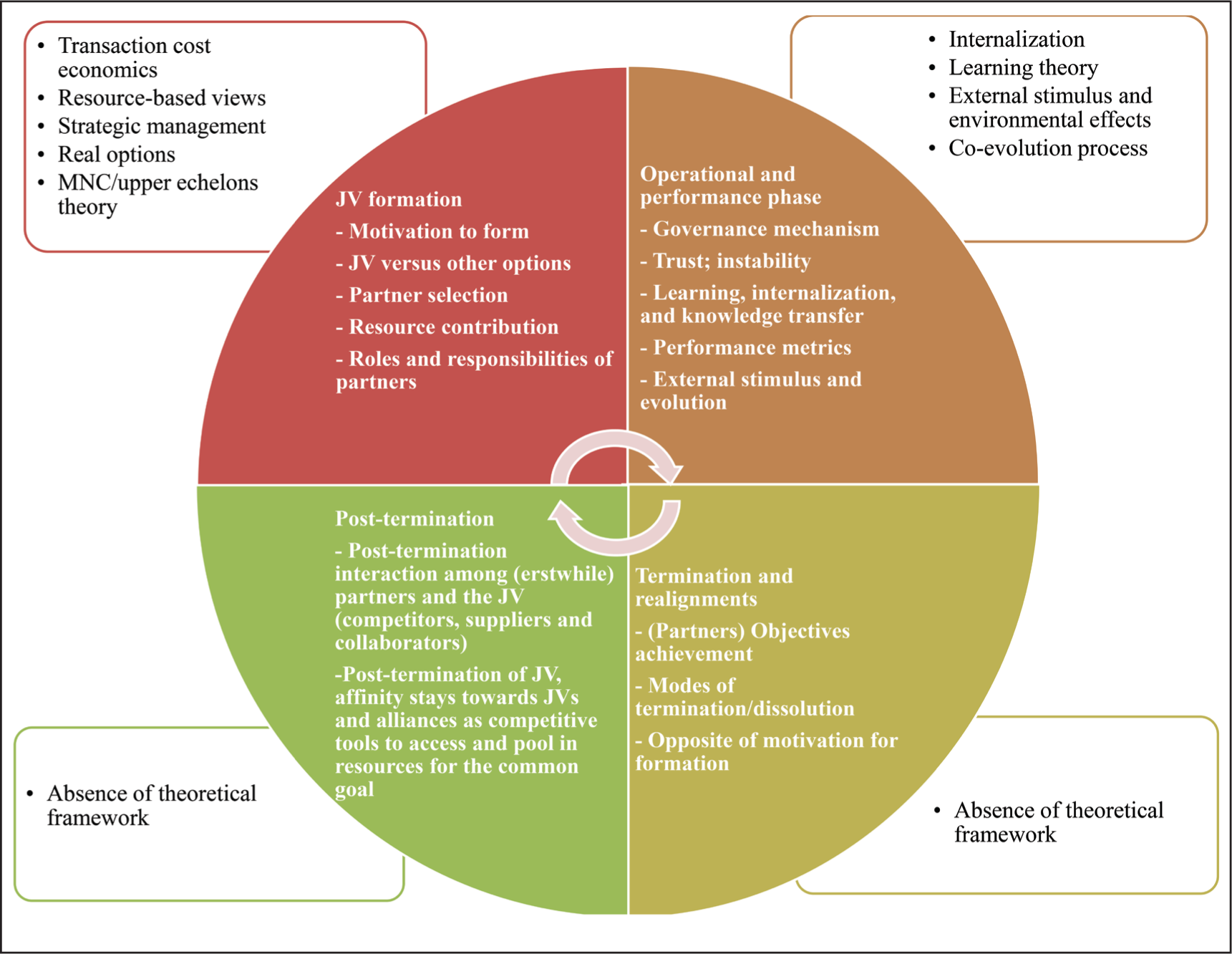
The need for studies focused on how alliances evolve, their dynamics and termination has continued to get enumerated by researchers in the areas needing further study, along with the failure of relational mechanisms and breakdown of trust (Duhaime et al., 2021).
Context
JVs in India across sectors, including the ones in automobiles and insurance, which came into existence between the 1980s and 2000s, are maturing; similar is the situation in other developing nations, prompting the need for a fresh look at the research capturing the life cycle of JVs towards possible termination followed by the post-JV stage of the venture.
This article aims to dissect the life cycle of IJVs, with a specific focus on the termination and post-termination stages. By addressing this critical aspect, the article seeks to fulfil the industry’s demand for practical insights into JV management, thereby contributing significantly to management education. It does so by presenting the JV life cycle as a longitudinal case study. This refers to the largest manufacturer and seller of cars in India. This venture, which started as a wholly owned subsidiary (WOS), turned into an IJV when an equity partner was inducted with a minority (26%) stake. The minority partner continued to enhance its stake in stages transitioning the IJV as its majority-owned subsidiary. The original parent finally exited and completely sold off its entire stake in phases to the other partner and another group of investors. Over the last four decades, the company had its share of challenges and transformed as a result of environmental factors. In presenting this case study of an IJV in India, we go back to the practitioner’s view to showcase its lifecycle and how it evolved through the same.
This study is motivated by the necessity to explore the dynamic factors within alliances that ultimately culminate in termination. It concludes that external factors often prompt JVs to undergo significant reorientation. A new organization evolves as the JV adjusts itself to face the new realities, which were not foreseen at the time of the establishment of JV. The JV’s functional stage turns out to be the foundation for its performance in the post-termination stage. The research also points out the hybrid form of JV’s termination, which is somewhat different from the plain vanilla dissolution or acquisition as the two main forms of JV termination studied so far.
Methodology
An integrated life-cycle approach to understanding JV applications had been advocated among the earliest seminal research on the subject (Franko, 1971). This approach found a place in studies by Kogut (1988a, 1998b), Chowdhury and Chowdhury (2001) and Dhaundiyal & Coughlan (2020) among others. Nippa and Nemeth (2013) in their overarching research on IJV exit, termination and longevity covering papers published across two decades (1991–2011) recommended grounding research for significant theory development and putting case studies to use along with deployment of similar qualitative research methodologies. This is due to the multi-dimensional and interdisciplinary nature of IJV research, which includes various factors such as interpersonal trust, fairness, governance systems, legal and cultural institutions and cross-level influences. Quantitative methods often struggle to capture the nuances and complexities involved, making them feel like a forced fit (Arora et al., 2023).
The demand for longitudinal case studies and research capable of capturing the complexities and dynamics of cooperation has persisted since Smith et al. (1995) and continued till Nippa & Reuer (2019), who suggested a study track covering the IJV life cycle and bringing a practitioner’s input into the IJV scholarship.
Research carried out by Bruner and Spekman (1998) and Inkpen (2005, 2008) brought out the case study heuristics by scrutinizing alliances of Volvo-Renault and General Motors-Toyota, respectively, at different periods. However, these have been far and few. Nippa and Reuer (2019) reviewed IJV studies and reported a dearth of case studies in this field, which got overcounted by quantitative, survey-based, cross-sectional studies. This has been reflected in the application, with the actual situation in industry and organizations being different in each case.
The research is based on the case study of Maruti-Suzuki, the largest car manufacturing company in India. A subsidiary of Suzuki Motor Corporation (SMC) of India since 2003, it used to be an IJV prior to that (1983–2003). Data for this longitudinal study, covering four decades, were gathered from company annual reports, press releases and interviews with key leaders, some of whom have been quoted, while others remained anonymous for reasons of confidentiality. Multiple rounds of interactions across different formats in formal and informal settings were done for the study. These interactions spanned stakeholders of various functionaries of the senior leadership team as well as the middle management. Since these interplays were iterative, sometimes involving going back and forth across the same (or a subset) of the original target group of respondents, it will not be fair to give an exact number of such interactions, but the number of participants involved in the study crossed a dozen and a half individuals.
Insights from officials who experienced the transition from an IJV to a subsidiary, including one of the paper’s authors, had been captured. Views of other stakeholders who facilitated this transition (viz., leading investment bankers and consultants), who provided support and advice to the company, and JV partners for effecting the exit of one of the partners have been brought in too. The case study integrates data and findings from interviews with existing IJV and alliance literature, incorporating research from both qualitative and quantitative methods spanning over the last seven decades (1953–2023).
The case was selected for its dynamic setting with significant variance in key concepts and its long operational history, which provided a basis for anticipating relational issues.
Case
The year 2023 marked four decades of the journey of Maruti-Suzuki India Ltd (MSIL), formerly Maruti Udyog Ltd (MUL), India’s leading car manufacturer. Having started as the WOS of one parent and then transformed as a JV early on in its life before turning into the subsidiary of the other parent, it reached a major milestone of ₹1 trillion ($11.76 billion) turnover in a single financial year (FI; 2022–2023). The journey of four decades has had its ups and downs. This case study investigates the life cycle of the JV and various factors at play as it evolved dynamically. This becomes particularly useful in view of the future challenges facing the organization.
The study follows the case study research guidelines of describing, explaining, predicting, and controlling (Woodside & Wilson, 2003) of the JV organization (MUL and its parents) in this case. This carried forward the approach of Yin (1994), which suggested the investigation of phenomena through a linear, iterative process and tagged case studies with capabilities to lead to theoretical propositions through generalizations.
Maruti Suzuki (MSIL)
MSIL, a subsidiary of SMC, Japan, has been the largest player in the passenger car market in India. The company was incorporated in 1981 as MUL, owned 100% by the Government of India (GoI). GoI did not have access to any technology for manufacturing cars; hence, it decided to obtain technology from a foreign collaborator. After an extensive, worldwide search for a partner, SMC of Japan was inducted as a minority JV partner in MUL. The selection process by GoI involved the evaluation of expressions of interest from the world’s leading automakers based on the proposed product/technology and commercial details for the project as submitted by the prospective partners. In the words of RC Bhargava, Chairman Maruti-Suzuki:
Maruti started as a company with no hope in 1981 when it started. It defied all odds and went on to become a successful example of Indo-Japanese collaboration. This was mainly due to the way the Japanese and Indian work cultures were merged to form a new work culture for Maruti that enabled better results.
Initial shareholding in the JV was 26% for SMC and 74% for GoI. The two partners agreed for the JV to be headed by a Chairman and Managing Director (CMD) appointed by the majority shareholder (GoI). SMC enhanced its stake in stages to 40% (in 1988) and 50% (in 1992). In the year 1992, the original JV and subscription agreement of 1982 was amended, and an amendment agreement was signed. SMC subscribed to additional preferential equity, making it a 50:50 JV. One of the terms of this amendment agreement was splitting the post of CMD into two—a (non-executive) Chairman and a (full-time) Managing Director (MD), with each partner entitled to nominate the officials to hold these positions for a term of 5 years each by rotation.
The journey of JV had its ups and downs. Spats and disagreements came to light between the two partners—from areas as diverse as modern technology in production to the expansion of operations and financing, going up to the appointment of key management personnel. While quite a few differences got resolved, some persisted and led to a breaking point wherein both the JV partners got ready for an impending separation but was averted.
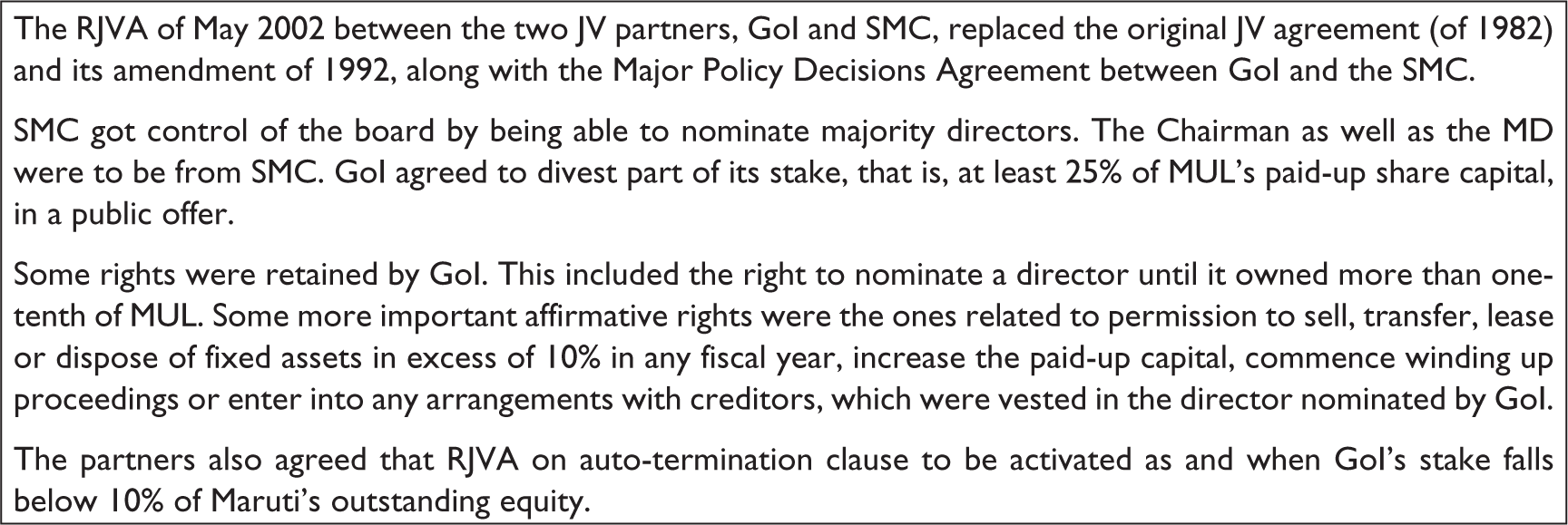
SMC acquired the controlling stake in 2002 by subscribing to the rights issue, whereby its stake was enhanced to 54.2%. A revised joint venture agreement (RJVA) was signed between the two partners (highlights of RJVA given in Figure 4).
Highlights of RJVA.
Transition of JV into Subsidiary: Organization Transformation Post-JV
The JV became a subsidiary of SMC in 2002 and the latter continued to increase its stake at regular intervals (Appendix A). Subsequently, MUL was renamed MSIL in 2007, post the complete exit of GoI. Many changes came into the fabric of the organization as part of the transition. The Ringi system of managerial decision-making was introduced in line with what was existing at SMC. This is based on approval through deliberations and focuses on a bottom-up approach for participatory management. Though sometimes viewed as time-consuming, this collective decision-making is a hallmark of Japanese organizations (Sagi, 2015).
‘Decision making became swifter due to unidirectional leadership of parent, SMC’, in the words of a former member of the senior leadership team who had been through the journey as part of the transformation.
At the end of two decades as a subsidiary of one of the parents, Maruti reported a stellar performance in FY’23 by having sold nearly two million units, having grown 19% over FY’22, and highest-ever exports of 2,59,333 units, which resulted in net sales revenues crossing ₹1 trillion ($12 billion) and operating profit of ₹81.844 billion ($1 billion).
MSIL got the position of largest subsidiary of SMC. Its share in parent SMC’s global sales rose to an all-time high of 54.8% in FY’23 (Mukherjee, 2023). The performance trend of Maruti is given in Appendices B, C and D.
Results and Discussion
Motivation for JV
Alliances and JVs have long been part of a firm’s consideration list for expansion, diversification and internationalization strategies. One strand of research pointed out that JVs are preferred when organizational strategies focus on expansion and related diversification (Ortiz-de-Urbina-Criado et al., 2014). Researchers have deduced that accessing and complementing resources is the primary motivation for JVs (Ainuddin et al., 2007). The resources are pooled in the JV by each of the parents (also referred to as partners) for mutual benefit; however, this was to be balanced with the increase in transaction costs of managing alliances. Resource-based theory along with transaction cost theory form the bedrock of most of the research frameworks focused on JV motivation (Beamish & Lupton, 2016; Ferreira et al., 2014; Gomes et al., 2016).
In this particular case, GoI and SMC contributed respective resources to the JV based on each other’s strengths. GoI, being a sovereign partner, brought market access (the policy of industrial licensing debarred any other car company from setting up shop), providing a head start to JV during its first decade and helping it establish a strong footprint. SMC was the source of the entire technology, production know-how and training of manpower. Among the entry mode choices for multinational enterprises, wherein multiple studies have been done comparing WOS with JV (Barkema et al., 1997; Beamish & Lupton, 2009; Gaur & Lu, 2007; Gomes-Casseres, 1989; Pan & Tse, 2000; Yiu & Makino, 2002), the option of WOS was not available for SMC owing to GoI’s policy; JV with GoI was the only option for it to tap the potential of a growing emerging (Indian) market. SMC was thus constrained to follow the JV route. The case illustrates that JVs are vehicles for shared learning, knowledge acquisition and capacity building (Barkema et al., 1997; Inkpen, 2005, 2008; Inkpen & Dinur, 1998; Luo, 2002). Training provided by SMC to Maruti’s Indian engineers and workmen along with deputing its representative from Japan as SMC advisors helped Maruti capture the knowledge from one of its parents. However, it was often criticized for holding back critical knowledge like (research and development [R&D] and gearbox technology, which turned out to be one of the friction points between the two partners (Iype, 1997).
Operationalizing the JV
Roles and responsibilities defined for each of the partners during the formation stage help align JV towards a common goal. In the case presented in this research, SMC had a stellar contribution in managing Maruti. Besides the appointment of key management personnel, technical functionaries were regularly deputed from SMC. Till the JV’s active period (i.e., the first two decades of 1982–2003), two directors on the board were nominated by SMC. It provided training to personnel and homogenized Japanese management practices such as Kaizen in the factories.
Under the agreed responsibilities between the partners, SMC was required to support all technology and product development. Licence agreements were signed between Maruti (the JV company) and SMC (one of the parents) for each of the new products when they were introduced. Maruti on its part was supposed to pay a fixed and variable fee (fixed royalty and running royalty) to SMC. Later on, during the JV life cycle, this became one of the points of disagreement between the two partners. SMC’s continuing to charge royalty for models older than a specified period was objected to by the other partner, GoI, since it expected that SMC would help in complete indigenization by transferring critical technology to help it become self-sufficient. This brought instability to the JV as the partner relationships soured, thus threatening to impact its longevity.
Partner relationships have been the focus of quite a few studies around JVs. One of the highly cited research based on practitioners’ views propositioned that top executives devote a disproportionate amount of time to screening potential partners in financial terms than to managing the partnerships in human terms; they worry more about controlling relationships than about nurturing them (Kanter, 1994). Another empirical research hypothesized that trust between parents and support provided to the IJV by foreign parents are associated with performance instead of directly with learning (Lane et al., 2001).
Performance occupies the top place among the dependent variables studied in JV research. It is often used to distinguish between successful and failed ventures. Several metrics of performance, financial and non-financial, the latter largely alluding to things like stakeholder satisfaction, achievement of objectives and a number of other parameters, found their place as response variables in the topmost cited studies (Arora et al., 2023)
Research on JV performance has led to conjectures that the presence of local partner(s) helps access local knowledge and improve performance; past JV experience in the host country assists JV performance enhancement through local knowledge (Makino & Delios, 1996), and this came out very much in the case of Maruti, SMC’s India JV. Pak-Suzuki, SMC’s venture, a WOS in India’s neighbouring country, Pakistan, turned out to be much less successful (Sarwar & Sarwar, 2017). Maruti continued to report improved performance across parameters post-transitioning as a subsidiary of SMC in FY’03. Its share in parent SMC’s global production rose to an all-time high of 60% in FY’23 (Mukherjee, 2023).
Instability, Re-evaluation and Realignment
Research around instability in JV has been relatively new phenomenon in line with its stage in the life cycle. Nippa and Nemeth (2013) brought out a multitude of variables, with nearly 120 independent ones impacting JV termination and over 50 playing a role in the longevity of JV. The multi-dimensional nature of research in this arena encompassing interpersonal trust and fairness, control and governance systems, legal and cultural institutions and cross-level influences turned out to be the reasons behind so many variables (Nippa & Reuer, 2019).
A critique of previous research on IJV instability showcased unclear conceptualizations, lack of clarity in the relationship of instability with performance and static focus on the eventual destination, besides very little managerial relevance (Yan & Zeng, 1999). The case of Maruti-Suzuki as presented here corroborated the findings of Yan and Zeng (1999) that inter-partner conflict in co-management, control/ownership structure, characteristics of parents and external environment were the factors that contributed to instability. The company (initially a JV) operated almost like a monopoly for the first 13 years (with little competition) as new automobile players were not allowed by GoI (which itself was one of the partners in the JV), and thereby MUL continued to flourish. The onset of competition from global peers as part of the industrial liberalization in India brought in India from the year 1991 onwards brought the company under pressure and differences became more evident. New investment proposals, as were required to be done by the company (in mid-1990s), became a flashpoint.
Africa and José de la (1998) brought out the perspective of monitoring the efficiency of the alliance aimed towards its re-evaluation by the partners. The research posited that reassessment of initial conditions, along with a fresh sequence of negotiations and commitments, could result in a revised set of conditions leading to a new equilibrium. Furthermore, alterations in external conditions also contribute to this cyclic process. Inkpen and Pien (2006) elucidated the JV’s transition from initial conditions to evolved conditions, demonstrating how the partners adapted their interactions and gained deeper insights into each other, thereby fostering increased cooperation and the development of relationship-specific assets. The roadmap of evolution involves a realignment of equity and roles for respective partners as it comes out in the case study of Maruti-Suzuki as presented in this article. The case also elucidated the transformation of JV from a symmetrical control to asymmetry for Maruti and the resultant impact of one partner dominating while the other withdrawing, as hypothesized by Lu and Wang (2021) in their empirical research. The complementing, cooperative and complementing learning aspects were captured by Wang et al. (2023) to outline the dynamic learning perspective in a dynamic environment, which in turn impacts the IJV instability and termination.
Co-evolution found a place in extant literature with JV partners’ understanding of each other leading to the evolution of the relationship from initial conditions as hypothesized by Inkpen et al. (2004, 2006). This is driven by the fact that when the JV is initially established, none of the partners are accurately able to foresee the future implications. This lack of foresight underscores the unpredictable nature of business ventures and the inherent uncertainty that accompanies collaboration.
Trust in JV
Trust (on the other partner) is the foundation of a successful JV, while lack of trust is quoted by managers as well as researchers as the reason for failed ones (Parkhe, 1998b). In the realm of alliance and JV research, trust, control and learning stand out as three pivotal and extensively studied concepts (Inkpen et al., 2004), as these pillars not only shape the dynamics within partnerships but also significantly influence their success and longevity. Parkhe (1993) concluded that empirical, quantitative methods of investigating JVs are unable to capture soft variables like trust, reciprocity, opportunism and forbearance. Conceptualizing and measuring trust in an IJV through a multi-level approach at the person, group and firm level had been articulated by Inkpen and Currall (1998). Parkhe (1998a) underlined the need to appropriately ‘calibrate’ the trust level in an alliance to the life-cycle stage. Outcomes of JV trust like forbearance and governance structures are enumerated in the present study of Maruti-Suzuki.
In the case of Maruti, trust issues came into being with GoI (one partner) getting into believing that the other partner (SMC) was making enormous amounts of profits by supplying completely knocked-down kits and parts to Maruti, the JV company (Bhargava & Seetha, 2020). GoI also felt that SMC was delaying the localization of critical components (gearbox) in India and not doing enough to develop R&D for Maruti to continue remaining dependent on it.
‘Trust & confidence between the JV partners is the key to success of any JV especially when technology & production know-how is entirely with one partner’, said R. C. Bhargava, Chairman of MSIL.
Two equal partners in JV had matching presence on the board with one-half of the total strength of directors (eight) nominated by GoI and SMC alike. The differences played out in the boardroom in the mid to late 1990s (particularly during the 1996–1998 period).
SMC challenged the appointment of Maruti’s MD as nominated by the other JV partner, that is, GoI (Iype, 1997) and filed a case against the latter at the International Court of Arbitration over this (Mitra, 1997; Nayar, 1997). GoI toyed with the idea of replacing the SMC with another technology partner.
Critical decisions like the introduction of new models and expansion of manufacturing capacity stayed in the state of suspension. As a result, the JV that reported robust growth in the first 17 years suffered badly. The negative impact on performance came out as the partner differences (during the period FY’98–FY’02) became more evident. The margins shrank and JV got into the red in FY’01, having made its first and only loss, as shown in Appendix D.
Finally, the impasse was resolved when one of the partners (GoI) decided to exit in stages and agreed to transfer management control to SMC. The former received ₹10,000 million (about $200 million) in lieu of relinquishing its part of the control to the latter. In addition, SMC acquired an additional stake in the JV by subscribing to the rights issue, taking its holding to 54.2% of Maruti (from 50% before that). The two partners entered into RJVA in May 2002 (highlights of RJVA are given in Figure 4). As per the terms of the RJVA, GoI agreed to divest its remaining stake (45% stake) in stages to the public. It started with its offer to sell a 25% stake in an Initial Public Offer (IPO). SMC agreed to underwrite the stake sale during the IPO at the floor price.
The company that had been a JV for the first two decades of its lifespan (1982–2002) then turned into a subsidiary of SMC, that is, one of the partners. The next two decades (2003–2023) had been even more successful. While the former period gave a sound footing to the JV, the latter period made it more competitive and focused.
Researchers have argued that learning is central to JV evolution. As trust deepens and learning progresses, partners are prompted to recalibrate their control mechanisms to reflect the evolving dynamics and mutual understanding (Inkpen et al., 2004).
Culture in JV
The issue of culture impacting the longevity of JV has been addressed in various studies, often with contradictory results. While a section of researchers hypothesized about culture conflicts leading to reduced longevity and enhanced probability of dissolution (Hennart & Zeng, 2002), another strand surmised that cross-border JVs tend to have higher longevity (Park & Ungson, 1997), despite the diversity in culture and that cross-border JVs do not end up being more unstable than national JVs. The case of Maruti represented partners in JV from two diverse nationalities and organizational frameworks (one being a company, the other being a government, sovereign power) but could not finalize any of these findings regarding cultural differences impacting longevity. However, it does point out that one partner that gets access to resources pooled in by the other partner decides to go on its own, thus confirming the finding of one of the seminal papers by Parkhe (1991) about the likelihood of dissolution of a coalition as the party gaining access acquires its internal skills.
Post-termination: The New Journey
Research has brought out that the majority of JVs fail (Bruner & Spekman, 1998; Hennart & Zeng, 2002; Inkpen & Beamish, 1997; Kogut, 1988a, 1988b, 1989; Lowen & Pope, 2008; Park & Ungson, 1997; Peng & Shenkar, 2002; Spekman et al., 1996, 1998). The failure of JVs has been due to various reasons—Bruner & Spekman (1998) considered alliances in the category of R&D projects, wherein failure is inherently part of the process and should be expected. Kogut (1988a, 1988b) gave several explanations for JV termination in the form of conflict between parents and JV, trade-off between autonomy and parental control and conflict increasing with the degree of coordination desired by parents. Besides, the health of the industry, cooperative incentives (among the partners) and the degree of competitive rivalry influence stability. Maruti-Suzuki case corroborated the shared control leading to inferior performance (as compared to dominant parent) proposition as put forth by Killing (2013).
Other researchers have suggested that the success rate of alliances (at 60%), however, compares favourably with other modes of business growth—with venture capital and acquisitions being 30% and 50%, respectively (Pekar & Allio, 1994). In most cases, JV partners do not have a specific plan for termination; hence, premature termination can be traumatic for them. JV longevity is not equivalent to JV success, and the one that is prematurely terminated may be treated as a successful one, depending on whether it helped serve the strategic and financial needs of the partners. Eighty-five per cent of JVs that terminate end with the acquisition of the venture with one of the original partners as it came out in an inductive, longitudinal case study—the framework comprises the following three overlapping stages of development: formation, adjustment and evaluation with shorter, cyclical periods (Bettina, 2000). Many researchers have hypothesized about the failure of JVs; their success is proposed to be an exception rather than the rule while ruining the fragmented literature on the poor performance of JVs (Park & Russo, 1996).
Maruti JV did not have any specific termination provision. The licence agreement signed subsequently for various products had a timeline of 10 years during which royalty was to be paid to SMC for technology. The renewal of these, however, became a sticking point but later got resolved as one parent decided to exit, paving the way for a hybrid mode of JV’s dissolution.
JVs are said to be inherently unstable transitory organization forms, likely to be dissolved, acquired or merged sooner or later driven by the strategic intent of parents, suggesting that instability and termination of JVs are not necessarily its failure (Harrigan, 1988; Reuer, 1998). Maruti JV, after facing instability, advanced first with one parent buying out part of the stake of the other and the exit of the other parent driven by the dynamically evolving environment. Maruti JV could have collapsed due to partner differences, but it survived and evolved as the company, and the partners adapted to a newer environment, thus preventing extinction like dinosaurs (Brusatte et al., 2015). The hybrid exit of GoI actually enhanced the longevity of the venture.
Termination and post-termination stages have been among the least studied in JV research. Some researchers have brought up the post-termination interaction recently (Batra et al., 2021; Parameswar & Dhir, 2019). Research around IJV termination has centred around three modes of termination for an IJV—complete liquidation of the venture, bought over by the local partner and international partner, respectively (Gomes-Casseres, 1987).
The case of Maruti JV presented here has been a combination of the options presented as the termination mode, with one of the partners relinquishing control to the other upon getting paid a control premium and then selling its stake in the stock market. This hybrid dissolution happened as outlined in the RJVA. The smooth exit of one of the partners (after the instability phase) led it to become a subsidiary of the other partner. The subsidiary then cruised ahead on its growth path, reaching new echelons.
A complete journey of shareholding changes, the evolution and transition of MUL over the last four decades, from a WOS (of GoI) to a JV (between GoI and SMC) to a subsidiary (of SMC), along with the changes in organization, is depicted in Figure 5.

Transition of JV into Subsidiary: Organization Transformation Post-JV
SMC’s control brought in a renewed focus on productivity, quality and cost at Maruti by integrating it against other plants of SMC. Programmes like Challenge 50 and Challenge 30 were launched. These targeted 50% improvement in productivity and 30% reduction in cost over 3 years. The target of 50% improvement in particular was finalized after SMC benchmarked Maruti against its Kosai Plant in Japan and found that the latter was 20% behind Kosai. Since Kosai Plant intended to improve by 30% in the next 3 years, the target for Maruti was decided to be 50% (Shahadave, 2014).
‘We evolved our own Maruti Production System (MPS) from the Suzuki Production System to drive productivity improvement and cost reduction with the help of experts from Japan who made frequent trips to India to guide our managers and suppliers’, said Jagdish Khattar, former MD of Maruti.
MPS was introduced to identify and eliminate waste in the processes, a bottom-up approach for implementing lean manufacturing principles. Hours per vehicle, a parameter used by leading manufacturers across the globe for measuring productivity, became the norm at Maruti (Shahadave, 2014).
Decision-making officials with designations like signations like Executive Officers and Managing Executive Officers were introduced in line with SMC’s organizational structure.
The transition led to the emergence of issues around governance, with the majority shareholder driving all the decisions, including new investments, expansion of plant and machinery, as well as setting up of its other subsidiaries impacting MSIL, some of which came under the scanner of minority investors (more on governance issues given in supplementary material; see the list of related party ventures set up by SMC given in Appendix E).
Contribution to Theory
Acceptance of case studies in theory development continues to get enhanced (Eisenhardt & Graebner, 2007), those being distinguished from empirical methods for their particularization (Stake, 1995). The case of Maruti amplified the deployment of existing theories to explain the various phenomena within JVs by presenting distinct situations. It confirmed some theories and challenged a few. The role of cultural differences among the partners does not come to light during the conflicts between the two partners—GoI and SMC. In addition to the three options to dissolve the JV as given by Gomes-Casseres (1987), the case presents a hybrid option—whereby one of the partners gives up the control to the other partner while simultaneously selling its stake to another group of shareholders (public at large through an IPO), thereby presenting a unique dissolution mechanism not yet examined in the literature. This has been a novel approach to finding a solution to resolve the instability of JV. The resultant subsidiary of the overseas parent then continued to march ahead, forging new alliances and partnerships to get itself ready for the challenges of the future. This confirmed the finding that past performance as a JV partner leads to a higher propensity for future partnerships (Makino & Delios, 1996). This is also demonstrated by the JV company (Maruti) forming its own JVs for securing critical supplies, where safeguarding intellectual property becomes important.
The case illustrates partners agreeing to an objective beforehand (say market share, scale of business or other milestone) and terminating the JV once the said target is achieved, which saves acrimony among the partners and the JV. This calls for cautious planning for exit or JV termination based on the value appropriation of each partner being one such criterion as studied by Goyal & Dubey (2022).
Conclusion
JV research has spanned across its life cycle. Research themes evolved from entry mode options and partner selection to operational phase and dissolution (Ferreira et al., 2014). Studies on motivation for JV have been found to dominate the research space (Arora et al., 2023). The lack of a comprehensive study and theory on JV has illuded (Parkhe, 1993). This research showcased a framework of the JV life cycle as a collectively coherent case using the lifecycle of an IJV that has undergone the entire cycle, amalgamated with an underlying theoretical structure.
The research brings out the linkages between the impact of external stimuli and the evolution of JV organization. It showcases that changes in the composition and equity proportions of partners in a JV due to external factors are part of the JV’s evolution. The evolution of learning, closely linked with trust, plays a significant role in shaping control decisions within partnerships. When a JV is terminated due to shifts in the market environment or the strategies of parent companies, it should be viewed as an adaptation rather than a failure. The changes that occur during the JV process—rather than the initial formation conditions—are the primary drivers of termination.
Managerial Implications and Future Research Directions
The case confirmed the currently held belief about the JV life cycle culminating in its dissolution or acquisition by one of the parents. The research presented insightful results for practising managers to capture the entire life cycle of a successful JV, which then transitioned to being the subsidiary of one of the partners. Starting with the understanding of partner selection and assignment of responsibilities among the partners for smooth operations of JV, it showcased the conflict phase of JV partners in greater depth. It demonstrated how the partners agreed to revise the JV agreement as the market became competitive, which helped the JV to evolve catering to a dynamic environment. The hybrid form of exit by one of the partners, GoI, carried through a stretched time, thus preventing a sudden shock to the JV, as explained in the case representing an unchartered territory. This has been one of the unique contributions of this case in the academic world, which has so far researched only straitjacket JV termination options. This is also of interest to the industry as many of the existing JVs reach the maturity stage, wherein one or more partners seek an exit. The time has come for contemporary literature to be developed around this aspect, which is soon going to become a need of industry. An academic focus to complement this facet of hybrid exit would not just help enhance the effectiveness of the model but also has the potential to bring out other possible solutions wherein one or more JV partners seek and exit.
The continued affinity of the organization, which was once a JV, itself towards newer alliances and JVs as it faces challenges as presented in the case confirms the previous research findings.
The study highlighted the need for adequate legal safeguards to be built into the JV agreement to ringfence the JV from disagreements among the parents. Any such continued discord among the parents has the potential to harm the JV and its survival, as has been evident from the slide in the financial performance of MUL during the time when its parents, SMC and GoI, were squabbling. The dynamic external environment has the potential to alter the playing field, and JVs as well as the relationships among partners need to evolve for not just continued growth but also for the survival of the organization. The RJVA signed between the two partners of MUL, prompted by the emerging competitive environment in the early 2000s, and the newer alliances and JVs of MSIL in the wake of EVs in the 2020s clearly showcase progress on this front. Extant literature needs to focus on this aspect of JVs, alliances and other forms of cooperative businesses.
The case calls to attention the need for an inbuilt termination or progression of JVs to be incorporated at the time of establishment under various scenarios, as that would reduce the possibility of dispute among the partners.
The findings of the case presented a longitudinal study of a successful IJV that had undergone metamorphosis in the wake of an evolving external environment. Research on JVs and alliances is likely to be strengthened by more of such meticulous and extensive studies capturing practitioners’ views combined with the academic literature. These studies may involve different industries and countries to help develop an understanding of the scenario in a broader sense. While the case study in the article was a successful evolution, some not-so-successful cases could help complement it, which may be catered to by future research. Furthermore, the need to conduct in-depth studies into the governance issues as they emerge after the JV transitions into the subsidiary of one of the partners post the JV termination needs to be studied in detail.
The automobile industry in India is set for a disruption with the advent of electric vehicles (EVs). GoI is encouraging the use of EVs through a favourable policy regime offering tax breaks, subsidies and investment promotion in the field (growth of EVs in India given in Appendix F). Indigenous automobile manufacturer Tata Motors took an early lead in this segment, having captured nearly three-fourths of the EV market in 2022–2023. MSIL continued to remain absent in this small yet fast-growing segment, referred to as the ‘future of mobility’ by many (Arora & Inkpen, 2022). Focusing on its strategy of seeking alliances and JVs, SMC in Japan partnered with Toshiba Corporation and Denso Corporation for the development and production of lithium-ion batteries, an important component of EVs. This paved the way for a three-way JV—Toshiba Denso Suzuki Gujarat Pvt Ltd to tap into the strengths of each of these partners—a manufacturing operation derived by SMC’s expertise complemented with Toshiba and Denso’s cell and module technology, respectively. SMC held a stake of 50%, Toshiba 40% and the rest 10% with Denso in this JV. At a global level, SMC partnered with the world’s biggest car manufacturer, Toyota Motor Corp in 2016 for the new energy space, and this alliance kicked off with collaboration through cross-badging in India through MSIL (Das, 2020). Thus, as the company gets ready to face the new reality, particularly in the alternate mobility and green mobility solutions, it is turned to signing up new alliance partners. Future research may be directed to study whether this new phase of global alliance strategy will be successful in the domestic market as well.
Abbreviations
Supplemental Material
Supplemental material for this article available online.
Footnotes
Declaration of Conflicting Interests
The authors declared no potential conflicts of interest with respect to the research, authorship and/or publication of this article.
Funding
The authors received no financial support for the research, authorship and/or publication of this article.
Appendix
EV Sales Growth Across Different Segments of the Auto Industry in India.

| EVs (Category) | Growth in 2023 (%) |
| Electric two-wheelers | 36 |
| Electric three-wheelers | 65 |
| Electric commercial vehicles | 114 |
| Electric passenger vehicles | 115 |
Note
References
Supplementary Material
Please find the following supplemental material available below.
For Open Access articles published under a Creative Commons License, all supplemental material carries the same license as the article it is associated with.
For non-Open Access articles published, all supplemental material carries a non-exclusive license, and permission requests for re-use of supplemental material or any part of supplemental material shall be sent directly to the copyright owner as specified in the copyright notice associated with the article.
