




Abstract
This article proposes a neoclassical growth model with endogenous capital accumulation and knowledge creation. The model integrates Arrow’s learning by doing, Uzawa’s two-sector growth model and Walrasian general equilibrium theory. We use a utility function, which determines leisure time, saving and consumption with utility optimization without leading to a higher dimensional dynamic system like the Ramsey approach. The dynamics of J-household economy is described by a ( J + 1)-dimensional differential equations system. We simulate the motion of the model and demonstrate transitional and long-term effects of changes in the propensity to save, the propensity to use leisure time, the population, the learning-by-doing efficiency and knowledge utilization efficiency. The comparative dynamic analysis provides some insights into issues related to inequality and growth.
Keywords
Introduction
The purpose of this study is to study inequality and growth by building a neoclassical growth model of heterogeneous households with endogenous capital accumulation and knowledge creation. Our model is influenced by three main theories in economics—Arrow’s learning by doing, Walrasian general equilibrium theory and neoclassical growth theory. The Walrasian general equilibrium theory of pure exchange and production economies is the core theory of formal economic theories with microeconomic foundation. The theory is proposed by Walras and further formalized by Arrow, Debreu and others in 1950s (e.g., Arrow, 1974; Arrow and Debreu, 1954; Arrow and Hahn, 1971; Debreu, 1959; Gale, 1955; Mas-Colell et al., 1995; McKenzie, 1959; Nikaido, 1956, 1968; Walras, 1874). The general equilibrium theory describes market equilibrium with economic mechanisms of production, consumption and exchanges with heterogeneous industries and households. Nevertheless, the theory has not been successfully generalized and extended to growth theory of heterogeneous households with endogenous wealth. Although Walras introduced saving and capital accumulation in his general equilibrium theory, he failed to properly integrate his ideas about capital accumulation into the general equilibrium theory (e.g., Impicciatore et al., 2012). Over years, there are different attempts to further develop Walras’ capital accumulation within Walras’ framework of heterogeneous households (e.g., Dana et al., 1989; Diewert, 1977; Eatwell, 1987; Montesano, 2008; Morishima, 1964, 1977). The common problem for these approaches is the lack of proper microeconomic foundation for wealth accumulation. To overcome this problem, Impicciatore et al. (2012) propose a model in which it is assumed that consumers store capital goods in order to supply their services to the production sector in the next period under the condition that capital goods exiting in one period totally depreciate at the end of the period. Nevertheless, the model still relies on a proper treatment of household saving behaviour. This study introduces an alternative approach for modelling wealth accumulation with the traditional Walrasian general equilibrium framework of heterogeneous households.
Although the Walrasian general equilibrium theory shows how economic equilibrium is achieved, the theory is not proper for addressing issues related to growth and structural change with wealth and income distribution. The neoclassical growth theory mainly developed since the 1950s deals with capital accumulation, even though the theory is not effectively for explaining wealth and income distribution as it is mainly for economies with homogeneous population (e.g., Barro and Sala-i-Martin, 1995; Burmeister and Dobell, 1970; Solow, 1956). The neoclassical growth theory directly models endogenous wealth accumulation with microeconomic foundation (e.g., Ramsey model). This study is based on the neoclassical growth theory. This study follows Uzawa’s two sector growth model in describing economic structure (Uzawa, 1961). Uzawa’s two-sector model has been generalized and extended in different ways over years (see Diamond, 1965; Drugeon and Venditti, 2001; Mino, 1996; Stiglitz, 1967). We will integrate the neoclassical growth theory with the Walrasian general equilibrium theory for studying dynamic interactions among growth, wealth and income distribution and economic structures. It should be noted that some attempts have been made to introduce neoclassical growth theory into the general equilibrium analysis (e.g., Jensen and Larsen, 2005). As reviewed by Shoven and Whalley (1992, p. 1), ‘Most contemporary applied general models are numerical analogs of traditional two-sector general equilibrium models popularized by James Meade, Harry Johnson, Arnold Harberger, and others in the 1950s and 1960s.’ From the history of analytical economics, we know it is difficult to properly model economic growth with wealth and income distribution.
Except integrating the two theories in a single analytical framework, we also take account of endogenous knowledge and elastic labour supply in modelling wealth and income distribution. The literature on endogenous knowledge and economic growth has increasingly expanded since Romer (1986) re-examined issues of endogenous technological change and economic growth in his 1986’s paper (see also Aghion and Howitt, 1998; Brecher et al., 2002; Chari and Hopenhayn, 1991; Grossman and Helpman, 1991; Lucas, 1988; Martin and Ottaviano, 2001; Nocco, 2005). The pioneering work on formally modelling endogenous knowledge is by Arrow (1962) who introduced learning by doing into the formal growth theory. In this study, we model the knowledge creation with Arrow’s learning by doing. There are many applications of Arrow’s idea to different issues in economic growth theory (e.g., Albelo and Manresa, 2005; Kitaura and Yakita, 2010; Martin and Rogers, 1997; Shea, 2013; Solow, 1997; Young, 1991, 1993). This study follows an application of learning by doing by Zhang (1993). This article also extends a recent article on economic growth with heterogeneous households by Zhang (2012) by introducing endogenous knowledge into the neoclassical growth model. The rest of this article is organized as follows. The second section defines the heterogeneous-households neoclassical growth model with capital accumulation and knowledge creation. The third section shows that the dynamics of the economy with J types of households can be described by ( J + 1)-dimensional differential equations. As mathematical analysis of the system is too complicated, we demonstrate some of the dynamic properties by simulation when the economy consists of three types of households. The fourth section carries out comparative dynamic analysis with regard to the population, knowledge utilization efficiency, propensity to save and learning-by-doing efficiency. The fifth section concludes the study.
The Model of Heterogeneous Households with Capital and Knowledge
The economic structure is based on the traditional two-sector model initially proposed by Uzawa (1961). The two sectors use capital and labour inputs. The capital goods sector produces capital goods, while the consumer goods sector produces consumer goods. Consumer and capital goods are different commodities. Capital depreciates at a constant exponential rate

where Z(t) (> 0) is the knowledge stock at time t and Z(t) (> 0). Here, we interpret

The Production Sectors
The capital and consumer goods sectors use neoclassical technology. We use subscripts i and s to denote the capital goods sector and the consumer goods sector. Let

where j is sector j’s total productivity,

where

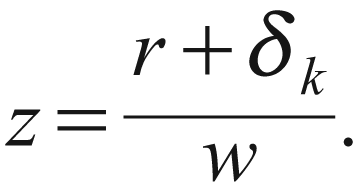
In perfectly competitive markets, labour and capital inputs are paid according to their marginal products. Let

Labour and capital are fully employed, that is,

Behaviour of Consumers
Each worker may get income from wealth ownership and wages. Consumers make decisions on consumption levels of goods as well as on how much to save. This study uses the approach to consumers’ behaviour proposed by Zhang (1993). Let

Each consumer of group j obtains current income

from the interest payment

The disposable income is used for saving and consumption. It should be noted that the value,
The disposable income is used for saving and consumption. At each point of time, the representative consumer would distribute the total available budget among savings

Let

Substituting (9) into (8) yields

At each point of time, households decide the three variables subject to the disposable income. We assume that utility level

where

where

where
According to the definitions of

This equation simply states that the change in wealth is equal to the savings minus dissavings.
Knowledge Accumulation through Arrow’s Learning by Doing
Arrow (1962) first introduced learning by doing into growth theory. Like capital, a refined classification of knowledge and technologies tend to lead new conceptions and modelling strategies. This study uses knowledge in a highly aggregated sense. We assume that knowledge growth is through the so-called learning by doing. We propose the following equation for knowledge growth:

in which

in which
Balance of Demand and Supply
The total capital stock is equal to the wealth owned by all the households. That is,

Demand and Supply of the Two Sectors
The demand for consumer goods is equal to the supply of consumer goods at any point of time. That is,
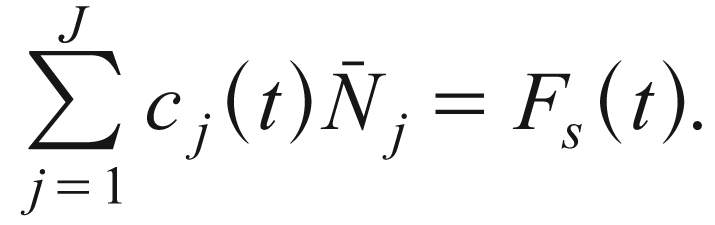
The national saving is the sum of the households’ saving. As output of the capital goods sector is equal to the net savings and the depreciation of capital stock, we have

where

We have thus built the model with trade, economic growth, capital accumulation, knowledge creation and utilization. Irrespective of the obvious strict assumptions in our model, from a structural point of view, the model is quite general in the sense that some well-known models in economics can be considered as its special cases. For instance, if the population is homogeneous, our model is structurally similar to the neoclassical growth model by Solow (1956) and Uzawa (1961). It is structurally similar to the Ricardian models by Pasinetti and Samuelson (e.g., Caravale and Tosato, 1980; Casarosa, 1985; Pasinetti, 1960, 1974; Samuelson, 1959).
The Economic Dynamics
It is reasonable to expect that the dynamics should be described by highly dimensional differential equations. In the Appendix, we show that the dynamics is described by a
Lemma
The dynamics of the economy is governed by the following

in which
The computational procedure is important for us to plot motion of the economic system with any number of types of households. With regard to the Arrow–Debreu concept of general equilibrium the final stage of analysis is to find a price vector at which excess demand is zero (Judd, 1988). There are numerical approaches for calculating equilibria (e.g., Scarf, 1967; Scarf and Hansen, 1973). We can apply these traditional methods to find how the prices and other variables are related to the variables in the differential equations. As it is difficult to provide analytical properties of the dynamic system, for illustration we simulate the model with the following parameters:

The population of Group 3 is the largest, while the population of Group 2 is the next. Group 1 applies knowledge mostly effective, while Group 3 applies least effectively. The capital goods and consumer goods sectors’ total productivities are 1. We specify the values of the parameters,

The motion of the variables is plotted in Figure 1. In Figure 1, the national income is

The knowledge stock rises over time, while the level of the national capital stocks falls. The national output is augmented over time. The labour force is increased, while Group
The Motion of the Economic System

It is straightforward to confirm that the variables become stationary. The simulation confirms that the system has a unique equilibrium. We list the equilibrium values in (19):
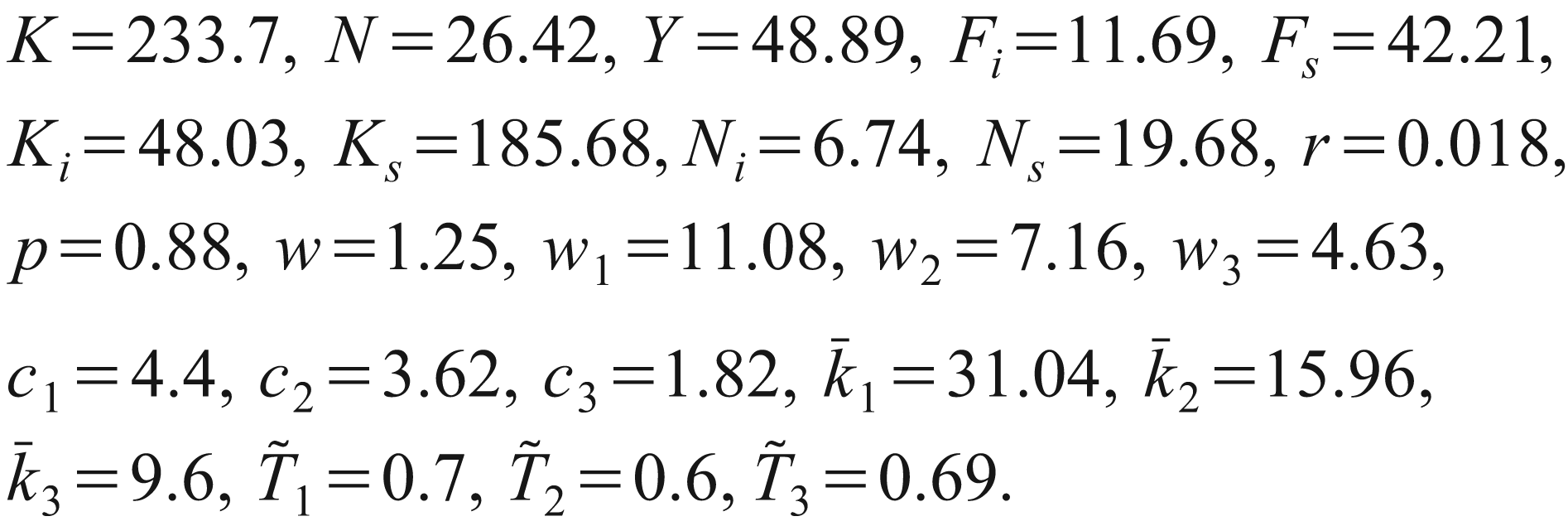
It is straightforward to calculate the four eigenvalues as follows:

The eigenvalues are real and negative. The unique equilibrium is locally stable. This is important as the stability guarantees that we can effectively conduct comparative dynamic analysis for transitional dynamics as well as long-term state.
Comparative Dynamic Analysis
As we can plot the motion of the national economy, it is straightforward for us to show how the economic system reactions to exogenous changes. As the lemma gives the computational procedure to calibrate the motion of all the variables, we can study effects of change in any parameter on transitional processes as well as stationary states of all the variables. We introduce a variable
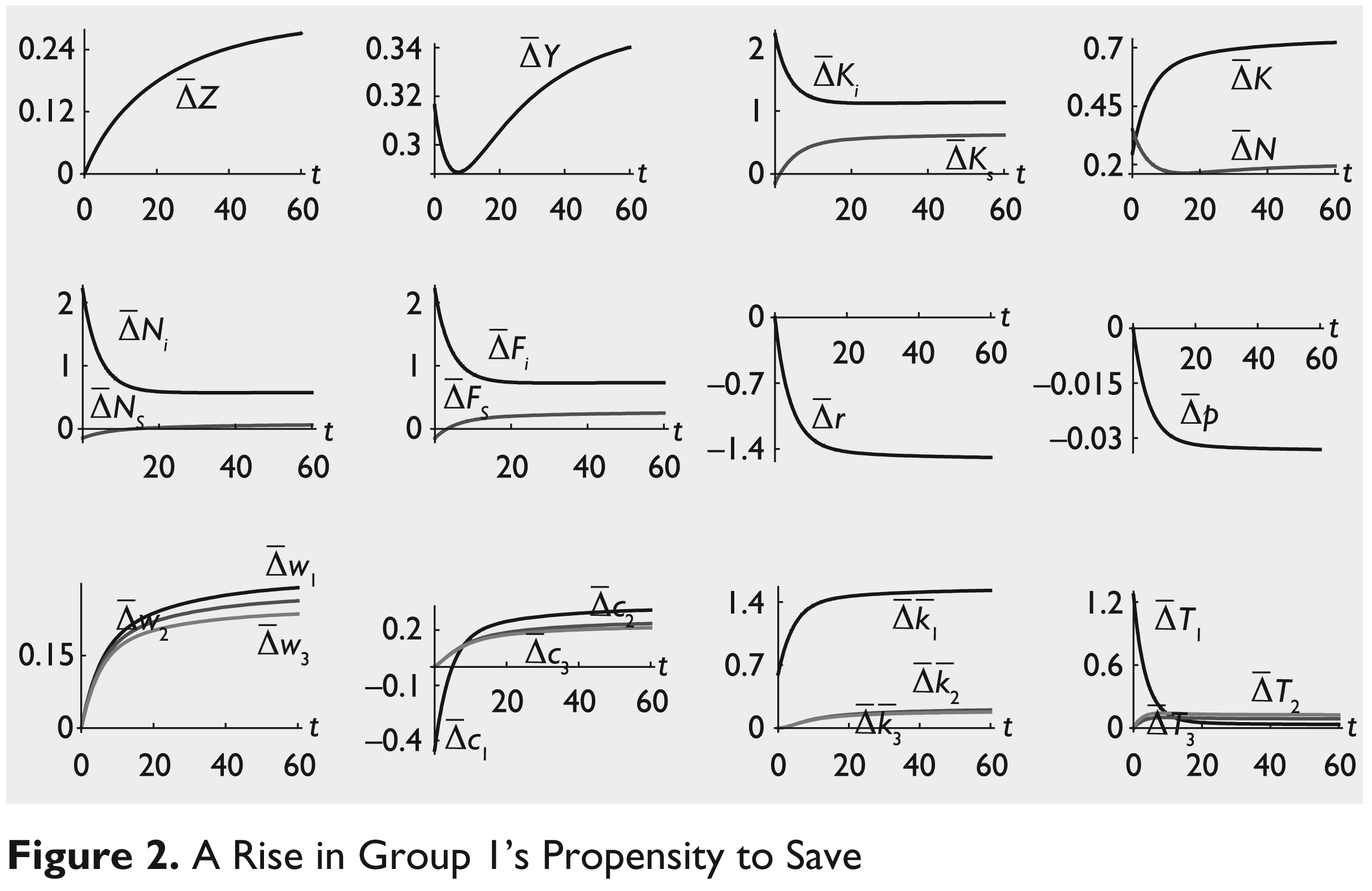
Group 1 Augmenting Its Propensity to Save
From the Walrasian general equilibrium theory, it is well established that changes in preferences of different households influence distributions of production factors and incomes and prices. Nevertheless, as the Walrasian general equilibrium theory has not been properly extended to general dynamics with wealth accumulation, important issues such as effects of changes in saving propensities on economic structure cannot be properly addressed by the traditional analytical framework. As our analytical framework integrates the economic mechanisms of the Walrasian general equilibrium theory and neoclassical growth theory, in principle, we can analyze effects of a change in the preference of any people on the dynamic path of the economic growth. For illustration, we now study the case that Group 1 increases its propensity to save in the following way:
A Rise in Group 1’s Propensity to Save
Group 1 Enhancing its Knowledge Utilization Efficiency
The impact of human capital is currently a main topic in economic theory and empirical research (e.g., Bandyopadhyay and Tang, 2011; Barro, 2001; Castelló-Climent and Hidalgo-Cabrillana, 2012; Easterlin, 1981; Hanushek and Kimko, 2000; Krueger and Lindahl, 2001). There are different empirical conclusions about inequalities and human capital (e.g., Could et al., 2001; Fleisher et al., 2011; Tilak, 1989; Tselios, 2008). This study addresses issues related to dynamic interactions among growth, inequality and distribution by assuming heterogeneity in preferences and knowledge utilization efficiencies among different types of people. To see how we discuss the issues, we now allow Group 1 to enhance its knowledge utilization efficiency as follows:
Group 1 Enhancing Its Knowledge Utilization Efficiency
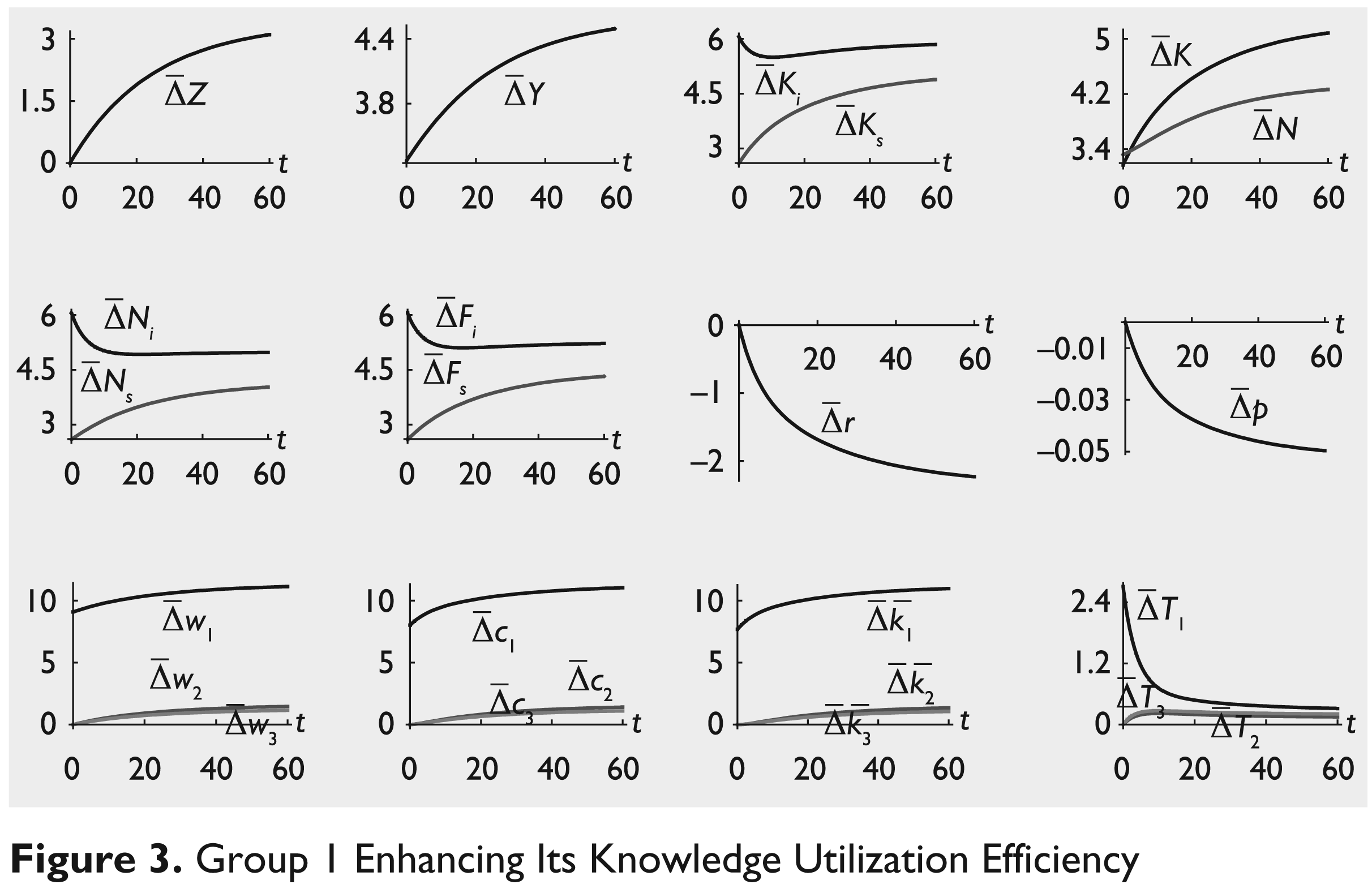
As Forbes (2000) comments, a ‘careful reassessment of the relationship between these two variables (growth rate and income inequality) needs further theoretical and empirical work evaluating the channels through which inequality, growth, and any other variables are related.’ Our simulation demonstrates that as Group 1 improves its knowledge utilization efficiency, national economic growth is sped up and the inequalities in the wage rates, consumption and wealth among Group 1 and the other groups are enlarged. It is straightforward to demonstrate that if Group 3 increases its knowledge utilization efficiency, then the inequalities in the wage rates, consumption and wealth among Group 1 and the other groups are diminished. This implies that in order to reduce inequalities, it is effective for the government to encourage the groups of less education and low income to more effectively accumulate and apply knowledge.
Group 2’s Population Being Increased
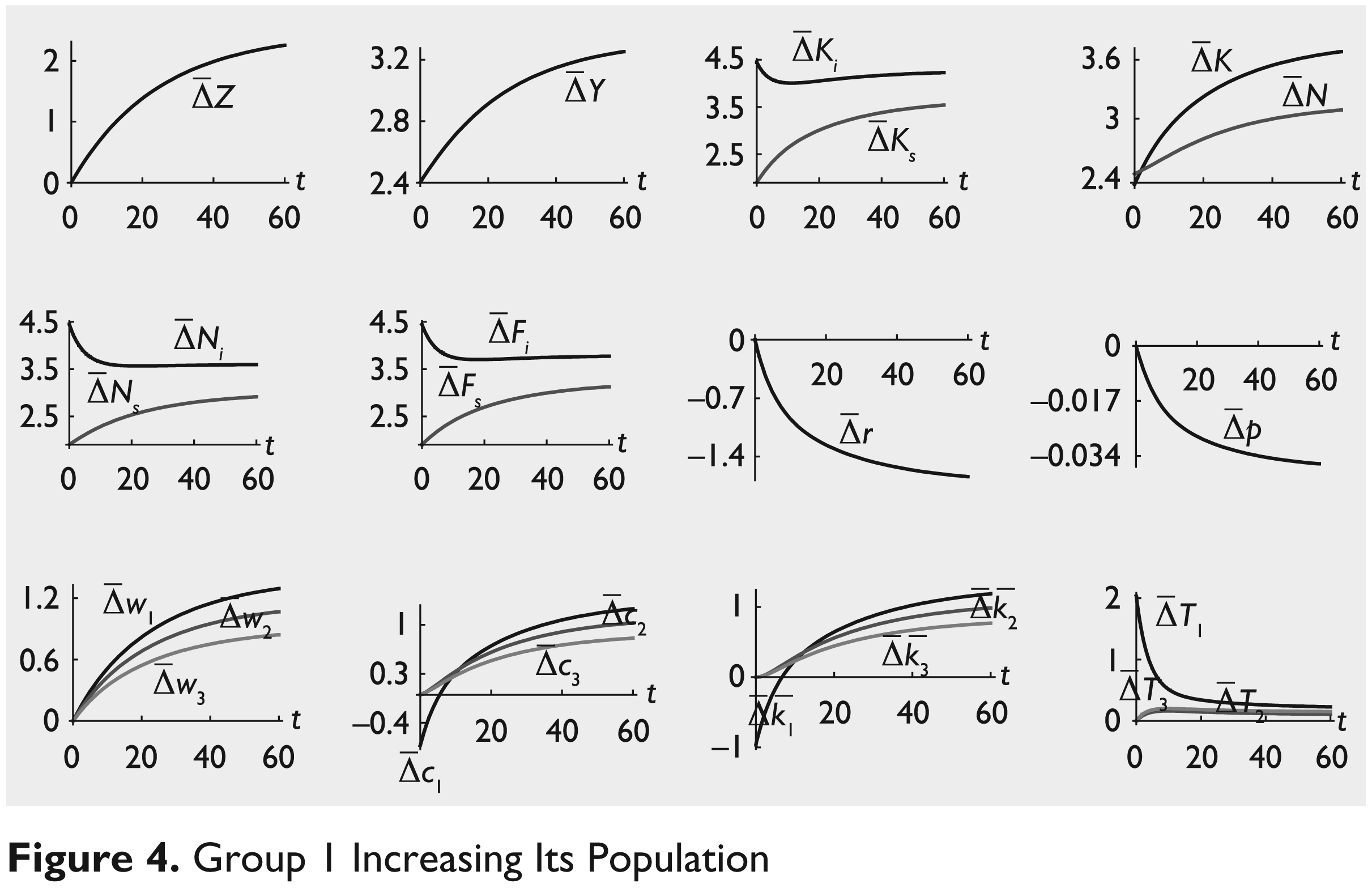
There are debates about relationships between population change and economic growth. Theoretical models with human capital predict situation-dependent interactions between population and economic growth (see Boucekkine et al., 2002; Bretschger, 2013; Ehrlich and Lui, 1997; Galor and Weil, 1999). There are also mixed conclusions in empirical studies on the issue (e.g., Furuoka, 2009; Yao et al., 2013). Although this study keeps the population and its structure fixed, we may provide some insights into the relationship by examining effects of changes in the population sizes. As different groups have different levels of knowledge utilization efficiency and creativity, increases in the population sizes may have different effects upon the economy. We now change Group 1’s population to be increased as follows:
Group 1 Increasing Its Population
Group 3 Increasing its Propensity to Use Leisure Time
We now change Group 3’s propensity to use leisure time as follows:
Group 3 Increasing Its Propensity to Use Leisure Time

The Capital Goods Sector Learning More Effectively through Doing
We now study the case that the capital goods sector learning more effectively through doing as follows:
The Capital Goods Sector Learning More Effectively through Doing

Conclusions
This article proposed a neoclassical growth model with endogenous capital accumulation and knowledge creation. The model is influenced by Arrow’s learning by doing, Uzawa’s two-sector growth model and Walrasian general equilibrium theory. Different from the growth models with the Ramsey approach in the literature, we used a utility function, which determines leisure time, saving and consumption with utility optimization without leading to a higher dimensional dynamic system like the traditional approach. The dynamics of
Footnotes
Proving Lemma 1
By (4) we obtain
Hence, we determine the rate of interest, the wage rate and the price as functions of
From the definitions of
Insert
Insert
where we use
where
From this equation and
where
where
Solve (A12) with regard to
where
In summary, we proved the lemma.
Acknowledgements
The author is grateful to the constructive comments of the anonymous referee. The author is also grateful for the financial support from the Grants-in-Aid for Scientific Research (C), Project No. 25380246, Japan Society for the Promotion of Science.