



Abstract
Abstract
This article examines the links between responsible leadership and corporate social responsibility (CSR) in one country, the Grand Duchy of Luxembourg, a linguistically and culturally specific country, and how they are perceived to be enacted or not. The purpose of this study is to combine Hofstede’s cross-cultural research with a research on responsible leadership and CSR in Luxembourg, in order to determine if there are any particularities that apply only in the country. In this qualitative study from Spring/Summer 2017, 64 semi-structured interviews were conducted mainly in four culturally different categories. This study is combined with the results of a 2016 study “What is responsible leadership in Luxembourg.” Findings indicate that language is used as a key identifier, affecting CSR outcomes, and point to high uncertainty avoidance levels in Luxembourg as a possible reason for lack of change and innovation. Finally, the article discusses the various implications of the findings.
Keywords
Introduction
Corporate social responsibility (CSR) can be seen as a part of larger societal efforts for sustainably and inclusion. CSR strategies aim to help companies adjust to economic, social, and environmental conditions while maintaining and creating value for the companies themselves and for society as a whole. CSR strategies are thus a multidimensional concept within companies and can encompass a wide range of initiatives and actions. Such actions and initiatives undertaken within a CSR strategy first aim to comply with the regulations in force in the matter, second to comply voluntarily with any optional industry- or country-wide standards or norms, and third to initiate voluntary philanthropic or “ethical” or “responsible” actions (Schinzel, 2018). Definitions of CSR vary, and stakeholders may understand CSR differently by focusing only on the aspects that concern them, but the European Commission defines CSR as “the responsibility of enterprises for their impacts on society” (European Commission, 2011).
Responsible leadership in practice and in concept also has multiple definitions. It can be generally defined as being “about making business decisions that, next to the interests of the shareholders, also takes into account all the other stakeholders such as workers, clients, suppliers, the environment, the community and future generations” (The Financial Times, 2018). In this respect, it can be seen as a leadership that effectively implements CSR strategies. Stückelberger and Mugambi (2007) split ‘responsible business leadership’ into five aspects: responsible leadership in general, economically, socially, politically, and environmentally.
Despite the interest in CSR studies (Bertels, Howard-Grenville, & Pek, 2016; Bode, Singh, & Rogan, 2015; Risi & Wickert, 2017), there is little academic literature on CSR activities in Luxembourg in particular and on Luxembourg in general. This article tries to fill this gap. Luxembourg is notable for having three official, administrative languages, a trilingual public education system, a majority of its private enterprise employees commuting daily from three neighboring countries, and more than a quarter of its workforce as resident foreigners. It also aims to attract talented workers and executives from around the world. In this context, the study of how differences in culture and/or language may affect, or underlie, notions of corporate behavior and their implementation, as viewed and applied by the different cultural groupings in the country, is an area that is appropriate for a detailed study.
This article explores approaches and attitudes to responsible leadership and CSR. It is the combination of research on responsible leadership, CSR in the context of the Luxembourg environment. Practically, this article is a qualitative study and a combination of two studies, one from 2016 and one from 2017. The results from the 2016 study with the research question: “What is responsible leadership in Luxembourg?” were combined with those from the 2017 Spring/Summer research, with the following research question: “What is typical for Luxembourg in the field of CSR?”
By reviewing literature on three research areas (Luxembourg, responsible leadership, and CSR), it was evident that there is a very limited amount of literature on responsible leadership theories and CSR theories as applied in Luxembourg.
The findings showed the importance of the Luxembourgish language as a cultural identifier. The language plays an even more important role, as it is impacts talent management and responsible leadership. Qualified personnel speaking the Luxembourgish language are favored. There are those who are part of the in-group or the out-group, those who speak the Luxembourgish language or those who do not speak it, in addition to all of the other day-to-day languages of the country: French, German, Portuguese, and English, but which may also include also Italian, Spanish, and other languages.
There being little published research in this area concerning Luxembourg, this article contributes to theory and to practice on Luxembourg in general, and second by examining the link between responsible leadership and CSR and how these may be enacted, or not, in companies with similar profiles. Such research is important for people living and working in Luxembourg, and for corporate leaders who want to be responsible and who want to integrate CSR measures into their companies. Many companies in Luxembourg already have diverse CSR activities, and also policies on responsible leadership, but not all of them. Those who have integrated some of them might consider measures taken by other firms and integrate them in their companies, while always being in a position to be able to take into account the cultural and linguistic particularities of the individual company. This is where Hofstede’s (2001) research on cultural comparison comes into focus, as well as Schein’s research on corporate culture (2009, 2010).
In the first section of this article, there will be a review of the extant literature on responsible leadership and then on CSR. It will then, in the following section, elaborate Luxembourg’s linguistic and cultural particularities and the author will present a proposition. After this, there will be a section covering the description of the applied method—semi-structured interviews—and the following two sections will present the results from the four categories of respondents and selected portions of interviews or responses will be reprinted. The final section will cover the conclusion, discussion, implications, research limitations, and further research opportunities followed by references section.
Review of Literature on Responsible Leadership and Corporate Social Responsibility
Maccoby and Scudder (2011) defines a leader as follows: “There is only one irrefutable definition of a leader: someone people follow. Therefore, leadership is a relationship between the leader and the led. Unlike management, the leadership relationship cannot be delegated or automated.” Similar definitions are by Northouse (2012). Waddock (2004, p. 10) in Du, Swaen, Lindgreen, and Sen (2013) defines CSR as “the broad array of strategies and operating practices that a company develops in its efforts to deal with and create relationships with its numerous stakeholders and the natural environment.” Freeman and Auster (2011, pp. 15–23) include the following as a broad range of elements of CSR: ethics, values, responsibility, sustainability, authenticity, involving one’s history, one’s relationship with others, my aspirations, my value system, acting true to oneself, acting on one’s values, treating employees as rights-holders, creating value in an environmentally sustainable way, implementing CSR, becoming a good citizen in civil society, being a force for peace in the world, “engaging in social entrepreneurship, and being an ethical or responsible leader”.
There are different streams of responsible leadership (Voegtlin, Patzer, & Scherer, 2012): ethical leadership, transformational leadership (Waldman, Siegel, & Javidan, 2006), authentic leadership (Avolio & Gardner, 2005), servant leadership (Greenleaf, 1977; Liden, Wayne, Zhao, & Henderson, 2008), and responsible leadership in combination with CSR (Metcalf, Angus-Leppan, & Benn, 2010). The link between and interrelatedness of CSR and responsible leadership is viewed from various positions. There are three streams of theories in the field of “responsible leadership and CSR”: first those who see only benefits in this combination, second those who criticize the negative outcomes of this combination, and third those who reflect on positive and negative outcomes. Voegtlin et al. (2012) ask: “Who is responsible for what and towards whom in an interconnected business?” Pruzan and Miller (2006, pp. 85–87) ask: “To what extent are leaders and organizations responsible for creating wealth for the largest possible group/community/society rather than for their own personal benefit?” On the other hand, Maak (2007, p. 339) posits that the responsible leader is a weaver of value networks, contributing with these social ties to a sustainable business, the common good, and eventually to a sustainable future. Pless and Maak (2011) and Pless (2007, p. 438) emphasizes such ties by highlighting relations based on the values and ethics “between leaders and stakeholders who are connected through a shared sense of meaning and purpose through which they raise one another to higher levels of motivation and commitment for achieving sustainable values creation and social change.”
Linguistic Particularities and Cultural Dimensions of Luxembourg
Luxembourg is a parliamentary democracy and a constitutional monarchy and it is the only remaining Grand Duchy in the world (Central Intelligence Agency, n.d.). Historically a backwater in Europe, over the past 60 years, its population has become increasingly diverse and its economic importance has grown. At the end of 2019, Luxembourg’s total population consisted of 602,005 inhabitants of whom 313,800 (52.1%) were Luxembourgers and 288,200 (47.9%) were foreigners (STATEC, 2019). The nationalities of resident foreigners were as follows: 96,500 Portuguese, 45,800 French citizens, 22,000 Italians, 20,200 Belgians, 13,100 Germans, 46,700 from other EU countries, and 43,800 from other countries (see
For the purposes of this article, its geography is to be noted. Luxembourg is one of the smallest countries in Europe with a total size of 2,586 km2. It is 82-km long and 57-km wide and has borders with Germany (138 km), with France (73 km), and with Belgium (148 km). As a result of high employment needs, its size and proximity to large neighboring pools of labor, Cross-Borderers (those who commute to work in Luxembourg but do not live there) is a distinguishing characteristic of Luxembourg’s employment situation. Domestic employment was 432,400, comprising 188,100 Cross-Borderers (43.50%): 92,900 from France, 45,500 from Germany, and 45,100 from Belgium.
Also for this article, the language situation should be noted. Language is deeply anchored in the country’s history (Schinzel, 2013) and there are three official administrative languages: French, German, and Luxembourgish (STATEC, 2019), with Luxembourgish (Lëtzebuergesch) being the national language. The public education system is tri-lingual. The instruction language in Kindergarten is Luxembourgish, which is replaced by German as the language of instruction in primary school and then gradually replaced by French in the secondary school (Kraemer, 1995; Schinzel, 2014a, 2014b; Weber & Horner, 2008). Citizenship is only awarded to those who speak Lëtzebuergesch (Spizzo, 1995).
In a previous study (Schinzel, 2014a), the author replicated Geert Hofstede’s cultural dimensions study in Luxembourg across two categories of Luxembourg inhabitants: those with Luxembourgish nationality (Lux.Nat) and those without Luxembourgish nationality but who live and/or work in the country, or have experience of the country (Lux.All). The findings related to cultural dimensions were compared with Hofstede’s previous estimates.
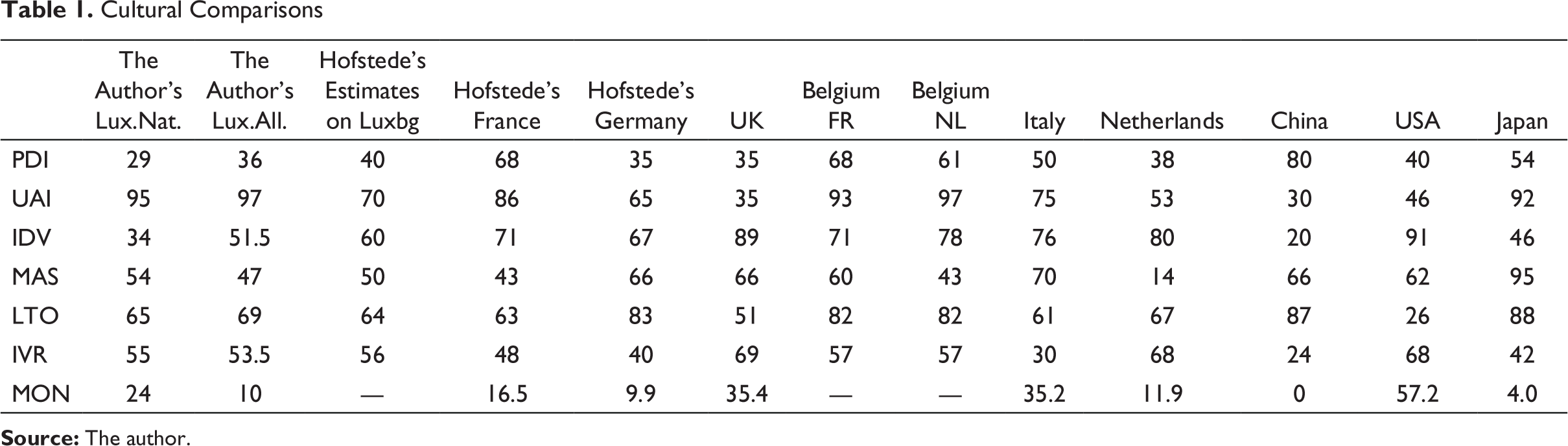
For the Lux.Nat category, Luxembourg’s specific cultural environment is characterized by low power distance (PDI = 29), high uncertainty avoidance (UAI = 95), low individualism = high collectivism (IDV = 34) (COL = 66), medium masculinity (MAS = 54), high long-term orientation (LTO = 65), medium indulgence versus restraint (IVR = 55), and low monumentalism (MON = 24).
In international trade, “companies must adapt their assortment, their collections, and their retail concepts.” This is about “cultural distance and local adaptation: The necessity of adapting. Wherever a company comes from, great chances exist to encounter cultural differences” (Feldmann, 2016, pp. 14–15).
Table 1 (Schinzel, 2017a) shows Hofstede’s (2001) and Hofstede, Hofstede, and Minkov’s (2010) cultural dimensions of Lux.Nat. and Lux.All., Hofstede’s estimates for Luxembourg, and his data for France, Germany, the UK, Belgium FR, Belgium NL, Italy, the Netherlands, China, the USA, and Japan (on a scale from 1 to 100, 1 being the lowest and 100 the highest score), where the cultural differences become clear.
As can be seen in Table 1, this study found a significant divergence with Hofstede’s estimates for power distance, uncertainty avoidance, and individualism in Luxembourg. Lux.Nats. are strong on uncertainty avoidance (UAI = 95) and weak on power distance (PDI = 29), like no other country in the world. Given the particularities of the country’s labor market and its linguistic situation, what these unique results for cultural dimensions may bring to CSR and responsible leadership in the country should, in the author’s view, be examined.
Cultural Comparisons
What responsible leadership and CSR are in Luxembourg will depend on the cultural and linguistical particularities of the company/leader and his/her value system.
Methodology
This is a qualitative study where semi-structured interviews were performed in Spring/Summer 2017. Although a deeper quantitative approach could have broadened the outcomes, the author was constrained by resources and the caution of respondents to disclose information. It was also deemed valuable at this stage that the perspective of the respondents was needed before undertaking more significant quantitative research, it being necessary to first understand behavior in a “natural” context within companies.
The methodology used was convenience sampling. It being very difficult to get managers to talk about their responsible leadership policies and also their CSR activities in Luxembourg, the author was pleased to be able to interview 64 companies. This is a large sample of companies in the small country. Not everybody is willing to share their activities, and not everybody is willing to talk about their own responsible or irresponsible leadership styles. The author chose to conduct semi-structured interviews, where the main questions were given as follows:
What is responsible leadership in Luxembourg? What is typical for Luxembourg in the field of CSR?
Secondary research questions were prepared and respondents were also asked to answer the following supplementary questions:
What else could your company do in CSR? What would you wish they would do (more)? What did not they do? What else do you know about CSR? What is specific about Luxembourg in the field of CSR?
The author chose to have respondents from four different categories and to interview as many respondents as possible from each category. The first category is the so-called Lux.Nat.; Lux.Nat. are Luxembourg Nationals, people who have the Luxembourgish nationality. The second category is the Lux.Foreigners. These are people who live in Luxembourg but who do not have the Luxembourgish nationality, they are foreigners living and residing in Luxembourg. The third category is Cross-Borderers. These are people living in France, Belgium, and/or Germany and traveling to work in Luxembourg every day. The fourth category is the rest of the world; this means people from all over the world, outside of the other three categories.
In this study, respondents from the four culturally different categories were divided as follows: Lux.Nat. (11), Lux.Foreigners (21), Cross-Borderers (10), and the rest of the world (22).
Given these circumstances, interviews were conducted in person, by phone, via Skype or email exchange, depending on the availability of the respondent, his geographical availability, or time availability. Interviews were therefore also in Luxembourgish, English, French, German, Italian, or Spanish, following the mother tongue of the respondent. Interviews other than in English were then translated into English for the purpose of this research. The duration of the interviews was between 30 minutes and 2 hours, again following availability of the respondents. Some respondents were more open and talkative than others. Some respondents proudly showed the author their company, with a guided tour of the premises and a small video included. From all of these diverse interviews; diverse in language, in duration, in geography, in transport, in means—telephone, Skype, email, in person—main topics were elaborated.
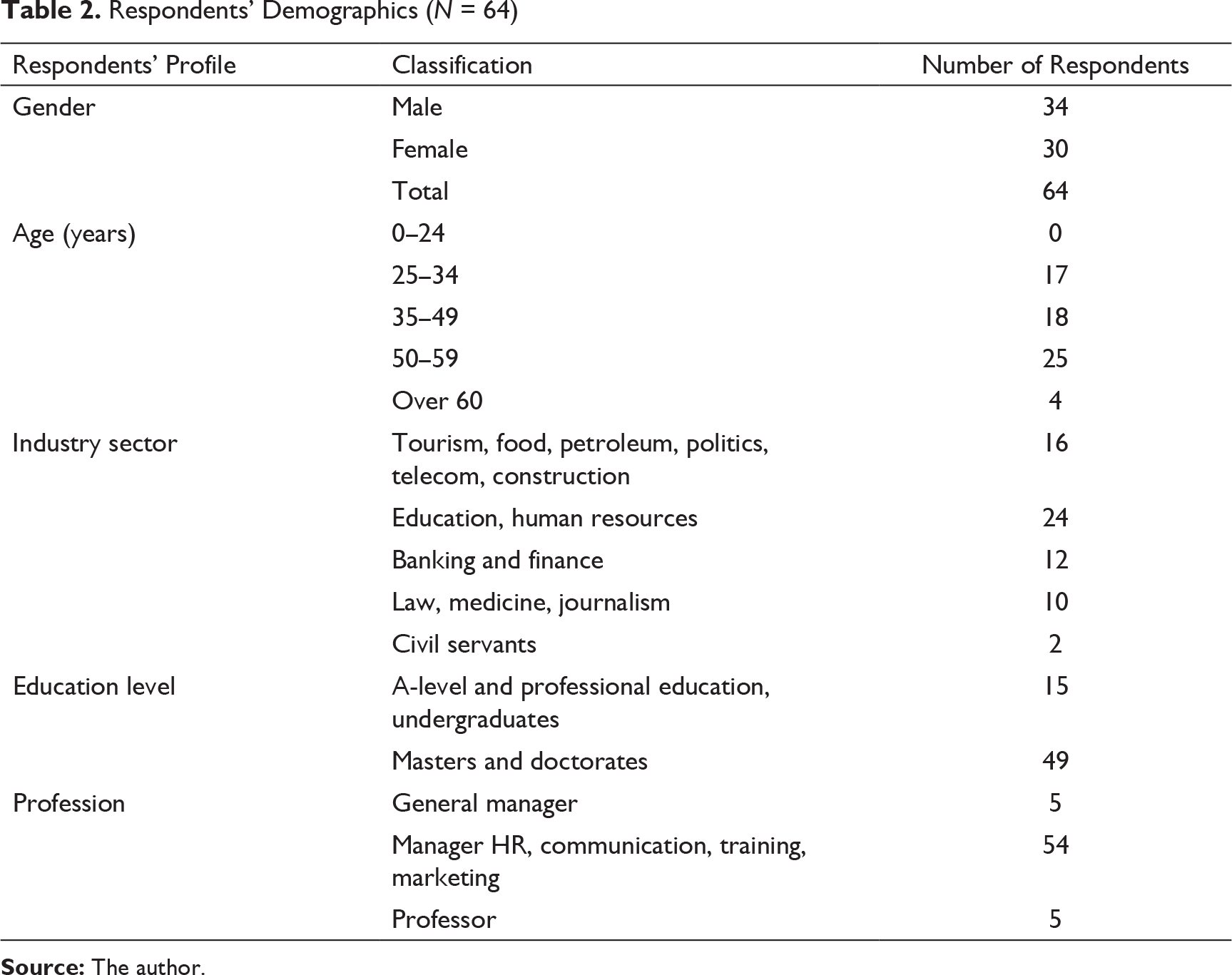
Table 2 summarizes the respondents’ demographics.
In terms of demographics and reflecting Luxembourg’s diversity, in total, the 64 respondents come from 14 different countries, have 14 different nationalities, and speak 14 different languages. This sample is representative of multilingual, multicultural Luxembourg.
Respondents’ Demographics (N = 64)
Findings
Responsible Leadership in Luxembourg—2016
Interview Summaries
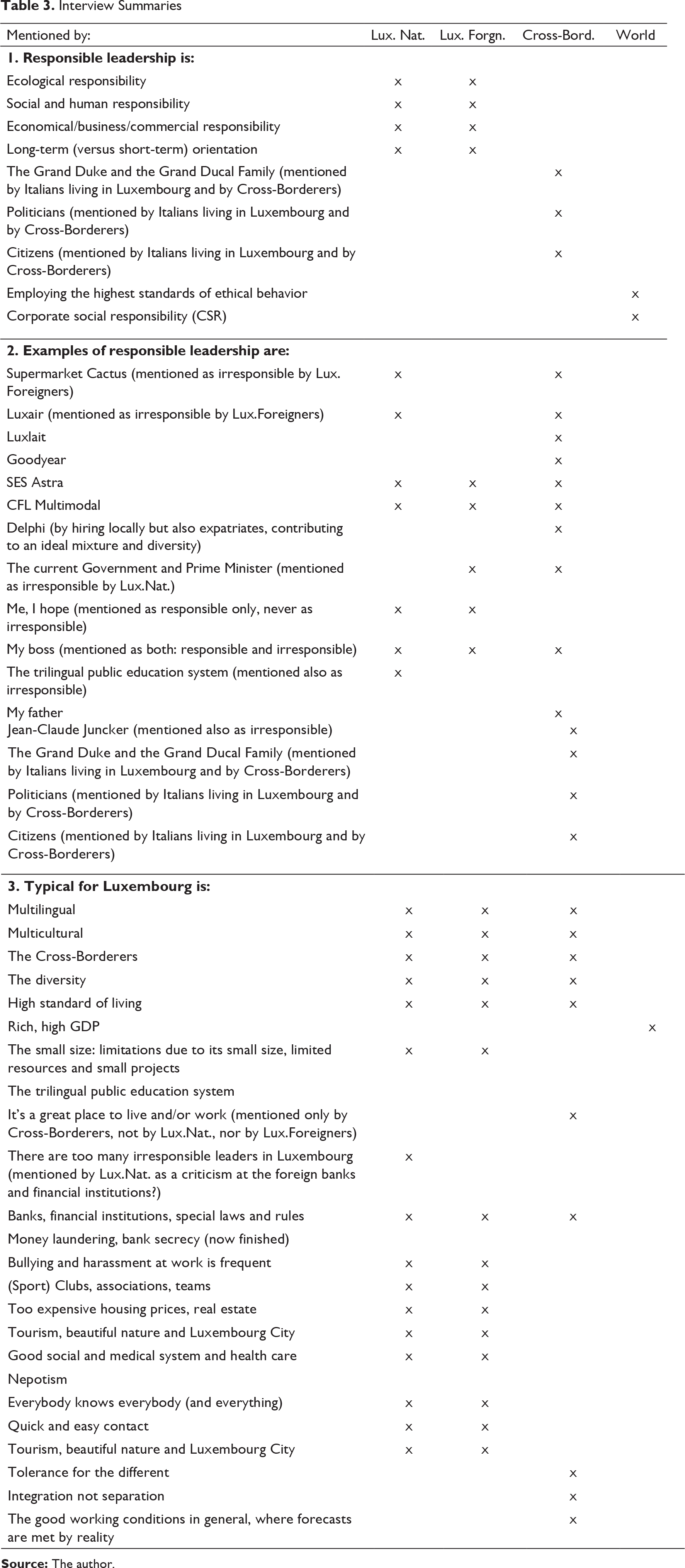
“Me, I hope” was mentioned by Lux.Nat. and Lux.Foreigners.
The main categories of responsible leadership were: (a) ecological, (b) social and human, (c) economic responsibility, followed by (d) long-term and short-term orientation, (e) personal capabilities, (f) getting results, (g) interpersonal skills, (h) trust, (i) ethical behavior, (j) security, (k) respect, (l) fairness, (m) reliability, (n) doing not talking, (o) commitment, (p) compassion, (q) keeping your promises, and finally (r) CSR.
What respondents mainly said about what is typical for Luxembourg was: multilingual, multicultural, diversity, and cross-borderers.
Respondents also mentioned the European institutions, the high GDP, banks and financial institutions, peace, and the geographical situation in the middle of Europe (Schinzel, 2017b, p. 22).
Responsible Leadership and Corporate Social Responsibility in Luxembourg—2017
In the following, the answers are divided into three groups.
First, those respondents who are euphoric and positive about responsible leadership and CSR in Luxembourg. Second, those respondents who are more moderate. Third, the critical respondents: those who criticize the current situation, denying any existence of either responsible leadership or CSR, expressing a call for change and innovation.
Summary of Responses to “What is Responsible Leadership and CSR in Luxembourg?”
What is responsible leadership and CSR in Luxembourg is best shown by the respondents’ citations, separated into the three groups: (a) euphoric and positive respondents, (b) moderate respondents, and (c) critical respondents.
Summary of Responses to “What Does Your Company Do in the Field of CSR?”
What respondents understand their company does in the field of CSR is shown by their citations, separated into the three groups: (a) euphoric and positive respondents, (b) moderate respondents, and (c) critical respondents.
Summary of Responses to “What Else Could Your Company do in CSR? What Would You Wish They Would do (more)? What Didn’t They do?”
Summary of Responses to “What else do you know about CSR?”
Summary of Responses to “What is specific about Luxembourg in the field of CSR?”
Typical for Luxembourg is the “Tripartite,” this is the social model typical for Luxembourg, in combination with the state, industry, and the trade unions, functioning since the 1970s. We try to resist price dumping from China. This is a real challenge, but until now we resisted successfully, thanks to the development of high added value products and innovation. We practice the Japanese management method, 5S, in our plant. The prepension possibilities. The varied training program, including security, health, field competence, languages, and law. We aim at 0 accidents. Benchmark regarding the environment. The high standard in general, and in specific environmental technologies. The diversity in cultures and languages. The turnover of the employees is very low. In general, employees remain until retirement, and over several generations.
Responsible leadership linked with social responsibility: the human being should be in the middle of the economic actions. The question is: is this really so? Today everything is impersonal; I think I realized my objectives of being a responsible leader. Being a responsible leader of my employees stood always in the center of my endeavors. I succeeded in having satisfied employees and a good climate, otherwise I could not have realized the good results. My company was shut down. I was laid off. Despite its generally high standard of wealth, Luxembourg’s corporate entities should more easily be able to allocate budget and human resources to CSR policy than in economically less fortunate countries. Change and innovation is needed here.
Discussion, Conclusions, Limitations, and Further Research
This study was a combination of research on responsible leadership and CSR in Luxembourg, for which the cultural and linguistic peculiarities of Luxembourg are taken into account.
Is there a link between responsible leadership and CSR in Luxembourg (Schinzel, 2018)? The third group of critical respondents in this study: deny any existence of either responsible leadership or CSR and express a call for change and innovation.
The traditionally high levels of uncertainty avoidance in Luxembourg are offered as the reason for stagnation and no change. It is at this point that the authenticity of the leader is questioned, where a leader’s influence is not a positive one, but negatively affects change and innovation. Respondents ask that leaders should learn ethics (Stückelberger & Mugambi, 2007), sustainability, responsibility, and as a matter of priority in order to eradicate stagnation via uncertainty avoidance. But how? How to be “uncertainty allowing” rather than “uncertainty avoiding”? Or to ask with the words of Murray (2014): “What Makes a Great Leader?” In a future research, the author will investigate the advantages and disadvantages of a high “uncertainty avoidance index.” Luxembourg was found to be one of the high uncertainty avoidant countries, if not one of the highest, by Hofstede, and also by the author. The combination of research on “responsible leadership” and “CSR” and “uncertainty avoidance” being new, this research will be interesting, again, for business leaders who want to succeed in the particular cultural setting that is the Grand Duchy of Luxembourg. Several interviews have been already performed in this field, and an academic article is underway, as well as participation in a conference presenting the results.
In this article, what is being questioned is the leader’s values and/or other stakeholders’ values system and culture and/or the board of directors’ vision/mission, as well as the corporate culture in general, because of the high levels of uncertainty avoidance. This questioning on corporate stagnation can extend to the government and the monarchy.
In the eyes of the interviewed managers, they were exclusively responsible leaders, none claimed to be an irresponsible leader (Schinzel, 2017b).
Many respondents showed the ecological, the social, and human and the economic responsibility they are carrying. They pointed out the long-term orientation, the personal capabilities, the results orientation, the interpersonal skills, and values, trust, ethics, security, reliability, and fairness, commitment, and CSR. Despite all the positive answers, innovation and change are needed according to a significant number of respondents.
The primary limitation of this study is the fact that it was a qualitative study that did not look beyond one country. Research constraints did not enable the author to examine in a measurable manner the efficacy of how outcomes can be deepened and how the measures that are claimed are implemented.
Further research may include the investigation of links between Hofstede’s cultural dimensions, in one country or across groups of countries, and the country-specific responses to defining CSR and responsible leadership strategies. This would be particularly interesting in the case where outlying countries such as Luxembourg are investigated.
Another field of future research is talent management. How to find the “talent” needed in this peculiar work environment. Requirements for gender equality and continuous change, growth and innovation include the call for talent.
Regarding talent management, it cannot be pointed out enough how important the Luxembourgish language is to the Luxembourgers. Luxembourgish, or Lëtzebuergesch, serves as an identifier (Spizzo, 1995). This language spoken by about 300,000 people is used as an identifier, separating the in-group from the out-group, those who speak the Luxembourgish language from those who do not speak it. In regards to talent and talent management, the language plays an important role, as it is of the greatest importance for the recruitment success, if a candidate—for whatever job offer—speaks the Luxembourgish language or not, in addition, of course, to the often many other required languages, such as French, German, English, Portuguese, Italian, Spanish, and others. It is indeed very difficult to find accountants, or any other specialist speaking four or five languages, including Luxembourgish. This language plays a decisive role in the recruitment process, and not only because it shows the affiliation to a nationality. The importance of Luxembourgish cannot be stressed on enough.
In conclusion, the cultural and linguistical particularities in Luxembourg mean that responsible leadership, CSR, and the link between them are not homogeneous and depends on the company/leader and his/her value system.
Footnotes
Declaration of Conflicting Interests
The author declared no potential conflicts of interest with respect to the research, authorship, and/or publication of this article.
Funding
The author received no financial support for the research, authorship, and/or publication of this article.