



Abstract
Abstract
This study aims to explore tourist’s satisfaction on the accommodation provided during their stay in Vlore (Albania) touristic structures, and if there are possible associations between different characteristics related to this service and tourists. Lack of studies on analyzing customer satisfaction in the industry of accommodation, especially for Vlore, have prompted us to undertake this study. The study results are important for local government, the accommodation industry, and is a source of information for whom is interested to improve their accommodation services, or to invest in accommodation industry located in Vlore, Albania. “Netnography” is used to collect data for our research purpose from the reviews in TripAdvisor website. Using descriptive and inferential statistics, this study concludes that 64.9 percent of the ratings are “very good” or “excellent,” regardless of the accommodation structure chosen. Accommodation structures should have a clear defined idea of what kind of tourist they want to attract in a certain period of the year, in order to offer the quality tourists expect. Furthermore, understanding of tourist satisfaction evaluation is important in implementing successful marketing campaigns.
Introduction
“Is Albania Europe’s next big beach holiday destination?” was one of the articles of Telegraph (Leadbeater, 2017) where among others it was claimed that, “One of the other issues with seaside breaks in Albania is that the standard of accommodation in the tourism heartlands is, while not quite the phalanx of creaking concrete communist bolt holes that popular opinion might imagine, barely more than adequate.”
National Geographic included Albania as one of the 21 places, one need to visit in 2018 (Duckett, 2018) and highlighted its relatively unexplored waters as one of the strongest points. Vlore is one of the Albania most famous coastal cities, and it is listed as one of the top 10 places to visit (Traveling Top Tens, 2018). The wonderful beaches stretch for several kilometers along the coast and are some of the finest in Balkans.
The competitive environment for accommodation businesses is also rapidly changing. As such, the accommodation tourism sector never stands still and constantly needs to monitor its quality performance in service delivery; as satisfaction can make or break a business (del Vecchio, Secundo, & Passiante, 2018). Social media and review sites create challenges but also offer connections opportunity between tourists and make it easier to interact with satisfied or dissatisfied customers. These sites also create satisfaction and other topics research opportunities, as demonstrated in studies based on review platforms, web questionnaires, and social media analyses (Filieri, Alguezaui, & McLeay, 2015; Ghazi, 2017).
In 1988, Gummesson gave two types of definitions for quality. First definition defined quality in terms of conformance to requirements based on company specifications, and the second one was a fitness-for-purpose definition with focus upon customer utility and satisfactions. Quality is not a fact, but a perception in the mind of the customer that depends on their individual attitudes, expectations, and previous experiences as a consumer, and also on the benefits they are looking for from a particular purchase (Horner & Swarbrooke, 2007). Studies have shown that satisfaction may vary across different socio-demographic and trip characteristics, such as age, occupation, lifestyle, country of origin, national culture, and purpose of the trip (Chu & Choi, 2000; Crotts & Erdman, 2000; Füller & Matzler, 2008; Master & Prideaux, 2000; Reisinger & Turner, 1997, 1998; Turner, Reisinger, & McQuilken, 2002; Yu & Goulden, 2006). Decades of academic research (Chea & Luo, 2014; Gounaris, Dimitriadis, & Stathakopoulos, 2010; Szymanski & Henard, 2001) offer insights into the outcomes of customer’ satisfaction (Horner & Swarbrooke, 2007) as important for three main reasons:
It leads to positive word-of-mouth (wom) recommendations; It contributes in loyal customer creation; It helps in dealing with complaints which is expensive, time-consuming and not good for the organization’s reputation.
There are national differences in quality standards and consumer satisfaction. Lack of studies on analyzing customer satisfaction in the industry of accommodation, especially for Vlore city (Albania), have prompted us to undertake this study. Our purpose is to explore about how satisfied are the tourists accommodated in Vlore touristic structures and if there are possible associations between different characteristics related to this service and tourists.
The study results are important for local government, the accommodation industry, and also, they give an overview for whom is interested to improve their accommodation services, or invest in accommodation industry located in Vlore, Albania.
To collect data for our research purpose, we have used reviews in TripAdvisor website. TripAdvisor is an American travel and restaurant website company that provides hotel and flight booking, vacation rentals, restaurant finding, travel guides, and reviews about them. It was founded by Stephen Kaufer, Langley Steinert, Nick Shanny, and Thomas Palka in February 2000 (Wikipedia, n.d.).
The rest of the paper is organized as follows: in the second section, we provide some current achievements in relation to the research problem being investigated; the third section describes procedures and techniques used to select, process, and analyze information applied to understanding the problem. Findings are then presented in correspondence with each of the research questions and are discussed in the fourth section. Finally, in the fifth section, we provide the conclusions of this research.
Literature Review
The extent to which customers feel happy about the ability of vendors to meet their needs and expectations is known as satisfaction (Stringam, Gerdes, & Vanleeuwen, 2010). It is a very important concept in the life of the modern businesses. Customer satisfaction is a barometer that predicts the future customer behavior (Hill, Roche, & Allen, 2007). This is always considered an essential objective for businesses from all market sectors (Christofi, Vrontis, & Leonidou, 2014).
Tourist satisfaction impacts behavioral intentions and it profoundly affects the choice of destination, consumption of products and services, future intentions to revisit, and recommendation to others (Devesa, Laguna, & Palacios, 2010; Lu, Chi, & Liu, 2015; Qu, Kim, & Im, 2011). It is impossible for a business organization to grow up in case the company ignores or disregards the needs of customers (Tao, 2014.) Han and Hyun (2015) indicate that satisfied tourists have been shown to return to a destination and recommend it to their friends and family. Customer satisfaction is defined as an overall evaluation based on the total purchase and consumption experience with the good or service over time (Fornell, Johnson, Anderson, Cha, & Bryant, 1996).
It means that revisiting a destination as well as providing word of mouth in social networks is likely to happen (Mohammad Shafiee, Alsadat Tabaeeian, & Tavakoli, 2016). The overall destination image has a positive impact on tourist behaviors including destination selection and intention to revisit (Fakeye & Crompton, 1991; Kim & Lee, 2015; Kozak, Crotts, & Law, 2007; Nadeau, Heslop, O’Reilly, & Luk, 2008). Customer expects a certain level of service quality from a service provider during the transaction; therefore, customer’s opinion about the quality standards and also what kind of a standard customer expects are essential to know (Bitner, Zeithaml, & Gremler, 2010).
Tourism is an information-intense industry (Sheldon, 1997; Werthner & Klein, 1999); therefore, it is critical to understand changes in technologies and consumer behavior that impact the distribution and accessibility of travel-related information (Tuominen, 2011). Actionable information on how to make customers further satisfied is, therefore, a crucial outcome (Oliver, 1999). Customer satisfaction is often found to be at the heart of firms’ marketing activities (Machleit & Mantel, 2001), because it helps them achieving their desired strategic objectives. Every firm’s activity must organize keeping this in mind. It is important for companies to close the gap between customer expectations and perceptions in order to satisfy their customers and build long-term relationships with them (Zeithaml & Bitner, 2000).
Consumer enjoyable or beneficial experiences with the retailer will prompt them to promote the same trading experience with the same retailer among family and friends (Babin, Chebat, & Michon, 2004; Jones, Reynolds, & Arnold, 2006). The growth of Internet applications on hospitality and tourism leads to enormous amounts of consumer-generated online reviews on different travel-related facilities (Mohammad Shafiee et al., 2016). Online reviews can be placed indifferent ways and generate powerful word-of-mouth online (Chen & Xie, 2008).
Goldenberg, Libai, and Mulier (2001) showed that a consumer’s decision-making process is strongly influenced by word of mouth. But some previous studies reported that online user-generated reviews are perceived as having lower credibility than traditional WOM due to the absence of source cues on the Internet (Dellarocas, 2003; Stephen & Smith, 1994).
Gretzel and Yoo (2008) further lamed that travel reviews are often perceived as more likely to provide up-to-date, enjoyable, and reliable information than content posted by travel service suppliers. This is probably because the online reviews platform plays an important role, attracting more travelers to post and share good or bad experiences (Zhong, Leung, Law, & Wu, 2013). Customers like to search for objective opinions, and they prefer reviews, which are mostly delivered through large feedback platforms and consumer-centric sites, because of their independence from official or corporate content (Forman, Ghose, & Wiesenfeld, 2008).
TripAdvisor (2018) is the most influential source of information when researching accommodation for beach holidays, city breaks, and cruisers (Nicoli & Papadopoulou, 2017; Sotiriadis, 2017). A vast majority of travelers (86%) will not book accommodation without reading reviews first, and 89 percent of them usually do some research before traveling. The research statistics conform to the importance and influence of online reviews on guests’ decisions in the hotels, and tourism sector (Molinillo, Ximénez-de-Sandoval, Fernández-Morales, & Coca-Stefaniak, 2016; Nwaogu, Simittchieva, Whittle, & Richardson, 2014) represent the necessity to further test the influence of consumer reviews. Online reviews work as a medium between customers and service providers, which can not only reflect satisfaction with the consumption experience, but also offer valuable information to help potential consumers make decisions (Bissell, 2012; Xiang & Gretzel, 2010).
Taken together, these findings indicate that social networks are increasingly a source of in-market traffic for hoteliers (Feeds, 2009). Businesses must be aware of the role of online reviews and have strategies in place to deal with this fast-emerging medium (Dwivedi, Shibu, & Venkatesh, 2007). Particularly, it has been argued that understanding the nature of the online tourism domain, i.e., the composition of online tourism related information potentially available to travelers, provides an important stepping-stone for the development of successful marketing programs and better information systems in tourism (Fesenmaier, Wöber, & Werthner, 2006; Xiang, Wöber, & Fesenmaier, 2008).
Methodology
We have used “netnography” (Kozinets, 2002) as an online marketing research technique, which is a version of ethnography adapted to the study of online communities for providing consumer insights about accommodation services. As an advantage, it is faster, simpler, and less expensive than traditional ethnography, and more naturalistic and unobtrusive than focus groups or interviews.
To get insights on accommodation satisfaction of tourists who have stayed in Vlore, Albania, we collected archival data on TripAdvisor (n.d.). Information related to components such as “property name,” “property’s type,” “tourist’s name,” “continent” of tourist, “tourist rating,” “time of year” staying in Vlore, and whom they stayed with (which defined “tourist type”) were gathered from 1,417 reviews made in accommodation businesses located in Vlore. These components are variables of interest during our analysis. We cleaned the data set from those reviews, which did not have full information for all the components of interest. After that, we worked only on 1,187 reviews related to 90 accommodation businesses for a period from 5 June 2005 to 3 October 2018.
In particular, this study aims to answer the following questions:
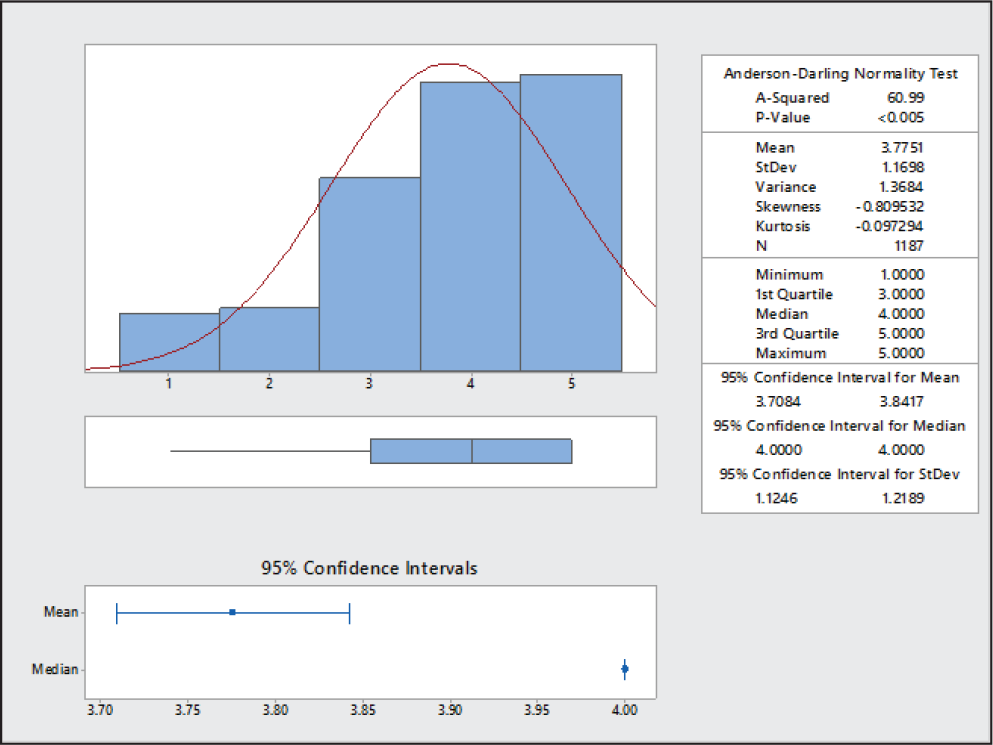
Q1: How much satisfied are tourists with their holiday accommodation? Q2: Does tourist rating has a normal distribution? Q3: Is there any relationship between the Tourist type and Property type they have? Q4: Is there any relationship between the Time of year and Property type they have chosen? Q5: Is there any relationship between the Continent variable they come from and Property type they have chosen? Q6: Is there any relationship between the Time of year and Tourist type variable? Q7: Is there any relationship between Property type and Tourist rating? Q8: Is there any relationship between Time of year and Tourist rating? Q9: Is there any relationship between Traveler type and Tourist rating?
Percentage frequency distribution of variables are given by pie charts or bar charts. To summarize, tourist rating variables are given with some descriptive statistics, which include measures of location (mean, median, mode, and quartiles), measures of variability (variance and standard deviation), and measures of distribution shape (skewness and kurtosis). Through a box plot, a graphical summary of exploratory data analysis is provided. Furthermore, to provide information about the shape of the distribution, its histogram is constructed, and 95 percent confidence intervals are given for mean, median, and standard deviation.
After suspecting for an asymmetrical distribution on the tourist rating variable, Anderson–Darling (AD) test was performed (Anderson & Darling, 1954), which is treated as an excellent one (Yap & Sim, 2011) to control if data have a normal distribution (null hypothesis) or not (alternative hypothesis). AD test compares the empirical cumulative distribution function of the sample data with the distribution expected if the data were normal. If the observed difference is adequately large, the null hypothesis will be rejected. p-Value is equal to the probability of obtaining the observed difference, or one more extreme, if the null hypothesis is true and the chosen significance level is 5 per cent. Confidence intervals are also given.
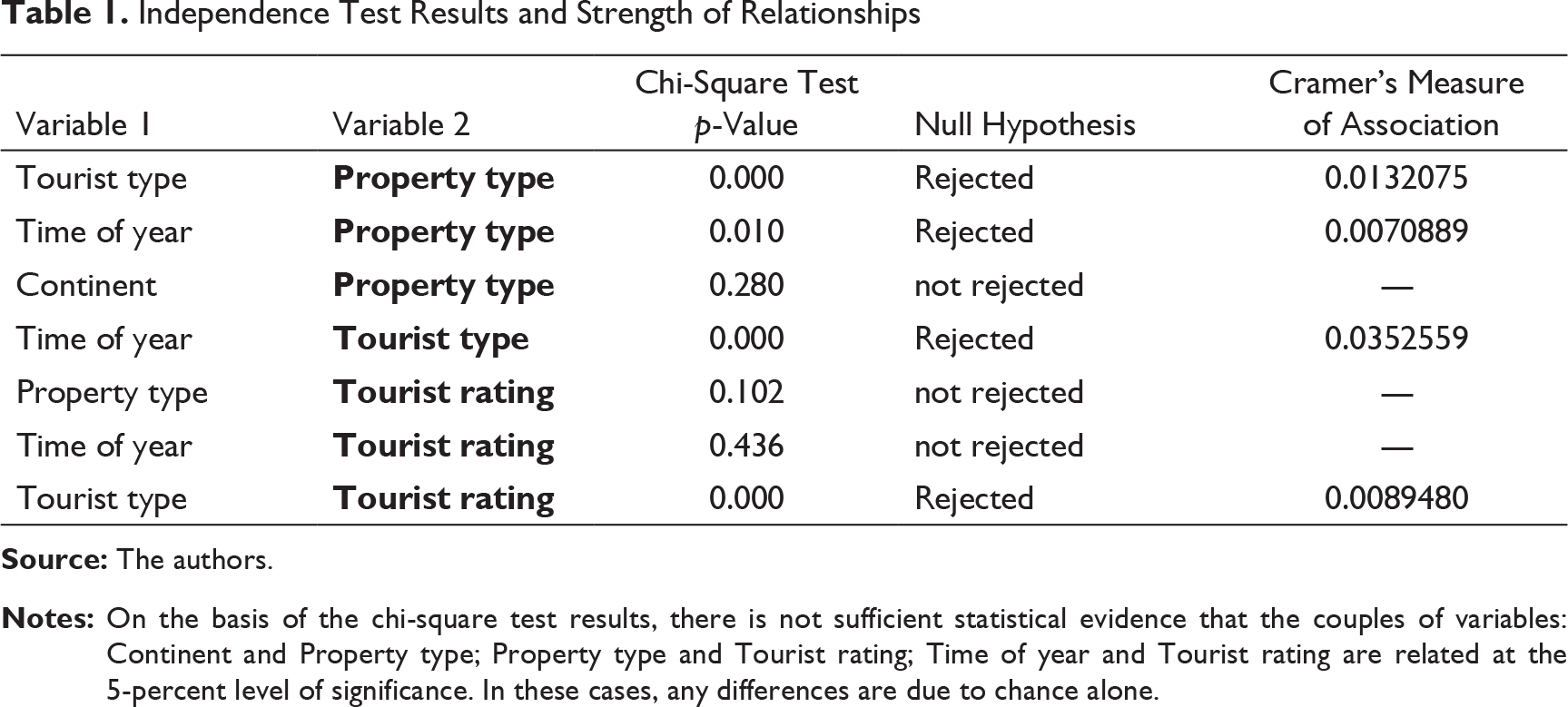
Relationship mentioned in research questions from Q3 to Q9 is studied through a chi-square test, as a nonparametric test that is commonly used to determine if there is an association between two categorical variables in larger samples (more than 20).
The null hypothesis is –H0: There is no relationship between the two categorical variables; and the alternative one is –Ha: There is a relationship between the two categorical variables.
The formula of the test statistic is

where nij stands for observed quantity, and eij for expected quantity. In case that H0 is true, the chi-square statistic
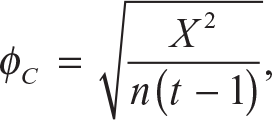
Since the chi-square is a significance statistic, we used Cramer’s V (Cramér, 1946) as the most common strength test to test the data when a significant chi-square result has been obtained. Cramer’s V formula is as follows:
where
All the statistical analyses, with the necessary computations, are performed by using Minitab 18.
Results and Discussion
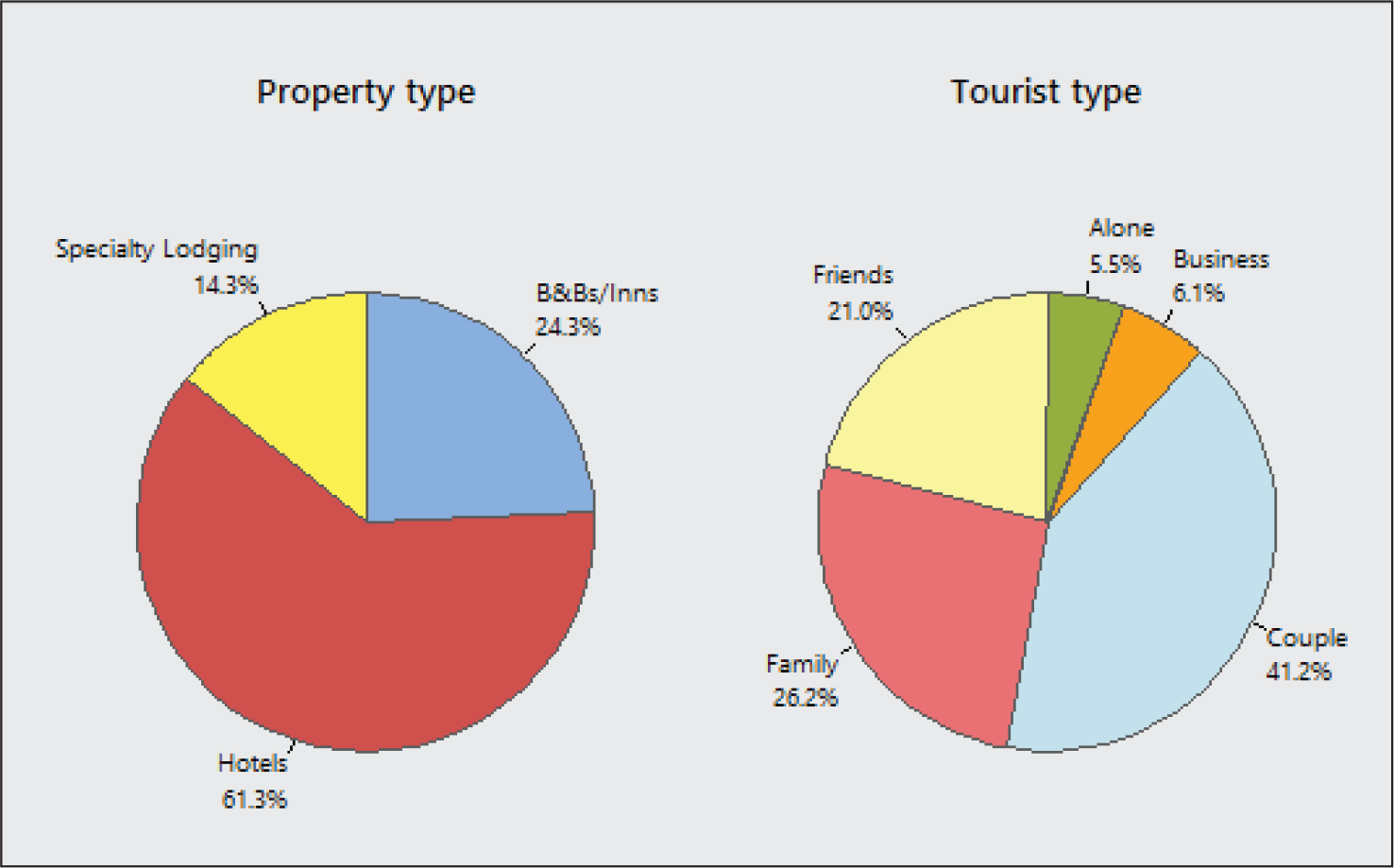
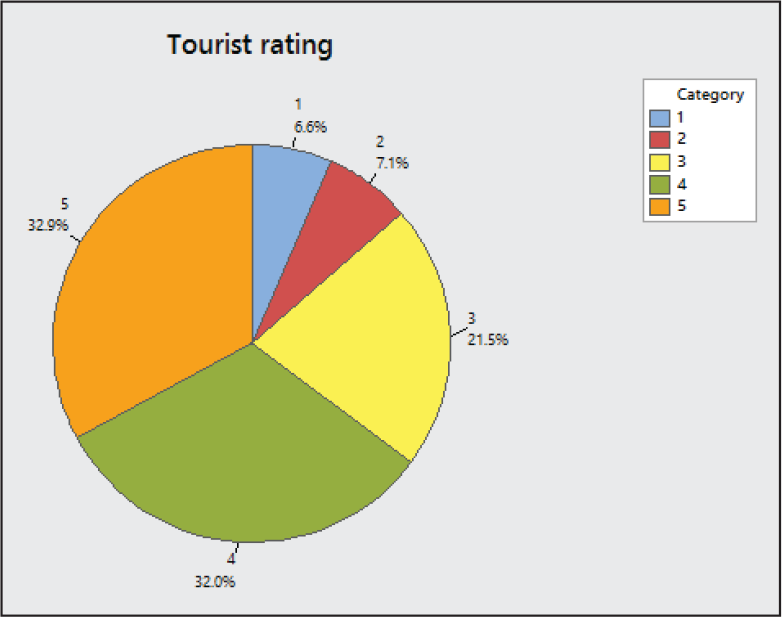
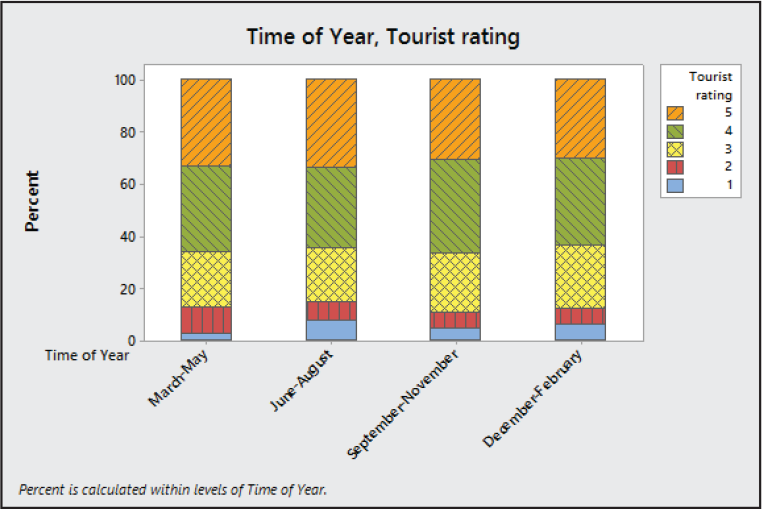
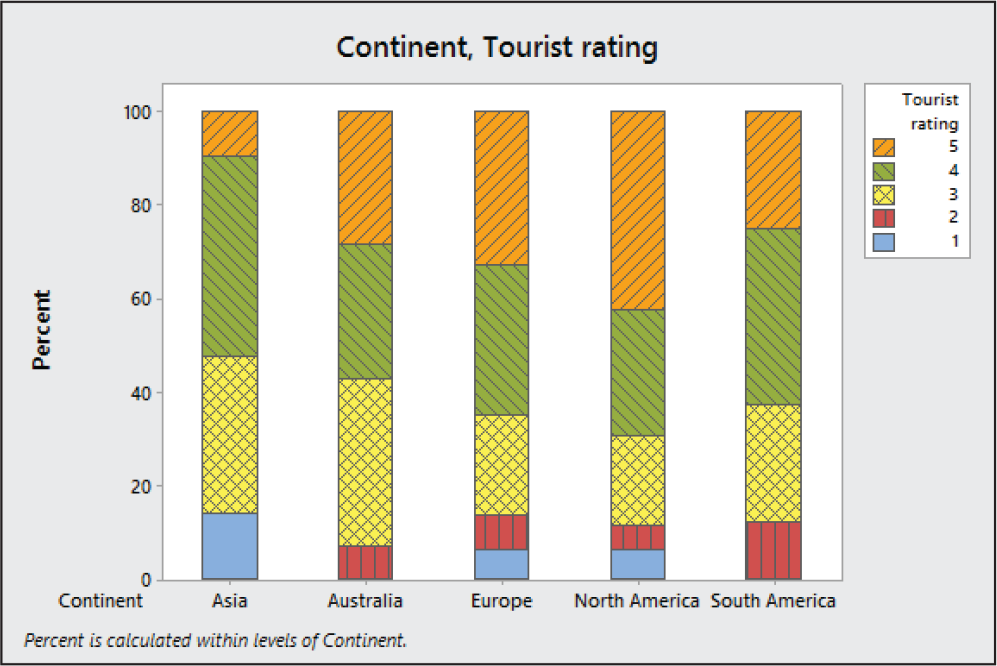
Figure 1 gives a word map of countries from where tourists, who visit Vlore, come. Percentage frequency distributions of the variables: Property type, Tourist type, Time of Year, and Continent are given by Figures 2 and 3. The highest attendance of accommodation services, included in this study, has occurred in the time period June–August (61.8%), and the majority of the tourists who visit Vlore came from Europe (89.8%). Possible ratings for accommodation services are with numbers 1, 2, 3, 4, and 5, respectively, for “terrible,” “poor,” “average,” “very good,” and “excellent.” As we can see from Figure 4, in the overall rating, 64.9 percent of the ratings are 4 or 5, regardless of the accommodation chosen. Within a selected accommodation structure (Figure 5), the highest percentage (68.86%) of ratings 4 or 5 is encountered in B&Bs/Inns (Bed and breakfast in a small lodging establishment that offers overnight accommodation and breakfast.), although in all selected accommodation structures, ratings 4 or 5 are over 63 percent. The highest percentage (15.29%) of ratings 1 or 2 is encountered in Specialty Lodging. As we can see in Figure 6, within a selected time period, the highest percentage (66.4%) of ratings 4 or 5 is encountered in September–November, and the highest percentage (14.85%) of ratings 1 or 2 is encountered in June–August. One of the main reasons for this result maybe that the service quality is directly influenced by the high touristic flow during the peak period.



Independence Test Results and Strength of Relationships
Conclusions
In marketing, the costs associated with retaining customers are lower than those of attracting new customers. So, it is less expensive to keep current tourists satisfied than it is to attract new ones. Customer satisfaction has long been a focal point not only in academic research but also in business operation and industry practice. Due to the fast-evolving environment, tourists’ satisfaction must be seen as a key point for achieving differentiation.
Therefore, businesses that operate in the Albanian touristic sector in Vlore must understand that tourists nowadays are more experienced, have higher expectations, and they also need some flexibility in the service offering. In general, tourists regarding their stay in Vlore expressed satisfaction with the accommodation service, despite the accommodation structure. However, depending on the structure of accommodation, the highest percentage of satisfaction is encountered by B&Bs/Inns attendants as the highest dissatisfaction with Specialty Lodging.
From the findings of the study, it does not turn out that dissatisfaction and satisfaction with accommodation service are influenced by the time period but what is noticed is that the highest percentage of dissatisfaction is encountered in the June–August period, whereas highest percentage of satisfaction is encountered in the September–November period. Given that the June–August period is accompanied by a soaring flow of tourists, whereas, in September–November, it is average, we tend to believe that the increase in the flow affects the quality of the accommodation service and consequently cause the reduction of customer satisfaction with the service received from the customer. However, further studies are needed to control this hypothesis. Given that the most satisfied tourists were from North America and Europe and the least satisfied from Asia, accommodation businesses should have a clearly defined idea about the tourist type they want to attract in a certain period of the year, and to offer the level of quality they expect.
Customer satisfaction is strongly related to economic performance because businesses with high levels of customer satisfaction tend to have higher financial returns compared to their competitors (Christofi, Leonidou, & Vrontis, 2015). From another point of view, customer satisfaction predicts both consumer spending and gross domestic product growth. Today empowered tourists often force the businesses to differentiate services because of the information they possess from the technological development (Christofi, Leonidou, Vrontis, Kitchen, & Papasolomou, 2015; Leonidou, Christofi, Vrontis, & Thrassou, 2018). Social media and review sites make great use in evidencing the role of electronic Word of Mouth (e-WOM) in shaping tourist expectations, a trend that the industry must not ignore. Businesses engaged in the tourism sector need to design an appropriate method for monitoring customer satisfaction on an ongoing basis. This method needs to be cost-effective, preferably real time, and should be able to be used to inform strategic planning and management. They must specify the type of satisfaction they need to measure, the metrics they will use, the measurement objective, and data collection sources. Understanding of tourist satisfaction evaluation is important in implementing successful marketing campaigns.
Footnotes
Declaration of Conflicting Interests
The authors declared no potential conflicts of interest with respect to the research, authorship, and/or publication of this article.
Funding
The authors received no financial support for the research, authorship, and/or publication of this article.