




Abstract
Career re-entry of women in the technology sector remains an unexplored area. With the increasing focus of information technology (IT) organisations to attract, retain and promote women at the workplace, career re-entry among women professionals’ merits attention. The purpose of this study is to investigate the reasons and enablers of career re-entry among women who plan a re-entry in the IT sector in India. This study employed a qualitative research method and used interviews as a tool for data collection. Data collected through the interviews of re-entry women (n = 28) was analysed with the help of qualitative analysis software ATLAS.ti. Further, text analysis was also performed through Voyant tools. Findings suggest that a strong career identity, a high level of work centrality and an urge to regain financial independence motivated women to return to IT careers. Findings revealed seven distinct enablers of career re-entry. Based on this finding, a model of the support ecosystem is discussed that presents an intricate relationship between the enablers of career re-entry, support ecosystem and career resumption. Moreover, findings indicate that an active agency of women, a support ecosystem and favourable life events lead to career re-entry. Managerial and theoretical implications of findings are discussed. The article concludes with limitations and future research agenda.
Keywords
Introduction
Underrepresentation of women in the professional front in general and information technology (IT) sector is a known fact. Parity remains a challenge, and women remain underrepresented at every level (McKinsey, 2019) and more so in the technology industry in India (NASSCOM, 2017). Another related phenomenon is the voluntary dropout of women professionals from IT jobs due to several structural, systemic and social challenges (Kirton, & Robertson, 2018). This voluntary dropout of talented women professionals adversely affects gender equation. As gender diversity is found to positively influence performance and key employee outcomes (Catalyst, 2018), IT organisations are taking initiatives to curb voluntary dropout. Family-friendly policies, stringent rules to curb harassment, fair and transparent practices are some of the notable organisational initiatives (NASSCOM, 2017).
Recently, organisations have initiated corporate restart programmes to attract and support women on a career break to restart their careers (Hortikar, 2018). Alongside, technology has fuelled the digital learning and networking platforms, which has enabled women on a career break to reskill and network for career resumption (Rajesh, 2013). Although women’s career restart has generated a great deal of interest among corporates and popular press (Barratt, 2018), it is surprising to find limited evidence of scholarly research on the subject, especially for IT careers in the Indian context.
India as a context merits attention as research evidences a high rate of voluntary dropout in the Indian IT sector (NASSCOM, 2017; World Bank, 2017). As a response to this and the growing evidence of business case for diversity, Indian IT organisations introduced several initiatives to support career resumption of women after career break (Modassir & Ramesh, 2017; Raghavan & Dastidar, 2015). Career resumption, however, for women in the IT sector is tough and exasperating (Herman, 2015). A break in IT career often results in knowledge gap and subsequent loss of confidence, self-belief and networking opportunities (Panteli, 2006; Panteli & Pen, 2010), making career re-entry difficult. Alongside, research in the Indian context indicates that women’s career decisions in India are not self-driven but relational. Women’s career choices are negotiated, discussed, compromised and accommodated with respect to social situations, external environment, and conditions (Srinivasan et al., 2013; Tiwari, 2019a). Women’s career, hence, is strained by ‘cultural constraints’—social as well as family obligations—majorly due to gendered norms. Heteronormative gender role expectations towards family obligations means that the benefits of organisational career resumption policies may, thus, be limited. Apparently, in the Indian context, social support and favourable life conditions appear to be crucial for career re-entry. A study on women’s re-entry in India, hence, assumes significance.
‘Re-entry women’ form a distinct segment of women professionals, knowing their career experience can be crucial for IT organisations. Such insights can effectively help IT organisations to design career restart programme, for the on boarding of re-entry women, and provide adequate support after re-entry. In addition, given the call for the need for more research on gender differences in career decisions (Herman, 2015; Sullivan & Baruch, 2009), this study assumes significance from the research perspective as well. Considering the dearth of studies on re-entry of women and its importance to the practice and research alike, we present this study to investigate the reasons and enablers of career re-entry among women professionals in the Indian IT sector.
The term ‘re-entry women’ used herein is defined as women returning to work after a career break of more than six months, to the same careers they were associated with (in this case IT). For this study, we do not include women professionals returning to jobs in a different field, other sectors or those who become self-employed after taking a break from an IT career. With the inclusion criteria of the same sector, we attempt to explore the reasons behind returning to the same sector (i.e. IT), which is characterised by rapid technological changes, skill obsolescence and challenging tasks (Hombert & Matray, 2019).
Literature Review
Women’s Career Break and Career Re-entry
Career break refers to a period where an employee is not engaged in work due to specific reasons (Institute of Physics, 2004). Major reasons of women taking a career break include higher education, marriage, relocation, motherhood and elderly care (Panteli & Pen, 2010; Tiwari, 2019b). Career breaks result in downward mobility in salary and employment status (Gwal, 2016). This emanates from skill obsolescence, employment discontinuity, orientation towards a better fit but a lower paid job, redirection towards low-paying sectors, and deterioration of human capital (Ravindran & Baral, 2013). The impact of career breaks is more deteriorating in technology careers such as IT owing to the fast-changing technological advancements (Moore et al., 2013). Further, career breaks are perceived negatively (Gregory & Connolly, 2008; McIntosh et al., 2012) as many organisations tend to give preference to continuous employment (Manning & Petrongolo, 2008), putting women on career break at a disadvantage.
Owing to the disadvantages of career break, career re-entry for women is often difficult. Mostly women on break opt for a compromised yet a better fit paid work in sync with their non-work roles (Hakim, 2000). Women on career break usually indulge in three types of behaviour—returning to same sector (full-time/part-time), returning to work (any sector, part-time, freelancing, entrepreneurship etc.), and opting out of work. This has been discussed as rebooting, rerouting and retreating (Herman, 2015). Re-entry in general has been studied as a woman’s decision to engage in paid work (Harman & Sealy, 2017). Hence, women’s decision to restart a career after a break has been studied as re-entry irrespective of shifts in career or field: e.g. self-employment (McKie et al., 2013), shifts in career and shift in sector (Hewlett & Luce, 2005).
Literature suggests that women re-enter the workforce to gain financial independence (Cabrera, 2007), do meaningful work and to regain lost confidence (Hewlett & Luce, 2005). A few studies have attempted to study women’s re-entry in the same career after a career break, e.g. nursing (Stanley, 2018). However, there is limited evidence focusing on the IT sector. Furthermore, such studies have mainly highlighted the barriers and challenges related to career re-entry. For instance, the unavailability of a flexible work arrangement, part-time work and lack of training are reported as barriers to career re-entry of women in IT (Panteli, 2006). Similarly, gendered culture in the workplace and gender role in the domestic sphere is reported as a challenge for re-entry in the technology field (Herman, 2009). Limited research on women’s re-entry in science careers, however, indicates that women who identify strongly with their careers and possess a sense of affiliation with their profession return to the same career after the career break (Herman, 2015). However, there is a clear dearth of understanding about the reasons for re-entry of women in IT career and the enablers of women’s re-entry in IT.
Women’s Career in IT
Women’s career in IT has been an important topic of discussion in industry and academia in the recent past. The ‘leaky pipeline’ (Seward, 2019), i.e. underrepresentation of women in IT (Muller, 2003), gender inequality (Davies & Matheiu, 2005) and gender pay gaps (Wynarczyk & Renner, 2006), has been discussed in detail. A dominant perspective concerning women’s career in IT is the ‘leaky pipeline’ perspective (Berryman, 1983). The ‘leaky pipeline’ metaphor has been used to describe the phenomenon of women disappearing from IT careers progressively, and thus fewer women remain until the later stages of career (Kossek et al., 2017). Hence, only few women persist in their career in IT. The ‘leaky pipeline’ perspective has been employed to discuss career decisions of women in technology careers in different contexts (e.g. Srinivasan et al., 2013, in India; Seward et al., 2019, in Canada etc.). It is, however, notable that the ‘leaky pipeline’ perspective implies a linear progression through an IT career and obscures women’s agency in her career (Castaño & Webster, 2011). With this perspective of the linear progression of women’s career in IT, such that women progressively opt out of a career as the career progresses, usually spurns the important career decisions, e.g. career re-entry after a career break (Diekman et al., 2019).
An alternate perspective of analysing women’s career in IT is the ‘life-course approach’ (Castaño & Webster, 2011; Xie & Shauman, 2003). The life-course approach maintains that life events (marriage, motherhood, educational achievements, qualification, relocation, global mobility etc.) separately and in combination with women’s ability and self-belief to engage in IT field impact the trajectory of women’s career in IT. Not all women experience similar life events, and thus career experiences of women cannot be articulated with a linear progression perspective (Makarem & Wang, 2020; Sabelis & Schilling, 2013). Life events, women’s ability and self-belief impact women’s entry in IT, persist career in IT, decision to take a career break and re-entry in IT career. The life-course approach posits that a woman on a career break may decide to restart her career if life events are favourable and she can engage in an IT career. In the case of a woman’s career, this perspective is highly relevant, as certain life events influence career decisions greatly, for example motherhood (McIntosh et al., 2012; Shanmugam, 2017) and marriage (Ahuja, 2002; Srinivasan et al., 2013) etc. The life-course approach, hence, assumes significance to study the career re-entry of women professionals in the IT sector.
Theoretical Perspectives on Women’s Career
Women’s careers are characterised by several transitions and complex career trajectories. Traditional career models based on linear career progression, thus, appear insufficient to explain women’s career patterns. Conceptualisation of contemporary careers, e.g. boundaryless (Arthur & Rousseau, 1996) and protean careers (Hall, 2004), is often used to explain careers which do not map easily to traditional careers. Protean careers, which stress the importance self-direction and subjective career success, have been used by scholars to study women’s career decision and transition. Further, scholars have also developed models that specifically address issues of women’s career, e.g. kaleidoscope career model (Mainiero & Sullivan, 2005) and career scape (McKie et al., 2013).
The kaleidoscope career model proposes that very similar to a kaleidoscope, which produces changing pattern after rotation due to adjustment of glass chips, individuals also change the pattern of their career by shifting the different aspects of their lives to adjust their roles and relationships in a new manner. The decision related to career depends upon the individual’s evaluation of available career choices that best suit the work and non-work demands, constraints, resources, personal strengths, interest and values. As kaleidoscope’s three mirrors create infinite patterns, individuals also use three parameters to create numerous career patterns. These are (a) authenticity, following which an individual makes career choices that allows the individual to be true to oneself; (b) balance, following which an individual looks for work and non-work equilibrium; and (c) challenge, following which an individual strives to achieve career advancements. Mainiero and Sullivan (2005) argue that women in early careers focus on challenge, during their mid-career focus on balance and in the later career look for authenticity. Further, McKie et al. (2013) proposed the careerscape framework to explain women’s career decisions across the lifespan. This model is based on the temporal and spatial dynamics; it proposes that women’s career choices are driven by willingness to have greater control on work content, time and need for autonomy.
These models provide the theoretical lens to understand women’s career trajectories. It is, however, notable that the models highlighting life-course and iterative perspectives are vital, yet they are not unproblematic as there is a risk of assuming individual agency. This assumption of individual agency may become problematic if external constraints and enablers of women’s career are not accounted (Herman, 2015). For instance, in science, technology and IT careers, women’s career may get impacted due to systemic and structural gender inequalities. Further, external constraints or enablers may also emanate from the cultural and social context in which women’s career is shaped, e.g. collective versus individualistic culture. Thus, it can be argued that although these career models (which are developed in the Western context) are illuminating, they may (or may not) fully explain the women’s career trajectories in India, thus pointing out the need for studies in this direction.
Method
A qualitative approach was used to explore the experiences of re-entry of women professionals in the IT sector. The research questions, along with the need to elicit meaning, gain insights and interpret the experience of respondents; this was considered the most appropriate methodological approach (Corbin & Strauss, 2008) for the study.
Sample
The scholarly opinion differs on the number of participants desired for qualitative studies, varying from 6 to 20 and above (Guest et al., 2006; Mason, 2010). Notwithstanding the number of participants, the objective is to reach a theoretical saturation, which is achieved when the new information does not provide further insights into the understanding of the phenomenon (Creswell, 2007, p. 160). After achieving the theoretical saturation at 28 interviews, the interviews were stopped. Purposive sampling was employed, followed by snowball sampling to select the participants. Purposive sampling was employed to choose the participants with diverse experience of the phenomenon being studied (Charmaz, 2008). Snowball sampling was used to find the potential participants for the study. This sampling technique is generally used when finding potential participants is not easy (Heckathorn, 2011). Participants were requested to refer to other individuals who met the study requirement (Noy, 2008). Further, the diversity in the participants is vital for qualitative research, as the sample size is generally small. To ensure diversity of representation, a pool of potential participants was created with the help of snowball sampling, and purposive sampling was used to finally select the participants. Participants were selected based on certain criteria such as the span of the career break, the reason for the career break, number of children and family type. This two-step sampling process ensured the required diversity of representation.
Data Collection
In the first step, re-entry women were contacted through social media and joining websites dedicated to women’s career. Further, the authors also attended career restart seminars and webinars to connect with re-entry women. The purpose of the study was shared, and women were requested to participate. We ensured that their responses would be kept confidential. Once the consent was received, the individual was included as a participant in the study. The participants were from Hyderabad, Bangalore and Pune, the top IT cities in India. Due to the geographic dispersal of participants, interviews were largely conducted over the phone and skype. Further, 11 face-to-face interviews were also conducted. A pre-interview questionnaire and an interview manual were designed to solicit responses. The pre-interview questionnaire included questions on age, marital status, number of children, family size, family type, household income, role in IT (core/support), the span of a career break, the reason of career break, years of experience etc. The pre-interview questionnaire provided the background information about the participant, which helped during the interview process. The interview manual was used as a guide during the interview. It included instructions about interview settings, interview procedure and interview closing.
Interviews were conducted in English. For the interview, an attempt was made to keep the setting informal to ensure that participants felt comfortable. Each interview lasted for 30–40 minutes. Interviews were recorded after the interviewee’s consent. The recorded interviews were transcribed on the same day. A conscious attempt to carry out an initial analysis of the interview on the same day was done (Green et al., 2007). The initial analysis guided the future interviews in terms of the selection of participants, inclusion/exclusion of questions and assessment of the theoretical saturation.
Participant’s Information
Demographic Profiles and Participant’s Information
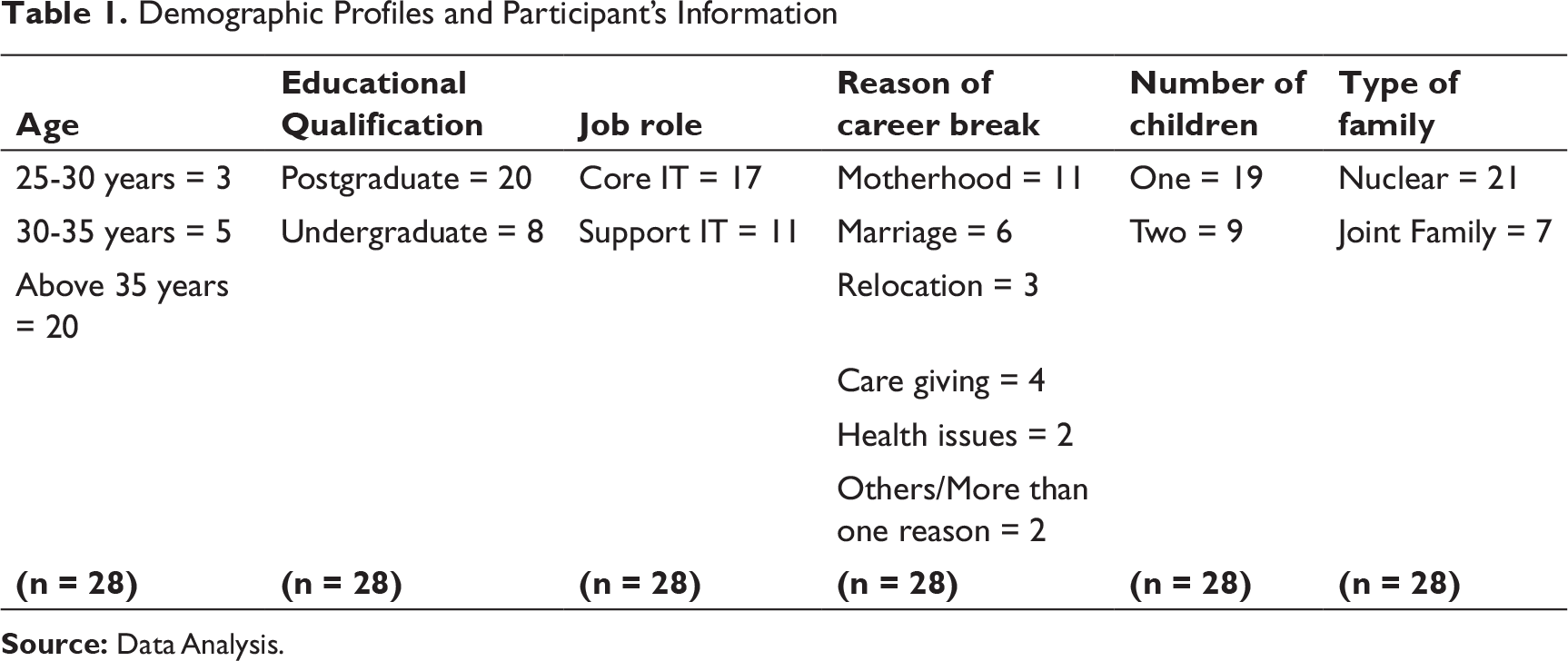
Data Analysis and Results
Data collected through interviews were analysed with the help of qualitative analysis software ATLAS.ti version 8. Text analysis was performed using Voyant tools, an open-source text analysis tool used in social science research (Uboldi & Caviglia, 2015).
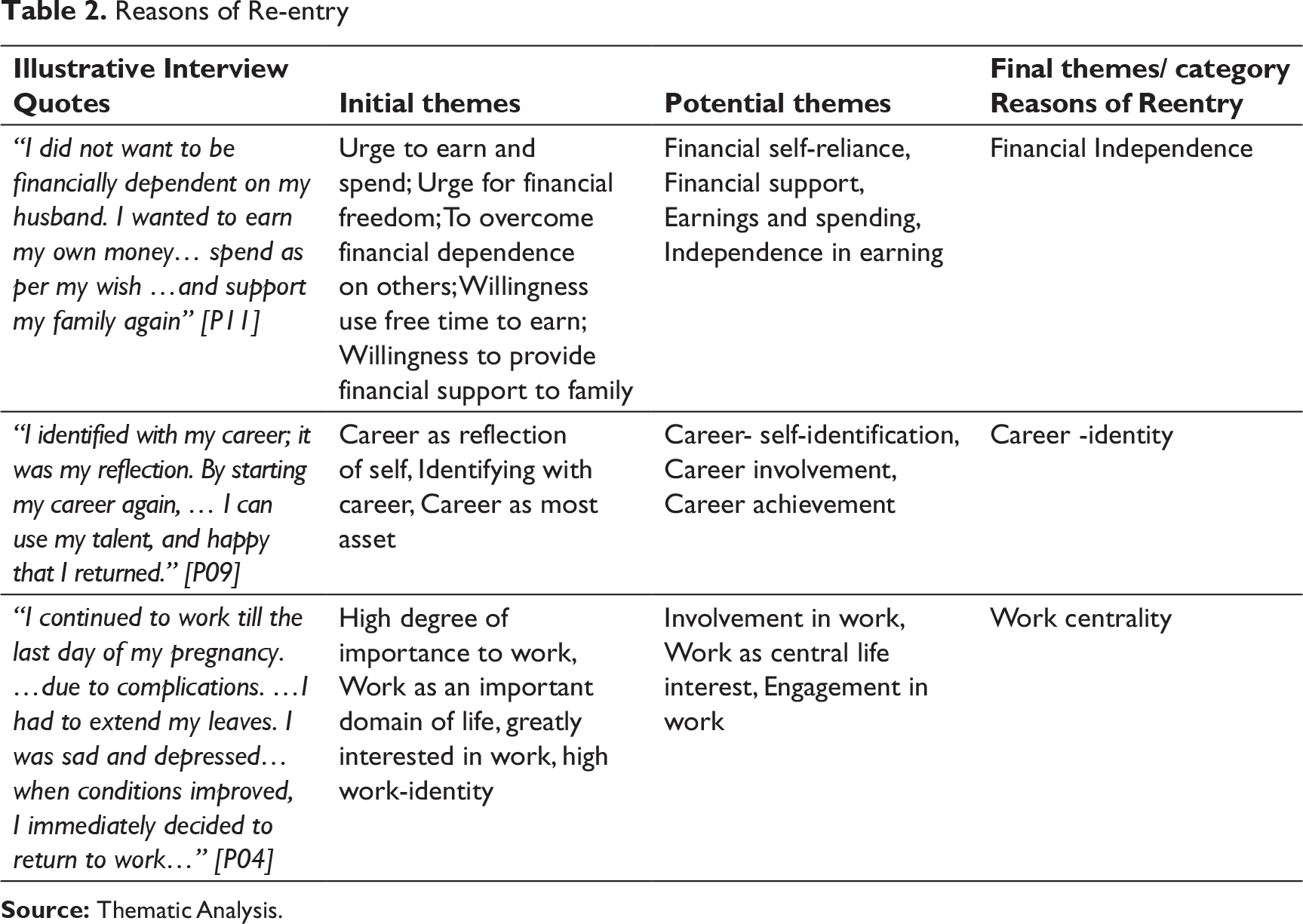
Thematic analysis, a popular method of qualitative data analysis, was used. The six-phase approach proposed by Braun and Clarke (2006) was adopted. The six steps used in the study included (a) familiarising with the data, (b) generating initial codes, (c) searching for themes, (d) reviewing potential themes, (e) defining and naming themes and (f) producing the report. The first five steps related to the coding and themes that emerged from the data. The sixth step pertained to the overall story that revealed the underlying relationship between the themes (Braun & Clarke, 2012). Thematic analysis of reasons and enablers of career re-entry is depicted in Tables 2 and 3. The underlying relationship between the enablers was analysed with the help of ATLAS.ti network to create a network link of enablers, as shown in Figure 3.
Reasons for Re-entry
Financial Independence
One of the objectives of the study was to understand the reason behind the re-entry of women professionals. The analysis revealed that one of the major reasons for re-entry was the urge to become financially independent. However, diverse opinions and thoughts about financial independence were observed. Findings indicate that, although participants wanted to gain financial independence, the decision was anchored in the family needs. Moreover, the outcome of the decision was also anchored to benefitting the family. Simply put, the participant wanted to gain financial independence to support her family. However, financial independence as a category did not explain the reason why women chose to return to the same career. Further analysis provided insight into the same.
Career Identity
Career identity emerged as another reason behind re-entry of women professionals. The importance of career identity as a reason behind career re-entry was depicted in the way respondents narrated about their comeback in the same occupation (see Table 2 for details). Research evidences that career identity is a broader concept as compared to organisational identity or professional identity, and it is not tied to a job role or experience. In contrast, career identity is defined as individual’s commitment towards specific career or occupation. Analysis of quotes reveals interesting insights about the role of career identity in career re-entry. Participant opinion revealed that for them, ‘their career was (her) reflection’, ‘career was an asset’, ‘career was (her) identity’ etc. These accounts clearly signify that women returned to the same career, that is, IT after the break, because they identified strongly with their IT careers.
Work Centrality
A great degree of work centrality was observed among the participants. Participant responses revealed that they gave a high degree of importance to their work. Their expressions towards achievements at work, returning to work, feeling void/emptiness while not working, indicated that ‘work’ was central to their lives. Work centrality signifies an individual’s belief about the value and importance of work in his/her life. This concept highlights that individuals who consider their work as a central life interest possess strong identification with their work and invest efforts to attain professional development (Moura & Oliveira-Silva, 2019). During the interview, participants stressed upon acquiring competencies such as coding, technical skill etc. for re-entry, which are specific to IT-related works. Hence, it is evident that a high degree of work centrality among the participants was a key reason behind the re-entry in the same career.
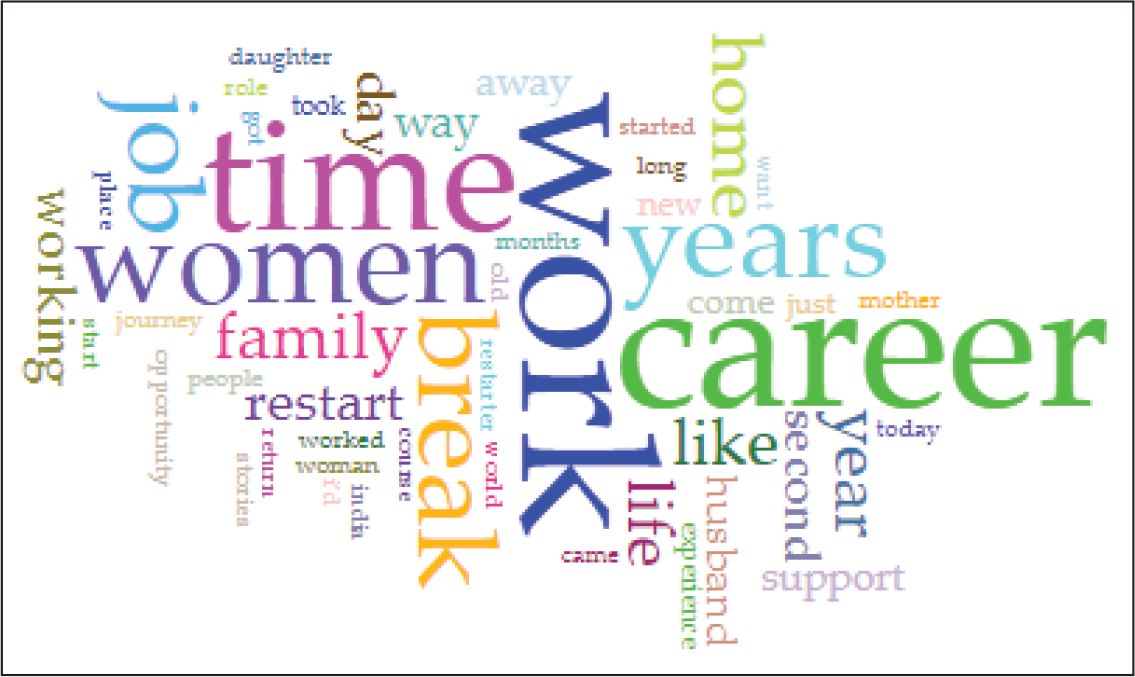
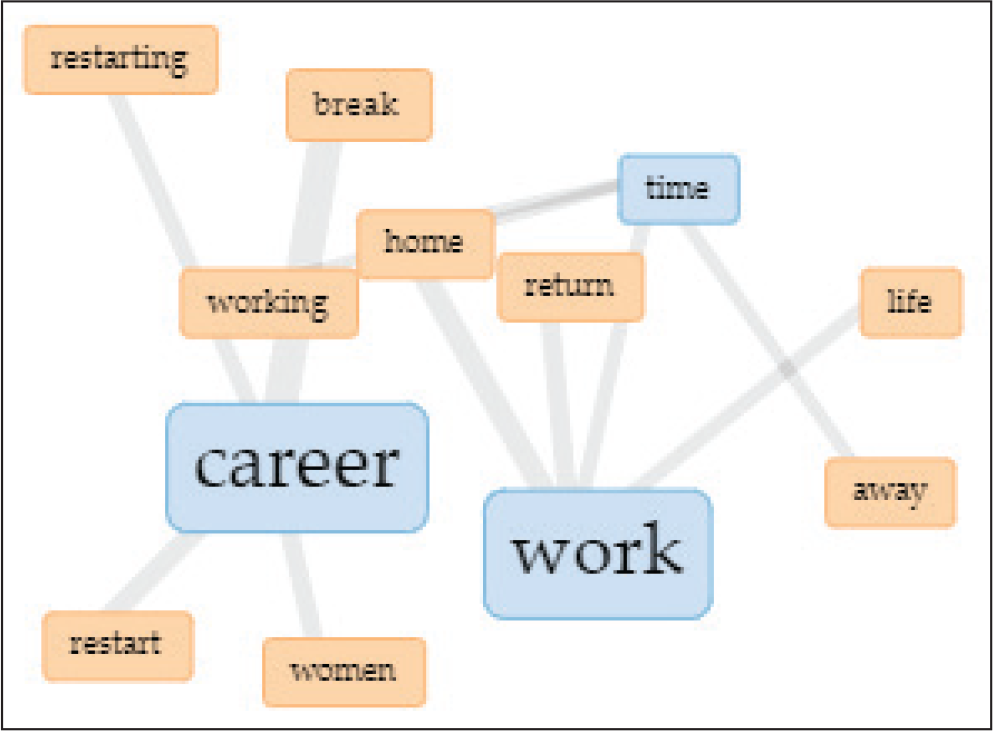
Text analysis also provided evidence for career identity and work centrality. The word cloud, shown in Figure 1, depicted that most frequent words were career and work. Further, for the career, what was observed links with restart, restarting, women (see Figure 1), which suggests that career restart was important to the women. The link analysis also supported the emerging accounts of carer identity and work centrality. The link of work and life (see Figure 2) denotes that work was central to the lives of women.
Reasons of Re-entry
Enablers of Career Re-entry
Enablers of Career Re-entry
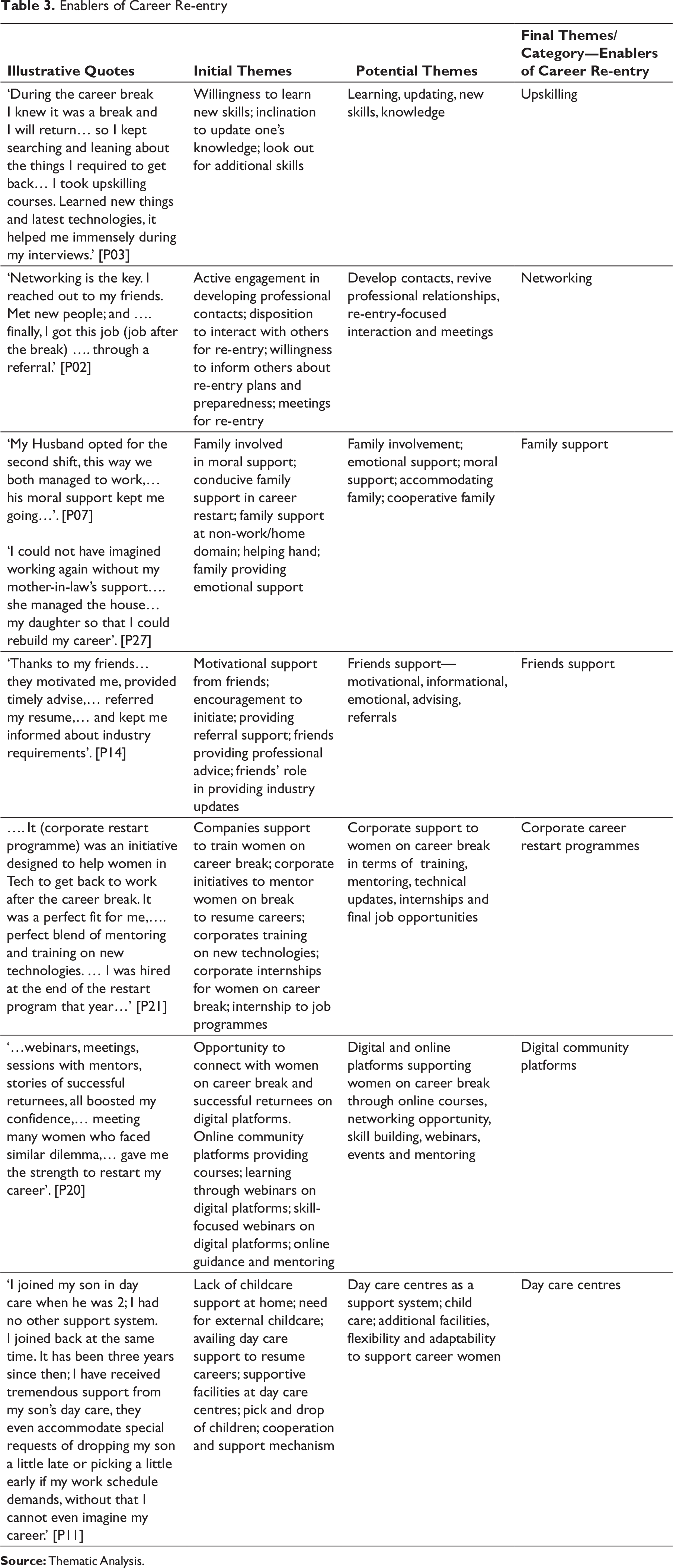
The analysis of enablers delineates that the enablers together form a support ecosystem. This support ecosystem together facilitates the career re-entry. Interestingly, each enabler is linked to the other, thus creating a web of support for women. The ATLAS.ti network was used to create a network link of enablers. Figure 3 demonstrates the link between the enablers, support ecosystem and career re-entry.
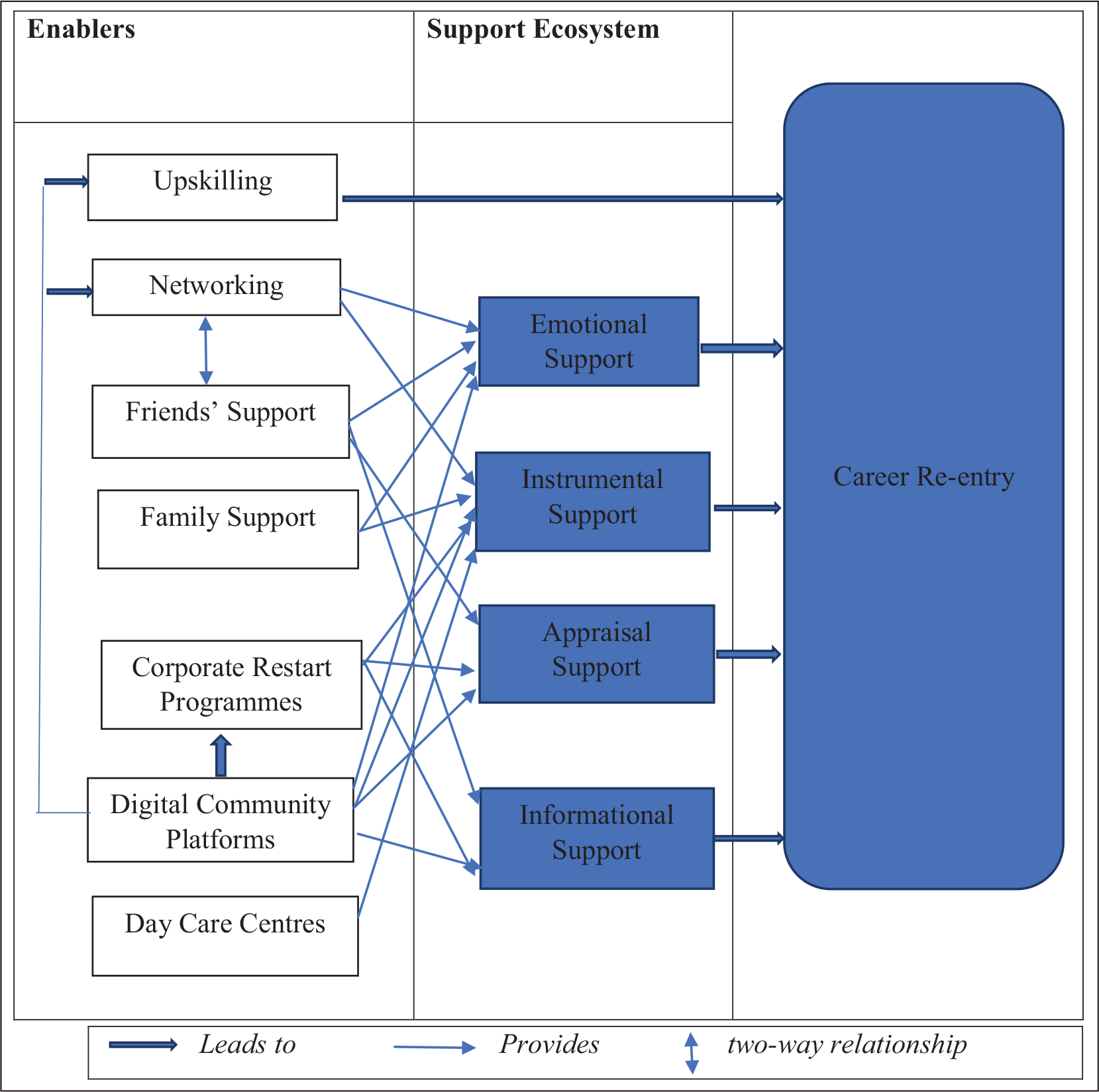
The network diagram depicts the complexities involved in career re-entry after a career break. It is thus clear that women on a career break require different types of support to return to work. Interestingly, different types of support together form a support ecosystem which facilitates women’s re-entry (see Figure 3).
Further, it also reveals that upskilling leads to career re-entry, and hence it is crucial to reskill and upgrade during the career break. Alongside, the figure also depicts that enablers provided different set of support for women. Instrumental support, that is, tangible, concrete support, emerged as a key to re-entry. Nevertheless, emotional (e.g. empathy and care), informational (advice, suggestion, valuable information sharing etc.) and appraisal support (i.e. sharing information which is vital for self-evaluation) also facilitated career restart.
A compelling observation was noted concerning DCP. The presence on these platforms provided instrumental, emotional, informational and appraisal support. Furthermore, presence on DCP leads to opportunities to upskill, network and apply to corporate restart programmes. Friends support and family support emerged as separate facilitators, indicating that these two factors play a distinct role in women’s career re-entry. Emergence of day care as an enabler was not surprising owing to long working hours in the IT sector and increasing nuclear families in India. Results of the study are discussed in detail in the next section.
Discussion
This study attempted to examine the reasons and enablers of re-entry of women in IT after a career break. Results revealed that the need for financial independence, career identity and work centrality were major reasons behind career re-entry. The urge to be financially independent shows that monetary benefits motivated women to return to work. This finding is consistent with earlier research which suggested that financial concern is a primary reason behind women’s decision to restart the career (Cabrera, 2007).
Furthermore, career identity and work centrality explain the phenomenon of returning to the same career. Women depicted strong career identity, i.e., the aspect of an individual’s identity which is engaged in working in a given profession (White, 1995). Literature suggests that a high career-involved person has high career identity (Praskova et al., 2015). This highlights an interesting fact that although women took a career break, they always identified themselves with their careers and therefore returned to the same career. Similar result was reported by Herman (2015), who found out that those women who identified strongly with their careers and possessed a sense of affiliation with their profession returned to science careers. Interestingly, career identity was reported to be one of the key predictors of career persistence in the IT sector in a study among women professionals in the Indian IT sector (Srinivasan et al., 2013). This signifies that a strong career identity and professional affiliation drives women to persist in IT careers and to return to it after a career break.
Similarly, women exhibited high work centrality. Work centrality refers to the extent to which work is central to an individual’s life (Paullay et al., 1994). People with a high degree of work centrality prefer to work even after retirement, continue to work even if they are financially well off and do not require to work (Arvey et al., 2004; Miller et al., 2001). A high degree of work centrality among re-entry women is not surprising, as it shows that work has an important role in their life, and thus they returned to work. This shows that women returned to their work to regain their confidence and work identity for professional satisfaction (Moura & Oliveira-Silva, 2019). These findings are in line with those of Hewlett and Luce (2005), who reported that women return to work to gain non-monetary benefits of working.
Further, based on the findings, a model of a support ecosystem for women’s career re-entry was developed. This model highlights the factors that enable career re-entry for women. The most striking finding with respect to the enablers pertains to family support. Findings suggest that re-entry women found support from family (husband, mother, sibling and in-laws) as instrumental in their career re-entry. This finding signifies a change in the social and cultural mindset in India, where women’s careers are valued (Singh & Vanka, 2020), and family members contribute significantly towards the development of women’s career. These results show a departure from an established view of India as a highly patriarchal society (Rajadhyaksha, 2012; Rajadhyaksha & Smita, 2004). These findings, however, are limited to this context, yet reveal a significant change in the way a woman’s career is viewed.
Another striking finding reveals that friends and family contributed differently to the re-entry of women professionals. While friends contributed towards informational and emotional support, family acted as an instrumental support along with the emotional support. Studies in the West, however, largely discussed friends and family together as an important non-work-related factors related to women’s career (e.g. Mainiero & Sullivan, 2005; Panteli & Pen, 2010). This result may be explained by the fact that family ties and friendship bonds are viewed differently in India (Koydemir et al., 2013). Although both contribute significantly to social support, yet the role of family and friends is still distinct.
The study found empirical evidence of ‘life-course approach’ (Castaño & Webster, 2011; Xie & Shauman, 2003). Consistent with the life-course approach, the analysis revealed that women prepared to renter the workforce when life events were favourable, e.g. children attaining the school-going age. The evidence of another aspect of life-course approach, that is, women’s career decisions are related to women’s ability to engage in her career, was also confirmed. The women’s ability to learn new skills (upskilling), connect with people (networking) and utilise career re-entry opportunities (corporate restart programme and DCPs) contributed to their re-entry to a large extent.
Furthermore, it can also be observed that women require a great deal of support for re-entry. It is interesting to note that the enablers identified in the study provided different types of support, e.g. informational, instrumental, emotional and appraisal (Taylor, 2011). Notably, women received this support from different sources, e.g. family, friends, corporates, digital platforms, day cares etc., all of which together facilitated the career restart for women.
Alongside, it was also found that women took opportunities to restart, depicting a sign of active agency and leaning in (Sandberg, 2015). Re-entry women reached out to their old networks, joined new courses, asked for help in raising kids so that they can get back to work. Active agency of women signifies women’s intentionality to shape her career, more specifically, career return. At the core of active agency lies the concept of self-directedness reflected in terms of self-motivation, affect and action. Findings reveal that women career re-entry was intricately linked her intention to restart her career. Findings also indicated that all key enablers of women’s re-entry were related to active agency of women, e.g. networking, presence of DCPs and upskilling. Put simply, women’s career re-entry was the function of active agency of women to a large extent. In sum, the findings indicated that an active agency of women along with the strong support system facilitates women’s re-entry to the workplace.
Recent surveys revealed that 100 best companies in India offered the best enablers—formal/structured mentoring (92%), leadership training (99%), childcare support (72%) and formal phase-back programmes for women returning after maternity leave (74%). In addition, mentoring, career sponsorship, hi-potential talent programmes and flexible working are open to all employees including women. Moreover, there are specific programmes for the vast cross-section of employees—across levels and roles—to sensitise and create awareness among the employees and build conviction in diversity and inclusion (AVTAR Inc, 2019). Managers can execute them in letter and spirit, to help create inclusive cultures, although the inclusion intent is top driven.
Limitations, Implications and Future Research
The study has certain limitations. First, the data collected were restricted to the individual’s response and recall. The participants self-reported about their career experiences and career decisions, which can be a limitation. Since the focus was only on re-entry women in the IT sector, the findings may only pertain to this setting.
Despite these limitations, the study carries some important implications for research. The study adds to the existing understanding of career restart by exploring the reasons behind re-entry in the same career after a career break. The study also found evidence for the ‘life-course approach’ and need for active agency for career re-entry. Future research can be done to establish the relationship between enablers and career re-entry. Quantitative research investigating such relationships can provide additional insight into the role and contribution of various enablers. A further study with more focus on the relative contribution of enablers is therefore suggested. To develop a full picture of career re-entry, further research is needed on the work–family balance after re-entry. Such studies will provide a comprehensive picture of two salient domains of women’s life, i.e. work and family. Moreover, this study highlighted the importance of career identity and work centrality for career re-entry in the IT sector. Future research may also explore other perspectives such as career transition, reluctance and resilience to examine the re-entry among women professionals in other sectors. Additionally, a research demonstrating a comparative analysis of reasons and enablers of women’s re-entry in different sectors may bring interesting and valuable insight.
The study carries implications for practice as well. The study evidenced that the re-entry of women depends upon several factors. Moreover, the study suggested that a support ecosystem is required to facilitate career restart of women, and thus only corporate restart programmes cannot guarantee career re-entry of women in the IT sector. IT organisations can create a support ecosystem to encourage smooth re-entry of women by providing on-campus day care facility, mentoring facility to women on break, networking and upskilling opportunities to stay updated while on break. Most of these facilities can be offered online and thus can be provided as integrated facilities. Further, in the IT sector, technologies change rapidly and, hence, career breaks lead to skill obsolescence and knowledge gap. IT organisations can tie up with DCPs to launch upskilling programmes. A collaborative initiative with DCP will provide an opportunity to IT organisations to reach out to a host of women on a career break who are willing to return to work. On the other hand, DCP will gain visibility, credibility and subscriptions. Hence, collaboration can be a win-win situation for IT organisations, DCPs and women on a career break.
The study has implications for women on a career break. The findings suggested that although a support ecosystem is required for re-entry, an active agency of women is a prerequisite. According to a survey of 100 best companies in India, women’s representation substantially increased from 25 to 33 per cent between 2016 and 2019, a trend, if enabled and continued in the same pace, is poised to achieve the gender balance as early as 2027 in India. The survey also revealed that 53 per cent of them attended formal second career hiring programmes, which would become a norm, going by the pattern of best practice adoption, by 2025 (AVTAR Inc, 2019) These projections mandate women, who intend to re-enter, to actively engage in reskilling, upskilling and networking for a smooth re-entry into the workforce.
Conclusion
The present study sought to understand the career experiences of women’s re-entry at the workplace in the IT sector. An attempt was made to enhance the current understanding of the career restart in the technology sector. More specifically, the aim was to understand the reasons and enablers of re-entry. Considering the dearth of research on re-entry women in the technology area, research on the various aspects of re-entry, e.g. barriers of re-entry, boundary conditions of enablers of re-entry etc., across sectors is advocated. We hope that the findings of this study will be helpful and kindle scholarly interest in career re-entry of women professionals.
Footnotes
Declaration of Conflicting Interests
The authors declared no potential conflicts of interest with respect to the research, authorship and/or publication of this article.
Funding
The authors received no financial support for the research, authorship and/or publication of this article.
