




Abstract
This research seeks to examine and distinguish the factors influencing empowerment and exertion of knowledge management along with the effect of knowledge management on organizational performance. In addition, this paper investigates human capital as mediator between the relationship of knowledge management and organizational performance. The conceptual model was extended based on the literature review. The primary data were gathered using a questionnaire comprising 48 questions distributed to the personnel of all branches of one of the largest private banks in Iran. Three hundred sixty-one questionnaires were randomly distributed among the personnel, and 334 questionnaires were answered. The gathered data were examined through SPSS and SMART PLS. The results demonstrated the positive impacts of variables including structure, organizational technology, strategy, culture, and trust on organizational knowledge management under study. Moreover, knowledge management directly affects the performance of the organization and through human resource management as mediator. This study motivates the managers and personnel to exploit the accessible organizational assets for enhancing knowledge management practices as well as human resources as the most exquisite organizational capitals.
Keywords
Introduction
Organizations are changing along with the improvement of knowledge and technology and becoming more complex. As a result, the management of organizations also needs higher capabilities. Today, it is not possible to manage organizations with the traditional methods, because managing the people who are the main assets of organizations is not an easy task, and the managers of organizations, especially the managers of human capital, must acquire the necessary knowledge and skills and apply them effectively. One of the most important challenges in the field of human resources is the relationship and coordination between human resource strategy and senior managers’ strategies such as business strategy. Applied and fundamental research in the last 20 years for addressing the above challenges has created a new and emerging field including the hypotheses and patterns of human capital management (HCM) and strategy. Recent studies have identified HCM as a factor in increasing competitive advantage, and employees have widely tested their approach, process, and vision with the organization’s strategic planning (Sheehan, 2014).
HCM is a way to make decisions about the goals and plans of the organization that are related to the following issues: employment relationships, hiring, training, rewards, and policies and methods related to employee relations. In general, HCM pays attention to any major human resource-related issues that either affect or are affected by the strategic plan of the organization. On the other hand, knowledge in today’s world is one of the most important factors of gaining a competitive advantage, and the competitive advantage of an organization stems from its unique knowledge (Lee & Choi, 2003). Knowledge is a very important tool to reduce environmental complexity and an important factor that enables entrepreneurs to differentiate themselves from their competitors (Pastor, 2011). Knowledge is an essential factor for organizations that leads them to success in the competitive environment. Those organizations that identify and value knowledge-based assets will be more successful (Richard & Johnson, 2001). Nowadays, knowledge management (KM) is a tool to create a competitive advantage and an essential part of the business activities of organizations that are intertwined with their short-term and long-term goals. KM and its various aspects have long been a contentious issue among researchers in various sciences (Nonaka & Takeuchi, 1995).
The foundation of KM is knowledge employees who facilitate the creation, dissemination and use of knowledge. Therefore, interactions between individuals can act as an accelerator and determinant of KM implementation. However, knowledge creation does not necessarily lead to improvement of organizational performance (OP) or value creation in the organization but requires that human resources, as the most fundamental organizational resources, be managed efficiently, effectively, and strategically.
While studies indicated a relationship between KM and OP (Abubakar et al., 2019; Durst et al., 2019; Ha et al., 2016; Liu et al., 2021; Mustapha & Abdelheq, 2018; Muthuveloo et al., 2017; Singh et al., 2021), other research works displayed the effect of human resources management (HRM) on the improvement of OP (Al-Swidi et al., 2021; Antonioli et al., 2013; Becker & Gerhart, 1996; Chen & Huang, 2009; Liu et al., 2007; Marrucci et al., 2021; Mousa & Othman, 2020). In addition, it has been shown that a close relationship between KM and HRM exists (Gill, 2018; Keats & Evans, 2020; Popaitoon & Siengthai, 2014; Wang et al., 2012). Several studies demonstrated the role of KM as a mediator variable between HRM and OP (Jackson et al., 2014). A review of previous studies presents that limited studies investigated the relationship between KM and OP and the mediator effects of HRM. Therefore, regarding the necessity of practical studies that examine the role of HRM, the main goal of this study is to provide a view about the mediating role of HRM between KM and OP. This approach is somehow significant because it aligns the employees’ behavior and results in the optimized performance of the organization (Jiang et al., 2013).
Theoretical Background and Hypotheses
Knowledge is comprehension, consciousness, or awareness that is formed by perusal, scrutiny, experience, and investigation of the outer world and is an impalpable asset that is integrated with other financial and physical organizational resources to create capabilities (Grant, 2013). KM is a coherent procedure that gathers, preserves, and disseminates knowledge in organizations (Jasimuddin & Zhang, 2011). Human resource practices make employees to share their opinions and insights and acquire knowledge of cutting-edge services and products. Information and communications technology is of extreme importance for knowledge discovery and exploitation (Santoro & Usai, 2018). KM is a designed organized approach for managing production, distribution, and collection. KM is also the usage of knowledge leverage for improving the organizational pace, capability, and usefulness in order to render goods and services to their customers (Du Plessis, 2007). During the last decades, firms have been actively searching for competitive privileges to differentiate themselves from their competitors. KM has received remarkable attention by executive management because of its capability in strategic outcomes in relation with competitiveness, profitability, and capacity development (Oluikpe, 2012).
KM Processes
KM activities do not take place individually in an organization. There exist particular organizational factors affecting the KM initiatives and knowledge-based practices (Alaarj et al., 2016). Several research works have recognized and investigated the organizational KM factors such as executive management support, leadership, human capital practices, structure, climate, culture, and technology (Koohang et al., 2017).
Forming and developing internal and external KM committees endorse networking and communication, and foster knowledge sharing (KS) and transferring. KM systems, practices, and techniques are analyzed to distinguish the effective systems, practices, and techniques (Cader et al., 2013). Knowledge originates from organizational culture, strategy, and structure (Mahmoudsalehi et al., 2012). Organizations can form a pleasant environment for KS and transferring considering organizational culture. In addition, organizational culture and structure facilitate KS through the moderating variable of technological infrastructure (Islam et al., 2015). Moreover, the impact of team’s KS, emotional intelligence and culture on its performance was investigated, and the significant relationship between team’s culture and performance was shown (Jamshed & Majeed, 2019).
Social capital (SC) as mediator between the relationship of organizational KM and culture along with the direct effect of organizational culture on KM has been probed, and the positive and remarkable impact of organizational culture on SC and KM has been demonstrated. Also, the negative effect of technology on KM as well as the positive impact of culture and the structure on KM has been shown. KM strategies affect OP and innovation (Nikabadi et al., 2016). Transferring implicit knowledge is crucial so that individual expertise is disseminated among the whole department or team (Borges, 2013).
Many organizations have confronted several challenges with launching KM activities due to wrong leadership and focus. Leadership style that has an important role in successful KM activities is corresponding with organizational knowledge infrastructure such as structure, culture, and information technology. Organizational managers should employ a transformational leadership style for promoting KM initiatives. Efficacious leadership is a necessity for building trust inside organizations (Paliszkiewicz & Koohang, 2013). In addition, KM activities can improve OP (Paliszkiewicz et al., 2015). Efficacious leadership, which is a top strategic priority, comprising individual, organizational, and people leadership results in employees’ reciprocal trust, successful administration of KM activities, and improvement of OP (Koohang et al., 2017). Trust plays a crucial role in KS within organizations (Kuo, 2013). Trust promotes the KS behavior of non-academic personnel of higher education institutions (Rahman et al., 2018).
Proper KM strategies are vital for the survival of organizations in this tough competition. Technology is described as exploiting knowledge, systems, tools, techniques, materials, and processes for producing goods and rendering services. The organizational IT infrastructure contributes to transferring explicit and tacit knowledge (TK) (Alavi & Leidner, 2001). Explicit knowledge is officially preserved and documented to facilitate knowledge retrieval (Yang et al., 2012). Culture is known as a set of features and characteristics that differentiate one group, firm, or nation from others (Ho, 2009). The culture of an organization is regarded as an ongoing process of identity forming/reforming inside and outside the organization (Trong Tuan, 2012).
Leadership deals with communication between leader and followers to gain desirable outcomes (De Jong & Den Hartog, 2007). Trust is a substantial element of successful and productive teamwork (Berry, 2011). Leadership has a direct impact on KS behavior and environment, trust among employees, and the learning of the organization. Interpersonal trust directly affects KS behavior and has an indirect influence on the learning of the organization via KS behavior (Park & Kim, 2018). Trust as the underlying foundation for building commitment among employees for KM pertains to the following factors: Measures taken for promoting trust in an organization; Individuals’ understanding about the personal advantages of KS (Kuo, 2013). Trust positively and significantly affects KS as well as affective and normative organizational commitment. KS is a partial mediator between the relationship of trust and affective organizational commitment (Curado & Vieira, 2019).
Related Studies on KM and HCM
Several studies have examined the relationship between HCM and KM. For example, Lin and Kuo (2007) revealed that HCM strategies directly and significantly affect organizational learning and KM capabilities. It was also found that there are two different approaches to HCM strategies that affect KM: The extractive approach to HCM particularly emphasizes on explicit knowledge and seeks IT-based solutions for KM. While, the exploratory approach based on human capital strategy relies on an additional step as TK that leads to knowledge transfer, increased innovation and organizational learning, and the integration of these two strategies leads to an effective KM strategy (Edvardsson, 2008).
Shih and Chiang (2005) proposed that companies that employ cost leadership strategies have a tendency towards codified KM strategies, while companies that pursue a differentiation strategy are more inclined to a personal KM strategy. Organizational competition strategies, KM strategies, and HCM strategies seem to be interrelated (Brewer & Brewer, 2010). Hatch and Dyer (2004) showed that effectively managing some human resource processes such as recruitment and empowerment leads to the overall performance improvement of organization. In addition, firms that focus on improving human capital possess more cost-effective and productive employees. Moreover, they stated that better human resources result in superior learning performance and better human capital development activities are used for learning activities. Organizations should know how to continually update their knowledge capitals through creating a pro-KM environment, encouraging positive KS attitudes, and forming organizational KS culture. Socializing and orienting programs, performance evaluation and appraisal, rewards and recognition systems, trust in culture, and selecting appropriate information technology foster effective KM. O’Neill and Adya (2007) stated that increasing personnel’s readiness for sharing knowledge may significantly relate to recognition and rewards corresponding with KS. Successfully cultivating a KS workplace needs the grasp of the principal cultural norms and values of individuals and organizations. Cultural norms and values differ between and within countries (Kok, 2006).
Related Studies on the Relationship Between HCM and OP
Human capital conceptually includes any consciously valuable learning that leads to flourishing individual’s thought and intellect. The emphasis on human capital is in line with the emphasis on the strategy of exploring internal competencies in which economic benefits are attributed to individuals’ skills. When the term of human capital was first introduced, it was used as an individual-level structure in the analysis of the impact of investment and the rate of return on individuals. Hence, the definitions of human capital often include structures, such as knowledge, skills, capabilities, experience, and motivation, that support the individual-level analysis approach. However, human capital was also considered by KM theorists as an organizational level concept in order to express the overall strength of a company’s workforce to generate intellectual capital (Edvinsson & Malone, 1997). Marimuthu et al. (2009) examined the significant intangible factors in the performance of organization and found that the quality of organizational human capital is an important factor affecting financial performance. Knowledge-based HRM includes recruitment, training, performance appraisal, and compensation that are fully designed to enhance knowledge processes in an organization. In general, knowledge recruitment involves a strong and explicit focus on selecting candidates through knowledge, learning, and related capabilities (Kianto et al., 2017). Organizations can determine the appropriateness of existing knowledge and skills and students by designing and implementing knowledge training and development activities. As a result, they can create knowledge, improve human capital and finally improve the performance of organizations (De Winne & Sels, 2010). Gunday et al. (2011) concluded that the application of HRM to KM capabilities increases organizational training that is essential for innovation and sustainable competition. Due to the human nature of knowledge and innovation, HRM practices can significantly increase the intellectual capital and performance of organization (Bowen & Ostroff, 2004). To improve the organization performance as a knowledge process, managers must customize traditional HRM methods to advance and create knowledge in organization (Minbaeva, 2013). Kianto et al. (2017) stated that HCM can indirectly affect an organization’s innovation performance through the implementation of intellectual capital.
Related Studies on KM and OP
Numerous studies have analyzed the relationship between KM and OP. For example, Gold et al. (2001) investigated the effect of knowledge on OP. They tried to empirically confirm the capability of KM in improving OP. The findings showed that acquiring and sharing new knowledge may bring competitive advantages for organizations and improved OP. Also, Rajabi farjad & Najar (2018) reviewed the effect of KM on OP by considering the mediating role of strategic measures of HRM. The results showed that strategic measures of human resources have a positive relationship with the capacity of KM and OP. It also supports the moderating effect and role of KM capacity on strategic measures of human resources and OP. Moreover, it concluded the moderating effect and role of KM capacity on strategic measures of human resources and OP. It should be noted that strategic human resources actions have desirable effects on OP through acquiring, sharing, and applying knowledge. Ha et al. (2016) studied the relationship between KM and OP in Small and Medium Enterprises (SME) in Malaysia. The results showed that the four dimensions of knowledge acquisition, knowledge conversion, knowledge application, and knowledge protection have a positive and significant relationship with both financial and non-financial performances of SME. Muthuveloo et al. (2017) stated that tacit KM has a significant effect on employees’ performance. However, among the four dimensions of socialization, internalization, externalization, and integration, two dimensions of internalization and socialization had more effects on OP. Findings showed that knowledge creation and KM, especially TK, are significant for organizational managers to improve and flourish OP.
Khalifa et al. (2008) examined the relationship between KM and OP. They introduced agility and innovation of employees as the mediating variables in this relationship. Results indicated that applying KM affects OP in direct and indirect ways via mediator variables. Furthermore, Hatefi and Rousta (2019) studied the mediating role of management styles on the relationship between KM and OP. They stated that task-oriented management style has the highest effect on knowledge creation and OP. Moreover, among empowering factors of KM, the organization learning variable has the highest effect and significance.
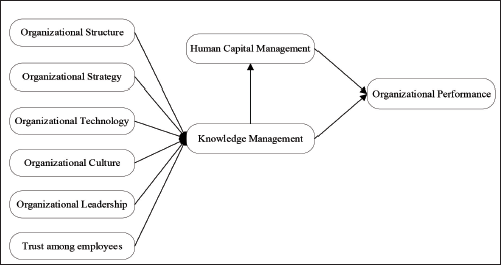
Based on the literature review, we developed our conceptual model. Figure 1 shows a conceptual model.
The Conceptual Model of the Research.
The Conceptual Model of the Research.
As a result of the review of the related studies on KM, the first objective of the study is to study the antecedents of KM. The hypotheses are stating each of the factors as antecedents of KM. First, the main purpose of the current research is to identify the influencing variables on organizational KM. The second objective of the current research is to investigate the mediation of HCM in the relationship of KM and OP.
According to the conceptual model, the research hypotheses are presented as follows:
H1: The structure of the organization positively affects KM. H2: The strategy of the organization positively affects KM. H3: The technology of the organization positively affects KM. H4: The culture of the organization positively affects KM. H5: The leadership of the organization positively affects KM. H6: Trust among employees positively affects KM. H7: KM positively affects HCM. H8: HCM positively affects OP. H9: KM positively affects OP. H10: KM through HRM has an indirect positive and meaningful relationship with OP.
Research Methodology
A questionnaire was employed for data collection in this study. A number of 48 questions in this questionnaire were used to analyze and measure the impacts of the strategy, structure, technology, leadership, culture, and trust of the organization on KM together with the effects of KM on HRM and finally its impact on the performance of the Iranian Parsian bank (one of the private banks in Iran) as the case study. Five-point Likert scale as one of the most common scales for measurement was used in the questionnaire. The statistical population of this study includes all personnel working in 109 branches of Parsian bank. Three hundred sixty-one questionnaires were randomly distributed among the personnel and 334 questionnaires were answered. Based on Cochran’s formula, the accepted sample size for the statistical population with the total number of 1,591 personnel is about 309 with an error level of 5%, which is calculated according to the following formula:

n: The sample size
N: The population size
d: Acceptable error
Z: The normal variable value with the confidence level of 1 − α
In general, three steps can be considered for data analysis: (i) data evaluation, (ii) data fitness test, and (iii) hypothesis test. In the first step, data are evaluated in terms of quality and encoded. In the second step, the validity and reliability of the data are examined. Finally, in the third step, the hypotheses testing is conducted using statistical analysis software. In this research, the Smart PLS2.2 software is used for the first and second stages.
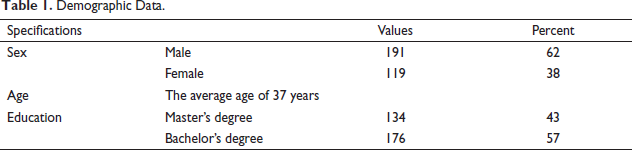
Demographic data show that 62% of respondents were male and 38% were female. Also, 43% have a master’s degree and 57% have a bachelor’s degree. Finally, the average age of the study population is about 37 years, which is mentioned in Table 1.
Demographic Data.
Demographic Data.
Remote data are very different from other distributed data. One way to identify this type of data is to calculate the standard deviation. In this study, the questionnaires whose standard deviations were less than 0.4 and more than 2.4 were removed. Also, during the distribution and collection of questionnaires, the researcher reviewed each questionnaire and removed the questionnaires that were filled with very low accuracy. By applying these filters, a total of 187 questionnaires remained intact for analysis.
Confirmatory Factor Analysis
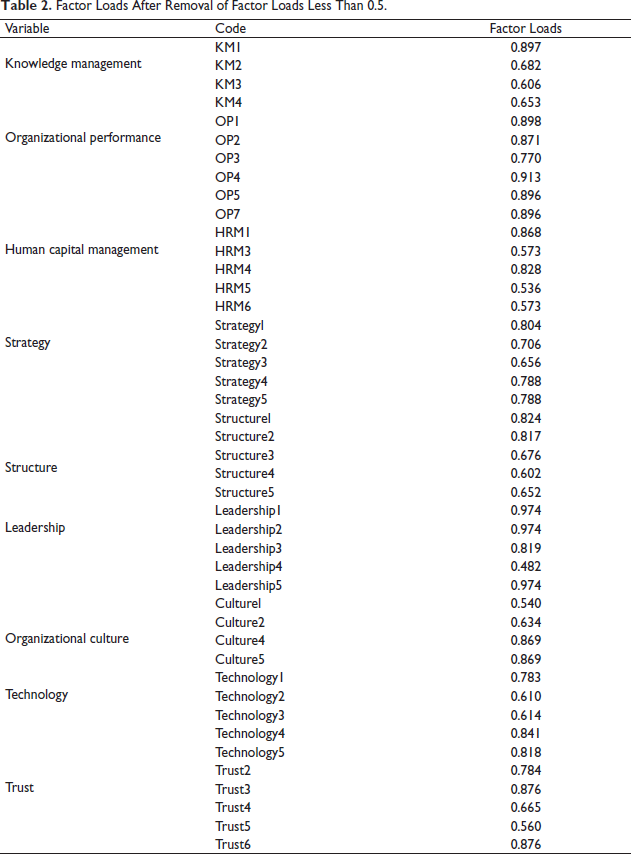
The confirmatory factor analysis is used to check the reliability of the measurement for the research variables. Consolidation and purification of collected data is one of the important applications of confirmatory factor analysis. Factor loads are considered as regression coefficients in the confirmatory factor analysis. By examining these coefficients, the degree of correlation between the latent variable and the observable indices can be determined. In other words, the weight of each factor load of the questionnaire items (observed indicators) shows the validity of the variables. Table 2 and Figure 2 shows the factor loads of all variables after removing those indicators with factor loads less than 0.5.
Factor Loads After Removal of Factor Loads Less Than 0.5.
Factor Loads After Removal of Factor Loads Less Than 0.5.
Factor Loads After Removal.

Root Mean Square Error of Approximation (RMSEA): This index is actually the root of the squares and its best value is between 0.5 and 0.8. On the other hand, some experts believe that if an amount is between 0.3 and 0.8, it can be 95% sure of the model fitness (as shown in Table 3).
Normed Fit Index (NFI): The NFI index, also known as the Bentler–Bonett Index, should be above 0.9 to ensure the model fitness.
Comparative Fit Index (CFI): This index is actually a modified index of the NFI index, and its value should be higher than 0.9, and the closer it is to 1, the better the fitness of the model.
The chi-square (χ2) index: The statistical index obtained from the comparison of observed and estimated covariance matrices is one of the main indexes for model fitness. This index is one of the best indicators of the goodness of model fitness. The appropriate value for this index should be less than three.
Fitness Indexes.

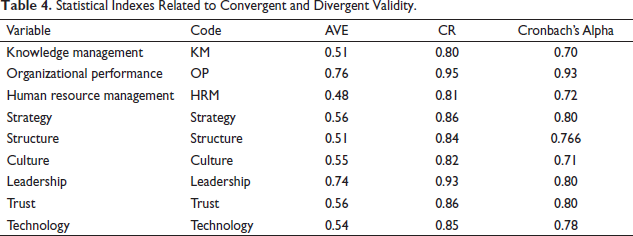
Convergent validity means that there is a good variance among the research variables. Convergent variability is generally measured in three ways: (i) mean variance extracted variance (AVE), (ii) factor loads, and (iii) composite reliability (CR). AVE is the product of dividing the total squares of the factor loads by the number of observable variables and its standard value must be greater than 0.5. However, if the AVE is less than 0.5, and its CR value is higher than 0.7, it can be accepted. Divergent validity indicates that two separate measures be considered as separate measures. To calculate this validity, the square root of AVE (CR) and correlation with other latent variables are used. To measure this correlation, Cronbach’s alpha and CR indices are used and the standard values of both indices should be higher than 0.7. But it should be noted that the strength of the CR compared to Cronbach’s alpha is the lack of equal weight for observable variables (as shown in Table 4).
Statistical Indexes Related to Convergent and Divergent Validity.
Statistical Indexes Related to Convergent and Divergent Validity.
Since the value of R2 of the endogenous variables is greater than 0.67, it indicates a suitable fitness of the structural model of the research (as shown in Table 5).
R2 Index.

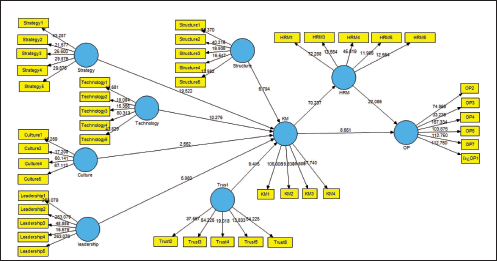
The method of structural equation modeling is to test a specific model of relationships between variables in research. This method consists of two steps: (i) Evaluation of the external model that examines and confirms the validity and reliability of the research model (research measurement model). (ii) Internal research model that tests the research hypotheses, in testing the internal research model, t-statistic, coefficient of determination and path coefficient are used. The path coefficient or β indicates the degree of influence of one variable on another variable and its positive or negative effect. The t-statistic is used to test the significance of the hypotheses, and in Smart PLS software, the bootstrap test is used to obtain that index for each hypothesis. If the value of the t-statistic for each hypothesis is between +1.96 and −1.96, the hypothesis is rejected and if it is greater than +1.96 or less than −1.96, the hypothesis is confirmed at the 95% confidence level (as shown in Table 6 and Figure 3).
Hypothesis Test.
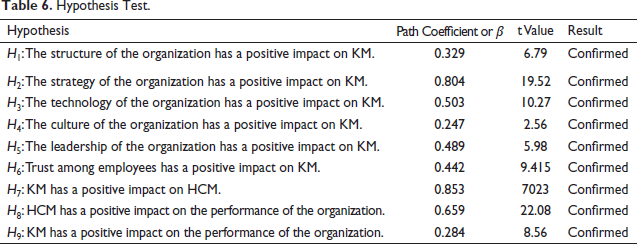
Hypothesis Test.
Structural Equation Modeling in Meaningful Mode (t-value).
The Sobel test is used to examine the mediation effects. This test has the following statistics:

in which,
a: The path coefficient between the independent and mediating variables
b: Path coefficient between mediating and dependent variables
Also, to distinguish the strength of the indirect impact of the independent variable in relation to the total effect of this variable on the dependent variable, the variance accounted for (VAF) index is used. The value of this index is between 0 and 1 and values close to 1 indicate the high impact of the mediating variable on the path of effect of the independent variable on the dependent variable. This index is calculated as follows:

in which,
a: The path coefficient between the independent and mediating variables
b: Path coefficient between mediating and dependent variables
c: The path coefficient between the independent and dependent variables
H10: KM through HRM has an indirect positive and meaningful relationship with OP:

Considering the z-value of the Sobel test which is greater than 1.96, it can be stated that at the 95% confidence level, the effect of the mediating variable of HCM between OP and KM is significant. Also, according to the value of the VAF test which is 0.654, the effect of this mediating variable is strong (as shown in Table 7).
Path Coefficients and Standard Error Between Mediator Variable and Independent and Dependent Variables.

The aim of this study was to investigate the effect of KM on OP considering the mediating role of HCM. Hence, the first objective of this research is to identify the antecedents of KM in the organization. Therefore, six variables of organizational structure, organizational strategy, organizational technology, organizational culture, organizational leadership, and trust were identified through a literature review, and their impacts on KM were investigated and approved. As the second objective of this study, HCM was examined as the mediating variable in the relationship between KM and OP. For this purpose, the relationship between variables KM and HCM as well as the relationship between HCM and OP were analyzed. Finally, the direct relationship between KM and OP in the form of three partial objectives was investigated.
The result of the first subsidiary objective shows that KM has a positive impact on HCM and HCM can be fruitful through KS. The productivity and performance of the organization depend on knowledgeable employees, and the quality of the employees depends on knowledge generation, rectification, and sharing (Ferdows & Das, 2010). Also, if the organization has knowledgeable personnel, it will be able to adapt to drastic environmental changes. Analyzing the relationship between KM components and economic outcomes revealed that opportunities to achieve competitive advantage through growth in profitability and increase in the quality of production through proper training and implementation of innovative approaches in human capital training are possible (Cahyaningsih et al., 2017). For the survival and expansion of the organization, it is required to establish a strong relationship between KM and HCM. Therefore, it can be inferred from the findings that HCM is influenced by KM. This finding is consistent with the results of Rehman et al. (2020), Muñoz-Pascual et al. (2020), Keats and Evans (2020), and Birasnov (2009).
We also tried to generalize the effect of HCM on the OP, so that we can provide an approach to measure and evaluate intangible assets (personnel) of Parsian bank.
The result of the second subsidiary objective showed evidence that HCM has a positive and meaningful effect on OP. Our results are consistent with the findings of Green et al. (2006), Chen and Huang (2009), and Otoo (2019), which indicate the relationship between human resource functions and perceived performance in the organization. In fact, the focus of the organization’s management on organizational and individual learning opportunities, as well as its focus on knowledge distribution, the organization is assured that knowledge will be maintained through efficient HCM in the organization and information and learning will also flow throughout the organization. HCM enables employees to display behaviors that are most associated with higher business performance, including risk-taking, innovation, KS, and building trust between managers and subordinates (Çalişkan, 2010). As a result, it is suggested to bank managers to pay attention to the alignment of HRM functions with the strategies of the organization. This can be done through the following mechanisms:
Annual monitoring and compilation of measurable indicators, such as the amount of training budget of the organization and holding specialized training for employees and managers, Targeting organizational functions according to the functions of organizational HRM, Creating an atmosphere in which KM components flow among bank staff.
The third result showed that KM positively influences OP. It means that with higher desirable KM in the organization, the organization would have better performance.
This finding is consistent with the results of most studies in this field (Abubakar et al., 2019; Durst et al., 2019; Liu et al., 2021; Singh et al., 2021). Studies indicated that to improve OP, it is necessary to prioritize KS and knowledge protection in the organization. For this purpose, managers of organizations should have a clear understanding of the importance of knowledge, knowledge protection, and different methods of KS. Since TK has a significant effect on OP, organization management must involve and guides employees’ minds and persuade them to share their knowledge to present more desirable products and services. Vaccaro et al. (2010) emphasized that using a proper and effective KM chain in the organization by improving the quality of services will promote OP. Moreover, KM can facilitate the learning of new knowledge more efficiently, and therefore, it empowers and develops the professional skills of employees to fulfill their assigned duties more efficiently; this, in turn, will increase OP.
The third subsidiary objective of this research examines the direct relationship between KM and OP. Also, for the second main objective of this study, the results showed that the HCM mediates this relationship. Therefore, KM can improve the performance of the organization through HCM. That is, KM can effectively enhance the expertise, skills, creativity, and knowledge of employees. This relationship is because of the decisive role of the human factor in KM actions. Therefore, since HCM is a valuable variable for the efficient and effective management of individuals, then HCM and KM should be closely related and this relationship will facilitate the OP to achieve organizational goals. Our results support the theorical approach of Sánchez et al. (2015), Soliman and Spooner (2000), and Wang et al. (2012). Chuang et al. (2013) pointed out that strategic HRM should be applied to monitor, disseminate, and create knowledge so that the organization can achieve an appropriate level of knowledge, skills, experience, and creativity. Accordingly, KM strategy should be considered as a key factor at the organizational level. In this regard, some researchers have conceptualized HRM and oriented the methods of human resource actions from the point of view of organizational goals and knowledge strategy (Chen et al., 2013). Strategic measures of HRM are a reflection of organizational capacity and provide a mechanism to improve employee efficiency to support employee work activities (Jiang, 2014). For example, strategic HRM measures are developed to improve the OP in accordance with the KM strategy of the organization (Chen et al., 2013). In fact, participation as one of the strategic HCM measures may lead to positive attraction of employees and their involvement in KM and learning activities (Huselid, 1995). Individuals with more skills, experience, and responsibility are more independent, set things up, and share tacit and explicit knowledge among the organization’s personnel (Wang et al., 2012).
In these years, KM and HRM turned to important assets for the organizations that may bring worthy and unrepeatable capabilities for organizations. In various studies, researchers stated that KM and HRM have a close relationship (Gill, 2018; Keats & Evans, 2020) that makes different approaches to the relationship of these two variables with OP (Jackson et al., 2014).
This study goes beyond the classic views in which KM is regarded as the mediator variable in the relationship between HRM and organization performance. Based on recent studies, this study suggested a model that represents the effects of HRM as the mediator variable on the improvement of OP through KM strategies (Jackson et al., 2014; Jiang et al., 2013; Sánchez et al., 2015). The findings of the present study will support the theory that KM is a coordinating mechanism that requires strategic human resources of the organization to improve the efficiency of the organization and HRM acting as the mediator between KM and OP.
According to the findings of this study, HRM measures facilitate KM and act as a mediating variable between KM and OP. In other words, the research results show that KM measures have a positive effect on HCM as well as OP.
Managerial Implications
KM and HCM are among the most important assets of any organization. These valuable assets can create capabilities and benefits for the organization and improve OP. The findings of the current research can help organizations in improving their performance by using organizational KM and HCM. The research results are also useful in the theoretical development of conceptual models to describe the relationship between KM, HCM, and OP.
Research Limitations and Suggestions
This study was limited to the banking sector in one country, as the data were collected from a private bank in Iran. Although the findings of the present study are consistent with the previous studies, it is recommended to consider various companies in different sectors in further studies to investigate the findings of this research. It is also possible that the inclusion of variables such as flexibility or leadership as modulators could contribute to the development of the model. Also, further studies could extend the model to include other factors that may help specify the relationship between HRM and KM and the impact of these two variables on OP.
Footnotes
Declaration of Conflicting Interests
The authors declared no potential conflicts of interest with respect to the research, authorship and/or publication of this article.
Funding
The authors received no financial support for the research, authorship and/or publication of this article.
