




Abstract
The present study synthesized the extant literature on electronic shopping cart abandonment (ESCA) for the last 22 years (2000–2022) using the PRISMA approach. This is one of the first studies that comprehensively synthesized the widely applied theories in the ESCA literature and the reasons for ESCA during the various stages of online shopping process (search stage, consideration stage, evaluation stage, and purchase stage). The findings suggest that Stimulus Organism Response theory, Cognitive Dissonance theory, and the Theory of Reasoned Action are the most prominent theories used in the ESCA literature. Further, customers abandon the electronic shopping cart due to several personal factors (e.g., trust, experience), website features (e.g., perceived behavioral tracking), and product attributes (e.g., perceived service quality). This study gives a snapshot of knowledge gaps in the ESCA domain and suggests future research directions from multifarious perspectives i.e., theoretical underpinnings, contexts, and customer characteristics. For marketers, it provides insights on factors affecting ESCA at each stage of the online shopping process to develop stage wise pragmatic strategies like gamification on shopping websites, improving navigational aspects on websites, removing threats to customer privacy, and creating greater transparency to increase customer trust.
Introduction
The evolution of e-commerce has changed the sphere of retailing business as momentum has shifted toward online retailing. Similarly, the mode and strategies of shopping have changed drastically (Sondhi, 2017). Many retailers have brought their offline businesses online and others have started new businesses online (Wildeboer & Donkers, 2014). E-commerce is growing rapidly across the world. In 2021, e-commerce retail sales amounted to 4.9 trillion U.S. dollars worldwide (Chevalier, 2022). Further, it is expected to grow by 50% over the next four years, reaching about 7.4 trillion dollars by 2025 (Chevalier, 2022). This will increase the market volume of the e-commerce industry up to US$ 200 billion by 2026 (Nagdev, 2022). Moreover, the number of digital buyers is increasing rapidly worldwide (Chevalier, 2022). Thus, the e-commerce industry has a promising future with a steady growth rate. The sudden outbreak of the pandemic COVID-19 has also pushed customers to adopt online shopping due to lockdown, social distancing, and other safety measures (contactless delivery and sanitized products). According to the World Trade Organization (WTO, 2020) report, it has resulted in a spike in business-to-commerce (B2C) sales, particularly for household products, foods, and medical supplies. Further, e-commerce is effectively supporting small businesses and customers. Online shopping relieves customers’ stress and negativity created by external contingencies (Hello Heart, 2020).
Electronic shopping cart abandonment (ESCA) has been identified as the biggest roadblock to online purchase completion (Close & Kukar-Kinney, 2010). It can be defined as leaving the products in the electronic shopping at any stage of the buying process, that is, from logging into the shopping website to the final payment stage (Xu & Huang, 2015). Kristensen (2021) reported that on average customers leave $4 trillion merchandise in the cart every year. It is hurting the e-retailers’ efforts as 43.8% of the customers leave the retail website only after browsing the product pages resulting in a reduction of 75% of online retail orders globally (Charlton, 2021). Overall average global ESCA rate is about 70% (Baymard Institute, 2020). It represents approximately more than $4 trillion lost sales annually for e-retailers (Bell et al., 2020). Therefore, it is pertinent to understand the reasons for ESCA for the future growth of the e-commerce industry and online retailing sector (Nair, 2016).
ESCA is attracting the interest of marketing researchers due to its critical impact on e-commerce (Kapoor & Vij, 2021; Mishra et al., 2021; Wang et al., 2021, 2022a; Zhao et al., 2021). But the literature on this domain has not been synthesized till date. There is no review paper on this domain.
Research Methodology
This review paper has two main objectives. First, to synthesize the widely applied theories in the ESCA literature. Secondly, to develop a comprehensive framework of factors leading to ESCA at each stage of the buying process.
Scope
Online shopping websites evolved worldwide around the late 1990s. The first online transaction was done through the Net Market website in 1994. The online retailing giants: Amazon and eBay launched their online websites in 1995 (Çadırcı & Güngör, 2021). Therefore, the online marketing concept became mature toward the end of the 1990s. The commercialization of the internet took place at a faster pace after 2000. Hence, the present study explored and synthesized the existing literature on the phenomenon of ESCA for the past 22 years, that is, 2000–2022.
Selection Criteria
The present study has applied the Preferred Reporting Items for Systematic Reviews and Meta-Analyses (PRISMA) protocol to select the relevant articles for the study (Moher et al., 2009). This process consists of four stages, that is, (1) the identification stage, (2) the screening stage, (3) the eligibility stage, and (4) the inclusion stage. For the identification of relevant articles, Google Scholar was used as a search engine due to its advantages over other databases. It has high accessibility, with globally acknowledged reliability. Further, it enjoys the status of the world’s largest academic search engine (Lim et al., 2021). This minimizes the probability of missing out on any relevant papers.
Next, the keywords need to be finalized. The keywords used for searching the relevant studies were: “online buying behavior,” “electronic shopping cart abandonment,” “online shopping,” and “non-buying behavior.” These keywords were decided after discussions with four professors who are experts in the marketing domain. Further, the initial 15 papers were screened out to finalize and update the keywords. To search the relevant published paper we used these keywords with a Boolean “OR” operator. As such, keywords used for article search with the search string are “(online buying behavior*) OR (electronic shopping cart abandonment*) OR (online shopping*) OR (non-buying behavior*).” Research papers with these keywords included in their title, abstract, or keyword list were considered for this study with due attention given to the inclusion and exclusion criteria.
Figure 1 depicts the steps taken for shortlisting the relevant research papers as per the PRISMA approach. A total of 2,404 studies were identified using the Boolean keyword search. Further, 900 articles out of these papers were dropped because they were downloaded multiple times. Moreover, 1,389 articles were dropped because they were not related to the ESCA domain. These excluded papers were either related to repurchase intention or the comparative studies of online and offline shopping. The remaining 115 articles were critically examined for their arena of research. In total, 60 papers were further excluded because they were not from the marketing domain (health and transportation field). Further, 13 non-English articles were removed, leaving 42 articles for review. Lastly, 2 articles were dropped because of the nonavailability of the full-text version. Hence, a total of 40 articles were examined for the accomplishment of the objective of the present study.

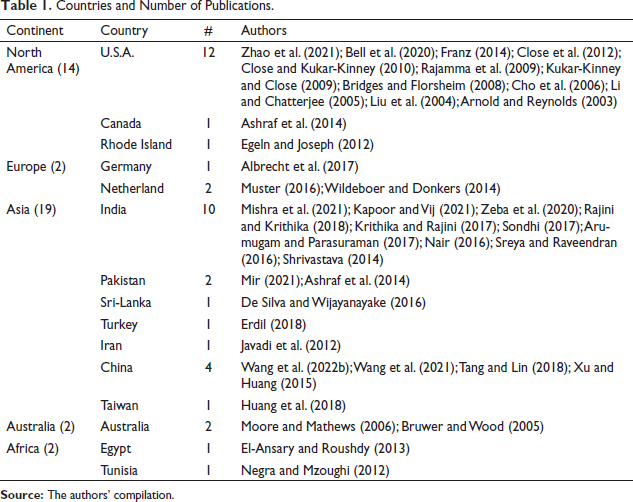
Most of the research on the ESCA has been conducted in the U.S.A (12 studies) followed by India (10 studies) (Table 1). But the continent-wise analysis of extant literature on ESCA reveals that Asia (19 studies) outnumbers North America (14 studies) in terms of research on this domain. Therefore, there is a need for future research on this domain in other parts of the world.
Countries and Number of Publications.
Structure of the Article
The current review on ESCA is organized according to the objectives of the current study. As per the first objective of the study, the first section on the theoretical framework synthesizes the theoretical underpinning used in the ESCA literature. The review of the second objective related to factors affecting ESCA is structured using the framework approach. The present study used Howard and Sheth’s (1969) “Theory of Buyer Behavior” to systematically structure the extant literature on ESCA in a framework. Thus, the popular and robust framework-based review approach has been adopted for the review analysis (Paul & Criado, 2020). The widely studied variables in ESCA have been organized as attributable to the four stages in the online buying process, that is, the electronic search stage, the electronic consideration stage, the electronic evaluation stage, and the electronic purchase stage (Close & Kukar-Kinney, 2010; Li & Chatterjee, 2005). The next section presents the findings and discussions as an outcome of a critical analysis of the framework-based synthesis conducted in the previous section. Further, in light of the aforementioned sections, the academic and pragmatic implications are summarized in the next section. Conclusively, the authors have proposed future directions for research.
Theoretical Framework
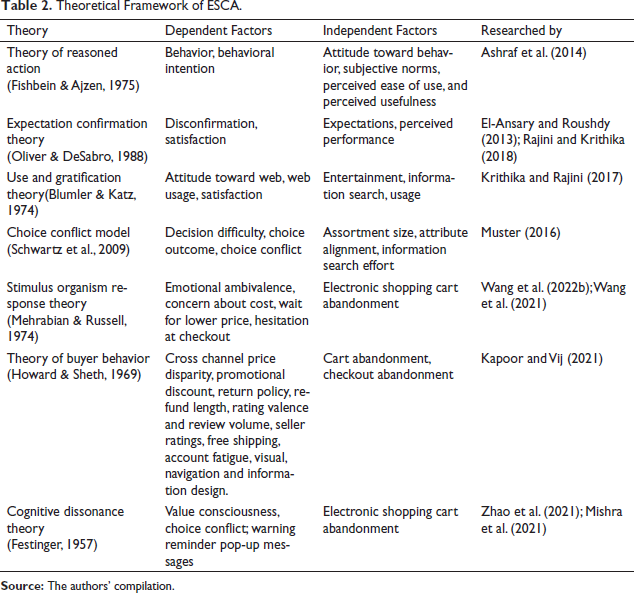
Several theories have been used in the extant literature on ESCA but none of these is extensively used. Krithika and Rajini (2017) and El-Ansary and Roushdy (2013) have used the underpinning of expectation confirmation theory in the ESCA context. This theory implies that customers discover some expectations based on their prior online shopping experience. If such expectations remain unmet, they resort to ESCA. Similarly, customers’ experience of using the internet also affects ESCA (El-Ansary & Roushdy, 2013).
The next theory, the use and gratification theory help to understand the reason behind the usage of specific technology. Krithika and Rajini (2017) found that customers visit online shopping websites to satisfy either their hedonic or utilitarian motives which affect ESCA distinctively.
Muster (2016) adopted the choice conflict model to explain the ESCA phenomenon. Different forms of choice conflicts are experienced during online purchase which results in decision difficulties. These decision difficulties increase the chances of abandoning the shopping cart by 22%.
Ashraf et al. (2014) applied the technology acceptance model to understand the adoption of e-commerce across different cultures. Perceived ease of use and perceived usefulness have a prominent role in framing customers’ intention to shop online in some cultures (Pakistani and Canadian).
Stimulus organism response theory was applied by Wang et al. (2022b) and Wang et al. (2021) to understand the stimuli that derive ESCA. Waiting for a lower price and emotional ambivalence (stimuli) trigger the customers’ internal cognitive processes (hesitation at checkout) that result in the increased likelihood of ESCA.
The cognitive dissonance theory was applied by Zhao et al. (2021) to measure the impact of warning reminder pop-up messages on ESCA. When customers encounter warning reminder pop-up messages, a state of dissonance (urgency) to buy or abandon the product in the cart within a stipulated time is created. Such a state of urgency may create discomfort resulting in ESCA.
The findings suggest that stimulus organism response theory, cognitive dissonance theory, and theory of reasoned action are the most prominent theories used in the ESCA literature (Table 2). The review from the theoretical perspective indicated that there is still a dearth of extensive theory applications in this domain. Other theories that can be tested in the ESCA context are the Use and gratification theory (Blumler & Katz, 1974), and the Unified theory of acceptance and use of technology (UTAUT) model (Venkatesh et al., 2003).
Theoretical Framework of ESCA.
Stages of Online Purchase—Motives and Challenges
Howard and Sheth (1969) propounded a model on the “Theory of Buyer Behavior” which elaborates on the four stages of the buying process: the search stage, the consideration stage, the evaluation stage, and lastly the purchase stage. These stages can be replicated for the electronic shopping process (Close & Kukar-Kinney, 2010; Li & Chatterjee, 2005). Customers can abandon e-carts at any stage during the online buying process. Hence, it is crucial to understand the various factors that lead to ESCA pertaining to each stage of the buying process.
Electronic Search Stage—Attitude, Social Influence, Hedonic, and Utilitarian Motive
The electronic search stage mainly includes the reasons for preferring online shopping over offline shopping. The theory of planned behavior explains customers’ intentions and behavior in different contexts (Ajzen et al., 2020). Therefore, the attitude toward online shopping, subjective norms (social influence), and perceived behavioral control influence the customers’ intention and behavior during online shopping.
Customers who have a favorable attitude toward online shopping are more likely to complete the purchase process rather than abandon the electronic shopping cart (Javadi et al., 2012; Mir, 2021). Thus, attitude toward electronic shopping has a negative relationship with ESCA. Further, social influence affects the customers’ online purchase decisions. Customers are more likely to abandon the electronic shopping cart if the referral group has a negative opinion of the shopping experience from a website or products to be purchased (Ashraf et al., 2014).
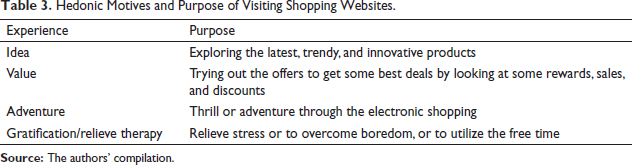
The customer generally visits an online shopping website with a hedonic or utilitarian motive (Arnold & Reynolds, 2003; Bridges & Florsheim, 2008; Krithika & Rajini, 2017; Papacharissi & Rubin, 2000; Wildeboer & Donkers, 2014; Zeba et al., 2020). Customers with hedonic motives are involved in shopping for experiences related to fun and pleasure (Zeba et al., 2020). Table 3 depicts a summary of the various experiences that customers can have from online shopping such as idea shopping, value shopping, gratification shopping, and adventure shopping (Arnold & Reynolds, 2003). Customers who visit online shopping websites with a hedonic motive are more likely to browse the pages of online shopping websites and abandon the e-cart before making the purchases (Arumugam & Parasuraman, 2017; Erdil, 2018; Krithika & Rajini, 2017).
Hedonic Motives and Purpose of Visiting Shopping Websites.
Customer with utilitarian motives indulges in the online buying process to acquire functional benefits from it. Table 4 depicts the list of such benefits. Customers with utilitarian motives are goal and task-oriented (Close et al., 2012; Franz, 2014). They are more likely to purchase the products rather than abandon the electronic shopping cart.
Functional Motives and Purpose of Visiting Shopping Websites.

Electronic Consideration Stage—Research and Organization Motive
During the electronic consideration stage, customers use electronic shopping carts as a means of research and organizational tool. Further, their motives behind using the e-cart for research and organization may affect ESCA. These motives may differ from shortlisting the products for offline or online shopping. The former group of customers who prefer to buy from land-based retailers uses online shopping websites as the organization and research tools only (Kukar-Kinney & Close, 2009). Therefore, they leave the shortlisted products in the e-cart and do not complete the purchase process (Arumugam & Parasuraman, 2017; Erdil, 2018; Muster, 2016; Xu & Huang, 2015).
The customers usually get comparative information about the product by browsing through multiple web pages of single or multiple online shopping websites (Kukar-Kinney & Close, 2009; Tang & Lin, 2018). The unlimited choices sought during this stage lead to choice conflict or a cynical attitude (Arumugam & Parasuraman, 2017). Some customers face perceived decision difficulty due to the choice conflict and resort to ESCA to resolve it (Close et al., 2012; Xu & Huang, 2015). Similarly, overcautious customers who overthink the product quality and value either postpone their purchase decisions or resort to ESCA (Negra & Mzoughi, 2012).
Electronic Evaluation Stage—Choice Conflict Resolution and Trust
The customers who have shortlisted the products during the previous stage evaluate these products in the e-cart according to some pre-decided scrutiny criteria. Customer characteristics such as income level, confidence, and experience of online shopping affect their scrutiny criteria (Close & Kukar-Kinney, 2010; Egeln & Joseph, 2012). These scrutiny criteria include mental budgeting and accounting, perceived quality, company, and brand image (Huang et al., 2018). Customers may generally have a budget for different products or online shopping expenses. Customers resort to ESCA when they realize on evaluation that the shortlisted product is out of their budget (Cho et al., 2006; Sondhi, 2017). Sometimes, customers also abandon the e-cart when they are unable to evaluate the quality of the product and they do not trust the seller (De Silva & Wijayanayake, 2016; El-Ansary & Roushdy, 2013; Liu et al., 2004; Tang & Lin, 2018). The evaluation against these criteria helps the customer to resolve the choice conflict that arises during this stage by comparing their expectation and perceived experience (Close & Kukar-Kinney, 2010).
Electronic Payment Stage—Convenience, Economy, and Privacy Concerns
After the evaluation of products, customers enter the electronic checkout and payment stages. During this stage, customers may sometimes get frustrated due to long perceived waiting time (Bruwer & Wood, 2005; Krithika & Rajini, 2017; Rajamma et al., 2009; Shrivastava, 2014). Some customers also face inconvenience due to a non-supportive payment mechanism (nonavailability of plastic cards demanded for the payment). Such frustrated and dissatisfied customers resort to ESCA (De Silva & Wijayanayake, 2016; Javadi et al., 2012; Nair, 2016).
Perceived behavioral control, that is, customers’ perceptions of their ability to complete the online purchase process also affect their purchase decisions. Sometimes, customers abandon the online shopping cart when they encounter difficulty in handling technological aspects, navigating sites, queuing, and crowding (Albrecht et al., 2017). Further, shipping charges, taxes, and handling costs that are added at the checkout stage raise the overall price of the product. If it is above the budgeted amount expected by the customers they resort to ESCA. Further, customers are also restrained from completing the purchase process if they fail to avail the discount on promo codes, coupons, and vouchers offered to them (Close et al., 2012; Erdil, 2018; Nair, 2016; Sreya & Raveendran, 2016). Additionally, payment intention also influences customers’ purchase decisions. Customers’ payment intention negatively influences ESCA (Close & Kukar-Kinney, 2010; Wildeboer & Donkers, 2014).
Many online shopping websites use cookies files to monitor customers’ online activities. Such activities are termed perceived online behavioral tracking. It involves tracking customers’ tastes, preferences, or interests, and communications over time across social websites for marketing purposes (Rajini & Krithika, 2018). This raises privacy concerns among customers and they resort to ESCA (Close & Kukar-Kinney, 2010).
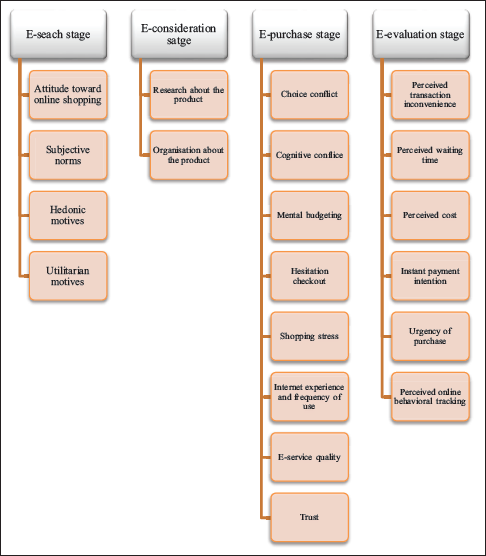
Figure 2 provides a snapshot view of the factors affecting ESCA at each stage of the online buying process in form of a conceptual framework.
Findings and Suggestions
This article aims to synthesize the widely applied theories in the ESCA literature and to develop a comprehensive framework of factors leading to ESCA at each stage of the buying process. Hence, to accomplish the aforementioned objectives the existing literature on ESCA for the last 22 years (2000–2022) was synthesized using the PRISMA approach.
The extant literature on ESCA indicates that most of the studies have focused on the last stage of the buying process, that is, the e-purchase stage. The seminal work on the stagewise e-cart abandonment pattern has been authored by Li and Chatterjee (2005). They found that most of the e-cart abandonment occurs at the third stage of the buying process, that is, the e-evaluation stage. Hence, extant literature reveals that there is a dearth of studies on analyzing the stagewise abandonment pattern of ESCA. Hence, future researchers can explore this blue ocean area.
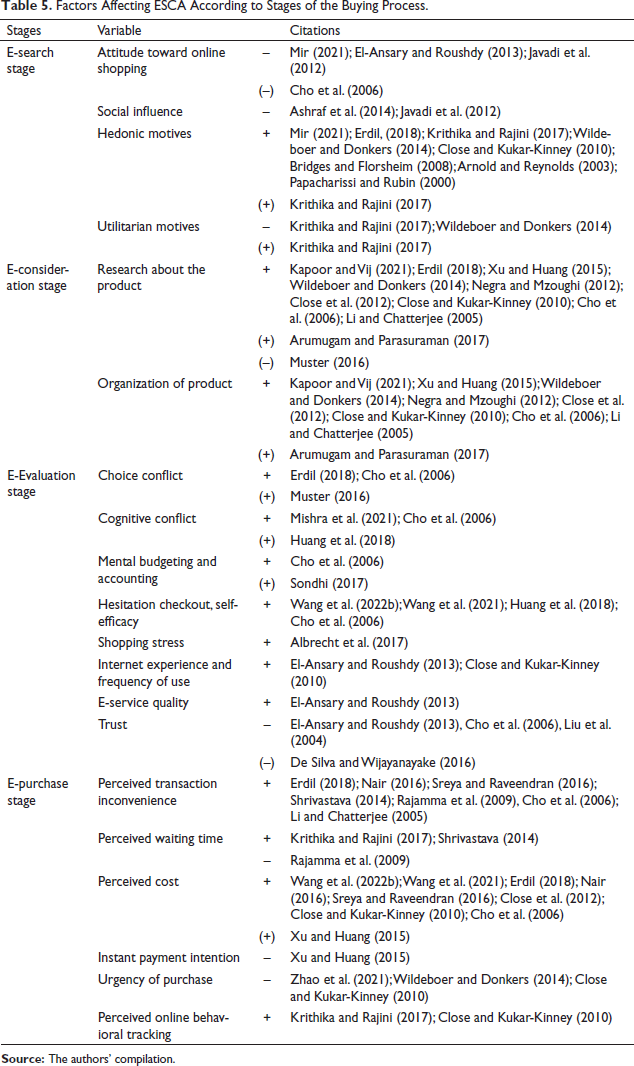
The current review paper synthesizes the factors affecting ESCA using the online buying process framework. Table 5 presents the synthesis of stagewise factors affecting ESCA, the direction of their relationship with ESCA, and the citations for the same. The findings suggest that numerous factors persuade customers to leave the buying process incomplete. Customers abandon the electronic shopping cart due to several personal factors (e.g., trust, experience), website features (e.g., perceived behavioral tracking), and product attributes (e.g., perceived service quality.
Factors Affecting ESCA According to Stages of the Buying Process.
Electronic Search Stage
During the electronic search stage, motives behind online shopping (i.e., hedonic or utilitarian), attitude toward online shopping, and social influence affect ESCA. The researchers have studied hedonic motive (eight studies) more extensively than utilitarian motive (three studies) in ESCA literature (Table 5).
Hedonic Motive
It is one of the most widely studied variables in the ESCA domain (Table 5). It has been studied as an antecedent (seven studies) and mediator (one study) affecting ESCA. All the studies unanimously reported that hedonic motive has a positive impact on ESCA. It means that customers with higher hedonic motives are more likely to abandon the electronic shopping cart. Further, perceived risk may mediate the relationship between hedonic motive and ESCA (Krithika & Rajini, 2017).
Utilitarian Motive
Contrastingly, the utilitarian motive has a negative impact on ESCA (Table 5) because the customers with such a motive are more task-oriented compared to those who visit the shopping websites for recreation only. It means that they are more likely to complete the purchase process and less likely to abandon the e-cart (Krithika & Rajini, 2017; Wildeboer & Donkers, 2014). But if customers with utilitarian motives sense higher perceived risk, they are more likely to abandon their e-cart (Krithika & Rajini, 2017).
Attitude toward Online Shopping and Social Influence
Customers with an unfavorable attitude toward online shopping hesitate to purchase the products and services online and abandon the e-cart (Cho et al., 2006; El-Ansary & Roushdy, 2013; Javadi et al., 2012). Similarly, the attitude and suggestions of peers, family, and friends affect ESCA decisions (Ashraf et al., 2014; Javadi et al., 2012). There is a future scope to explore the impact of these factors on ESCA because both these factors are among the least studied factors in the ESCA domain (Table 5).
Suggestions Related to Electronic Search Stage to Combat ESCA
Marketers cannot influence the motives of the customers behind visiting online shopping websites. But they can still capture the attention of customers with hedonic motives by providing them ample suggestions related to the products and services they are exploring to keep them engaged. Moreover, online retailers can design and offer various entertainment opportunities to create a long-lasting impression on their customers while shopping, like gamification of shopping websites, social shopping, and guided selling. Forever 21 (apparel company) uses the Chirpify platform (a marketing platform) to amplify its social commerce efforts. Chirpify promotes marketing campaigns on social networks like Facebook, Twitter, and Instagram. Customers have to retweet the original post of the company (Forever 21) to get a 10% discount on the product. This not only helps the company to attract customers through discounts but also helps to enter into their social space and increase traffic to their website. Social shopping or social commerce has a promising future due to the rapidly increasing number of internet users. So, e-commerce industries can take advantage of this emerging trend based on social networking and social influence to overcome ESCA among customers with hedonic motives. It should be given as an option so that it does not disturb the customers with a utilitarian motive. Further, e-commerce companies must also develop focused strategies for the customers with a utilitarian motive by providing ample details of the products and services interestingly. This will help in reducing their perceived risk and developing confidence to explore the products/services in detail.
Electronic Consideration Stage
In the electronic consideration stage of the buying process, organizational and research motives have been found to impact the buying intention of customers’ behavior. Customers usually use organizational and research tools as an additional benefit of using e-cart and as an information-gathering tool. The existing literature indicates that it has a positive impact on ESCA (Table 5). Further, perceived decision difficulty may mediate the relationship between organizational and research motives and ESCA (Erdil, 2018; Muster, 2016).
Suggestions Related to the Electronic Consideration Stage to Combat ESCA
It is the need of the hour that e-retailers must upgrade their websites to make them more appealing and attractive. Sometimes, the developers make the shopping websites appear complicated and shoppers resist complexities that emerge during the buying process. They want easily navigable websites to avoid inconveniences while organizing and researching products and services. Therefore, websites must be more informative and easily navigable to support customers in organizing and researching the desired products and services with a lesser number of clicks.
Electronic Evaluation Stage
Customer characteristics play a dominant role in influencing ESCA during the evaluation stage. The personal characteristics that affect ESCA include cognitive and choice conflict, mental budgeting and accounting, self-efficacy of the customer, shopping stress, hesitation, and trust (Table 5). Further, customers’ technology-related attributes such as the frequency of use of the online websites and their online experiences also affect ESCA.
Cognitive and Choice Conflict
Customers usually experience certain psychological conflicts while shopping online (cognitive and choice conflict) that lead to ESCA (Cho et al., 2006; Erdil, 2018). When the customers encounter decision-making difficulties due to choice conflict (i.e., confusion in choosing the best alternative), they abandon their e-cart (Muster, 2016). Similarly, when they encounter emotional ambivalence due to cognitive conflict (to buy or abandon), they abandon the e-cart (Huang et al., 2018). There is a need to further investigate this factor in the ESCA domain as it has received inadequate focus in the extant literature.
Mental Budgeting and Accounting
Most of the customers (especially in developing nations) are price-conscious (Wang et al., 2021, 2022b). If the price of the product in the electronic cart (e-cart) exceeds the customers’ budgeted price, they encounter cognitive dissonance and stress and opt to abandon the e-cart to relieve the same (Sondhi, 2017).
Self-Efficacy and Shopping Stress
Customers who are shopping online might lose their self-confidence during this stage due to complications in handling the shopping websites. While some other customers may encounter negative emotions (stress, emotional ambivalence) due to the efforts involved in comparing and evaluating the products/services in e-cart (Huang et al., 2018). Such customers often abandon their e-cart (Albrecht et al., 2017).
Trust
Customers’ trust in sellers, companies, brands, shopping websites, and offerings affects customers’ intention to purchase or abandon products and services online. Customers abandon their e-cart if they perceive anything deceitful during the evaluation stage of the buying process (Cho et al., 2006; El-Ansary & Roushdy, 2013; Liu et al., 2004).
Suggestions Related to Electronic Evaluation Stage to Combat ESCA
Usually, online shopping websites offer many varieties of products and services. But too many choices prove futile because this confuses and exhausts the customers mentally. This leads to choice and cognitive conflicts. So, e-retailers must consider the mindset of their customers (via filters adopted for choices, clickstreams) and provide apt choices to the customers. Further, customers dislike the deceitful appearance and covert description of products and services. So, marketers must provide ample information about the products and services along with photos, graphics, and videos to win customer trust and combat ESCA.
Electronic Payment Stage
The customer enters the e-purchase stage with the motive to purchase the product after a satisfactory evaluation of their choices. When proceeding to the checkout and payment stage customers may encounter some glitches or hindrances which turn their interest into anguish and they resort to ESCA. Uncertainty factors such as perceived transaction inconvenience, perceived waiting time, perceived cost, instant payment intention, the urgency of purchase, and perceived online behavioral tracking lead to ESCA (Table 5).
Perceived Transaction Inconvenience and Perceived Waiting Time
Perceived transaction inconvenience is positively related to ESCA. If customers experience inconveniences (e.g., queuing and crowding) during online shopping, they are more likely to resort to ESCA at this stage (Table 5) Contrastingly, the customers who value the importance of time and efforts spent on searching, considering, and evaluating the products/services, may not abandon the e-cart despite perceived transaction inconvenience (Rajamma et al., 2009). The inconsistent relationship between perceived transaction inconvenience and ESCA call for further research in different contexts.
Perceived Cost
Customers are usually price-conscious. On experiencing additional costs (e.g., shipping charges, taxes, and handling costs) at the checkout and payment stage, they are disappointed (Cho et al., 2006; Kukar-Kinney & Close, 2009; Xu & Huang, 2015). This disappointment arousing due to an increased payable amount as the price of the products leads to ESCA (Table 5).
Instant Payment Intention and Urgency of Purchase
If a customer visits the online shopping website with the urgency to purchase, they are more likely to complete the purchase process. Hence, the urgency to purchase has a negative impact on ESCA. Similarly, once customers form a strong payment intention during online shopping, they are less likely to resort to ESCA (Xu & Huang, 2015).
Perceived Online Behavioral Tracking
The increasing cybercrime rate and ease in accessibility of personal information through shopping websites and social media have probed customers to be cautious of behavioral tracking. Perceived online behavioral tracking involves customers’ feeling of being tracked across social websites. Many customers resort to ECSCA to avoid acceptance of the cookies, and pop-up options on websites (Close & Kukar-Kinney, 2010; Krithika & Rajini, 2017). There is a need to further investigate this factor in the ESCA domain because it is one of the least studied factors in this domain.
Suggestions Related to the Electronic Payment Stage to Combat ESCA
E-retailers must not surprise customers with hidden charges at checkout and payment stages. The complete price details must be provided at the early stages of the buying process as additional information about the product. Further, such additional charges should be avoided. As customers expect an effortless and flawless shopping experience, whatever, whenever, and wherever they shop, e-retailers must avoid using cookies or behavioral tracking systems that threaten the customers.
Implications of the Study
The present study has implications for both academics and industry.
Theoretical Implications
The present study identified the factors affecting customers’ ESCA decisions during each stage of the online buying process. Academicians can use these insights presented as a conceptual framework in Figure 2 and empirically test the framework using experimental designs, interviews, or longitudinal studies. This will enrich the extant literature on ESCA which is fragmented and incohesive.
Theoretically, future researchers may apply the technology-oriented theories in the ESCA context. For example, the UTAUT model has not yet been used in the research on understanding ESCA. This model is an integrated and extended version of eight existing popular theories. So, applying this model in this context may give new insights and results. Further, future researchers can apply the market attribution model to analyze the ESCA rate pertaining to various stages of the buying process. Initially, through the linear attribution model, researchers can assign equal weights to each customer touch point during the buying process (Brown, 2020). Later on, they can identify the most crucial stages as per customer-assigned values. This will help in suggesting strategies to create a delightful customer experience.
The review of extant literature reveals that ESCA studies are highly concentrated in Asia and North America (Figure 1). Further, the majority of the studies have been conducted in the USA (30%) and India (25%). Therefore, there is future scope of research in other contexts, that is, continents, countries, specific products and services, and cross-cultural studies. Moreover, customer characteristics (such as attitude toward online shopping, social influence, trust, and shopping stress) have not been studied extensively in the extant literature. Therefore, future researchers can include these variables in their studies to strengthen the ESCA literature.
Practical Implications
The current article synthesizes the factors affecting ESCA during the various stages of the online buying process and presents a conceptual framework as an outcome (Figure 2). Further, various stagewise pragmatic strategies have been suggested to marketers to enrich the customer online buying experience and combat ESCA. As summarized in the previous section, the marketer can adopt customer-oriented strategies like gamification on shopping websites, improving navigational aspects on websites, removing threats to customer privacy, and creating greater transparency to increase customer trust.
Limitations of the Study
The present study has not considered the impact of demographic variables on ESCA. Demographic variables cannot be attributed to various stages of the buying process. But the future empirical studies based on the suggested conceptual framework can use these variables as moderators for each stage of the buying process. Further, no quality criteria were adopted to review the extant literature on this domain.
Footnotes
Declaration of Conflicting Interests
The authors declared no potential conflicts of interest with respect to the research, authorship, and/or publication of this article.
Funding
The authors received no financial support for the research, authorship, and/or publication of this article.